
Research article · 2024 · Full text
International Journal of Agriculture Extension and Social DevelopmentKnowledge and perception of urban youth on urban agriculture
Volume 7(5) · Pages 412–415 · DOI: 10.33545/26180723.2024.v7.i5f.648 ↗
Research areasUrban Agriculture and Sustainability
Abstract
Author-writtenThe goal of the current study was to evaluate urban youth's perceptions and degree of knowledge regarding urban agriculture. About 105 urban youngsters from Coimbatore district of Tamil Nadu were chosen at random for the study. The majority of young people living in cities are immigrants from rural areas, and they do not currently engaged in agriculture. According to the current study, the majority of farmers had a medium degree of understanding about agricultural practices, general agriculture, agricultural technologies, and agricultural schemes and policies. While young people in urban areas view urban agriculture more favorably than they do with other sector as a whole, they view it differently as a profession. Young people who receive financial aid, education, career opportunities, and technological integration would play a significant role in urban agriculture.
Summary
Source-checkedPlain-language reading of the full paper, prepared with AI and checked against the text. Each point links to the authors' own words.
Why it matters
- Rapid global urbanization is expected to increase the urban population from 3.5 billion to over 6 billion by 2050, creating significant challenges for food security. View evidence ↗
- Urban agriculture serves as a global alternative to meet food needs, providing urban residents with income and direct access to nutritionally dense foods. View evidence ↗
- Engaging youth in agriculture can help mitigate the issue of an aging farming population and reduce unemployment among young people. View evidence ↗
The question
- The study aimed to evaluate the level of knowledge and the perceptions that urban youth hold regarding urban agriculture. View evidence ↗
What they did
- The researchers randomly selected 105 urban youth from the Coimbatore district of Tamil Nadu for the assessment. View evidence ↗
- Knowledge was measured across four criteria: general agriculture, agricultural practices, agricultural technologies, and agricultural schemes and policies. View evidence ↗
- Data were gathered through personal interviews using a pre-designed schedule and analyzed using mean, percentage analysis, and Garrett ranking. View evidence ↗
What they found
- Only 30% of the surveyed urban youth were currently practicing urban agriculture, while 70% were not. View evidence ↗
- The majority of urban youth (71%) possessed a medium level of knowledge about urban agriculture, with 16% having high knowledge and 13% having low knowledge. View evidence ↗
- Among the knowledge categories, youth were most aware of agricultural practices and least aware of agricultural schemes and policies. View evidence ↗
- Youth held the most positive perception toward urban agriculture in general, but the least positive perception toward agriculture as a profession. View evidence ↗
- To encourage youth involvement in urban agriculture, the top-ranked suggestions were education and awareness, followed by technology integration and career opportunities. View evidence ↗
What it means
- The authors conclude that providing education, professional prospects, technological integration, and financial aid is essential for youth to play a significant role in urban agriculture. View evidence ↗
- The authors state that leveraging the innovation and passion of youth in urban agriculture can transform cities into resilient communities with better food access and prosperity. View evidence ↗
Visual summary
2 visualsIllustrations explain the paper; charts are replotted from the paper's own table values.
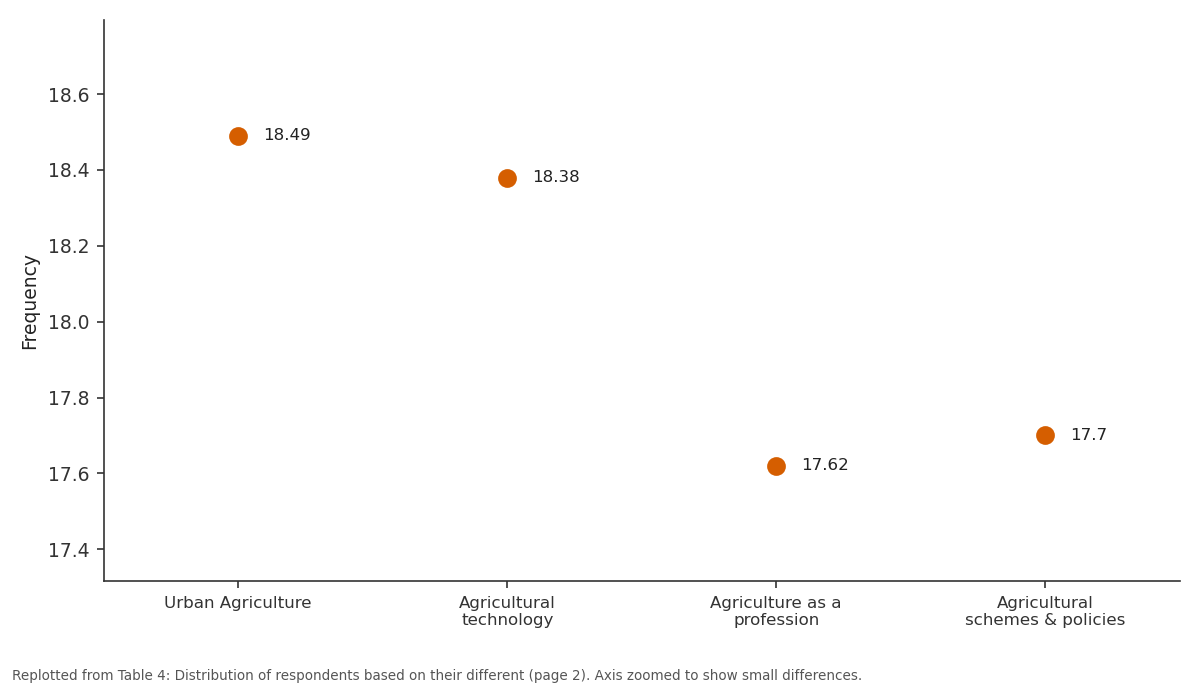
Frequency: Urban Agriculture vs Agricultural technology vs Agriculture as a... vs Agricultural schemes &...
Replotted from Table 4 (page 2) of the original paper. Every bar is the paper's own table value.
View source evidence ↗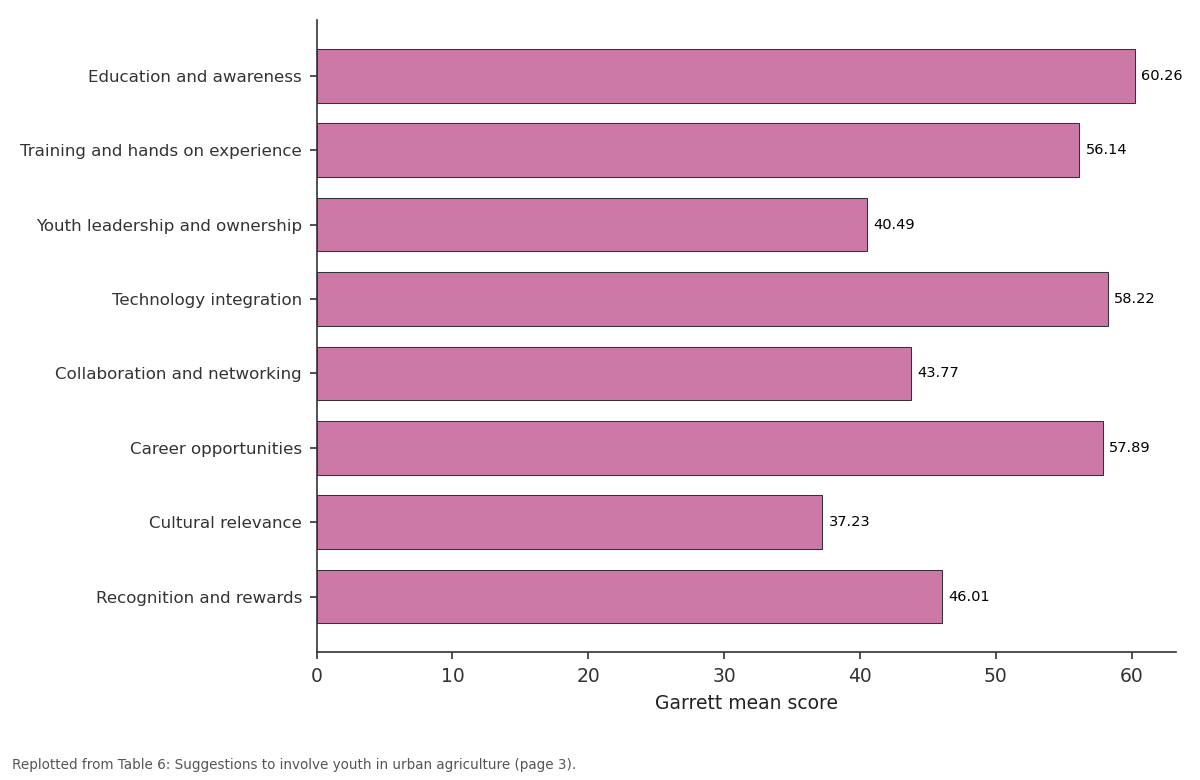
Garrett mean score: Education and awareness vs Training and hands on... vs Youth leadership and... vs Technology integration vs Collaboration and...
Replotted from Table 6 (page 3) of the original paper. Every bar is the paper's own table value.
View source evidence ↗Figures & tables
From the original paper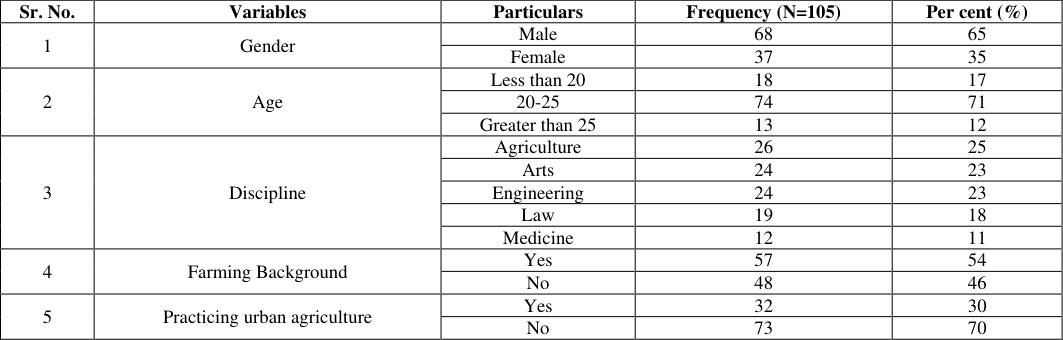 Table 1
 Table 3
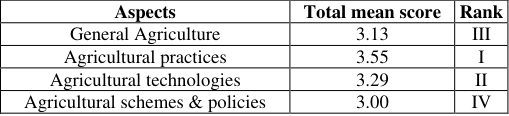 Table 2
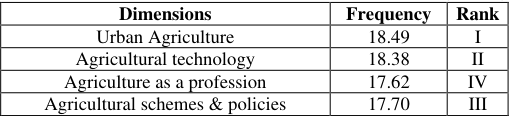 Table 4
 Table 5
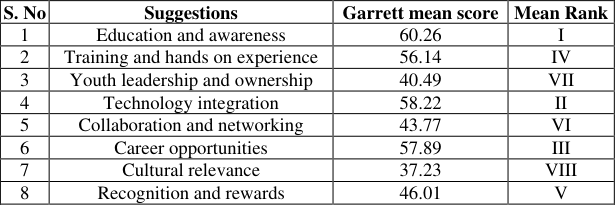 Table 6
Introduction
Urbanization is a primary driver of change in the globe today, with the global urban population expected to nearly double from 3.5 billion to more than 6 billion by 2050. It is a challenge for both urban and rural locations. Supporting the most vulnerable groups in an urbanizing world necessitates talks about food, agriculture, and cities within the context of rural-urban linkages. According to a 2007 UN State of the World Population study, by 2030, 40.76 percent of the country's population is predicted to live in cities, and by 2050, two-thirds of the global population will live in cities. (World Urbanisation Prospects, 2014). Resources are constantly limited. Even in a developing and densely populated country like India, resources are scarce. The population increase causes a shortage of even the most basic resources, such as food. According to a World Bank Group report, "more than half of all children under the age of four are malnourished, 30% of newborns are significantly underweight, and 60% of women are anemic."(World Bank Group, 2010). The recent global food price crisis has highlighted the need of recognizing and addressing the causes of food insecurity among the urban poor. Poor urban dwellers, who are predominantly net food consumers and rely heavily on markets for their food supplies, are more exposed to unfavorable food price shocks, and they are regularly the group in society that suffers the most from rising food costs. Urban agriculture is one of the global alternatives for meeting the food needs of urban populations. At the home level, urban agriculture can provide a source of income as well as direct access to a broader range of nutritionally dense foods (Vegetables, fruit, and meat) and a more diverse diet (Zezza, A., & Tasciotti, L., 2010) [10] . Youth are expected to play an important role in India's longawaited agricultural reform. According to national youth policy, those aged 15 to 35 are considered young. The migration of rural youth to urban areas is estimated to be over 45% in the country, with only about 5% of young engaged in agriculture. Youth participation in agricultural activities has the ability to address the aging farm population and minimize youth unemployment. This group of people acts as the backbone of every society's economy, a key source of insights and innovations, the primary market for food consumption, and are frequently the stakeholders and leaders of the general public, public policy, and social development (Geza et al., 2021) [3] . In practically every nation around the globe, Youth have played a vital part because youth members possess the zeal and skill required to provide opportunities for national growth. Youth development determines community and national growth. The social and economic growth and prosperity of agricultural regions are dependent on the youth of the country.
Materials and Methods
The study was undertaken to assess urban youth's knowledge and perceptions of urban agriculture in the Coimbatore district of Tamil Nadu. For the purpose of the study, around 105 urban youth were selected randomly from the district. The knowledge level of urban youth on urban agriculture was assessed using four separate criteria: general agriculture, agricultural practices, agricultural technologies, and agricultural schemes and policies. Perceptions of urban agriculture among urban youth have been studied over four www.extensionjournal.com dimensions: urban agriculture, agricultural technologies, agriculture as a profession, and agricultural schemes and policies. Respondents were asked to rank a list of options for getting involved in urban agriculture. The data were collected with the help of the pre designed interview schedule by approaching the youth for personal interview to get more reliable information. Collected data were tabulated and analyzed using mean, percentage analysis and Garrett ranking.
Results and Discussion
Total 105 respondents being urban young in age 15-29 years were studied to analyze their knowledge and perception on urban agriculture during the period of January and February 2024. Socioeconomic characters of urban youth in Coimbatore district is presented in Table 1. Table 1 shows that of the 105 respondents, 65% of the respondents were male and 35% were female. According to age, where 71% of the respondents were between Age 20 -25 years, 17% of them were less than 20 years and 12% of them were above 25 years of age. Based on their discipline of the study where 25% students belonged to Agriculture, 23% belonged to Arts, 23% belonged to Engineering, 18% belonged to Law and 11% belonged to Medicine. About 54% of the urban youth in Coimbatore district were from farming background and 46% of the urban youth were not from farming background. It also reveals that only 30% of the urban youth were practising urban agriculture and 70% of the urban youth were not practising urban agriculture currently. Distribution on respondents based on their level of knowledge in different aspects of urban agriculture is presented in Table 2. Among four different aspects of knowledge, urban youth had more knowledge towards agricultural practices followed by agricultural technologies, schemes and policies. It shows that the urban youth were more aware of agricultural practices and had least knowledge on agricultural schemes and policies been employed and supported with the findings of Frick et al., (1995) [2] . Distribution of respondents based on their overall knowledge on urban agriculture is given in Table 3. Overall knowledge of urban youth on urban agriculture were analyzed through percentage analysis and catagorized into three levels of knowledge. About 13% of the youth were having low level of knowledge on urban agriculture, 16% of the youth are having high level of knowledge on urban agriculture and most of the youth that is 71% of them were having medium level of knowledge on urban agriculture and the results were supported by Duncan, D. W., & Broyles (2006) [1] . Distribution of respondents based on their different dimensions of perception towards urban agriculture is presented in Table 4. Among four different dimensions of perception, urban youth had more positive perception towards urban agriculture in general followed by agricultural technologies, schemes and policies and agriculture as profession. It shows that the urban youth have high perception for urban agriculture in general and agriculture as profession had least perception www.extensionjournal.com level among urban youth on urban agriculture. Distribution of respondents based on their overall perception towards urban agriculture is presented in Table 5. Overall perception of urban youth towards urban agriculture were analysed through percentage analysis and categorized into three levels of knowledge. About 16% of the youth were having low level of perception on urban agriculture, 17% of the youth were having high level of perception towards urban agriculture and most of the youth about 67% of them were having medium level of perception towards urban agriculture and the respondents had positive perception on urban agriculture as in findings of Ngahdiman et al., (2017) [5] . 100 x (R ij -0.50)
| Perception score range | Frequency | Percentage (%) |
|---|---|---|
| Low (<62 ) | 17 | 16 |
| Medium (62 to 82 ) | 70 | 67 |
| High (> 82 ) | 18 | 17 |
Table text extracted from the original PDF; superscript letters are shown inline. The original table image is below.
View original table image
| Dimensions | Frequency | Rank |
|---|---|---|
| Urban Agriculture | 18.49 | I |
| Agricultural technology | 18.38 | II |
| Agriculture as a profession | 17.62 | IV |
| Agricultural schemes & policies | 17.70 | III |
Table text extracted from the original PDF; superscript letters are shown inline. The original table image is below.
View original table image
| Aspects | Total mean score | Rank |
|---|---|---|
| General Agriculture | 3.13 | III |
| Agricultural practices | 3.55 | I |
| Agricultural technologies | 3.29 | II |
| Agricultural schemes & policies | 3.00 | IV |
Table text extracted from the original PDF; superscript letters are shown inline. The original table image is below.
View original table image
| Knowledge Range | Frequency | Per cent (%) |
|---|---|---|
| Low (<10 ) | 14 | 13 |
| Medium (10 to 16 ) | 74 | 71 |
| High (>16 ) | 17 | 16 |
Table text extracted from the original PDF; superscript letters are shown inline. The original table image is below.
View original table image
| Sr. No. | Variables | Particulars | Frequency (N=105) | Per cent (%) |
|---|---|---|---|---|
| 1 | Gender | Male | 68 | 65 |
| Female | 37 | 35 | ||
| 2 | Age | Less than 20 | 18 | 17 |
| 20-25 | 74 | 71 | ||
| Greater than 25 | 13 | 12 | ||
| 3 | Discipline | Agriculture | 26 | 25 |
| Arts | 24 | 23 | ||
| Engineering | 24 | 23 | ||
| Law | 19 | 18 | ||
| Medicine | 12 | 11 | ||
| 4 | Farming Background | Yes | 57 | 54 |
| No | 48 | 46 | ||
| 5 | Practicing urban agriculture | Yes | 32 | 30 |
| No | 73 | 70 |
Table text extracted from the original PDF; superscript letters are shown inline. The original table image is below.
View original table image
Where, R ij = Rank given for the i th item by j individual, N j = Number of items ranked by j th individual
Garrett ranking formula
List of suggestions were identified to involve youth in urban agriculture and ranked by the respondents accordingly using Garrett ranking formula followed by Kalvakolanu et al., (2019) [4] and presented in Table 6. Among the list of suggestions ranked to involve youth in urban agriculture, Education & Awareness was ranked first followed by technology integration, career opportunities and so on. The results represents that urban youth were expecting a proper education and awareness on urban agriculture to get involved and provided the career opportunities in the urban agriculture to the youth will lead to a prosperous growth of the nation.
| S. No | Suggestions | Garrett mean score | Mean Rank |
|---|---|---|---|
| 1 | Education and awareness | 60.26 | I |
| 2 | Training and hands on experience | 56.14 | IV |
| 3 | Youth leadership and ownership | 40.49 | VII |
| 4 | Technology integration | 58.22 | II |
| 5 | Collaboration and networking | 43.77 | VI |
| 6 | Career opportunities | 57.89 | III |
| 7 | Cultural relevance | 37.23 | VIII |
| 8 | Recognition and rewards | 46.01 | V |
Table text extracted from the original PDF; superscript letters are shown inline. The original table image is below.
View original table image
Conclusion
Most urban youth are more knowledgeable about agricultural practices than agricultural technology policies and schemes, and urban youth had more positive perception on general urban agriculture, whereas urban youth have a lower perception of urban agriculture as a profession.
Creating interest and confidence in agriculture among young people is tough, but not impossible. Youth who receive education, professional prospects, technological integration, and financial aid will play an important role in urban agriculture. Youth participation in urban agriculture will be a powerful force for positive change, pushing long-term development at both the local and global levels. By utilizing the innovative thinking, power, and passion of young people, urban agriculture has the ability to convert cities into dynamic, resilient, and equitable communities where everyone has access to good food and prospects for prosperity.
References
9 in the original paper- Duncan DW, Broyles TW. A comparison of student knowledge and perceptions toward agriculture before and after attending a Governor's School for Agriculture. NACTA J. 2006;50(1):16-21. Available from: http://www.jstor.org/stable/43766889
- Frick M, Birkenholz R, Machtmes K. Rural and urban adult knowledge and perceptions of agriculture. J Agric Educ. 1995;36:44-53. doi: 10.5032/jae.1995.02044.
- Geza W, Ngidi M, Temitope O, Adetoro A, Slotow R, Mabhaudhi T, Gasparovic S, Prieto-Flores Ò. Youth participation in agriculture: A scoping review. Sustainability. 2021;13(69120). doi: 10.3390/su13169120.
- Kalvakolanu S, Hanumantha Rao S, Kumar V. Application of Henry Garrett ranking method to determine dominant factors influencing smartphone purchase decisions of customers. J Adv Res Dyn Control Syst. 2019;11:213-8.
- Ngahdiman I, Terano R, Mohamed Z, Sharifuddin J. Factors affecting urban dwellers to practice urban agriculture. Int J Adv Res. 2017;5:1580-1587. doi: 10.21474/IJAR01/4872.
- The World Bank. The World Bank annual report 2010 [Internet]; c2010. Available from: https://elibrary.worldbank.org/doi/abs/10.1596/978-08213-8376-6
- United Nations. World urbanization prospects: The 2014 revision -highlights. Statistical Papers -United Nations (Ser. A), Population and Vital Statistics Report; c2014. Available from: https://doi.org/10.18356/527e5125-en.
- United Nations Population Fund. State of World Population 2007. United Nations; c2007. Available www.extensionjournal.com from: https://www.unilibrary.org/content/books/9789210603546
- Zezza A, Tasciotti L. Urban agriculture, poverty, and food security: Empirical evidence from a sample of developing countries. Food Policy. 2010;35(4):265273. doi: 10.1016/j.foodpol.2010.04.007