
Research article · 2024 · Full text
International Journal of Agriculture Extension and Social DevelopmentErgonomic assessment of the pit loom weaving workstation
Volume 7(5) · Pages 401–403 · DOI: 10.33545/26180723.2024.v7.i5f.646 ↗
Research areasEngineering Technology and MethodologiesMechanical Engineering Research and ApplicationsAssembly Line Balancing Optimization
Abstract
Author-writtenIndia's handloom sector is one of the country's largest unorganized economic activity that has a long history of exceptional craftsmanship which symbolizes and preserves the lively Indian culture. The highest incidence of musculoskeletal disorders (MSDs) among handloom weavers can be related to long hours of static work with uncomfortable posture at traditionally designed looms. The study aimed to assess the Pit loom workstation of handloom weaving activity. Exploratory research design was used to collect the data of the study. The study was conducted in Rayalaseema region of Andhra Pradesh. A sample of 120 handloom weavers using pit looms were selected for the study. NIOSH Workstation analysis checklist was used to assess the workstation. Most of the weavers reported that pit loom working station does not provide full movement of upper and lower extremities. The workstation was hindering the movement to perform the activity. The workstation is not free from clutter and place provided for the workstation was not spacious and is not fitting the work to the worker rather worker is adjusting with the workstation. Therefore, pit loom workstation is more prone to various hazards leading to occupational health problems to the handloom weavers. The research findings indicate that the design of workstations in a handloom unit should prioritize worker productivity, safety, efficiency, and workflow.
Summary
Source-checkedPlain-language reading of the full paper, prepared with AI and checked against the text. Each point links to the authors' own words.
Why it matters
- The handloom sector is one of India's largest unorganized economic activities and is culturally significant for its craftsmanship. View evidence ↗
- Handloom weavers often experience high rates of musculoskeletal disorders (MSDs) due to prolonged static work and uncomfortable postures at traditional looms. View evidence ↗
- Work-related musculoskeletal disorders (WMSDs) are primarily caused by uncomfortable postures resulting from poor workstation design. View evidence ↗
The question
- The objective of this study was to evaluate the ergonomic conditions of the pit loom workstation used in handloom weaving. View evidence ↗
What they did
- The researchers used an exploratory research design in the Rayalaseema region of Andhra Pradesh. View evidence ↗
- The study purposively selected a sample of 120 handloom weavers who used pit looms. View evidence ↗
- Ergonomic risks were identified using the NIOSH workstation analysis checklist. View evidence ↗
- Data collection involved physical observation of the workstations and interviews with the weavers. View evidence ↗
What they found
- Three-fourths (75%) of the weavers reported that their workspace did not allow for a full range of movement. View evidence ↗
- None of the workstations (100%) were equipped with mechanical aids or equipment. View evidence ↗
- For all 120 weavers (100%), the work surface height was not adjustable, and the surface could not be tilted or angled. View evidence ↗
- 100% of the workstations failed to reduce or eliminate wrist bending/twisting, reaching above the shoulder, static muscle loading, full arm extension, or raised elbows. View evidence ↗
- All weavers (100%) reported an inability to vary their posture according to the requirements of the work. View evidence ↗
- Armrests and footrests were completely absent (100%) across all studied workstations. View evidence ↗
- Only 47.5% of weavers reported that their floor surface was free from obstacles. View evidence ↗
What it means
- The authors recommend that future workstation designs in handloom units prioritize safety, efficiency, workflow, and worker productivity. View evidence ↗
Figures & tables
From the original paper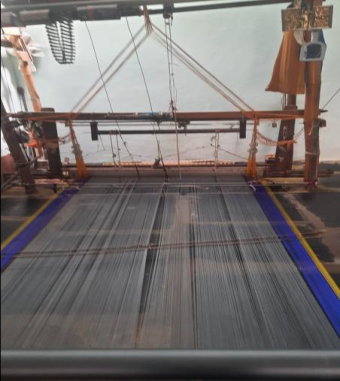 Figure 1
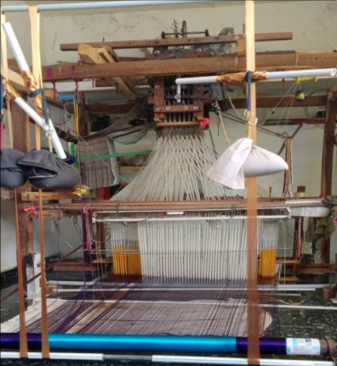 Figure 2
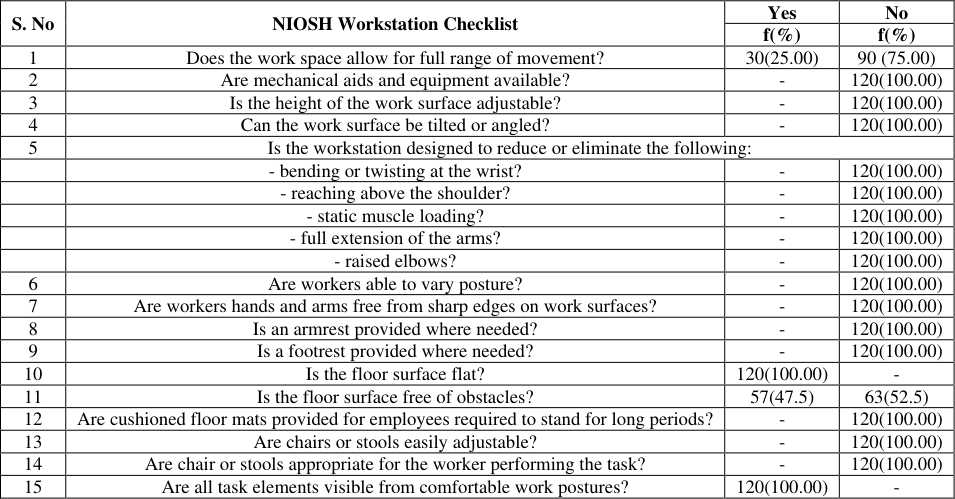 Table 1
Introduction
India's handloom sector is one of the country's largest unorganized economic activity that has a long history of exceptional craftsmanship which symbolizes and preserves the lively Indian culture. The highest incidence of musculoskeletal disorders (MSDs) among handloom weavers can be related to long hours of static work with uncomfortable posture at traditionally designed looms. The most prevalent occupational health issues among workers in any industry are work-related musculoskeletal disorders (WMSDs), which can result from neglecting to apply ergonomics principles in the design of tasks, tools and machines. The main causes of WMSDs are uncomfortable work postures imposed on by ergonomically inappropriate workstation design (Satheesh and Krishna, 2020) [5] . Ergonomic is a holistic approach to work layout that is rooted in achieving the best possible match of the workers attributes and capabilities to design and configuration of a work task. A work environment refers to the elements that comprise the setting in which employees work and impact workers. The goal of ergonomics is to create a workplace that is as safe, comfortable, and efficient as feasible. A balance between task demands and worker characteristics can be achieved through the effective application of ergonomics in workplace design. This can improve employee safety, happiness at work, productivity, and physical and mental health. Workplace ergonomics refers to the selection of components that enable individuals to adopt a comfortable healthy posture, thus preventing pain in various body parts. The most hazardous condition that is directly linked to poorly built workstations is musculoskeletal disorders, or MSDs. MSDs are caused by repetitive injury and deterioration of the joints, tendons, nerves, and tissues that impact the body's muscles and supporting structures of the body. As per the Fourth All India Handloom Census (2020-2021) there were 31.45 lakhs of households working in handloom sector. In fact, the handloom industry in India accounts for close to 15% of all textile manufacturing. The postures that weavers adopt at work depend on the type of work they do, how well the workspace is designed, their personal characteristics, the equipment required to do the particular task and the length and frequency of work cycles. The weaving task demands close observation to ensure that threads don't come loose, to patch any breaks, and to change the beam after one is finished. Sometimes at work, weavers are required to adopt positions without considering their individual capabilities and limits, which causes stress and trauma for the weavers. This eventually causes a drop-in output and quality of work. Due to the demands of the tasks, the workers accomplish them in various awkward and unnatural positions without considering their unique capabilities and limitations. Additionally, over time, these unnatural postures may cause stress and trauma for the workers, putting their health at danger (Nag et al., 2010; Dewangan et al. 2015) [4,2] . Impact of work station on health of Ikat fabric handloom weavers in Nalgonda district was investigated by Lakshmi et al. (2018) [3] . Ikat weaving entails a number of processes, including warping, creating wefts, weaving designs onto warp yarn, tying and drawing the warp thread, and weaving the final piece. In order to perform any of these procedures, weavers must sit with their heads forward, without the use of arm rests or back support. Approximately 83.3% of respondents said they were unable to go through their entire range of motion at their workstation. Eighty-three percent of those surveyed said they were experiencing pain in their left and right thighs and buttocks. Approximately 25% of the participants experienced pain throughout their sleep, with only 2-4 hours of sleep. Choobineh et al. 2004 [1] investigated the effects of workstation particularly weaving height and seat type of Carpet weavers and found that weavers suffer from musculoskeletal problems mainly attributed to poor working postures. The design of their workstations mostly determines their posture. It was found that weaving height affected postures of the head, neck, and shoulders. The weaving height and seat type, two design criteria, affected the postures of the elbows and trunk. Weaving height was found to influence weaver's perception of neck, shoulders, and elbows, whereas seat type affected their perspective of their back and knees.
Methodology
Exploratory research design was carried out to collect the data for the study. The study was conducted in the Rayalaseema region of Andhra Pradesh. A sample of 120 handloom weavers who were involved in weaving activity on Pit loom were selected purposively for the study. National Institute of Occupational Safety and Health (NIOSH) work station analysis checklist was used to identify the ergonomic risks of pit loom handloom weaving activity. The workstation was physically observed by the researcher and interview method was used to collect information from the weavers. The responses of the weavers performing the different tasks of handloom weaving activity were recorded in terms of 'Yes' and 'No' with scores 2 and 1.
Results and Discussion
The work station analysis revealed that three fourth of the handloom weavers reported that the workspace does not allow for full range of movement. None of the workstation where weavers perform task had mechanical aids and equipments, height of the worksurface is not adjustable and the work surface cannot be titled or angled. The workstation design neither reduces nor eliminates the bending or twisting of the wrist and full extension of the arms and raised elbows as reported by cent percent of the weavers. Cent percent of the weavers said that they were not able to vary their posture as per the requirement of work. The hands and arms of the weavers were not free from sharp edges on work surfaces. The workers while performing the work were not provided with arm rest and foot rest. The weavers were working sitting in flat floor surface. Nearly half (47.5%) reported that floor surface is free from obstacles in the workplace. www.extensionjournal.com Most of the weavers reported that pit loom working station does not provide full movement of upper and lower extremities. The workstation was hindering the movement to perform the activity. The workstation is not free from clutter. The place provided for the workstation was not spacious and is not fitting the work to the worker rather worker is adjusting with the workstation. Therefore, pit loom workstation is more prone to various hazards leading to occupational health problems to the handloom weavers. The workstation analysis of pit loom workstation revealed that most of the weavers expressed that they are working in poorly designed workstation which is hindering their work performance and also leading to various musculoskeletal discomforts. Therefore, ergonomically designed workstation taking into consideration of needs of weavers has to be given attention.
The following advantages will result from creating an ergonomically safe workplace such as decrease in the number of injuries due to MSDs; enhances the productivity of workers; Lower absenteeism; reduced expenses due to declining workers compensation and replacement worker payments; boost worker morale, decrease fatigue, raise comfort levels, and improve worker safety.
Conclusion
The prevention of WMSDs and the improvement of working conditions in small-scale industries will have a significant impact on enhancing and maintaining people's quality of life and improving efficiency. The Work station analysis revealed that three fourth of the handloom weavers reported that the workspace does not allow for full range of movement. None of the workstation where weavers perform task had mechanical aids and equipments.
Figures and tables from the paper
| S. No | NIOSH Workstation Checklist | Yes | No |
|---|---|---|---|
| f(%) | f(%) | ||
| 1 | Does the work space allow for full range of movement? | 30(25.00) | 90 (75.00) |
| 2 | Are mechanical aids and equipment available? | - | 120(100.00) |
| 3 | Is the height of the work surface adjustable? | - | 120(100.00) |
| 4 | Can the work surface be tilted or angled? | - | 120(100.00) |
| 5 | Is the workstation designed to reduce or eliminate the following: | ||
| - bending or twisting at the wrist? | - | 120(100.00) | |
| - reaching above the shoulder? | - | 120(100.00) | |
| - static muscle loading? | - | 120(100.00) | |
| - full extension of the arms? | - | 120(100.00) | |
| - raised elbows? | - | 120(100.00) | |
| 6 | Are workers able to vary posture? | - | 120(100.00) |
| 7 | Are workers hands and arms free from sharp edges on work surfaces? | - | 120(100.00) |
| 8 | Is an armrest provided where needed? | - | 120(100.00) |
| 9 | Is a footrest provided where needed? | - | 120(100.00) |
| 10 | Is the floor surface flat? | 120(100.00) | - |
| 11 | Is the floor surface free of obstacles? | 57(47.5) | 63(52.5) |
| 12 | Are cushioned floor mats provided for employees required to stand for long periods? | - | 120(100.00) |
| 13 | Are chairs or stools easily adjustable? | - | 120(100.00) |
| 14 | Are chair or stools appropriate for the worker performing the task? | - | 120(100.00) |
| 15 | Are all task elements visible from comfortable work postures? | 120(100.00) | - |
Table text extracted from the original PDF; superscript letters are shown inline. The original table image is below.
View original table image
References
5 in the original paper- Choobineh A, Lahmi M, Hosseini M, Shahnavaz H, Jazani RZ. Workstation Design in Carpet HandWeaving Operation: Guidelines for Prevention of Musculoskeletal Disorders. Int J Occup Saf Ergon (JOSE). 2004;10(4):411-424.
- Lakshmi VV, Deepika, Paul MM. Impact of work station on health of handloom weavers in Nalgonda district. Pharma Innov J. 2018;7(9):44-48.
- Nag A, Vyas H, Nag PK. Gender differences, work stressors and musculoskeletal disorders in weaving industries. Ind Health. 2010;48(3):339-348.
- Satheesh KM, Krishna KK. Work related musculoskeletal disorders among handloom workers in Kerala, India. IJARET. 2020;11(6).
- National Institute for Occupational Safety and Health (NIOSH). Workstation Checklist. Available from: https://www.cdc.gov/niosh/topics/ergonomics/ergoprim er/pdfs/Workstation-Checklist.pdf. Accessed 2023 Aug 23.