
Research article · 2024 · Full text
International Journal of Agriculture Extension and Social DevelopmentConstraints in marketing of mango in Muzaffarpur district of Bihar
Volume 7(5) · Pages 272–273 · DOI: 10.33545/26180723.2024.v7.i5d.643 ↗
Research areasAgricultural Economics and PracticesLivestock Management and Performance Improvement
Abstract
Author-writtenKnown as the "King of Fruits", mango is a drupe prized for its sweet, juicy fruit and flavour. They are native to South Asia, thrive in warm climates, and are grown worldwide. Mangoes are rich in vitamins A and C and have many health benefits, including improving immunity and skin health. It has many uses in cooking, from eating it fresh to using it in smoothies, desserts, and stews. The present study entitled "Constraints in marketing of mango in Muzaffarpur district of Bihar". In this study, two blocks namely Meenapur and Katra were deliberately selected. 5% of respondents wanted to be divided into three groups based on the size of their mango plantations: small, medium and large. The study found that most farmers sell their mangoes to agents, who then sell them to wholesalers, local traders and finally directly to the customer. The study found that the mango industry in the study area faces eight constraints: lack of storage facilities, low exchange rates, lack of government schemes and subsidy information, etc.
Summary
Source-checkedPlain-language reading of the full paper, prepared with AI and checked against the text. Each point links to the authors' own words.
Why it matters
- The Muzaffarpur district of Bihar is a significant production hub for mangoes, particularly the Shahi and Dussehri varieties. View evidence ↗
- Post-harvest losses in the region are driven by poor infrastructure, including a lack of refrigeration and inadequate transportation. View evidence ↗
The question
- The study aimed to identify the constraints faced in the marketing of mangoes within the Muzaffarpur district of Bihar. View evidence ↗
What they did
- The researchers employed purposive random sampling to select the study areas, blocks, villages, and participants. View evidence ↗
- The Minapur and Katra blocks were specifically selected because they had a high concentration of mango growers. View evidence ↗
- A total of 100 mango farmers were selected using a random sampling method. View evidence ↗
- To assess consumer sentiment and product awareness, five respondents each were selected from the categories of vendors, traders, and retailers. View evidence ↗
What they found
- The typical marketing channel involves farmers selling to agents, who then distribute the fruit to wholesalers and local traders before it reaches the customer. View evidence ↗
- Frequent price fluctuation was ranked as the most significant constraint, with a Garrett mean score of 61.88. View evidence ↗
- Inadequate transportation facilities were identified as the second major constraint, with a mean score of 56.68. View evidence ↗
- Market intermediaries were ranked as the third most significant constraint, with a mean score of 52.51. View evidence ↗
- The non-availability of storage facilities was the fourth highest constraint, scoring 50.08. View evidence ↗
- Lack of information regarding government schemes and subsidies was ranked fifth with a mean score of 44.95. View evidence ↗
- Distance to the market was ranked as the sixth constraint, with a mean score of 44.84. View evidence ↗
- Labor problems related to grading and packaging were ranked seventh, with a mean score of 44.65. View evidence ↗
- Lack of market infrastructure was ranked as the eighth constraint, with a mean score of 47.41. View evidence ↗
What it means
- The authors conclude that improving the industry requires a combination of infrastructure development, agricultural training, better business connections, and supportive policies. View evidence ↗
- A major limitation noted is the lack of economic data, as farmers typically rely on local market prices instead of comparing prices across multiple markets. View evidence ↗
Visual summary
2 visualsIllustrations explain the paper; charts are replotted from the paper's own table values.
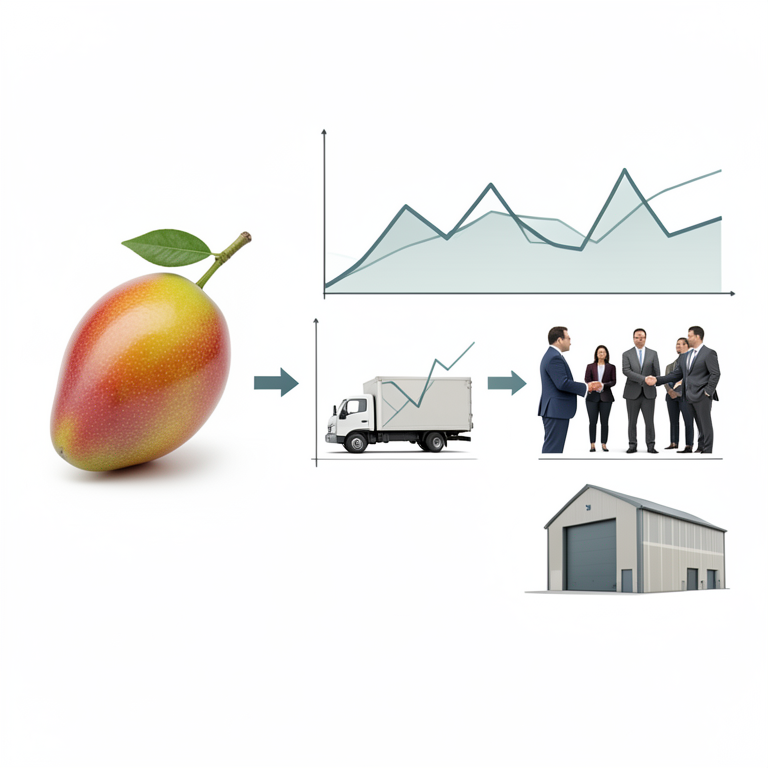
Hierarchy of Marketing Constraints
AI-generated conceptual illustration (Mango fruits and agricultural logistics in Bihar, India). It explains the idea and does not show study data.
View source evidence ↗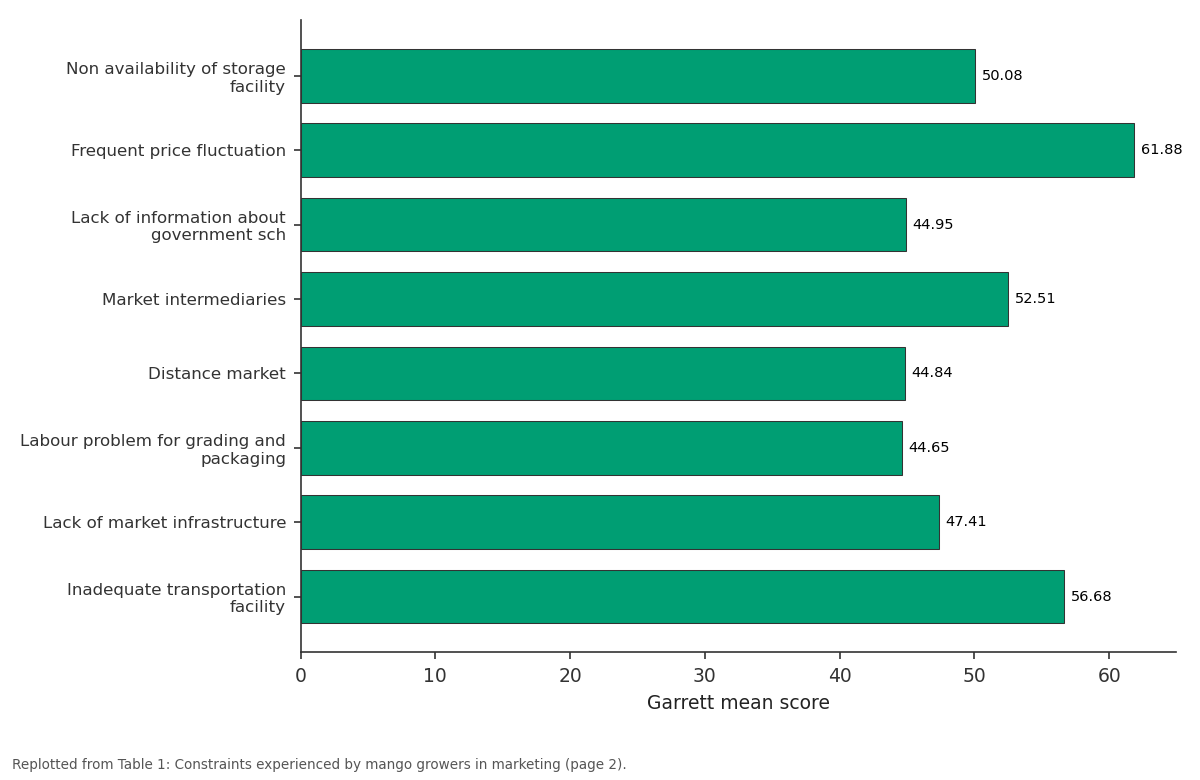
Garrett mean score: Non availability of... vs Frequent price... vs Lack of information... vs Market intermediaries vs Distance market
Replotted from Table 1 (page 2) of the original paper. Every bar is the paper's own table value.
View source evidence ↗Figures & tables
From the original paper Table 1
Introduction
Known as the "King of Fruits", mango is loved for its sweet, sweet taste and bright color. They originally grew in tropical and subtropical climates in South Asia and are now grown worldwide. Mango is rich in vitamins A and C, which support immunity and skin development. Their products are used in many ways, from eating fresh to adding them to smoothies, desserts and meals. In addition to its nutritional values, mango has cultural importance in many areas and symbolizes prosperity and wealth in many cultures and cuisines. (Taapopi, M., Kamwi, J.M. & Siyambango, N. 2018) [4] . Muzaffarpur district of Bihar is known for its production of mangoes, especially Shahi and Dussehri varieties. The fertile soil and good climatic conditions of the region help to grow mango well. Mango cultivation in Muzaffarpur follows this practice and many small and medium farmers are interested in this sector. Although the region has a high level of prosperity, problems such as inadequate water supply, lack of modern agriculture and inadequate storage facilities affect production and productivity. Improving infrastructure, providing education and promoting market access are key to realizing the full potential of mango in Muzaffarpur. (Uddin, M.G. 2015) [6] . The mango in Bihar's Muzaffarpur district is facing some restrictions. Poor infrastructure, such as inadequate transportation and lack of refrigeration, leads to post-harvest depression. (Srinivasalu, T. 2016) [2] . Today's agricultural practices and limited access to business information make it difficult for farmers to optimize production and cost. Additionally, fragmented supply chains and dependence on intermediaries reduce farmers' income. Inadequate government support and lack of industry cooperation have further compounded these challenges, making it difficult for mango farmers in Muzaffarpur to compete in the broader market and earn a fair return on their property.
Research methodology
The method used to select areas, blocks, villages and participants is purposive random sampling. Muzaffarpur district was chosen to avoid inconvenience and time constraints for researchers. All blocks in Muzaffarpur district were selected from Minapur and Katra blocks were selected as most of the respondents were engaged in mango cultivation. A separate list of villages was prepared for the constituencies and 5% of the villages with more mango growers in the selected blocks were selected. A list of all mango growers in the villages was prepared and divided into three groups based on their mango tree farms. Random sampling method was used to select 100 mango farmers from the list. Five respondents each from vendors/traders/retailers were selected to study product awareness and consumer sentiment in the study area. Important information is collected at appropriate times. Secondary data is collected from books/journals/publications/data on district/block basis. Information was collected from the participants by personal interview method. Statistical tools are used to analyze data and current results. Information about agriculture in 2023-2024.
Analytical Tools
Garret Ranking: Percent position = 100 (R ij -0.5) /N j www.extensionjournal.com
Results and Discussion
Results and Discussion
Conclusion
As a result, the mango industry in Muzaffarpur district of Bihar is affected by various constraints that limit the profitability and sustainability of the mango industry. Major problems include poor infrastructure, such as inadequate transportation and lack of refrigeration, leading to significant post-harvest damage and reduced fruit quality. In addition, farmers face challenges due to limited access to modern agriculture, business information and financial resources, restricting them from maximizing profits and maintaining fair prices. While the lack of government support and effective cooperation has led to these difficulties, the control of intermediaries in the chain continues to prevent farmers from reaping these benefits. Overcoming these barriers requires a range of approaches, including infrastructure development, agricultural training, better business connections and supportive policies. By addressing these issues, the Muzaffarpur mango industry can become competitive, develop farmers and contribute to the economy and food security in the region.
Figures and tables from the paper
| S. No. | Particulars | Percent position | Garrett score | Garrett mean score | Rank |
|---|---|---|---|---|---|
| 1 | Non availability of storage facility | 6.25 | 80 | 50.08 | IV |
| 2 | Frequent price fluctuation | 18.75 | 68 | 61.88 | I |
| 3 | Lack of information about government scheme and subsidies | 31.25 | 60 | 44.95 | V |
| 4 | Market intermediaries | 43.75 | 53 | 52.51 | III |
| 5 | Distance market | 56.25 | 47 | 44.84 | VI |
| 6 | Labour problem for grading and packaging | 68.75 | 41 | 44.65 | VII |
| 7 | Lack of market infrastructure | 81.25 | 33 | 47.41 | VIII |
| 8 | Inadequate transportation facility | 93.75 | 21 | 56.68 | II |
Table text extracted from the original PDF; superscript letters are shown inline. The original table image is below.
View original table image
References
9 in the original paper- Singh Y, Prakash S, Prakash O, Singh S. Effect of integrated nutrient management to reduce the cost of cultivation of Amrapali mango by minimizing the indiscriminate use of chemical fertilizers under highdensity planting. Int J Pure Appl Biosci. 2017;5(4):6467.
- Srinivasalu T. Constraints in cultivation of mangoes. A case study in Andhra Pradesh. J Agric Marketing. 2016;4(2):125-136.
- Sundaramari M, Ganesh S, Kannan GS. Rationality and adoption of indigenous agricultural practices on hill banana cultivation. J Extension Res. 2008;11(1):52-59.
- Taapopi M, Kamwi JM, Siyambango N. Perception of farmers on conservation agriculture for climate change adaptation in Namibia. Environ Nat Resour Res. 2018;8(3):33-44.
- Tyagi V. India's agriculture: challenges for growth & development in the present scenario. Int J Phys Soc Sci. 2012;2(5):116-127.
- Uddin MG. Extraction of eco-friendly natural dyes from mango leaves and their application on silk fabric. Textiles Clothing Sustainability. 2015;2(4):157-168.
- Ugese FD, Iyango PO, Swem TJ. Mango fruit production and production constraints in Gboko local government area of Benue State. Nasarawa State Univ. 2012;8(1):164-174.
- Usman M, Fatima B, Jaskani MJ. Review breeding in mango. Int J Agric Biol. 2001;3(4):522-531.
- Vadivelu A, Kiran BR. Problems and prospects of agricultural marketing in India: an overview. Int J Agric Food Sci. 2013;3(3):108-118.