
Research article · 2024 · Full text
International Journal of Research in AgronomyRelational analysis between demographic profile of ATIC beneficiaries and impact of ATIC beneficiaries
Volume 7(5S) · Pages 249–252 · DOI: 10.33545/2618060x.2024.v7.i5sd.771 ↗
Research areasRetirement, Disability, and Employment
Abstract
Author-writtenThe present investigation was undertaken in the Marathwada region of Maharashtra state during the years 2021–22. For the study, a sample of 180 ATIC beneficiaries was collected. The research design was ex post facto was used. The relationship between the demographic profile of ATIC beneficiaries and the overall impact of ATIC indicates that Education, Occupation, Land holding, Annual income, Farming Experience, Social participation, Source of information, Scientific Orientation, scientific orientation, Economic motivation and Training received positive significant correlation. Age and Family size indicate a negative, non-significant correlation with the impact of ATIC.
Summary
Source-checkedPlain-language reading of the full paper, prepared with AI and checked against the text. Each point links to the authors' own words.
Why it matters
- Agricultural Technology Information Centres (ATIC) act as a bridge between scientists and farmers to provide cost-effective, eco-friendly solutions and new technologies. View evidence ↗
- Timely flow of information and inputs from research institutes to end users is necessary to increase the income potential of the agricultural sector. View evidence ↗
- Technology transfer depends critically on the efficient dissemination of innovative information to farmers and the reporting of farmer feedback back to the research system. View evidence ↗
The question
- The study aimed to investigate how the demographic profiles of ATIC beneficiaries relate to the overall impact of the ATIC program. View evidence ↗
What they did
- A total sample of 180 ATIC beneficiaries was collected by randomly selecting 10 individuals from each of the selected villages. View evidence ↗
- The study analyzed the impact of ATIC (dependent variable) against independent variables including age, education, family size, occupation, land holding, annual income, farming experience, social participation, information sources, scientific orientation, economic motivation, and training. View evidence ↗
- The researchers used an ex-post facto design and analyzed data using tools such as correlation, multiple regressions, path analysis, and the 'Z' test. View evidence ↗
What they found
- Annual income had a positive and highly significant relationship (r = 0.268) with the impact of ATIC, suggesting that higher income increases the ability to procure inputs for adoption. View evidence ↗
- Occupation showed a positive and highly significant relationship (r = 0.260) with the impact of ATIC. View evidence ↗
- Training received had a positive and significant relationship (r = 0.237) with the impact of ATIC, as it helps individuals acquire necessary skills and knowledge. View evidence ↗
- Education was positively and significantly related (r = 0.219) to the impact of ATIC, which the authors attribute to a wider knowledge base and greater inclination toward new ideas. View evidence ↗
- Farming experience showed a positive and significant relationship (r = 0.215) with the impact of ATIC. View evidence ↗
- Social participation had a positive and significant relationship (r = 0.210) with the impact of ATIC. View evidence ↗
- Land holding showed a positive and significant relationship (r = 0.208) with the impact of ATIC. View evidence ↗
- The source of information had a positive and significant relationship (r = 0.198) with the impact of ATIC. View evidence ↗
- Scientific orientation had a positive and significant relationship (r = 0.197) with the impact of ATIC. View evidence ↗
- Age showed a non-significant relationship (r = 0.157) with the impact of ATIC. View evidence ↗
- Family size showed a non-significant relationship (r = 0.067) with the impact of ATIC. View evidence ↗
What it means
- The authors conclude that variables such as education, income, and training significantly impact beneficiaries and should be considered to improve ATIC efficiency. View evidence ↗
Visual summary
1 visualsIllustrations explain the paper; charts are replotted from the paper's own table values.
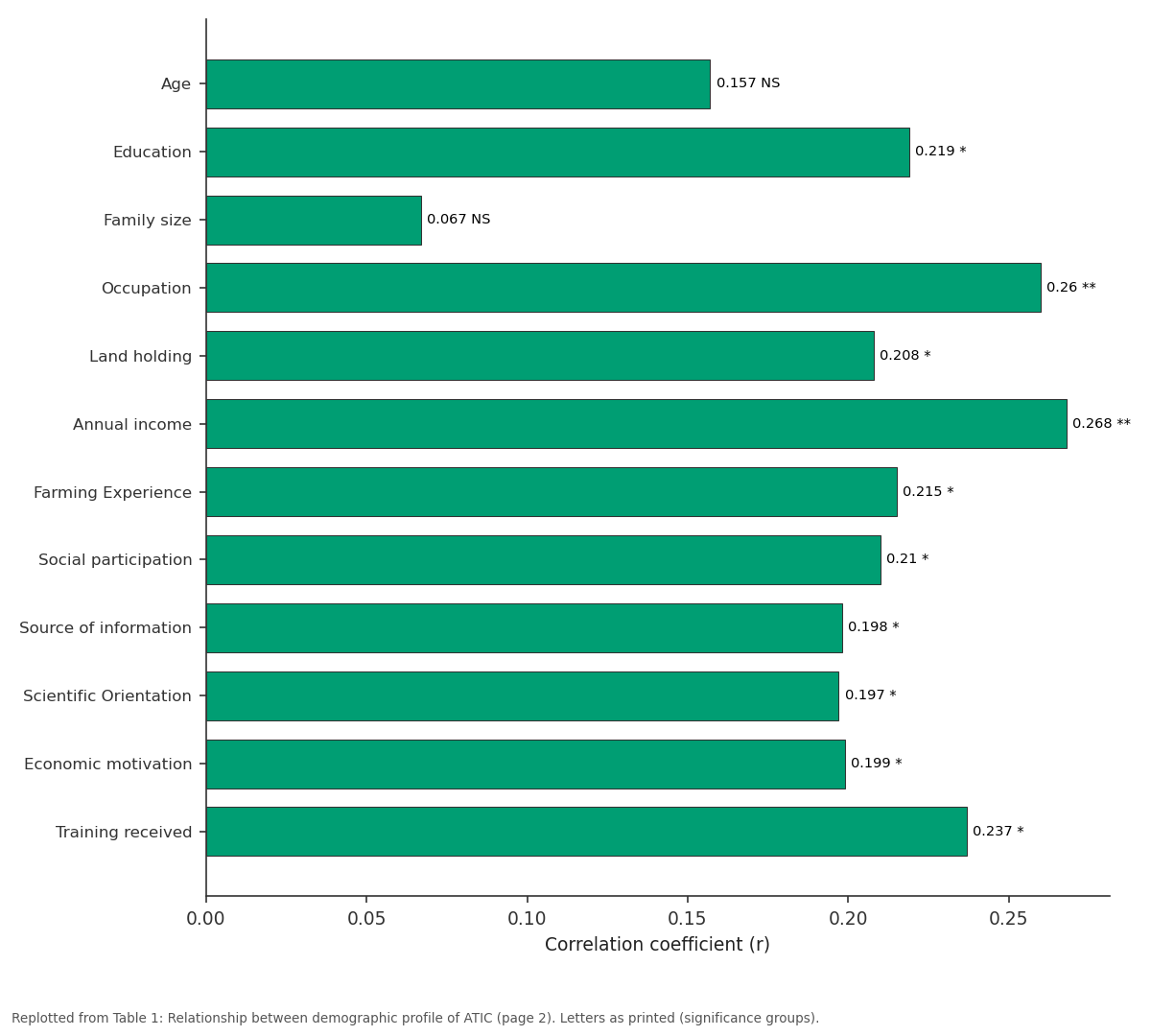
Correlation coefficient (r): Age vs Education vs Family size vs Occupation vs Land holding
Replotted from Table 1 (page 2) of the original paper. Every bar is the paper's own table value.
View source evidence ↗Figures & tables
From the original paper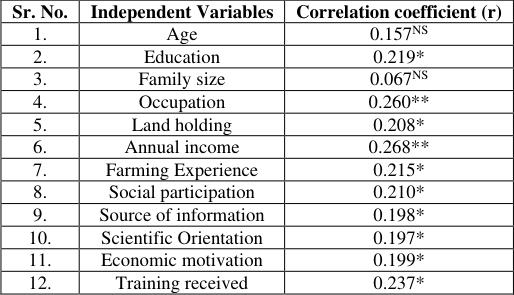 Table 1
Introduction
The National Agriculture Technology Project (NATP) was launched the Agricultural Technology Information Centre (ATIC) in 1999.ATIC fully fills the needs of the farming community, in particular through a single-window system to address a series of farm-related problems. The ATIC at VNMKV Parbhani has been serving as a bridge between the farmers and the scientists, providing solutions to many problems through farmer-friendly, eco-friendly, and cost-effective services and the latest agricultural technologies. The efficient dissemination of suitable agricultural innovative technological information from the Agricultural Research System to the farmers in the field and the reporting of farmers' feedback to the research system are one of the critical inputs in the transfer of technology. Today, India is on the verge of a technological revolution, with an immense number of agriculture technologies developed by research institutes and agricultural universities to enhance agriculture production. These technologies have changed the total production of agricultural commodities in the country. To further enhance the income potential of the existing agriculture sector, information and inputs need to flow in a timely and regular manner from the research institutes to the end users. The importance of an appropriate package of the latest information and its dissemination as an input has assumed added emphasis in this "information age". With the above objectives in focus, the Agricultural Technology Information Centers have been established in the country in the important ICAR institutes and state Agriculture Universities. At present, more than 40 ATIC's are working across the country, with the major focus being the dissemination of research information directly to end users.
Objective
The purpose of the current research is to investigate the relationship between demographic profile of ATIC beneficiaries with overall impact of ATIC
Materials and Methods
The purpose of the current research investigation is to determine the relationship between the beneficiaries' demographic profile and the impact of ATIC. The present research was conducted in purposively selected two districts viz., Parbhani and Hingoli district of Marathwada region in Maharashtra state as the highest number of ATIC beneficiaries among eight districts of Marathwada region from each selected district Three talukas were selected purposefully for this investigation on the basis of highest number of ATIC beneficiaries. Parbhani, Purna and Manwat from Parbhani district and Hingoli, Basmat and Aundha from Hingoli district were selected for research study. From each selected taluka three villages were selected purposively for the study on the basis of highest number of ATIC beneficiaries for that purpose list was collected from Agricultural Technology Information Centre, Vasantrao Naik. Ten (10) ATIC beneficiaries were selected randomly from each selected village. Thus total 180 beneficiaries were selected for research. The interview schedule and Impact Scale was used as a tool for collection of data. The data were collected with the help of a interview schedule from the beneficiaries as per their convenience at home or on farms. The independent variables, namely, age, Education, Size of family Occupation, Land holding, Annual income, Farming experience, Social participation, Source of information, Scientific orientation, Economic motivation, Training Received were selected for this study. The impact of ATIC as a dependent variable has been selected for this study. The suitable statistical tools used were viz., The statistical methods and tests such as correlation, frequency, percentage, standard deviation, mean, multiple regressions, path analysis and 'Z' test, was used for the analysis of the data Ex-post facto research design was used in this research. The results of the study presented in Table no 1
as follows
as follows
Results
Results
Relationship between demographic profile of ATIC beneficiaries and impact of ATI
The relationship between demographic profile of ATIC beneficiaries with their overall impact of ATIC was calculated and results were discussed here under. Training received 0.237*
Age with impact
Table 1 shows that, there was non-significant (0.157) relationship between age of ATIC beneficiaries and impact of ATIC.
| Sr. No. | Independent Variables | Correlation coefficient (r) |
|---|---|---|
| 1. | Age | 0.157NS |
| 2. | Education | 0.219* |
| 3. | Family size | 0.067NS |
| 4. | Occupation | 0.260** |
| 5. | Land holding | 0.208* |
| 6. | Annual income | 0.268** |
| 7. | Farming Experience | 0.215* |
| 8. | Social participation | 0.210* |
| 9. | Source of information | 0.198* |
| 10. | Scientific Orientation | 0.197* |
| 11. | Economic motivation | 0.199* |
| 12. | Training received | 0.237* |
Table text extracted from the original PDF; superscript letters are shown inline. The original table image is below.
View original table image
The age of beneficiaries of ATIC increases also experience of beneficiaries of ATIC increases so participate actively. It means that age of beneficiaries doesn't effect on the impact of ATIC on its beneficiaries. This finding was supported by finding of Bhandari (2014) [2] .
Education with impact
Table 1 reflect that, there was positive and significant (0.219) relationship between education of ATIC beneficiaries and impact of ATIC.
Education has profound impact on every aspect of life of beneficiaries. It widens the knowledge base of beneficiaries. This leads to widen the vision of beneficiaries. Educated people have greater inclination of new ideas and thus, they are more prone to change, to take risk and have better understanding of subject matter. It was therefore, assumed that, highly educated ATIC beneficiaries might have more impact, as there was a positive and significant relationship between educations and impact of ATIC on beneficiaries. This finding is in the conformity with the findings of Adsul (2016) [1] , Dhulgand (2020) [5] and Nair (2021) [6] .
Family size with impact
Table 1 shows that, there was non-significant (0.067) relationship between family size of ATIC beneficiaries and impact of ATIC.
It means that size of family doesn't effect on the impact of ATIC on its beneficiaries. The findings are in line with the findings of Dhulgand (2020) [5] .
Occupation with impact
Table 1 indicate that, there was positive and highly significant (0.260) relationship between occupation of ATIC beneficiaries and impact of ATIC. Occupation of the beneficiaries of ATIC was directly related with the environment of family, thus it was positively related with the impact of ATIC. This finding was supported by finding of Adsul (2016) [1] , Dhulgand (2020) [5] and Nair (2021) [6] .
Land holding with impact
Table 1 revealed that, there was non-significant (0.039) relationship between land holding of ATIC beneficiaries and impact of ATIC. Land holding of the beneficiaries of ATIC was directly related with the impact of ATIC, thus it was positively related with the impact of ATIC. The findings are in line with the findings of Adsul (2016) [1] , Dhulgand (2020) [5] and Nair (2021) [6] .
Annual income with impact
Table 1shows that, there was positive and highly significant (0.268) relationship between annual income of ATIC beneficiaries and impact of ATIC. It means that with increase in annual income of ATIC beneficiaries there was increase in impact of ATIC. Annual income provides the economic base for ATIC beneficiaries and increases their risk orientation and make them more capable to procure inputs need for the adoption of different activity. Annual income help to increase the living standard, thus annual income has positive relationship with impact of ATIC. This finding get strengthened with the findings of Bhandari (2014) [2] , Chapke et al. (2015) [4] , Adsul (2016) [1] , Dhulgand (2020) [5] and Nair (2021) [6] .
Farming experience with impact
Table 1 reflect that, there was positive and significant (0.215) relationship between farming experience of ATIC beneficiaries and impact of ATIC. It means that more the experience in farming business higher the impact of ATIC on its beneficiaries. Farming experience was made to adopt new innovative information technology and cultivation package of practices. There was positive and significant relationship of farming experience with impact of ATIC. This finding was supported by finding of Soni et al. (2012) [7] 8. Social participation with impact Table 1 shows that, there was positive and significant (0.210) relationship between social participation of ATIC beneficiaries and impact of ATIC. These findings may be due to fact of ATIC beneficiaries of ATIC who participate more in voluntary organization, develop broader outlook. Hence, social participation could establish positive and significant relationship with impact. Therefore, due to which there might be positive and significant relation between social participation and impact of ATIC. This finding was supported by finding of Bhandari (2014) [2] ,
Adsul (2016) [1] , Dhulgand (2020) [5] and Nair (2021) [6] .
Source of information with impact
Table 1 indicate that, there was positive and significant (0.198) relationship between source of information of ATIC beneficiaries and impact of ATIC. Beneficiaries of ATIC gain variety and more amount of knowledge if he or she has an opportunity to expose with more number of sources of information. ATIC beneficiaries those used more sources of information have higher exposure and enriches the level of impact. Therefore, use of sources of information might establish positive and significant relationship with impact of ATIC. This finding was supported by finding Bhandari (2014) [2] , Adsul (2016) [1] and Dhulgand (2020) [5] .
Scientific orientation with impact
Table 1 revealed that, there was positive and significant (0.197) relationship between scientific orientation of ATIC beneficiaries and impact of ATIC. More the scientific orientation of the ATIC beneficiaries with different extension personnel/people which helps for increasing their knowledge about different activity implemented by ATIC which enhance them to adopt these activity. The findings are in the line with the findings reported by Shekhawat (2014) [8] .
Economic motivation with impact
Table 1indicated that, there was positive and significant (0.199) relationship between economic motivation of ATIC beneficiaries and impact of ATIC. It means that increasing economic motivation of the ATIC beneficiaries will helps in increase in the impact of ATIC on its beneficiaries. There was positive and significant relationship of economic motivation with impact of ATIC. These findings were supported by Bhandari (2014) [2] , Adsul (2016) [1] and Dhulgand (2020) [5] .
Training received with impact
Table 1 reported that, there was positive and significant (0.237) relationship between training received of ATIC beneficiaries and impact of ATIC.
Training helps an individual in acquiring skill and knowledge through interaction about new cultivation package of practices, agro-based business, processing and farm mechanization and value addition of farm produce. There was positive and significant relationship of training received with impact of ATIC. These findings were supported by Nair (2021) [6]
Conclusion
The correlation analysis reveals that the independent variables, i.e., education, occupation, land holding, annual income, farming experience, social participation, source of information, scientific orientation, economic motivation, and training received, show a positive and significant impact on the beneficiaries and need to be considered for improving the efficiency of ATIC. Similarly, age and family size, which show a non-significant impact, need to be analyzed for their significance. The positive and significant variables that showed an impact on the ATIC beneficiaries in the multiple regression analysis were land holding, annual income, and scientific orientation. Apart from these significant variables, other social, economic, and psychological variables that show a nonsignificant impact need to be properly studied for their significant impact.
Acknowledgement
AcknowledgementI express my deepest sense of gratitude towards my honorable research guide Dr. R. P. Kadam for his learned council, intellectual inspiration, constructive criticism, valuable suggestions, constant guidance, cooperative attitude and willing help throughout the course of investigation and preparation of the manuscript.
References
3 in the original paper- Chapke RR, Bhagwat VR, Patil JV. Impact of national training on sorghum cultivation for value addition. Indian Journal of Extension Education. 2015;51(1 & 2):78-83.
- Soni RL, Kothari GL, Singh R. Impact of training programme on adoption of organic farming practices. Raj. J. Ext. Edu. 2012;(20):148-151.
- Ghag SB, Shekhawat UK, Ganapathi TR. Host-induced post-transcriptional hairpin RNA-mediated gene silencing of vital fungal genes confers efficient resistance against F usarium wilt in banana. Plant biotechnology journal. 2014 Jun;12(5):541-553.