
Research article · 2024 · Full text
International Journal of Research in AgronomyEvaluation of different okra (Abelmoschus esculentus L.) hybrids for growth, yield and quality under Prayagraj agro-climatic conditions
Volume 7(5) · Pages 728–732 · DOI: 10.33545/2618060x.2024.v7.i5j.769 ↗
Research areasAgricultural Practices and Plant GeneticsAgricultural Economics and PracticesAgricultural Science and Fertilization
Abstract
Author-writtenA present investigation was carried at the Horticultural research farm, Department of Horticulture, Naini Agricultural Institute, Sam Higginbottom University of Agriculture Technology and Sciences, Prayagraj, Uttar Pradesh during kharif Season, 2023 with a view to evaluation of different okra (Abelmoschus esculentus L) hybrids for growth, yield and quality under Prayagraj agro climatic condition. The experiment was laid in the randomized block design with 8 treatments and 3 replication with different hybrid varieties. Nine treatment of in different combinations were applied along with hybrid varieties. Result showed that the present investigation it is concluded that, the treatment varieties of T3 (F1 COVI PLUS) was recorded the best among all combinations, different varieties in term of growth parameters viz., Plant height (139.48 cm), Number of branches (23.40), Number of fruit per (16.08), Fruit length (22.63 cm), Fruit weight (31.69 g) and Fruit diameter (6.35 mm). Yield parameters like days to 50% flowering (42.07), No of fruit/Plant (28.19), Fruit yield/Plant (237.39 g) and Yield (10.36 t/ha), quality parameters TSS (3.92 ˚Brix), Ascorbic acid (2.07 mg/100g). Among the different treatments the highest gross return (254000.00 ₹/ha), net profit/ha (₹18904.00), cost benefit ratio (2.95) was obtained in hybrid varieties of F1 COVI PLUS (T3).
Summary
Source-checkedPlain-language reading of the full paper, prepared with AI and checked against the text. Each point links to the authors' own words.
Why it matters
- Okra, also known as Bhendi, is a significant warm-season vegetable valued for its tender green fruits. View evidence ↗
- India is the world's leading producer of okra, which contributes to foreign exchange through exports. View evidence ↗
- In India, okra is grown across 532 thousand hectares, producing 6146 thousand MT with a productivity of 12 MT per hectare. View evidence ↗
The question
- The study aimed to evaluate various okra hybrids for their growth, yield, and quality within the agro-climatic conditions of Prayagraj. View evidence ↗
What they did
- The researchers used a randomized block design featuring 8 treatments and 3 replications of different hybrid varieties. View evidence ↗
- The experiment took place during the 2023 kharif season at the Vegetable Research Farm in Prayagraj, using a planting spacing of 0.60 x 0.45 m. View evidence ↗
- Growth and yield parameters were recorded and analyzed using analysis of variance (ANOVA) appropriate for a randomized block design. View evidence ↗
What they found
- The F1 COVI PLUS hybrid (T3) showed the best growth parameters, including a plant height of 139.48 cm, 23.40 branches, 16.08 fruits per plant, fruit length of 22.63 cm, fruit weight of 31.69 g, and fruit diameter of 6.35 mm. View evidence ↗
- For yield, F1 COVI PLUS (T3) recorded 42.07 days to 50% flowering, 28.19 fruits per plant, a fruit yield per plant of 237.39 g, and an overall yield of 10.36 t/ha. View evidence ↗
- The quality parameters for F1 COVI PLUS (T3) were a TSS of 3.92 ˚Brix and ascorbic acid content of 2.07 mg/100g. View evidence ↗
- F1 COVI PLUS (T3) provided the highest economic returns, with a gross return of 254,000.00 ₹/ha, a net profit of 18,904.00 ₹/ha, and a cost-benefit ratio of 2.95. View evidence ↗
- The lowest plant height was recorded in treatment T1 at 106.28 cm. View evidence ↗
- The Madhavi hybrid (T1) produced the minimum fruit yield per plant at 207.33 g. View evidence ↗
- The lowest ascorbic acid content (0.74%) was found in the Madhavi hybrid (T1). View evidence ↗
What it means
- The authors conclude that the F1 COVI PLUS hybrid (T3), with a yield of 10.16 t/ha, is the most economically viable option with the best growth and yield characteristics. View evidence ↗
- The authors state that further testing is needed to confirm these results as the study was based on only one growing season. View evidence ↗
Visual summary
3 visualsIllustrations explain the paper; charts are replotted from the paper's own table values.
Experimental Layout
AI-generated conceptual illustration (okra plants (Abelmoschus esculentus)). It explains the idea and does not show study data.
View source evidence ↗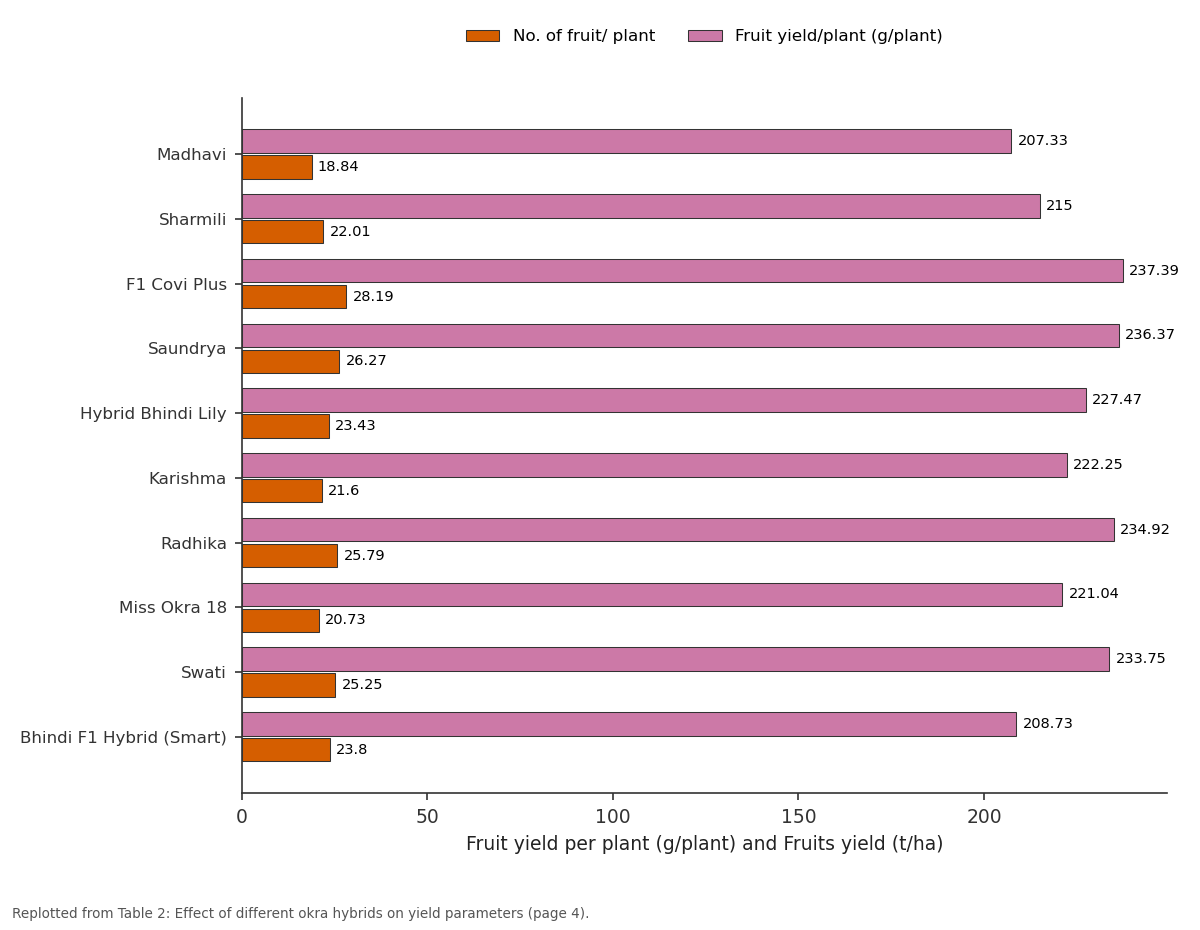
No. of fruit/ plant and Fruit yield/plant (g/plant): Madhavi vs Sharmili vs F1 Covi Plus vs Saundrya vs Hybrid Bhindi Lily
Replotted from Table 2 (page 4) of the original paper. Every bar is the paper's own table value.
View source evidence ↗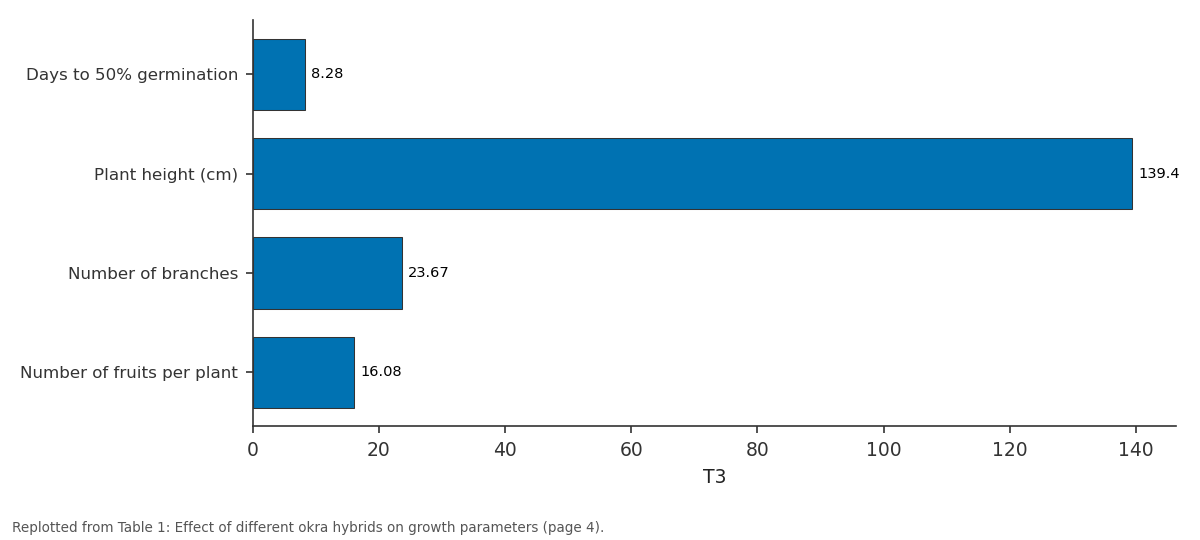
T3: Days to 50% germination vs Plant height (cm) vs Number of branches vs Number of fruits per...
Replotted from Table 1 (page 4) of the original paper. Every bar is the paper's own table value.
View source evidence ↗Figures & tables
From the original paper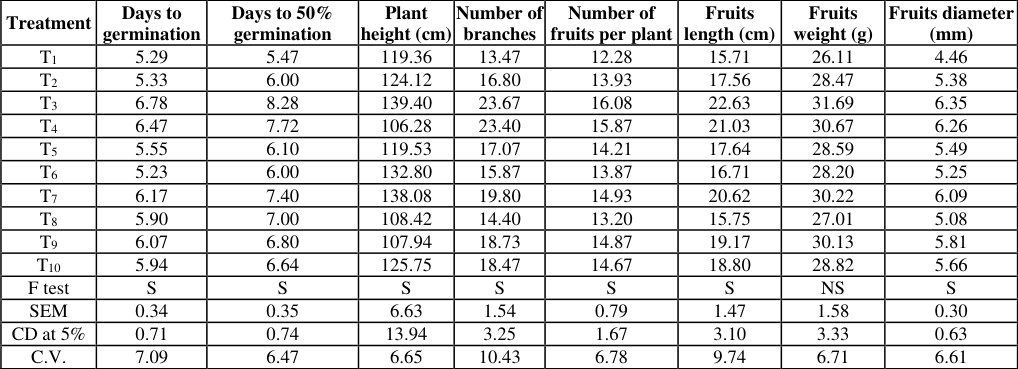 Table 1
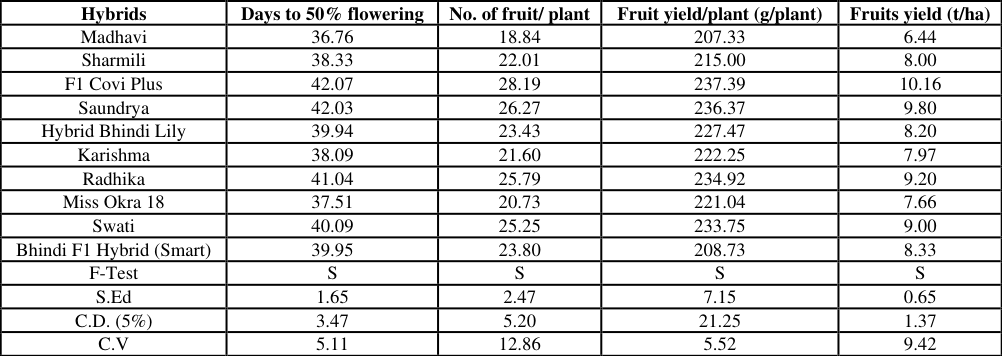 Table 2
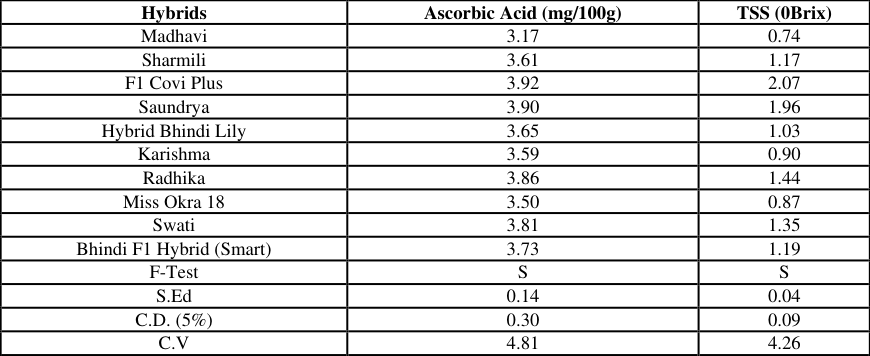 Table 3
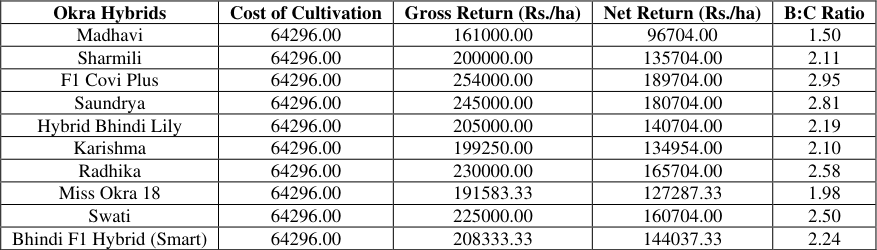 Table 4
Introduction
Okra [Abelmoschus esculentus (L.) Moench] commonly known as lady's finger or that, belongs to the family Malvaceae. Okra popularly known as Bhendi' is an important warm season vegetable, widely cultivated for its tender, green fruits. It is widely adopted and popular vegetable in Indian kitchens and can be grown in summer and rainy seasons throughout India. India is the highest producer in the world and exported there by helping in earning foreign exchange. Okra is an important vegetable grown for its tender fruits which are used as a vegetable in various ways. It is also grown during early winter season of mid cool temperature. Okra is specially valued for its tender and delicious fruits. However, to a limited extent, it finds its use in dehydrated or frozen form. It has been reported to have an average nutritive value. In India, it ranks first in its consumption but its original home is Ethiopia and Sudan, the Northeastern African countries. It is one of the oldest cultivated crops and presently grown in many countries and is widely distributed from Asia to Africa, Southern Europe and America. In India area under okra crop is 532 thousand hectare with 528.4 production 6146 thousands MT and productivity is 12 MT per hectare. In Maharashtra okra occupies about 23 thousand hectare of land with production of 241 thousand MT and productivity of 11 MT per hectare. Andhra Pradesh is leading state in production of okra 1184.2 thousand tones from area of 78.90 thousand hectare with productivity of 15 tonnes per hectare. In India, okra is cultivated throughout the country for its immature tender pods (fruits), occupying an area over 511 hectares with production of 6219 tonnes. Therefore, the present investigation entitled "Evaluation of different okra (Abelmoschus esculentus L) hybrids for growth, yield and quality" was be undertaken at Vegetable Research Farm, Department of Horticulture, Naini Agricultural Institute, Sam Higginbottom University of Agriculture, Technology & Sciences, SHUATS, Prayagraj (UP) during kharif season 2023.
Materials and Methods
The okra at the 0.60 x 0.45 m spacing were used for the experiment will be conducted at Vegetable Research Farm, Department of Horticulture, Naini Agricultural Institute, Sam Higginbottom University of Agriculture, Technology & Sciences, Prayagraj (UP) during kharif season 2023. All the facilities necessary for cultivation, including labour will be made available in the department. Geographically Prayagraj is situated at an elevation of 78 meters above sea level at 25.870 North latitude and 81.150 E longitudes. The experimental land is situated in the river basin of the Ganga and the Yamuna. Prayagraj, the region has a sub-tropical climate prevailing in the South-East part of U.P. with both the extremes in temperature, i.e., the winter and the summer. In cold winters, the temperature sometimes is as low as 20 °C in December -January and very hot summer with temperature reaching up to 48 °C in the months of May and June. The average rainfall is around 1042 mm with maximum concentration during July to September months with occasional showers in winters. In growth parameters dry weight (g/plant), crop growth rate (g/m2/day) and yield parameters were recorded and statistically analyzed using analysis of variance (ANOVA) as applicable to Randomized Block Design (Gomez, K. A. and Gomez, A. A. 1984) [7] .
Results and Discussion
Results and Discussion
Growth Parameters Effect of days to germination
The data pertaining to effect of different okra hybrids on days to germination is presented in Table 1. At harvesting the maximum days to germination was recorded in the treatment T 3 (F1 COVI PLUS) 6.78 followed by 6.47 with T 4 (SAUNDRYA), T 7 (RADHIKA) and T 9 (SWATI) respectively, was found to be statistically at par with T 3 (F1 COVI PLUS). At minimum day to germination 5.23 was recorded in T 6 (KARISHMA). More intensive flower setting was elicited either by improved plant growth through varieties extract application or by endogenous components, especially genotypes which chance nutrient partitioning in vegetative plant organ, days to 50% germination and increase in the transport to assimilates to the growing and yield of fruits. A similar effect was observed for bitter gourd with different varieties by Patel et al., (2014) [18] .
| Treatment | Days to germination | Days to 50% germination | Plant height (cm) | Number of branches | Number of fruits per plant | Fruits length (cm) | Fruits weight (g) | Fruits diameter (mm) |
|---|---|---|---|---|---|---|---|---|
| T1 | 5.29 | 5.47 | 119.36 | 13.47 | 12.28 | 15.71 | 26.11 | 4.46 |
| T2 | 5.33 | 6.00 | 124.12 | 16.80 | 13.93 | 17.56 | 28.47 | 5.38 |
| T3 | 6.78 | 8.28 | 139.40 | 23.67 | 16.08 | 22.63 | 31.69 | 6.35 |
| T4 | 6.47 | 7.72 | 106.28 | 23.40 | 15.87 | 21.03 | 30.67 | 6.26 |
| T5 | 5.55 | 6.10 | 119.53 | 17.07 | 14.21 | 17.64 | 28.59 | 5.49 |
| T6 | 5.23 | 6.00 | 132.80 | 15.87 | 13.87 | 16.71 | 28.20 | 5.25 |
| T7 | 6.17 | 7.40 | 138.08 | 19.80 | 14.93 | 20.62 | 30.22 | 6.09 |
| T8 | 5.90 | 7.00 | 108.42 | 14.40 | 13.20 | 15.75 | 27.01 | 5.08 |
| T9 | 6.07 | 6.80 | 107.94 | 18.73 | 14.87 | 19.17 | 30.13 | 5.81 |
| T10 | 5.94 | 6.64 | 125.75 | 18.47 | 14.67 | 18.80 | 28.82 | 5.66 |
| F test | S | S | S | S | S | S | NS | S |
| SEM | 0.34 | 0.35 | 6.63 | 1.54 | 0.79 | 1.47 | 1.58 | 0.30 |
| CD at 5% | 0.71 | 0.74 | 13.94 | 3.25 | 1.67 | 3.10 | 3.33 | 0.63 |
| C.V. | 7.09 | 6.47 | 6.65 | 10.43 | 6.78 | 9.74 | 6.71 | 6.61 |
Table text extracted from the original PDF; superscript letters are shown inline. The original table image is below.
View original table image
The data pertaining to effect of different okra hybrids on Plant height (cm) is presented in Table 1. Significantly maximum plant height (cm) was recorded in the treatment T 3 (F1 COVI PLUS) 139.40 cm followed by 138.03 cm with T 7 (SAUNDRYA), T 6 (KARISHMA). 132.80 cm and T 10 (BHINDI F1 HYBRID (SMART) 125.75 cm respectively, was found to be statistically at par with T 3 (F1 COVI PLUS) 139.40. At minimum plant height 106.28cm was recorded in T 1 . Many hybrid okra varieties are bred to have a more controlled and consistent plant height. This trait can be beneficial for farmers as it makes the plants easier to manage and harvest. Hybrid okra varieties often exhibit vigorous growth, leading to robust plants that can reach significant heights, typically ranging from 3 to 6 feet, depending on the variety and environmental conditions. The height of hybrid okra plants can contribute to better space utilization in the field. Taller plants can support more foliage and, consequently, more flowers and fruits, leading to higher yields per unit area.Similar findings are also reported by Billore et al. (2000) [3] , Parmar and Nema (2002) [17] and Masum et al.
Effect of number of branches on okra
The data pertaining to effect of different okra hybrids on fruit length is presented in Table 1. At harvesting the maximum on number of branches was recorded in the treatment T 3 (F1 COVI PLUS) 23.67 followed by 23.40, T 4 (SAUNDRYA), T 7 (RADHIKA) 19.80 respectively, was found to be statistically at par with T 3 (F1 COVI PLUS) 23.67. At minimum on number of branches 13.47 was recorded in T 1 . Similar findings were reported by Mishra et al., (2020) [22] ; in okra. The findings are same concordance with reports of Meerabai et al., (2007) [13] as highly significant and positive association of fruit weight.
Effect of number of fruit per plant
The data pertaining to effect of different okra hybrids on number of fruit per plant is presented in Table 1. Significantly highest number of fruit per plant (16.08) F1 COVI PLUS (T 3 ) followed by SAUNDRYA (15.87) (T 4 ), RADHIKA (14.93) (T 7 ), SWATI (14.87) (T 8 ), respectively, was found to be statistically at par with (16.08) F1 COVI PLUS (T 3 ). The number of fruits produced by a hybrid okra plant can vary based on several factors, including the specific hybrid variety, growing conditions, soil fertility, climate, and overall plant health. However, hybrid okra plants are generally bred for higher productivity, and under optimal conditions, they can produce a significant number of pods per plant. On average, a wellmanaged hybrid okra plant can produce between 20 to 30 pods per plant during the growing season. However, under ideal conditions, some high-performing hybrid varieties can yield upwards of 50 to 100 pods per plant. This is especially crucial for organic farming, since inorganic fertilizers are not permitted. Similar findings were deduced by Malik et al., (2020) [23] .
The data pertaining to effect of different okra hybrids on number of fruit per plant is presented in [11] , Rahman et al. (2013) [19] and Mondal et al. (2014) [15] .
The data pertaining to effect of different okra hybrids on fruit weight (g) is presented in Table 1. Significantly highest fruit weight (31.69 g) F1 COVI PLUS (T 3 ) followed by SAUNDRYA (30.67 g) (T 4 ), RADHIKA (30.22 g) (T 7 ), SWATI (30.13 g) (T 8 ), respectively, was found to be statistically at par with (31.69) F1 COVI PLUS (T 3 ). At minimum fruit weight 26.11 g was recorded in T 1 .More intensive flower setting was elicited either by improved plant growth like node of flower, through habitability along with high genetic advance as percent of mean was observed for or by endogenous components, especially cytokinin, which chance nutrient partitioning in vegetative plant organ and increase in the transport to assimilates to the growing fruits. A similar effect was observed for bitter gourd different variety by Nayak et al. (2016) [16] .
In present study, fruit yield was directly associated with number of fruits per plant as number of fruits per plant increases fruit yield proportionately. The data pertaining to effect of different okra hybrids on number of fruit/plant is presented in Table 1. Significantly highest fruit diameter (6.35 mm) F1 COVI PLUS (T 3 ) followed by SAUNDRYA (6.26 mm) (T 4 ), RADHIKA (6.09 mm) (T 7 ), SWATI (5.81 mm) (T 8 ), respectively, was found to be statistically at par with (31.69) F1 COVI PLUS (T 3 ). At minimum fruit diameter 4.46 mm was recorded in T 1 . Different hybrid okra varieties may have slightly different optimal fruit diameters based on their breeding objectives. Some hybrids may produce slightly thicker pods while others may be thinner, depending on consumer preferences and culinary uses.
Environmental factors, such as soil quality, water availability, and nutrient levels, can influence the size and diameter of okra fruits. Consistent and optimal growing conditions help maintain the ideal fruit size. (Anburani and Manivannan 2002), [2] . Similar results were reported by Choudhury et al., (2013) [4] and Akand et al., (2015) [1] in bitter gourd.
Yield parameter
The data pertaining to yield parameter is presented in Table 2. It is evident from the table that the effect of different okra hybrids on yield parameter significantly influenced fruit weight at clearly marked out the obvious different among the treatment with respect to different treatment.
| Hybrids | Days to 50% flowering | No. of fruit/ plant | Fruit yield/plant (g/plant) | Fruits yield (t/ha) |
|---|---|---|---|---|
| Madhavi | 36.76 | 18.84 | 207.33 | 6.44 |
| Sharmili | 38.33 | 22.01 | 215.00 | 8.00 |
| F1 Covi Plus | 42.07 | 28.19 | 237.39 | 10.16 |
| Saundrya | 42.03 | 26.27 | 236.37 | 9.80 |
| Hybrid Bhindi Lily | 39.94 | 23.43 | 227.47 | 8.20 |
| Karishma | 38.09 | 21.60 | 222.25 | 7.97 |
| Radhika | 41.04 | 25.79 | 234.92 | 9.20 |
| Miss Okra 18 | 37.51 | 20.73 | 221.04 | 7.66 |
| Swati | 40.09 | 25.25 | 233.75 | 9.00 |
| Bhindi F1 Hybrid (Smart) | 39.95 | 23.80 | 208.73 | 8.33 |
| F-Test | S | S | S | S |
| S.Ed | 1.65 | 2.47 | 7.15 | 0.65 |
| C.D. (5%) | 3.47 | 5.20 | 21.25 | 1.37 |
| C.V | 5.11 | 12.86 | 5.52 | 9.42 |
Table text extracted from the original PDF; superscript letters are shown inline. The original table image is below.
View original table image
Number of fruit per plant
The data pertaining to effect of different okra hybrids on number of fruit per plant is presented in
The data pertaining to effect of different okra hybrids on fruit yield per plant (g) is presented in Table 2. Significantly highest fruit yield per plant (g) (237.39 g) F1 COVI PLUS (T 3 ) followed by SAUNDRYA (236.37 g) (T 4 ), RADHIKA (234.92 g) (T 7 ), SWATI (233.75) (T 9 ), respectively, was found to be statistically at par with (237.39 g) F1 COVI PLUS (T 3 ). At minimum fruit yield per plant (g) 207.33 g was recorded in (MADHAVI) T 1 .
The data pertaining to effect of different okra hybrids on fruit yield (t/ha) is presented in Table 2. Significantly highest fruit yield (t/ha) (10.16 t/ha) F1 COVI PLUS (T 3 ) followed by SAUNDRYA (9.80 t/ha) (T 4 ), RADHIKA (9.20 t/ha) (T 7 ), SWATI (9.00 t/ha) (T 9 ), respectively, was found to be statistically at par with (10.16 t/ha) F1 COVI PLUS (T 3 ). At minimum fruit yield (t/ha) 6.44 t/ha was recorded in (MADHAVI) T 1 . Hybrid okra typically produces fruits of consistent size and quality. Enhanced flowering and fruit-setting capabilities, along with disease resistance, contribute to an increased number of pods harvested per plant. The weight of individual okra pods from hybrid varieties is often more consistent and can be slightly higher compared to traditional varieties. This contributes to the overall yield by increasing the total mass of harvested pods. Hybrid okra plants usually exhibit more vigorous growth and a faster growth rate. This results in robust plants that can support a larger number of fruits, contributing to higher yields. Some hybrid okra varieties are designed to mature earlier than traditional varieties. Early maturity allows for quicker harvests and the possibility of multiple cropping cycles within a single growing season, increasing overall yield. Hybrids are often more adaptable to varying environmental conditions, including different soil types and climatic conditions. This adaptability ensures stable yields across diverse growing regions and reduces the risk of crop failure due to adverse conditions. The consistent and prolonged fruiting period of hybrid okra varieties allows for regular and frequent harvests. This can lead to a steady supply of fresh okra over an extended period, benefiting both farmers and markets. The combination of higher yields, better fruit quality, and disease resistance in hybrid okra varieties often translates to better economic returns for farmers. Increased productivity and reduced losses contribute to higher profitability. This is especially crucial for organic farming, as inorganic fertilizers are not permitted by Parani and Nanthini (2021) [24] .
The data pertaining to quality parameter is presented in Table 3.
| Hybrids | Ascorbic Acid (mg/100g) | TSS (0Brix) |
|---|---|---|
| Madhavi | 3.17 | 0.74 |
| Sharmili | 3.61 | 1.17 |
| F1 Covi Plus | 3.92 | 2.07 |
| Saundrya | 3.90 | 1.96 |
| Hybrid Bhindi Lily | 3.65 | 1.03 |
| Karishma | 3.59 | 0.90 |
| Radhika | 3.86 | 1.44 |
| Miss Okra 18 | 3.50 | 0.87 |
| Swati | 3.81 | 1.35 |
| Bhindi F1 Hybrid (Smart) | 3.73 | 1.19 |
| F-Test | S | S |
| S.Ed | 0.14 | 0.04 |
| C.D. (5%) | 0.30 | 0.09 |
| C.V | 4.81 | 4.26 |
Table text extracted from the original PDF; superscript letters are shown inline. The original table image is below.
View original table image
TSS (˚Brix)
The data pertaining to effect of different okra hybrids on TSS (˚Brix) is presented in Table 3. Significantly highest TSS (˚Brix) (3.92) F1 COVI PLUS (T 3 ) followed by SAUNDRYA (3.90 ˚Brix) (T 4 ), RADHIKA (3.86 ˚Brix) (T 7 ), SWATI (3.81 ˚Brix) (T 9 ), respectively, was found to be statistically at par with (3.92) F1 COVI PLUS (T 3 ). At minimum TSS (˚Brix) 3.17 was recorded in (MADHAVI) T 1 . After varying cultivars, there was an increase in the quality of solids dissolved in the liquid portion of okra, known as total soluble solids (T.S.S.). These results closely match those of Solanki and Mishra. The heightened photosynthetic and metabolic activities, which led to the synthesis of more acids, metabolites, and glucose, may be responsible for the quality increase brought about by the application of nitrogen and variety. In the end, these reserves helped okra synthesize TSS. These results are in conformity with Kamili et al., (2002) [8] .
The data pertaining to effect of different okra hybrids on Ascorbic acid (%) is presented in Table 3
Conclusion
Based on the result of the above experimental finding it is concluded that the hybrid F1 COVI PLUS of (10.16 yield t/ha) (Treatment 3), have highest growth metrics and yield characteristics while also being economically viable. However, additional tests are required to corroborate the findings because they are based only one season.
Figures and tables from the paper
| Okra Hybrids | Cost of Cultivation | Gross Return (Rs./ha) | Net Return (Rs./ha) | B:C Ratio |
|---|---|---|---|---|
| Madhavi | 64296.00 | 161000.00 | 96704.00 | 1.50 |
| Sharmili | 64296.00 | 200000.00 | 135704.00 | 2.11 |
| F1 Covi Plus | 64296.00 | 254000.00 | 189704.00 | 2.95 |
| Saundrya | 64296.00 | 245000.00 | 180704.00 | 2.81 |
| Hybrid Bhindi Lily | 64296.00 | 205000.00 | 140704.00 | 2.19 |
| Karishma | 64296.00 | 199250.00 | 134954.00 | 2.10 |
| Radhika | 64296.00 | 230000.00 | 165704.00 | 2.58 |
| Miss Okra 18 | 64296.00 | 191583.33 | 127287.33 | 1.98 |
| Swati | 64296.00 | 225000.00 | 160704.00 | 2.50 |
| Bhindi F1 Hybrid (Smart) | 64296.00 | 208333.33 | 144037.33 | 2.24 |
Table text extracted from the original PDF; superscript letters are shown inline. The original table image is below.
View original table image
References
20 in the original paper- Akand II, Khairul Mazed ILEM, Pulok Md. AI, Chowdhury Md, Shah N, Moonmoon JF. Intl. J Appl. Res. 2015;1:7174.
- Anburani A, Manivannan, K. Effect of integrated nutrient management on growth in brinjal (Solanum melongena L.) cv Annamalai South Indian J Hort. 2002;50(4-6):377-386.
- Billore SD, Joshi OP, Ramesh A. Performance of Soya bean [Glycine max (L) Merrill] genotype on different sowing dates and row spacing in vertisol. Indian J. Agric. Sci. 2000;70(9):577-50.
- Choudhury S, Islam N, Sarkar MD, Ali MA. Intl. J Sustain. Agric. 2013;5:25-28.
- Contreras-Cornejo HA, López-Bucio JS, Méndez-Bravo A, Macias-Rodriguez, La Ramos-Vega M, Guevara-Garcia AA, et al. Mitogen-activated protein kinase 6 and ethylene and auxin signalling pathways are involved in Arabidopsis root-system architecture alterations by Trichoderma atroviride. Mol. Plant Microbe Interact. 2015;28:701-710.
- Devi HJ, Maity TK, Thapa U, Paria NC. Effect of integrated nitrogen management on yield and economics of brinjal. J Interacademica. 2002;6(4):450-453.
- Kamili KL, Tamilselvi C, Vijayaraghavan H. Impact of plant growth regulators and formulations on growth of bitter gourd (Momordica charantia L.), Plant Gene and Trait. 2002;5(8):1-3.
- Kumar R, Prasad VM. Hybrid evaluation trial in bottle gourd gourd [Lagenaria siceraria (Mol.) Standl.). Environment. and Eco. 2011;29(1):74-77.
- Malek MA, Shafiquzzaman M, Rahman MS, Ismail MR, Mondal MMA. Standaridization of soya bean row spacing based on morpho-physiological characters. Legume Res. 2012;35(2):138-143.
- Meerabai M, Jayachandran BK, Asha KIR. Bio farming in bitter gourd (Momordica charantia L.). Acta Horticulture. 2007;752:349-352.
- Mishra RK, Singh A. International Journal of Research and Review in Applied Sciences. 2011;8:1-7.
- Mondal MMA, Puteh AB, Kashem MA, Hasan MM. Effect of plant density on canopy structure and dry matter partitioning into plant parts of soya bean (Glycine max). Life Sci. J. 2014;11(3):67-74.
- Nayak DA, Pradhan M, Mohanty S, Paridaand AK, Mahapatra P. Effect of integrated nutrient management on productivity and profitability of pointed gourd (Trichosanthes dioica Roxb.). Journal of Crop & Weed. 2016;12(1):25-31.
- Patel BJ, Wagh AP, Umbarkar PS, Bondre SV. Influence of nutrient management studies in bottle gourd. Journal of Pharmacognosy and Phytochemistry. 2014;7(5):1383-1385.
- Rahman MM, Hossain MM. Effect of row spacing and cultivar on the growth and seed yield of soya bean [Glycine max (L.) Merrill] in kharif-ll season. A Scientific Journal of Krishi Foundation. 2013;11(1):33-38.
- Singh V, Shah KN, Rana DK. Performance of different Bittergourd (Momordica charantia L.) strain for growth, yield and quality traits under Garhwal hills. Plant Archives. 2011;16(2):815-820.
- Vyas MD, Khandwe R. Effect of row spacing and seed rate on morpho physiological parameters, yield attributes and productivity of soya bean [Glycine max (L) Merrill] cultivars under rain fed condition of Vindhyan plateau of Madhya Pradesh. Soya bean Res. 2014;(Special Issue):8291.
- Mishra L, Gupta T, Shree A. Online teaching-learning in higher education during lockdown period of COVID-19 pandemic. International journal of educational research open. 2020 Jan 1;1:100012.
- Malik AA, McFadden SM, Elharake J, Omer SB. Determinants of COVID-19 vaccine acceptance in the US. E Clinical Medicine. 2020 Sep 1;26.
- Parani K, Nanthini M. Effect of Inorganic Fertilizers on Growth of Chilli (Capsicum annuum L.). Res. Jr. of Agril. Sci. 2021 Jul;12(4):1298-1301.
Cited by 2
From OpenAlex, OpenCitations and reference lists read by Scinovex
- Varietal performance of okra (Abelmoschus esculentus L.) under the agro-climatic conditions of Balaghat, Madhya Pradesh
Aditya Nitin Agashe, Avadhesh Singh Choudhary, Prakash Ghodeswar, Mohd Wamiq, Pallavi Verma · International Journal of Advanced Biochemistry Research · 2026
The present investigation clearly demonstrated significant differences among the evaluated okra varieties with respect to growth, yield-attributing characters, fruit yield and economic performance under the agro-climatic conditions of Balaghat. The observed variation among the varieties indicates their differential adaptability and productive potential under the local environmental conditions. Among all the varieties evaluated, Parbhani Kranti (T5) exhibited the most superior overall performance, with the highest fruit yield of 107.85 q ha⁻¹, in addition to better performance for important gro
- Evaluation of different hybrids of okra [Abelmoschus esculentus (L.) Moench] under Prayagraj agro-climatic conditions
Anjali Saroj, Devi Singh · International Journal of Advanced Biochemistry Research · 2025
The Rabi season of 2024 saw the completion of a field experiment at the Research Farm of the Department of Horticulture, Sam Higginbottom Institute of Agriculture, Technology, and Sciences, Prayagraj, Uttar Pradesh, India, entitled "Evaluation of different hybrids of okra [Abelmoschus esculentus L. Moench] under Prayagraj agro-climatic conditions." Nine distinct okra hybrids were used in the experiment, which was set up using a Randomized Block Design (RBD). Days to 50% germination and flowering, plant height, number of leaves and branches, internode length, fruit characteristics, yield attrib