
Research article · 2024 · Full text
International Journal of Veterinary Sciences and Animal HusbandryProbable rabies case report in a Kangayam bull in Udumalpet, India: Insights into rabies surveillance and control strategies in resource-limited settings
Volume 9(3) · Pages 274–276 · DOI: 10.22271/veterinary.2024.v9.i3d.1419 ↗
Research areasRabies epidemiology and controlYersinia bacterium, plague, ectoparasites researchViral Infections and Vectors
Abstract
Author-writtenA ten-month-old Kangayam bull calf was presented with the ailment of anorexia, frequent bellowing and hypersalivation for the past five days. On clinical examination, the animal was found to be more aggressive with erected ears, ataxic gait, hyperesthesia and lameness. Epidemiological investigations revealed that the animal was recently purchased from the local sandy. There was no known history of dog bites and no visible bite marks. Based on the characteristic signs, the animal was suspected of having a case of rabies and post-exposure prophylaxis (PEP) and isolation procedures were instructed. The calf died on the second day of isolation, exhibiting progressive paralysis. Due to the lack of standard laboratories, the antemortem clinical index was adopted in the suspicion of probable rabies cases where rabies is endemic. This case highlights the need for public awareness of rabies prevention and a better understanding of the
Summary
Source-checkedPlain-language reading of the full paper, prepared with AI and checked against the text. Each point links to the authors' own words.
Why it matters
- Rabies is a neglected zoonotic disease that is always fatal once clinical signs appear. View evidence ↗
- Dog-mediated rabies causes approximately 59,000 human deaths globally each year, with 30,000 to 35,000 of those occurring in Asia. View evidence ↗
- In India, dogs are the primary transmitters of rabies, accounting for 95-99% of cases. View evidence ↗
The question
- The study aims to document the challenges of diagnosing rabies in resource-limited settings and to increase scientific awareness among the public. View evidence ↗
What they did
- The subject was a ten-month-old male Kangayam bull treated at the Veterinary Clinical Complex in Udumalpet, Tamil Nadu. View evidence ↗
- Initial clinical measurements for the bull showed a temperature of 102° F, a pulse rate of 102/minute, and a respiratory rate of 66/minute. View evidence ↗
- Because laboratory resources were limited, the physician used an antemortem clinical diagnosis index to identify the case as probable rabies. View evidence ↗
What they found
- The bull presented with a five-day history of anorexia, hypersalivation, and frequent bellowing. View evidence ↗
- Clinical examination revealed behavioral changes, ataxia, lameness, hyperesthesia to sound, and erected ears. View evidence ↗
- The bull died on the second day of isolation, exhibiting progressive ascending paralysis. View evidence ↗
- The owner incorrectly believed that cattle are 'dead-end hosts' and cannot spread the rabies virus to other animals or humans. View evidence ↗
- Contrary to the owner's belief, the rabies virus in bovine saliva is highly infectious and poses a risk similar to other animals. View evidence ↗
What it means
- The authors conclude that risk assessments for suspected rabies in cattle should be treated with the same urgency as confirmed dog bites. View evidence ↗
- The authors recommend that the public verify rabies information with physicians to combat myths and seek immediate treatment for bites. View evidence ↗
- Laboratory confirmation was not possible because the animal was cremated due to the owner's hesitation to allow a post-mortem examination. View evidence ↗
Visual summary
1 visualsIllustrations explain the paper; they do not show study data.
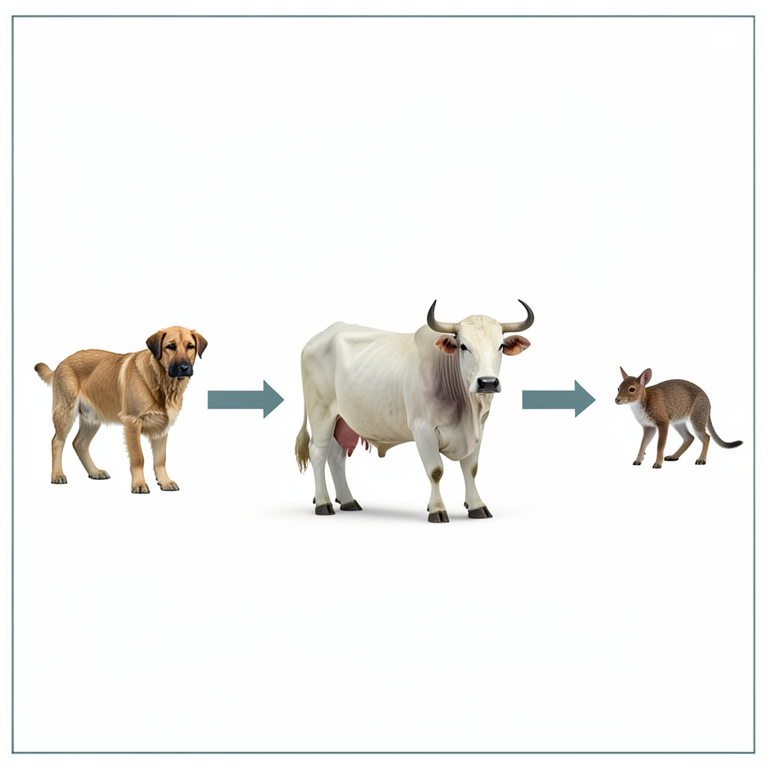
The Myth of the Dead-End Host
AI-generated conceptual illustration (Kangayam bull, stray dog, and a small mammal). It explains the idea and does not show study data.
View source evidence ↗Introduction
Rabies is a neglected zoonotic disease with a 100 percent case fatality rate. Despite its long history (more than 4300 years), rabies is still a dangerous and deadly disease of domestic and wild animals and humans (Naveenkumar et al. 2022) [1] . Except few countries, rabies remains an endemic disease list of the World. Rabies is caused by a lyssavirus and transmitted by the bite of suspected domestic, feral and wild animals viz., dogs, cats, monkeys, skunks, bats, etc., Considering global rabies data, approximately 59,000 people die annually due to dog-mediated rabies. In the Asian scenario, 30,000 -35,000 people die annually. Though the data is an alarming rate, the real data is more than this, as not all rabies cases are reported properly (Pantha et al. 2020) [2] . In countries like India, rabies is predominantly transmitted by dogs (95-99%) followed by other species viz., cats, jackals, mongooses and others. Due to the endemic status of rabies in India, bites/ scratches by all warm-blooded animals are supposed to be treated like rabiessuspected animal bite /wound management as suggested by the World Health Organisation (WHO) (Naveenkumar et al. 2022) [1] . The discrepancies in the understanding of rabies among the general populations with the availability of abundant unvaccinated stray dog populations are being found to be driving factors for the peak of rabies. Considering the seriousness of this fatal neglected disease, government and private health agencies are keep on working on the formation of suitable preventive strategies and extending support to create awareness among the general public in order to provide (i) preexposure prophylaxis to the suspected animals; (ii) post-exposure prophylaxis to the dog/ suspected animals based on the category of exposure and (iii) social and community awareness creation among the general people. Further, WHO and other global health agencies are calling the nations to devise a suitable strategy to combat this deadly disease in the title of "eliminating dog-mediated human rabies deaths by 2030" (Minghui et al. 2018) [3] . The availability of standard rabies diagnosis laboratories is limited globally due to various factors and at the field level (limited resources settings), the diagnosis will be made by the physician using an ante-mortem clinical diagnosis index. In countries like India, ante-mortem clinical diagnosis is widely practiced which helps in decision-making at the earliest possible at a field. Timely intervention strategies like PEP and immunoglobulin administration at the wound site in the zeroth hour will facilitate the elimination of rabies virus at the site of bite/ scratches leading to control of the disease transmission (Naveenkumar et al. 2022) [1] . Though the incidences of rabies are reported frequently in dogs, ruminants are the next accountable host for rabies occurrence in India (Gill et al. 2019) [4] . Despite its form of clinical manifestations in animals, the furious/ paralytic form of rabies is more prevalent than the dumb form, the clinical signs may vary between individual animals as not all animals exhibit similar signs. The wide spectrum of clinical manifestations makes it difficult to diagnose where laboratory confirmation is mandatory. However, the limited availability of laboratories and the issues in conducting post-mortems of infected animals led to the worsening of the situation without deciding further. In those situations, the characteristics and signs of rabies will help to decision-making process by the probable clinical diagnosis (Naveenkumar et al. 2022) [1] . Lack of awareness among the general people is the foremost hindrance factor in devising a suitable control strategy in the field conditions. Based on the facts described above, the present case of probable rabies in Kangayam Bull is taken to document the serious issues in rabies diagnosis at limited resource settings as well as to import scientific awareness to the general people and future researchers.
Case Presentation
Ten-month old Kangayam breed male cattle was brought to the Veterinary Clinical Complex (VCC), Veterinary College and Research Institute (VC&RI), Tamil Nadu Veterinary and Animal Sciences University (TANUVAS), Udumalpet, Tamil Nadu for treatment. Veterinary Clinical Complex is a referral, multi-specialty and renowned veterinary hospital governed by TANUVAS and a regular out-patient caseload of 60 -70 from the Tirupur and adjoining districts of Tamil Nadu and Kerala. The present case was admitted to the hospital with a history of anorexia, frequent bellowing and hypersalivation for the past five days. General clinical examinations revealed that the animal had a temperature of 102° F, pulse rate of 102/ minute, and respiratory rate 66/ minute. Further, thorough inspection and examination marked that, behavioural changes, vocalization difference, alertness, erected ear, ataxia, hyperaesthesia to the sound, and lameness. Epidemiological investigations revealed that, the animal was purchased from a local sandy within a week and since then animal had frequent bellowing. As per the new buyer (owner)'s knowledge no history of dog bites/ scratches. Based on the clinical and epidemiological findings, the case was diagnosed as probable rabies using the antemortem clinical diagnosis by the attending physician. As it's suggestive of rabies, the physician was using proper personal protective equipment (PPE) to avoid the disease transmission and handled the animal with foremost care (World Health Organisation 2018) [5] . In this case report, the characteristics signs noticed were frequent bellowing, behavioral changes, hypersalivation, erected ear and hyperaesthesia. The owners were briefed about the rabies, post-exposure prophylaxis needs to be adopted by the owners as well as animal handlers. Since the suggestive signs are directed to be the rabies suspicion criterion, the owners were informed to isolate the animal in a separate room where entry was limited. The owner discussed the "Dead end host" significance of Rabies in bovines through internet browsing and expressed his perspective as "Rabies in cattle is not transmitted to other animals or humans". On day 2 of isolation, the animal died with progressive ascending paralytic signs. Due to the hesitations in conducting post mortem and lack of knowledge on rabies the animal was cremated. Upon the detailed in-person investigations, the owners were strictly instructed to have PEP and other managemental suggestions to control rabies transmission.
Discussion
Rabies is still a neglected and fatal viral zoonotic disease of mammals including humans. Though the disease has been a deadly viral disease from ancient times to now, still it's a preventable disease by adopting appropriate preventive strategies in animals and humans. The dog is considered to be a prime reservoir host (about 95%) for human rabies transmission and other domestic and wild animals (Naveenkumar et al. 2022) [1] . Despite of modernized immunoglobulin therapy adopted, once the rabies virus reaches the neuronal tissue, the end is always fatal (Thiptara et al. 2011) [6] . The alarming rate of the annual incidence of rabies in humans and animals warrants the need for continuous surveillance and effective vaccination protocol adoption in the rural and urban sectors. The long journey of rabies virus with favourable host availability (dog) poses a challenging task for both human and animal health sectors for many decades (Naveenkumar et al. 2022) [1] . Lack of awareness among the general public, creates a path to unstoppable rabies. At this juncture, even a small drop of information on rabies would help in the preparation of effective control measures at the global level. Based on this fact, the study was documented to mark the necessity of awareness creation against rabies and to clarify the myth of dead-end host significance in bovine rabies. Further, the manuscript explains the possible hindrance factors in the arrival of laboratory-based diagnosis in limited resource settings/ environments. The present case was suspected as a probable rabies case in Kangayam Bull in Udumalpet, Tamil Nadu. In limited resource settings, the laboratory-aided diagnosis is not as easy as we did for all other medical diagnostic procedures. The confirmation of rabies diagnosis can be achievable through Fluorescent Antibody Tests; Seller staining and molecular confirmations. These diagnostic tests were quite costlier, need an expert and need a standard diagnostic laboratory (World Health Organization 2018) [5] . In a limited resources area, the confirmation of rabies diagnosis is achieved by the antemortem diagnostic index (Naveenkumar et al. 2022) [1] . The owner of this present case was not cooperative for postmortem and they felt that it was a highly prestigious issue to declare their animal was having rabies. At this juncture and due to a lack of available standard laboratory, the case was diagnosed as a furious form of probable rabies in Kangayam bull cattle using the antemortem clinical diagnostic index. Similar kinds of approaches already done by the various researchers claimed that, not always possible to go with laboratory-aided confirmation in the case of rabies where the clinical diagnosis would help to device appropriate PEP at the earliest possible (Tepsumethanon et al. 2005 [7] , Leung et al. 2007 [8] , Radhakrishnan et al. 2020 [9] and Naveenkumar et al. 2022 [1] ). The earlier decision-making process will help to follow the PEP as per WHO recommendation. This immediate effort helps in (i) the prevention of rabies to other animals by isolation of suspected rabies animals and (ii) adopting post-exposure prophylaxis to the owners and animal handlers (control), which helps in protecting the vulnerable population. In this case, the following suggestive signs were considered to be significant classical signs for the antemortem clinical diagnosis viz., frequent bellowing, behavioural changes, hypersalivation, erected ear and hyperaesthesia. The earlier researchers agreed that the characteristic clinical signs were an appropriate criterion for rabies suspicion in limited resource settings (Leung et al. 2007 [8] , Naveenkumar et al. 2022 [1] ). The isolation of suspected animals in a separate room was followed as per WHO recommendations (World Health Organisation 2018) [5] . The animal showed progressive paralytic signs on day 2 of isolation and collapsed. The characteristics signs and progressive clinical manifestations suggested that the bull was a probable rabies-infected case. Due to the owner's misconception, they cremated the dead carcass. In these unavoidable situations, the diagnostic test confirmation was impaired. Further, the owner misbelieved that "Cattle are the dead-end host for rabies and from rabies-infected cattle, the virus will not spread to any animal" from his own perspective and internet misguidance. It can be challenging for the physicians to clarify the owner's perspectives on their animal health when they have obtained information from the internet (Madhusudana et al. 2008) [10] . Though the case report is a single case study, still the mistakes or errors made by the owners and the information received from their perspectives are highly useful in stepping further against particular disease control. Based on that, the owner was briefed by the physician that, a dead-end host means the animal not going to spread to other animals in a normal manner. However, in bovines the virus released in saliva is highly infectious and this may be treated as equal risk in comparison with other animals (Wald et al. 2007) [11] . The veterinarians and animal handlers are always suggested to use PPE while handling the suspected animals and the treatment should be carried out based on the category as per WHO recommendations.
Conclusion
The present case report of probable rabies cases in ten-monthold kangayam male cattle was confirmed by the ante-mortem clinical diagnosis index by the characteristic signs. The issues faced in limited resource settings on the rabies diagnosis were briefed and countries like India, the endemicity and the abundant unvaccinated host (dog) availability stresses the need for effective awareness among the public and the treatment/ risk assessment should be calculated as much as equal to the weightage given for rabies-confirmed dog bites in all cases. The misbeliefs, myths and other understanding on rabies should be confirmed with a physician and addressing the dog bite wound cases at the earliest possible time is pivotal in devising a strong controlling policy.
References
11 in the original paper- Naveenkumar V, Bharathi MV, Kannan P, Selvaraju G, Vijayarani K, Kharkwal P, et al. Temporal pattern and risk factors for occurrence of Canine Rabies in Chennai. Comparative Immunology Microbiology and Infectious Diseases. 2022;90:101903. https://doi.org/10.1016/j.cimid.2022.101903.
- Pantha S, Subedi D, Poudel U, Subedi S, Kaphle K, Dhakal S. Review of rabies in Nepal. One Health. 2020;10:100155. https://doi.org/10.1016/j.onehlt.2020.100155.
- Minghui R, Stone M, Semedo MH, Nel L. New global strategic plan to eliminate dog-mediated rabies by 2030. Lancet Glob Health. 2018;6(8):e828-829. https://doi.org/10.1016/S2214-109X(18)30302-4.
- Gill GS, Singh BB, Dhand NK, Aulakh RS, Sandhu BS, Ward MP, et al. Estimation of the incidence of animal rabies in Punjab, India. PloS One. 2019;14(9):e0222198. https://doi.org/10.1371/journal.pone.0222198.
- World Health Organization (WHO). WHO expert consultation on rabies: third report (Vol. 1012), World Health Organization, 2018. https://iris.who.int/bitstream/handle/10665/272364/97892 41210218-eng.pdf?sequence=1. 21 May 2024.
- Thiptara A, Atwill ER, Kongkaew W, Chomel BB. Epidemiologic trends of rabies in domestic animals in southern Thailand, 1994-2008. American Journal of Tropical Medicine and Hygiene. 2011;85(1):138. https://doi.org/10.4269/ajtmh.2011.10-0535.
- Tepsumethanon V, Wilde H, Meslin FX. Six criteria for rabies diagnosis in living dogs. Journal of Medical Association of Thailand. 2005;88(3):419-422. https://api.semanticscholar.org/CorpusID:15851492.
- Leung AK, Davies HD, Hon KLE. Rabies: epidemiology, pathogenesis, and prophylaxis. Advances in Therapy. 2007;24:1340-1347. https://doi.org/10.1007/BF02877781.
- Radhakrishnan S, Vanak AT, Nouvellet P, Donnelly CA. Rabies as a public health concern in India-A historical perspective. Tropical Medicine and Infectious Diseases. 2020;5(4):162. https://doi.org/10.3390/tropicalmed5040162.
- Madhusudana SN, Sukumaran SM. Antemortem diagnosis and prevention of human rabies. Annals of Indian Academy of Neurology. 2008;11(1):3-12. https://doi.org/10.4103%2F0972-2327.40219.
- Wald HS, Dube CE, Anthony DC. Untangling the WebThe impact of Internet use on health care and the physician-patient relationship. Patient Education and Counseling. 2007;68(3):218-224. https://doi.org/10.1016/j.pec.2007.05.016
Cited by 2
From OpenAlex, OpenCitations and reference lists read by Scinovex
- Epidemiological insights into canine rabies in Chennai: Trends, forecasting and One Health implications ↗
V. Naveenkumar, Mangalanathan Vijaya Bharathi, Porteen Kannan, B. S. Pradeep Nag, Sureshkannan Sundaram, Nithya Quintoil Mohanadasse et al. · One Health · 2025
Eliminating canine-mediated human rabies deaths by 2030 is a global priority, necessitating a data-driven approach to understand rabies dynamics and implement effective prevention strategies. This study provides epidemiological insights into canine rabies in Chennai, analyzing nine years of surveillance data ( n = 428, March 2010 – February 2019) to assess trends, seasonality and predictive patterns. Change point and time…
❝ 3PDF - Exploring transmission risk and challenges in the diagnosis of bovine rabies: A case report ↗
V. Naveenkumar, M Thangapandiyan, S Vigneshwaran, PARAMASIVAM RAJA, C Inbaraj, US Kalyaan et al. · The Indian Journal of Animal Sciences · 2024
Rabies is a devastating zoonotic disease affecting all warm-blooded animals and humans. Although dogs are commonly recognized as primary transmitters of rabies in India, ruminants also significantly contribute as hosts within livestock populations. This study aimed to highlight the critical issues surrounding bovine rabies and propose practical strategies for documenting and managing it in resource-limited settings. A 40-day-old female Kangeyam…
❝ 2PDF