
Research article · 2024 · Full text
International Journal of Research in AgronomyImpact of organic nutrient modules on productivity of pigeonpea based intercropping system
Volume 7(5) · Pages 686–690 · DOI: 10.33545/2618060x.2024.v7.i5i.763 ↗
Research areasAgronomic Practices and Intercropping Systems
Abstract
Author-writtenThe field experiment was conducted during Kharif season of 2018-19 at research farm of Department of Agronomy, Dr. Panjabrao Deshmukh Krishi Vidhyapeeth, Akola (Vidarbha, Maharashtra) to evaluate the impact of organic nutrient modules on productivity of pigeonpea based intercropping system. The experiment was laid out in strip plot design (SrPD) with four main plot factors (intercropping system) and three sub plot factors (organic integrated nutrient management) and replicated thrice. The treatment consists of T1 - sole pigeonpea, T2 - pigeonpea + soybean (1:4), T3 - pigeonpea + foxtail millet (1:4) and T4 - pigeonpea + cotton (1:4) and three organic integrated nutrient management (OINM) viz., N1 - 100% FYM (Farm Yard Manure) + vermicompost, N2 - 75% FYM + vermicompost + 25% neem cake and N3 - control (No manure). Among the intercropping systems, pigeonpea + soybean (1:4) recorded significantly higher seed yield (1043.6 kg ha-1), stalk yield (3241.7 kg ha-1) and biological yield (4687.4 kg ha-1) of pigeonpea than all other intercropping systems. Pigeonpea equivalent yield (PEY) (2123.4 kg ha-1) and system productivity (11.8 kg ha-1 day-1) was also found highest in pigeonpea + soybean (1:4) intercropping systems. Regarding the organic nutrient management practices, significantly the highest seed yield (922.2 kg ha-1), stalk yield (2730.3 kg ha-1), biological yield (3652.5 kg ha-1), pigeonpea equivalent yield (1610.8 kg ha-1) and system productivity (8.9 kg ha-1 day-1) were found in 75% FYM + vermicompost + 25% neem cake. Regarding the interaction, pigeonpea + soybean (1:4) intercropping system with 75% FYM + vermicompost + 25% neem cake had registered the highest seed yield (1228.0 kg ha-1) and PEY (2644.6 kg ha-1).
Summary
Source-checkedPlain-language reading of the full paper, prepared with AI and checked against the text. Each point links to the authors' own words.
Why it matters
- Pulses are critical for national food and nutritional security in India because they are the primary protein source for most of the population. View evidence ↗
- The long-term use of chemical fertilizers in monocropping has negatively impacted soil physico-chemical properties and reduced crop yields. View evidence ↗
- Intercropping is considered more beneficial than monocropping, and pigeonpea is well-suited for this due to its wide row spacing and long growth duration. View evidence ↗
The question
- The study aimed to evaluate how different organic nutrient modules affect the productivity of intercropping systems based on pigeonpea. View evidence ↗
What they did
- The experiment took place during the 2018-19 Kharif season at the Department of Agronomy research farm in Akola, Maharashtra. View evidence ↗
- Researchers used a strip plot design with three replications, testing four intercropping systems as main plot factors and three organic nutrient management options as sub plot factors. View evidence ↗
- The intercropping treatments included sole pigeonpea, and pigeonpea paired with soybean, foxtail millet, or cotton (all at 1:4); nutrient treatments included 100% FYM + vermicompost, 75% FYM + vermicompost + 25% neem cake, and a no-manure control. View evidence ↗
What they found
- Among the intercropping systems, pigeonpea + soybean produced the highest seed yield (1043.6 kg ha-1), while pigeonpea + foxtail millet produced the lowest (609.2 kg ha-1). View evidence ↗
- The organic nutrient module consisting of 75% FYM + vermicompost + 25% neem cake resulted in the highest seed yield (922.2 kg ha-1), whereas the no-manure control had the lowest (497.5 kg ha-1). View evidence ↗
- Stalk yield was highest in the pigeonpea + soybean system (3241.7 kg ha-1) and lowest in the pigeonpea + foxtail millet system (1754.6 kg ha-1). View evidence ↗
- Biological yield was maximized in the pigeonpea + soybean system (4285.3 kg ha-1) compared to sole pigeonpea (3215.3 kg ha-1) and other intercrops. View evidence ↗
- The pigeonpea + soybean intercropping system achieved the highest Pigeonpea Equivalent Yield (PEY) at 2123.4 kg ha-1. View evidence ↗
- System productivity was highest for pigeonpea + soybean (11.8 kg ha-1 day-1) and lowest for sole pigeonpea (4.0 kg ha-1 day-1). View evidence ↗
- Regarding nutrient management, the 75% FYM + vermicompost + 25% neem cake module provided the highest system productivity (8.9 kg ha-1 day-1). View evidence ↗
- The interaction of the pigeonpea + soybean system with the 75% FYM + vermicompost + 25% neem cake module produced the highest seed yield (1228.0 kg ha-1) and PEY (2644.6 kg ha-1). View evidence ↗
What it means
- The authors recommend the combination of pigeonpea + soybean (1:4) intercropping and the 75% FYM + vermicompost + 25% neem cake nutrient module for sustainable productivity in the black soils of the Vidarbha region. View evidence ↗
Visual summary
2 visualsIllustrations explain the paper; charts are replotted from the paper's own table values.
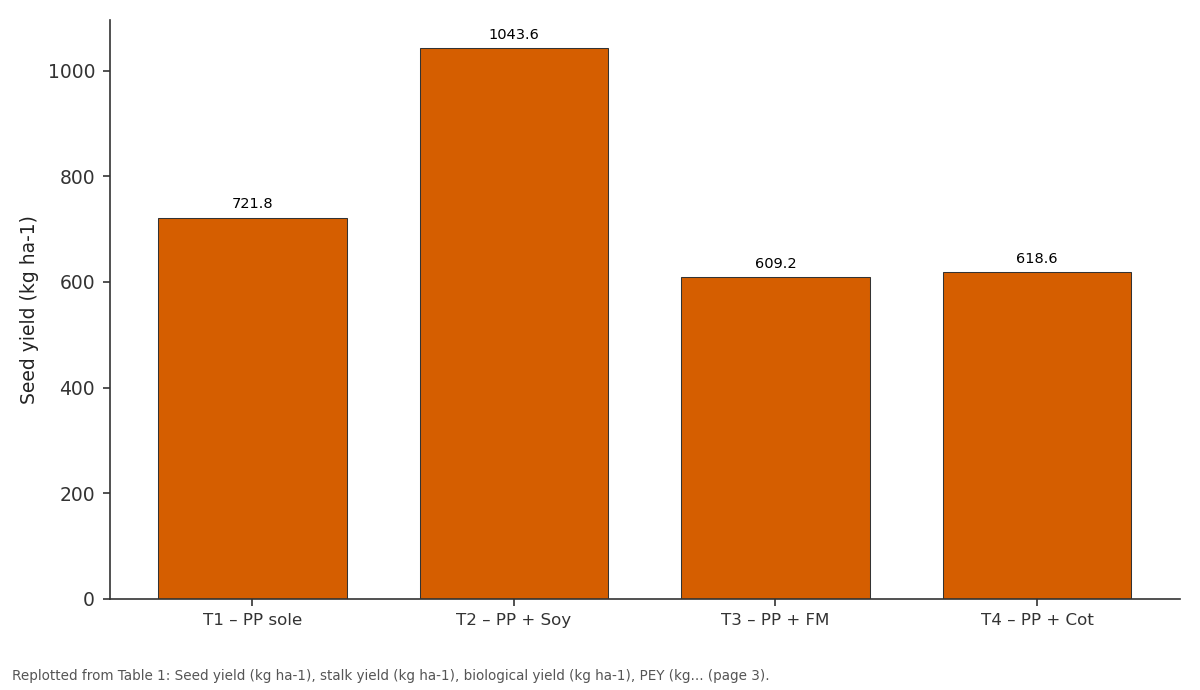
Seed yield (kg ha-1) / Main crop / PP: T1 – PP sole vs T2 – PP + Soy vs T3 – PP + FM vs T4 – PP + Cot
Replotted from Table 1 (page 3) of the original paper. Every bar is the paper's own table value.
View source evidence ↗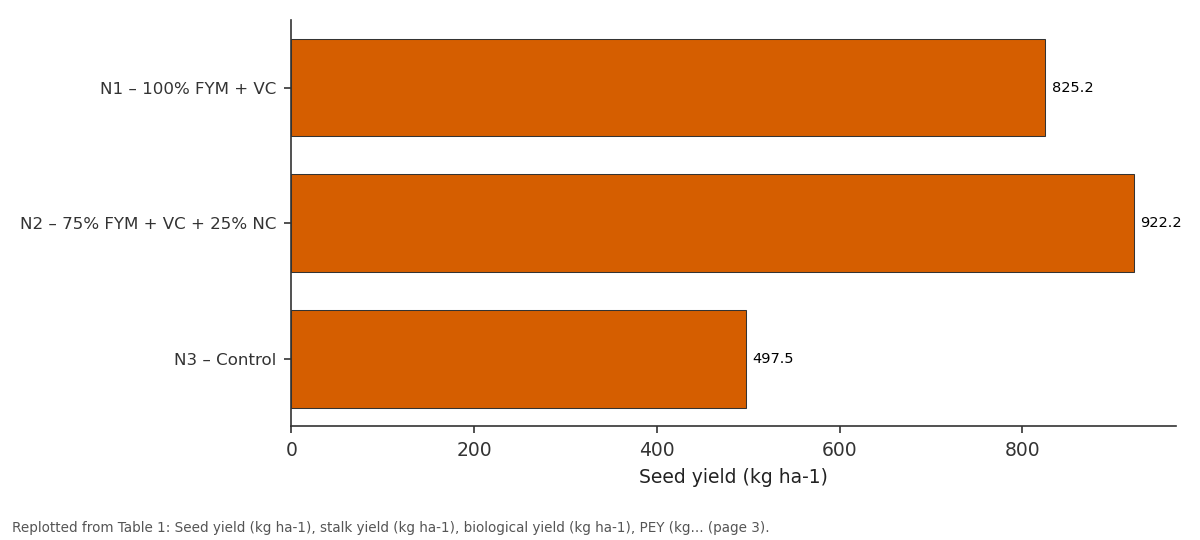
Seed yield (kg ha-1) / Main crop / PP: N1 – 100% FYM + VC vs N2 – 75% FYM + VC + 25%... vs N3 – Control
Replotted from Table 1 (page 3) of the original paper. Every bar is the paper's own table value.
View source evidence ↗Figures & tables
From the original paper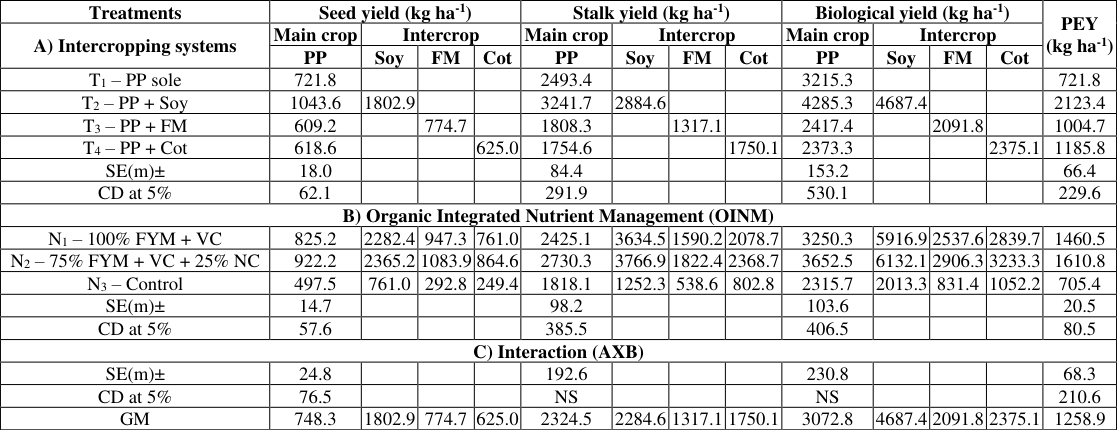 Table 1
 Table 2
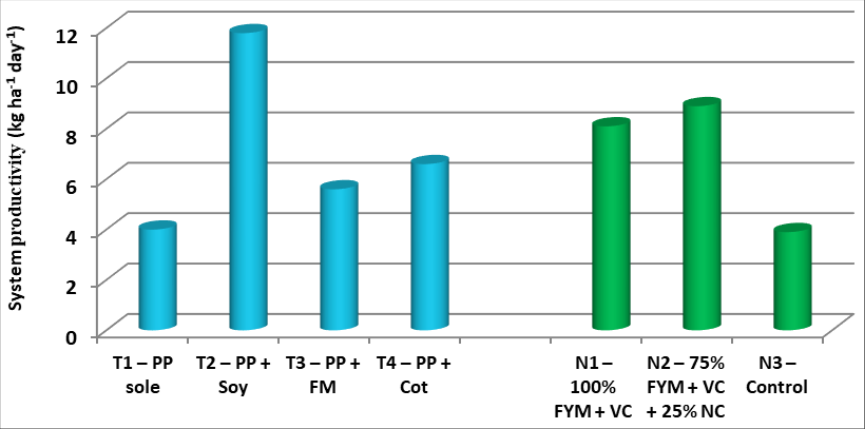 Figure 1
Introduction
Pulses are the richest source of protein for the majority of the population of our country. Pulses are an important group of food crops that can play a vital role to address national food and nutritional security and also tackle environmental challenges. As a restorative crop of soil fertility, pulses have a unique position in cropping systems of wet land, dry land or rainfed agriculture. These are drought resistant and prevent soil erosion due to their deep root system and good coverage, because of these good characteristics pulses are called as "Marvel of Nature". Pulses are equally important for maintaining soil health and sustainability of different cropping systems. India is the largest producer, consumer and importer of the pulses in the world. Our country is predominantly vegetarian and pulses are the main source of quality protein and essential amino acids. The United Nations, declared 2016 as "International Year of Pulses" (IYP) to heighten public awareness of the nutritional benefits of pulses as part of sustainable food production aimed at food security and nutrition. Pigeonpea (Cajanus cajan) commonly known as redgram, arhar or tur is one of the most important pulse crops in India. Pigeonpea is excellent source of high quality protein and occupies an important place in vegetarian population. Globally, pigeonpea is grown in an area of 63.57 lakh hectares with a production of 54.75 lakh tonnes and productivity of 861.25 kg ha -1 [1] . In India, pigeonpea occupies 5.05 million hectares area with a production of 4.34 million tonnes and productivity of 859 kg ha -1 [2] . In Maharashtra area, production and productivity under pigeonpea is 11.95 lakh hectares, 9.71 lakh tonnes and 8.13 q ha -1 , respectively [3] .
The productivity of pulses in our country including pigeonpea is not sufficient enough to meet the domestic demand of the population. Hence, there is need for enhancement of the productivity of pigeonpea by proper agronomic practices. India has made spectacular breakthrough in production and consumption of fertilizers during last decades. Moreover, the continuous use of chemical fertilizers in intensive mono cropping system has led to reduction in the crop yields and resulted in imbalanced nutrients in soil which has adverse effect on soil physico-chemical properties. The soil health and ecological hazards due to long term excessive use of chemical fertilizers also pose a serious problem. Hence, there is an urgent need to counterbalance these negative environmental impacts caused by chemical fertilizers. Organic inputs like crop residues, bulky and concentrated organic inputs, on farm cheap inputs, composts not only reduce the cost but help to build up soil humus and beneficial microbes, besides improving the soil physical properties. The scientific community all over the world is desperately looking for an 'economically viable, socially safe and environmentally sustainable' alternative to the agrochemicals. Interest in food production without chemical fertilizer and pesticide practices is increasing. Such food is commonly referred as organic [4] . Farmyard manure is an effective and efficient source of nutrients to plants and soil microorganisms, additionally it improves physical, chemical and biological properties of the soil [5] . Vermicompost has been recognized as an eco-friendly approach for converting organic wastes into high value organic manure rich in nitrates, available form of phosphorus, calcium, vitamins and natural plant growth regulators in balanced form which helps in restoration of natural fertility of soil [6] . Neem cake applied as a soil amendment, it binds several macro and micronutrients, allowing their controlled release and limiting their loss by leaching [7] and added advantage by its insecticidal and nematicidal activity. Intercropping has been recognized as beneficial cropping system compared to monocropping. Pigeonpea with its long duration and wide row spacing forms an ideal intercrop with other crops viz., soybean, foxtail millet and cotton. The space in between the rows is usually not utilized in the initial growth stages by pigeonpea, so it is remunerative to raise intercrops in between the pigeonpea rows, which will also suppress the growth of weeds and adds organic matter to the soil by leaf litters. Hence, integration of organic nutrient modules along with pigeonpea based intercropping system would surely influence agricultural sustainability by enhancing productivity along with maintaining dynamic soil nutrient status and safe environment. Based on the above points in view, the field experiment was taken up to evaluate the impact of organic nutrient modules on productivity of pigeonpea based intercropping system.
Materials and Methods
The field experiment on the "Impact of organic nutrient modules on productivity of pigeonpea based intercropping system'' was conducted during Kharif season of 2019 at research farm of Department of Agronomy, Dr. Panjabrao Deshmukh Krishi Vidhyapeeth, Akola, Maharashtra. The soil of experimental plot was clayey in texture and medium in organic carbon, low in available nitrogen, very low in available phosphorus and high in available potassium. The experiment was laid out in strip plot design (SrPD) with four main plot factors (intercropping system) and three sub plot factors (organic integrated nutrient management) and replicated thrice. The gross plot size is 9.0 x 10.0 m 2 . The crop and variety were PKV-Tara (pigeonpea), AMT-1001 (soybean), Co-1 (foxtail millet) and AKA-7 (cotton). The spacing for pigeonpea, Soybean, foxtail millet and cotton were 225 x 20 cm (paired row), 45 x 5 cm, 45 x10 cm and 45 x15 cm respectively. The treatment consists of T1 -sole pigeonpea, T2 -pigeonpea + soybean (1:4), T3 -pigeonpea + foxtail millet (1:4) and T4 -pigeonpea + cotton (1:4) and three organic integrated nutrient management (OINM) viz., N1 -100% FYM + vermicompost, N2 -75% FYM + vermicompost + 25% neem cake and N3 -control (No manure). The crop was fertilized as per the treatments. Other cultural operations were done as per the crop requirements. Finally, the crop was harvested and produce was threshed, cleaned, dried and weighed. The yields of the intercrops are appropriated to the pigeonpea equivalent yield (kg ha -1 ) by using formula, PEY =
The system productivity of each treatment are calculated by using the formula, System Productivity (kg ha -1 day -1 ) =
The data were analyzed statistically following the procedure given by Gomez and Gomez (1984) [8] . Critical differences were worked out at five percent level of significance. The treatment differences that were non-significant were denoted as NS.
Results and Discussion
Seed yield (kg ha -1 ) Mean seed yield of pigeonpea, soybean, foxtail millet and cotton were 748.3, 1802.9, 774.7 and 625.0 kg ha -1 respectively.
Intercropping system
Seed yield (kg ha -1 ) was significantly influenced by intercropping system. The highest seed yield was recorded under pigeonpea + soybean (1043.6 kg ha -1 ) followed by sole pigeonpea (721.8 kg ha -1 ), pigeonpea + cotton (618.6 kg ha -1 ) and was least with pigeonpea + foxtail millet (609.2 kg ha -1 ) (Table 1). The probable reason behind the increase in seed yield could be due to improved aeration by wider spacing of pigeonpea and soybean, there by scope for light interception, the benefit of more preserved moisture and its support at critical growth stages such as flowering, pod initiation and development. These results were in line with the findings of Dhale et al. (2022) [9] .
| Treatments | Seed yield (kg ha-1) | — | — | — | Stalk yield (kg ha-1) | — | — | — | Biological yield (kg ha-1) | — | — | — | PEY (kg ha-1) |
|---|---|---|---|---|---|---|---|---|---|---|---|---|---|
| A) Intercropping systems | Main crop | Intercrop | Main crop | Intercrop | Main crop | Intercrop | |||||||
| PP | Soy | FM | Cot | PP | Soy | FM | Cot | PP | Soy | FM | Cot | ||
| T1 – PP sole | 721.8 | 2493.4 | 3215.3 | 721.8 | |||||||||
| T2 – PP + Soy | 1043.6 | 1802.9 | 3241.7 | 2884.6 | 4285.3 | 4687.4 | 2123.4 | ||||||
| T3 – PP + FM | 609.2 | 774.7 | 1808.3 | 1317.1 | 2417.4 | 2091.8 | 1004.7 | ||||||
| T4 – PP + Cot | 618.6 | 625.0 | 1754.6 | 1750.1 | 2373.3 | 2375.1 | 1185.8 | ||||||
| SE(m)± | 18.0 | 84.4 | 153.2 | 66.4 | |||||||||
| CD at 5% | 62.1 | 291.9 | 530.1 | 229.6 | |||||||||
| B) Organic Integrated Nutrient Management (OINM) | |||||||||||||
| N1 – 100% FYM + VC | 825.2 | 2282.4 | 947.3 | 761.0 | 2425.1 | 3634.5 | 1590.2 | 2078.7 | 3250.3 | 5916.9 | 2537.6 | 2839.7 | 1460.5 |
| N2 – 75% FYM + VC + 25% NC | 922.2 | 2365.2 | 1083.9 | 864.6 | 2730.3 | 3766.9 | 1822.4 | 2368.7 | 3652.5 | 6132.1 | 2906.3 | 3233.3 | 1610.8 |
| N3 – Control | 497.5 | 761.0 | 292.8 | 249.4 | 1818.1 | 1252.3 | 538.6 | 802.8 | 2315.7 | 2013.3 | 831.4 | 1052.2 | 705.4 |
| SE(m)± | 14.7 | 98.2 | 103.6 | 20.5 | |||||||||
| CD at 5% | 57.6 | 385.5 | 406.5 | 80.5 | |||||||||
| C) Interaction (AXB) | |||||||||||||
| SE(m)± | 24.8 | 192.6 | 230.8 | 68.3 | |||||||||
| CD at 5% | 76.5 | NS | NS | 210.6 | |||||||||
| GM | 748.3 | 1802.9 | 774.7 | 625.0 | 2324.5 | 2284.6 | 1317.1 | 1750.1 | 3072.8 | 4687.4 | 2091.8 | 2375.1 | 1258.9 |
Table text extracted from the original PDF; superscript letters are shown inline. The original table image is below.
View original table image
Organic integrated nutrient management
Seed yield was significantly influenced by the organic integrated nutrient management and the treatment 75% FYM + vermicompost + 25% neem cake had the highest seed yield of 922.2 kg ha -1 and followed by 100% FYM + vermicompost (825.2 kg ha -1 ) (Table 1). Improvement in yield could be due to higher quantity of macro and micronutrients added to soil in the form of FYM and vermicompost resulting in increased availability of nutrients in root zone thus more uptake by crop resulting in higher values of yield attributing characters and yield. This could be earlier emphasized by Mittollia et al. (2015) [10] and Pradeep et al. (2018) [11] . Neem cake application gave additional benefit in terms of insect and disease control. The treatment N3 (no manure) registered the lowest seed yield (497.5 kg ha -1 ).
Interaction
Interaction effect on the seed yield between intercropping system and organic integrated nutrient management was significantly influenced (Table 2). The treatment 75% FYM + vermicompost + 25% neem cake in pigeonpea + soybean intercropping system had significantly recorded the highest seed yield (1228.0 kg ha -1 ).
| OINM | Seed yield (kg ha-1) in pigeonpea | — | — | — | Pigeonpea equivalent yield (kg ha-1) | — | — | — |
|---|---|---|---|---|---|---|---|---|
| Intercropping system | Intercropping system | |||||||
| T1 – PP sole | T2 – PP + Soy | T3 – PP + FM | T4 – PP + Cot | T1 – PP sole | T2 – PP + Soy | T3 – PP + FM | T4 – PP + Cot | |
| N1 – 100% FYM + VC | 765.0 | 1143.5 | 680.6 | 711.8 | 765.0 | 2510.5 | 1164.2 | 1402.4 |
| N2 – 75% FYM + VC + 25% NC | 931.7 | 1228.0 | 810.2 | 718.7 | 931.7 | 2644.6 | 1363.5 | 1503.3 |
| N3 – Control | 468.7 | 759.3 | 336.8 | 425.3 | 468.8 | 1215.1 | 486.3 | 651.7 |
| SE(m)± | 24.8 | 68.3 | ||||||
| CD at 5% | 76.5 | 210.6 |
Table text extracted from the original PDF; superscript letters are shown inline. The original table image is below.
View original table image
Table 1:
Seed yield (kg ha -1 ), stalk yield (kg ha -1 ), biological yield (kg ha -1 ), PEY (kg ha -1 ), system productivity (kg ha -1 day -1 ) of pigeonpea, soybean, foxtail millet and cotton as influenced by intercropping systems and organic nutrient modules 76.5 210.6 Note: PP -Pigeonpea, Soy -Soybean, FM -Foxtail millet, Cot -Cotton, FYM -Farm Yard Manure, VC -Vermicompost, NC -Neem Cake.
Mean stalk yield of pigeonpea, soybean, foxtail millet and cotton were 2324.5, 2284.6, 1317.1 and 1750.1 kg ha -1 respectively.
Intercropping system
Stalk yield was significantly influenced by intercropping system. The highest stalk yield was recorded under pigeonpea + soybean (3241.7 kg ha -1 ) followed by sole pigeonpea (2493.4 kg ha -1 ), pigeonpea + cotton (1808.3 kg ha -1 ) and was least with pigeonpea + foxtail millet (1754.6 kg ha -1 ). This results were in line with the findings of Rajesh Kumar et al. (2015) [12] .
Organic integrated nutrient management
Stalk yield was significantly influenced by the organic integrated nutrient management. The treatment combination of 75% FYM + vermicompost + 25% neem cake had registered the highest stalk yield of 2730.3 kg ha -1 and at par with 100% FYM + vermicompost (2425.1 kg ha -1 ). The combined application of organic nutrients could have helped in balanced availability of nutrients at all the growth stages of crop which ultimately led to better translocation of photosynthates from source to sink resulting in higher number of yield attributes and stalk yield. This result was supported by Mishra et al. (2018) [13] . Better growth parameters and higher accumulation of dry matter in stem parts with application of vermicompost that contributed for the higher stalk yield production [14] . The lowest stalk yield was recorded under N3 (no manure).
Interaction: Interaction effect on the stalk yield between intercropping system and organic integrated nutrient management was not significant.
Mean biological yield of pigeonpea, soybean, foxtail millet and cotton (kg ha -1 ) were 3072.8, 4687.4, 2091.8 and 2375.1 kg ha -1 respectively.
Intercropping system
Biological yield was significantly influenced by intercropping system. The highest biological yield was registered with pigeonpea + soybean (4285.3 kg ha -1 ), followed by sole pigeonpea (3215.3 kg ha -1 ), pigeonpea + foxtail millet (2417.4 kg ha -1 ) and pigeonpea + cotton (2373.3 kg ha -1 ). In pigeonpeasoybean intercropping system, the differences in the canopy of the two crops are large, and soybean poses too little competition to cause serious reduction in seed yield of pigeonpea. Precisely for this reason, intercropping of pigeonpea with soybean has resulted in more grain and straw yield (biological yield) than sole crop and higher net return in many front-line demonstrations [15] .
Organic integrated nutrient management
Biological yield was significantly influenced by the organic integrated nutrient management and treatment with 75% FYM + vermicompost + 25% neem cake had higher biological yield of 3652.5 kg ha -1 and was at par with 100% FYM + vermicompost (3250.3 kg ha -1 ). The highest biological yield under OINM with 75% FYM + vermicompost + 25% neem cake could be attributed to slow and steady release of nutrients by FYM and vermicompost that provided nutrients such as available N, soluble K, exchangeable Ca, Mg and P that could be readily taken by the plants in balanced manner resulting in more photosynthates assimilation and subsequent conversion of assimilates into yield attributes in larger fraction which ultimately resulted in more biological yield. The lowest biological yield was recorded under N3 (no manure).
Interaction
Interaction effect on the biological yield between intercropping system and organic integrated nutrient management was not significant.
Pigeonpea equivalent yield (PEY)
Average value of pigeonpea equivalent yield (PEY) was 1258.9 kg ha -1 .
Intercropping system
The highest PEY was recorded with pigeonpea + soybean intercropping system (2123.4 kg ha -1 ) which was higher than all the other treatments due to the synergistic complementarity between the pigeonpea and soybean. The higher pigeonpea equivalent yield was due to higher seed yield of pigeonpea. The results are in line with the findings of Pandey et al. (2013) [16] and Rajesh Kumar et al. (2015) [12] and Chatte et al. (2021) [17] .
Organic integrated nutrient management
Pigeonpea equivalent yield was significantly influenced by the organic integrated nutrient management. The treatment of 75% FYM + vermicompost + 25% neem cake had registered the highest PEY of 1610.8 kg ha -1 and followed by 100% FYM + vermicompost (1460.5 kg ha -1 ). Due to the integrated management of nutrients the soil nutrient status gets better with improved source of primary, secondary and micro nutrients. Besides, nutrient management through integration of different kinds of organic sources improves the physical, chemical and biological properties of the soil, which provide better conditions to the base crop (pigeonpea) as well as the intercrops (soybean, foxtail millet and cotton) yield. The results were in harmony with results recorded by Tiwari et al. (2012) [18] and Barathwal et al. (2018) [19] .
Interaction
The interaction effect of intercropping system and organic integrated nutrient management was found significant (Table 2). It could be understood that intercropping of pigeonpea + soybean with 75% FYM + vermicompost + 25% neem cake had significantly positive interaction by recording the highest pigeonpea equivalent yield (2644.6 kg ha -1 ).
System productivity (kg ha -1 day -1 ) System productivity was calculated based on main crop duration and the average productivity recorded was 7.0 (kg ha -1 day -1 ).
Intercropping system
The maximum system productivity was recorded in treatment pigeonpea + soybean (11.8 kg ha -1 day -1 ) followed by pigeonpea + cotton (6.6 kg ha -1 day -1 ), pigeonpea + foxtail millet (5.6 kg ha -1 day -1 ) and lowest in sole pigeonpea (4.0 kg ha -1 day -1 ) (Fig. 1). Intercropping of soybean in between two rows of a wide spaced pigeonpea which has initial slow growth rate not only help in better resource utilization but also stabilize system productivity by reducing impact of weather vagaries and increases the cropping intensity. Similar trend has also been observed by Udhaya et al. (2015) [20] . Organic integrated nutrient management Among organic integrated nutrient management treatments maximum system productivity was found in 75% FYM + vermicompost + 25% neem cake (8.9 kg ha -1 day -1 ) followed by 100% FYM + vermicompost (8.1 kg ha -1 day -1 ) and found least under treatment control (3.9 kg ha -1 day -1 ). Greater availability of nutrients through integration of FYM along with vermicompost to pigeonpea and soybean intercropping induced all growth parameters which in turn facilitated higher translocation of photosynthates to the reproductive organs leading to higher yield. It is directly reflected on higher values of system productivity.
Conclusion
From the above study it can be concluded that, pigeonpea + soybean (1:4) intercropping system and organic integrated nutrient management with 75% FYM + vermicompost + 25% neem cake application recorded the highest grain yield, stalk yield, biological yield, pigeonpea equivalent yield and system productivity. Hence, this combination is recommended for sustaining the productivity of pigeonpea along with efficient utilization of organic nutrient sources in the black soils of Vidarbha region of Maharashtra State.
References
3 in the original paper- FAOSTAT. 2021. Data, Crops and Livestock Products. Food and Agriculture Organization of United Nations.
- DES, 2022. Commodity profit-pulses, Directorate of Economics and Statistics, Department of Agriculture and Co-operation and Department of Commerce.
- DES, 2020. Commodity profit-pulses, Directorate of Economics and Statistics, Department of Agriculture and
Cited by 1
From OpenAlex, OpenCitations and reference lists read by Scinovex
- Effect of organically grown cropping systems on uptake, yield and shedded biomass
Ekta Pramod Mankar, NM Konde, Yugraj Dharmaraj Gawande · International Journal of Research in Agronomy · 2025
Organic agriculture is getting vital significance and considering the benefits of intercropping in crop diversity, sustainability and its role in the enhancement of organic carbon in soil, Effect of organically grown cropping systems on soil physical and chemical properties in vertisols was investigated during Kharif 2021-22 at Research Farm, Centre for Organic Agriculture Research and Training, Department of Agronomy, Dr. Panjabrao Deshmukh Krishi Vidyapeeth, Akola. The experiment was laid out in Randomized Block Design (RBD) with seven treatments consisting cropping systems viz. cotton (sole