
Research article · 2024 · Full text
International Journal of Research in AgronomyEfficiency of different quantities of bio stimulant on chilli (Capsicum annum L.) crop under polyhouse condition
Volume 7(5) · Pages 669–672 · DOI: 10.33545/2618060x.2024.v7.i5i.755 ↗
Research areasPineapple and bromelain studiesInnovations in Aquaponics and Hydroponics Systems
Abstract
Author-writtenA present investigation was carried out with title “Efficiency of Different Quantities of Bio Stimulant on Chilli (Capsicum annum L.) crop under Polyhouse Condition” at the central research farm, Department of Horticulture, Naini Agricultural Institute, Sam Higginbottom University of Agriculture Technology and Sciences, Prayagraj, Uttar Pradesh during rabi, 2023-24 with a view to identify the effects of different doses of bio stimulant and its role in growth, yield and quality of Chili variety New Ghoomar-2 F1 Hybrid. The experiment was laid in the randomized block design with 05 treatments and 06 replications with different combination of different quantities of bio stimulant. Under this experiment, over all, 10 treatments were taken including control. Different quantities of bio stimulant used comprised of Amalgerol Essence virtue all one at different doses of 1.0 L, 2.0 L, 3.0 L, and 4.0 L, (1 hectare) and mix with water each. From the above experiment finding it may be concluded that the treatment of 3.0 L/ hac. Amalgerol Essence was found to be best in the terms of growth viz, Plant height, Days to First Flowering, Days to 50% Flowering, Number of Fruits per plant and in terms of yield viz, Average fruit weight, Yield per plant, Yield per Hectare and in terms of quality viz, TSS and Ascorbic acid.
Summary
Source-checkedPlain-language reading of the full paper, prepared with AI and checked against the text. Each point links to the authors' own words.
Why it matters
- Chili is a critical vegetable and spice crop in the Indian subcontinent. View evidence ↗
- Farmers are adopting biostimulants as a technological solution to overcome issues with plant growth and crop yields. View evidence ↗
- Biostimulants are defined as microorganisms or substances used to improve the productivity, development, and growth of plants. View evidence ↗
The question
- The study aimed to determine how different doses of a biostimulant affect the quality, yield, and growth of the New Ghoomar-2 F1 Hybrid chili variety. View evidence ↗
What they did
- The researchers used a randomized block design featuring six replications and five different treatment groups. View evidence ↗
- The biostimulant tested was Amalgerol Essence, applied in doses of 1.0 L, 2.0 L, 3.0 L, and 4.0 L per hectare, mixed with water. View evidence ↗
- The study took place during the 2023–24 kharif season at the Horticulture Research Farm in Prayagraj. View evidence ↗
What they found
- The 3.0 L/ha dose (T3) resulted in the fastest germination, taking 7.57 days, compared to the control group which took the longest. View evidence ↗
- The highest average plant height was achieved with the 3.0 L/ha dose (117.67 cm), followed closely by the 4.0 L/ha dose (117.17 cm). View evidence ↗
- The 3.0 L/ha dose yielded the most fruit per plant (1174.84 gm), significantly outperforming the control group (756.84 gm). View evidence ↗
- The highest ascorbic acid content (157.74 mg/100 gm) was found in plants treated with 3.0 L/ha of the biostimulant. View evidence ↗
Visual summary
3 visualsIllustrations explain the paper; charts are replotted from the paper's own table values.
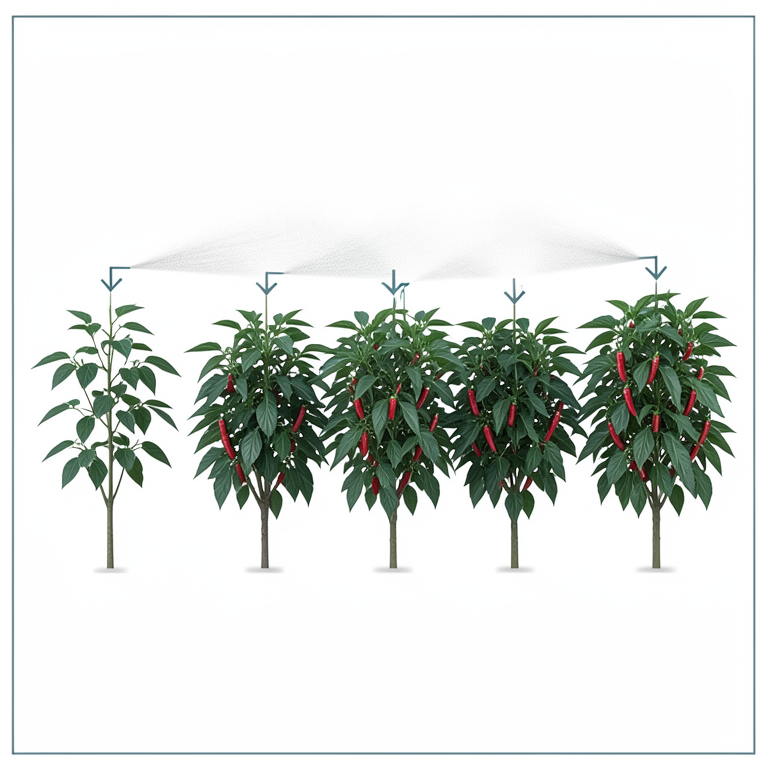
Experimental Treatment Layout
AI-generated conceptual illustration (chilli plants (Capsicum annum L.) in a polyhouse). It explains the idea and does not show study data.
View source evidence ↗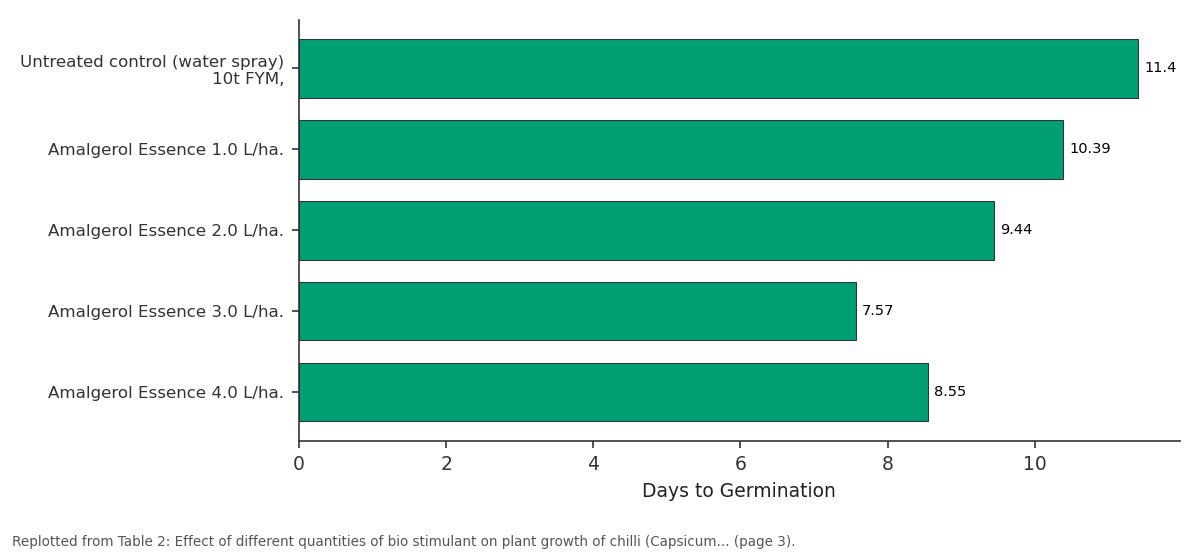
Days to Germination: Untreated control... vs Amalgerol Essence 1.0... vs Amalgerol Essence 2.0... vs Amalgerol Essence 3.0... vs Amalgerol Essence 4.0...
Replotted from Table 2 (page 3) of the original paper. Every bar is the paper's own table value.
View source evidence ↗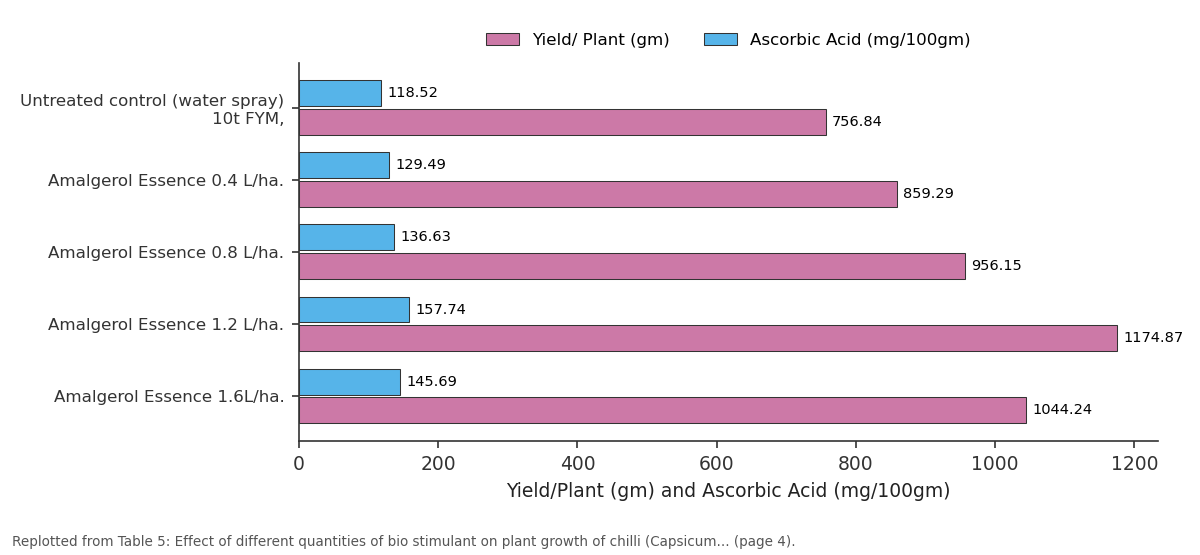
Yield/ Plant (gm) and Ascorbic Acid (mg/100gm): Untreated control... vs Amalgerol Essence 0.4... vs Amalgerol Essence 0.8... vs Amalgerol Essence 1.2... vs Amalgerol Essence...
Replotted from Table 5 (page 4) of the original paper. Every bar is the paper's own table value.
View source evidence ↗Figures & tables
From the original paper Table 1
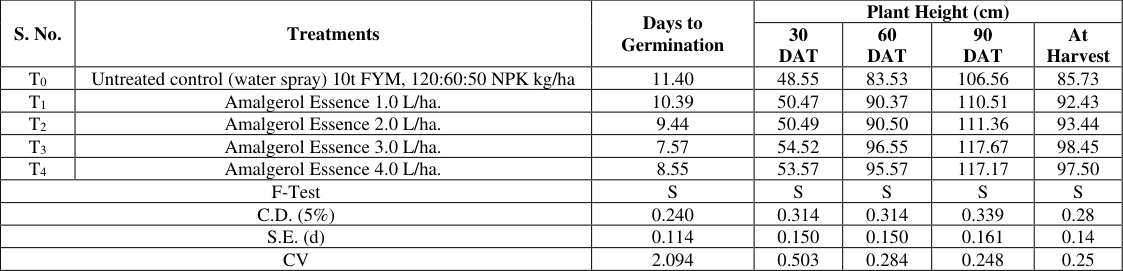 Table 2
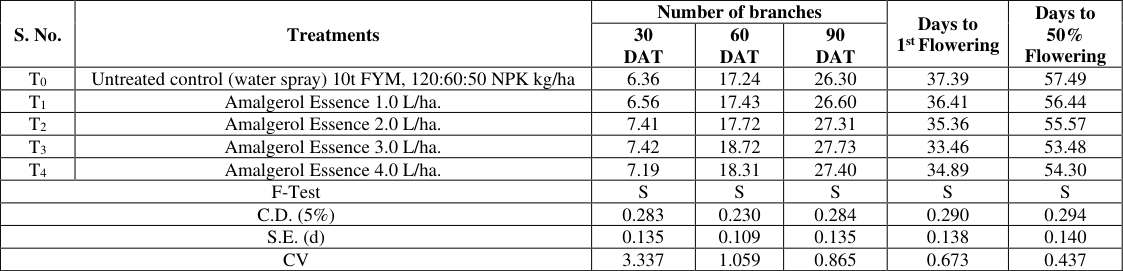 Table 3
 Table 4
 Table 5
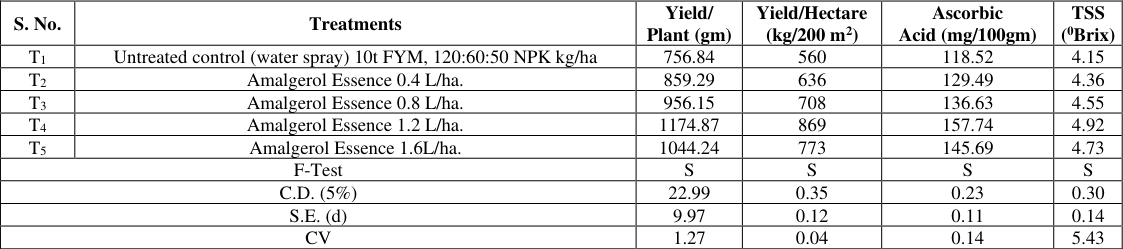 Table 5
 Table 6
Introduction
Chili (Capsicum annuum L.) is one of the most important vegetable cum spice crups in the Indian subcontinent. It has originated in Mexico, Southern Peru and Bolivia. In 2020, 36 alllion tons of green chilli peppers were produced worldwide, it seems that the genetic potentiality of the varieties to increase their production has already been reached saturation, Chilli belongs to the genus Capsicum which are members of the nightshade family Solanacese, cultivated for their pungency. It is a diploid (2n-24) species and genetically self-pollinated and chasmogamous crop whose flowers open only after pollination. The numerous races of chillies are broadly divided in to two species: Capsicum annum L and Capsicum frutescens L. Chilli peppers are widely used in many cuisines as a spice to add heat to dishes. Capsicum and related compounds are known as carcinoids are the substances giving chilli peppers their intensity when ingested or applied totally. It is mainly cultivated for three constituents of fruits viz., capsaicin, capsanthin and oleoresin. Undoubtedly, chilli is a pungent stimulant, its pungency is due to the presence of a crystalline volatile alkaloid called "capsaicin (C18 1128 NO3. 8-methyl-N-vanillyl-6-none amid) in the cross wall or septuin of the fruits. Green chillies are rich in vitamin 'A' and 'C" and the seeds contain traces of starch. In addition, peppers are a good source of most B vitamins and vitamin B6 in particular. Regardless of the scale of the agricultural business, growers face issues affecting plant growth and crop yields. This constant problem prompts farmers to adopt new technology as the world changes. Some farmers have turned to biostimulants as advanced horticultural technology to help solve their plant growth and crop production problems. Experts claim that biostimulants reduce the need for plant inputs, like fertilizers and pesticides while maintaining an ideal quality and quantity of crop output. With less input and a constant or pbly higher output, any grower would naturally assess their options to improve their forming productivity. Stimulants are a new type of agricultural additive product that many Europene experts Jave observed to improve plant growth and crop yields. Biostimulants have no direct actiоn against pests and therefore do not fall within the regulatory framework of pesticides. Biostimulants can improve food crop quality through biofortification, enhancing the plant's nutritional composition, such as their sugar and protein content. Biostimulants are substances or microorganisms that can be applied to plants to enhance their growth, development, and productivity. They can stimulate plant growth by improving nutrient uptake, increasing stress tolerance, and enhancing plant metabolism In chilli crop production, biostimulants can play a vital role in improving crop performance and yield. Biostimulants can enhance root growth and development, leading to improved nutrient uptake and water absorption. This can result in healthier plants with higher yields. Chilli plants can be subjected to various stresses, such as drought, high temperatures, and diseases. Biostimulants can help plants cope with these stresses by improving their resistance and resilience. Enhanced fruit quality can improve the quality of chilli fruits by increasing their size, color, and flavor. This can increase market value and profitability. Improved soil health can promote beneficial microbial activity in the soil, leading to improved soil health and fertility. This can create a more favorable environment for chilli crop growth. Untreated control (water spray) 10t FYM, 120:60:50 NPK kg/ha T1 Amalgerol essence 1.0 L /ha. is added to the amount of water required for foliar spray. At different stages of plant. T2 Amalgerol essence 2.0 L /ha. is added to the amount of water required for foliar spray. At different stages of plant. T3 Amalgerol essence 3.0 L /ha. is added to the amount of water required for foliar spray. At different stages of plant. T4 Amalgerol essence 4.0 L /ha. is added to the amount of water required for foliar spray. At different stages of plant.
Materials and
Statistical analysis the statistical analysis of the data was carried out using STATISTICA (7.0) software.
Results and Discussion Growth parameters
Crop growth parameters in chili were measured in terms of days to germination plant height (cm), Plant spread at 30, 60, 90 DAT and at Harvest are shown in Table 2. The minimum number of days taken to germination of plants with the treatment T3 (3.0 L/hac Amalgerol Essence) was 7.57 days and the Maximum number of days to germination was found the treatment (control). The application of bio stimulants might have improved the soil physical and chemical properties and leading to the adequate supply of nutrients to the 4 plant which might have promoted the early germination. Similar Finding were reported. Maximum height was reported 3.0 L/hac. (Amalgerol essence) (T3) with an average height of 117.67 cm followed by 4.0 L/hac. (Amalgerol essence) (T4) with an average height recorded 117.17 cm which was significantly higher from rest of treatments. All the treatments significantly increase plant height as compared to control. Minimum plant height 106.56 cm was recorded (T0 The maximum number of fruits (15.51) was recorded in (T3) which was significantly higher from rest of the treatments. Among the rest of treatments number of fruits different significantly which was as 3.0 L/hac. (Amalgerol essence) (T3) (15.51) and 4.0 L/hac. (Amalgerol essence) (T4) (14.55). The minimum number of fruits per plant i.e., 11.44 recorded in the control treatment which was lower significantly. Maximum fruit yield per plant i.e., 1174.84 gm was obtained in 3.0 L/hac. (Amalgerol essence) (T3) which was significantly higher from rest of the treatments followed by 4.0 L/hac. (Amalgerol essence) (T4) (1044.24 gm), The minimum fruit yield per plant i.e., 756.84 gm recorded from the plot which was kept control (T0) and it was significantly lower from rest of treatments. The data showed that maximum yield of 869 (kg/200 m 2 ) with the treatment (T3) was reported using bio stimulants were followed by treatment(T4) with the value of 773 (kg/200 m 2 ). Minimum fruit yield of chili was recorded in weedy check (T0) 560 (kg/200m 2 ) which was significantly lower from rest of treatments. The popularity of bio stimulants in agriculture is associated with the possibility of obtaining higher yields without the need to discontinue the production of ecological crops.
| S. No. | Treatments | Days to Germination | Plant Height (cm) | — | — | — |
|---|---|---|---|---|---|---|
| 30 DAT | 60 DAT | 90 DAT | At Harvest | |||
| T0 | Untreated control (water spray) 10t FYM, 120:60:50 NPK kg/ha | 11.40 | 48.55 | 83.53 | 106.56 | 85.73 |
| T1 | Amalgerol Essence 1.0 L/ha. | 10.39 | 50.47 | 90.37 | 110.51 | 92.43 |
| T2 | Amalgerol Essence 2.0 L/ha. | 9.44 | 50.49 | 90.50 | 111.36 | 93.44 |
| T3 | Amalgerol Essence 3.0 L/ha. | 7.57 | 54.52 | 96.55 | 117.67 | 98.45 |
| T4 | Amalgerol Essence 4.0 L/ha. | 8.55 | 53.57 | 95.57 | 117.17 | 97.50 |
| F-Test | S | S | S | S | S | |
| C.D. (5%) | 0.240 | 0.314 | 0.314 | 0.339 | 0.28 | |
| S.E. (d) | 0.114 | 0.150 | 0.150 | 0.161 | 0.14 | |
| CV | 2.094 | 0.503 | 0.284 | 0.248 | 0.25 |
Table text extracted from the original PDF; superscript letters are shown inline. The original table image is below.
View original table image
According to numerous scientific studies, bio stimulants have a positive effect on yielding plants. The yield is usually determined as the amount of fruit obtained from one plant or plot. The yield depends on the type of bio stimulant used, the dose, the method of application, and the plant variety. Increased yield is often associated with improving the quality of vegetables or fruit. This is particularly important in organic farming, where artificial fertilizers cannot be used. Among the various treatments, application 3.0 L/ha. (Amalgerol essence) (T3) maximum increase in Ascorbic acid content of 157.74 mg/100 gm. The Followed by ascorbic acid content of (T4) 145.69 mg/100 gm. Similar finding of using these bio stimulants, Fruit Taste values improved significantly, as evidenced by the increase in the 6 level to an average of Ascorbic acid content. Among the treatment used T3 treatment with (4.92) and have highest TSS 0 Brix which were significantly superior than T0 (Control) and other treatment. The maximum TSS value in Chili was recorded in T3 with 4.92 0 Brix and the minimum was recorded in T0 (Control) with 4.15 0 Brix. Bio stimulant can affect a number of the chemical properties of fruits and vegetables, including dry mass, acidity or vitamin content. The chemical composition of the fruit directly affects their palatability. It is assumed that fruits with a content of dissolved solids (SSC) above 120 Brix are characterized by an excellent taste. In the first year of using bio stimulants containing the biopolymers of polysaccharides, humic and fulvic acids as well as carboxylic acids, the average value of SSC in apricots stood at 10.70 Brix. In the second year of using these bio stimulants, fruit taste values improved significantly, as evidenced by the increase in the SSC level to an average of 14.1 0 Brix.
Conclusion
According to the current research, the use of Bio stimulant (Amalgerol Essence) had a significantly positive impact on the growth and development of chilies. Among the various treatments that were evaluated, T3 yield the most favourable results in terms of growth viz., plant height, number of primary branches, early flowering and maturation and yield viz., fruit weight, length of fruit, fruit girth, number of fruits per plant, and yield per plant. Furthermore, T3 had the highest benefit cost ratio of 2.50. T3 consisted of Amalgerol Essence 3.0 L /ha.
Figures and tables from the paper
| Treatment Notation | Treatment Details |
|---|---|
| T0 | Untreated control (water spray) 10t FYM, 120:60:50 NPK kg/ha |
| T1 | Amalgerol essence 1.0 L /ha. is added to the amount of water required for foliar spray. At different stages of plant. |
| T2 | Amalgerol essence 2.0 L /ha. is added to the amount of water required for foliar spray. At different stages of plant. |
| T3 | Amalgerol essence 3.0 L /ha. is added to the amount of water required for foliar spray. At different stages of plant. |
| T4 | Amalgerol essence 4.0 L /ha. is added to the amount of water required for foliar spray. At different stages of plant. |
Table text extracted from the original PDF; superscript letters are shown inline. The original table image is below.
View original table image
| S. No. | Treatments | Number of branches | — | — | Days to 1st Flowering | Days to 50% Flowering |
|---|---|---|---|---|---|---|
| 30 DAT | 60 DAT | 90 DAT | ||||
| T0 | Untreated control (water spray) 10t FYM, 120:60:50 NPK kg/ha | 6.36 | 17.24 | 26.30 | 37.39 | 57.49 |
| T1 | Amalgerol Essence 1.0 L/ha. | 6.56 | 17.43 | 26.60 | 36.41 | 56.44 |
| T2 | Amalgerol Essence 2.0 L/ha. | 7.41 | 17.72 | 27.31 | 35.36 | 55.57 |
| T3 | Amalgerol Essence 3.0 L/ha. | 7.42 | 18.72 | 27.73 | 33.46 | 53.48 |
| T4 | Amalgerol Essence 4.0 L/ha. | 7.19 | 18.31 | 27.40 | 34.89 | 54.30 |
| F-Test | S | S | S | S | S | |
| C.D. (5%) | 0.283 | 0.230 | 0.284 | 0.290 | 0.294 | |
| S.E. (d) | 0.135 | 0.109 | 0.135 | 0.138 | 0.140 | |
| CV | 3.337 | 1.059 | 0.865 | 0.673 | 0.437 |
Table text extracted from the original PDF; superscript letters are shown inline. The original table image is below.
View original table image
| S. No. | Treatments | Fruit Length (cm) | Fruit Weight (gm) | Fruit Diameter (cm) | Fruit Girth (cm) | No. of fruits per plant |
|---|---|---|---|---|---|---|
| T0 | Untreated control (water spray) 10t FYM, 120:60:50 NPK kg/ha | 20.00 | 68.09 | 2.5 | 8.57 | 11.44 |
| T1 | Amalgerol Essence 1.0 L/ha. | 20.35 | 68.18 | 2.6 | 8.97 | 12.52 |
| T2 | Amalgerol Essence 2.0 L/ha. | 20.48 | 70.96 | 2.7 | 9.51 | 13.54 |
| T3 | Amalgerol Essence 3.0 L/ha. | 21.13 | 74.92 | 3.2 | 10.53 | 15.51 |
| T4 | Amalgerol Essence 4.0 L/ha. | 20.69 | 73.14 | 2.9 | 9.83 | 14.55 |
Table text extracted from the original PDF; superscript letters are shown inline. The original table image is below.
View original table image
| F-Test | S | S | S | S | S |
|---|---|---|---|---|---|
| C.D. (5%) | 0.49 | 3.29 | 0.22 | 0.42 | 0.13 |
| S.E. (d) | 0.21 | 1.43 | 0.11 | 0.18 | 0.05 |
| CV | 1.27 | 2.46 | 6.60 | 2.33 | 0.50 |
Table text extracted from the original PDF; superscript letters are shown inline. The original table image is below.
View original table image
| S. No. | Treatments | Yield/ Plant (gm) | Yield/Hectare (kg/200 m2) | Ascorbic Acid (mg/100gm) | TSS (0Brix) |
|---|---|---|---|---|---|
| T1 | Untreated control (water spray) 10t FYM, 120:60:50 NPK kg/ha | 756.84 | 560 | 118.52 | 4.15 |
| T2 | Amalgerol Essence 0.4 L/ha. | 859.29 | 636 | 129.49 | 4.36 |
| T3 | Amalgerol Essence 0.8 L/ha. | 956.15 | 708 | 136.63 | 4.55 |
| T4 | Amalgerol Essence 1.2 L/ha. | 1174.87 | 869 | 157.74 | 4.92 |
| T5 | Amalgerol Essence 1.6L/ha. | 1044.24 | 773 | 145.69 | 4.73 |
| F-Test | S | S | S | S | |
| C.D. (5%) | 22.99 | 0.35 | 0.23 | 0.30 | |
| S.E. (d) | 9.97 | 0.12 | 0.11 | 0.14 | |
| CV | 1.27 | 0.04 | 0.14 | 5.43 |
Table text extracted from the original PDF; superscript letters are shown inline. The original table image is below.
View original table image
| Treatment Notation | Treatment details | Fruit Colour |
|---|---|---|
| T0 | Untreated control (water spray) 10t FYM, 120:60:50 NPK kg/ha | Dark green |
| T1 | Amalgerol Essence 1.0 L/ha. | Dark green |
| T2 | Amalgerol Essence 2.0 L/ha. | Dark green |
| T3 | Amalgerol Essence 3.0 L/ha. | Dark green |
| T4 | Amalgerol Essence 4.0 L/ha. | Dark green |
Table text extracted from the original PDF; superscript letters are shown inline. The original table image is below.
View original table image
References
10 in the original paper- Ali L, Mahmood N, Abbasi N, Hafiz IA, Zakia S. Effect if Bio stimulants on growth, yield and quality of bell pepper cv. Yolo wonder. Pakistan Journal of Agricultural Research. 2017;54(2):311-317.
- Asane GB, Patil RS, Shinde US, Kadam VM, Bhalekar MN. Effect of plant growth regulator and micronutrients on growth and yield of chilli (Capsicum annuum L.) during summer season. Advances in Plant Sciences. 2009;22(1):111-113.
- Biswas TK, Singh N, Sharma R. Impact of plant growth regulators on vegetative characters, quality and yield attributes in Chilli (Capsicum annuum L.) cv. G-4. New Agriculturist. 2014;25(2):227-233.
- Bosland P, Votava E. Purification and Biochemical Characterization of a Protease Inhibitor II Family from Jalapeño Pepper (Capsicum annuum L.). Advances in Bioscience and Biotechnology. 2014, 5(7).
- Chandini RAKHKHJ, SD. Effect of plant growth regulators on growth and yield of chilli (Capsicum annuum L.). Research on Crops. 2016;17(2):320-323.
- Chetti Gollagi G, SMBGS, Hiremath. Effect of growth regulator and nutrients on growth parameters and yeild in chilli ev. Byadagi Kaddi. International Journal of Agricultural Sciences. 2009;5(1):123-125.
- Lemonnier Le Penhuizic C, Chatelet C, Kloareg B, Potin P. Carrageenan oligosaccharides enhance stress-induced microspore embryogenesis in Brassica oleracea var. italica. Plant Science. 2001;160(6):1211-1220. DOI: 10.1016/S0168-9452(01)00372-7
- Doris Rentsch, Susanne S, Mechthild T. Transporters for uptake and allocation of organic nitrogen compounds in plants. FEBS Letters. 2007;581(12):2281-2289.
- Dobrowolski A, Gadomska JM, Jadwisienczak KK, Kaliniewicz Z, Francke A. Effect of biostimulants on the growth, yield and nutritional value of Capsicum annum grown in an unheated plastic tunnel. Scientific Reports, 2021, (3).
- Ertani A, Sambo P, Nicoletto C, Santagata S, Schiavon M, Nardi S. The use of organic Biostimulants in hot pepper plants to help low input sustainable agriculture. Chemical and Biological Technologies in Agriculture, 2015, (36).