
Research article · 2024 · Full text
International Journal of Agriculture Extension and Social DevelopmentStudy of self-help group (SHG) on women empowerment in Bankura district of West Bengal, India
Volume 7(5) · Pages 363–365 · DOI: 10.33545/26180723.2024.v7.i5e.633 ↗
Research areasMicrofinance and Financial Inclusion
Abstract
Author-writtenThis research paper explores the role of Self-Help Groups (SHGs) in empowering community members, enhancing their standard of living, and addressing the various challenges faced by both beneficiary and non-beneficiary members. Utilizing quantitative data from surveys conducted within the study area, the research analyzes factors such as financial inclusion, social empowerment, income generation, and access to healthcare. The findings indicate that SHGs significantly empower members through improved social awareness and financial access, with Likert scale scores averaging above 60 for these parameters. However, critical gaps in training, access to government schemes, and financial services are identified, underscoring areas needing strategic improvements. This study contributes to the understanding of SHGs' impacts and offers insights into targeted interventions that could enhance their effectiveness in community development and member empowerment.
Summary
Source-checkedPlain-language reading of the full paper, prepared with AI and checked against the text. Each point links to the authors' own words.
Why it matters
- Self-Help Groups (SHGs) are considered significant for empowering women and advancing socio-economic development in rural areas. View evidence ↗
- Prior research suggests that SHGs can democratize institutions for deprived societal sections, which improves social inclusion and empowerment for women. View evidence ↗
- SHGs have been noted in previous studies as instruments for promoting financial inclusion and economic empowerment for rural women. View evidence ↗
The question
- The study aims to investigate how SHGs impact social empowerment, financial inclusion, and the general quality of life for members in the Bankura district of West Bengal. View evidence ↗
What they did
- The Bankura district in West Bengal was purposively selected for the study because of its extensive network of women's SHGs involved in livestock farming and fisheries. View evidence ↗
- The Bankura-I block was chosen from 22 available blocks due to its high density of SHGs across 137 villages. View evidence ↗
- Approximately 5% of villages were randomly selected, including Nangalbera, Dhobagaon, Chingra, Bhikurdihi, and Baindhka, which together had 4,203 residents. View evidence ↗
- The final sample consisted of 418 participants, selected by randomly choosing 10% of members from the selected SHGs. View evidence ↗
What they found
- Social empowerment was one of the highest-rated factors of empowerment, receiving a Likert scale score of 67.17. View evidence ↗
- Financial inclusion and access to credit were strongly perceived as empowering factors, with a Likert scale score of 62.50. View evidence ↗
- Access to government schemes and services was the lowest-rated empowerment factor, scoring only 29.49 on the Likert scale. View evidence ↗
- Joining SHGs was associated with an increase in social awareness, which received a Likert scale score of 61.00. View evidence ↗
- Members reported improved access to healthcare after joining SHGs, with a Likert scale score of 57.12. View evidence ↗
- The impact on starting new businesses using income from SHGs was low, scoring 35.35 on the Likert scale. View evidence ↗
- The most significant problem reported by members was a lack of adequate training and education, cited by 38 participants. View evidence ↗
- Insufficient access to credit was ranked as the second most pressing issue, cited by 35 participants. View evidence ↗
- High interest rates on loans were ranked as the third most significant constraint, cited by 30 participants. View evidence ↗
What it means
- The authors conclude that while SHGs positively impact economic and societal empowerment, they must improve financial services, training, and access to government schemes to reach their full potential. View evidence ↗
Visual summary
2 visualsIllustrations explain the paper; charts are replotted from the paper's own table values.
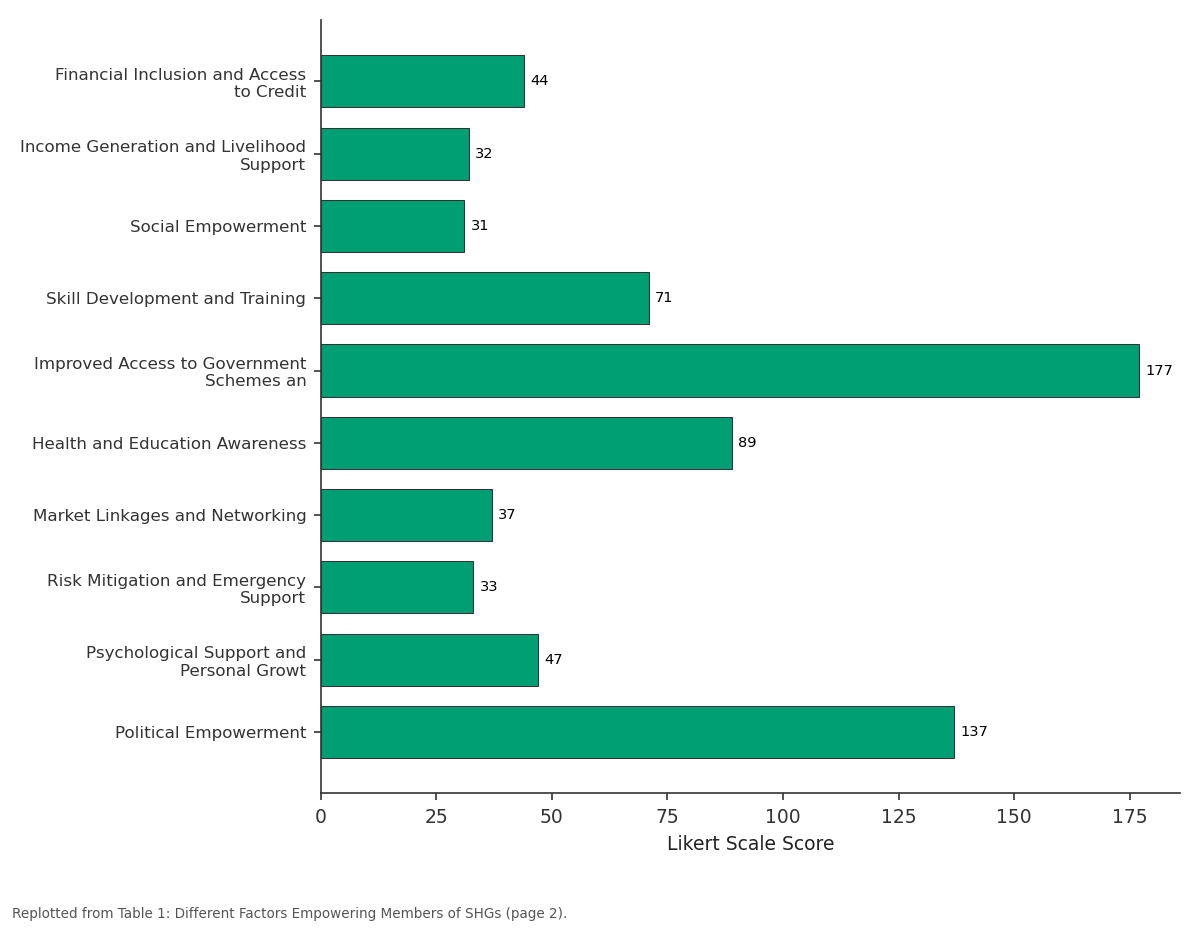
Strongly Disagree: Financial Inclusion and... vs Income Generation and... vs Social Empowerment vs Skill Development and... vs Improved Access to...
Replotted from Table 1 (page 2) of the original paper. Every bar is the paper's own table value.
View source evidence ↗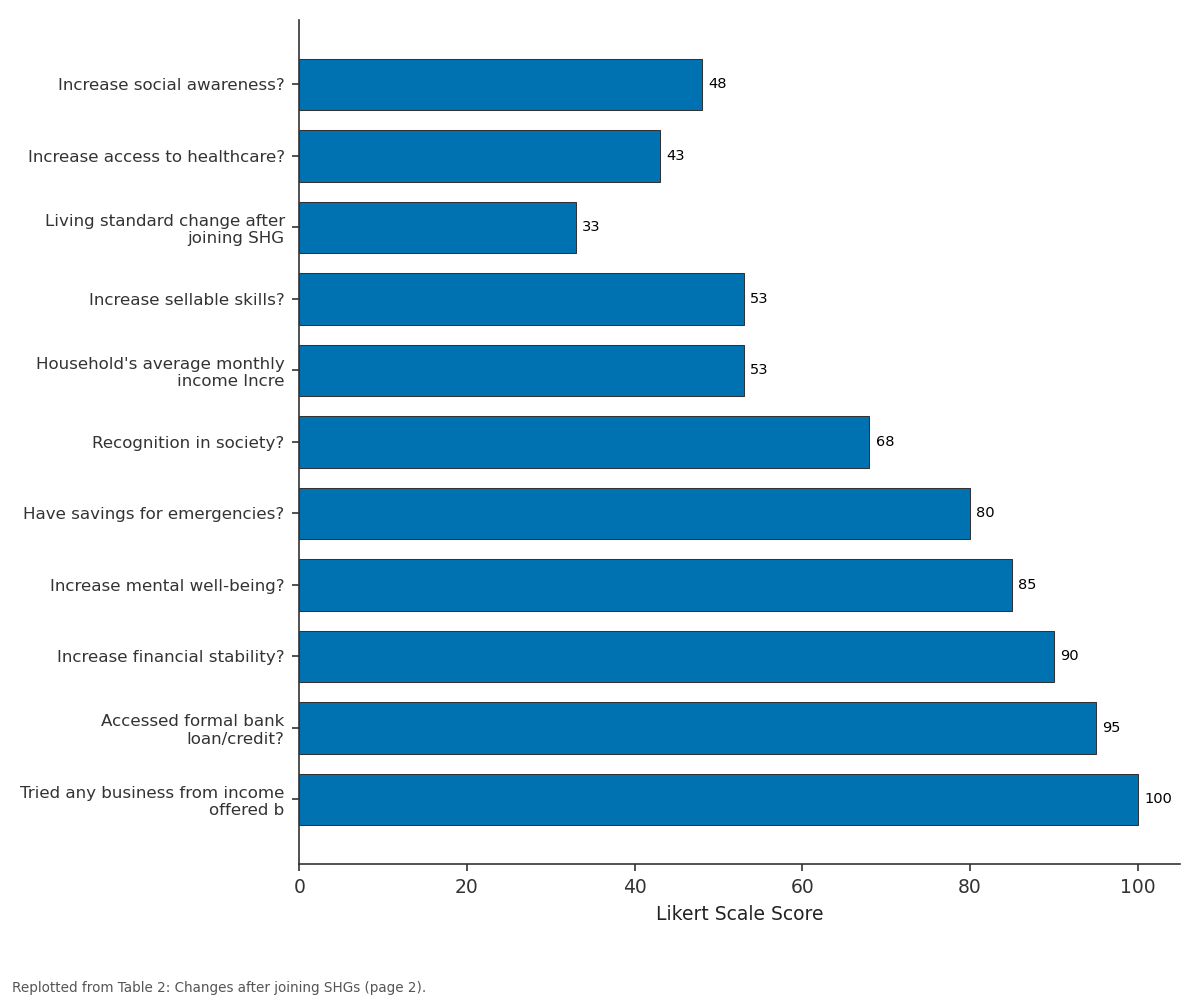
Strongly Disagree: Increase social... vs Increase access to... vs Living standard change... vs Increase sellable... vs Household's average...
Replotted from Table 2 (page 2) of the original paper. Every bar is the paper's own table value.
View source evidence ↗Figures & tables
From the original paper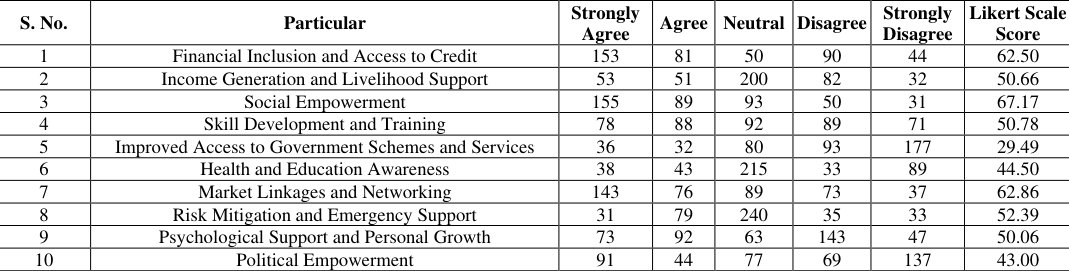 Table 1
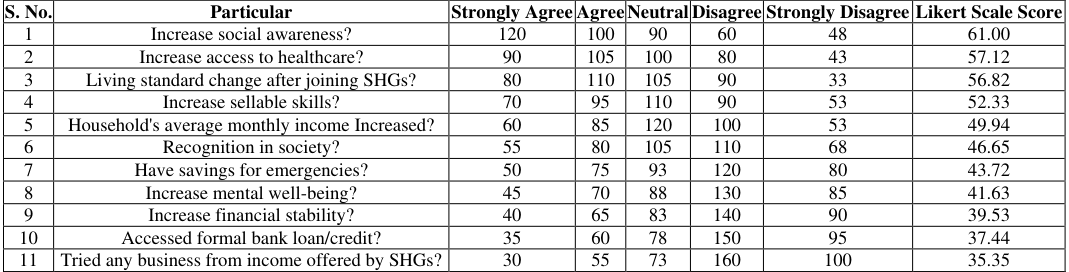 Table 2
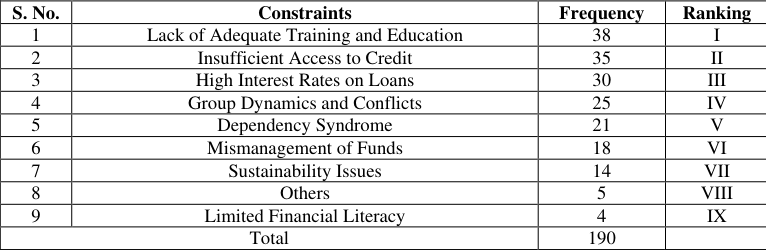 Table 3
Introduction
The significant role of Self-Help Groups (SHGs) in advancing socio-economic development and empowering women in rural settings forms the core of this research paper. Focusing on the district of Bankura, West Bengal, this study employs a rigorous multistage stratified random sampling method to investigate the impacts of SHGs on aspects such as financial inclusion, social empowerment, and overall improvements in the quality of life of their members. Empirical data gathered for this research suggests that SHGs have been effective in enhancing social and financial empowerment, corroborating the findings from several studies that illustrate the pivotal role these groups play in rural economies. For instance, research published in Management and Labour Studies notes that SHGs help democratize institutions that represent the deprived sections of society, significantly impacting women's social empowerment and inclusion (Rajagopal, 2020) [1] . Moreover, a study highlighted by Poverty Action discusses how SHGs have been instrumental in promoting financial inclusion, thereby fostering economic empowerment among women in rural areas (Poverty Action, 2020) [2] . Despite the successes, this research also identifies persistent challenges that limit the efficacy of SHGs, such as inadequate access to government schemes, which is also reflected in the broader literature. For example, a study on the social impact of SHGs on women's socio-economic and political opportunities discusses the need for better integration of SHGs with governmental programs to enhance their effectiveness (Sage Perspectives, 2020) [3] . The results also point to significant improvements in living standards among SHG members, including increased access to healthcare and social awareness. These findings align with global observations by the World Bank on SHGs under the NRLM program, which have notably improved financial and market access and health outcomes during the COVID-19 pandemic (World Bank, 2020) [4] . While SHGs have had a transformative impact on rural development and women's empowerment, the research underscores the need for targeted interventions to address the identified gaps. By integrating findings from established studies with new empirical data, this paper provides a comprehensive understanding of the dynamics and impacts of SHGs on community development.
Research Methodology
The research methodology employed a multistage stratified random sampling technique across five stages to ensure a representative and systematic selection of study participants. Initially, the district of Bankura in West Bengal was selected due to its extensive network of women's self-help groups actively engaged in enterprises such as fisheries and livestock farming. Bankura was chosen purposively from among 23 districts, with its rich presence of 190 gram panchayats and 137 villages. Subsequently, the block of www.extensionjournal.com Bankura-I was selected from 22 available blocks for its high density of self-help groups; this block consists of 137 villages. The selection of villages was conducted by obtaining a comprehensive list from the block development office and randomly choosing approximately 5% of these villages, which included Baindhka, Bhikurdihi, Chingra, Dhobagaon, and Nangalbera, collectively housing 4203 residents. Within Bankura-I, 10% of the self-help groups such as Maa Durga Mandali and Swami Vivekananda Sangh were randomly selected. Lastly, the respondents were chosen by preparing a complete list of members from these groups, with assistance from the gram Pradhan, and randomly selecting 10% of them, leading to a total of 418 participants. This structured selection process was pivotal in aligning with the research objectives, ensuring a thorough and balanced representation across the studied demographic.
Results
Results
factors empowering beneficiary members against the non-beneficiary members in the study area
factors empowering beneficiary members against the non-beneficiary members in the study area
The impact on the standard of living of beneficiary members of Self-Help Group (SHGs) in the study area
The impact on the standard of living of beneficiary members of Self-Help Group (SHGs) in the study area
The problems associated with the members (beneficiary & non-beneficiary) of SHG
The problems associated with the members (beneficiary & non-beneficiary) of SHG
Discussion
The tables provided offer insights into various aspects of Self-Help Groups (SHGs) and their impact on members' empowerment, standard of living, and challenges faced.
Conclusion
The statistical findings from the tables underscore the multifaceted impact of Self-Help Groups (SHGs) on their members, indicating both successes and areas for improvement. Notably, SHGs have significantly empowered members through social empowerment and financial inclusion, as reflected by Likert scale scores of 67.17 and 62.50 respectively. However, challenges persist, particularly in accessing government schemes and services, which received a notably lower score of 29.49, highlighting a critical gap. Furthermore, the problems table reveals pressing issues like inadequate training and limited credit access, ranked as the top challenges faced by members. These statistics collectively reveal that while SHGs contribute positively to societal and economic empowerment, they must address critical deficiencies in training, financial services, and scheme accessibility to fully realize their potential in community development.
Figures and tables from the paper
| S. No. | Particular | Strongly Agree | Agree | Neutral | Disagree | Strongly Disagree | Likert Scale Score |
|---|---|---|---|---|---|---|---|
| 1 | Financial Inclusion and Access to Credit | 153 | 81 | 50 | 90 | 44 | 62.50 |
| 2 | Income Generation and Livelihood Support | 53 | 51 | 200 | 82 | 32 | 50.66 |
| 3 | Social Empowerment | 155 | 89 | 93 | 50 | 31 | 67.17 |
| 4 | Skill Development and Training | 78 | 88 | 92 | 89 | 71 | 50.78 |
| 5 | Improved Access to Government Schemes and Services | 36 | 32 | 80 | 93 | 177 | 29.49 |
| 6 | Health and Education Awareness | 38 | 43 | 215 | 33 | 89 | 44.50 |
| 7 | Market Linkages and Networking | 143 | 76 | 89 | 73 | 37 | 62.86 |
| 8 | Risk Mitigation and Emergency Support | 31 | 79 | 240 | 35 | 33 | 52.39 |
| 9 | Psychological Support and Personal Growth | 73 | 92 | 63 | 143 | 47 | 50.06 |
| 10 | Political Empowerment | 91 | 44 | 77 | 69 | 137 | 43.00 |
Table text extracted from the original PDF; superscript letters are shown inline. The original table image is below.
View original table image
| S. No. | Particular | Strongly Agree | Agree | Neutral | Disagree | Strongly Disagree | Likert Scale Score |
|---|---|---|---|---|---|---|---|
| 1 | Increase social awareness? | 120 | 100 | 90 | 60 | 48 | 61.00 |
| 2 | Increase access to healthcare? | 90 | 105 | 100 | 80 | 43 | 57.12 |
| 3 | Living standard change after joining SHGs? | 80 | 110 | 105 | 90 | 33 | 56.82 |
| 4 | Increase sellable skills? | 70 | 95 | 110 | 90 | 53 | 52.33 |
| 5 | Household's average monthly income Increased? | 60 | 85 | 120 | 100 | 53 | 49.94 |
| 6 | Recognition in society? | 55 | 80 | 105 | 110 | 68 | 46.65 |
| 7 | Have savings for emergencies? | 50 | 75 | 93 | 120 | 80 | 43.72 |
| 8 | Increase mental well-being? | 45 | 70 | 88 | 130 | 85 | 41.63 |
| 9 | Increase financial stability? | 40 | 65 | 83 | 140 | 90 | 39.53 |
| 10 | Accessed formal bank loan/credit? | 35 | 60 | 78 | 150 | 95 | 37.44 |
| 11 | Tried any business from income offered by SHGs? | 30 | 55 | 73 | 160 | 100 | 35.35 |
Table text extracted from the original PDF; superscript letters are shown inline. The original table image is below.
View original table image
| S. No. | Constraints | Frequency | Ranking |
|---|---|---|---|
| 1 | Lack of Adequate Training and Education | 38 | I |
| 2 | Insufficient Access to Credit | 35 | II |
| 3 | High Interest Rates on Loans | 30 | III |
| 4 | Group Dynamics and Conflicts | 25 | IV |
| 5 | Dependency Syndrome | 21 | V |
| 6 | Mismanagement of Funds | 18 | VI |
| 7 | Sustainability Issues | 14 | VII |
| 8 | Others | 5 | VIII |
| 9 | Limited Financial Literacy | 4 | IX |
| Total | 190 |
Table text extracted from the original PDF; superscript letters are shown inline. The original table image is below.
View original table image
References
5 in the original paper- Rajagopal N. Social impact of women SHGs: A study of NHGs of 'Kudumbashree' in Kerala. Manag Labour Stud [Internet]; c2020 [cited 2024 May 21]. Available from: https://journals.sagepub.com/doi/10.1177/0258042X20 922116
- Poverty Action. Women's economic empowerment through financial inclusion [Internet]; c2020 [cited 2024 May 21]. Available from: https://povertyaction.org/sites/default/files/publications/WomensEconomic-Empowerment-Through-Financial-InclusionWeb.pdf
- Sage Perspectives. The social impact of self-help groups widen women's socio-economic and political opportunities [Internet]; c2020 [cited 2024 May 21]. Available from: https://perspectivesblog.sagepub.com/blog/research/thesocial-impact-of-self-help-groups-widen-womenssocio-economic-and-political-opportunities
- World Bank. Unleashing the power of women's collectives for rural development in the Indian state of Bihar [Internet]; c2020 [cited 2024 May 21]. Available from: https://www.worldbank.org/en/news/feature/2020/12/10 /unleashing-the-power-of-womens-collectives-for-ruraldevelopment-in-the-indian-state-of-bihar
- Mondal T, Sarkhel J. An analysis of the problems faced by poor tribal women members in Self Help Groups (SHGs): A study of tribal inhabited rural areas from the district of Bankura, West-Bengal. International Journal of Management Research and Reviews. 2015 Mar1;5(3):179.