
Research article · 2024 · Full text
International Journal of Agriculture Extension and Social DevelopmentProductivity and profitability of contract farming over non-contract farming in sugarcane cultivation in Vizianagaram district of Andhra Pradesh
Volume 7(5) · Pages 366–369 · DOI: 10.33545/26180723.2024.v7.i5e.636 ↗
Research areasAgricultural Economics and PracticesAgricultural Systems and PracticesRice Cultivation and Yield Improvement
Abstract
Author-writtenThe study has been conducted in Vizianagaram district of Andhra Pradesh with an objective of identifying profitability and productivity of sugarcane under contract and non-contract farming. Decomposition analysis was used for the study. The results shown that the estimated productivity change stood at 8.22%, it was found to slightly underestimate the actual observed change of 10.34%. Further examination of input factors highlights the significant positive impact of input substitution, particularly in human labor and machine labor, contributing 6.91% to contract farming productivity. Machine labor emerged as the major contributor, followed by human labor and fertilizers and manures. This suggests that allocating more resources to human and machine labor enables contract farmers to achieve higher outcomes compared to non-contract counterparts. Conversely, certain inputs such as seed, bullock labor, and irrigation were found to diminish gross returns, highlighting the costs associated with these inputs for non-contract farmers. The findings underscore the intricate interplay of various factors in contract farming productivity dynamics, emphasizing the pivotal role of technological advancements and strategic input allocation in influencing outcomes. This analysis provides valuable insights for policymakers and stakeholders aiming to enhance productivity and efficiency in contract farming systems.
Summary
Source-checkedPlain-language reading of the full paper, prepared with AI and checked against the text. Each point links to the authors' own words.
Why it matters
- Sugarcane is a critical economic crop in India, serving as the nation's primary source of sugar and energy. View evidence ↗
- Contract farming is increasingly popular among farmers because it offers guaranteed markets and support to improve productivity. View evidence ↗
- Beyond market access, contract farming helps reduce risks associated with disease and weather, and simplifies the certification process required by developed markets. View evidence ↗
The question
- The study aimed to identify and compare the productivity and profitability of sugarcane cultivation between contract and non-contract farming in the Vizianagaram district of Andhra Pradesh. View evidence ↗
What they did
- The researchers purposively selected a sample of 104 farmers from the Vizianagaram district. View evidence ↗
- The sampling involved selecting two villages per mandal, with 13 contract and 13 non-contract farmers chosen from each village using Simple Random Sampling Without Replacement. View evidence ↗
- The study employed the Bisaliah (1977) output decomposition model to analyze how different input patterns contributed to differences in productivity and profitability. View evidence ↗
- The analysis measured gross returns (kg/ha) against seven inputs: human labor, seed cost, bullock labor, machine labor, manures/fertilizers, plant protection chemicals, and irrigation. View evidence ↗
What they found
- The actual observed difference in system productivity between contract and non-contract farming was 10.34%. View evidence ↗
- The estimated difference in system productivity between the two farming types was 8.22%, which slightly underestimated the observed change. View evidence ↗
- Changes in input use levels contributed 6.91% to the productivity gap. View evidence ↗
- Machine labor was the largest positive contributor to gross returns (4.73%), followed by fertilizers and manures (2.71%). View evidence ↗
- Human labor also had a significant positive impact on productivity, contributing 3.87%. View evidence ↗
- Technological differences accounted for 1.48% of the productivity change. View evidence ↗
What it means
- The study emphasizes that technological advancements and strategic input allocation are pivotal in driving the productivity dynamics of contract farming. View evidence ↗
Figures & tables
From the original paper Table 1
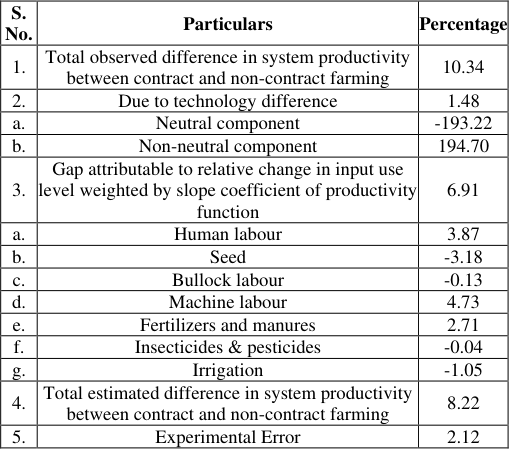 Table 2
Introduction
Contract farming is the practice of producing agricultural products in accordance with a contract between farm producers and buyers. Sometimes the farmer agrees to provide at a later time, and the customer specifies the quality and price needed (Jabbar & Jabbar, 2011) [1] . Contracts, on the other hand, usually specify terms related to the production of agricultural goods and their transportation to the buyer's location (Kirsten & De Janvry, 2009) [3] . The farmer commits to providing the buyer with the specified amounts of a crop or livestock product, according to the buyer's quality requirements and delivery specifications. In exchange, the buyer-typically a business-agrees to purchase the good, frequently at a predetermined cost (Gulati & Rao, 2004) [4] .
Although it has been a method of agricultural production for many years, contract farming seems to be becoming more and more popular lately. Many farmers are finding that using contracts is appealing since they can provide access to productivity support as well as a guaranteed market. Buyers looking for suppliers of goods for processing or further sales down the value chain are also interested in contract farming. The primary users of contracts are processors, who may maximize the use of their processing capacity due to the guaranteed supply. Aside from lowering weather-and disease-related risk, contracts with farmers can also make certification easier, something that developed markets are requesting more and more. Eaton and Shepherd (2019) [7] delineated five distinct models of contract farming. In the centralized approach, a business buys the produce, supports smallholder production, processes or markets it while strictly regulating its quality. Crops like tobacco, cotton, sugar cane, bananas, tea, and rubber are all modeled using this approach. In accordance with the Nucleus Estate model, the business also oversees a plantation to support smallholder agriculture and guarantee a minimum throughput for the processing facility. Rubber and oil palm trees are the primary crops for which this strategy is employed. In the multipartite approach, commercial businesses, government agencies, and farmers typically collaborate. The Intermediary model, at a lower level of sophistication, might involve firms subcontracting to intermediates, who can be dealers or have less formal affiliations, such cooperatives, with farmers. Last but not least, the informal model entails small and medium-sized businesses that enter into straightforward seasonal contracts www.extensionjournal.com with farmers. Even though they are mostly seasonal agreements, they are frequently renewed every year and typically depend on the buyer and seller being close to one another. One of the most important economic crops for Indian farmers, sugarcane (Saccharum officinarum L.) is the primary source of energy and sugar in the country (Rana, 2001) [5] . It is a member of the Poaceae family and genus Saccharum. The first sugarcane was grown in Western India and South East Asia circa 327 B.C. It was first brought to Egypt in 647 AD, and it arrived in Spain in 755 AD, about a century later. Since then, sugarcane production has been adopted by almost all tropical and subtropical nations. It was carried to the New World by Portuguese and Spanish explorers early in the 16th century. It was originally introduced to Louisiana in the United States of America in 1741. India is regarded as the birthplace of sugarcane, which has been grown there since the Vedic era (Rana, 2001) [5] . Due to the favorable agro-climatic conditions in India for sugarcane growing, it is a significant commercial crop, second only to cotton (Shelar, C.R., & Jadhav, J.P. 2013) [6] . It is India's primary source of sugar and is essential to the country's agro-industrial economy. The study will take insight into profitability and productivity of contract farming over non-contract farming under sugarcane cultivation (Rana, 2001) [5] .
Study Location
The study was conducted in the state of Andhra Pradesh, which is recognized as the 8th largest sugarcane-producing state in India, constituting about 0.86 lakh ha of cultivated area with an overall production of 6.71 million tonnes and yield of 78.15 tonnes ha-1 during the year 2019-20 (Agricultural Statistics at glance 2019-20). Multi stage sampling techniques have been used for selection of the respondents at different levels in this present study. Vizianagaram district is selected for the study as it ranks third in terms of area (0.12 lakh ha.) for sugarcane production in Andhra Pradesh in the year 2020 (Agricultural Statistics at a Glance 2019-20). From each district 104 sample farmers were selected purposively. From the district, two mandals are selected based on majority of the farmers practicing and non-practicing contract farming from which 52 sample farmers were selected purposively from each mandal. From each mandal, two villages having both contract and non-contract farmers were selected purposively for the study from which 26 sample farmers i.e., 13 farmers each from both contract and non-contract farming were selected from each village with the help of Simple Random Sampling Without Replacement Method (SRSWRM). The study is mainly based on primary data collected from sample sugarcane contract farmers in the district. Secondary data from different sources was used as and when necessary. The age of the respondents ranges from 19 to 65 years overall the sample farmers. Majority of contract farmers are aged between 41-60 years while very few sample farmers are aged less than 20 years in the district. The average size of the family of sample farmers is 6.5 and the average members of the family engaged in agriculture are 3.2.
Regarding education of the sample farmers states, it is noted that there are no illiterates and graduates among sample farmers and majority of the sample farmers are in category of primary education followed by secondary and higher secondary education in the district. As regards, years of experience majority of the sample farmers are in between the range of 11-20 years in the district. While very few are there in between the range of 31-40 years. The distance of the sugarcane land to the market data is a range of less than <25 and 25-75 kms distance in case of majority of the contract farmers. The size-class wise cropping pattern followed by sample farmers in the district shows that majority of the area is operated under paddy followed by sugarcane in kharif season. During zaid, vegetables are grown and during rabi, the crops grown mainly in are maize and groundnut.
Materials and Methods
Decomposition analysis reveals the total productivity, profitability and input use pattern difference between contract and non-contract sugarcane farmers. The output decomposition model developed by Bisaliah (1977) [2] was used for investigating the contribution of various constituent sources to the input use pattern, productivity and profitability difference between the contract and noncontract farmers. For any two different production functions, the total change in the productivity could be brought out by shifts in the production parameters that defined the production functions itself and by the changes in the input-use levels. Therefore, the production function was considered as the convenient econometric model for decomposing the productivity difference. Where, Y, X 1 , X 2 , X 3 , X 4 , X 5 , X 6 , X 7 , b j and u i are as denoted in Equation (1). However, Equations ( 2) and ( 3) represents contract and non-contract regression functions, respectively. The difference between the equations of contract and non-contract farmers is as given in equation ( 4 The decomposition Equation ( 4) gives an approximate measure of the percentage change in output in contract farming in the sugarcane production process. The first flower bracketed expression on the right-hand side of Equation ( 4) is the measure of percentage change in output to shift in scale parameter of the production function. The second flower bracketed expression is the difference between output elasticities each weighted by natural logarithms of the volume of that input used under noncontract farmer category, a measure of change in output is due to shift in the slope parameters of the production function. The third flower bracketed expression is the sum of the natural logarithms of the ratio of each input of contract to non-contract farmers, each weighted by the output elasticity of that input. This expression is a measure of change in the output due to change in per hectare quantities of inputs used in the production process.
Results and Discussion
The Table 2. reveals that the estimated productivity change in contract farming was of 8.22 percent over non-contract farming situation while the actual change was found to be 10.34 percent. Hambirao (2016) [8] reported that in sugarcane the yield gain was 11.49 percent higher as a result of technical advancement. However, the estimated change in system productivity was divided into two categories i.e., technological changes and subsequent changes in input utilization. The total change in system productivity was accorded to the technological change in farming situations. While the neutral technological gap attributes positive impact over non-neutral technological change (1.48%). The production function assumes variable returns to scale regarding technological gap for the contract farming. Also there was a positive impact of input substitution on contract farming in this region (6.91%). The major contributor amongst all the inputs to the difference in returns was machine labour (4.73%) followed by human labour (3.87%) and fertilizers and manures (2.71%). This implies that the contract farmers gained a higher outcome by spending more on human labour, machine labour than the non-contract farmers. Whereas, Seed, bullock labour, manures and fertilizers, insecticides & pesticides and irrigation were found to reduce the gross returns. This means that the costs of seed, bullock labour, insecticides & pesticides and irrigation adopted by the noncontract farmers increased output by 3.18 percent, 0.13 percent, 0.04 percent and 1.05 percent respectively. Divya et al. (2014) [9] reported that per acre returns of contract farmers were 55.14 percent higher than non-contract farmers. It could be suggested that usage of seed, bullock labour, insecticides & pesticides and irrigation on higher scale leading to inefficiencies.
| S. No. | Particulars | Percentage |
|---|---|---|
| 1. | Total observed difference in system productivity between contract and non-contract farming | 10.34 |
| 2. | Due to technology difference | 1.48 |
| a. | Neutral component | -193.22 |
| b. | Non-neutral component | 194.70 |
| 3. | Gap attributable to relative change in input use level weighted by slope coefficient of productivity function | 6.91 |
| a. | Human labour | 3.87 |
| b. | Seed | -3.18 |
| c. | Bullock labour | -0.13 |
| d. | Machine labour | 4.73 |
| e. | Fertilizers and manures | 2.71 |
| f. | Insecticides & pesticides | -0.04 |
| g. | Irrigation | -1.05 |
| 4. | Total estimated difference in system productivity between contract and non-contract farming | 8.22 |
| 5. | Experimental Error | 2.12 |
Table text extracted from the original PDF; superscript letters are shown inline. The original table image is below.
View original table image
Conclusion
In conclusion, the analysis of Table 2 provides valuable insights into the productivity dynamics of contract farming compared to non-contract farming situations. The estimated productivity change in contract farming, standing at 8.22%, slightly underrepresented the actual observed change of 10.34%. This disparity was further dissected into technological changes and alterations in input utilization.
The study highlights that the total change in system productivity was predominantly attributed to technological advancements in farming practices. Notably, the positive impact of the neutral technological gap, accounting for 1.48%, underscores its favorable influence over non-neutral technological changes. The production function's consideration of variable returns to scale concerning technological gaps in contract farming adds depth to our understanding.
A closer examination of input factors reveals that input substitution, particularly in human labor and machine labor, had a significant positive impact on contract farming, contributing 6.91%. Machine labor emerged as the major contributor among all inputs, with a 4.73% increase in gross returns, followed by human labor at 3.87%, and fertilizers and manures at 2.71%. This implies that contract farmers, by allocating more resources to human and machine labor, www.extensionjournal.com were able to achieve higher outcomes compared to their non-contract counterparts. Conversely, certain inputs such as seed, bullock labor, manures and fertilizers, insecticides & pesticides, and irrigation were found to diminish gross returns. The costs associated with seed, bullock labor, insecticides & pesticides, and irrigation adopted by non-contract farmers resulted in a combined decrease in output by 3.18%, 0.13%, 0.04%, and 1.05% respectively. In essence, the findings underscore the nuanced interplay of various factors in the productivity dynamics of contract farming, shedding light on the substantial role of technological advancements and strategic input allocation in influencing outcomes.
Figures and tables from the paper
| S. No. | Districts | Mandals | Villages | Population size | Sample size |
|---|---|---|---|---|---|
| 1. | Vizianagaram (104) | Jami (52) | Bheemasingi (26) | CF=50 NCF=34 | CF=13 NCF=13 |
| Alamanda (26) | CF=54 NCF=35 | CF=13 NCF=13 | |||
| Korukonda (52) | Koti (26) | CF=47 NCF=33 | CF=13 NCF=13 | ||
| Kanupuru (26) | CF=48 NCF=26 | CF=13 NCF=13 |
Table text extracted from the original PDF; superscript letters are shown inline. The original table image is below.
View original table image
References
6 in the original paper- Jabbar MA, Jabbar S. Contract farming and its impact on small farmers' livelihood: A case study of poultry contract farming in Bangladesh. J Dev Agric Econ. 2011;3(3):294-305.
- Bisaliah S. Decomposition analysis of output change under new production technology in wheat farming: Some implications to returns on research investment. 1977;32(3):193-201.
- Gulati A, Rao V. Contract farming with imperfect information: Moral hazard and adverse selection. Am J Agric Econ. 2004;86(1):188-203.
- Rana SS. Sugarcane in India. International Books & Periodicals; 2001.
- Shelar CR, Jadhav JP. Sugarcane Industry in India: Opportunities and Challenges. Int J Agric Sci Res. 2013;3(8):254-259.
- Divya K, Siva K, Mahendran K. Determinants of farmers preference for informal contract farming system for chillies. Int J Commerce Bus Manag. 2014;7(1):122-125.