
Research article · 2024 · Full text
International Journal of Research in AgronomyEffect of weed control and fertilizer management on wheat (Triticum aestivum L.)
Volume 7(5) · Pages 614–617 · DOI: 10.33545/2618060x.2024.v7.i5h.746 ↗
Research areasAgricultural Science and FertilizationRice Cultivation and Yield ImprovementAgronomic Practices and Intercropping Systems
Abstract
Author-writtenA field experiment was conducted during rabi season of 2023-24 on loamy sand of in the rural area of Kanpur district of Mandhana, located 10 km from Kanpur in Uttar Pradesh to Effect of weed control and fertilizer management on wheat (Triticum aestivum L.). The soil was normal in pH of 7.62, electrical conductivity (EC) of 0.25 dSm-1, organic carbon content of 0.44%, and available nutrients including nitrogen (N), phosphorus (P), and potassium (K) at levels of 215.60, 19.58, and 148.50 kg ha-1, respectively. The experiment was laid out during Rabi season of 2023-24. The experiment consisted of 15 treatment combinations {3 nutrient level & 5 weed control}, was laid out in Factorial Randomized Block Design (FRBD) with three replications.
Summary
Source-checkedPlain-language reading of the full paper, prepared with AI and checked against the text. Each point links to the authors' own words.
Why it matters
- Wheat is a globally critical cereal crop and a primary source of vegetarian protein for humans. View evidence ↗
- Weed infestation is a major cause of low crop yields, potentially reducing them by 20% to 50% due to competition with the crop. View evidence ↗
- Using only chemical fertilizers can harm soil health and productivity, making the integration of organic and inorganic nitrogen sources a better approach. View evidence ↗
The question
- The study aimed to evaluate how different weed control methods and fertilizer management strategies affect the growth and yield of wheat. View evidence ↗
What they did
- The experiment took place during the 2023-24 rabi season on loamy sand soil in the Mandhana area of Kanpur district, Uttar Pradesh. View evidence ↗
- The researchers used a Factorial Randomized Block Design with three replications, testing 15 combinations of three nutrient levels and five weed control methods. View evidence ↗
- Weed control methods tested were three different herbicide combinations (Metribuzin+Metsulfuron, Sulfosulfuron+Metsulfuron, and Clodinofop), two hand weedings, and a weedy check. View evidence ↗
What they found
- Twice hand weeding resulted in the highest number of effective tillers at 273.27 m-2, which was statistically similar to the Sulfosulfuron + Metsulfuron treatment (268.80 m-2). View evidence ↗
- The maximum spike length of 10.30 cm was achieved with two manual weedings, performing significantly better than the weedy check and similarly to all herbicide treatments. View evidence ↗
- Twice hand weeding produced the highest grain weight per spike, which was statistically comparable to the Sulfosulfuron + Metsulfuron treatment at 1.87. View evidence ↗
- The highest grain yield was recorded with twice hand weeding (51.20 q ha-1), which was statistically similar to the Sulfosulfuron + Metsulfuron treatment (50.18 q ha-1). View evidence ↗
- Twice hand weeding achieved the highest straw yield of 75.43 q ha-1, which was comparable to the Sulfosulfuron + Metsulfuron treatment (73.79 q ha-1). View evidence ↗
- The highest biological yield was observed with two hand weedings (126.63 q ha-1), performing similarly to the Sulfosulfuron + Metsulfuron treatment (123.98 q ha-1). View evidence ↗
- The maximum harvest index of 44.8% was observed when using 75% RDF combined with 10 t ha-1 FYM. View evidence ↗
What it means
- The authors conclude that the combination of 75% RDF + 10 t ha-1 FYM and the application of Sulfosulfuron + Metsulfuron (30+2 g a.i. ha-1) provides the highest grain, straw, and biological yields. View evidence ↗
Visual summary
3 visualsIllustrations explain the paper; charts are replotted from the paper's own table values.
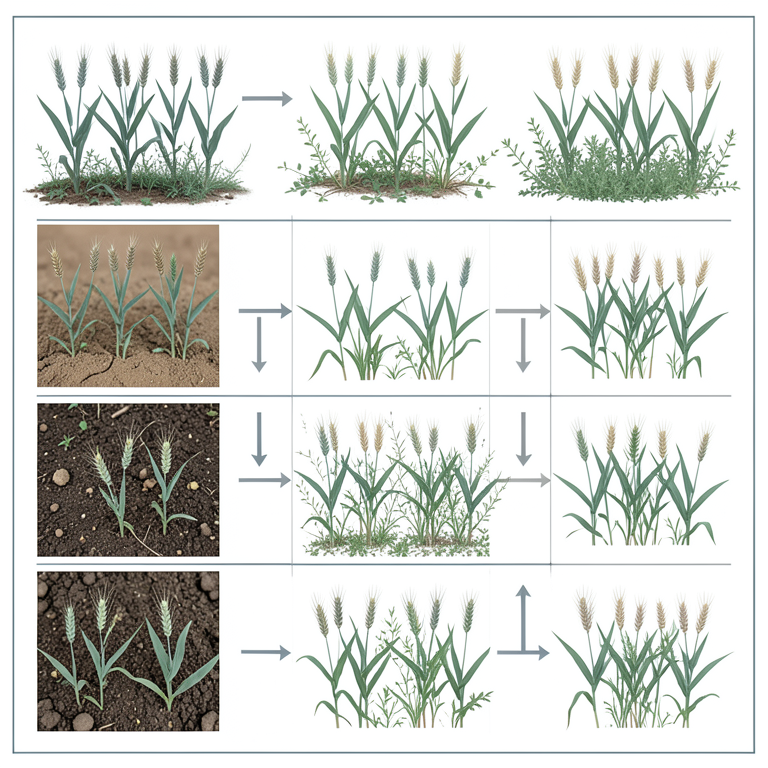
Experimental Design Layout
AI-generated conceptual illustration (wheat plants (Triticum aestivum L.)). It explains the idea and does not show study data.
View source evidence ↗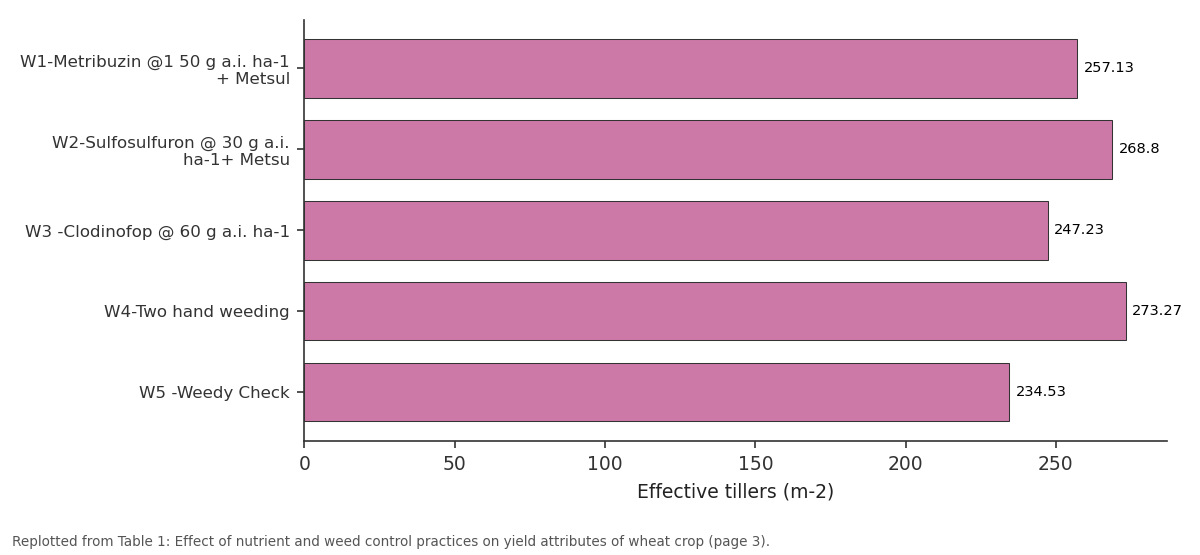
Yield attributes / Effective tillers (m-2): W1-Metribuzin @1 50 g... vs W2-Sulfosulfuron @ 30 g... vs W3 -Clodinofop @ 60 g... vs W4-Two hand weeding vs W5 -Weedy Check
Replotted from Table 1 (page 3) of the original paper. Every bar is the paper's own table value.
View source evidence ↗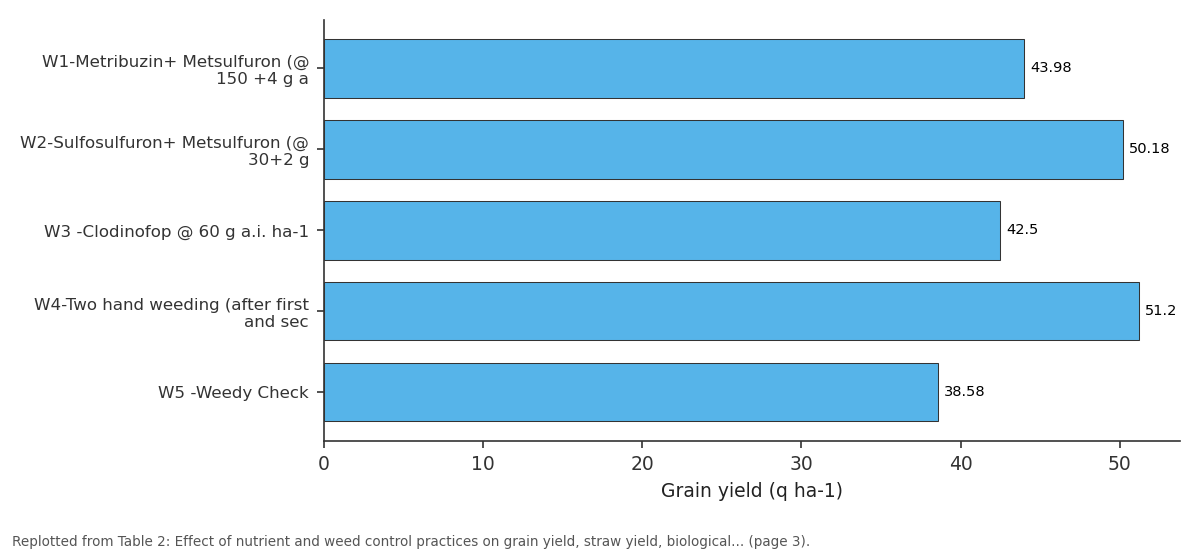
Grain yield (q ha-1): W1-Metribuzin+... vs W2-Sulfosulfuron+... vs W3 -Clodinofop @ 60 g... vs W4-Two hand weeding... vs W5 -Weedy Check
Replotted from Table 2 (page 3) of the original paper. Every bar is the paper's own table value.
View source evidence ↗Figures & tables
From the original paper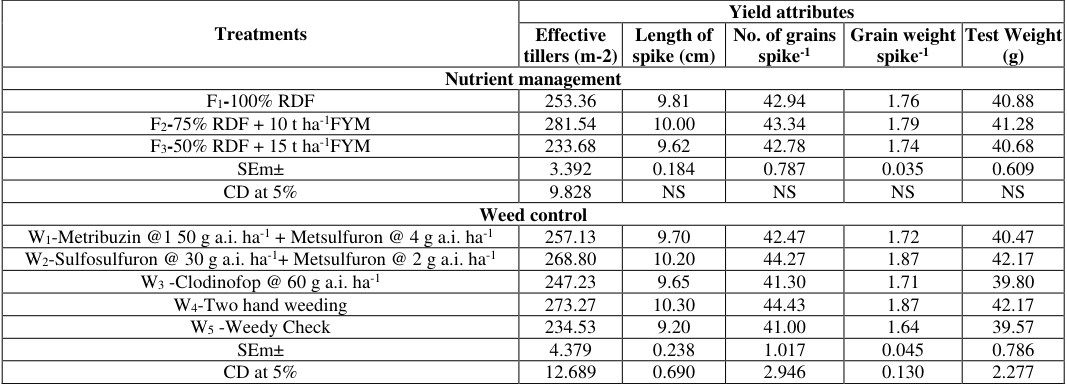 Table 1
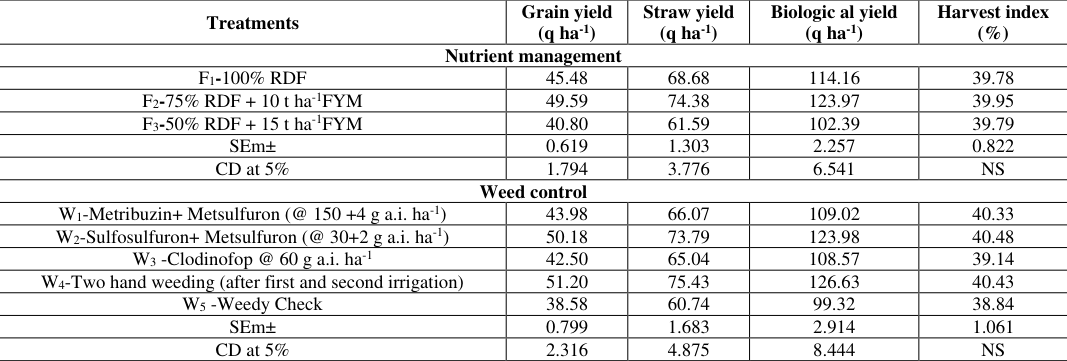 Table 2
Introduction
The sector's staple grain, wheat (Triticum aestivum L.), is a member of the Poaceae family. It is a cereal crop, and caryopsis is the name of the seed. The North-Western parts of the Indian subcontinent, which include Afghanistan as a neighbor, are the wheat's origin region. This region is also the center of origin for bread wheat. In the winter, it is typically grown in areas with temperate and tropical climates. It is regarded as an essential component of food safety in many different countries. Wheat is the primary source of vegetarian protein for human meals worldwide and has a higher protein content than the majority of other cereals. It is a staple meal in India, served after rice. The three cultivated species of wheat are known as Marconi wheat, Emmer wheat, and common bread wheat, respectively: Triticum aestivum, Triticum durum, and Triticum dicoccon. For the production of chapattis, bread, cakes, biscuits, pastries, and other bakery goods, 80-85% of wheat is used. The ingredients for making rawa, suji, and seaway are wheat. Specifically, livestock are fed with wheat straw. Because of its enormous productivity and acreage, it is referred to as the "king of cereals". According to FAS/USDA 2019-20, wheat is the most productive crop in the world, requiring an area of 217.02 mha and a production of 764.50 mmt, or 3.52 mt ha -1 . During the 2018-19 rabi season in India, the total wheat crop production was 99.87 mmt on a 29.65 mha cultivated area, yielding a productivity of 3.37 mt ha - 1 (Anonymous, 2019-20) [2] . In terms of India, the six northern states of Uttar Pradesh, Punjab, Haryana, Madhya Pradesh, Rajasthan, and Bihar account for nearly 91% of the country's wheat production. U.P. is ranked highest among them in terms of area (9.54 mha) and production (32.74 mt); however, in comparison to Punjab (5123 kg ha -1 ) and Haryana (5195 kg ha -1 ) states, its productivity (3432 kg ha -1 ) is relatively low (Anonymous, 2018-19) [3] . The wheat crop is the second most important food grain crop in Indian agriculture, after rice. The foundation of Indian agriculture is wheat cultivation, which is healthier than other cereals from a nutritional standpoint. Wheat grains contain 60-67% starch, 8-15% protein, 1.5-2.0% fat, 2.0-2.5% cellulose, and 1.5-2.0% minerals (Rathore, 2001) [5] . Roughly 73% of the average diet's calories and proteins come from wheat (Heyne 1987) [4] . Fertilizer application alone has a negative impact on soil health and crop productivity; thus, integrating different sources of nitrogenous (organic and inorganic) fertilizer is more appropriate because it lowers the need for chemical fertilizer application and cultivation costs. In addition to being an environmentally friendly approach, this method also shows that FYM in combination with chemical fertilizer has a positive effect on wheat (Ram and Mir, 2006; Gupta et al., 2006) [6,7] . Since ancient times, farmers have applied farmyard manure (FYM) to the soil. This practice has improved soil fertility, enhanced crop yield, increased soil organic matter, increased microbiological activity, and improved soil structure for sustainable agriculture (Behara et al., 2006 and Khan et al., 2007) [8,9] . Weed infestation and management is one of the key factors among many others that contribute to low yield. Crop plants are in competition with weeds, which reduces yield by 20-50%. P. minor, Chenopodium album, Melilotus alba, Fumeria parviflora, Medicago denticulata, Vicia hirsuita, Vicia sativa, Avena ludoviciana, Coronopus didymus, and Reumex acetocel are the notable weeds that can be identified in wheat fields. Reduction in wheat crop yield of 15-50%, depending on weed density and weed flora type (Jat et al., 2003) [11] . One of the most dangerous problems with wheat in the rice-wheat cropping system is Phalaris minor, which accounts for 65% of crop losses. (2008) Chhokar et al. Mechanical, chemical, and cultural methods are frequently employed to eradicate weeds. Timely control of weeds is impeded by unfavorable weather conditions and labor shortages during peak season. As a result, mechanical weed control techniques and hand or manual weeding by themselves are ineffective. Thus, chemical weed control is an essential alternative. Because weed killers are so successful and efficient, they have proven to be a useful and very effective way to control weeds in wheat (Azad et al., 1997) [13] . But weeds become resistant when a single herbicide is applied repeatedly. In the 1990s, reports of resistant strains of Phalaris minor from Western U.P. and Haryana were made against isoproturon. Later, new herbicide molecules such as Fenoxaprop-ethyl, Clodinofop, and Sulfosulfuron were registered and suggested as a means of managing Phalaris minor in wheat (Walia, U.S. and Brar, L.S., 2006) [15] .
Materials and Methods
A field experiment was conducted during rabi season of 2023-24 on loamy sand of in the rural area of Kanpur district of Mandhana, located 10 km from Kanpur in Uttar Pradesh to Effect of weed control and fertilizer management on wheat (Triticum aestivum L.).The soil was normal in pH of 7.65, electrical conductivity (EC) of 0.27 dSm -1 , organic carbon content of 0.41%, and available nutrients including nitrogen (N), phosphorus (P), and potassium (K) at levels of 217.0, 19.5, and 149.50 kg ha -1 , respectively. The experiment was laid out during Rabi season of 2023-24. The experiment consisted of 15 treatment combinations {3 nutrient level & 5 weed control}, was laid out in Factorial Randomized Block Design (FRBD) with three replications. F1: 100% RDF, F2: 75% RDF + 10 t ha - 1 FYM, F3: 50% RDF + 15 t ha -1 FYM Weed control:, W1: Metribuzin @ 150 g a.i. ha -1 + Metsulfuron @ 4 g a.i. ha -1 , W2: Sulfosulfuron @ 30 g a.i. ha -1 + Metsulfuron @ 2 g a.i. ha -1 , W3: Clodinofop @ 60 g a.i. ha -1 , W4: Two hand weeding (after first and second irrigation), W5: Weedy Check data were gathered on five plants chosen from each plot.
Results and Discussion
Results and Discussion
Yield and yield attributes Effective tillers m -2
The number of tillers (m-2) was also significantly influenced by all weed control methods. Of these, twice hand weeding produced the highest number of effective tillers (273.27 m-2), which was comparable to sulfosulfuron + metsulfuron @ 30+2 g a.i. ha -1 (268.80 m-2) and significantly higher than the remaining weed control methods. Additionally, Barthwal et al. (2013) [16] and Jat et al. (2013) [17] have reported results that are similar. It could be the result of effective weed control, as Tomar & Tomar (2014) [19] have also reported similar results with low densities and dry weights of weeds.
Every weed control method had a major impact on the spike's length (in centimeters). W4 recorded the maximum length of spike (10.30 cm) after two manual weeding sessions; this was significantly higher than the weedy check, but it was on par with sulfosulfuron + metsulfuron @ 30+2 g a.i.ha -1 , metribuzin + metsulfuron @ 150+4 g a.i.ha -1 , and W3 clodinafop @ 60 g a.i.ha -1 . Similar results have also been reported by Sharma et al. (2005) [21] . It could be because there were more nutrients, moisture, spaces, and lights available, which led to the plants' improved growth and development. Singh (2011) [23] also presented comparable findings.
Number of grains spike -1
The maximum number of grains spike -1 recorded with twice hand weeding (44.43) was comparable to sulfosulfuron + metsulfuron @ 30+2 g a.i.ha -1 and metribuzin + metsulfuron @ 150+4 g a.i.ha -1 . All weed control techniques had a significant impact on the number of grains spike -1 . This may be the result of successfully controlling weeds in crop fields during the crop's main growing season, which improves the availability of nutrients, moisture, space, and light and promotes better plant growth and development. Singh (2015) [23] also presented comparable findings.
Grain weight spike -1
Every weed control method had a major impact on the grain weight spike -1 . The treatment of twice-hand weeding produced the highest grain weight spike -1 , which was significantly higher than the other weed control methods and on par with sulfosulfuron + metsulfuron @ 30+2 g a.i.ha -1 (1.87). This could be the result of increased leaf area, which increased photosynthesis and the production of photosynthates. Chopra et al. (2008) [10] also presented similar findings.
All the weed control practices influenced the 1000 grain weight significantly. The highest 1000 grain weight recorded with the treatment twice hand weeding which was being at par with sulfosulfuron + metsulfuron @ 30+2 g a.i.ha -1 and W1 metribuzin + metsulfuron @ 150+4 g a.i.ha -1 , which was significantly higher than rest of the weed control practices. This might be due to less competition for different resources resulted more translocation of food from source to sink relationship and it is the cumulative function of various growth parameters and yield attribute. Similar results have been also been reported by Barthwal et al. (2013) [16] .
The weed control practices also had significant effect on grain yield. The data further revealed that the twice hand weeding recorded significantly highest grain yield (51.20 q ha -1 ) and being at par with sulfosulfuron + metsulfuron @ 30+2 g a.i.ha -1 (50.18 q ha -1 ) and significantly higher than rest of the weed control practices. It might be due to more translocation of food from source to sink responsibly more yield. The similar findings have been also been reported by Malik et al. (2011) [24] and Tomar and Tomar (2014) [19] .
The results of the weed control practices showed that twice hand weeding produced the highest straw yield (75.43 q ha -1 ) and was significantly higher than other weed control practices. It was also on par with sulfosulfuron + metsulfuron @ 30+2 g a.i. ha -1 (73.79 q ha -1 ). This could be as a result of the weeds being effectively controlled, which improved the growth parameters and yield attributes. Higher yield attributes, when combined with better vegetative growth, led to higher yields of grain and straw. Sasode et al. (2017) [26] have also reported findings that are similar.
The biological yield over weedy check increased significantly as a result of all weed control techniques. The two hand weeding methods produced the highest biological yield (126.63 q ha -1 ), which was considerably higher than the other weed control methods and on par with sulfosulfuron + metsulfuron @ 30+2 g a.i. ha -1 (123.98 q ha -1 ). This could be because more growth and development led to a higher biological yield through effective weed control achieved by such treatment enhancement. The similar findings have been also been reported by Malik et al. (2011) [24] and Tomar and Tomar (2014) [19] .
The maximum index of 44.8 percent was observed under weed control practices with 75% RDF + 10 t ha -1 FYM and 39.95 percent under sulfosulfuron + metsulfuron @ 30+2 g a.i. ha -1 . This could be because using effective weed control techniques led to a proportionate increase in the distribution of grain, a photosynthetic sink, increasing the harvest index. Kumari et al. (2013) [25] have also reported comparable findings.
Conclusion
At 60 and 90 DAS, the minimum dry weight of weeds was recorded when 100% RDF treatment was applied and Sulfosulfuron + Metsulfuron @ 30+2 g a.i. ha -1 was sprayed. The highest grain yield (49.59 q ha -1 & 50.18 q ha -1 ), straw yield (74.38 q ha -1 & 73.79 q ha -1 ), and total biological yield (123.97 q ha -1 & 123.98 q ha -1 ) were obtained by applying a 75% RDF+ 10 t ha -1 FYM treatment along with the spraying of Sulfosulfuron + Metsulfuron @ 30+2 g a.i. ha -1 . These results were significantly higher than the other treatments while remaining comparable to two hand weeding.
Figures and tables from the paper
| Treatments | Yield attributes | — | — | — | — |
|---|---|---|---|---|---|
| Effective tillers (m-2) | Length of spike (cm) | No. of grains spike-1 | Grain weight spike-1 | Test Weight (g) | |
| Nutrient management | |||||
| F1-100% RDF | 253.36 | 9.81 | 42.94 | 1.76 | 40.88 |
| F2-75% RDF + 10 t ha-1FYM | 281.54 | 10.00 | 43.34 | 1.79 | 41.28 |
| F3-50% RDF + 15 t ha-1FYM | 233.68 | 9.62 | 42.78 | 1.74 | 40.68 |
| SEm± | 3.392 | 0.184 | 0.787 | 0.035 | 0.609 |
| CD at 5% | 9.828 | NS | NS | NS | NS |
| Weed control | |||||
| W1-Metribuzin @1 50 g a.i. ha-1 + Metsulfuron @ 4 g a.i. ha-1 | 257.13 | 9.70 | 42.47 | 1.72 | 40.47 |
| W2-Sulfosulfuron @ 30 g a.i. ha-1+ Metsulfuron @ 2 g a.i. ha-1 | 268.80 | 10.20 | 44.27 | 1.87 | 42.17 |
| W3 -Clodinofop @ 60 g a.i. ha-1 | 247.23 | 9.65 | 41.30 | 1.71 | 39.80 |
| W4-Two hand weeding | 273.27 | 10.30 | 44.43 | 1.87 | 42.17 |
| W5 -Weedy Check | 234.53 | 9.20 | 41.00 | 1.64 | 39.57 |
| SEm± | 4.379 | 0.238 | 1.017 | 0.045 | 0.786 |
| CD at 5% | 12.689 | 0.690 | 2.946 | 0.130 | 2.277 |
Table text extracted from the original PDF; superscript letters are shown inline. The original table image is below.
View original table image
| Treatments | Grain yield (q ha-1) | Straw yield (q ha-1) | Biologic al yield (q ha-1) | Harvest index (%) |
|---|---|---|---|---|
| Nutrient management | ||||
| F1-100% RDF | 45.48 | 68.68 | 114.16 | 39.78 |
| F2-75% RDF + 10 t ha-1FYM | 49.59 | 74.38 | 123.97 | 39.95 |
| F3-50% RDF + 15 t ha-1FYM | 40.80 | 61.59 | 102.39 | 39.79 |
| SEm± | 0.619 | 1.303 | 2.257 | 0.822 |
| CD at 5% | 1.794 | 3.776 | 6.541 | NS |
| Weed control | ||||
| W1-Metribuzin+ Metsulfuron (@ 150 +4 g a.i. ha-1) | 43.98 | 66.07 | 109.02 | 40.33 |
| W2-Sulfosulfuron+ Metsulfuron (@ 30+2 g a.i. ha-1) | 50.18 | 73.79 | 123.98 | 40.48 |
| W3 -Clodinofop @ 60 g a.i. ha-1 | 42.50 | 65.04 | 108.57 | 39.14 |
| W4-Two hand weeding (after first and second irrigation) | 51.20 | 75.43 | 126.63 | 40.43 |
| W5 -Weedy Check | 38.58 | 60.74 | 99.32 | 38.84 |
| SEm± | 0.799 | 1.683 | 2.914 | 1.061 |
| CD at 5% | 2.316 | 4.875 | 8.444 | NS |
Table text extracted from the original PDF; superscript letters are shown inline. The original table image is below.
View original table image
References
22 in the original paper- Anonymous. United States Department of Agriculture and Foreign Agricultural Service, Circular series world agricultural production. 2019:9-19.
- Rathore AL. Studies on nitrogen and irrigation requirement of late-sown wheat. Indian J Agron. 2001;46(4):659-664.
- Ram Tulsa, MIR MS. Effect of irrigated nutrient management on yield and yield attributing characters of wheat. Indian J Agron. 2006;51(3):189-192.
- Gupta M, Bail AS, Sharma BC, Kachroo, Bharat A. Productivity, nutrient uptake and economics of wheat under various tillage and fertilizer management practices. Indian J Agron. 2006;52(2):127-130.
- Behara UK, Sharma AR, Pandey HN. Sustaining productivity of wheat-soybean cropping system through integrated nutrient management practices on the vertisols of central India. Plant Soil. 2006;297(1/2):185-199.
- Khan JK, Agrawal SB, Naik KR. Response of late-sown wheat to irrigation and nitrogen. J Soil Crops. 2007;14(2):445-446.
- Chopra NK, Chopra N, Singh HP. Assessment of nutrient uptake by weeds and crop and its subsequent effect on grain quality in wheat. Indian J Agril Scie. 2008;78(6):540-542.
- Jat RS, Napalia V, Chaudhary PD. Influence of herbicide and methods of sowing on weed dynamics in wheat (Triticum aestivum). Indian J Weed Sci. 2003;35(1&2):1820.
- Azad BS, Harbans S, Singh H. Effect of weed control measures and nitrogen on the productivity of wheat. Indian J Agron. 1997;42(1):98-103.
- Brar A Singh, Walia US. Effect of rice residue management techniques and herbicides on nutrient uptake by Phalaris minor Retz and wheat (Triticum aestivum L.). Indian J Weed Sci. 2008;40(3&4):121-127.
- Walia US, Singh B. Performance of triasulfuron and carfentrazone ethyl against broadleaf weeds in wheat. Indian J Weed Sci. 2007;39(1&2):52-54.
- Barthwal A, Bhardwaj AK, Chaturvedi S, Pandiaraj T. Sitespecific NPK recommendation in wheat (Triticum aestivum) for sustained crop and soil productivity in mollisols of T aria region. Indian J Agron. 2013;58(2):208-214.
- Jat G, Majumdar, Jat SP, Maujndar SP. Potassium and zinc fertilization of wheat (Triticum aestivum) in the western arid zone of India. Indian J Agron. 2013;58(1):67-71.
- Srivastava D, Vishwakarma SK, Verma N, Shah M. Bioefficacy and phytotoxicity of clodinofop-propatgyl (15% WP) on weed control in wheat. Plant Archives. 2013;13(1):307-310.
- Tomar SK, Tomar TS. Effect of herbicides and their tank mix mixture on weed dynamics and yield of zero-tilled wheat (Triticum aestivum) under rice-wheat cropping system of eastern Uttar Pradesh. Indian J Agron. 2014;59(4):624-628.
- Prasad S, Yashwant, Singh RP, Singh G. Effect of crop establishment, weed control method and time of nitrogen application on late-sown wheat. Indian J Weed Sci. 2011;37(1&2):93-95.
- Sharma JJ, Sharma V. Management of complex weed flora with herbicide mixture in wheat. Indian J Weed Sci. 2005;29(3&7):125-128.
- Broadleaf Weeds of Wheat. Indian J Weed Sci. 2011;43(1&2):12-22.
- Singh GD, Vyas AK, Dhar S. Productivity and profitability of wheat based cropping system under different nutrientmanagement practices. Indian J Agron. 2015;60(1):52-56.
- Malik RS, Yadav A, Kumar R. Ready mix formulation of clodinafop-propargyl + metsulfuron-methyl against complex weed flora in wheat. Indian J Weed Sci. 2011;45(3):179-182.
- Kumari A, Kumar S, Singh B, Dhaka A. Evaluation of herbicides alone and in combination for weed control in wheat. Indian J Weed Sci. 2013;45(3):210-213.
- Gupta V, Sasode DS, Kansana BS, Arora A, Dixit JP, Joshi E. Weed management with pre-and post-emergence herbicides in blackgram. Indian Journal of Weed Science. 2017;49(3):256-259.