
Research article · 2024 · Full text
International Journal of Agriculture Extension and Social DevelopmentA study on constraints faced by irrigation users in renewable energy and non- renewable energy shallow tube-well sources of irrigation in Cooch Behar districts of West Bengal
Volume 7(5) · Pages 246–248 · DOI: 10.33545/26180723.2024.v7.i5d.625 ↗
Research areasIrrigation Practices and Water ManagementWater resources management and optimizationPhotovoltaic System Optimization Techniques
Abstract
Author-writtenAgriculture is a multifaceted enterprise that employs millions of small and marginal farmers in India. The majority of Indian farmers are resource-poor and illiterate, with limited or no access to modern technologies. Agriculture and rural development success is determined by the availability of information, knowledge, technologies, and a proper irrigation system for millions of rural families. Cooch Behar district has an agrarian economy that is supported by a variety of irrigation systems. The shallow tube wells (STW) have a direct impact on the cropping intensity of the Cooch Behar District. In this context, a study was conducted in the Cooch Behar district of West Bengal to reveal constraints faced by farmers in renewable and non-renewable energy shallow tube-well sources of irrigation.
Summary
Source-checkedPlain-language reading of the full paper, prepared with AI and checked against the text. Each point links to the authors' own words.
Why it matters
- Many small and marginal farmers in India are resource-poor and illiterate, which limits their access to modern agricultural technologies. View evidence ↗
- In the Cooch Behar District, shallow tube wells (STW) are critical because they directly influence cropping intensity. View evidence ↗
- Water scarcity acts as a primary barrier to increasing overall agricultural output. View evidence ↗
The question
- The study aimed to identify the specific constraints farmers face when using both renewable and non-renewable energy sources for shallow tube-well irrigation in the Cooch Behar district of West Bengal. View evidence ↗
What they did
- The researchers randomly selected 50 respondents from each of two blocks (Cooch Behar I and Cooch Behar II) within the Cooch Behar district. View evidence ↗
- Data for the investigation was gathered through field surveys conducted at the study locations. View evidence ↗
- The Garrett ranking technique was employed to comprehensively capture and rank the constraints faced by farmers. View evidence ↗
- Statistical analysis of the tabulated data was performed using MS-Excel. View evidence ↗
What they found
- For diesel (non-renewable) shallow tube-wells, high initial investment was the top constraint, with a mean score of 61.68. View evidence ↗
- The rising cost of diesel fuel was the second most significant constraint for non-renewable sources, scoring 58.74. View evidence ↗
- Small land holdings (mean score 48.40) and lack of technical expertise (mean score 48.38) were the lowest-ranked constraints for diesel tube-wells. View evidence ↗
- For solar (renewable) shallow tube-wells, higher maintenance costs were the primary constraint, with a mean score of 61.48. View evidence ↗
- Low farm income was the second most significant constraint for solar tube-well users, with a mean score of 59.82. View evidence ↗
What it means
- The authors recommend a comprehensive strategy combining government intervention, technical progress, and financial assistance to help farmers overcome these irrigation constraints. View evidence ↗
- The study concludes that farmers face a complex and diverse set of financial limitations, including initial capital needs and ongoing operational expenses. View evidence ↗
Visual summary
3 visualsIllustrations explain the paper; charts are replotted from the paper's own table values.
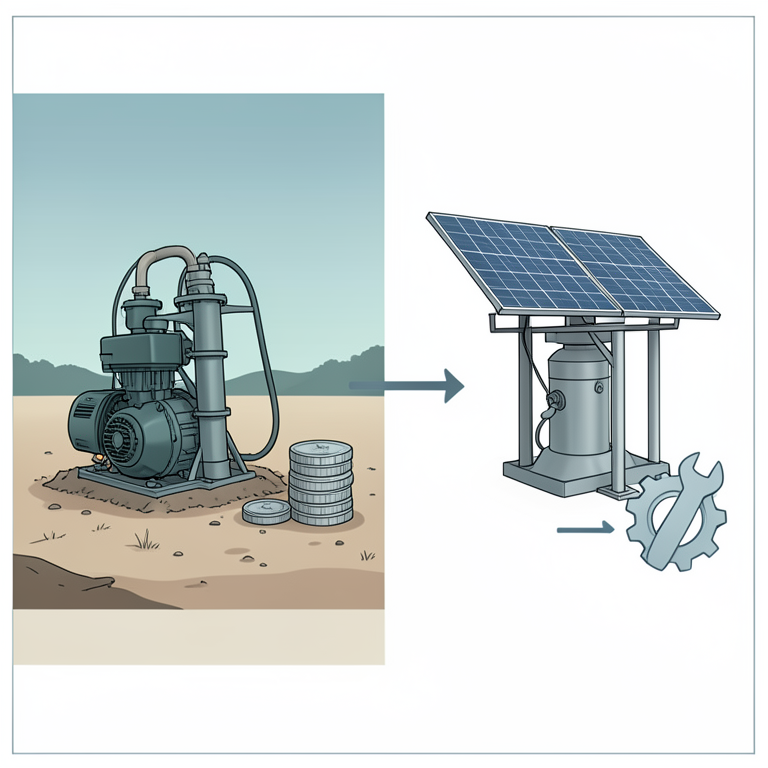
Comparison of Primary Constraints
AI-generated conceptual illustration (shallow tube-wells in agricultural fields). It explains the idea and does not show study data.
View source evidence ↗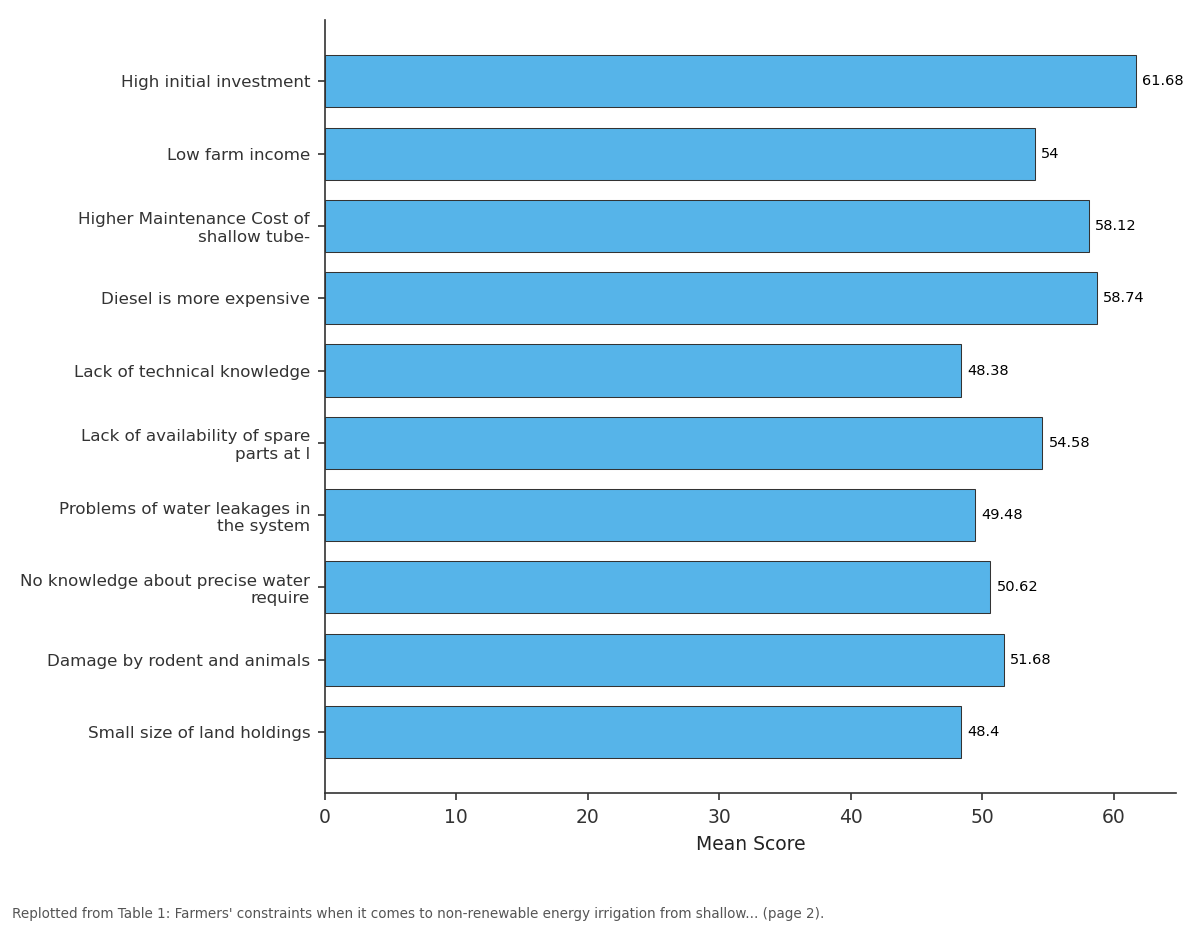
Mean Score: High initial investment vs Low farm income vs Higher Maintenance Cost... vs Diesel is more expensive vs Lack of technical...
Replotted from Table 1 (page 2) of the original paper. Every bar is the paper's own table value.
View source evidence ↗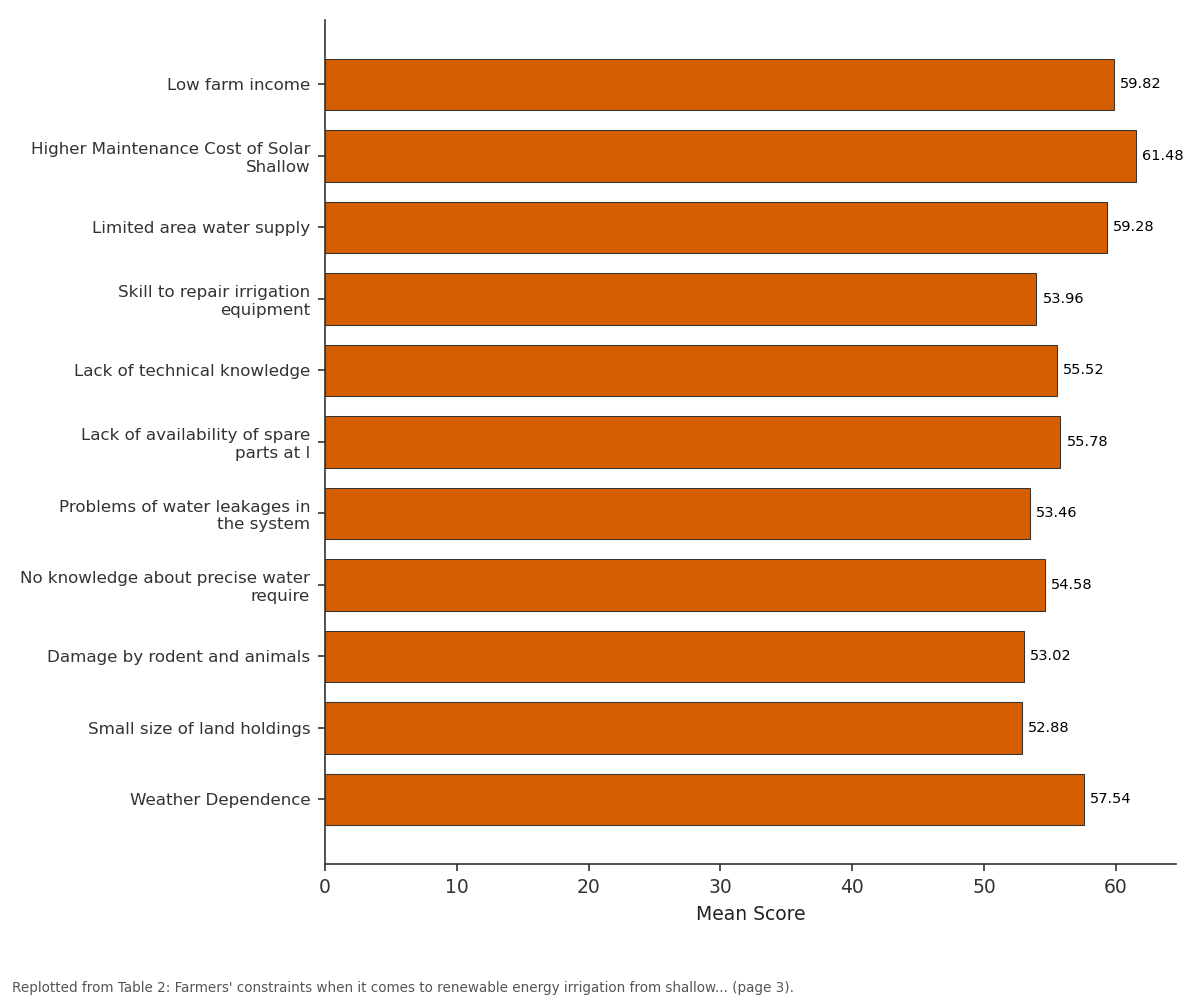
Mean Score: Low farm income vs Higher Maintenance Cost... vs Limited area water... vs Skill to repair... vs Lack of technical...
Replotted from Table 2 (page 3) of the original paper. Every bar is the paper's own table value.
View source evidence ↗Figures & tables
From the original paper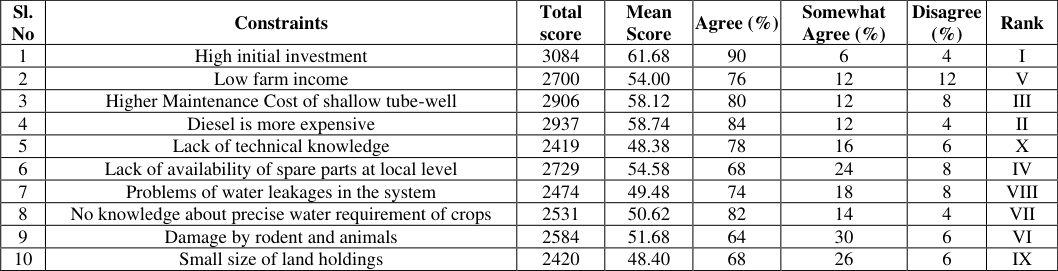 Table 1
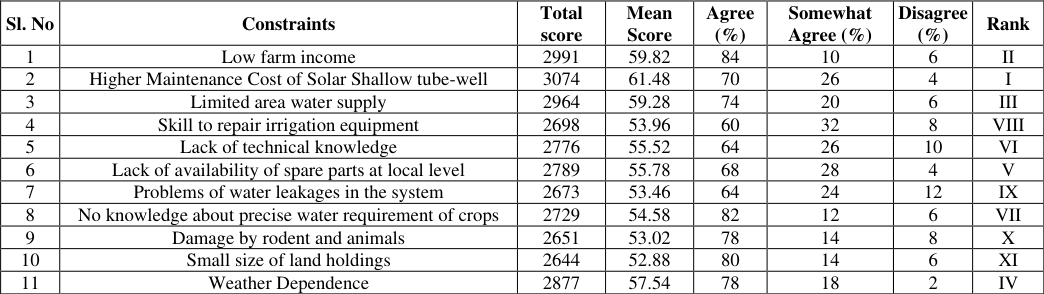 Table 2
Introduction
The Earth's environment, societal well-being, and means of subsistence-particularly through water-are all significantly impacted by climate change. Freshwater makes up the remaining 2.50% of the water on Earth, whereas saltwater makes up the majority (97.5%). The freshwater supply is made up of only 0.26% lakes, reservoirs, and rivers. Just 5% of freshwater is useful and accessible (Mittermeier et al., 2010) [1] . Water, like religion and philosophy, can have a profound impact on millions. Water is necessary for human survival. All living creatures, including humans, depend on water to survive. Water scarcity is a major obstacle to increasing agricultural output (Newson, 2008) [2] . Irrigation is essential for raising crop intensity, yield utilization, productivity, and input efficiency. Producing crops requires a lot of water. All the countries of the world are looking for new source of energy such as renewable (Solar, wind, geo thermal and wave energies) and nuclear due to the scarcity of conventional energy (Rana et al., 2021) [3] . According to Dain and Pawar (1987), groundwater irrigation may account for 70-80% of the value of irrigated production in India. This indicates a significant increase in India's agricultural production. The production relies on groundwater. Agriculture's poor performance can be attributed to limited access to irrigation, production inputs, credit, markets, and advanced technology. According to Yang et al. (2006) [9] , water scarcity directly affects food production, which is the largest user of water. Water scarcity is a major barrier to increasing food production for a growing population (Playan and Mateos, 2006) [10} . In India, agriculture accounts for 84% of water resources, with farm efficiency ranging from 20-50%. Rivers, tanks, canals, and ponds are the primary sources of water for surface irrigation. Surface water irrigation canals are the primary means of releasing water from the main dam into major canals and distributaries leading to farmers' land, ensuring adequate irrigation in command areas (Saha et al., 2023) [7] . While the initial capital cost of solar pump may be far greater than a generator but because of low maintenance and zero fuel costs, solar power system can be cheaper option at a long run. On the other hand, solar power irrigation system can greatly reduce the water wastage and human intervention in irrigation system (Rana et al., 2021) [3] .
Methodology
To achieve the study's objectives, the investigation was conducted using data collected from field surveys in the study locations. A multistage sampling technique was used to select sample units for the various irrigation systems used by farmers. Irrigation techniques in the Cooch Behar district include open-dug wells, deep tube wells, shallow tube wells, river lift irrigation, and tanks. The study investigated at the Cooch Behar district, specifically two of its 12 blocks, Cooch Behar I and Cooch Behar II. In each block, 50 respondents were selected randomly.
Tools of analysis
To meet the numerous aims stated earlier, the tabular method of analysis is aggressively adopted. The tabulated data have been subjected to statistical analysis by utilizing MS-Excel.
Garret ranking technique
To capture comprehensively the constraints faced by the farmers during installation and maintenance of drip systems in coconut orchards, Garret ranking technique was used. Some major prevailing constraints were highlighted during preliminary survey and the order of the merit given in ascending order was converted into ranks by using the formula. Accordingly, these ranks were converted to scores by referring to Garrets table. Garrett's formula for converting ranks into percent was given by Percent Position = Where, R ij = Rank given for ith item by j th farmer Nj = Number of items ranked by jth farmer The percent position of each rank was converted to scores by referring to tables given by Garret and Woodworth (1969) [13] . Then for each factor, the scores of individual respondents were summed up and divided by the total number of respondents for whom scores were gathered. The mean scores for all the factors were ranked, following the decision criterion that higher the value, the more important is that constraint.
(i)
Mean score Mean score was obtained by total scores of each statement divided by total number of respondents.
Results and Discussion
Diesel shallow tube-well The examination of 50 respondents' shallow tube-well irrigation systems revealed the presence of restrictions that are unrelated to renewable energy sources. The significant upfront cost emerged as the primary limitation, achieving the highest average score of 61.68 and ranking first. Furthermore, the increased cost of diesel fuel appeared as the second most significant financial obstacle, with an average score of 58.74. The reasons for the lower ranking of shallow tube-wells are as follows: higher maintenance costs, difficulty in finding spare parts locally, low income from farming, damage caused by rodents and animals, a lack of knowledge about the precise water requirements of crops, and problems with water leakages in the system. We ranked these factors 3rd, 4th, 5th, 6th, 7th, and 8th, with mean scores of 58.12, 54.58, 54.00, 51.68, 50.62, and 49.48, respectively. In addition, the limited quantity of land holdings and the absence of technical expertise were identified as important limitations, ranking 9th and 10th with mean scores of 48.40 and 48.38, respectively.
Solar shallow tube-well
An examination of restrictions associated with solar shallow tube-wells for renewable energy was conducted based on feedback from 50 participants. The analysis identified a range of constraints, including financial, technological, and natural factors. The data from the table indicates that the respondents considered the higher maintenance cost of Solar Shallow tube-well to be the most significant financial limitation, with a mean score of 61.48. This constraint obtained the top position in the ranking. The second highest mean score of 59.82 was obtained by low farm income of solar shallow tube-wells. This was followed by limited area water supply, weather dependence, lack of availability of spare parts at the local level, lack of technical knowledge, no knowledge about precise water requirements of crops, skill to repair irrigation equipment, and problems of water leakages in the system. These factors were ranked 3rd, 4th, 5th, 6th, 7th, 8th, and 9th, with mean scores of 59.28, 57.54, 55.78, 55.52, 54.58, 53.96, and 53.46, respectively. In addition, the restrictions of damage by rodent and animals and small size of land holdings were identified as significant, ranking 10th and 11th with mean scores of 53.02 and 52.88 respectively. This discovery bears resemblance to the unofficial, non-formalized water markets in the Kathmandu Valley (Raina et al., 2020) [12] . www.extensionjournal.com
Conclusion
The results of the current investigation highlight the notable economic limitations faced by farmers, with multiple crucial variables contributing to their difficulties. One of the main obstacles is the substantial upfront investment that is necessary, which presents a big challenge for several farmers looking to enter or expand their operations. Moreover, the financial strain on farmers intensifies due to the elevated price of diesel and the elevated maintenance costs associated with shallow tube wells. In addition, the scarcity of spare parts at the local level presents logistical challenges and may prolong the period of inactivity for crucial equipment, exacerbating financial difficulties. Furthermore, insufficient agricultural revenue exacerbates these difficulties, resulting in a recurring cycle of financial hardship for farmers. Rodents and animals increase the costs, while the dependence on non-renewable energy sources raises both financial and environmental issues.
Overall, the study emphasizes the complex and diverse range of financial limitations that farmers have. These constraints include the need for initial capital, ongoing expenses, income levels, and external concerns such as insect damage and dependence on non-renewable energy sources. We need a comprehensive strategy that integrates financial assistance mechanisms, technical advancements, and governmental interventions to tackle these difficulties. This would help reduce the challenges faced by farmers and promote the adoption of sustainable farming methods.
Figures and tables from the paper
| Sl. No | Constraints | Total score | Mean Score | Agree (%) | Somewhat Agree (%) | Disagree (%) | Rank |
|---|---|---|---|---|---|---|---|
| 1 | High initial investment | 3084 | 61.68 | 90 | 6 | 4 | I |
| 2 | Low farm income | 2700 | 54.00 | 76 | 12 | 12 | V |
| 3 | Higher Maintenance Cost of shallow tube-well | 2906 | 58.12 | 80 | 12 | 8 | III |
| 4 | Diesel is more expensive | 2937 | 58.74 | 84 | 12 | 4 | II |
| 5 | Lack of technical knowledge | 2419 | 48.38 | 78 | 16 | 6 | X |
| 6 | Lack of availability of spare parts at local level | 2729 | 54.58 | 68 | 24 | 8 | IV |
| 7 | Problems of water leakages in the system | 2474 | 49.48 | 74 | 18 | 8 | VIII |
| 8 | No knowledge about precise water requirement of crops | 2531 | 50.62 | 82 | 14 | 4 | VII |
| 9 | Damage by rodent and animals | 2584 | 51.68 | 64 | 30 | 6 | VI |
| 10 | Small size of land holdings | 2420 | 48.40 | 68 | 26 | 6 | IX |
Table text extracted from the original PDF; superscript letters are shown inline. The original table image is below.
View original table image
| Sl. No | Constraints | Total score | Mean Score | Agree (%) | Somewhat Agree (%) | Disagree (%) | Rank |
|---|---|---|---|---|---|---|---|
| 1 | Low farm income | 2991 | 59.82 | 84 | 10 | 6 | II |
| 2 | Higher Maintenance Cost of Solar Shallow tube-well | 3074 | 61.48 | 70 | 26 | 4 | I |
| 3 | Limited area water supply | 2964 | 59.28 | 74 | 20 | 6 | III |
| 4 | Skill to repair irrigation equipment | 2698 | 53.96 | 60 | 32 | 8 | VIII |
| 5 | Lack of technical knowledge | 2776 | 55.52 | 64 | 26 | 10 | VI |
| 6 | Lack of availability of spare parts at local level | 2789 | 55.78 | 68 | 28 | 4 | V |
| 7 | Problems of water leakages in the system | 2673 | 53.46 | 64 | 24 | 12 | IX |
| 8 | No knowledge about precise water requirement of crops | 2729 | 54.58 | 82 | 12 | 6 | VII |
| 9 | Damage by rodent and animals | 2651 | 53.02 | 78 | 14 | 8 | X |
| 10 | Small size of land holdings | 2644 | 52.88 | 80 | 14 | 6 | XI |
| 11 | Weather Dependence | 2877 | 57.54 | 78 | 18 | 2 | IV |
Table text extracted from the original PDF; superscript letters are shown inline. The original table image is below.
View original table image
References
7 in the original paper- Rana J, Kamruzzaman M, Oliver MH, Akhi K. Financial and factors demand analysis of solar powered irrigation system in Boro rice production: A case study in Meherpur district of Bangladesh. Renewable Energy. 2021;167:433-439.
- Geerts S, Raes D. Deficit irrigation as on-farm strategy to maximize crop water productivity in dry areas. Agricultural Water Management. 2009;96:1275-1284.
- Seckler D, Barker R, Amarasinghe U. Water scarcity in the twenty-first century. Water Resources Development. 1999;15:29-42.
- Yang HL, Wang K, Abbaspour, Zehnder A. Virtual water and the need for greater attention to rainfed agriculture. Water Magazine, International Water Association. 2006;21:14-15.
- Playan E, Mateos L. Modernization and optimization of irrigation systems to increase water productivity. Agricultural Water Management. 2006;80(1-3):100116.
- Rani J, Paul B. Challenges in arid region reclamation with special reference to Indian Thar Desert-its conservation and remediation techniques. International Journal of Environmental Science and Technology. 2023;20(11):12753-12774.
- Raina A, Gurung Y, Suwal B. Equity impacts of informal private water markets: case of Kathmandu Valley. Water Policy. 2020;22(S1):189-204.