
Research article · 2024 · Full text
International Journal of Research in AgronomyEffect of phosphorus with zinc and zinc solubilizer on the physical growth of pearl millet
Volume 7(5S) · Pages 97–100 · DOI: 10.33545/2618060x.2024.v7.i5sb.719 ↗
Research areasCrop Yield and Soil FertilityRice Cultivation and Yield ImprovementAgricultural Science and Fertilization
Abstract
Author-writtenThe physicochemical involvement of Zn in soil-plant systems. Zinc (Zn) is required for the metabolism of plants, enzyme function, and ion transport. Zinc-solubilizing rhizobacteria can convert insoluble zinc to an accessible form and increase Zn bioavailability in soil, which help mitigate Zn deficiency in crops. A field experiment was conducted during Kharif season of 2023 at Crop Research Farm Department of Agronomy. The soil was tasted in lab and contain pH range of 7.8, which is almost neutral and contain EC 0.41 (ds/m) of The treatments consisted of 3 levels of Zinc (0 kg/ha, 2.5 kg/ha and 5 kg/ha) with Zinc Solubilizer and 3 level of Phosphorus (20, 40 and 60 kg/ha). The experiment was laid out in a Randomized Block Design with 10 treatments and replication thrice. Application of Phosphorus 40 kg/ha with Zinc 2.5 kg/ha and Zinc Solubilizer (Treatment 5) recorded highest plant height (154.17cm), maximum plant dry weight (91.29 gm) However the highest CGR (42.80 g/m2/ day) and RGR (0.01270 g/g/days) are observed in (Treatment 7) Phosphorus 60 kg/ha+ Zinc 0 kg/ha + Zinc Solubilizer in between 40 to 60 DAS and in between 20 to 40 DAS accordingly.
Summary
Source-checkedPlain-language reading of the full paper, prepared with AI and checked against the text. Each point links to the authors' own words.
Why it matters
- Pearl millet is a critical crop for rain-fed regions in India and Africa, serving as a staple food in West Africa. View evidence ↗
- Phosphorus is essential for plant growth, playing key roles in root formation, seed germination, and metabolic activities like photosynthesis and respiration. View evidence ↗
- Zinc is necessary for plant metabolism and enzyme function; zinc-solubilizing rhizobacteria can improve its bioavailability to help prevent crop deficiencies. View evidence ↗
The question
- The study aimed to investigate how different levels of phosphorus, zinc, and zinc solubilizers affect the growth, yield, and economics of pearl millet. View evidence ↗
What they did
- The field experiment was conducted during the 2023 Kharif season at the Crop Research Farm of the Naini Agriculture Institute in Prayagraj, India. View evidence ↗
- The study used a Randomized Block Design with 10 treatments replicated three times, testing three levels of phosphorus (20, 40, 60 kg/ha) and three levels of zinc (0, 2.5, 5 kg/ha) combined with a zinc solubilizer. View evidence ↗
- Plant height was measured every 20 days starting at 20 DAS, and dry weight was determined by oven-drying five plants per plot for 24 hours. View evidence ↗
What they found
- The highest plant height was achieved with 40 kg/ha phosphorus and 2.5 kg/ha zinc plus solubilizer, reaching 128.63 cm at 60 DAS and 154.17 cm at physiological maturity. View evidence ↗
- The maximum total plant dry weight was recorded for the treatment of 40 kg/ha phosphorus and 2.5 kg/ha zinc plus solubilizer, measuring 61.28 g at 60 DAS and 91.29 g at physiological maturity. View evidence ↗
- The highest Crop Growth Rate (CGR) between 40 to 60 DAS was 42.80 g/m²/day, observed with 20 kg/ha phosphorus and 5 kg/ha zinc plus solubilizer. View evidence ↗
- The highest Relative Growth Rate (RGR) between 15 to 30 DAS was 0.1270 g/g/day, found in the treatment with 60 kg/ha phosphorus, 0 kg/ha zinc, and zinc solubilizer. View evidence ↗
What it means
- The authors conclude that the combination of 40 kg/ha phosphorus, 2.5 kg/ha zinc, and zinc solubilizer resulted in the highest growth. View evidence ↗
Visual summary
3 visualsIllustrations explain the paper; charts are replotted from the paper's own table values.
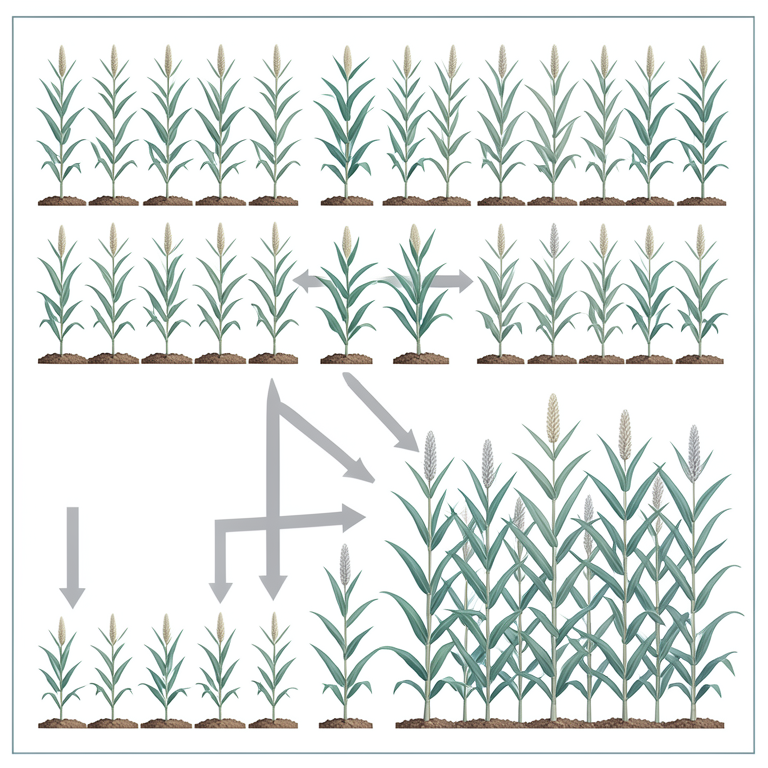
Experimental Treatment Matrix
AI-generated conceptual illustration (pearl millet plants). It explains the idea and does not show study data.
View source evidence ↗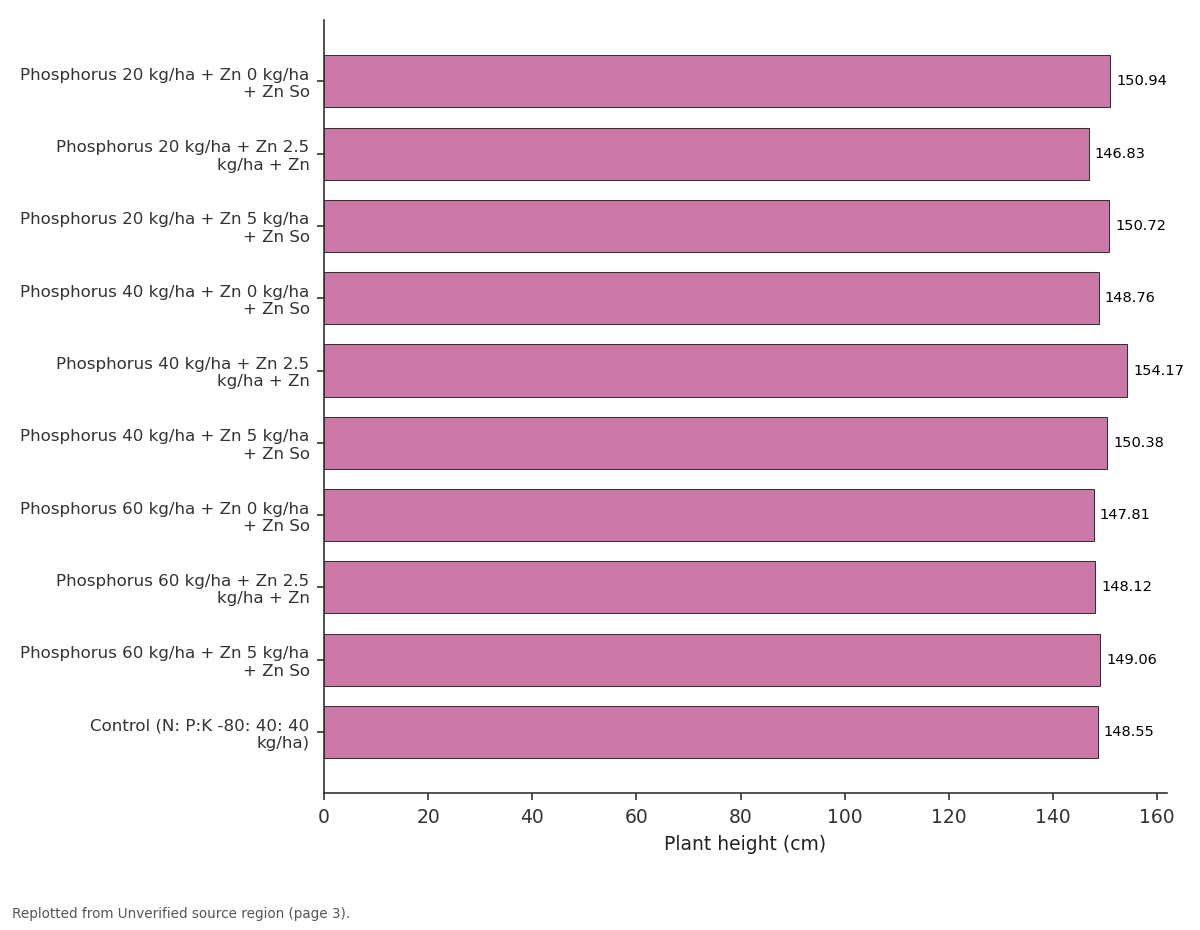
Plant height (cm): Phosphorus 20 kg/ha +... vs Phosphorus 20 kg/ha +... vs Phosphorus 20 kg/ha +... vs Phosphorus 40 kg/ha +... vs Phosphorus 40 kg/ha +...
Replotted from a table (page 3) of the original paper. Every bar is the paper's own table value.
View source evidence ↗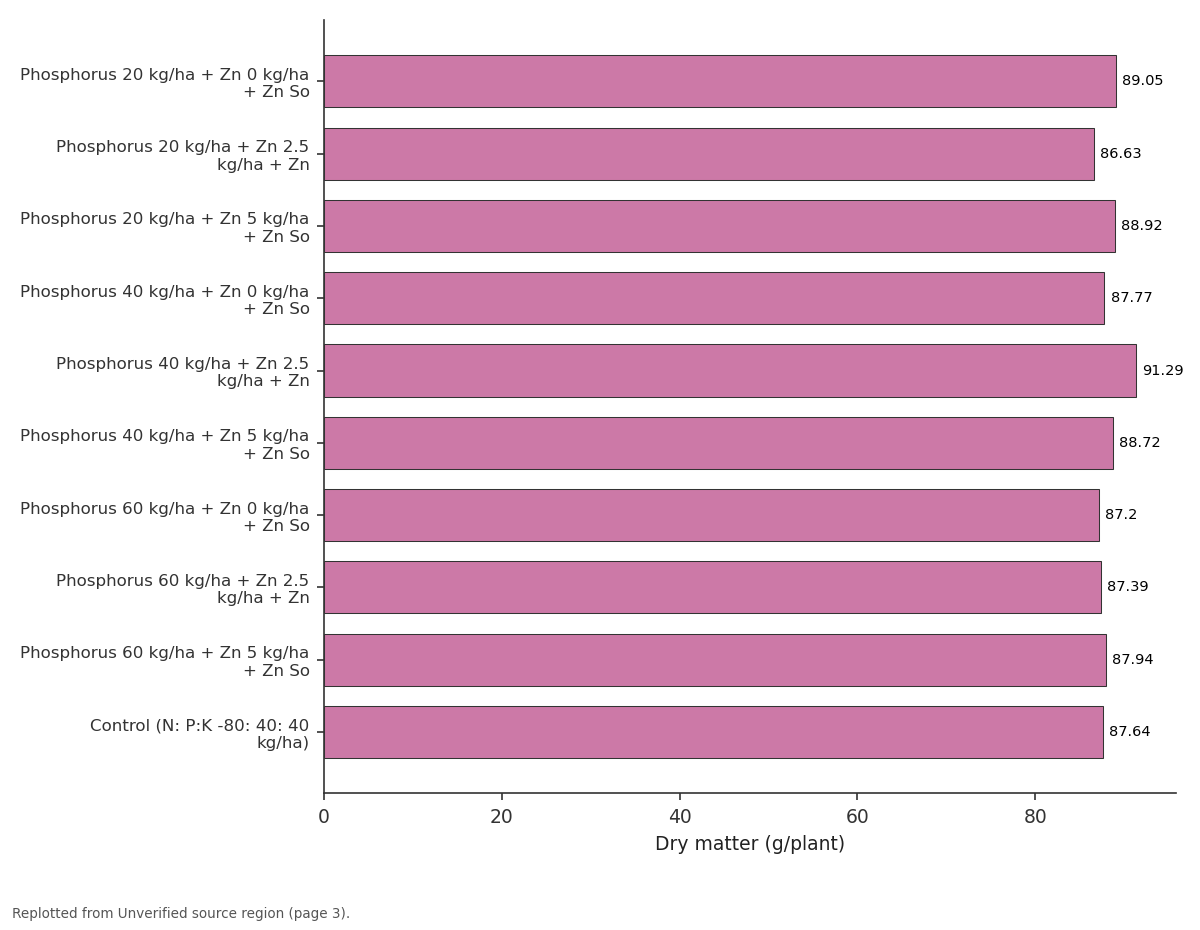
Dry matter (g/plant): Phosphorus 20 kg/ha +... vs Phosphorus 20 kg/ha +... vs Phosphorus 20 kg/ha +... vs Phosphorus 40 kg/ha +... vs Phosphorus 40 kg/ha +...
Replotted from a table (page 3) of the original paper. Every bar is the paper's own table value.
View source evidence ↗Introduction
Pearl millet Crop is a traditional name for Pearl Millet. It is an edible seed of the Pearl Millet plant species. Pearl millet crop cultivation is done in various varieties and is grown in various colours, such as white, yellow and grey. It is an important crop with many health benefits and is one of the most commercial crops. India is the largest Pearl millet -producing country, followed by the African country, Nigeria. Pearl millet [Pennisetum glaucum L.] is an important crop of rain fed areas of Africa India and Serves as staple food for West Africa. It is the most widely cultivated millet crop, occupying prominent position in global agriculture. India is the largest producer of pearl millets in world occupying about 9.4 million hector area with annual production 10.1million tones with average productivity of 1069 kg/ha. India is largest producer of pearl millets covering about 8.75 million ha of marginal and sub marginal lands primarily in the states of Rajasthan, Gujarat, Haryana, Uttar Pradesh and Maharashtra and ranking 3 rd after rice and wheat in acreage. In addition to its grain consumption as human feed, it is also as green fodder in India. Pearl millet may be an alternative crop that exhibits great advantages in physiological characteristics when compared to other cereals as it is resistant to drought, low soil fertility, high salinity and high temperature tolerance [Singh et al., 2019] [23] . Because of it drought escaping mechanism pearl millet can grow in areas that have extended dry periods. The balanced fertilization as shown in positive effects on various aspects of growth development and biological yield of the crop in comparison to nutrient use in single or in combination. In India, pearl millet is the fourth most widely cultivated food crop after rice, wheat and maize. During 2019-20, pearl millet was grown in 7.41 million ha with an average production of 10.3 million tonnes and 1391 kg/ha productivity (3rd advanced estimate from Directorate of Millets Development, 2020). Phosphorus (P) is an essential nutrient for growth and development of plant. Phosphorus plays a very important role in photosynthesis, respiration, energy storage cell division and other metabolic activities in plantlets and also it is very important for seed germination and root formation for plant growth and development (Hrinathan et al. 2016) [28] in plants, zinc plays a key role as a structural constituent or regulatory co-factor of a wide range of different enzymes in many important biochemical pathways. Zinc deficiency in the plant retards development and maturation of the panicles of grain crops. As in soils and plants, Zn deficiency is also a common nutritional problem in humans, predominantly in developing countries where diets are rich in cereal-based foods and poor in animal products. Enhancing Zn in plant derived food is one of the way to improve human health in developing countries where and when the local population cannot afford food sources from which zinc can be taken up easily in large enough quantities in the human gut. Therefore, present investigation 3 was undertaken on Effect of Phosphorus, Zinc and Zinc solubilizer on Growth, Yield and Economics of Pearl Millet (Pennisetum glaucum L.). To increase the availability of zinc for plants. zinc Solubilizer use to solubilize the fixed unavailable zinc into available form and that residue fertilizer can be utilize by succeeding crop. Therefore, an attempt was made to increase the productivity of pearl millet with different residual phosphorous and zinc levels, Kumawat et al.
[2018] [8] . Keeping an eye on the above aspects the present study entitled "Effect of Phosphorus, Zinc and Zinc solubilizer on growth of Pearlmillet." was carried out at Crop Research Farm, Department of Agronomy, Sam Higginbottom University of Agriculture, Technology and Sciences. Prayagraj during 2023 Kharif Season.
Materials and Methods Experimental sites and soil
The experiment was conducted during the Kharif season 2023 at the Crop Research Farm, Department of Agronomy, Naini Agriculture Institute, Sam Higgin bottom University of Agriculture, Technology and Sciences, Prayagraj, U P. The Crop Research Farm is located at 250 24' 42"N latitude, 810 50' 56" E longitude and 98 m altitude from the sea level. This area is situated on the right side of the river Yamuna and by the opposite side of Prayagraj, Rewa Road about 5 km away from Prayagrajcity.
The soil been collected from the experimental site was tasted in laboratory and the results are been observed
Statistical analysis
All data were analyzed using the MS Excel software, and the results were expressed as the arithmetic mean value (±) standard deviation. The differences in the means were compared by the ANOVA. P <.05 was considered as statistically significant.
Result and Discussion
The maximum plant height was recorded with the application of Phosphorus 40 kg/ha with Zinc 2.5 kg/ha and Zinc Solubilizer (128.63 and 154.17 cm) at 60 DAS and at physiological maturity stages, respectively, followed by the application of Phosphorus
Conclusion
It is concluded that application Phosphorus 40 kg/h along with Zinc 2.5 kg/ha and Zinc Solubilizer (Treatment 5) recorded higher growth.
References
28 in the original paper- Arshewar SP, Karanjikar PN, Tskankhar VG, Waghmare YM. Effect of Nitrgen and Zinc on growth, yield and Economics of Pearl Millet (Pennisetum glaucum L.). International Journal Current Microbiology Applied Sciences. 2018;6:2246-2253.
- Arshewar SP, Karanjikar PN, Dambale AS, Kawde MB. Effect of nitrogen and zinc levels on growth, yield and economics of pearl millet (Pennisetum glaucum L.). International Journal of Bio-resource and Stress Management. 2018;9(6):729-732.
- Asungre PA, Akromah R, Kena AW, Gangashetty P. Assessing the adaptability and stability of new pearl millet hybrids for grain yield, grain iron and zinc content in Ghana using AMMI analysis. Journal of Crop Science and Biotechnology. 2022;25(5):501-514.
- Buerkert A, Haake C, Ruckwied M, Marschner H. Phosphorus application affects the nutritional quality of millet grain in the Sahel. Field Crop Research. 1998;57:223235.
- Dadhich LK, Gupta AK. Productivity and economics of pearl millet fodder as influenced by sulphur, zinc and planting pattern. Forage Research. 2003;28(4):201-209.
- Gautam DK, Singh V, Kumar V, Ram S, Babu A. Effect of nitrogen and phosphorous levels on growth, yield and nutrient uptake of pearl millet (Pennisetum glaucum L). International Archive of Applied Sciences and Technology. 2020;11(1):101-105.
- Jain NK, Dahama AK. Residual effect of phosphorus and zinc on yield, nutrient content and uptake and economics of pearl millet-wheat cropping system. Indian Journal of Agricultural Sciences. 2005;75:281-4.
- Kumawat KS, Sammauria R, Kumawat P. Growth and productivity of succeeding pearl millet (Pennisetum glaucum L.) influenced by residual phosphorous, zinc and zinc solubilizer. International journal of chemical studies. 2018;6(5):272-275.
- Kumawat KR, Sharma NK, Sharma AK, Gupta PC. Identifying drought-tolerant hybrids in pearl millet [Pennisetum glaucum (L.) R. Br.] using stress indices for arid and semi-arid areas. Range Management and Agroforestry. 2020;41(2):218-226.
- Kumawat S, Kumar S, Kumar P. Influence of residual phosphorous and zinc fertilization on total nutrient content and uptake of succeeding pearl millet. 2022.
- Muhammad S, et al. Genome-wide association analysis for stripe rust resistance in spring wheat (Triticum aestivum L.) germplasm. Journal of Integrative Agriculture. 2020;19(8):2035-2043.
- Nandaniya KU, Mungra KD, Sorathiya JS. Assessment of combining ability for yield and micronutrients in pearl millet. Electronic Journal of Plant Breeding. 2016;7(4):1084-1088.
- Reddy SP, Satyavathi CT, Khandelwal V, Patil HT, Gupta PC, Sharma LD, Tonapi VA. Performance and stability of pearl millet varieties for grain yield and micronutrients in arid and semi-arid regions of India. Frontiers in Plant Science. 2021;12:670201.
- Reddy AL, Sehrawat KD, Bishnoi OP, Dey S. Assessment of genotype × environment interaction in pearl millet (Pennisetum glaucum (L.) R. Br.) hybrids in arid climate of Haryana. 2022.
- Sammauria R, Yadav RS. Response of pearl millet (Pennisetum glaucum L.) to residual fertility under rainfed conditions of arid region of Rajasthan. Indian Journal Dryland Agricultural Research & Development. 2010;25(1):53-60.
- Sepat RN, Rai RK, Shiva D. Planting system and integrated nutrient management for enhanced wheat (Triticum aestivum L.) productivity. Indian Journal of Agronomy. 2010;55(2):114-118.
- Sharma PK, Kumar S, Chaudhary GR. Effect of organic manure and nutrient management on productivity and soil fertility status in Pearl millet (Pennisetum glaucum L.). Research on Crops. 2012;13:503-506.
- Shekhawat PS, Kumawat N. Response of zinc fertilization on production and profitability of Pearl millet (Pennisetum glaucum L.) under rainfed condition of Rajasthan. Journal of Agricultural Search. 2017;4(4):251-254.
- Singh D, Garg AK, Chauhan A. Fodder yield and quality assessment of different Pearl millet Napier hybrids in central Gujarat of India. Range Management and Agroforestry. 2018;39(2):269-273.
- Singh MK, Kumar V. Evaluation of Pearl millet varieties under rainfed region of Eastern India: Evaluation of Pearl millet for rainfed condition. Journal of Agri Search. 2018;5(4):219-222.
- Singh P, Boote KJ, Kadiyala MDM, Nedumaran S, Gupta SK, Srinivas K, et al. An assessment of yield gains under climate change due to genetic modification of pearl millet. Science of the Total Environment. 2017;601:1226-1237.
- Singh S, Yadav YP, Yadav HP, Vart D, Yadav N. Morphological characterization of pearl millet hybrids [Pennisetum glaucum (L.) R. Br.] and their parents. African Journal of Agricultural Research. 2016;11(5):371-378.
- Solanki RK, Kakani RK, Jukanti AK, Singh SK, Bhatt RK. Performance of Pearl Millet Hybrids for Earliness and Grain Yield in Indian Hot Arid Region. Int. J. Curr. Microbiol. App. Sci. 2019;8(3):1956-1962.
- Sumathi P, Madineni S, Veerabadhiran P. Genetic variability for different biometrical traits in pearl millet genotypes (Pennisetum glaucum LR BR.). Electronic journal of plant breeding. 2010;1(4):437-440.
- Vaid SK, Kumar B, Sharma A, Shukla AK, Srivastava PC. Effect of zinc solubilizing bacteria on growth promotion and zinc nutrition of rice. Journal of soil science and plant nutrition. 2014;14(4):889-910.
- Yadav OP, Rai KN, Yadav HP, Rajpurohit BS, Gupta SK, Rathore A, Karjagi CG. Assessment of diversity in commercial hybrids of pearl millet in India. Indian Journal of Plant Genetic Resources. 2016;19(02):130-136.
- Yadav OP, Rajpurohit BS, Kherwa GR, Kumar A. Prospects of enhancing pearl millet (Pennisetum glaucum) productivity under drought environments of north-western India through hybrids. Indian Journal of Genetics and Plant Breeding. 2012;72(01):25-30.
- Harinathan B, Sankaralingam S, Palpperumal S, Kathiresan D, Shankar T, Prabhu D. Effect of Phosphate Solubilizing Bacteria on Growth and Development of Pearl Millet and Ragi. Journal of Advances in Biology & Biotechnology. 2016; 7(3):1-7.