
Research article · 2024 · Full text
International Journal of Research in AgronomyEvaluation of different Bitter gourd (Momordica charantia L.) hybrids for growth, yield and quality under Prayagraj Agroclimatic conditions
Volume 7(5S) · Pages 148–150 · DOI: 10.33545/2618060x.2024.v7.i5sc.732 ↗
Research areasAdvances in Cucurbitaceae ResearchFood Science and Nutritional StudiesNatural Antidiabetic Agents Studies
Abstract
Author-writtenA present investigation was carried at the Horticultural Research Farm, Department of Horticulture, NAI, SHUATS, Prayagraj, Uttar Pradesh during Zaid Season, 2023 with a view to evaluation of different Bitter gourd hybrids for growth, yield and quality under Prayagraj Agro climatic condition (Momordica charantia L.). The experiment was laid in Randomized Block Design 3 replications along with 7 different hybrids of bitter gourd. Result showed that, the hybrid AVT-1/2021/BIGHYB-5 (H5) was recorded the best among all combinations in term of growth, yield, and quality parameters followed by AVT-1/2021/BIGHYB-4 (H4), AVT1/2021/BIGHYB-6 (H6). Among the different hybrids the highest gross return was recorded (₹/ha) (₹519160), Net profit/ha (₹350614), Cost benefit ratio (2.08) was obtained in Soil drenching of AVT-1/2021/BIGHYB-5 (H5).
Summary
Source-checkedPlain-language reading of the full paper, prepared with AI and checked against the text. Each point links to the authors' own words.
Why it matters
- Bitter gourd is highly valued for its nutritional content, providing an affordable source of proteins, minerals, and vitamins A, B, and C. View evidence ↗
- The plant possesses significant therapeutic properties, including anti-diabetic, anti-carcinogenic, and hypercholesterolemic effects. View evidence ↗
- Bitter gourd productivity is currently limited by poor crop management, environmental stresses, and a lack of high-yielding, early-maturing hybrid varieties. View evidence ↗
What they did
- The researchers used a Randomized Block Design with three replications to test multiple hybrids, including several from IIVR Varanasi and commercial varieties like Sagar and Boss Gold. View evidence ↗
- The experiment was conducted in 2023 at the Vegetable Research Farm in Prayagraj, using a planting spacing of 1.5 x 0.75 meters. View evidence ↗
- Data were statistically analyzed using analysis of variance (ANOVA) appropriate for the Randomized Block Design. View evidence ↗
What they found
- Hybrid H4 (AVT-1/2022/BIGHYB-4) achieved the maximum vine length of 2.40 m, while H1 (AVT-1/2022/BIGHYB-1) had the shortest at 1.90 m. View evidence ↗
- The earliest male flowering occurred in H1 (49.60 days), whereas the Sagar hybrid (H8) was the slowest to flower (55.33 days). View evidence ↗
- Hybrid H4 produced the longest fruits averaging 17 cm, compared to the shortest fruits from H2 at 9.30 cm. View evidence ↗
- The largest fruit diameter was found in H6 (46.20 mm), while H3 had the smallest diameter (31.60 mm). View evidence ↗
- Hybrid H5 produced the heaviest fruits (47.10 g), while H3 produced the lightest (31.33 g). View evidence ↗
- H5 yielded the most fruits per plant (31), whereas H7 yielded the fewest (25.73). View evidence ↗
- The highest yield per plant was achieved by H5 (1.46 kg), while H3 had the lowest (0.86 kg). View evidence ↗
- Hybrid H5 provided the best economic returns, with a gross return of ₹519,160/ha, a net profit of ₹350,614/ha, and a cost-benefit ratio of 2.08. View evidence ↗
What it means
- The authors recommend the AVT-1/2021/BIGHYB-5 hybrid for farmers in the Prayagraj region due to its superior yield, quality, and cost-benefit ratio. View evidence ↗
Visual summary
3 visualsIllustrations explain the paper; charts are replotted from the paper's own table values.
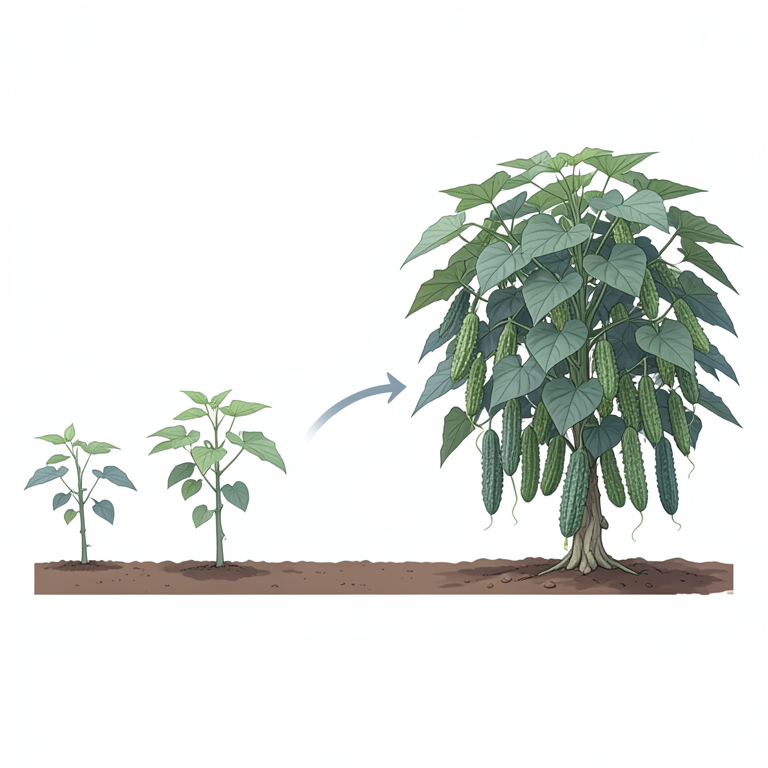
Hybrid Performance Comparison
AI-generated conceptual illustration (bitter gourd plants (Momordica charantia)). It explains the idea and does not show study data.
View source evidence ↗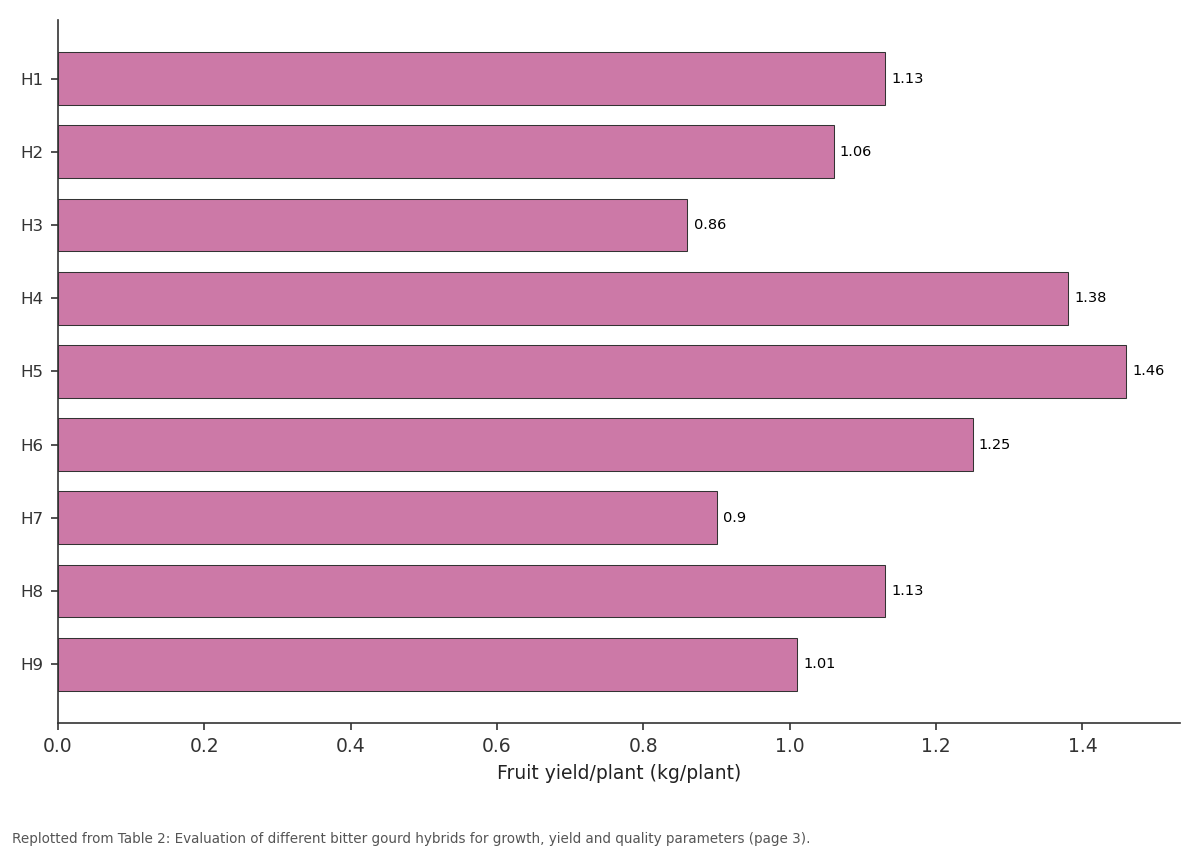
Fruit yield/plant (kg/plant): H1 vs H2 vs H3 vs H4 vs H5
Replotted from Table 2 (page 3) of the original paper. Every bar is the paper's own table value.
View source evidence ↗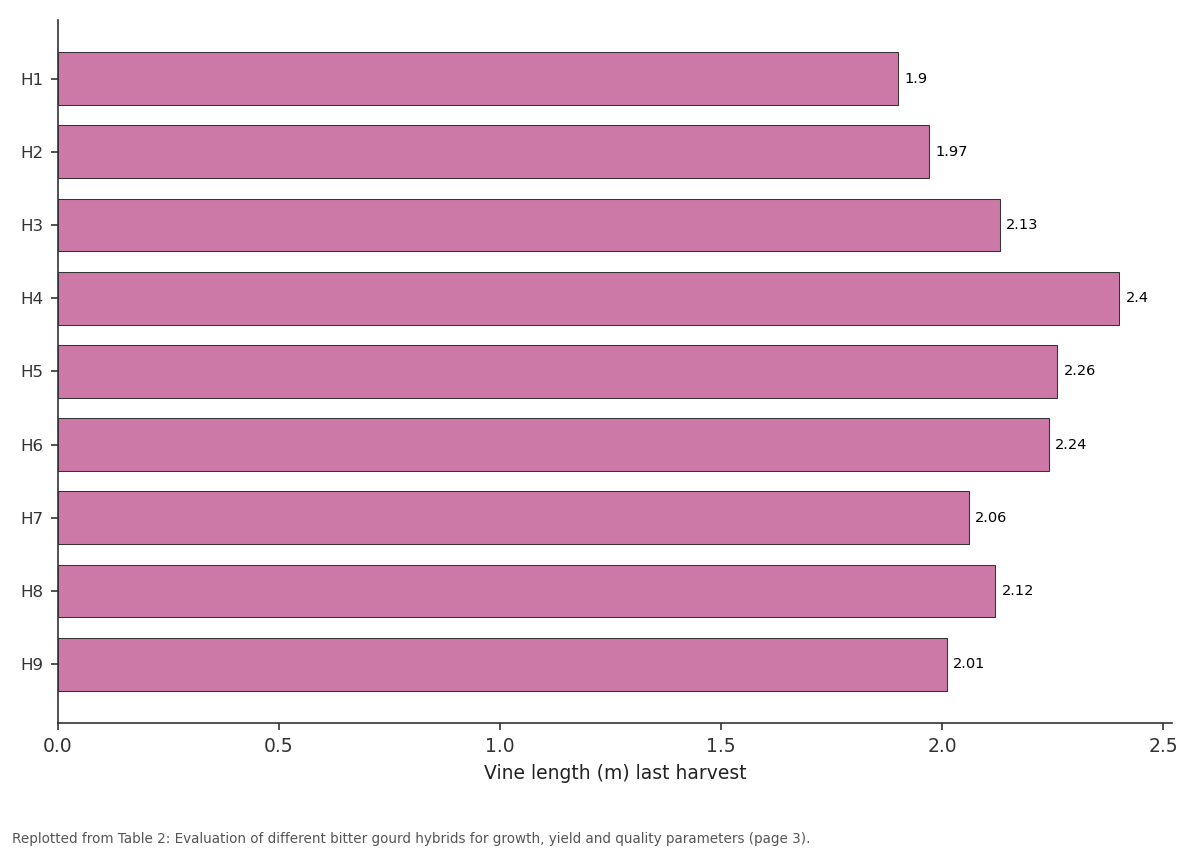
Vine length (m) last harvest: H1 vs H2 vs H3 vs H4 vs H5
Replotted from Table 2 (page 3) of the original paper. Every bar is the paper's own table value.
View source evidence ↗Figures & tables
From the original paper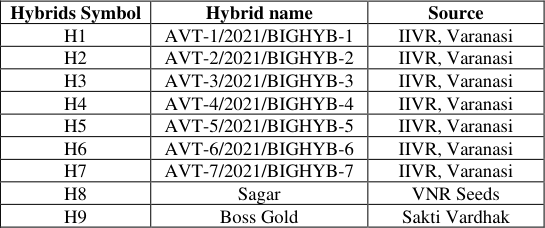 Table 1
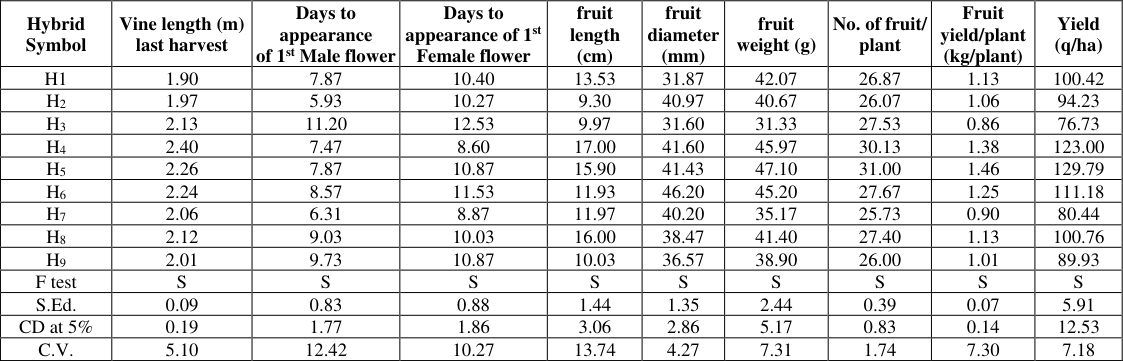 Table 2
Introduction
Bitter gourd (Momordica charantia L.), 2n =2x=22, is an annual, climber vine. It is monoecious and highly cross pollinated due to a high degree of heterozygosity (Singh et al., 2013) [17] . It used as a vegetable and reported to have medicinal properties. The genus derives its name from the Latin word, mordicus meaning bitten; because the jagged edges of the seed look like bite marks. The green fruits of bitter gourd are superior with regard to its nutritive value compared with any other vegetable. The fruits are rich in iron, Vitamin A, B, C & are an inexpensive source of proteins and minerals. The fruits contain 2.1 g of protein, 4.2 g of carbohydrates, 1.8 mg of iron, 20 mg of calcium, 88 mg of vitamin C, 55 mg of phosphorus and 210 IU of vitamin A in 100 g of edible portion (Handbook of Horticulture ICAR). Consumption of its fruit juice is extremely helpful for diabetic patients due to its potent oxygen free radical scavenging activity. Fruits and seeds of bitter gourd are consumed together at immature stage and both possess therapeutic properties such as anti-diabetes (Chen et al., 2003) [6] , anti-carcinogenic and hypercholesterolemic (Ganguly et al., 2000; Ahmed et al., 2001) [7,1] , charantin (Yeh et al., 2003) [18] , hypoglycemic compounds (Jayasooriya et al., 2000) [8] , momorcharin (Inactivating ribosome; Leung et al., 1997) [12] , MAP30 (a momordica-HIV protein that suppress HIV activity; Lee-Huang et al., 1995) [13] , momordicoside A and B (tumour growth inhibitor;). The fruits of bitter gourd additionally possess anti-fertility anti-microbial, anti-viral, and antiulcerogenic, anti-tumour activities characterized in bitter gourd attributed to broad array of biologically active phytochemicals together with triterpenes and steroids. The bitterness of bitter gourd is due to the cucurbitacin like alkaloid momordicine and triterpene glycosides viz., momordicoside K and L. Leading states cultivating bitter gourd in India are Tamil Nadu, Kerala, Maharashtra, Uttar Pradesh, Andhra Pradesh, Gujarat etc. Major constraints to productivity of bitter gourd are low genetic potential of improved varieties, lack of early and high yielding hybrids, and inaccessibility of quality seeds besides poor crop management, biotic and abiotic stresses. Therefore, hybrid varieties can play a vital role in increasing total production and productivity due to their high yield potential, early maturing, superior quality, disease and pest resistance.
Hence, in the present investigation, parents and hybrids were evaluated to identify the best parents and hybrid combination.
Materials and Methods
The Bitter Gourd at the 1.5 x 0.75 m spacing were used for the experiment will be conducted at Vegetable Research Farm, Department of Horticulture, Naini Agricultural Institute, Sam Higginbottom University of Agriculture, Technology & Sciences, Prayagraj (UP) during 2023. All the facilities necessary for cultivation, including labour will be made available in the department. Geographically Prayagraj is situated at an elevation of 78 meters above sea level at 25.87 0 North latitude and 81.15 0 E longitudes. The experimental land is situated in the river basin of the Ganga and the Yamuna. Prayagraj, the region has a sub-tropical climate prevailing in the South-East part of U.P. with both the extremes in temperature, i.e., the winter and the summer. In cold winters, the temperature sometimes is as low as 20 °C in December -January and very hot summer with temperature reaching up to 48 °C in the months of May and June. The average rainfall is around 1042 mm with maximum concentration during July to September months with occasional showers in winters. Statistically analyzed using analysis of variance (ANOVA) as applicable to Randomized Block Design.
Results and Discussion
Statistically analyzed mean data of the experiment revealed the presence of significant differences among the hybrids for most of the growth contributing characters studied. Wide range of variation in mean performance of genotypes was observed for all characters under study (Table 2). The mean performance was highly significant for all characters, suggesting that there is ample scope for selection in different traits for the improvements of Bitter gourd. Analysis of variance showed significant differences among the hybrids for the study of the characters at 0.1% and 5% significance.
| Hybrid Symbol | Vine length (m) last harvest | Days to appearance of 1st Male flower | Days to appearance of 1st Female flower | fruit length (cm) | fruit diameter (mm) | fruit weight (g) | No. of fruit/ plant | Fruit yield/plant (kg/plant) | Yield (q/ha) |
|---|---|---|---|---|---|---|---|---|---|
| H1 | 1.90 | 7.87 | 10.40 | 13.53 | 31.87 | 42.07 | 26.87 | 1.13 | 100.42 |
| H2 | 1.97 | 5.93 | 10.27 | 9.30 | 40.97 | 40.67 | 26.07 | 1.06 | 94.23 |
| H3 | 2.13 | 11.20 | 12.53 | 9.97 | 31.60 | 31.33 | 27.53 | 0.86 | 76.73 |
| H4 | 2.40 | 7.47 | 8.60 | 17.00 | 41.60 | 45.97 | 30.13 | 1.38 | 123.00 |
| H5 | 2.26 | 7.87 | 10.87 | 15.90 | 41.43 | 47.10 | 31.00 | 1.46 | 129.79 |
| H6 | 2.24 | 8.57 | 11.53 | 11.93 | 46.20 | 45.20 | 27.67 | 1.25 | 111.18 |
| H7 | 2.06 | 6.31 | 8.87 | 11.97 | 40.20 | 35.17 | 25.73 | 0.90 | 80.44 |
| H8 | 2.12 | 9.03 | 10.03 | 16.00 | 38.47 | 41.40 | 27.40 | 1.13 | 100.76 |
| H9 | 2.01 | 9.73 | 10.87 | 10.03 | 36.57 | 38.90 | 26.00 | 1.01 | 89.93 |
| F test | S | S | S | S | S | S | S | S | S |
| S.Ed. | 0.09 | 0.83 | 0.88 | 1.44 | 1.35 | 2.44 | 0.39 | 0.07 | 5.91 |
| CD at 5% | 0.19 | 1.77 | 1.86 | 3.06 | 2.86 | 5.17 | 0.83 | 0.14 | 12.53 |
| C.V. | 5.10 | 12.42 | 10.27 | 13.74 | 4.27 | 7.31 | 1.74 | 7.30 | 7.18 |
Table text extracted from the original PDF; superscript letters are shown inline. The original table image is below.
View original table image
The highest vine length (m) was recorded for AVT-1/2022/BIGHYB-4 (2.40) (H4) and lowest vine length (m) was recorded for AVT-1/2022/BIGHYB-1 (1.90) (H1). This character showed higher and positive significant association with vine length per plant, significant and negative association with vine length at both genotypic and phenotypic level was noticed by Nayak et al., (2016) [16] .
Days to First Male Flowering
The maximum number of days to appearance of 1 st male flower was recorded in Sagar (H8) (55.33) and minimum number of days to appearance of 1 st male flower was recorded in AVT1/2022/BIGHYB-1(49.60) (H1). The days to 1 st male flower emergence play an important role in deciding the earliness or lateness of crop in general. The variation in the 1 st male flower emergence migthave been due to internodal length, number of internodal & vigour of the crop. Similar finding was reported by Kumar et al. (2011) [10] , Bitter gourd.
Days to first male flowering
The maximum number of days to appearance of 1 st female flower was recorded in Boss Gold (H9) (57.13) and minimum number of days to appearance of 1 st female flower was recorded in AVT-1/2022/BIGHYB-2(52.80) (H2). The days to 1 st female flower emergence play an important role in deciding the earliness or lateness of crop in general. Similar finding was reported by Kumar et al. (2011) [10] , Bitter gourd.
The highest fruit average length (cm) was recorded for AVT-1/2022/BIGHYB-4 (17) (H4) and lowest fruit average length (cm) was recorded for AVT-1/2022/BIGHYB-2 (9.30) (H2).
The findings are same concordance with reports of Meerabai et al. (2007) [15] as highly significant and positive association of fruit weight.
The highest fruit average diameter (mm) was recorded for AVT-1/2022/BIGHYB-6 (46.20) (H6) and lowest fruit average diameter (mm) was recorded for AVT-1/2022/BIGHYB-3 (31.60) (H3). The enhancement in girth of fruit under different varieties and spacing seems to be due to the variation in seeds per pod among varieties which accounted for varietals inheritance.
The maximum average fruit weight (g) was recorded for AVT-1/2022/BIGHYB-5 (47.10) (H5) and minimum average fruit weight (g) was recorded for AVT-1/2022/BIGHYB-3 (31.33) (H3). These findings are in good lines with those achieved by Malek et al. (2012) [14] .
Number of fruits per plant
The highest No. of fruit per plant was recorded for AVT-1/2022/BIGHYB-5 (31) (H5) and lowest No. of fruit per plant was recorded for AVT-1/2022/BIGHYB-7 (25.73) (H7). The number of fruits per plant is an important determination of yield in bitter gourd due to apportioning efficiency part and hormonal balance in the plant system (Anburani and Manivannan 2002) [3] . Similar results were reported by Choudhury et al., (2013) [5] and Akand et al., (2015) [2] in bitter gourd.
The highest fruit yield per plant (Kg) was recorded for AVT-1/2022/BIGHYB-5 (1.46) (H5) and lowest fruit yield per plant (Kg) was recorded for AVT-1/2022/BIGHYB-3 (0.86) (H3).
The possible reasons might be improvement in fruit yield/plant, leading to increase in pollination and fertilization rates. This can result in higher fruit yield set and a greater number of fruits per plant, another possible reason might be the improvement in nutrient uptake and plant ability to withstand. This means that the plants continue to produce fruits for a longer period, resulting in an overall increase in fruit yield. Similar observation was recorded by Meerabai et al., 2007 [15] .
The highest fruit yield (q/ha) was recorded for AVT-1/2022/BIGHYB-5 (129.79) (H5) and lowest fruit yield (q/ha) was recorded for AVT-1/2022/BIGHYB-3 (76.73) (H3). The possible reason for increased fruit yield might be associated to better inorganic nitrogen utilization in the presence of bio fertilizers and varieties, which enhanced biological nitrogen fixation, better development of root system and possible higher synthesis of plant growth hormones. Similar trend of work has been noted by Anburani and Manivannan (2002) [3] .
Conclusion
It is concluded or recommended to the farmer of Prayagraj region for growing of bitter gourd hybrids AVT-1/2021/BIGHYB-5 was best for all the parameters including yield and quality of (129.79 q/ha) and highest Benefit cost ratio 2.08
Figures and tables from the paper
| Hybrids Symbol | Hybrid name | Source |
|---|---|---|
| H1 | AVT-1/2021/BIGHYB-1 | IIVR, Varanasi |
| H2 | AVT-2/2021/BIGHYB-2 | IIVR, Varanasi |
| H3 | AVT-3/2021/BIGHYB-3 | IIVR, Varanasi |
| H4 | AVT-4/2021/BIGHYB-4 | IIVR, Varanasi |
| H5 | AVT-5/2021/BIGHYB-5 | IIVR, Varanasi |
| H6 | AVT-6/2021/BIGHYB-6 | IIVR, Varanasi |
| H7 | AVT-7/2021/BIGHYB-7 | IIVR, Varanasi |
| H8 | Sagar | VNR Seeds |
| H9 | Boss Gold | Sakti Vardhak |
Table text extracted from the original PDF; superscript letters are shown inline. The original table image is below.
View original table image
References
18 in the original paper- Ahmed I, Lakhani MS, Gillett M, John A, Raza H. Hypotriglyceridemic and hypocholesterolemic effects of antidiabetic Momordica charantia (Karela) fruit extract in streptozotocin-induced diabetic rats. Diabetes Res Clin Pract. 2001;51:155-61.
- Akand II, Khairul Mazed ILEM, Pulok Md AI, Chowdhury Md S, Moonmoon JF. Int J Appl Res. 2015;1:71-4.
- Anburani A, Manivannan K. Effect of integrated nutrient management on growth in brinjal (Solanum melongena L.) cv Annamalai. South Indian J Hort. 2002;50(4-6):377-86.
- Anonymous. Handbook of Indian Horticulture Database. Gurgaon: National Horticulture Board; 2011.
- Bhardwaj DR, Singh A, Singh U. Genetic variability of bottle gourd [Lagenaria siceraria (Mol.) Standl.] by multivariate analysis. In: Proceedings of the National Symposium on Abiotic; Choudhury S, Islam N, Sarkar MD, Ali MA. Int J Sustain Agric. 2013;5:25-8.
- Chen Q, Laureen L, Chan L, Li ET. Bitter melon (Momordica charantia) reduces adiposity, lowers serum insulin and normalizes glucose tolerance in rats fed a highfat diet. J Nutr. 2003;133:1088-93.
- Ganguly C, De S, Das S. Prevention of carcinogen induced mouse skin papilloma by whole fruit aqueous extract of Momordica charantia. Eur J Cancer Prev. 2000;9:283-8.
- Jayasooriya AP, Sakono M, Yukizaki C, Kawano M, Yamamoto K, Fukuda N. Effects of Momordica charantia powder on serum glucose levels and various lipid parameters in rats fed with cholesterol-free and cholesterolenriched diets. J Ethnopharmacol. 2000;72:331-6.
- Kamili KL, Tamilselvi C, Vijayaraghavan H. Impact of plant growth regulators and formulations on growth of bitter gourd (Momordica charantia L.). Plant Gene Trait. 2002;5(8):1-3.
- Kumar R, Prasad VM. Hybrid evaluation trial in bottle gourd [Lagenaria siceraria (Mol.) Standl.]. Environ Ecol. 2011;29(1):74-7.
- Kumaran Y, Natrajan MC. Quality and safety of fresh fruits and vegetables at harvest. Sci Hortic. 2018;239:78-9.
- Leung KC, Meng ZQ, Ho WKK. Antigenic determination fragments of α-momorcharin. Biochim Biophys Acta. 1997;1336:419-24.
- Lee HS, Huang PL, Huang PL, Bourinbaiar AS, Chen HC, Kung HF. Inhibition of the integrase of human immunodeficiency virus (HIV) type 1 by anti-HIV plant proteins MAP30 and GAP31. Proc Natl Acad Sci USA. 1995;92:8818-22.
- Malek MA, Shafiquzzaman M, Rahman MS, Ismail MR, Mondal MMA. Standardization of soybean row spacing based on morpho-physiological characters. Legume Res. 2012;35(2):138-43.
- Meerabai M, Jayachandran BK, Asha KIR. Biofarming in bitter gourd (Momordica charantia L.). Acta Hortic. 2007;752:349-52.
- Nayak DA, Pradhan M, Mohanty S, Parida AK, Mahapatra P. Effect of integrated nutrient management on productivity and profitability of pointed gourd (Trichosanthes dioica Roxb.). J Crop Weed. 2016;12(1):25-31.
- Singh V, Shah KN, Rana DK. Performance of different bitter gourd (Momordica charantia L.) strains for growth, yield and quality traits under Garhwal hills. Plant Arch. 2013;16(2):815-20.
- Yeh GY, Eisenberg DM, Kaptchuk TJ, Phillips RS. Systematic review of herbs and dietary supplements for glycemic control in diabetes. Diabetes Care. 2003;26:127794.
Cited by 1
From OpenAlex, OpenCitations and reference lists read by Scinovex
- Genetic architecture of biochemical traits for heterosis and combining ability in bitter gourd (Momordica charantia L.) ↗
Diksha Saini, Yashpal Singh Bisht, Amit Saurabh, Anand Singh Rawat, Megha Ahir, Ruksana Khan et al. · Vegetos · 2026
❝ 0