
Research article · 2024 · Full text
International Journal of Agriculture Extension and Social DevelopmentAn effective extension approach for improving milk production of Jafarabadi buffalo by dissemination of technological interventions under Farmers FIRST Project
Volume 7(5) · Pages 198–200 · DOI: 10.33545/26180723.2024.v7.i5c.620 ↗
Research areasLivestock Management and Performance ImprovementAgricultural Economics and PracticesAgricultural Systems and Practices
Abstract
Author-writtenField experiment was conducted on 50 Jafarabadi buffalo at four selected villages viz. Mavjinjava, Hadala, Deri Pipaliya and Nava Vaghaniya of Bagasara Taluka of Amreli district (Gujarat) during 2017-18 to 2019-20 under the Farmers FIRST Programme. Fifty Jafarabadi buffalo having mixed parity kept by small and marginal farmers at four selected villages were assigned treatment. Milk yield of the same buffaloes before commencement of the experiment was considered as control. Experiment group of buffaloes were supplemented with commercially available mineral mixture @ 40 g/day, calcium supplement @ 50 ml/day and deworming at 3 months interval. All buffaloes were fed seasonal Jowar, maize and lucerne as green fodder and groundnut haulm, Jowar hay and dry grass as dry fodder. Concentrate mixture were fed to advanced pregnant and lactating buffaloes only. Daily milk yield data were collected on monthly interval. Average daily milk yield of control and treatment group were 7.13 and 8.16 litres, respectively. Milk yield was significantly increased under technological intervention and recorded 14.40% more over the farmer's practice. Economic analysis of intervening technology revealed that additional gross return of Rs.47.60/buffalo/day incurred in treatment group as compared to the control. Farmers were benefitted by getting additional net return of Rs.37.11/buffalo/day and Rs. 11133/buffalo/year with BCR 1.28. Farmers’ feedbacks revealed that the technology is feasible and adoptable. Impact survey indicated that the technologies have been spread horizontally to non-adopted farmers to increase milk yield and income of buffalo owners. This has definitely helped in socio-economic empowerment of the farmers.
Summary
Source-checkedPlain-language reading of the full paper, prepared with AI and checked against the text. Each point links to the authors' own words.
Why it matters
- Buffalo production is a popular business in Gujarat, but farmers often fail to reach the full milk yield potential of their animals because they lack scientific supplementation. View evidence ↗
- The Farmers' FIRST Programme (FFP) is an ICAR initiative designed to support smallholder agriculture by improving the interface between farmers and scientists. View evidence ↗
- A baseline survey in the target villages identified that mineral deficiencies (specifically calcium) and worm infestations were causing low milk production and poor reproductive health in Jafarabadi buffaloes. View evidence ↗
The question
- The study aimed to implement latest animal husbandry technologies to increase farmer income, reduce input costs, and evaluate the socio-economic impact on beneficiary farmers. View evidence ↗
What they did
- The field experiment involved 50 Jafarabadi buffaloes across four villages in the Bagasara Taluka of Amreli district, Gujarat, from 2017-18 to 2019-20. View evidence ↗
- The technological intervention consisted of daily supplements of 40g chelated mineral mixture and 50ml calcium, along with a 3g Fenbendazole deworming bolus every three months. View evidence ↗
- The control group was the milk yield of the same buffaloes before the experiment; all animals received a standard diet of seasonal green fodder and dry fodder, with concentrates reserved for lactating or advanced pregnant buffaloes. View evidence ↗
- Daily milk yield was recorded monthly and analyzed using a standard 't' test. View evidence ↗
What they found
- The average daily milk yield increased from 7.13 litres in the control group to 8.16 litres in the treatment group. View evidence ↗
- The technological intervention resulted in a significant increase in milk yield of 1.03 litres per buffalo per day, representing a 14.40% increase over farmer practices. View evidence ↗
- The intervention provided an additional gross return of Rs. 47.6/buffalo/day and an additional net return of Rs. 37.11/buffalo/day (or Rs. 11,133/buffalo/year), with a Benefit-Cost Ratio (BCR) of 1.28. View evidence ↗
- Reproductive health improved, with 35 buffaloes coming into heat, 28 artificial inseminations performed, and 16 calves born (9 female, 7 male). View evidence ↗
- An impact survey showed that the implemented technologies spread horizontally to farmers who were not part of the original adoption group. View evidence ↗
What it means
- The authors conclude that supplementing Jafarabadi buffaloes with mineral mixtures, calcium, and dewormers increases milk production and improves reproductive health, leading to higher income and socio-economic upliftment for rural farmers. View evidence ↗
Visual summary
1 visualsIllustrations explain the paper; they do not show study data.
Impact of Technological Interventions
AI-generated conceptual illustration (Jafarabadi buffaloes). It explains the idea and does not show study data.
View source evidence ↗Figures & tables
From the original paper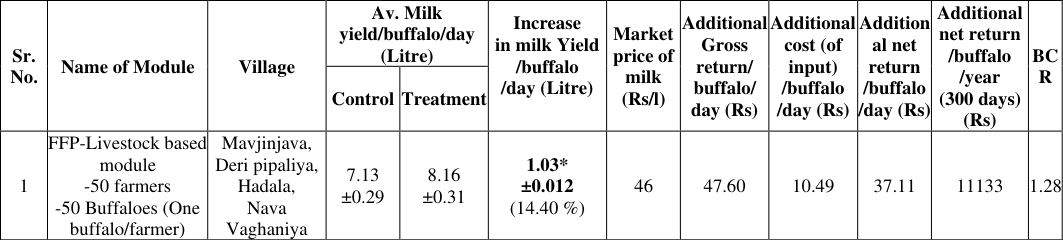 Table 1
Introduction
There are number of programmes, policies and schemes are being implemented by the Government for developing the people living in remotest corners of rural area. There are number of technologies generated by the Research Institutions and are communicated to the farmers for adoption. But according to local situations and resources available with the farmers are sometimes not in harmony with these new technologies. Farmers’ FIRST Project is a new way of research programme involving problems identification, prioritization and conduct of experiments and its management under farmers conditions.
The programme is having focus on farmer’s Farm, Innovations, Resources, Science and Technology (FIRST). Many times research recommendations coming out from research institutions may not fit as such in the farmers’ conditions and thus, certain alterations and adaptations are required at field level for their acceptance, adoption and success. The Farmers' FIRST Programme (FFP) is an ICAR initiative to move beyond the production and productivity, to privilege the smallholder agriculture and complex, diverse and risk prone realities of majority of the farmers through enhancing farmers-scientists interface. This project also involves in organizing extension programmes for disseminating the recent agricultural technologies to the farmer’s field.
Buffalo production is very popular enterprise in Gujarat. However, farmers are not getting the milk yield as per the potential of their buffaloes due to lack of scientific supplementations. Therefore, buffalo owners of Saurashtra region were focussed for farmers’ FIRST programme by Junagadh Agricultural University, Junagadh. On this background the project “Integrated Resource Management in Agriculture and Allied Fields for Stakeholders” under FFP comprising Livestock based module was conducted with following objectives: ▪ To increase the interface among people and development organizations. ▪ Effective implementation of latest technology in animal husbandry. ▪ To develop capacity building of beneficiary farmers regarding agricultural (livestock) technologies. ▪ Impact evaluation of livestock based module on socio- economic and demographic traits of beneficiary farmers. ▪ To increase in the income of farmers and reduce input cost.
Materials And Methods
Under the Farmers FIRST Programme (FFP), Livestock Based Module, 50 farmers families (one Jaffrabadi buffalo/farmer family) from the cluster of four villages (i.e. 198 https://www.extensionjournal.com Mavjinjava, Nava Vaghania, Deri Pipaliya and Hadala villages) of Bagasara Taluka of Amreli district (Gujarat) have been selected on the basis of land holding, animal husbandry, leadership characteristics, socio-economic status, felt needs and their interest. These villages are situated in the radius of 4 to 5 km in Bagasara Taluka. Farmers belonged to large, medium, small and marginal size of land holding, scheduled caste, socially & educationally backward and women farmers were selected for the experiment. The region falls under North Saurashtra Agro- Climatic Zone–VI.
It is an agriculture oriented Taluka having medium black calcareous soils with 600-700 mm rainfall. Baseline survey of the selected villages revealed deficiency of calcium and other minerals and worm infestation in Jaffrabadi buffalo led to low milk production and poor reproductive health in the area.Farmers were facing problems related to lower milk production and poor reproductive health but they might not have found out solutions to overcome them. FFP-Livestock module Table 1: Yield and economics of milk production in Jafarabadi buffalo. Additional Additional Additional Addition Av.
Milk yield/buffalo/day net return Increase in milk Yield cost (of (Litre) Market price of /buffalo BC Sr. No. Name of Module Village /buffalo /day (Litre) milk (Rs/l) /year (300 days) R Control Treatment Gross return/ buffalo/ day (Rs) input) /buffalo /day (Rs) al net return /buffalo /day (Rs) (Rs) FFP-Livestock based Mavjinjava, Deri pipaliya, 1 Hadala, 46 47.60 10.49 37.11 11133 1.28 7.13 ±0.29 8.16 ±0.31 module -50 farmers -50 Buffaloes (One 1.03* ±0.012 (14.40 %) buffalo/farmer) Nava Vaghaniya Technology intervened: (1) Chelated mineral mixture: 40 g/buffalo/day (2) Calcium supplement: 50 ml/buffalo/day (3) Fenbendazole bolus-3g: one bolus in 3 month interval Control: Milk yield before experiment *Significant at P<0.05 Technical Observations Average increase in milk yield/buffalo/day: 1.03 litre (14.40%) Average additional net return/buffalo/year: Rs. 11133/- No of buffaloes came in heat: 35 No. of Artificial Insemination done: 28 No of buffalo calves born: 16 Sex of the calf born: 9 Female, 7 Male Very good improvement in general and reproductive health is observed. 5. Preparations and distribution of extension teaching Work plan of project 1.
Field experiment was conducted on 50 Jafarabadi materials like booklets, leaflets and folders was carried out for knowledge by team of scientists 6. Organized trainings / capacity building programmes for farmers by team of scientist buffalo at four selected villages during 2017-18 to 201920 under the Farmers FIRST Programme. All 50 buffaloes (one buffalo/farmer family) were subjected to following intervention. Technology intervened: Supplementing with chelated mineral mixture (40 g/buffalo/day) + Calcium supplement (50 ml/buffalo/day) + Dewormer (Fenbendazole bolus 3 g in 3 month interval) to Jafarabadi buffalo.
Milk yield of the same buffaloes before commencement of the experiment was considered as control. All buffaloes were fed seasonal Jowar, maize and lucerne as green fodder and groundnut haulms, Jowar hay and dry grass as dry fodder. Concentrate mixture were fed to only advanced pregnant and lactating buffaloes. Daily milk yield data were collected on monthly interval.
Data were analysed as per standard statistical procedure using ‘t’ test. 2. Monitoring and Implementation of interventions of livestock module was done by team of scientists 3. Data collection and evaluation of project was carried at the end of each year. 4. Community mobilization for awareness creation through campaigning meeting, field visits etc. by team of scientists
Results And Discussion
Jafarabadi buffalo given mineral mixture, calcium supplements and dewormer produced significantly (p<0.05) (14.40%, 1.03 lit/buffalo/day) more milk than control. Increase in additional gross income of Rs. 47.6 /buffalo/day was observed in experiment group. Farmers were benefitted by getting additional net return of Rs.37.11/buffalo/day and Rs.11133/buffalo/year with BCR of 1.28. In addition to this more numbers of buffaloes came in oestrous, showed prominent heat symptoms, reduced incidences of retained placenta and prolapse.
Thus, reproductive health of the buffaloes improved greatly. Various studies on effect of supplementation of mineral mixtures on milk yield and reproductive health of buffaloes have supported the present
Result
(Harendra Kumar, et al., 2012; Singh, et al., 2016; Rathore, et al., 2017; Deepak Kumar, et al., 2017; Atkre, et al., 2018 and Tanwar, et al. 2019) [3, 6, 5, 2, 1, 7]. Farmers’ feedbacks revealed that the technologies are feasible and adoptable to increase yield and income. Impact survey indicated that the technologies have been spread horizontally to non-adopted farmers. 199 https://www.extensionjournal.com
Conclusion
Based on the three-year experimentation on farmers’ field under farmers’ FIRST programme (Livestock Based Module), it can be concluded that the technological intervention of supplementing mineral mixture, calcium supplement and dewormer increased milk production and improved health and reproduction in Jafarabadi buffalo and thus more income. This has definitely helped in socio- economic upliftment of rural farmers. Farmers got an opportunity to solve their problems with the support of the researchers and extensionists. Farmers learned and shared buffalo keeping experience with other farmers.
Acknowledgement
Authors are grateful to the Director of Extension Education, Junagadh Agricultural university, Junagadh and ICAR for providing facilities and funds to conduct the experiment.
References
7 in the original paper- Atkare VG, Shambharkar AD, Khupse SM. Effect of Feeding of Bypass Fat Mineral Mixture on Productive Performance and Quality of Milk of Buffaloes in Armori Tahsil. Int. J Curr. Microbiol. App. Sci. 2018;7(01):2949-2957.
- Kumar D, Surinder S. Grewal, Ravi Kumar, Ramkaran and Sajjan Sihag. Effect of Supplementation of Chelated Minerals on Serum Mineral Profile of Buffalo Calves. Int. J Curr. Microbiol. App. Sci. 2017;6(11):4242-4247.
- Kumar H, Bhooshan N, Dass RS, Nandi S. Supplementation of area specific mineral mixture improves the reproductive performance in buffaloes-a field study. Indian Journal of Animal Sciences. 2012;82(10):1245-1247.
- Madke PK, Pal D, Prakash S, Kumar A. Effect of Mineral Mixture Feeding on Milk Yield in Buffalo. Research Journal of Animal Husbandry and Dairy Science 2016;9(2):84-86.
- Rathore RS, Verma RK, Dayanand D, Mehta SM. Effect of mineral supplementation and dewormer on service period and milk production in buffaloes under field conditions. Annals of Arid Zone. 2017;56(1-2):47- 50.
- Singh S, Chhabra S, Singh C, Randhawa SS, Gupta DK. Effect of Area Specific Mineral Mixture Feeding On Milk Yield and Composition of Dairy Animals of Central Zone of Punjab. International Journal of Livestock Research. 2016;6(3):62-65.
- Tanwar PS, Verma HK, Jadoun YS. Effect of mineral supplementation on production and reproduction performance of buffaloes under farmer management practices. International Journal of Agriculture Sciences. 2019;11(1):7707-7709. 200