
Research article · 2024 · Full text
International Journal of Research in AgronomyTechno-economic evaluation of solar distillation system for essential oil extraction from medicinal plants
Volume 7(5) · Pages 520–523 · DOI: 10.33545/2618060x.2024.v7.i5g.726 ↗
Research areasSolar Thermal and Photovoltaic SystemsSolar-Powered Water Purification MethodsProcess Optimization and Integration
Abstract
Author-writtenEnergy is an inevitable option for sustainable development and energy saving has become more significant nowadays. The environmental problems such as climate change caused by the overuse of fossil fuels has emerged as one of the biggest challenges for the world. In this regard, renewable energy sources such as solar energy, tidal energy, wind energy, biomass energy, etc. could be used to meet the demand of developing countries over the world. Among these sources, solar energy is the most abundant source and solar energy technologies have become a viable option for so many applications in the field of agriculture. This study evaluated the application of solar energy for essential oil extraction and its economic feasibility. It was found that benefit-cost ratio is 1.80 and payback period is 21 months. The study concluded that solar distillation system is an economically feasible method for essential oil extraction.
Summary
Source-checkedPlain-language reading of the full paper, prepared with AI and checked against the text. Each point links to the authors' own words.
Why it matters
- Climate change driven by the excessive use of fossil fuels is one of the most significant global challenges. View evidence ↗
- Solar energy is the most abundant renewable source and provides a viable alternative for various agricultural applications. View evidence ↗
- Solar distillation systems can extract essential oils from plant materials by using solar heat to vaporize and then condense aromatic compounds. View evidence ↗
The question
- The study aimed to evaluate the application of solar energy for extracting essential oils and determine if the process is economically feasible. View evidence ↗
What they did
- The Solar Based Distillation System (SBDS) consisted of a Scheffler solar concentrator, a secondary reflector, a distillation still, and a condenser. View evidence ↗
- The researchers used dried lemongrass leaves as the botanical material for oil extraction using the developed system. View evidence ↗
- The economic analysis assumed the system operated for 200 days per year, processing two batches per day. View evidence ↗
- The economic viability was assessed using four indicators: Net Present Worth (NPW), Benefit-Cost Ratio (BCR), Internal Rate of Return (IRR), and Payback Period (PP). View evidence ↗
What they found
- For lemongrass extraction over 200 operating days per year, the system's Net Present Worth (NPW) was calculated as Rs. 961,144.51. View evidence ↗
- The Benefit-Cost Ratio (BCR) for lemongrass extraction was 1.80, indicating that the benefits outweigh the costs. View evidence ↗
- The investment in the system for lemongrass extraction is recovered in a payback period of 21 months. View evidence ↗
- The Internal Rate of Return (IRR) for the system was 55 percent over a 10-year period, suggesting a strong commercial return. View evidence ↗
What it means
- Based on the BCR of 1.80 and a payback period of 21 months, the authors conclude that the solar distillation system is economically feasible for essential oil extraction. View evidence ↗
Visual summary
1 visualsIllustrations explain the paper; they do not show study data.
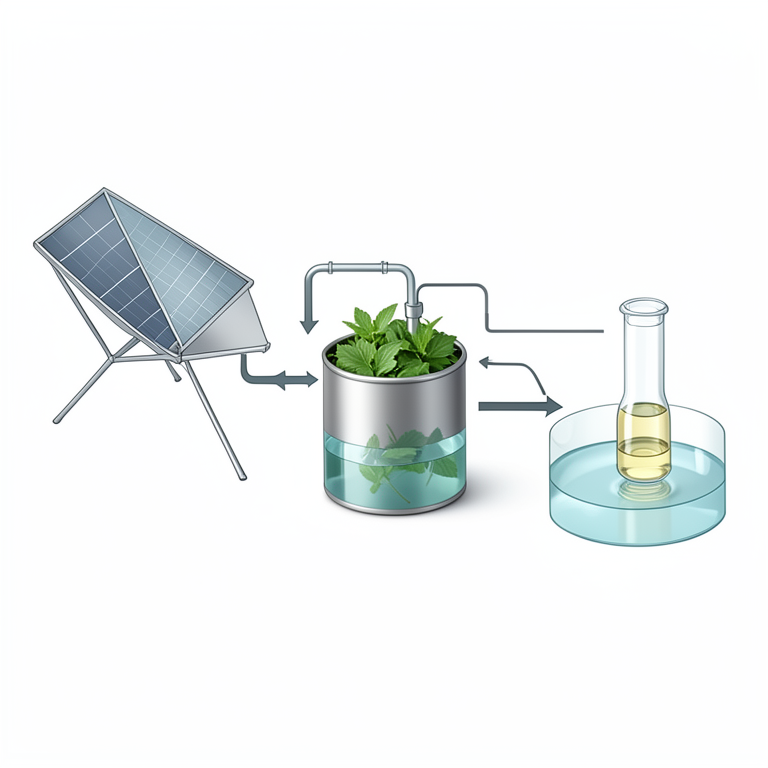
SBDS Component Flow
AI-generated conceptual illustration (Scheffler solar concentrator, distillation still, and condenser for medicinal plant oil extraction). It explains the idea and does not show study data.
View source evidence ↗Figures & tables
From the original paper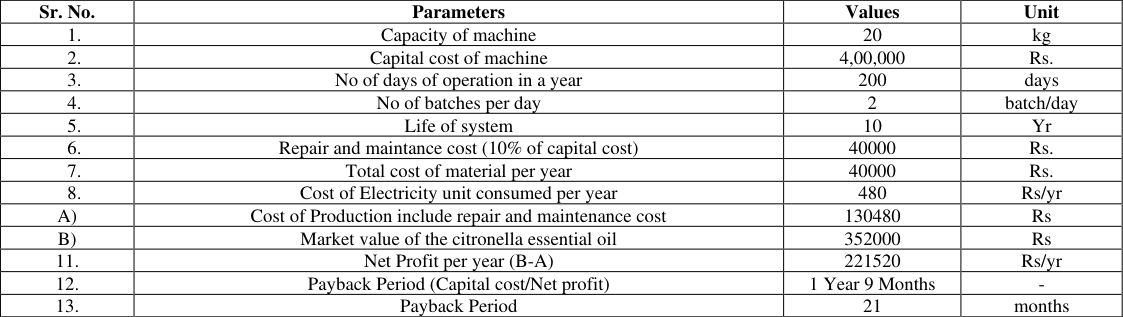 Table 1
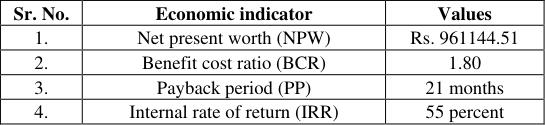 Table 2
Introduction
Renewable energy, particularly solar power, stands as a beacon of hope in the global pursuit of sustainable energy sources (Cuce and Cuce, 2013) [1] . Harnessing the virtually limitless energy emitted by the sun, solar power has emerged as a leading contender in the fight against climate change and the quest for energy independence. Solar panels, comprised of photovoltaic cells, convert sunlight into electricity with remarkable efficiency. Moreover, advancements in solar technology have made it increasingly affordable and accessible, democratizing energy production and empowering communities worldwide. From sprawling solar farms dotting deserts to rooftop installations on homes and businesses, solar energy is revolutionizing the way we power our world, offering a clean, abundant, and renewable alternative to fossil fuels. Beyond its environmental benefits, solar energy also promises economic prosperity and social equity (Buratti and Muretti, 2012) [2] . By tapping into the sun's energy, nations can reduce their dependence on costly and volatile fossil fuels, mitigating the economic risks associated with fluctuating oil prices and geopolitical tensions. Furthermore, the decentralized nature of solar power allows individuals and communities to take control of their energy production, fostering local resilience and reducing disparities in energy access. As governments, businesses, and individuals increasingly recognize the potential of solar energy to drive sustainable development, investments in solar infrastructure continue to soar, paving the way for a brighter, cleaner, and more equitable energy future. Solar energy holds tremendous promise in revolutionizing post-harvest operations across various agricultural sectors, offering sustainable solutions to preserve and process crops efficiently. In regions where access to electricity is limited or unreliable, solar-powered technologies present an invaluable opportunity to extend the shelf life of harvested produce and reduce post-harvest losses. Solar dryers, for instance, provide an eco-friendly alternative to traditional drying methods, allowing farmers to efficiently dehydrate fruits, vegetables, grains, and herbs using solar heat. By harnessing the power of the sun, these dryers not only accelerate the drying process but also maintain the nutritional integrity and quality of the harvested crops, ensuring higher market value and reducing food waste (Belessiotis and Delyannis, 2011) [4] .
Moreover, solar energy finds innovative applications in essential oil extraction, offering a sustainable and environmentally friendly approach to producing high-quality botanical extracts. Solar distillation systems utilize solar heat to vaporize aromatic compounds from plant materials, such as flowers, leaves, and seeds, and then condense them into essential oils (Munir and Hensel, 2010) [3] . This solar-powered extraction method not only eliminates the need for fossil fuels but also minimizes greenhouse gas emissions and chemical residues, resulting in purer and more natural essential oils (Hilali et al., 2019) [7] . From lavender and rosemary to citrus fruits and eucalyptus, solar-powered essential oil extraction holds immense potential for small-scale farmers, cooperatives, and artisanal producers seeking to harness the healing and aromatic properties of plants while promoting sustainable agricultural practices. By integrating solar energy into post-harvest operations and essential oil extraction processes, communities can enhance food security, promote rural livelihoods, and contribute to a more sustainable and resilient agricultural sector. This study was conducted to analyse the economic feasibility of solar distillation system.
Materials and Methods
Materials and Methods
Solar Based Distillation System (SBDS)
SBDS was developed to extract essential oil from medicinal and aromatic plants. The major components of the system were solar concentrator, secondary reflector, distillation still and condenser. The Scheffler concentrator acted as a pivotal apparatus for providing energy. Within the distillation still, botanical material placed above water underwent thermal exposure induced by the concentrated solar energy. This thermal elevation initiated the vaporization of water, concurrently entraining the essential oils present within the botanical matrix. Transitioning from vapor phase to liquid, the laden vapor traversed to the condenser, where it encountered conditions conducive to condensation. The condensed mixture was collected and separated (Munir et al., 2014) [6] . The lemongrass leaves were dried and extracted oil from it using the developed system.
Economic analysis
Economic analysis of systems is highly relevant across various domains due to its ability to provide insights into how different components within a system interact and influence each other economically. Economic analysis of the SBDS was carried out by following indicators (Afzal et al., 2017) [5] . 1. Net Present Worth (NPW) 2. Benefit-Cost Ratio (BCR) 3. Internal Rate of Return (IRR) 4. Payback Period (PP)
Net present worth (NPW)
The net present worth or NPW is a measure of the difference between the current value of all future returns and the initial investment required. It is based on the principle of discounting, where future returns are adjusted to their present value. Discounting involves converting future benefits and costs into their current equivalents using an assumed interest rate as the discount rate. For instance, if a project yields consistent benefits over several years, NPW helps determine how much it's worthwhile to invest today to receive those future returns. Essentially, NPW was calculated by subtracting the total discounted present value of the cost stream from that of the benefit stream, providing a straightforward measure of project worth based on discounted cash flows.
Where, Ct= Cost in each year Bt= Benefit in each year t = 1, 2, 3.n (years) i = Discount rate, %
Benefit cost ratio
The benefit-cost ratio is a financial metric used to assess the economic viability of a project or investment. It involves comparing the present value of benefits to the present value of costs associated with the project. By calculating this ratio, it can be determined whether the benefits of the project outweigh the costs, with a ratio greater than 1 indicating a favourable investment. This analysis helps in evaluating the efficiency and desirability of projects by considering their long-term financial implications. This is the ratio obtained when the present worth of the benefit stream is divided by the present worth of the cost stream. The present value of benefits and costs was calculated by discounting future cash flows back to their present values using the chosen discount rate. Mathematically benefit-cost ratio can be expressed as:
Where, Ct = Cost in each year Bt = Benefit in each year t = 1, 2, 3.n (year) i = Discount rate
Payback period
The payback period is a financial metric used to evaluate the time it takes for an investment to recover its initial cost. It offers a simple and intuitive way to assess the risk and return of investment projects, particularly for those seeking quick returns or concerned about liquidity. Essentially, the payback period indicates the length of time required for the cumulative cash flows generated by the investment to equal or surpass the initial investment amount. The payback period is then expressed in terms of the number of periods (e.g., months or years) it takes to recover the initial investment.
Internal rate of return
An alternative way to assess a project's value is by determining its internal rate of return (IRR), which identifies the discount rate that sets the net present value of incremental cash flows to zero. Essentially, IRR represents the maximum interest rate the project could handle while still covering its costs and breaking even. It reflects the return on invested capital over each period, offering a crucial measure of profitability. The IRR is calculated through a trial-and-error process to find the discount rate that balances the present value of cash inflows and outflows, revealing the project's break-even point and providing valuable insights into its economic viability.
Results and Discussion
The economic feasibility of the SBDS for essential oil extraction from medicinal plants was calculated by considering the initial investment, average repair and maintenance costs, and the cost of raw materials and oil obtained. The average parameters are drawn on the basis of experimental results. The different economic parameters for essential oil extraction from using SBDS are summarized in Table 1.
| Sr. No. | Parameters | Values | Unit |
|---|---|---|---|
| 1. | Capacity of machine | 20 | kg |
| 2. | Capital cost of machine | 4,00,000 | Rs. |
| 3. | No of days of operation in a year | 200 | days |
| 4. | No of batches per day | 2 | batch/day |
| 5. | Life of system | 10 | Yr |
| 6. | Repair and maintance cost (10% of capital cost) | 40000 | Rs. |
| 7. | Total cost of material per year | 40000 | Rs. |
| 8. | Cost of Electricity unit consumed per year | 480 | Rs/yr |
| A) | Cost of Production include repair and maintenance cost | 130480 | Rs |
| B) | Market value of the citronella essential oil | 352000 | Rs |
| 11. | Net Profit per year (B-A) | 221520 | Rs/yr |
| 12. | Payback Period (Capital cost/Net profit) | 1 Year 9 Months | - |
| 13. | Payback Period | 21 | months |
Table text extracted from the original PDF; superscript letters are shown inline. The original table image is below.
View original table image
Following points were considered to carry out the economic analysis of the SBDS 1. The capacity of the distillation system was 20 kg. 2. The initial cost of distillation system was Rs. 100000 and the cost of Scheffler solar collector was Rs. 3, 00,000. 3. Two batches were considered per day. 4. The operating days of solar distillation system was considered as 200 days. 5. Labour cost was considered to be 250 Rs/day 6. Repair and maintenance cost of the system was assumed to be 10 percent of total capital cost per year.
Net present worth (NPW)
The net present worth of the SBDS was calculated based on present investment and the interest rate considered for the system and the profit achieved in each year. The life of the developed system was assumed as 10 years. Thus, the net present worth of the system was Rs. 961144.51/-for lemongrass (Considering 200 days in a year) as shown in Table 1. The net present worth was calculated for next 10 years.
Benefit-cost ratio (BCR)
The benefit-cost ratio of the developed system was calculated by dividing the present worth of the benefit stream to the present worth of the cost stream. For lemongrass, present worth of the benefit stream was Rs. 342560.33/-whereas the present worth of the cost stream was Rs. 327876.16/-. The benefit-cost ratio of the developed system was found to be 1.80 lemongrass (Considering 200 days in a year).
Payback period (PP)
The payback period of the developed system was estimated by adding net cash flow in the project until the cumulative net cash flow was equal to the initial investment. It is clear from Table 2 that the developed system has a payback period of 21 months for lemongrass (considering 200 days in a year).
| Sr. No. | Economic indicator | Values |
|---|---|---|
| 1. | Net present worth (NPW) | Rs. 961144.51 |
| 2. | Benefit cost ratio (BCR) | 1.80 |
| 3. | Payback period (PP) | 21 months |
| 4. | Internal rate of return (IRR) | 55 percent |
Table text extracted from the original PDF; superscript letters are shown inline. The original table image is below.
View original table image
Internal rate of return (IRR)
The internal rate of return for the solar biomass hybrid distillation system was calculated and found to be 55 percent for lemongrass (10 years). The higher percentage of internal rate of returns indicated the good commercial return of the investment. Internal rate of return (IRR) 55 percent
Conclusion
Essential oils are highly concentrated and aromatic essence of the plants and have various applications in aromatherapy, fragrance, food, and pharmaceuticals. The adoption of renewable energy technology for the essential oil extraction is an innovative and sustainable method. The techno-economic feasibility of SBDS was analyzed. It was found that benefit-cost ratio is 1.80 and payback period is 21 months. Thus, it can be concluded that system is economically feasible.
References
7 in the original paper- Cuce E, Cuce PM. A comprehensive review on solar cookers. Applied Energy 2013;102:1399-421.
- Buratti C, Moretti E. Experimental performance evaluation of aerogel glazing systems. Applied Energy 2012;97:430-7.
- Munir A, Hensel O. On-farm processing of medicinal and aromatic plants by solar distillation system. Biosystems Engineering 2010;106(3):268-77.
- Belessiotis V, Delyannis E. Solar drying. Solar Energy 2011;85(8):1665-91.
- Afzal A, Munir A, Ghafoor A, Alvarado JL. Development of hybrid solar distillation system for essential oil extraction. Renewable Energy 2017;113:22-9. doi: 10.1016/j.renene.2017.05.027.
- Munir A, Hensel O, Scheffler W, Hoedt H, Amjad W, Ghafoor A. Design, development and experimental results of a solar distillery for the essential oils extraction from medicinal and aromatic plants. Solar Energy 2014;108:54859.
- Hilali S, Fabiano-Tixier AS, Ruiz K, Hejjaj A, Ait Nouh F, Idlimam A, et al. Green extraction of essential oils, polyphenols, and pectins from orange peel employing solar energy: Toward a zero-waste biorefinery. ACS Sustainable Chemistry & Engineering. 2019;7(13):11815-22.
Cited by 1
From OpenAlex, OpenCitations and reference lists read by Scinovex
- A green solar integrated hybrid distillation processing system (500 kg capacity) for extraction of high value aroma chemicals: A carbon-credit approach ↗
Manglesh Kumar Gupta, Suman Singh, Ankit V. Deorankar, Bhaskar Patel, Raviranjan Kumar, Akansha Dwivedi et al. · Renewable Energy · 2026
❝ 0