
Research article · 2024 · Full text
International Journal of Advanced Biochemistry ResearchIdentification of potential maize (Zea mays L.) hybrid at Kanpur agroclimatic condition
Volume 8(5) · Pages 568–572 · DOI: 10.33545/26174693.2024.v8.i5g.1134 ↗
Research areasAgricultural Economics and PracticesGenetics and Plant BreedingCrop Yield and Soil Fertility
Abstract
Author-writtenIn the present investigation, heterosis, combining ability effects and yield related parameters were studied for various traits to developed and identify suitable and stable single cross hybrids. The analysis of variance for experimental design revealed the presence of significant amount of variability for most of the characters in the experiment. This suggested that the parental lines selected were quite variable for most of the characters under study. Further, the analysis of variance revealed that genotypes showed significance for all the traits indicating the presence of sufficient variability in the experiment/ study material. Presence of sufficient amount of variability encourages for screening of the genotypes for yield. The per se performance of days to 50% tasseling, days to 50 % silking and anthesis silking interval revealed that the hybrids IL7 X IL8, IL1 X IL11, IL9 X IL12, IL9 X IL12 and IL5 X IL7 showed minimum value. On the basis of mean data we can identify the early maturity hybrids. Mean data revealed that yield and yield contributing traits revealed that the hybrids IL1 X IL8, IL7 X IL8, IL9 X IL10 and IL1 X IL3 showed maximum value. On the basis of mean data we can identify the high yielding genotypes hybrids.
Summary
Source-checkedPlain-language reading of the full paper, prepared with AI and checked against the text. Each point links to the authors' own words.
Why it matters
- Maize is a globally critical cereal crop that supports food security in many developing nations. View evidence ↗
- In India, maize is highly valued for its versatility, serving as food for humans, feed for poultry, fodder, and as a raw material for industrial products. View evidence ↗
- Indian maize hybrid development has focused primarily on grain yield, leaving potential improvements in oil, protein, and starch content under-explored. View evidence ↗
The question
- The study aimed to identify suitable and stable single cross maize hybrids by analyzing heterosis, combining ability, and yield-related parameters. View evidence ↗
What they did
- The research was conducted during the Kharif season of 2023-24 at the Agricultural Research Farm of Rama University in Kanpur. View evidence ↗
- The experimental material consisted of 12 inbred maize lines. View evidence ↗
- A diallel mating design was employed to evaluate the genetic worth of the parents and the resulting hybrids. View evidence ↗
What they found
- Analysis of variance showed that genotypes had a highly significant effect on all ten traits studied, indicating substantial variability. View evidence ↗
- Days to 50% tasseling varied from 59.50 to 107.50 days for parents and 55.00 to 112.00 days for hybrids. View evidence ↗
- Plant height ranged from 108.30 to 186.13 cm in parents and 80.40 to 199.28 cm in hybrids. View evidence ↗
- Yield per plant ranged from 50.14 to 97.14 g for parents and 38.63 to 108.95 g for hybrids. View evidence ↗
- Days to maturity ranged from 95.75 to 114.50 days for parents and 92.00 to 150.25 days for hybrids. View evidence ↗
- Hybrids IL7 X IL8, IL1 X IL11, IL9 X IL12, and IL5 X IL7 were identified as early maturity hybrids due to minimum values in tasseling, silking, and anthesis-silking interval. View evidence ↗
- Hybrids IL1 X IL8, IL7 X IL8, IL9 X IL10, and IL1 X IL3 were identified as high-yielding genotypes. View evidence ↗
What it means
- The authors conclude that mean performance data allows for the successful identification of both early maturing and high-yielding maize hybrids. View evidence ↗
- The authors state that the selection of parents for breeding programs must be based on both their individual performance and their combining ability. View evidence ↗
Visual summary
3 visualsIllustrations explain the paper; charts are replotted from the paper's own table values.
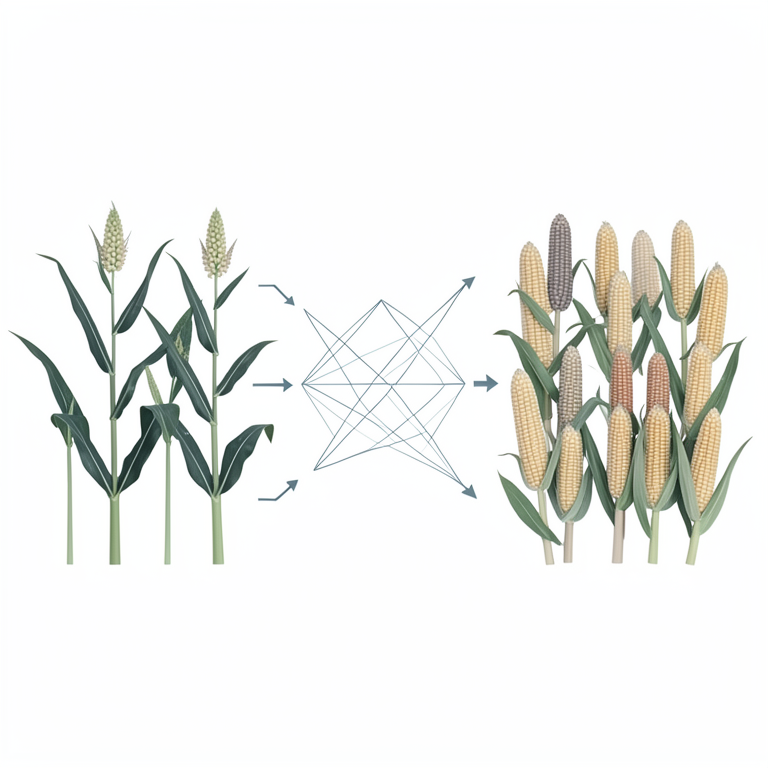
Diallel Crossing Strategy
AI-generated conceptual illustration (maize plants (Zea mays L.)). It explains the idea and does not show study data.
View source evidence ↗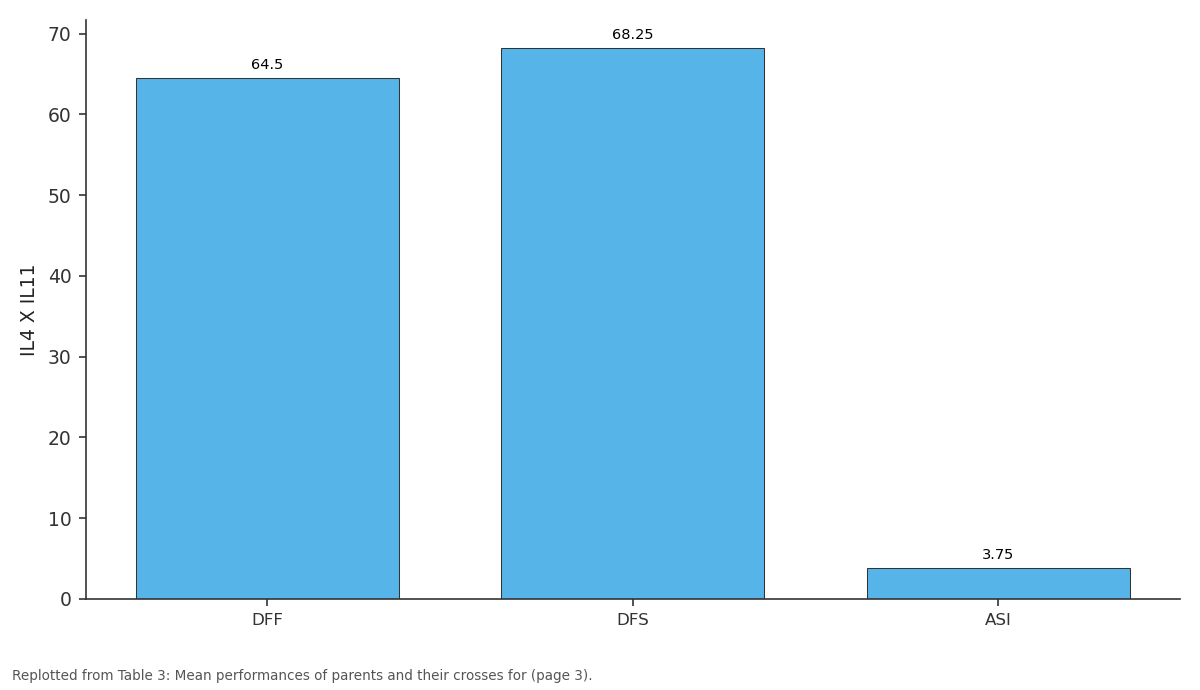
IL4 X IL11: DFF vs DFS vs ASI
Replotted from Table 3 (page 3) of the original paper. Every bar is the paper's own table value.
View source evidence ↗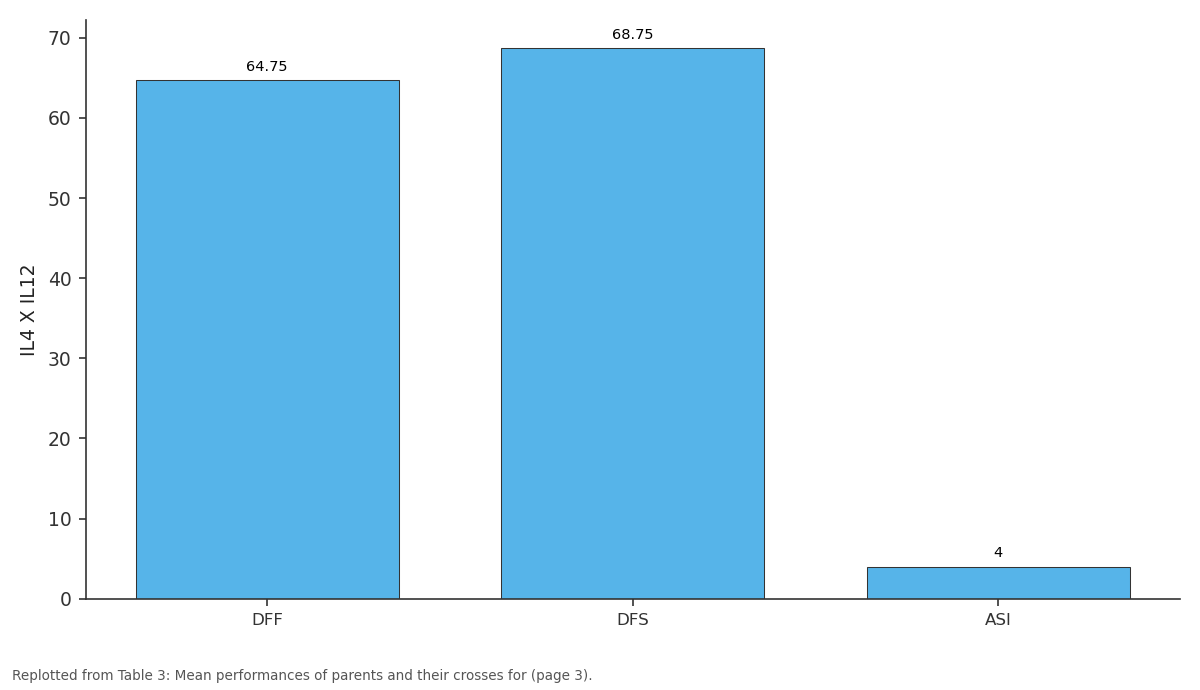
IL4 X IL12: DFF vs DFS vs ASI
Replotted from Table 3 (page 3) of the original paper. Every bar is the paper's own table value.
View source evidence ↗Figures & tables
From the original paper Table 1A
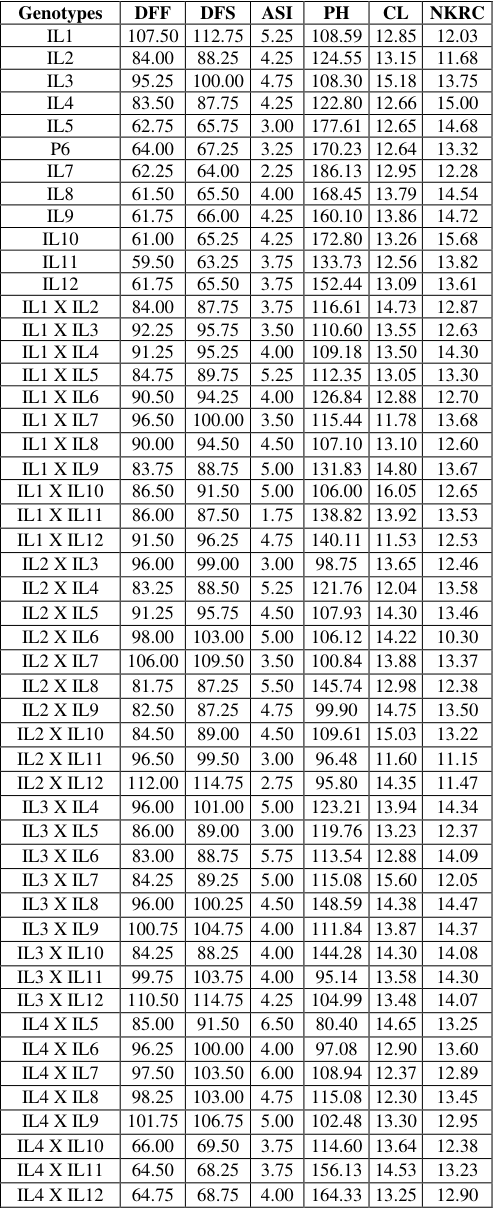 Table 3
Introduction
Maize (Zea mays L.) 2n=20 is one of the most important cereal crops of the world and contributes to food security in most of the developing countries. Maize is third most important crop after rice and wheat in the world. Maize has assumed a place of prominence in Indian agriculture owing to its varied uses viz., human consumption, poultry feed, green fodder, value added products and industrial usage. Globally 67 percent of maize is used for livestock feed, 25 percent for human consumption and rest for industrial purposes. In addition to staple food for human being and quality feed for animals, maize serves as a basic raw material as an ingredient to thousands of industrial products that includes starch, oil, protein, alcoholic beverages, food sweeteners, pharmaceutical, cosmetic, film, textile, gum, package and paper industries etc. Corn starch (Approximately 70 percent starch) is a major ingredient in home cooking and in many industrialized food products. Oil content of maize grain is about 4.5 percent, which has a high nutritional quality i.e., it is being considered as the highest Poly Unsaturated Fatty Acid (PUFA), linoleic acid (61.99%). Maize contains 9% protein. Protein present in maize is called as Zein. Zein has a variety of industrial and food uses. There is a strong possibility to develop hybrids having higher yielding ability and nutritionally superior and industrially important with respect to high starch, protein and oil content. There is no other cereal crop which has immense potential as maize and therefore, maize occupies the unique place as "Queen of cereals" or "Miracle Crop".
By origin, maize is native to South America. It is a seasonal crop and annually it can be harvested thrice, i.e. in kharif, rabi and summer seasons. In Rajasthan, it is grown as a major kharif season crop in major maize growing districts whereas rabi area is increasing in Banswara and Dungarpur district of the state where irrigation facilities are available. So that, rabi maize is gaining popularity among farmers and multinationals because of higher yield potential, long growing season, dry and cool temperatures and assured irrigation facilities.
In India, it is cultivated on an area of 98 lakh ha with production of 261.4 lakh tonnes and productivity 2679 kg/ha ha (Anonymous 2016-17), while in Rajasthan it occupied an area of 9.19 lakh ha with production of 13.79 lakh tonnes and productivity of 1501 kg /ha (Anonymous 2017). The productivity of maize in Rajasthan is very low than national productivity. Maize is highly allogamous crop and it has been successfully exploited in the production of hybrids (Venkatesh et al., 2003) [10] . Paul and Duara (1991) [11] pointed out that the combining ability gave useful information on the choice of parents in terms of expected performance of the hybrids and their progenies. In India, development of maize hybrids was aimed mainly to capitalize on the expression of heterosis for grain yield. Very less emphasis was given for exploitation of heterosis for quality traits like oil, protein and starch. There is strong possibility to develop maize hybrids which are nutritionally superior and industrially important with respect to high oil, protein and starch content.
Materials and Methods
Materials and Methods
Experimentation Site
The field experiment was conducted at Breeding material developments and Field experiments will be done in the Agricultural Research Farm, Faculty of Agricultural Sciences & Allied Industries, Rama University, Mandhana, Kanpur during Kharif, 2023-24.
Experimental Materials
The 12 inbred lines of maize obtained from Faculty of Agricultural Sciences & Allied Industries, Rama University, Mandhana, Kanpur.
Result and Discussion
Analysis of variance for experimental design Analysis of variance was performed to test the difference amongst parents and hybrids for all the ten traits and the result are presented in Table 1. The results revealed that the mean squares due to genotypes were highly significant for all the characters studied. The mean squares due to genotypes were further partitioned into parents, hybrids and parents vs. hybrids.
| Source of Variations | df | DFF | DFS | ASI | PH | CL | NKRC | NKR | HGW | SYP | NCP | DM |
|---|---|---|---|---|---|---|---|---|---|---|---|---|
| Treatments | 77 | 16432.45*** | 159.86*** | 323.35*** | 1289.42*** | 6.88*** | 694.14*** | 65.03*** | 3590.61*** | 1652.03*** | 41.78*** | 2475.05*** |
| Parents | 11 | 24445.45*** | 245.59*** | 258.33*** | 2744.29*** | 3.39*** | 833.60*** | 91.91*** | 4588.89*** | 801.30*** | 39.17*** | 3396.96*** |
| Hybrids | 65 | 13365.43*** | 122.75*** | 304.54*** | 866.82*** | 6.48*** | 652.24*** | 40.63*** | 3444.49*** | 1550.33*** | 42.69*** | 2304.61*** |
| Parents vs. Hybrids | 1 | 127645.68*** | 1629.12*** | 2261.59*** | 12754.91*** | 71.25*** | 1883.08*** | 1355.02*** | 2107.05*** | 17620.77*** | 11.13** | 3412.82*** |
| Error | 154 | 48.19 | 0.59 | 14.90 | 1.68 | 0.59 | 41.07 | 2.07 | 40.87 | 1.18 | 1.11 | 48.19 |
| Total | 233 | 30765.27 | 318.82 | 197.26 | 1086.77 | 2.26 | 208.19 | 20.27 | 1011.92 | 416.49 | 12.45 | 56643.02 |
Table text extracted from the original PDF; superscript letters are shown inline. The original table image is below.
View original table image
Per se performance of parents and their hybrids
The characters days to 50% flowering, days to maturity, plant height, the low scoring parent was considered as better parent. On the hand the parent with high yield and high oil content is also consider as better parents. The salient findings are described character wise in the next section.
Mean data revealed those days to 50% tasseling ranged from 59.50 days (IL11) to 107.50 days (IL1) and 55.00 days (IL7 X IL8) to 112.00 days (IL2 X IL12) for parents and hybrids respectively. The grand mean was of 77.01 days while the 77.01, 72.06 and 77.91 mean was observed for parents, hybrids and checks respectively. Mean data revealed those days to 50 % silking ranged from 63.25 days (IL11) to 112.75 days (IL1) and 58.50 days (IL7 X IL8) to 114.75 days (IL3 X IL12) for parents and hybrids respectively. The grand mean was of 80.89 days while the 75.94, 81.79 and 95.75 mean was observed for parents, hybrids and checks respectively. Mean data revealed that anthesis silking interval ranged from 2.25 days (IL7) to 5.25 days (IL1) and 1.75 days (IL1 X IL11) to 6.50 days (IL4 X IL5) for parents and hybrids respectively. The grand mean was of 3.91 days while the 3.92, 3.91 and 5.25 mean was observed for parents, hybrids and checks respectively. Mean data revealed that plant height ranged from 108.30 cm (IL3) to 186.13 cm (IL7) and 80.40 cm (IL4 X IL5) to 199.28 (IL9 X IL10) for parents and hybrids respectively. The grand mean was of 138.30 cm while the 148.81, 136.39 and 88.74 cm mean was observed for parents, hybrids and checks respectively.
Mean data revealed that cob length ranged from 12.56 cm (IL11) to 15.18 cm (IL3) and 11.53 cm (IL1 X IL12) to 16.05 cm (IL1 X IL10) for parents and hybrids respectively. The grand mean was of 13.62 cm while the 13.
Discussion
In order to exploit heterosis, choice of suitable parents is an important step. The selection of parents depends on factors like per se performance of the parents and their combining ability. The concept of general and specific combining ability (Sprague and Tatum, 1942) helps the breeder in choosing the lines to be used as parents in the production of hybrids and also in identifying the superior hybrids having additive and non-additive genes. It is therefore necessary to assess the genetic potential of the parents in hybrid combination through systematic studies in relation to general and specific combining ability which are due to additive and non-additive gene actions. Thus, the information regarding heterosis, combining ability and nature of gene action are the basic requirements for a thorough understanding of genetic architecture of yield and its components. The analysis of variance for experimental design revealed the presence of significant amount of variability among parents for most of the characters in the experiment. This suggested that the parental lines selected were quite variable for most of the characters under study. Further, the analysis of variance revealed that the variation due to moisture stress at two different times affect genotypes significantly for all the traits indicating the presence of sufficient variability in the experiment/ study material. Presence of sufficient amount of variability encourages for screening of the genotypes for moisture stress tolerance. Hybrid is one of the greater practical contributions of genetics and has its most significant expression in maize crop. The breeding strategy for exploitation of heterosis in maize (Zea mays L) through the cultivation of single cross hybrids is primarily development on the development and identification of high per se performance diverse, vigorous and productive inbred lines with good seed quality in cross combinations to identify single crosses with high heterotic effects. Genetic parameters like heterosis and combining ability provide adequate guide lines for selection of parents/crosses for getting desirable segregants/ exploitation of heterosis.
Various mating design are available to derive information about the combining ability but for present study diallel mating design was used because in this design more number of parents and hybrids can be evaluated for their genetic worth.
The per se performance of days to 50% tasseling, days to 50 % silking and anthesis silking interval revealed that the hybrids IL7 X IL8, IL1 X IL11, IL9 X IL12, IL9 X IL12 and IL5 X IL7 showed minimum value. On the basis of mean data we can identify the early maturity hybrids. Mean data revealed that yield and yield contributing traits revealed that the hybrids IL1 X IL8, IL7 X IL8, IL9 X IL10 and IL1 X IL3 showed maximum value. On the basis of mean data we can identify the high yielding genotypes hybrids.
Conclusion
The ultimate choice of parents to be used in a breeding programme is determined by per se performance and their behavior in hybrid combination. It is therefore, necessary to assess genetic potentialities of the parents in hybrid combination through systematic studies in relation to general and specific combining abilities. The combining ability elucidates the nature of gene action involved in the inheritance of a trait. The general combining ability is attributed to additive, additive x additive interactions and is fixable in nature. On the other hand, specific combining ability is attributed to non-additive (i.e. dominance, dominance x dominance and additive x dominance) gene action and it is non-fixable.
Acknowledgement
AcknowledgementsAuthors are highly thankful to the Department of Genetics and Plant Breeding Faculty of Agricultural Sciences and Allied Industries, Kanpur, Uttar Pradesh for providing all the necessary facilities to conducting the MSc.. research work experiment.
Figures and tables from the paper
| Genotypes | DFF | DFS | ASI | PH | CL | NKRC |
|---|---|---|---|---|---|---|
| IL1 | 107.50 | 112.75 | 5.25 | 108.59 | 12.85 | 12.03 |
| IL2 | 84.00 | 88.25 | 4.25 | 124.55 | 13.15 | 11.68 |
| IL3 | 95.25 | 100.00 | 4.75 | 108.30 | 15.18 | 13.75 |
| IL4 | 83.50 | 87.75 | 4.25 | 122.80 | 12.66 | 15.00 |
| IL5 | 62.75 | 65.75 | 3.00 | 177.61 | 12.65 | 14.68 |
| P6 | 64.00 | 67.25 | 3.25 | 170.23 | 12.64 | 13.32 |
| IL7 | 62.25 | 64.00 | 2.25 | 186.13 | 12.95 | 12.28 |
| IL8 | 61.50 | 65.50 | 4.00 | 168.45 | 13.79 | 14.54 |
| IL9 | 61.75 | 66.00 | 4.25 | 160.10 | 13.86 | 14.72 |
| IL10 | 61.00 | 65.25 | 4.25 | 172.80 | 13.26 | 15.68 |
| IL11 | 59.50 | 63.25 | 3.75 | 133.73 | 12.56 | 13.82 |
| IL12 | 61.75 | 65.50 | 3.75 | 152.44 | 13.09 | 13.61 |
| IL1 X IL2 | 84.00 | 87.75 | 3.75 | 116.61 | 14.73 | 12.87 |
| IL1 X IL3 | 92.25 | 95.75 | 3.50 | 110.60 | 13.55 | 12.63 |
| IL1 X IL4 | 91.25 | 95.25 | 4.00 | 109.18 | 13.50 | 14.30 |
| IL1 X IL5 | 84.75 | 89.75 | 5.25 | 112.35 | 13.05 | 13.30 |
| IL1 X IL6 | 90.50 | 94.25 | 4.00 | 126.84 | 12.88 | 12.70 |
| IL1 X IL7 | 96.50 | 100.00 | 3.50 | 115.44 | 11.78 | 13.68 |
| IL1 X IL8 | 90.00 | 94.50 | 4.50 | 107.10 | 13.10 | 12.60 |
| IL1 X IL9 | 83.75 | 88.75 | 5.00 | 131.83 | 14.80 | 13.67 |
| IL1 X IL10 | 86.50 | 91.50 | 5.00 | 106.00 | 16.05 | 12.65 |
| IL1 X IL11 | 86.00 | 87.50 | 1.75 | 138.82 | 13.92 | 13.53 |
| IL1 X IL12 | 91.50 | 96.25 | 4.75 | 140.11 | 11.53 | 12.53 |
| IL2 X IL3 | 96.00 | 99.00 | 3.00 | 98.75 | 13.65 | 12.46 |
| IL2 X IL4 | 83.25 | 88.50 | 5.25 | 121.76 | 12.04 | 13.58 |
| IL2 X IL5 | 91.25 | 95.75 | 4.50 | 107.93 | 14.30 | 13.46 |
| IL2 X IL6 | 98.00 | 103.00 | 5.00 | 106.12 | 14.22 | 10.30 |
| IL2 X IL7 | 106.00 | 109.50 | 3.50 | 100.84 | 13.88 | 13.37 |
| IL2 X IL8 | 81.75 | 87.25 | 5.50 | 145.74 | 12.98 | 12.38 |
| IL2 X IL9 | 82.50 | 87.25 | 4.75 | 99.90 | 14.75 | 13.50 |
| IL2 X IL10 | 84.50 | 89.00 | 4.50 | 109.61 | 15.03 | 13.22 |
| IL2 X IL11 | 96.50 | 99.50 | 3.00 | 96.48 | 11.60 | 11.15 |
| IL2 X IL12 | 112.00 | 114.75 | 2.75 | 95.80 | 14.35 | 11.47 |
| IL3 X IL4 | 96.00 | 101.00 | 5.00 | 123.21 | 13.94 | 14.34 |
| IL3 X IL5 | 86.00 | 89.00 | 3.00 | 119.76 | 13.23 | 12.37 |
| IL3 X IL6 | 83.00 | 88.75 | 5.75 | 113.54 | 12.88 | 14.09 |
| IL3 X IL7 | 84.25 | 89.25 | 5.00 | 115.08 | 15.60 | 12.05 |
| IL3 X IL8 | 96.00 | 100.25 | 4.50 | 148.59 | 14.38 | 14.47 |
| IL3 X IL9 | 100.75 | 104.75 | 4.00 | 111.84 | 13.87 | 14.37 |
| IL3 X IL10 | 84.25 | 88.25 | 4.00 | 144.28 | 14.30 | 14.08 |
| IL3 X IL11 | 99.75 | 103.75 | 4.00 | 95.14 | 13.58 | 14.30 |
| IL3 X IL12 | 110.50 | 114.75 | 4.25 | 104.99 | 13.48 | 14.07 |
| IL4 X IL5 | 85.00 | 91.50 | 6.50 | 80.40 | 14.65 | 13.25 |
| IL4 X IL6 | 96.25 | 100.00 | 4.00 | 97.08 | 12.90 | 13.60 |
| IL4 X IL7 | 97.50 | 103.50 | 6.00 | 108.94 | 12.37 | 12.89 |
| IL4 X IL8 | 98.25 | 103.00 | 4.75 | 115.08 | 12.30 | 13.45 |
| IL4 X IL9 | 101.75 | 106.75 | 5.00 | 102.48 | 13.30 | 12.95 |
| IL4 X IL10 | 66.00 | 69.50 | 3.75 | 114.60 | 13.64 | 12.38 |
| IL4 X IL11 | 64.50 | 68.25 | 3.75 | 156.13 | 14.53 | 13.23 |
| IL4 X IL12 | 64.75 | 68.75 | 4.00 | 164.33 | 13.25 | 12.90 |
Table text extracted from the original PDF; superscript letters are shown inline. The original table image is below.
View original table image
References
10 in the original paper- Ali JR, McKee GW, Mcgahen JH. Leaf Number and Maturity in Hybrid Corn and Relation of Leaf Number and Maturity. Agron J. 2007;65:233-235.
- Ali S, Allard R, Bradshaw A. Implications of genotypeenvironment interactions in applied plant breeding. Crop Sci. 2012;4:503-508.
- Amanullah K, Gangashetti, Arjun HG. Analysis of direct and indirect effects of quantitative traits in diallel crosses of maize. Ann Biol. 2011;15:173-176.
- Amiruzzaman M, Al-Tabbal JA, Al-Fraihat AH. Genetic variation, heritability, phenotypic and genotypic correlation studies for yield and yield components in promising barley genotypes. J Agril Sci. 2012;4(3):193-210.
- Barh C, Carena MJ. Classification of North Dakota maize inbred lines into heterotic groups based on molecular and testcross data. Euphytica. 2016;151(3):339-349.
- Bates S, Bassetti P, Westgate M. Water deficit affects receptivity of maize silks. Crop Sci. 1973;282(19):279282.
- Bennet JM, Hammond LC. Grain yields of several corn hybrids in response to water stress imposed during vegetative growth stages. Proc Soil Crop Sci Soc Florida. 1983;42:107-111.
- Edmeades GO. Drought Tolerance in Maize: An Emerging Reality. A Feature in James C. Global status of commercialized biotech/GM Crops: 2008. ISAAA Brief No. 39. ISAAA: Ithaca, NY; c2008. p. 1-8.
- Venkatesh V, Morris MG, Davis GB, Davis FD. User acceptance of information technology: Toward a unified view. MIS quarterly. 2003 Sep 1:425-478.
- Paul SK, Duara PK. Combining ability for yield and maturity in maize (Zea mays L.). 1991;9(4):250-254.