
Research article · 2024 · Full text
International Journal of Research in AgronomyDiversity of yam insect pests at Kalonge, Kalehe territory, South Kivu, East of Democratic Republic of Congo
Volume 7(5) · Pages 407–411 · DOI: 10.33545/2618060x.2024.v7.i5f.707 ↗
Research areasAgriculture and Rural Development ResearchAfrican Botany and Ecology Studies
Abstract
Author-writtenThe present study revealed a total of 6 orders and 17 families such us Thysanoptera (Thripidae), Lepidoptera (Lymantriidae, Sphingidae, Noctuidae, Hesperiidae), Isoptera (Termitidae), Hemiptera (Cercopidae, Aphididae, Coreidae, Aleyrodidae, Pseudococcidae), Coleoptera (Cerambycidae, Chrysomelidae, Dynastidae, Scarabaeidae, Scolytidae) and Diptera (Cecidomyiidae). Again 28 species of yam pests include Ancistrotermes sp showed the maximum species diversity, followed by Ferrisia virgata, Planococcus citri, Tagiades litigiosa, Pseudoplusia sp, Dialeurodes sp, Tagiades nestus, Heteroligus meles, Rhopasosiphum maidis, Aspidiotus destructor, Aphis gossypii, Aphis craccivora, Toxoptera citricida, Thrips crawfordi, Dasychira mendosa, Leptoglossus australis, Ptyleus grossus, Lasioptera sp, Apomecyna saltator Clytocera chinospila, Heteronychus spp, Galerucida bicolour, Apomecyna dioscorea, Heteroligus meles and least species diversity were observed in Crioceris livida, Heteroligus appius and Xyleborus ferrugineus. Those yam pest cause damage on root, tuber, foliage, vine borer, galls on leaves, xylem sap feeder, phloem sap feeder, virus vector, sap sucker and sap feeder, dried roots. The study showed a rich yam pest diversity mainly attributed to the study area.
Summary
Source-checkedPlain-language reading of the full paper, prepared with AI and checked against the text. Each point links to the authors' own words.
Why it matters
- Yams are a critical food crop in intertropical regions, contributing significantly to the food security of millions of people. View evidence ↗
- Sub-Saharan Africa is the primary global producer of yams, accounting for over 95% of the 47 million metric tonnes produced annually. View evidence ↗
- Low productivity in yam cultivation is driven by several factors, including the pressure from diseases and insect pests. View evidence ↗
The question
- The study aimed to update data regarding the diversity of insect fauna affecting local yam varieties within their farming environments. View evidence ↗
What they did
- The research was conducted in the Kalonge group of the Kalehe territory, located in South Kivu, East of the Democratic Republic of Congo. View evidence ↗
- Insects were collected using sweep nets and hand-capture during three growth phases (germination, growth, and maturation), twice weekly for 60 days per phase. View evidence ↗
- Insect identification was performed based on external morphological characteristics using a binocular magnifying glass with 10x to 20x magnification. View evidence ↗
- The Shannon diversity index was employed to estimate the species richness, uniformity, and overall diversity of the collected insects. View evidence ↗
What they found
- The survey identified a total of 17 families across 6 insect orders: Thysanoptera, Lepidoptera, Isoptera, Hemiptera, Coleoptera, and Diptera. View evidence ↗
- A total of 28 different species of yam pests were collected during the study. View evidence ↗
- The calculated Shannon diversity index for the yam pests in the study area was 2.8721. View evidence ↗
- Ancistrotermes sp. was the most abundant species observed, with 400 individuals collected. View evidence ↗
- Xyleborus ferrugineus was the least abundant species observed, with only 6 individuals collected. View evidence ↗
- Various pests were found to target different plant parts, such as Dasychira mendosa attacking the foliage. View evidence ↗
- Certain pests, including Ancistrotermes sp., were found to attack the tubers and dried roots. View evidence ↗
What it means
- The authors conclude that the study area's wide variety of yams creates an ideal breeding environment, supporting a rich diversity of insect pests. View evidence ↗
- The authors suggest that improving yam yields in the study area may help protect the crop against these insect pests. View evidence ↗
- The authors note that because the survey lasted only six months and pests are season-specific, there are likely more than the 28 identified species in the area. View evidence ↗
Visual summary
2 visualsIllustrations explain the paper; charts are replotted from the paper's own table values.
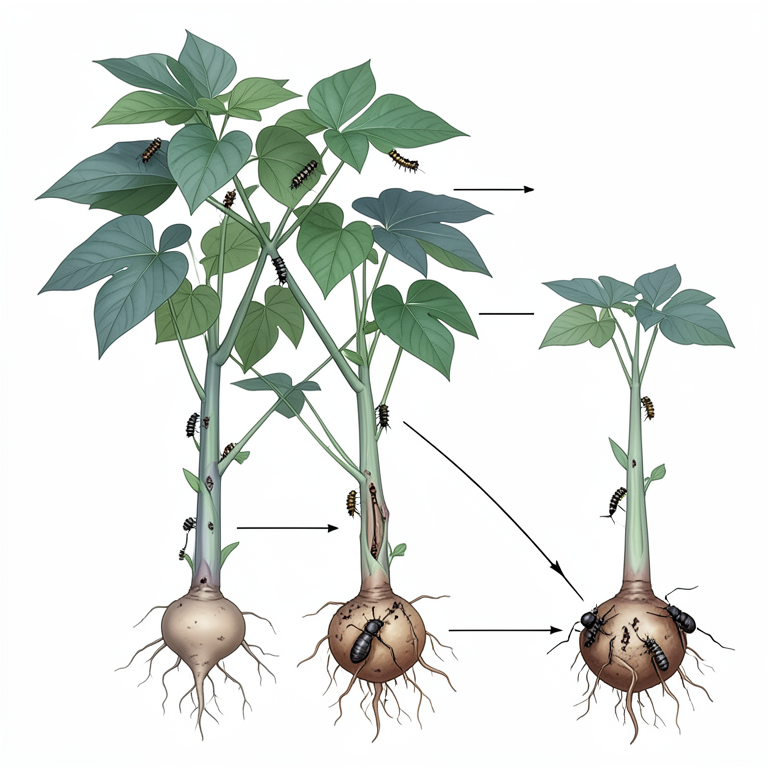
Yam Pest Damage Zones
AI-generated conceptual illustration (yam plants (Dioscorea species)). It explains the idea and does not show study data.
View source evidence ↗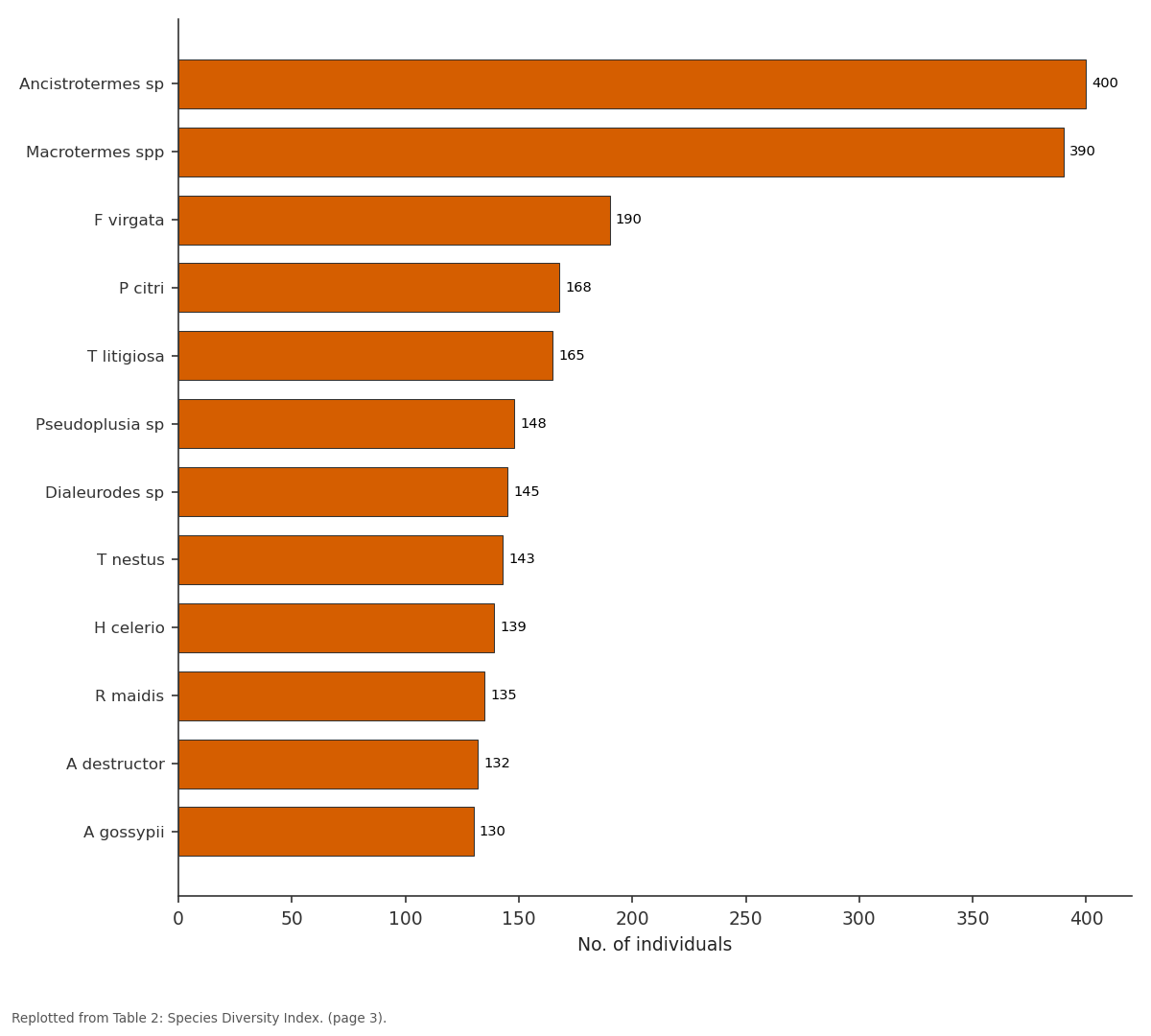
No. of individuals: Ancistrotermes sp vs Macrotermes spp vs F virgata vs P citri vs T litigiosa
Replotted from Table 2 (page 3) of the original paper. Every bar is the paper's own table value.
View source evidence ↗Figures & tables
From the original paper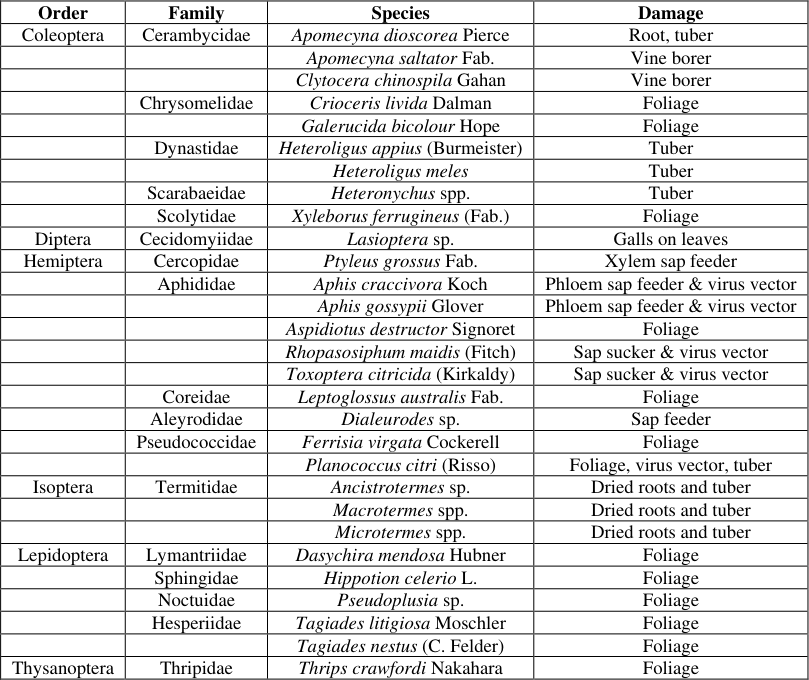 Table 1
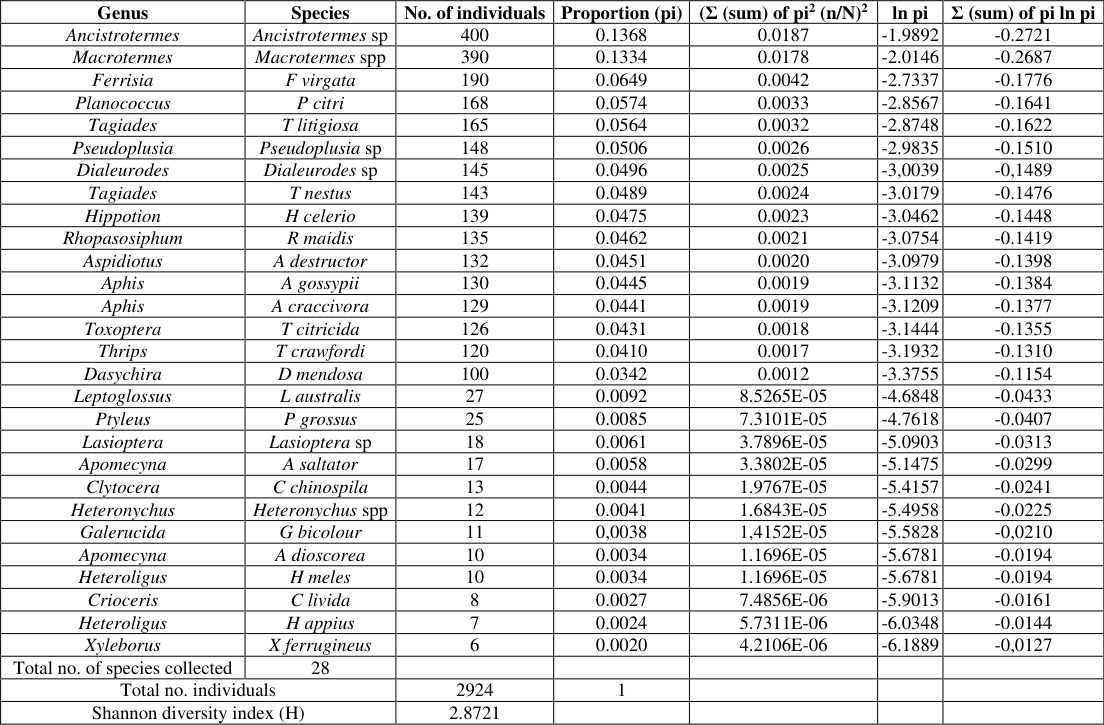 Table 2
Introduction
Yams (Dioscorea sp., family Dioscoreacea) are annual or perennial tuber-bearing and climbing plants. Of the 600 or so species of Dioscorea recognized worldwide, only 10 are grown for food in various tropical and subtropical parts of the world by Asiedu et al.(2001) [1] ; Korada et al. (2010) [2] , Didi Konan et al. (2016) [3] and Wembou et al. (2017) [4] . Asiedu et al. (2001) [1] reported a few species are grown on a small-scale for extraction of the pharmaceutical compounds dioscorin and diosgenin. Then, the tubers have organoleptic qualities that can make them the preferred carbohydrate staple and can contribute up to 350 dietary calories per person each day. Adeniji et al. (2012) [5] and Cornet (2015) [6] report that yam constitutes an important food crop in intertropical zones and plays a major role in the food security of millions of people. According IITA (2007) [7] and Korada et al. (2010) [2] , yams are produced over 5 million hectares in 47 countries in tropical and subtropical regions of the world. However, more than 95% of the world's 47 million metric tonnes of yam produced annually comes from Sub Saharan Africa. Moreover, in Africa, yields varied from 8.5 t/ha to 9.5 t/ha between 1990 and 2002. This increase is almost exclusively due to the increase in cultivated areas and the increase in yields. This low yam productivity is due to several factors including pressure from insect pests and diseases. Insects act in two ways: as vectors of viral diseases (generally biting suckers) on aerial parts and as pests of both leaves and tubers (Diby, 2005 cited by Soro et al., 2010) [8] . According to Degras (1986) cited by Soro et al. (2010) [8] , most of the damage observed on tubers has its origin in the fields. Foua Bi, (1982) cited by Soro et al. (2010) [8] reports that regarding losses due to insect pests, a reduction in the emergence rate of more than 30% due to scale insects has been reported. Manyong and Oyewole (1997) cited by Korada et al. (2010) [2] , the productivity of yam cultivation has been severely constrained by reduction in soil fertility, increases in infestation of coleopteran pests and increases in production costs. In addition to these problems, yam is increasing pressure from a range of insect pests (e.g. leaf and tuber beetles, mealybugs, scales), fungi (anthracnose, leaf spot, leaf blight, tuber rots) and viruses, as well as nematodes; contribute to sub-optimal yields and the deterioration of tuber quality in storage. The high-risk area for nematode infestation is estimated to be 45% in yam growing regions of West Africa. Bankole and Adebanjo (2003) [9] reported dried yam chips are also containing mycotoxins. Dans la zone d'étude, une espèce d'igname principalement Dioscorea alata (L) en fonction de provenance paysanne a fait l'objet de l'étude repartie en dix variétés locales d'ignames suivant leurs caractéristiques morphologiques et a été classée en trois groupes et/ou catégories basées sur les facteurs productivité et rendement dont : Haut rendement(HR), moyen rendement (MR) et faible rendement (FR).Parmi elles, Katesha, Nyalushuli, Kasakura et Kabeyabeyabeya ont un rendement moyen, Nyamishi et Nyabisu (RF), Nyabongwa, Bitarama, Nyaluliga et Kazanga (HR). Certaines de ces variétés ont manifestés la sensibilité aux maladies et d'autres aux insectes. On the markets and in the industry, there is a certain varietal preference among consumers, sellers and producers. This would be explained by the level of shelf life in the field, cooking time, precocity, vigor, productivity, resistance to diseases as well as organoleptic qualities (its improved flavor/taste), thus allowing customers to be attracted. In the present study, the overall strategy consisted of updating the data on the fauna of yam insects (diversity) on local varieties in farming environments.
Materials and Methods
Materials and Methods
Study area
This study was carried out in the Kalonge group located in the territory of Kalehe, province of South Kivu, in the east of the Democratic Republic of Congo. This group constitutes the large area where yams are produced, thus partly supplying neighboring territories as well as the city of Bukavu, apart from the quantity consumed by the indigenous population. Kalonge is a group of trees with average annual temperatures of 18 °C and rainfall which can reach 2114 mm.It borders with Ninja to the south, to the north by the Kahuzi Biega National Park (PNKB), to the east by Shabunda and to the west by the other villages of the Kabare Territory.
Choice of experimental plots
Six localities form the Kalonge group. The choice of these localities was precise. However, the choice of experimental plots was based on criteria linked to fallowness and not being next to another yam field to avoid any pre-existing entomological influence in the plot and surrounding areas, thus transmitting insect pests and vectors and of course diseases.
Insect trapping
Insects were captured using sweep nets. As for the flying insects, they were also captured using sweep nets and by hand between 6 a.m. and 8 a.m. and between 4:30 p.m. and 6:30 p.m. during the 3 phases, mainly in the tuber germination phase, in the growth phase as well as in the maturation, i.e. twice a week for 60 days for each phase.
Transport of samples (captured insects)
After capturing the insects, they were directly placed in alcohol (ethanol) concentrated at 95 percent and sent directly to the packaging location while awaiting their transfer to the agricultural entomology laboratory where they were identified.
Insect Identification
The insects captured and preserved in alcohol measured at 95 percent were made using a special identification key from Kouadjo et al. (2018) [10] at the Agricultural Entomology laboratory of the Department of Biology, from the Natural Sciences Research Center/CRSN-Lwiro. The identification was based on the external morphological characteristics of the insects using a binocular magnifying glass capable of enlarging the image of each insect 10 to 20 times larger, while referring to the collection of other insects found at Agricultural Entomology laboratory of the same Department and the same Center.
Data Analysis
In this study, for biodiversity analysis the data from collected insect samples were grouped according to source. The averages were calculated and there are several ways to test the species diversity. The biodiversity count was made using the Shannon diversity index (Shannon, 1948) [11] to estimate species richness uniformity and species diversity.
Species Diversity
The species diversity index was calculated by using the Shannon-Wieners Diversity index formula. H= -
Where p is the proportion ( N n ) of individuals of one particular species found (n) divided by the total number of individuals found (N), ln is the natural log, Σ is the sum of the calculations, and is the number of species.
Diversity index of different pests from Kalonge
The total of 1). My research is also consistent with Maliki et al. (2012) [12] , Andres et al. (2017) [13] , Kouadjo et al. (2018) [10] . Yam is attacked and damaged by field and storage pests wherever it is grown elsewhere, resulting in yield and storage losses (Taylor, 1964 [14] and Korada et al. (2010) [2] . Some of the most common pests include yam beetle, mealy bugs, termites, and nematodes. Pests may damage the yam tubers by decreasing their dry matter content, thus reducing germination capacity. Furthermore, the damage they cause to the epidermis may trigger secondary infections by rot fungi (i.e., molds), which can lead to high storage losses. Yam farmers hardly use synthetic pesticides. Effective control of pests is necessary to optimize yam yields (Andres et al., 2017) [13] . The species diversity index was calculated by Shannon-Weiner index formula comprising(2.8721), Ancistrotermes sp showed the maximum species diversity, followed by Ferrisia virgata, Planococcus citri, Tagiades litigiosa, Pseudoplusia sp, Dialeurodes sp, Tagiades nestus, Heteroligus meles, Rhopasosiphum maidis, Aspidiotus destructor, Aphis gossypii, Aphis craccivora, Toxoptera citricida, Thrips crawfordi, Dasychira mendosa, Leptoglossus australis, Ptyleus grossus, Lasioptera sp, Apomecyna saltator Clytocera chinospila, Heteronychus spp, Galerucida bicolour, Apomecyna dioscorea, Heteroligus meles and least species diversity were observed in Crioceris livida, Heteroligus appius and Xyleborus ferrugineus (Table 2). Goergen et al. (2010) [15] reported not similar results during the study.
| Genus | Species | No. of individuals | Proportion (pi) | (Σ (sum) of pi2 (n/N)2 | ln pi | Σ (sum) of pi ln pi |
|---|---|---|---|---|---|---|
| Ancistrotermes | Ancistrotermes sp | 400 | 0.1368 | 0.0187 | -1.9892 | -0.2721 |
| Macrotermes | Macrotermes spp | 390 | 0.1334 | 0.0178 | -2.0146 | -0.2687 |
| Ferrisia | F virgata | 190 | 0.0649 | 0.0042 | -2.7337 | -0.1776 |
| Planococcus | P citri | 168 | 0.0574 | 0.0033 | -2.8567 | -0.1641 |
| Tagiades | T litigiosa | 165 | 0.0564 | 0.0032 | -2.8748 | -0.1622 |
| Pseudoplusia | Pseudoplusia sp | 148 | 0.0506 | 0.0026 | -2.9835 | -0.1510 |
| Dialeurodes | Dialeurodes sp | 145 | 0.0496 | 0.0025 | -3,0039 | -0,1489 |
| Tagiades | T nestus | 143 | 0.0489 | 0.0024 | -3.0179 | -0.1476 |
| Hippotion | H celerio | 139 | 0.0475 | 0.0023 | -3.0462 | -0.1448 |
| Rhopasosiphum | R maidis | 135 | 0.0462 | 0.0021 | -3.0754 | -0.1419 |
| Aspidiotus | A destructor | 132 | 0.0451 | 0.0020 | -3.0979 | -0.1398 |
| Aphis | A gossypii | 130 | 0.0445 | 0.0019 | -3.1132 | -0.1384 |
| Aphis | A craccivora | 129 | 0.0441 | 0.0019 | -3.1209 | -0.1377 |
| Toxoptera | T citricida | 126 | 0.0431 | 0.0018 | -3.1444 | -0.1355 |
| Thrips | T crawfordi | 120 | 0.0410 | 0.0017 | -3.1932 | -0.1310 |
| Dasychira | D mendosa | 100 | 0.0342 | 0.0012 | -3.3755 | -0.1154 |
| Leptoglossus | L australis | 27 | 0.0092 | 8.5265E-05 | -4.6848 | -0.0433 |
| Ptyleus | P grossus | 25 | 0.0085 | 7.3101E-05 | -4.7618 | -0.0407 |
| Lasioptera | Lasioptera sp | 18 | 0.0061 | 3.7896E-05 | -5.0903 | -0.0313 |
| Apomecyna | A saltator | 17 | 0.0058 | 3.3802E-05 | -5.1475 | -0.0299 |
| Clytocera | C chinospila | 13 | 0.0044 | 1.9767E-05 | -5.4157 | -0.0241 |
| Heteronychus | Heteronychus spp | 12 | 0.0041 | 1.6843E-05 | -5.4958 | -0.0225 |
| Galerucida | G bicolour | 11 | 0,0038 | 1,4152E-05 | -5.5828 | -0,0210 |
| Apomecyna | A dioscorea | 10 | 0.0034 | 1.1696E-05 | -5.6781 | -0.0194 |
| Heteroligus | H meles | 10 | 0.0034 | 1.1696E-05 | -5.6781 | -0.0194 |
| Crioceris | C livida | 8 | 0.0027 | 7.4856E-06 | -5.9013 | -0.0161 |
| Heteroligus | H appius | 7 | 0.0024 | 5.7311E-06 | -6.0348 | -0.0144 |
| Xyleborus | X ferrugineus | 6 | 0.0020 | 4.2106E-06 | -6.1889 | -0,0127 |
| Total no. of species collected | 28 | |||||
| Total no. individuals | 2924 | 1 | ||||
| Shannon diversity index (H) | 2.8721 |
Table text extracted from the original PDF; superscript letters are shown inline. The original table image is below.
View original table image
Conclusion
The study area supports a rich diversity of insect pests with wide varieties of yam which provide an ideal breeding environment for yam insect pest. It is estimated that there are more than 28 yam insect pests' species on the Kalonge, Kalehe Territory, South Kivu, East of Democratic Republic of Congo as they are specific to different seasons and this survey was conducted for only six months. Therefore, it is difficult to collect, preserve, photograph and identify all species within the study area. The study is an attempt to provide a checklist for yam insect pests in the study area and will be continually updated for future reference. It was observed that Ancistrotermes sp was the most abundant species and had the highest number of individual species observed during the study, and Xyleborus ferrugineus had the least number of species observed respectively from the survey. Yam insect pests' diversity depends upon the cultural strategies or among other factors as climatic and soil. Therefore, it is possible that yam can be protected against those insect pests by improving the yam yield the study area.
Acknowledgement
AcknowledgementWe express thankfulness to my respected advisor Prof. Gueye Badara and all the laboratory members of Agricultural Entomology Research Centre in Natural Sciences, South Kivu/ DRC and others like Elie Misengero, Bisimwa Shamavu, Bacubizala Mutimirwa, Cubaka Mushunju and Bunani Lishombo.
Figures and tables from the paper
| Order | Family | Species | Damage |
|---|---|---|---|
| Coleoptera | Cerambycidae | Apomecyna dioscorea Pierce | Root, tuber |
| Apomecyna saltator Fab. | Vine borer | ||
| Clytocera chinospila Gahan | Vine borer | ||
| Chrysomelidae | Crioceris livida Dalman | Foliage | |
| Galerucida bicolour Hope | Foliage | ||
| Dynastidae | Heteroligus appius (Burmeister) | Tuber | |
| Heteroligus meles | Tuber | ||
| Scarabaeidae | Heteronychus spp. | Tuber | |
| Scolytidae | Xyleborus ferrugineus (Fab.) | Foliage | |
| Diptera | Cecidomyiidae | Lasioptera sp. | Galls on leaves |
| Hemiptera | Cercopidae | Ptyleus grossus Fab. | Xylem sap feeder |
| Aphididae | Aphis craccivora Koch | Phloem sap feeder & virus vector | |
| Aphis gossypii Glover | Phloem sap feeder & virus vector | ||
| Aspidiotus destructor Signoret | Foliage | ||
| Rhopasosiphum maidis (Fitch) | Sap sucker & virus vector | ||
| Toxoptera citricida (Kirkaldy) | Sap sucker & virus vector | ||
| Coreidae | Leptoglossus australis Fab. | Foliage | |
| Aleyrodidae | Dialeurodes sp. | Sap feeder | |
| Pseudococcidae | Ferrisia virgata Cockerell | Foliage | |
| Planococcus citri (Risso) | Foliage, virus vector, tuber | ||
| Isoptera | Termitidae | Ancistrotermes sp. | Dried roots and tuber |
| Macrotermes spp. | Dried roots and tuber | ||
| Microtermes spp. | Dried roots and tuber | ||
| Lepidoptera | Lymantriidae | Dasychira mendosa Hubner | Foliage |
| Sphingidae | Hippotion celerio L. | Foliage | |
| Noctuidae | Pseudoplusia sp. | Foliage | |
| Hesperiidae | Tagiades litigiosa Moschler | Foliage | |
| Tagiades nestus (C. Felder) | Foliage | ||
| Thysanoptera | Thripidae | Thrips crawfordi Nakahara | Foliage |
Table text extracted from the original PDF; superscript letters are shown inline. The original table image is below.
View original table image
References
15 in the original paper- Asiedu R, Mignouna H, Odu B, Hughes J d'A. Yam breeding. In: Proceedings of the Plant Virology in SubSaharan Africa (PVSSA) Conference; 2001; International Institute of Tropical Agriculture (IITA), Nigeria; c2001. p. 466-475.
- Korada RR, Naskara SK, Edison S. Insect pests and their management in yam production and storage: a world review. International Journal of Pest Management. 2010;56(4):337-349.
- Didi Konan EB, Kouakou AM, Camara B, N'zue B, Zohouri GP. Inventaire des méthodes de production de semenceaux d'igname (Dioscorea spp): une revue de la littérature. Journal of Animal and Plant Sciences. 2016;29(1):4496-4514.
- Wembou EP, Odah K, Dansi A, KAbiezim E, Tozo K, Akpagana K. Diversité variétale et conservation des ignames cultivées (Dioscorea cayenensis, Dioscorea rotundata et Dioscorea alata) dans la région de la Kara (Togo). Revue Marocaine des Sciences Agronomiques et Vétérinaires. 2017;5(4):391-399.
- Adeniji OB, Adebayo CO, Ajayi OP. Analysis of marketing margin of yam in selected rural areas of Niger State, Nigeria. Basic Research Journal of Agricultural Science and Review. 2012;1(3):58-62.
- Cornet D. Influence des premiers stades de croissance sur la variabilité du rendement parcellaire de deux espèces d'igname (Dioscorea spp.) cultivées en Afrique de l'Ouest [dissertation]. Paris, France: Institut des Sciences et Industries du Vivant et de l'Environnement (AgroParisTech); 2015. p. 174.
- IITA. International Institute of Tropical Agriculture. Nigeria. Annual Report 2007; c2007. p. 99.
- Soro S, Diallo Atta H, Doumbia M, Dao D, Tano Y. Inventory of yam insects: case of Bouake and Toumodi (Côte d'Ivoire). Journal of Animal & Plant Sciences. 2010;6(3):715-723.
- Bankole S, Adebanjo A. Aflatoxin contamination of dried yam chips marketed in Nigeria. Tropical Science. 2003;43(4):201-203.
- Kouadjo GC, Pokou ND, Zohouri GP, Kouakou AM, Essis EB, Dibi KE, Adiko A, Gnonhouri GP, Asiedu R, Abdourahamane S. Bien identifier les ravageurs de l'igname en Côte d'Ivoire. Bien identifier les maladies fongiques des ignames en Côte d'Ivoire. N° 14. AISA Développement. Revue Technique de l'Association Ivoirienne des Sciences Agronomiques. 2018;5.
- Shannon CE. A mathematical theory of communication. The Bell System Technical Journal. 1948;27:379-423.
- Maliki R, Toukourou M, Sinsin B, Vernier P. Productivity of yam-based systems with herbaceous legumes and short fallows in the Guinea-Sudan transition zone of Benin. Nutrient Cycling in Agroecosystems. 2012;92:9-19.
- Andres C, Ade Oluw OO, Bhullar GS. Yam (Dioscorea spp.). In: Brian Thomas, Brian G Murray and Denis J Murphy (Editors in Chief), Encyclopedia of Applied Plant Sciences. 2017;3:435-441.
- Asante SK, Mensah GWK, Wahaga E. Farmers' knowledge and perceptions of insect pests of yam (Dioscorea spp.) and their indigenous control practices in northern Ghana. Ghana Journal of Agricultural Science. 2007;40:185-192.
- Georg Goergen G, Dossou R, Asiedu R, Hanna R. Scale insects on yams in Benin: diversity, incidence and farmers' knowledge and perceptions. In: Proceedings of the 11th ISTRC-AB Symposium; 2010 Oct 4-8; Kinshasa, DR Congo.