
Research article · 2024 · Full text
International Journal of Research in AgronomyEffect of Guggul ash on physico-chemical properties of water
Volume 7(5) · Pages 343–345 · DOI: 10.33545/2618060x.2024.v7.i5e.694 ↗
Research areasPharmacological Effects of Medicinal Plants
Abstract
Author-writtenThe present paper focuses on properties of Commiphora wightii, Guggul- oleo-gum resin ash and it potential in water purification. The aqueous solution of ash is strongly alkaline (pH-12.57). The minerals-phosphorus, potassium, calcium, magnesium, sodium and aluminum were quantified 3.22, 56.05-, 234.45, 250.05, 5.3 and 19.32 g/kg d.m. respectively. The micronutrients iron and copper i.e. 0.013 and 0.099 g/kg d.m. were also present in ash, while mercury content was absent in the ash. The ash treatment affect quality of water significantly and after addition of ash, pH, color and odor of water changed, alkaline to neutral, colourless and odorless. Significant reduction in conductivity, TDS, hardness, BOD and COD were observed due to addition of Guggul ash in sewage, pond and tap water, respectively. The microbial population was also found decreased over control or untreated water.
Summary
Source-checkedPlain-language reading of the full paper, prepared with AI and checked against the text. Each point links to the authors' own words.
Why it matters
- Commiphora wightii produces an oleo-gum resin that is recognized for its potential medicinal applications. View evidence ↗
- The bioactive components of guggul are used to treat various conditions, including inflammation, microbial infections, and cardiovascular disorders. View evidence ↗
The question
- The study aims to investigate the properties of Guggul oleo-gum resin ash and its potential effectiveness in purifying water. View evidence ↗
What they did
- The researchers tested the ash on water samples from three different sources: sewage, pond, and tap water. View evidence ↗
- Atomic absorption spectrometry (AAS) and Inductively Coupled Plasma (ICP) were used to quantify minerals and toxic elements in the ash. View evidence ↗
What they found
- The ash contained several minerals, specifically phosphorus (3.22 g/kg d.m.), potassium (56.05 g/kg d.m.), calcium (234.45 g/kg d.m.), magnesium (250.05 g/kg d.m.), sodium (5.3 g/kg d.m.), and aluminum (19.32 g/kg d.m.). View evidence ↗
- Micronutrients including iron (13.50 mg/kg d.m.), cadmium (6.90 mg/kg d.m.), chromium (192.0 mg/kg d.m.), and copper (98.88 mg/kg d.m.) were detected, while mercury was absent. View evidence ↗
- Treatment with ash increased the pH of all water sources, shifting from 6.7 to 7.1. View evidence ↗
- Ash treatment significantly reduced electrical conductivity (34.24-78.80%), total dissolved solids (99.80-99.99%), and hardness (65.53-92.92%) across sewage, pond, and tap water. View evidence ↗
- Biological Oxygen Demand (BOD) decreased by 55.26-95.10% and the microbial population decreased by 43.89-82.90% compared to untreated water. View evidence ↗
- The color of the water changed significantly after treatment, moving from deep yellow to white or transparent. View evidence ↗
What it means
- The authors conclude that using Guggul oleo-gum resin ash is a practicable and result-oriented scientific method for water purification. View evidence ↗
Visual summary
2 visualsIllustrations explain the paper; charts are replotted from the paper's own table values.
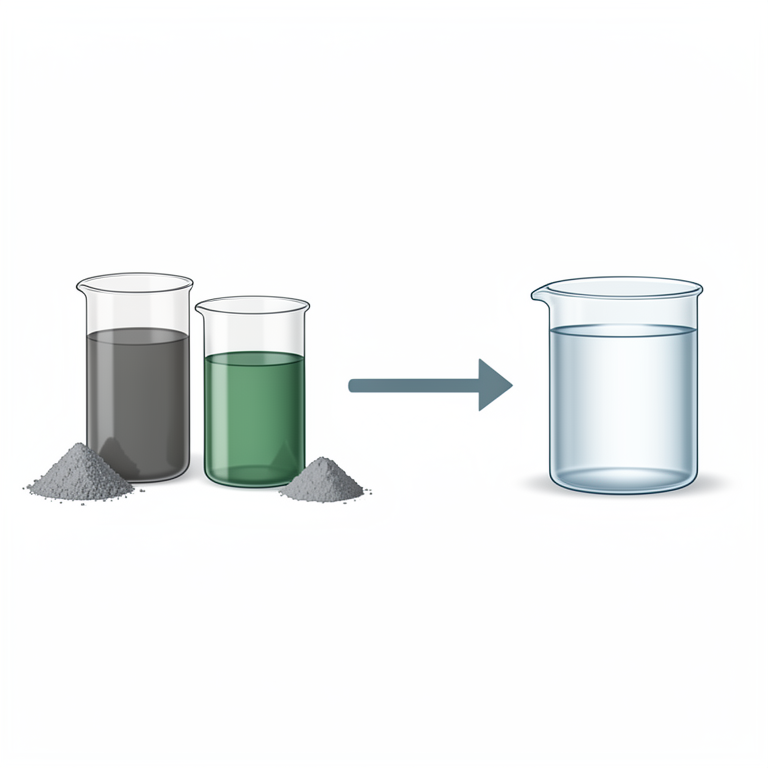
Water Purification Process Flow
AI-generated conceptual illustration (Water samples from sewage, ponds, and taps treated with Guggul resin ash). It explains the idea and does not show study data.
View source evidence ↗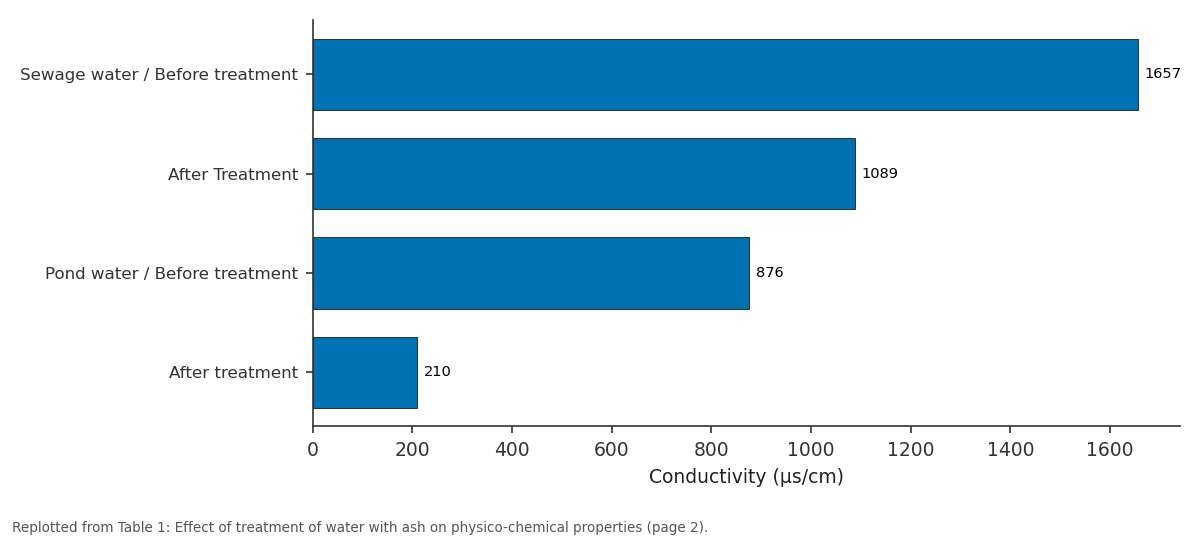
Conductivity (µs/cm): Sewage water / Before... vs After Treatment vs Pond water / Before... vs After treatment
Replotted from Table 1 (page 2) of the original paper. Every bar is the paper's own table value.
View source evidence ↗Figures & tables
From the original paper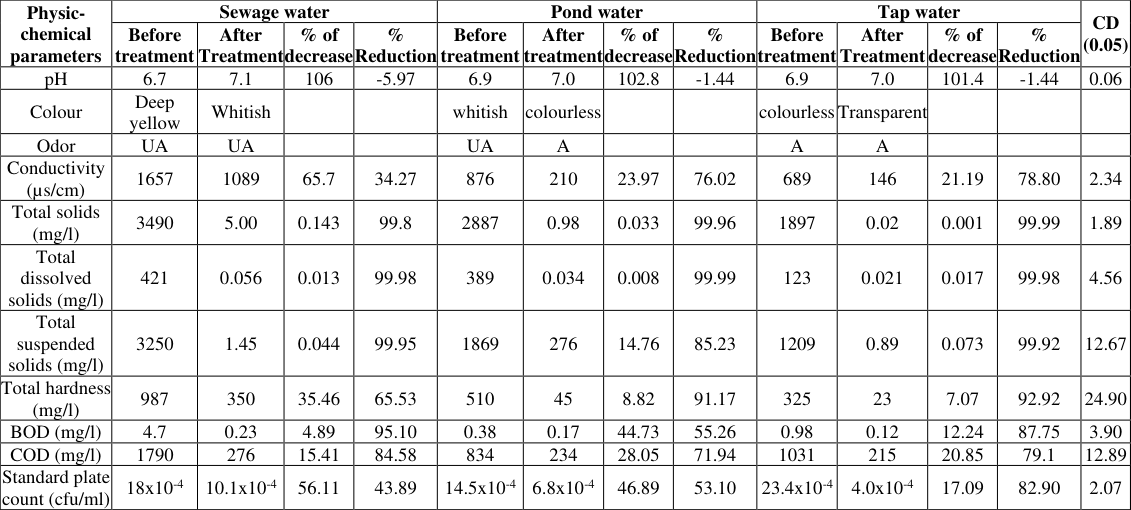 Table 1
Introduction
An oleo-gum resin exuded by the plant Commiphora wightii (Burseraceae is of potential medicinal uses. It consists many chemical constituents viz., steroids, diterpenoids, aliphatic esters, carbohydrates (61% resin, 29.3% gum) and several inorganic ions, sesamin, 6.1% miosture, and 0.6% essential oil etc. (Datt et al., 1942; Bose and Gupta, 1964; Kumar et al., 2003; Jain and Gupta, 2006) [2] . The bioactive chemicals of guggul are found useful in several diseases disorders related with bones, metabolism, inflammation, cardiovascular, tumor, wound, microbial infection, pain, skin and disorder of lipid metabolism. It is known as a Yog-Vahi rasayana which has synergistic action that enhances the effects of other herbal medicines when taken in conjunction. There are already over 25 medications on the market, some of which are combined with other herbal remedies. It is also one of the important ingredients of Hawan Samagri.
Materials and Methods
The 10 gm Guggul was burnt with cow dung and mango wood in equal quantity for half an hour. The properties of ash obtained after burning was determined.
Determination of pH
A pH meter was used for pH determination of water samples. 5 gm ash was dissolved in 50 ml of distilled water and measured pH.
Water-soluble extractive value of ash
Five gm. of the air-dried, ash was macerated with water in a flask, Shaked frequently, then filtered and evaporated filtrate to dryness. The residue was dried at 105 °C and weighed. The percentage of water-soluble extractives was calculated.
Ethanol soluble extractive value 5 gram of the air-dried ash was macerated with 50 ml of ethanol in a closed flask for 24 hours, shaking frequently and allowed to stand for 18 hours.
The ethanol, evaporated to dryness in a tarred flat-bottomed shallow dish and was dried at 105 °C, and weighed.
Acid insoluble ash value 5 gram of the air-dried oleo gum resin was weighed in a silica dish and incinerated at a temperature 450 °C until free from carbon and then cold and weighed again. Then the ash was boiled with 25 ml of 2M hydrochloric acid for 5 minutes. The insoluble matter was collected on an ash-less filter paper, washed with hot water, ignited, cold in desiccators, and weighed. The percentage of acid-insoluble ash was calculated.
Estimation of minerals
Minerals Na, K, Ca, Mg, Si, Al and Fe in ash samples were estimated with help of atomic absorption spectrometry (AAS-Thermo Scientific SOLAAR M6), Toxic elements (As, Cd, Cu, Cr, Hg, Ni, Pb, Zn, Mn and Ba) was determined using ICP (Inductively Coupled Plasma-Perkin Elmer Sciex Elan 9000).
Results and Discussion
Results and Discussion
Properties of ash containing Guggul, Cow dung and Mango wood
The properties of ash obtained after burning of Guggul, cowdung and wood. The ash mixed water is strongly alkaline, a pH of 12.57. The acid insoluble ash is observed 1.03%, while water soluble matter and alcohol soluble extractives were estimated 29.42 and 54.65% respectively. The minerals phosphorus, potassium, calcium, magnesium, sodium and aluminum were quantified 3.22, 56.05, 234.45, 250.05, 5.3 and 19.32 g/kg d.m., respectively. Similarly micronutrients, iron (13.50 mg/kg. d.m.), cadmium (6.90 mg/kg d.m.), chromium (192.0mg/kg d.m.), copper (98.88mg/kg d.m.) were also present in ash, while mercury content was not present in the ash. The results of efficacy of Guggul ash in water purification is presented in Table 1. There is a significant change in colour (deep yellow to white/transparent) of water of three different sources i.e. pond, tap and sewage water. As observed, pH of all sources were found to increase (changed 6.7 to 7.1). Significant (P=0.05) reduction in EC, TDS, hardness, BOD and COD were observed due to ash treatments. The EC, TDS and hardness of different sources varied /reduced 34.24-78.80%, 99.80-99.99% and 65.53-92.92% in sewage, pond and tap water, respectively. Similarly, BOD (55.26-95.10%) and microbs population (43.89-82.90%) were also found decresed over control or untreated water. ) were also present in ash, while mercury content was not present in the ash. It is evident that ash treatment affects quality of water significantly and after addition of ash, the pH, color and odor of water changed, alkaline to neutral, colorless and odorless. After treatment, microbial count also reduces up to 82.90%. Our findings are consistent with previous studies reported the effect of ash of water quality and purification. The ash from medicinal plants was also reported to have antimicrobial activities against number of pathogenic bacteria, decreased up to 20% in sewage water. Mondkar (1982) [5] ; Purandare and Prasad (2002) [6] were also reported potential of ash in purification. Sharma et al. (2011) [7] also studied the use of ash in purification of water of Narmada river (Madhya Pradesh), collected from four rivers-Omkareshwar, Mandaleshwar, Barwani, and Homa Therapy Goshala, near Maheshwar and emphasized that ash can be used to reduce the pollution of water resources as well as environment.
| Physic- chemical parameters | Sewage water | — | — | — | Pond water | — | — | — | Tap water | — | — | — | CD (0.05) |
|---|---|---|---|---|---|---|---|---|---|---|---|---|---|
| Before treatment | After Treatment | % of decrease | % Reduction | Before treatment | After treatment | % of decrease | % Reduction | Before treatment | After Treatment | % of decrease | % Reduction | ||
| pH | 6.7 | 7.1 | 106 | -5.97 | 6.9 | 7.0 | 102.8 | -1.44 | 6.9 | 7.0 | 101.4 | -1.44 | 0.06 |
| Colour | Deep yellow | Whitish | whitish | colourless | colourless | Transparent | |||||||
| Odor | UA | UA | UA | A | A | A | |||||||
| Conductivity (µs/cm) | 1657 | 1089 | 65.7 | 34.27 | 876 | 210 | 23.97 | 76.02 | 689 | 146 | 21.19 | 78.80 | 2.34 |
| Total solids (mg/l) | 3490 | 5.00 | 0.143 | 99.8 | 2887 | 0.98 | 0.033 | 99.96 | 1897 | 0.02 | 0.001 | 99.99 | 1.89 |
| Total dissolved solids (mg/l) | 421 | 0.056 | 0.013 | 99.98 | 389 | 0.034 | 0.008 | 99.99 | 123 | 0.021 | 0.017 | 99.98 | 4.56 |
| Total suspended solids (mg/l) | 3250 | 1.45 | 0.044 | 99.95 | 1869 | 276 | 14.76 | 85.23 | 1209 | 0.89 | 0.073 | 99.92 | 12.67 |
| Total hardness (mg/l) | 987 | 350 | 35.46 | 65.53 | 510 | 45 | 8.82 | 91.17 | 325 | 23 | 7.07 | 92.92 | 24.90 |
| BOD (mg/l) | 4.7 | 0.23 | 4.89 | 95.10 | 0.38 | 0.17 | 44.73 | 55.26 | 0.98 | 0.12 | 12.24 | 87.75 | 3.90 |
| COD (mg/l) | 1790 | 276 | 15.41 | 84.58 | 834 | 234 | 28.05 | 71.94 | 1031 | 215 | 20.85 | 79.1 | 12.89 |
| Standard plate count (cfu/ml) | 18x10-4 | 10.1x10⁻⁴ | 56.11 | 43.89 | 14.5x10⁻⁴ | 6.8x10⁻⁴ | 46.89 | 53.10 | 23.4x10⁻⁴ | 4.0x10⁻⁴ | 17.09 | 82.90 | 2.07 |
Table text extracted from the original PDF; superscript letters are shown inline. The original table image is below.
View original table image
Conclusion
This study highlights the potential of oleo-gum resin ash in purification of water quality. The ash treatment affects quality of water significantly and after addition, physico-chemical properties of water changed. It is pertinent that the use of medicinally important oleo-gum resin of Guggul may be a practicable, result oriented scientific practice to clean the water.
Acknowledgement
AcknowledgementThe authors are thankful to Director, Forest Research Institute, Dehradun and Director Research, Motherhood University, Roorkee for providing facilities to this study.
References
7 in the original paper- Bose S, Gupta KC. Structure of C. mukul-Part II. Structure of the Degraded Gum. Indian J Chem. 1964;2:156-158.
- Datt AT, Ghosh S, Chopra RN. Chemical Investigation of Gum Resin from Blasmodendron mukul. Indian J Med Res. 1942;30(2):331-334.
- Kumar S, Suri SS, Sonie KC, Ramawat KG. Establishment of embryonic cultures and somatic embryogenesis in callus culture of Guggul Commiphora wightii (Arnott.) Bhandari. Indian J Exp Biol. 2003;4:69-77.
- Jain A, Gupta VB. Chemistry and pharmacological profile of guggul: A review. Indian J Tradit Knowl. 2006;5:478-83.
- Mondkar AD. Agnihotra and Microbes. A Laboratory Experience. Satsang. 1982;9(20):3/4/1982.
- Purandare VR, Prasad NB. Effect of Agnihotra (Sacred Fire) on microbial growth. Int. J Ayurvedic Herb Med. 2013;2:799-802.
- Sharma S, Sengupta T, Sunar K. Somayag Influences on Different Parameters of Narmada River. Indian Res Commun. 2011;55-56.