
Research article · 2024 · Full text
International Journal of Research in AgronomyInfluence of Mid-Plain agro climatic zone of U.P on the Maturity and yield of pearl millet (Pennisetum glaucum L.)
Volume 7(5) · Pages 363–365 · DOI: 10.33545/2618060x.2024.v7.i5e.700 ↗
Research areasGenetics and Plant BreedingAgricultural Science and FertilizationCrop Yield and Soil Fertility
Abstract
Author-writtenThis experiment was carried out during Kharif 2023 at Crop Research Farm, Department of Agronomy, Sam Higginbottom University of Agriculture, Technology and Sciences, Prayagraj, U.P, which is located at 25.28⁰N latitude, 81.54⁰E longitude and 98m altitude above the mean sea level. This area is situated on the right side of the river Yamuna by the side of Prayagraj, Rewa road, about 5 km away from Prayagraj city. The evaluation consists of 5 private sector Pearl Millet hybrids. The experiment was laid out in Randomized Block Design with five treatments which were replicated Four times. The significantly highest stover yield (12.25 t/ha) was recorded in hybrid UP 505. However, minimum days to 50% flowering (53.57 DAS), days to maturity (75.75 DAS), number of grains per ear head (5617.8), seed yield (4.06 t/ha), biological yield (16.23 t/ha) and harvest index (24.95%) was significantly higher in UP-303.
Summary
Source-checkedPlain-language reading of the full paper, prepared with AI and checked against the text. Each point links to the authors' own words.
Why it matters
- Pearl millet is a critical crop for rain-fed regions in India and Africa, where it serves as a staple food source. View evidence ↗
- Compared to other cereals, pearl millet is advantageous due to its tolerance of high temperatures, high salinity, low soil fertility, and drought. View evidence ↗
- India is the world's leading producer of pearl millet, with an average productivity of 1069 kg/ha across approximately 9.4 million hectares. View evidence ↗
The question
- The study aimed to evaluate how the Mid-Plain agro-climatic zone of Uttar Pradesh influences the yield and maturity of pearl millet. View evidence ↗
What they did
- The experiment was conducted during the Kharif 2023 season at the Crop Research Farm in Prayagraj, Uttar Pradesh. View evidence ↗
- Five private sector pearl millet hybrids were tested using a Randomized Block Design with four replications. View evidence ↗
- Maturity was analyzed by observing the number of days to maturity and the days required to reach 50% flowering. View evidence ↗
- Laboratory measurements using a weighing balance and scale were used to determine test weight, the number of seeds per ear head, and ear head length. View evidence ↗
What they found
- Hybrid UP-303 had the shortest time to 50% flowering at 53.75 DAS, while UP-202 took the longest at 58.5 DAS. View evidence ↗
- The shortest maturity period was observed in UP-303 (75.75 DAS), whereas UP-202 had the longest maturity period (81 DAS). View evidence ↗
- At 75 DAS, hybrid UP-404 exhibited the significantly highest ear head length of 32.42 cm. View evidence ↗
- UP-303 produced the highest number of grains per ear head (5617.8), while UP-101 produced the lowest (3512.4). View evidence ↗
- The highest test weight was found in UP-101 (7.05 g), and the lowest was in UP-303 (5.17 g). View evidence ↗
- At 75 DAS, UP-303 achieved the highest grain yield of 4.06 t/ha, though UP-101 (3.4 t/ha) was statistically similar. View evidence ↗
- The highest stover yield at 75 DAS was recorded for hybrid UP-500 at 12.25 t/ha. View evidence ↗
- At 75 DAS, UP-303 had the highest harvest index (24.95%), while UP-500 had the lowest (20.85%). View evidence ↗
What it means
- The authors conclude that hybrid UP-303 is highly recommended for the Mid-Plain agro-climatic zone because it provides higher productivity and a shorter growing period. View evidence ↗
Visual summary
3 visualsIllustrations explain the paper; charts are replotted from the paper's own table values.
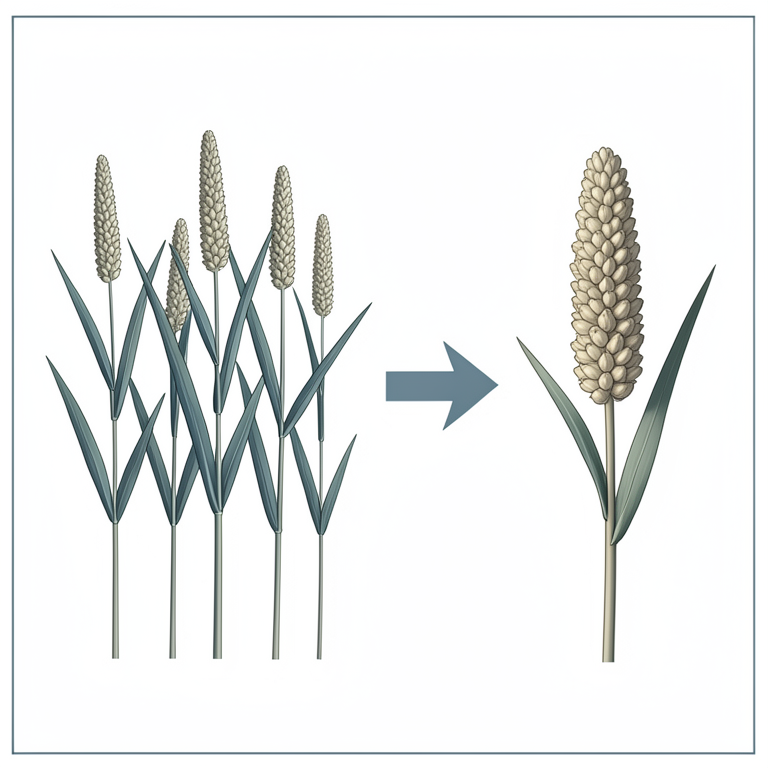
Hybrid Performance Comparison
AI-generated conceptual illustration (pearl millet plants (Pennisetum glaucum L.)). It explains the idea and does not show study data.
View source evidence ↗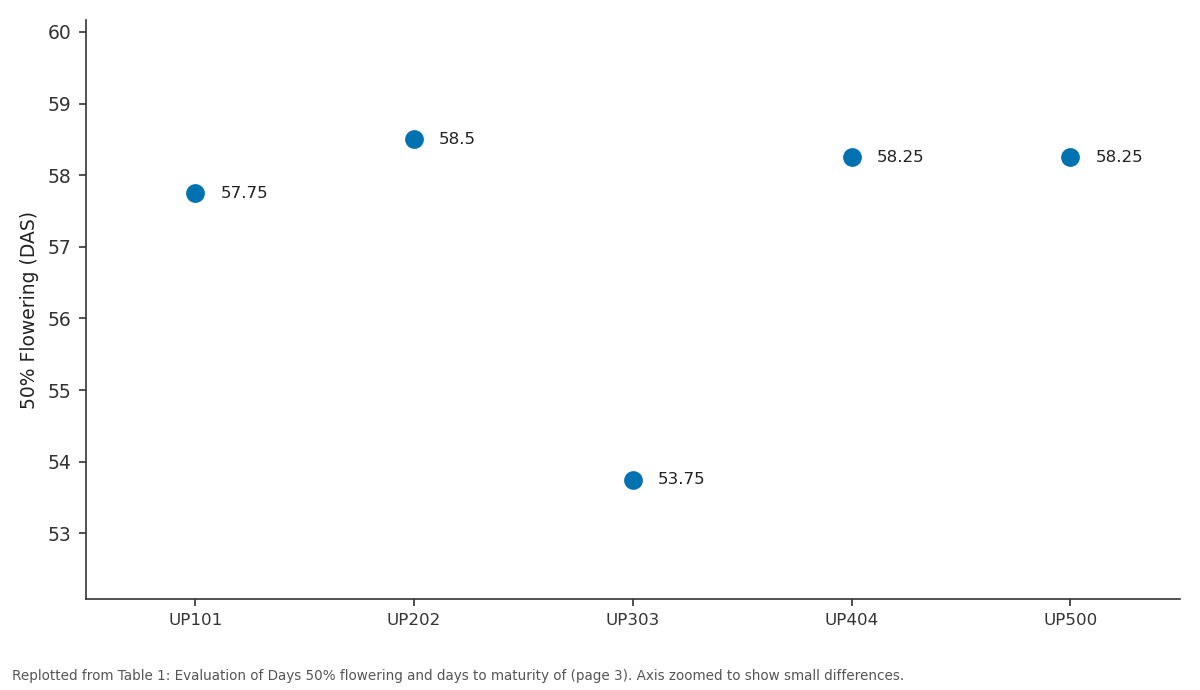
50% Flowering: UP101 vs UP202 vs UP303 vs UP404 vs UP500
Replotted from Table 1 (page 3) of the original paper. Every bar is the paper's own table value.
View source evidence ↗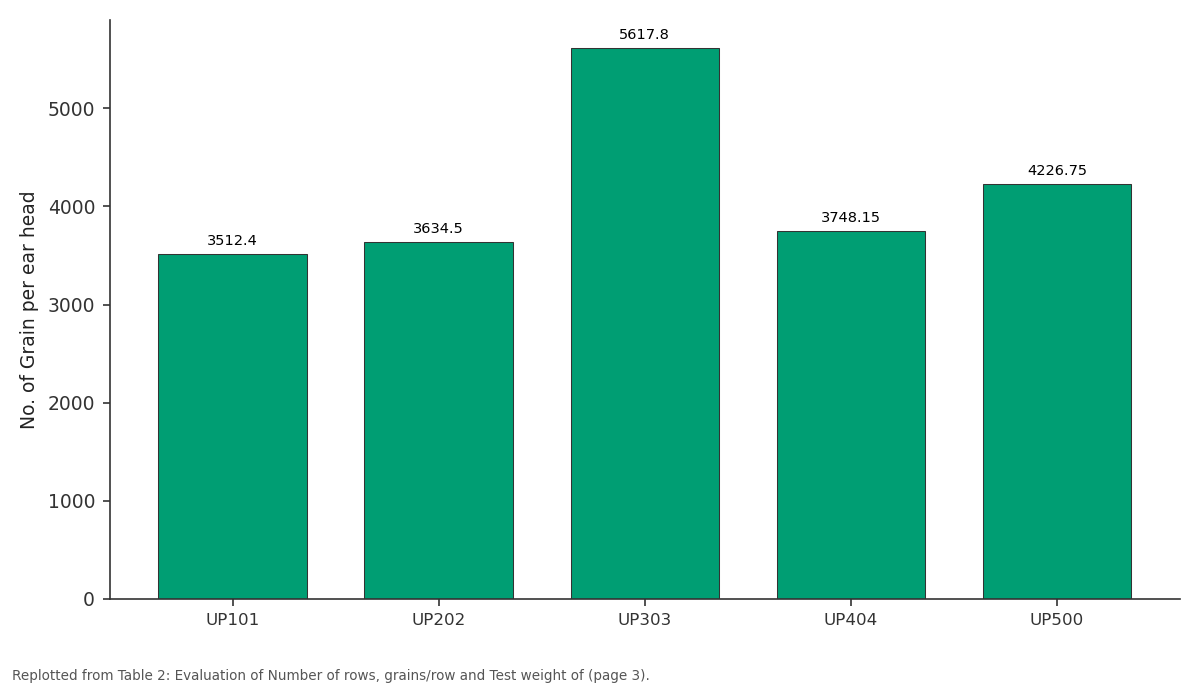
No. of Grain per ear head: UP101 vs UP202 vs UP303 vs UP404 vs UP500
Replotted from Table 2 (page 3) of the original paper. Every bar is the paper's own table value.
View source evidence ↗Figures & tables
From the original paper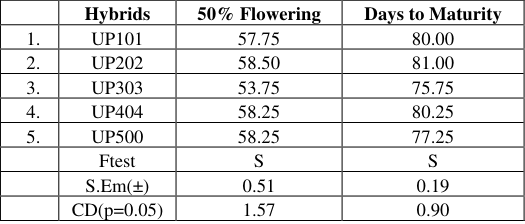 Table 1
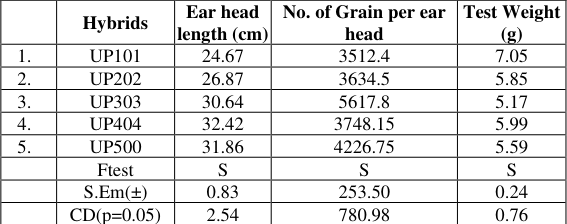 Table 2
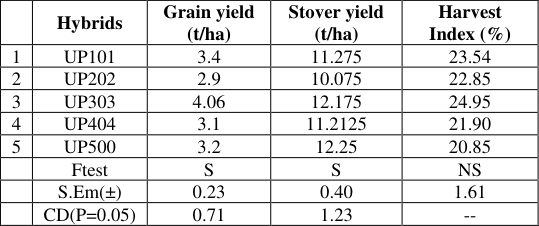 Table 3
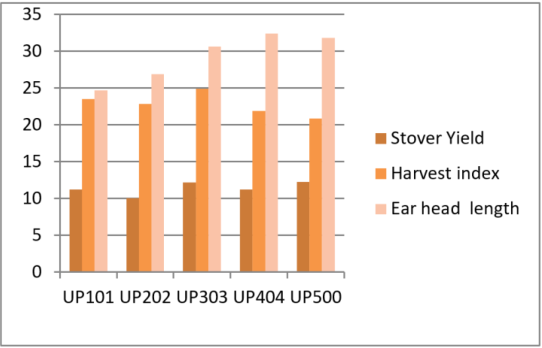 Figure 1
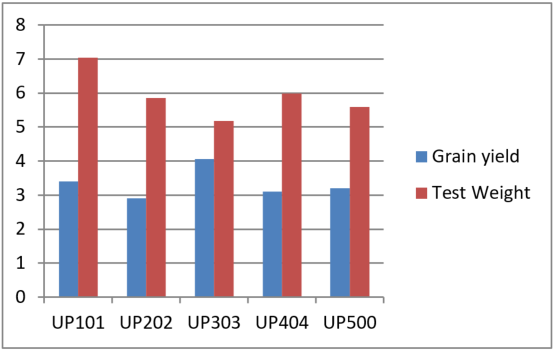 Figure 1
Introduction
Pearl millet (Pennisetum glaucum L.) is an important crop of rain fed areas of Africa, India and Serves as staple food for West Africa. It is the most widely cultivated millet crop, occupying prominent position in global agriculture. India is the largest producer of pearl millets in world occupying about 9.4 million hector area with annual production 10.1million tones with average productivity of 1069 kg/ha. India is largest producer of pearl millets covering about 8.75 million ha of marginal and sub marginal lands primarily in the states of Rajasthan, Gujarat, Haryana, Uttar Pradesh and Maharashtra and ranking 3 rd after rice and wheat in acreage. In addition to its grain consumption as human feed, it is also as green fodder in India. Pearl millet may be an alternative crop that exhibits great advantages in physiological characteristics when compared to other cereals as it is resistant to drought, low soil fertility, high salinity and high temperature tolerance [Singh et al., 2018] [7] . Because of it drought escaping mechanism pearl millet can grow in areas that have extended dry periods. The balanced fertilization as shown in positive effects on various aspects of growth development and biological yield of the crop in comparison to nutrient use in single or in combination. Pearl millet ranks as the fourth most extensively cultivated food crop in India, following rice, wheat, and maize. During 2019-20, pearl millet was grown in 7.41 million ha with an average production of 10.3 million tonnes and 1391 kg/ha productivity (3rd advanced estimate from Directorate of Millets Development, 2020). The Pearl millet crop is a coarse grain crop and is regarded as the primary food source for approximately 100 million rural populations. Africa and Asia both use it as livestock feed. With a yield of 7.9 million tonnes and productivity of 791 kg/ha, it is mostly farmed in India on 10 million hectares. Pearl millet crop contains a lot of carbohydrates (60-70%), fibre (1.2%), fat (5%) and protein (12.6%). Rajasthan is the state that produces the most Pearl millet crop, followed by Uttar Pradesh, Gujarat, Haryana, and Maharashtra. Tamil Nadu boasts the highest yield of pearl millet. In regions of Rajasthan, Uttar Pradesh, and Gujarat, cultivation spans from February to May, covering the summer season. Additionally, in Gujarat and Maharashtra, pearl millet is cultivated on a smaller scale from November to February, post the rainy season, known as the Rabi season.
The multi environmental trial is one of the most important steps towards the crop improvement programme which shows the performance of the genotype at the multi-environment (multilocation, multi-year or both). The MET data show the performance of genotype in a different environment. A specified difference in the environment may produce a differential effect on phenotypes. This interplay of genetic and non-genetic effects causing differential relative performances of genotypes in different environments is called genotypes × environment interaction (GEI). [Singh et al., (2023)] [8]
Materials and Methods
The experiment was conducted during the Kharif season 2023 at the Crop Research Farm, Department of Agronomy, Naini Agriculture Institute, Sam Higginbottom University of Agriculture, Technology and Sciences, Prayagraj, U P. The Crop Research Farm is located at 250 24' 42" N latitude, 810 50' 56" E longitude, and 98 m altitude from the sea level. This area is situated on the right side of the river Yamuna and by the opposite side of Prayagraj, Rewa Road about 5 km away from Prayagraj city. The soil collected from the experimental site was tasted in the laboratory of KVK and the results were observed. There are five pearl millet hybrids, i.e. UP101, UP202, UP303, UP404, UP500 which been grown under the mid plain agro climatic zone of U.P (Prayagraj). The hybrids were laid out in randomized block design which was replicated four times in 25 m 2 (5m x 5m) plot.
Parameters
For analyzing the maturity the parameter like Days to 50%flowering and days to maturity are kept in observation. Days to 50% flowering were counted from sowing to the day when 50% of the Pearl millet plants exhibited their flower in each plot. Days to Maturity was recorded as the number of days required from planting to when the Pearl millet plant showed full maturity plot. In this study, the yield per plot was measured by harvesting each plots of pearl millet from each treatment, the samples were then air-dried, weighed and same things are carried out for every plot. Among them, five representative plants were selected from each treatment for testing. The length of ear head, number of seeds per ear head, and test weight were determined in Laboratory by using scale and weighing balance. All data were analyzed using the OPSTAT software, and the results were expressed as the arithmetic mean value (±) standard deviation. The differences in the means were compared by the ANOVA. p<.05 was considered as statistically significant. The data underwent computation and analysis using the statistical methodology outlined.
Results and Discussion
Days to 50% Flowering Days taken to 50 percent flowering as influenced in hybrids is presented in Table -1 The days to 50% flowering was recorded significantly minimum in the hybrid UP-303 (53.75 DAS). However, the maximum (58.5 DAS) days to 50% Flowering was taken in UP-202.
Time required to reach 50% flowering influenced pearl millet grain yield with higher grain yield being associated longer days to attainment of 50% flowering. This could be due to longer periods of utilization of plant growth resources such as nutrients; soil moisture and solar radiation. The result confirmed with Kanton et al., (2015) [3] .
Days to Maturity
Days taken to Mature as influenced by hybrids are presented in Table 1.
| — | Hybrids | 50% Flowering | Days to Maturity |
|---|---|---|---|
| 1. | UP101 | 57.75 | 80.00 |
| 2. | UP202 | 58.50 | 81.00 |
| 3. | UP303 | 53.75 | 75.75 |
| 4. | UP404 | 58.25 | 80.25 |
| 5. | UP500 | 58.25 | 77.25 |
| Ftest | S | S | |
| S.Em(±) | 0.51 | 0.19 | |
| CD(p=0.05) | 1.57 | 0.90 |
Table text extracted from the original PDF; superscript letters are shown inline. The original table image is below.
View original table image
The days taken to Maturity were found to significantly minimum UP-303 (75.75 DAS). However, the maximum days to Maturity were recorded in UP-202 (81 DAS). Cultivars with longer maturity periods are typically more suitable for current climate conditions, as warmer climates tend to shorten the crop's life cycle. These longer-maturity cultivars can compensate for these conditions and often yield higher than baseline cultivars. Identifying an appropriate cultivar based on the length of the growing period is crucial for mitigating the impacts of climate change, given the ample genetic diversity within pearl millet maturity groups (Rai et al., 1999) [5] .
Yield and yield attributes
The variation in the quality parameters between the genotypes may be because of the genetic behavior of the genotypes tested. The Ear head length was affected by the selection of hybrids and different agro-climatic conditions, the recorded data is presented in Table 2. At 75 DAS, the Significantly highest Ear head length (32.42 cm) was recorded in UP-404. However, UP-500 (31.86 cm) & UP-303 (30.64cm) were found statistically at par with UP-404. The probable reason for longer Ear head length could be due to the optimum utilization of solar light, higher assimilated production, and its conversion to starches resulted in higher ear length as reported by Sumathi et al. (2010) [9] . The number of seeds per ear head was found significant. The data recorded is presented in Table - [4] . The stover yield was found significant. The data recorded is presented in the table -3. At 75 DAS, Significantly higher stover yield (12.25 t/ha) was recorded in UP-500. However, UP-303 (12.175 t/ha), UP-101 (11.27 t/ha), and UP-404 (11.17 t/ha) were found statistically at par with UP-500. The harvest index was found non-significant. The data recorded was presented in Table 3. 75 DAS, Significantly the highest harvest index (24.95%) was recorded in UP-303. However, the lowest harvest index (20.85%) was recorded in UP-500.
| — | Hybrids | Grain yield (t/ha) | Stover yield (t/ha) | Harvest Index (%) |
|---|---|---|---|---|
| 1 | UP101 | 3.4 | 11.275 | 23.54 |
| 2 | UP202 | 2.9 | 10.075 | 22.85 |
| 3 | UP303 | 4.06 | 12.175 | 24.95 |
| 4 | UP404 | 3.1 | 11.2125 | 21.90 |
| 5 | UP500 | 3.2 | 12.25 | 20.85 |
| Ftest | S | S | NS | |
| S.Em(±) | 0.23 | 0.40 | 1.61 | |
| CD(P=0.05) | 0.71 | 1.23 | -- |
Table text extracted from the original PDF; superscript letters are shown inline. The original table image is below.
View original table image
| — | Hybrids | Ear head length (cm) | No. of Grain per ear head | Test Weight (g) |
|---|---|---|---|---|
| 1. | UP101 | 24.67 | 3512.4 | 7.05 |
| 2. | UP202 | 26.87 | 3634.5 | 5.85 |
| 3. | UP303 | 30.64 | 5617.8 | 5.17 |
| 4. | UP404 | 32.42 | 3748.15 | 5.99 |
| 5. | UP500 | 31.86 | 4226.75 | 5.59 |
| Ftest | S | S | S | |
| S.Em(±) | 0.83 | 253.50 | 0.24 | |
| CD(p=0.05) | 2.54 | 780.98 | 0.76 |
Table text extracted from the original PDF; superscript letters are shown inline. The original table image is below.
View original table image
Conclusion
From the above study, we can conclude that the hybrid UP-303 gave higher productivity with a shorter growing period. So it is highly recommendable for this agro-climatic zone among all other hybrids.
Figures and tables from the paper
References
9 in the original paper- Ali Z. Studies on comparative economic returns of different maize genotypes. M.Sc. Thesis, Department of Agronomy, University of Agriculture., Faisalabad. Forage Res. 1994;47:279-282.
- Asungre PA, Akromah R, Kena AW, Gangashetty P. Assessing the adaptability and stability of new pearl millet hybrids for grain yield, grain iron and zinc content in Ghana using AMMI analysis. Journal of Crop Science and Biotechnology. 2022;25(5):501-514.
- Kanton RAK, Asungre P, Ansoba EY, Inusah BI, Bidzakin JK, Abubakari M, et al. Evaluation of pearl millet varieties for adaptation to the semi-arid agro-ecology of northern Ghana. Journal of Agriculture and Ecology Research International. 2015;3(1):1-11.
- Manjunatha B, Niranjana Kumara B, Jagadeesh GB. Performance Evaluation of Pearl millet Hybrids (Zea mays L.). International Journal of Current Microbiology and Applied Sciences. 2018;7(11):1198-1203.
- Rai KN, Murty DS, Andrews DJ, Bramel-Cox PJ. Genetic enhancement of pearl millet and sorghum for the semi-arid tropics of Asia and Africa. Genome. 1999;42(4):617-628.
- Rani P, Charu S, Kumar K. Growth trend of pearl millet and its impact on Indian economy: performance analysis. Int. J Adv. Multidiscip. Res Stud. 2023;3(3):162-6.
- Singh D, Garg AK, Chauhan A. Fodder yield and quality assessment of different Pearl millet Napier hybrids in central Gujarat of India. Range Management and Agroforestry. 2018;39(2):269-273.
- Singh G, Khanna R, Kaur R, Kaur K, Kaur R, Sharma N, et al. Performance under multi-environment trial for quantitative traits of rice (Oryza sativa L.) genotypes in North-West India (Punjab). Ecological Genetics and Genomics. 2023;28:100190.
- Sumathi P, Madineni S, Veerabadhiran P. Genetic variability for different biometrical traits in pearl millet genotypes (Pennisetum glaucum LR BR.). Electronic journal of plant breeding. 2010;1(4):437-440.