
Research article · 2024 · Full text
International Journal of Research in AgronomyEffect of nano urea and spacing on growth and yield of maize article type
Volume 7(5) · Pages 278–281 · DOI: 10.33545/2618060x.2024.v7.i5d.692 ↗
Research areasCrop Yield and Soil FertilityRice Cultivation and Yield ImprovementGenetics and Plant Breeding
Abstract
Author-writtenA maize field experiment was carried out at Crop Research Farm, Department of Agronomy, during the 2023 kharif season. The treatment consisted of 3 levels of N i.e. 120 kg N through urea, 30 kg of N through urea along with 4 ml/lit 2 sprays of Nano urea and 60 kg of N through along with 4 ml/lit 3 sprays of Nano urea and 3 methods of spacing (30x15 cm2, 30x20 cm2 and 30x45 cm2) along with recommended control (120-60-40 N-P-K kg/ha). The soil of the field, which is part of the central gangetic alluvium, is neutral and deep. The experimental field's soil had a sandy loam texture, was virtually neutral in soil reaction (pH - 7.7), contained 0.57% organic carbon, available N (171.48 kg/ha), available P (27.0 kg/ha), and available K (291.2 kg/ha). The experiment was laid out in a Randomized Block Design, with 10 treatments, and replicated three times. 60 kg of N through urea along with 4 ml/lit 3 sprays of Nano urea + Spacing- 30x20 cm2 (treatment 8) recorded maximum highest plant height (185.27 cm), plant dry weight (90.53 g), Number of cobs per plant (2.20), Number of grains per cob(434.13), Cob length (19.43 cm), Grain yield (4.20 t/ha), Stover yield (6.91 t/ha). The aforesaid treatment also recorded maximum gross returns (1,01,574.00 INR/ha), net returns (65,646.84 INR/ha) and B:C ratio (1.83).
Summary
Source-checkedPlain-language reading of the full paper, prepared with AI and checked against the text. Each point links to the authors' own words.
Why it matters
- Row spacing is a critical agronomic practice that affects maize yield by influencing plant population, growth, root formation, and fruiting. View evidence ↗
The question
- The study aimed to evaluate how different levels of nano urea and various plant spacing arrangements affect the growth and yield of maize. View evidence ↗
What they did
- The experiment was conducted during the 2023 kharif season at the Crop Research Farm, Department of Agronomy. View evidence ↗
- The research employed a Randomized Block Design with three replications for each of the 10 treatments. View evidence ↗
- The researchers measured plant height (cm), plant dry weight (g), number of cobs per plant, and corn yield (t/ha). View evidence ↗
What they found
- The highest plant height of 185.27 cm was achieved using 60 kg N urea with 3 nano urea sprays and 30x20 cm² spacing. View evidence ↗
- The maximum plant dry weight of 90.53 g was recorded for the treatment combining 60 kg N urea, 3 nano urea sprays, and 30x20 cm² spacing. View evidence ↗
What it means
- The authors conclude that the combination of 60 kg N urea, 3 nano urea sprays, and 30x20 cm² spacing is the most effective for improving maize growth and yield. View evidence ↗
Visual summary
3 visualsIllustrations explain the paper; charts are replotted from the paper's own table values.
Experimental Treatment Matrix
AI-generated conceptual illustration (maize plants). It explains the idea and does not show study data.
View source evidence ↗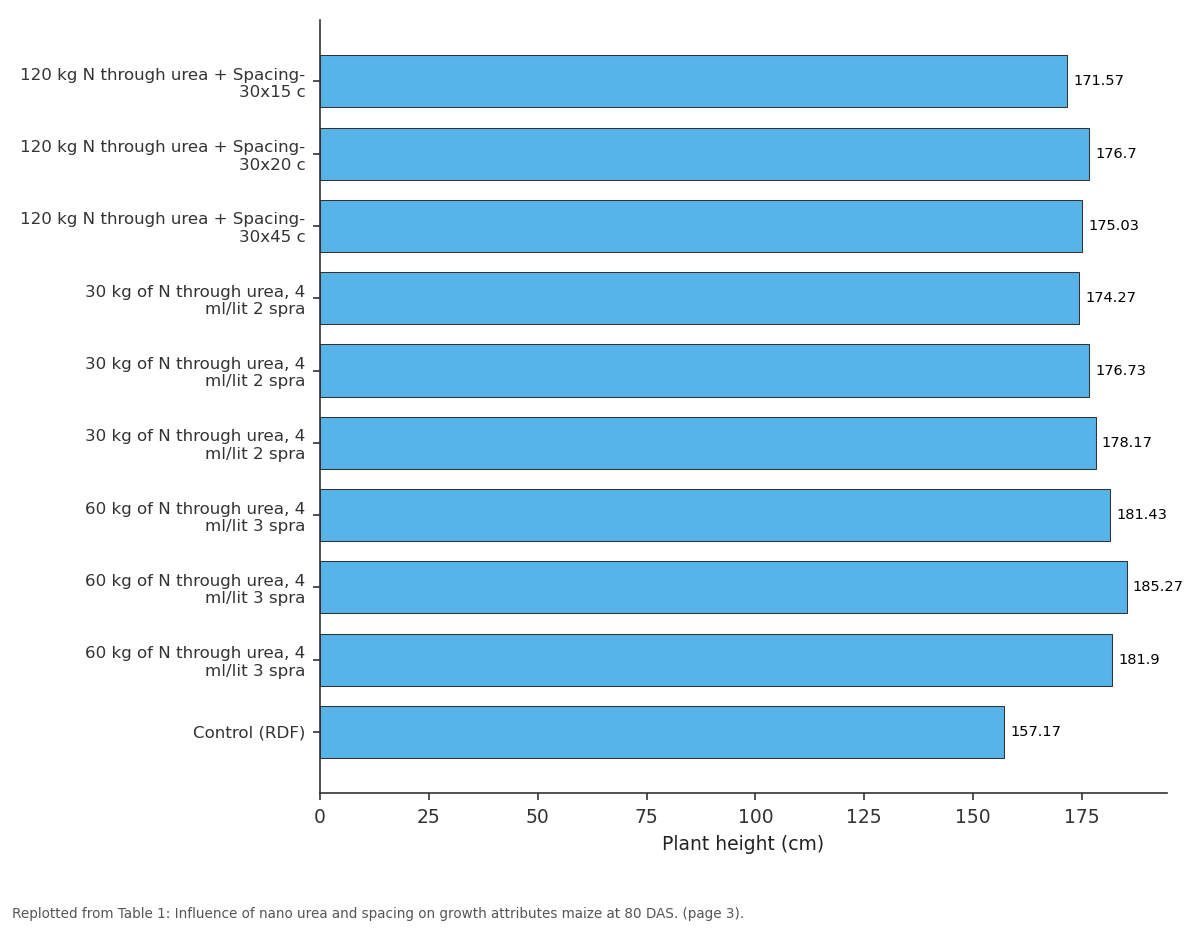
Plant height (cm): 120 kg N through urea +... vs 120 kg N through urea +... vs 120 kg N through urea +... vs 30 kg of N through... vs 30 kg of N through...
Replotted from Table 1 (page 3) of the original paper. Every bar is the paper's own table value.
View source evidence ↗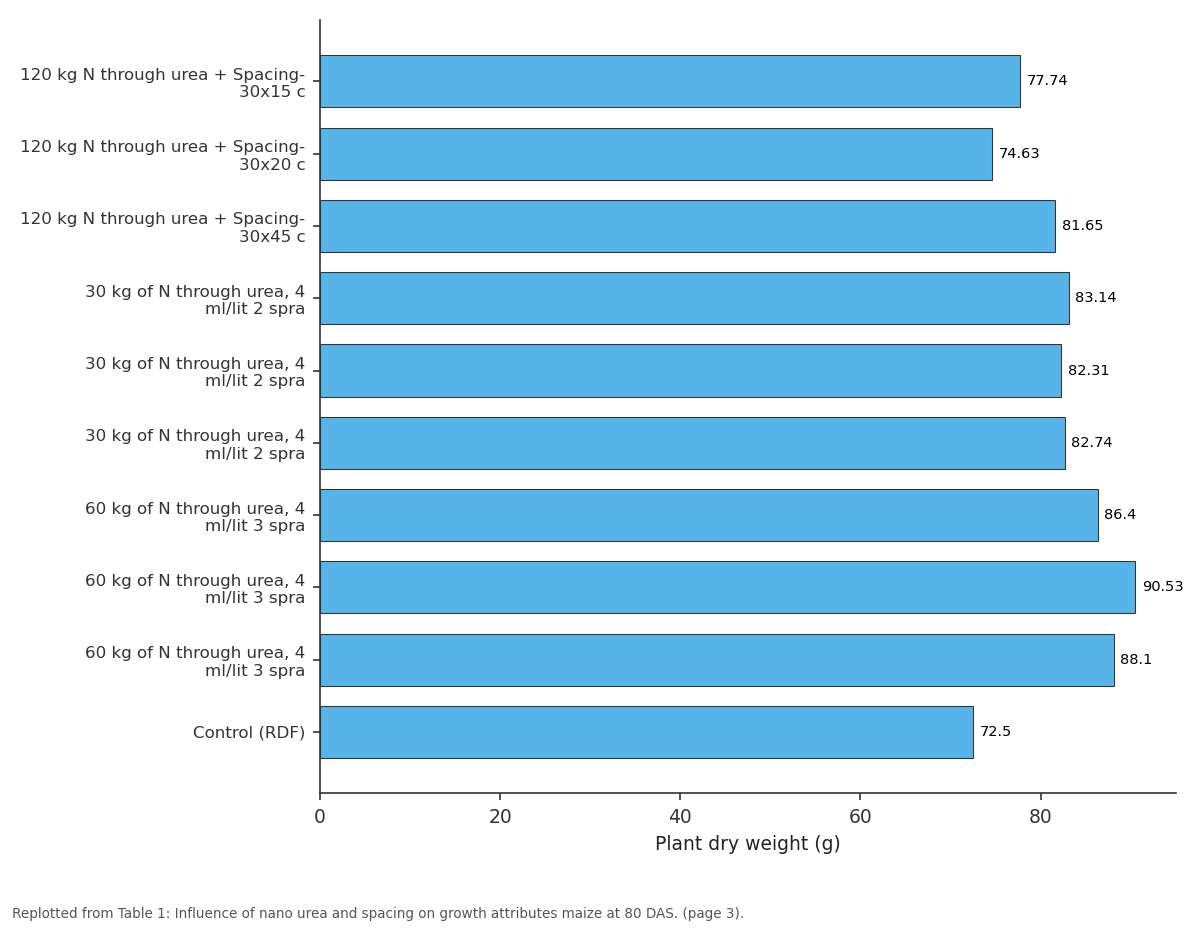
Plant dry weight (g): 120 kg N through urea +... vs 120 kg N through urea +... vs 120 kg N through urea +... vs 30 kg of N through... vs 30 kg of N through...
Replotted from Table 1 (page 3) of the original paper. Every bar is the paper's own table value.
View source evidence ↗Figures & tables
From the original paper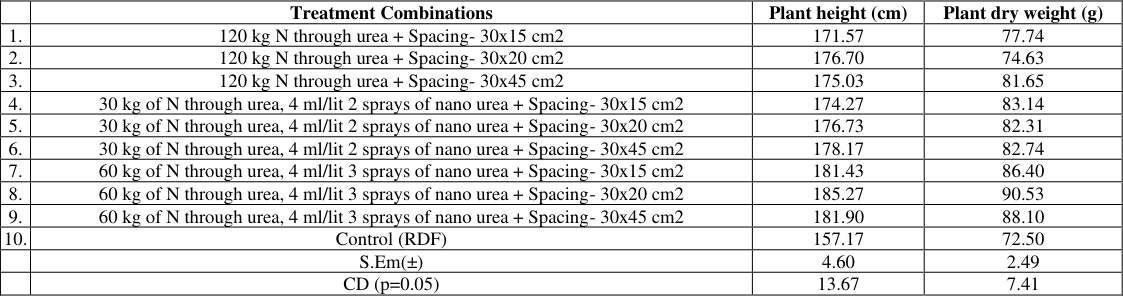 Table 1
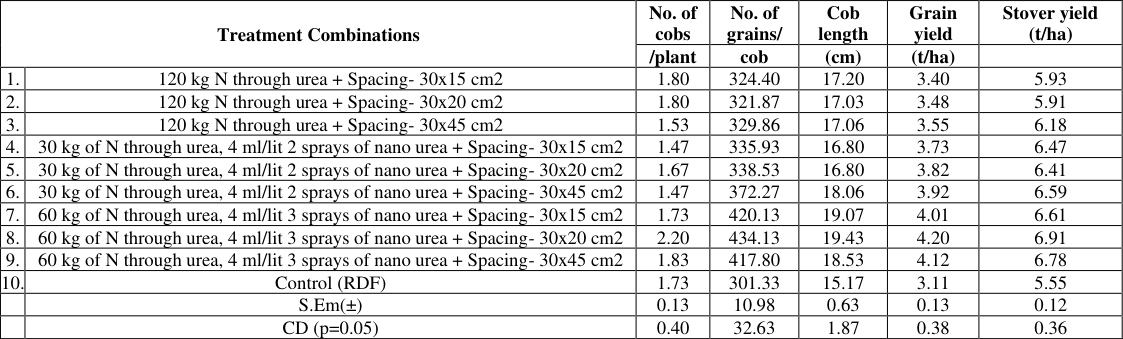 Table 2
Introduction
Maize is renowned as the "Queen of cereals" because it has the highest genetic production potential of all cereals. It comes in third place among cereals in India, after wheat and rice. Corn is defined as "to sustain life" and offers nutrients to humans and animals all around the planet. It is planted throughout the year in all seasons and grown all over the world. (Zea mays L.), or maize, is the scientific name for the most frequently grown food crop in the world. It supplies enough calories and protein to feed one billion plus people worldwide. The nutritional value of maize is high as it contains 72% starch, 10% protein, 8.5% fiber, 4.8% oil, 3.0% sugar and 1.7% ash. Comparatively maize gives more yield than the other cereals such as rice, wheat etc. India uses it as a fodder crop and as one of its staple foods. Maize is also used to extract gluten, starch, and cooking oil. In addition to being fermented and distilled to create grain alcohol, the starch in maize can also be hydrolysed and subjected to enzymatic treatment to create syrups, especially high fructose corn syrup and used as a sweetener. Rathore et al. 2022 [11] . Nano urea is environmentally friendly and has a high nitrogen use efficiency. This fertilizer is sometimes referred to as "smart fertilizer" since it lowers emissions of nitrous oxide, which is mostly to blame for contaminating soil, air, and water bodies. It also contributes to a decrease in global warming. At the present time, the greatest substitute for urea fertilizer is liquid nano fertilizer. A bag of urea fertilizer (45 kg) is equal to one bottle of nano urea (500 ml), which is 10% less than a bag of traditional urea. It has the potential to reduce fertilizer imports of urea. An individual nano urea liquid particle has a diameter of 30 nanometres and a surface area to volume ratio 10,000 times greater than that of a typical granular urea particle. Compared to conventional urea, foliar application of nano urea liquid at crucial crop growth phases of a plant effectively satisfies its nitrogen requirement and results in improved crop productivity and quality. Sahu et al. 2022 [12] . Therefore, there is potential to increase maize productivity using a variety of agronomic techniques. The traditional basis for spacing is the anticipated growth of a particular crop in a particular agroclimatic condition and the identification of factors that govern the crop's growth, development, and yield. Agronomic practices, particularly the spacing between rows, have a major impact on yield since they are ultimately linked to plant population, root formation, growth, and fruiting Devi et al. 1995 [2] . There is a complex link between yield and spacing. Maintaining an optimal plant population is essential to maximizing the use of natural resources including nutrients, sunlight, and soil moisture as well as to guarantee maximum economic grain yield for each area used for production. It has a significant impact on maize output and growth, which results in the timely initiation of vegetative and reproductive development. The way that maize reacts to plant density varies. Luque et al. 2006 [8] .
Materials and Methods
At the Department of Agronomy, Crop Research Farm, SHUATS, Prayagraj (U.P.), the experiment was carried out in the kharif season of 2023. Deep and neutral soil makes up the field that is a portion of the central gangetic alluvium. Almost neutral in soil response (pH -7.7), with organic carbon (0.57%), available N (171.48 kg/ha), available P (27.0 kg/ha), and available K (291.2 kg/ha), the soil in the experimental field had a sandy loam texture. The treatment consists of T1: 120 kg N through urea + Spacing-30x15 cm2, T2:120 kg N through urea + Spacing-30x20 cm2, T3: 120 kg N through urea + Spacing-30x45 cm2, T4: 30 kg of N through urea along with 4 ml/lit 2 sprays of nano urea + Spacing-30x15 cm2, T5: 30 kg of N through urea along with 4 ml/lit 2 sprays of nano urea + Spacing-30x20 cm2, T6: 30 kg of N through urea along with 4 ml/lit 2 sprays of nano urea + Spacing-30x45 cm2, T7: 60 kg of N through urea along with 4 ml/lit 3 sprays of nano urea + Spacing-30x15 cm2, T8: 60 kg of N through urea along with 4 ml/lit 3 sprays of nano urea + Spacing-30x20 cm2, T9: 60 kg of N through urea along with 4 ml/lit 3 sprays of nano urea + Spacing-30x45 cm2, T10: Control (RDF 120-60-40 NPK kg/ha) With three replications of each treatment, the experiment was set up using a randomized block design. Plant height (cm) and plant dry weight (g) were the physical measurements that were recorded. No. ofcorns per plant, Corn yield (t/ha). Hybrid maize was sown manually at about 5 cm depthin furrow with the spacing according to the treatments with seed rate of 20-25 kg/ha. Sowing is done on 12th August, 2023. Maize, variety (Hybrid maize) were selected for sowing. Seeds are sowed with spacing as per treatment along with recommended spacing i.e. 60x20 cm2. The basal application of urea is done at the time of sowing where as the foliar application of nano urea is done at 30, 45, 60 Days after sowing respectively. Nano urea formulations are often developed to improve nutrient uptake efficiency. By enhancing the availability and uptake of nutrients, including nitrogen, nano urea has the potential to promote plant growth reported by Kumar et al. (2022) [12] . The analysis of variance method was used to examine data on many aspects of the crop, such as growth, yield attributes, and yield. Statistical analysis was done by Gomez and Gomez (1976) [3] .
Result and discussion growth parameters
The data revealed that significantly higher plant height (185.27 cm) was recorded with application of 60 kg of N through urea along with 4 ml/lit 3 sprays of nano urea + spacing 30x20 cm2. However, treatment (T9) and treatment (T8) were found to be statistically at par with the highest. Application of Nano urea (4 ml/l) resulted in significantly higher plant height; this could be because increasing the dose of Nano urea increases cell division, cell metabolism, and cell growth. Similar result was reported by Singh et al. (2019). Significantly highest plant dry weight (90.53 g) was recorded with application of 60 kg of N through urea along with 4 ml/lit 3 sprays of nano urea + spacing 30x20 cm2. However, treatment (T9) was found to be statistically at par with highest. Nano urea has been suggested to enhance various physiological processes in plants, such as photosynthesis, nutrient uptake, and enzymatic activities. These improvements in plant physiology can contribute to better growth and development, potentially leading to increased plant height Srivastava et al. (2023) [14] .
Yield parameters
Treatment-8 (60 kg of N through urea along with 4 ml/lit 3 sprays of nano urea + spacing30x20 cm2) was recorded significantly higher number of cobs per plant (2.20). But it was discovered that, statistically speaking, treatment T9 was comparable to the best. Nano urea has the potential to enhance photosynthetic efficiency in plants. Improved photosynthesis can lead to increased carbohydrate production, which is essential for reproductive development and the formation of cobs Raliya et al. (2017) [10] . Treatment-8 (60 kg of N through urea along with 4 ml/lit 3 sprays of nano urea + spacing 30x20 cm2) was recorded significantly higher number of grains per cob (434.13). However, treatment T7 and T9 was found to be statistically at par with the highest. Nitrogen availability influences the allocation of carbohydrates within the plant. Adequate nitrogen supply ensures an optimal supply of assimilates to developing grains. Nitrogen deficiency can lead to resource limitations and reduced carbohydrate availability for grain filling. In contrast, optimal nitrogen levels facilitate carbohydrate transport and accumulation in developing grains, promoting the formation of a higher number of grains per cob reported by Worku et al. (2000) [15] . Treatment-8 (60 kg of N through urea along with 4 ml/lit 3 sprays of nano urea + spacing 30x20 cm2) was recorded significantly higher cob length (19.43 cm). However, treatment T7 and T9 was found to be statistically at par with the highest. The increased yield qualities resulting from higher amounts of nitrogen and more irrigations may be the reason of an increase in cob length. Similar findings were reported by Mukhtar et al. (2012) [9] . Treatment-8 (60 kg of N through urea along with 4 ml/lit 3 sprays of nano urea + spacing 30x20 cm2) grain yield (4.20 t/ha) was noted to be significantly higher. However, treatment T9 (4.12 t/ha) and T7 (4.01 t/ha) was found to be statistically at par with the highest. Theincrease in grain yield might be due to the favourable influence of nitrogen in increasingthe source size and establishing an appropriated source to sink relationship, respectively. Similar findings were observed by Srivastava et al. (2023) [14] . Treatment-8 (60 kg of N through urea along with 4 ml/lit 3 sprays of nano urea + spacing 30x20 cm2) was recorded significantly higher stover yield (6.91 t/ha). However, treatment T9 and T7 was found to be statistically at par with the highest. Nano urea formulations are often developed to improve nutrient uptake efficiency. Through improving the accessibility and assimilation of nutrients, including nitrogen, nano urea has the potential to promote plant growth, including stover biomass production reported by Kumar et al. (2022) [12] .
Conclusion
It can be concluded that application of 60 kg of N through urea along with 4 ml/lit at 3 intervals of spray through nano urea along with Spacing-30x20 cm2 as performed better in growth and yield attributes.
Acknowledgement
AcknowledgementI extend my heartfelt gratitude to my advisor, Dr. Rajesh Singh, Associate professor, for unwavering aid, crucial counsel, and valuable inputs that significantly enhanced the aspect of this research endeavor. Additionally, I would like to acknowledge the entire faculty of the Department Of Agronomy at SHUATS, Prayagraj, U.P for their provision of essential facilities, cooperation and support throughout this journey.
Figures and tables from the paper
| — | Treatment Combinations | Plant height (cm) | Plant dry weight (g) |
|---|---|---|---|
| 1. | 120 kg N through urea + Spacing- 30x15 cm2 | 171.57 | 77.74 |
| 2. | 120 kg N through urea + Spacing- 30x20 cm2 | 176.70 | 74.63 |
| 3. | 120 kg N through urea + Spacing- 30x45 cm2 | 175.03 | 81.65 |
| 4. | 30 kg of N through urea, 4 ml/lit 2 sprays of nano urea + Spacing- 30x15 cm2 | 174.27 | 83.14 |
| 5. | 30 kg of N through urea, 4 ml/lit 2 sprays of nano urea + Spacing- 30x20 cm2 | 176.73 | 82.31 |
| 6. | 30 kg of N through urea, 4 ml/lit 2 sprays of nano urea + Spacing- 30x45 cm2 | 178.17 | 82.74 |
| 7. | 60 kg of N through urea, 4 ml/lit 3 sprays of nano urea + Spacing- 30x15 cm2 | 181.43 | 86.40 |
| 8. | 60 kg of N through urea, 4 ml/lit 3 sprays of nano urea + Spacing- 30x20 cm2 | 185.27 | 90.53 |
| 9. | 60 kg of N through urea, 4 ml/lit 3 sprays of nano urea + Spacing- 30x45 cm2 | 181.90 | 88.10 |
| 10. | Control (RDF) | 157.17 | 72.50 |
| S.Em(±) | 4.60 | 2.49 | |
| CD (p=0.05) | 13.67 | 7.41 |
Table text extracted from the original PDF; superscript letters are shown inline. The original table image is below.
View original table image
| Treatment Combinations | — | No. of cobs | No. of grains/ | Cob length | Grain yield | Stover yield (t/ha) |
|---|---|---|---|---|---|---|
| /plant | cob | (cm) | (t/ha) | |||
| 1. | 120 kg N through urea + Spacing- 30x15 cm2 | 1.80 | 324.40 | 17.20 | 3.40 | 5.93 |
| 2. | 120 kg N through urea + Spacing- 30x20 cm2 | 1.80 | 321.87 | 17.03 | 3.48 | 5.91 |
| 3. | 120 kg N through urea + Spacing- 30x45 cm2 | 1.53 | 329.86 | 17.06 | 3.55 | 6.18 |
| 4. | 30 kg of N through urea, 4 ml/lit 2 sprays of nano urea + Spacing- 30x15 cm2 | 1.47 | 335.93 | 16.80 | 3.73 | 6.47 |
| 5. | 30 kg of N through urea, 4 ml/lit 2 sprays of nano urea + Spacing- 30x20 cm2 | 1.67 | 338.53 | 16.80 | 3.82 | 6.41 |
| 6. | 30 kg of N through urea, 4 ml/lit 2 sprays of nano urea + Spacing- 30x45 cm2 | 1.47 | 372.27 | 18.06 | 3.92 | 6.59 |
| 7. | 60 kg of N through urea, 4 ml/lit 3 sprays of nano urea + Spacing- 30x15 cm2 | 1.73 | 420.13 | 19.07 | 4.01 | 6.61 |
| 8. | 60 kg of N through urea, 4 ml/lit 3 sprays of nano urea + Spacing- 30x20 cm2 | 2.20 | 434.13 | 19.43 | 4.20 | 6.91 |
| 9. | 60 kg of N through urea, 4 ml/lit 3 sprays of nano urea + Spacing- 30x45 cm2 | 1.83 | 417.80 | 18.53 | 4.12 | 6.78 |
| 10. | Control (RDF) | 1.73 | 301.33 | 15.17 | 3.11 | 5.55 |
| S.Em(±) | 0.13 | 10.98 | 0.63 | 0.13 | 0.12 | |
| CD (p=0.05) | 0.40 | 32.63 | 1.87 | 0.38 | 0.36 |
Table text extracted from the original PDF; superscript letters are shown inline. The original table image is below.
View original table image
References
12 in the original paper- Gomez KA, Gomez AA. Three or more factor experiment. In: Statistical procedure for Agriculture research. 2 nd ed. 1976. p. 139-141.
- Imran S, Arif M, Khan A, Khan MA, Shah W, Latif A. Effect of nitrogen levels and plant population on yield and yield components of maize. Adv. Crop Sci. Technol. 2015;3(2):1-7.
- Iqbal J, Khan R, Wahid A, Sardar K, Khan N, Ali M, et al. Effect of nitrogen and zinc on maize (Zea mays L.) yield components and plant concentration. Adv. Environ Biol. 2016;10(10):203-209.
- Kebede MB. Effect of inter and intra row spacing on growth, yield components and yield of hybrid maize (Zea mays L.) varieties at Haramaya, Eastern Ethiopia. Am J Plant Sci. 2019;10(9):1548-1564.
- Kumar Y, Tiwari KN, Singh TS, Sain NK, Laxmi S, Verma R. Nano fertilizers for enhancing nutrient use efficiency, crop productivity and economic returns in winter season crops of Rajasthan. Ann Plant Soil Res. 2020;22(4):324335.
- Luque SF, Cirilo AG, Otegui ME. Genetic gains in grain yield and related physiological attributes in Argentine maize hybrids. Field Crops Res. 2006;95(2-3):383-397.
- Mukhtar T, Arif M, Hussain S, Atif M, Rehman S, Hussain K. Yield and yield components of maize hybrids as influenced by plant spacing. J Agric Res. 2012;50(1):59-69.
- Raliya R, Saharan V, Dimkpa C, Biswas P. Nanofertilizer for precision and sustainable agriculture: current state and future perspectives. J Agric Food Chem. 2017;66(26):64876503.
- Sahu TK, Kumar M, Kumar N, Chandrakar T, Singh DP. Effect of nano urea application on growth and productivity of rice (Oryza sativa L.) under midland situation of Bastar region. Pharma Innovation. 2022;11:185-87.
- Singh B, Singh A. Response of Kharif Maize (Zea mays L.) to Planting Methods and Nitrogen Management Approach by Leaf Colour Chart. Scientists joined as life member of the society of Krishi Vigyan. 2019.
- Srivastava A, Singh R. Effect of Nitrogen and Foliar Spray of Urea and Nano Urea on Growth and Yield of Rabi Maize (Zea mays L.). Int. J Plant Soil Sci. 2023;35(18):2037-2044.
- Worku M, Bänziger M, Erley GSAM, Friesen D, Diallo AO, Horst WJ. Nitrogen uptake and utilization in contrasting nitrogen-efficient tropical maize hybrids. Crop Sci. 2007;47(2):519-528.
Cited by 1
From OpenAlex, OpenCitations and reference lists read by Scinovex
- Ultrasonication-engineered urea nanomaterials: Chemical and morphological transformation toward enhanced fertilizer performance ↗
Aulia Dewi Rosanti, Fahmi Hidayat, Widyana Rahmatika, Nur Fitriyah, Yuly Kusumawati, Yatim Lailun Ni’mah et al. · Next Materials · 2026
Conventional urea fertilizers are highly susceptible to nitrogen losses through volatilization and leaching, resulting in low nitrogen-use efficiency (NUE) and increased environmental impacts. Although nano urea has emerged as a promising alternative, comparative studies on ultrasonication-engineered nano urea systems and their integration with conventional fertilization strategies remain limited. In this study, urea nanopowder (UNS) and urea nanofluid (UNF) were synthesized…
❝ 0PDF