
Research article · 2024 · Full text
International Journal of Research in AgronomyEffect of nutrient levels and cow urine spray on growth and yield of rice (Oryza sativa L.)
Volume 7(5) · Pages 340–342 · DOI: 10.33545/2618060x.2024.v7.i5e.693 ↗
Research areasHumic Substances and Bio-Organic StudiesRice Cultivation and Yield Improvement
Abstract
Author-writtenField experiment was conducted during Khairf 2023 at Crop Research Farm, Department of Agronomy, SHUATS, Prayagraj (U.P). The soil of experimental plot was sandy loam in texture, nearly neutral in soil reaction (pH 7.1), low in organic carbon (0.36%), available N (171.48 kg/ha), available P (15.2 kg/ha) and available K (232.5 kg/ha). The experiment was laid out in Randomized Block Design with nine treatments including control each replicated thrice on the basis of one year experimentation. The treatments consists of T1: RDF 50% + Cow urine spray 300 litres/ha, T2: RDF 50% + Cow urine spray 450 litres/ha, T3: RDF 50% + Cow urine spray 600 litres/ha, T4: RDF 75% + Cow urine spray 300 litres/ha, T5: RDF 75% + Cow urine spray 450 litres/ha, T6: RDF 75% + Cow urine spray 600 litres/ha, T7: RDF 100% + Cow urine spray 300 litres/ha, T8: RDF 100% + Cow urine spray 450 litres/ha, T9: RDF 100% + Cow urine spray 600 litres/ha. The application of RDF 100% + Cow urine spray 600 litres/ha recorded significantly higher Plant height (72.30 cm), Plant dry weight (35.74 g/plant), number of tillers per plant (13.67). Significantly maximum number of panicles per hill (11.53), number of grains per hill (105.20), grains yield (2605.71 kg/ha), stover yield (3692.08 kg/ha).
Summary
Source-checkedPlain-language reading of the full paper, prepared with AI and checked against the text. Each point links to the authors' own words.
Why it matters
- Rice is a critical staple crop for about half of the global population. View evidence ↗
- Global demand for rice was projected to rise by 25% between 2001 and 2025 to keep pace with population growth. View evidence ↗
- Macronutrients like nitrogen (N), phosphorus (P), and potassium (K) are essential for promoting plant growth, increasing tiller numbers, and improving overall grain production. View evidence ↗
The question
- The study aimed to evaluate how different nutrient levels and the application of cow urine spray affect the growth and yield of rice. View evidence ↗
What they did
- A field experiment was carried out during the Kharif season of 2023 at the Crop Research Farm in Prayagraj, Uttar Pradesh. View evidence ↗
- The researchers used a Randomized Block Design with nine different treatments, including a control group, with each treatment replicated three times. View evidence ↗
- Treatments varied the Recommended Dose of Fertilizer (RDF) at 50%, 75%, and 100% levels, combined with cow urine sprays at 300, 450, and 600 litres per hectare. View evidence ↗
- The rice variety used for the experiment was Super-10. View evidence ↗
What they found
- The combination of 100% RDF and 600 L/ha cow urine spray produced the maximum plant height (72.30 cm), compared to the control's minimum (67.90 cm). View evidence ↗
- The highest number of tillers per plant (13.67) was achieved with 100% RDF and 600 L/ha cow urine spray, while the control had the lowest (9.87). View evidence ↗
- Plant dry weight peaked at 35.74 g with 100% RDF and 600 L/ha cow urine spray, compared to 33.34 g in the control group. View evidence ↗
- The maximum number of panicles per hill (11.53) was found in the 100% RDF and 600 L/ha cow urine spray treatment, while the control was the lowest (10.07). View evidence ↗
- Grain yield was highest at 2605.71 kg/ha with 100% RDF and 600 L/ha cow urine spray, and lowest at 2293.50 kg/ha in the control. View evidence ↗
- Straw yield reached a maximum of 3692.08 kg/ha with 100% RDF and 600 L/ha cow urine spray, compared to 3473.60 kg/ha for the control. View evidence ↗
What it means
- The authors conclude that optimizing rice productivity requires appropriate nitrogen management, specifically recommending the combination of 100% RDF and 600 L/ha cow urine spray. View evidence ↗
- The authors state that more research is needed to determine if these fertilization practices are sustainable over the long term. View evidence ↗
Visual summary
3 visualsIllustrations explain the paper; charts are replotted from the paper's own table values.
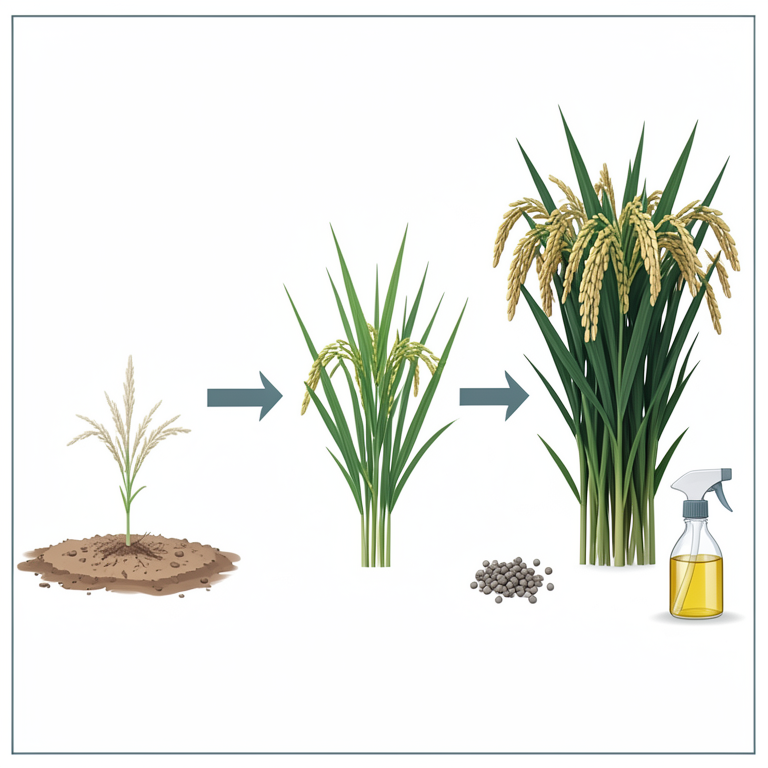
Nutrient and Cow Urine Interaction
AI-generated conceptual illustration (rice plants (Oryza sativa L.)). It explains the idea and does not show study data.
View source evidence ↗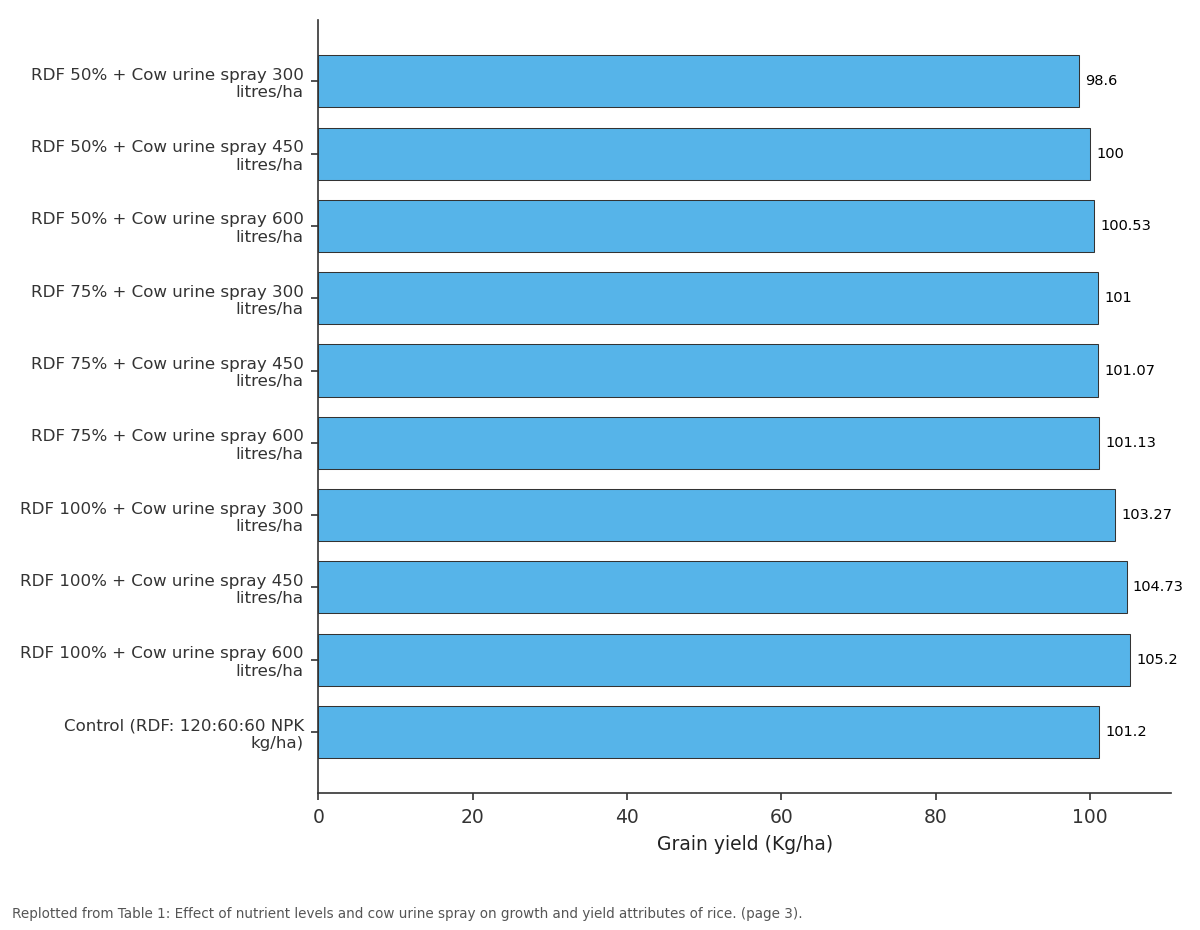
Number of grains per plant: RDF 50% + Cow urine... vs RDF 50% + Cow urine... vs RDF 50% + Cow urine... vs RDF 75% + Cow urine... vs RDF 75% + Cow urine...
Replotted from Table 1 (page 3) of the original paper. Every bar is the paper's own table value.
View source evidence ↗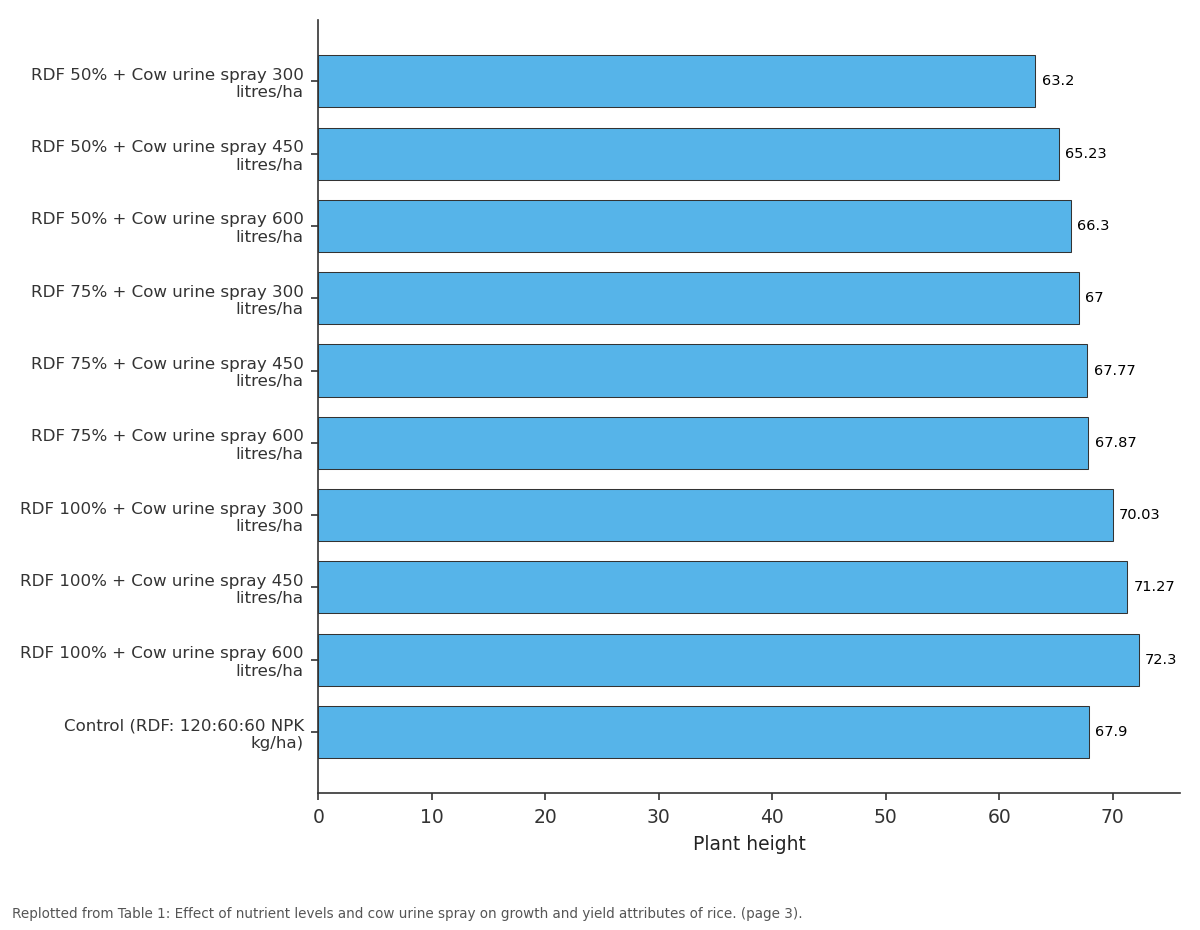
Plant height: RDF 50% + Cow urine... vs RDF 50% + Cow urine... vs RDF 50% + Cow urine... vs RDF 75% + Cow urine... vs RDF 75% + Cow urine...
Replotted from Table 1 (page 3) of the original paper. Every bar is the paper's own table value.
View source evidence ↗Figures & tables
From the original paper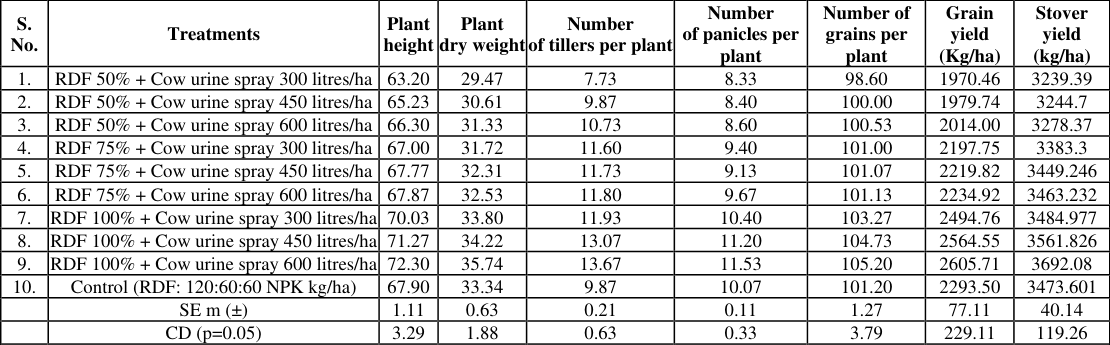 Table 1
Introduction
Rice is one of the staple crops of approximately half of the world's population. Therefore, rice production needs to be increased to meet the needs of the increasing world population. To keep up with population growth, world rice demand is expected to increase by 25% from 2001 to 2025, so it is very difficult to meet the increased demand for rice during the decline (Singh et al., 2016) [12] . The use of different improvement methods, the decision to use fertilizers and water, and appropriate management can help increase crop yields in farmers (Gairhe et al., 2018) [6] . Malnutrition results in reduced food production and returns (Wattoo et al., 2018) [14] . N, P and K are macro elements; Ca, Mg and S are secondary nutrients; It can promote rapid growth, increase crop yield and yield by increasing the number of tillers, leaf growth, grain production, grain deficiency and protein synthesis. In plants lacking nitrogen, there are fewer tillers, growth is stunted, and yellow green leaves die, starting from the top of the leaf to the middle of the leaf. Excessive use of nitrogen will cause damage such as weakening of straw, decreased yield, and decreased rice yield and quality. Distribution, expansion and internal processing of other crops. Most of the phosphorus absorbed by plants is in the form of primary orthophosphate ions (H2PO4), and a small part is absorbed in the form of other orthophosphate ions (H2PO4). Element P is important for seed production, helping to improve rooting and germination, increase water efficiency and increase resistance to diseases, ultimately improving crop quality. Lack of P content can slow ripening and reduce seed plumpness. Substance P is a component of adenosine triphosphate (ATP). Element P plays a direct role in activities involved in energy storage and conversion, as well as in crop metabolism. Rice contains high levels of phosphorus, especially in the early stages of growth, as it promotes root formation, increases quantity, accelerates flowering and grain maturation. After phosphorus. This product is involved in many plant metabolic processes, including photosynthesis, as an activator of many enzymes. Insufficient potassium will reduce photosynthesis and respiration. This phenomenon ultimately inhibits carbohydrate production.
The function of potassium is important in protein production, solubilization of carbohydrates, plant growth process, transport of heavy metals such as iron, resistance to diseases and fruit production, and controls the opening and closing of protective cells in the leaf. Stomata. Symptoms of potassium deficiency are scorched leaf edges and brown necrotic spots on older leaves and stems.
Materials and Methods
The experiments on the effect of nutrient levels and cow urine spray on the growth and yield of rice were conducted during the Kharif season of 2023-2024 at Crop Research Farm, Department of Agronomy, Naini Agricultural Institute, SHUATS, Prayagraj which is located at 250 24 42 N latitude, 810 50 56 E longitude and 98 m altitude above the mean sea level. This region is located approximately 5 kilometres from Prayagraj city on the right bank of the Yamuna River beside Prayagraj Rewa Road. A composite soil sample was taken between 0 and 30 cm down. It was crushed, let to air dry, and its chemical and physical qualities examined. The soil reaction of the sandy clay loam was 7.2, the organic matter content was 0.69 (0.72%), the available nitrogen was 181.7 kg/ha, the phosphorus was 32.74 kg/ha, the potassium was 120.0 kg/ha, the sulfur content was 7.2 mg/kg, the zinc was 0.81 mg/kg, and the available B was 0.66 mg/kg. Rice variety Super -10 were selected for sowing. Seeds were sown in line manually in 2023. Seeds were covered with the soil immediately after sowing. The spacing adopted was plant to plant 10 cm and row to row 20 cm according to the treatment details and the seeds were drilled at 4 -5 cm depth. All the treatments were applied by balancing to the initial soil test values and crop requirements to justify the crop response to the supplied nutrients in both years.
Results and Discussion
Plant height: At 100 DAS, there was significant difference among the treatments. However, highest plant height (72.30 cm) was recorded with the application of RDF 100% + Cow urine spray 600 litres/ha, whereas minimum plant height (67.90 cm) was recorded with the treatment Control (RDF: 120:60:60 NPK kg/ha) and RDF 100% + Cow urine spray 450 litres/ha (71.27 cm) was statistically at par with T9. Nitrogen, which is the main source and product of useful products such as protein, chlorophyll and DNA, plays an important role in microalgae culture. Changes in nitrogen concentration can affect microalgae growth and protein, lipid and carbohydrate synthesis (Pancha et al. 2014) [10] . Many studies have shown that nitrogen limitation reduces biomass productivity although it increases lipid accumulation.
Number of tillers per plant
At harvest, there was significant difference among the treatments. However, highest number of tillers per plant (13.67) was recorded with the application of RDF 100% + Cow urine spray 600 litres/ha, whereas minimum number of tillers per plant (9.87) was recorded with the treatment Control (RDF: 120:60:60 NPK kg/ha) and RDF 100% + Cow urine spray 450 litres/ha (13.07) was statistically at par with T9. Additional tillering with nitrogen fertilization is due to the increase in the amount of nitrogen, which plays an important role in cell division. In our study, the number of m2 tillers responded to nitrogen applications. (2017) found that rice tillering had a positive relationship with nitrogen application.
Plant dry weight
At harvest, there was significant difference among the treatments. However, highest plant dry weight (35.74 g) was recorded with the application of RDF 100% + Cow urine spray 600 litres/ha, whereas minimum plant dry weight (33.34) was recorded with the treatment Control (RDF: 120:60:60 NPK kg/ha) and RDF 100% + Cow urine spray 450 litres/ha (34.22 g) was statistically at par with T9. Nautiyal CS (2004) [8] conducted an experiment and showed that the dry weight/peak and duration of Kanpur basmati rice increased significantly with every 50 kg increase in nitrogen dosage from 0 kg/ha to 150 kg/ha. Dry matter increased significantly at all growth stages; It increased from 120 kg/ha to 240 kg/ha, an increase of 60 kg N/ha. 180 kg N/ha at each growth stage produces dry matter equivalent to 240 kg/ha. A higher dose of nitrogen can help plants grow, resulting in the positive effect of photo synthetically active radiation and increased photosynthesis in plants.
Number of Panicles/hills
The perusal of the data of Number of Panicles/hills was recorded at harvest, is presented in Table 1. The data reveals that there was significant effect among different treatments on Number of Panicles/hills. Significantly maximum Number of Panicles/hills (11.53) was recorded with the application of RDF 100% + Cow urine spray 600 litres/ha, whereas minimum number of panicles per hill (10.07) was recorded with the treatment Control (RDF: 120:60:60 NPK kg/ha) and RDF 100% + Cow urine spray 450 litres/ha (11.20) was statistically at par with T9. Nitrogen is important in the growth and development of rice and is closely related to the production of rice yield (Pittelkow 2015) [9] . Excessive nitrogen application will reduce nitrogen use efficiency and grain yield. Therefore, the correct application of nitrogenous fertilizer is very important and important for agricultural production.
| S. No. | Treatments | Plant height | Plant dry weight | Number of tillers per plant | Number of panicles per plant | Number of grains per plant | Grain yield (Kg/ha) | Stover yield (kg/ha) |
|---|---|---|---|---|---|---|---|---|
| 1. | RDF 50% + Cow urine spray 300 litres/ha | 63.20 | 29.47 | 7.73 | 8.33 | 98.60 | 1970.46 | 3239.39 |
| 2. | RDF 50% + Cow urine spray 450 litres/ha | 65.23 | 30.61 | 9.87 | 8.40 | 100.00 | 1979.74 | 3244.7 |
| 3. | RDF 50% + Cow urine spray 600 litres/ha | 66.30 | 31.33 | 10.73 | 8.60 | 100.53 | 2014.00 | 3278.37 |
| 4. | RDF 75% + Cow urine spray 300 litres/ha | 67.00 | 31.72 | 11.60 | 9.40 | 101.00 | 2197.75 | 3383.3 |
| 5. | RDF 75% + Cow urine spray 450 litres/ha | 67.77 | 32.31 | 11.73 | 9.13 | 101.07 | 2219.82 | 3449.246 |
| 6. | RDF 75% + Cow urine spray 600 litres/ha | 67.87 | 32.53 | 11.80 | 9.67 | 101.13 | 2234.92 | 3463.232 |
| 7. | RDF 100% + Cow urine spray 300 litres/ha | 70.03 | 33.80 | 11.93 | 10.40 | 103.27 | 2494.76 | 3484.977 |
| 8. | RDF 100% + Cow urine spray 450 litres/ha | 71.27 | 34.22 | 13.07 | 11.20 | 104.73 | 2564.55 | 3561.826 |
| 9. | RDF 100% + Cow urine spray 600 litres/ha | 72.30 | 35.74 | 13.67 | 11.53 | 105.20 | 2605.71 | 3692.08 |
| 10. | Control (RDF: 120:60:60 NPK kg/ha) | 67.90 | 33.34 | 9.87 | 10.07 | 101.20 | 2293.50 | 3473.601 |
| SE m (±) | 1.11 | 0.63 | 0.21 | 0.11 | 1.27 | 77.11 | 40.14 | |
| CD (p=0.05) | 3.29 | 1.88 | 0.63 | 0.33 | 3.79 | 229.11 | 119.26 |
Table text extracted from the original PDF; superscript letters are shown inline. The original table image is below.
View original table image
Significantly maximum grain yield (2605.71 kg/ha) was recorded with the application of RDF 100% + Cow urine spray 600 litres/ha, whereas minimum grain yield (2293.50 kg/ha) was recorded with the treatment Control (RDF: 120:60:60 NPK kg/ha) and RDF 100% + Cow urine spray 450 litres/ha (2564.55 kg/ha) was statistically at par with T9. Das et al. (2003) [2] reported that increasing levels of N application influenced the total N uptake at harvest of both rice and wheat, giving the highest values under 100% N level. Application of higher doses of N might have increased the N content in grain and straw of rice and wheat crop. Higher N content at higher level of N application together with higher dry matter production resulted higher N uptake.
Significantly maximum straw yield (3692.08 kg/ha) was recorded with the application of RDF 100% + Cow urine spray 600 litres/ha, whereas minimum straw yield (3473.60 kg/ha) was recorded with the treatment Control (RDF: 120:60:60 NPK kg/ha) and RDF 100% + Cow urine spray 450 litres/ha (3561.82 kg/ha) was statistically at par with T9.
References
13 in the original paper- Contreras HAS, Barzan RR, Contreras MS, Brito OR. Growth, yield and agronomic efficiency of rice (Oryza sativa L.) cv. IAPAR 117 affected by nitrogen rates and sources. Acta Agronomical. 2017;66(4):558-565.
- Das K, Medhi DN, Guha B. Application of crop residues in combination with chemical fertilizers for sustainable productivity in rice (Oryza sativa)-wheat (Triticum aestivum) system, Indian Journal of Agronomy. 2003;48(1):8-11.
- El-Kassas HY. Growth and fatty acid profile of the marine microalga Picochlorum sp. grown under nutrient stress conditions Egyptian Journal of Aquatic. Research. 2013;39(4):233-239
- Firmansyah I, Syakir M. The influence of dose combination fertilizer N, P, and K. Journal of Horticulture. 2017;27(1):69-78.
- Fisher RA, Yates F. Statistical tables for biological, agricultural and medical research. 1963;22(2):151-158.
- Gairhe S, Shrestha HK, Timsina KP. Dynamics of major cereal productivity in Nepal. Journal of Nepal Agricultural Research Council. 2018;4:60-71.
- Manonmani V, Srimathi P. Influence of mother crop nutrition on seed and quality of black gram. Madras Agricultural Journal. 2009;96(16):125-128.
- Pittelkow CM, Liang X, Linquist BA, van Groenigen KJ, Lee J, Lundy ME, et al. Productivity Limits and Potentials of the Principles of Conservation Agriculture. Nature. 2015;517:365-368.
- Pancha, Chokshi K, George B, Ghosh T, Paliwal C, Maurya R, et al. Nitrogen stress triggered biochemical and morphological changes in the microalgae Scenedesmus sp. CCNM 1077, Bio-resource Technology. 2014, p.146-154, p. 156.
- Shekara BG, Nagaraju, Shreedhara D. Growth and yield of aerobic rice as influenced by different levels of N, P and K in Cauvery command area. Journal of Maharashtra Agricultural Universities. 2010;35(2):195-198.
- Singh VP, Singh SP, Dhyani VC, Banga A, Kumar A, Satyawali K, et al. Weed management in directseeded rice, Indian Journal of Weed Science. 2016;48(3):233-246.
- Singh L, Singh P, Kotru R, Hasan B, Chand L, Lone A. Cow urine spray and integrated nutrient management of rice on productivity and energy-use under temperate valley conditions. Indian Journal of Agricultural Sciences. 2012;82(7):583-588.
- Wattoo FM, Rana RM, Fiaz S, Zafar SA, Noor MA, Hassan HM. Identification of Drought Tolerant Maize Genotypes and Seedling based Morpho Physiological Selection Indices for Crop Improvement. Sains Malays. 2018;47:295-302.