
Research article · 2024 · Full text
International Journal of Horticulture and Food ScienceEffect of intercropping systems with three varieties of soybean (Glycine max) on growth traits and seed yield in soybean
Volume 6(1) · Pages 108–113 · DOI: 10.33545/26631067.2024.v6.i1b.195 ↗
Research areasAgronomic Practices and Intercropping SystemsSoybean genetics and cultivation
Abstract
Author-writtenA field experiment was carried out in Hissar area of Kirkuk Governorate during the fall season of 2023 AD to determine effect of intercropping systems for Maize with three varieties of soybeans on growth and seed yield in soybeans. Experiment was carried out according to Randomized Complete Block Design (R.C.B.D) and with three replications, as study included two factors. First was three varieties of soybeans, namely (Lee, D, and Shaima), and the second was four intercropping systems, namely (Maize alone), (soybeans alone), (Maize line + soybean line), and (two maize lines + two soybean lines). The following results are that intercropping system (1 maize: 1 soybean) was superior in plant height, reaching (106.08) cm, while soybean cultivation alone was superior in traits of leaf area, number of vegetative branches, number of pods per plant, and in single plant yield, with means reaching (205.25) cm and (8.70) shoots. Plant and (99.71) pods. Plant and (33.22) grams. As for varieties that surpass Shaima variety in plant height, leaf area, number of branches on plant and weight of 300 seeds, it reached (128.14) cm, (191.47) cm2 and (8.45) branches. Plant and (38.66 grams, respectively, and Lee variety was superior in number of pods per plant and Single plant yield, reaching (101.38) pods. Plant and (32.70) grams. plant. As for interaction between parameters of varieties and intercropping systems, intercropping system (1 maize: 1 soybean variety, Shaima) gave highest average for two traits of plant height and weight of 300 seeds, amounting to (142.23) cm and (39.66) grams, respectively and intercropping system surpassed planting alone for Shaima variety in number of branches. Vegetative growth reached (9.60) branches of a plan and intercropping system (2 maize: 2 soybean variety Lee) was superior in number of pods per plant at a rate of (105.63) pods. A plant, while the loading system was superior to cultivation alone for Lee variety in terms of single plant yield, reaching (33.56) gm.
Summary
Source-checkedPlain-language reading of the full paper, prepared with AI and checked against the text. Each point links to the authors' own words.
Why it matters
- Intercropping, the practice of growing two or more crop types together in one field, is a long-standing global agricultural method used as an alternative to monoculture. View evidence ↗
- This system is used to potentially increase yields, optimize resource use (light, water, nutrients, and land), and lower the risk of pests and diseases. View evidence ↗
- Soybean is a legume valued for its high concentrations of minerals, vitamins, and protein. View evidence ↗
The question
- The study aims to determine how different intercropping systems affect the seed yield and growth characteristics of three soybean varieties. View evidence ↗
What they did
- The field experiment was conducted in the Hissar area of Kirkuk Governorate during the fall season of 2023. View evidence ↗
- The researchers measured plant height, leaf area, number of vegetative branches, pods per plant, seeds per pod, the weight of 300 seeds, and the yield of a single plant. View evidence ↗
What they found
- The 1:1 maize-soybean intercropping system produced the greatest plant height, averaging 106.08 cm. View evidence ↗
- Growing soybeans alone resulted in the best leaf area (205.25 cm²), number of vegetative branches (8.70 per plant), number of pods (99.71 per plant), and single plant yield (33.22 g). View evidence ↗
- Among the varieties, Shaima performed best in plant height (128.14 cm), leaf area (191.47 cm²), number of branches (8.45 per plant), and 300-seed weight (38.66 g). View evidence ↗
- The Lee variety achieved the highest number of pods per plant (101.38) and the highest single plant yield (32.70 g) among the varieties. View evidence ↗
- The combination of the 1:1 intercropping system with the Shaima variety yielded the highest plant height (142.23 cm) and 300-seed weight (39.66 g). View evidence ↗
- The 2:2 intercropping system using the Lee variety produced the most pods per plant, averaging 105.63. View evidence ↗
- No significant differences were found in the number of seeds per pod regardless of the soybean variety or the intercropping system used. View evidence ↗
What it means
- The authors conclude that growing soybeans alone generally outperformed intercropping for yield-related traits, likely because there was less competition for resources. View evidence ↗
- The study suggests that both the choice of soybean variety and the method of cultivation have a significant impact on agronomic traits. View evidence ↗
Visual summary
2 visualsIllustrations explain the paper; charts are replotted from the paper's own table values.
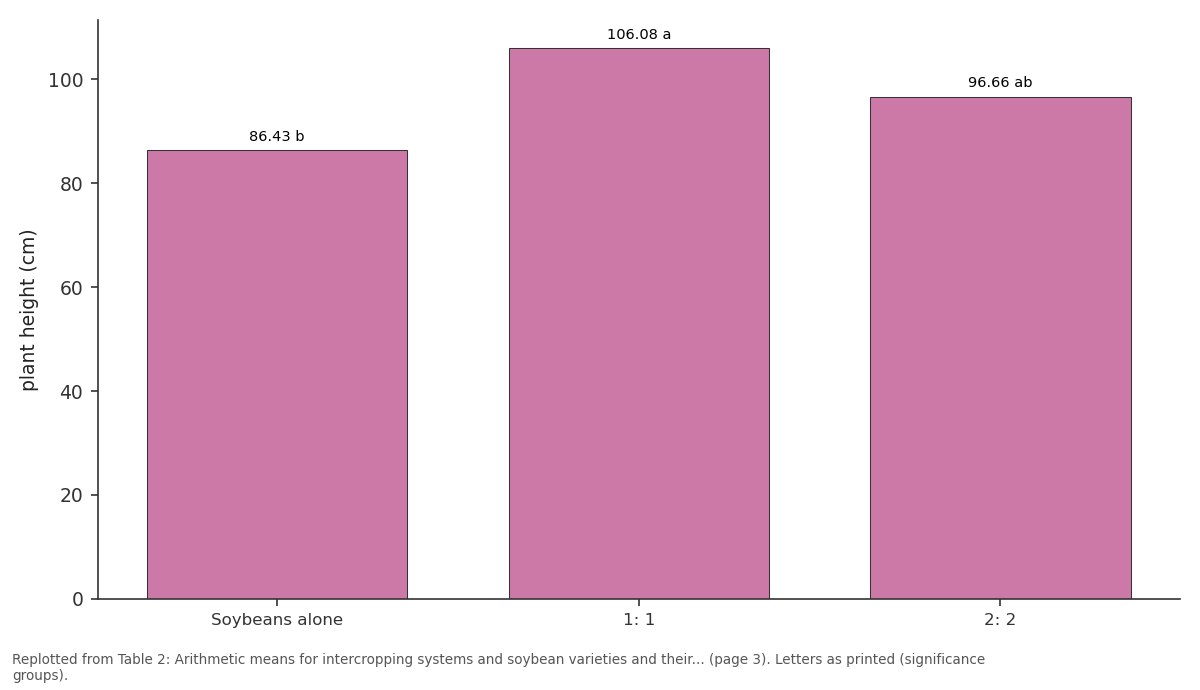
Intercropping mean: Soybeans alone vs 1: 1 vs 2: 2
Replotted from Table 2 (page 3) of the original paper. Every bar is the paper's own table value.
View source evidence ↗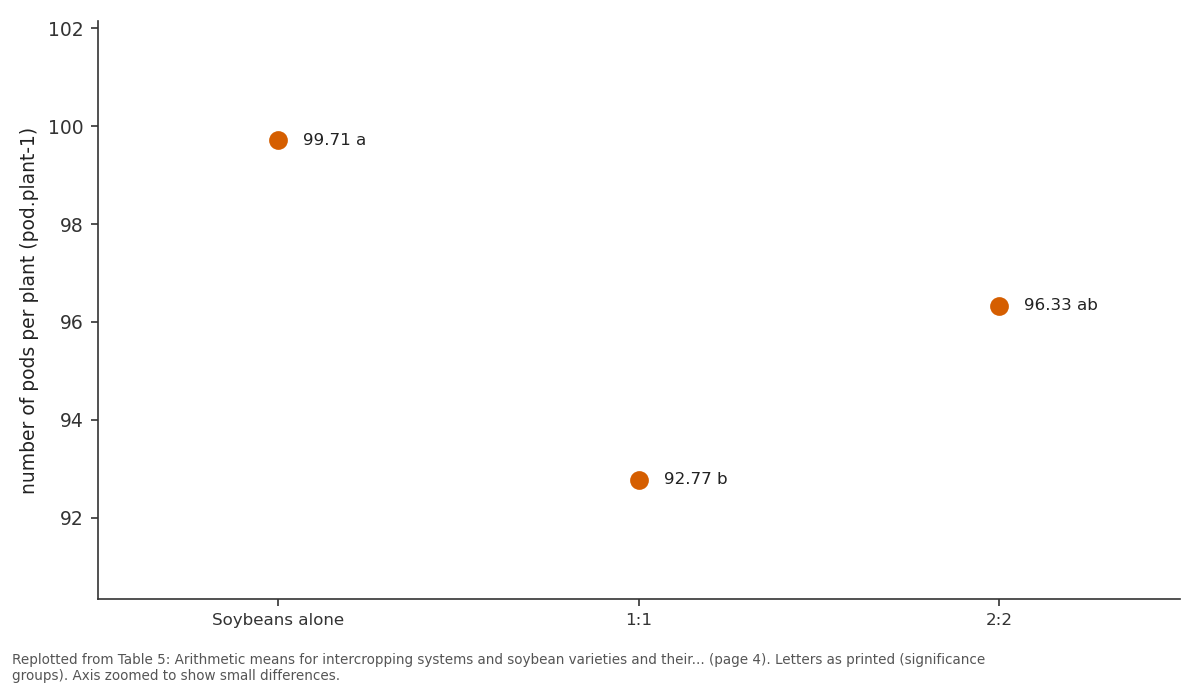
Intercropping mean: Soybeans alone vs 1:1 vs 2:2
Replotted from Table 5 (page 4) of the original paper. Every bar is the paper's own table value.
View source evidence ↗Figures & tables
From the original paper Table 1
 Table 2
 Table 3
 Table 4
 Table 5
 Table 6
 Table 7
 Table 8
Introduction
Intercropping is joint cultivation of two or more types of field crops in the same field. It is an ancient agricultural practice and is still widespread around the world, unlike monoculture (Gitari and Maitra, 2020) [13] . It is a system that has been practiced for a long time due to expected advantages, such as higher yield production, better use of resources (such as nutrients, light, water and land) and reduced risks of diseases and insect pests. Intercropping also helps reduce negative environmental impacts that threaten agro-ecosystems such as, climate change, Or soil acidification or terrestrial ecotoxicity (Raza et al., 2021) [14] . Maize (Zea may L.) is one of cereal crops belonging to Poaceae family. It is economically important and widespread throughout world. It ranks third after wheat and rice in terms of importance at the global level. It is called the king of crops because of its high productivity and adaptation to varying environmental conditions. Compared to other cereal crops, it is a source of food for humans, fodder for animals, and a source of bioenergy (Food and Agriculture Organization, 2018). Soybean Glycine max L. is one of crops that belong to the legume family (Fabaceae). It is a leguminous crop known for its high content of protein, vitamins and minerals. It has multiple food and industrial uses. It is described as a high-quality protein reservoir (Deng et al., 2022) [19] .
Cultivating it enhances soil characteristics and boosts fertility by fixing atmospheric nitrogen through root nodules in the soil. This process supplies plants with essential nutrients for development and adds easily decomposable biomass to the soil. Consequently, it is seen as a suitable crop for intercropping with other crops that exert stress on the soil, resulting in beneficial effects. The primary crop of this agricultural field is grass. Applying intercropping system is easiest and best way to optimally invest per unit area of land, make the most of agricultural production inputs, reduce production costs, and limit the risks resulting from failure of one of cultivated crops that could result from unsuitable environmental conditions if crop is grown. On its own research aims to demonstrate effect of intercropping on growth traits and seed yield of three varieties of soybeans.
Materials and Methods
An agricultural field experiment was conducted in the village of Hisar, located in the Shawan district of Kirkuk Governorate. The village is situated 22 km away from the governorate's center, at a latitude of 62.35 north and a longitude of 40.45 east. The experiment took place during the summer agricultural season of 2023, with the aim of investigating the impact of different loading systems using soybean varieties on the competitive indicators of growth and yield of yellow corn. An experiment was conducted using a Randomized Complete Block Design (R.C.B.D), with three replications. The area was first mulched and then plowed twice in perpendicular directions. The rotary plow was employed to flatten the field, which was further leveled with disc harrows. The field was partitioned into three sectors, each having a total of 10 experimental units, resulting in a total of 30 experimental units. The distance between each replication was 1.5 meters. The dimensions of each experimental unit were 3 meters. The plant density reached 133,333 plants per hectare, using three soybean types named Lee, D, and Shaima, represented by the numerals 1V, V2, and V3, respectively. The yellow corn was sown on July 15, 2023. The planting of the synthetic variety (Sara) was done at a pace of six lines per pad, with a gap of 0.20 meters between each plant. The plant density reached 75,000 plants per hectare. Two crops were planted in the shape of lines, and 20-20 compound fertilizer was added. -55) respectively and at an addition rate of (320 kg. ha1 All at once before planting. (2-3) seeds were planted in each hole for two crops, to ensure that the seeds germinated and did not fail, at a depth of (3-5) cm. Two weeks after germination, thinning process was carried out, removing weak plants and keeping strong plants in hole. Irrigation was done (drip) according to the plant's need for irrigation. During the growing season, weeds were removed manually three times as needed, and the insecticide (Advantage) indoxacarb was used at a concentration of (15)% for soybean crop after it was exposed to a sucking rodent insect such as aphids, and granular pesticide diazinon (10)% was used at an amount of (6) kg. Hectare. After (30) days of germination to prevent corn stem borer, the harvest of both crops was carried out on 11/10/2023. Traits were studied height of plant (cm), the leaf area of plant (cm 2 ), number of vegetative branches (branch. plant -1 ), number of pods in plant (pod. plant -1 ), number of seeds in pod (seed. pod -1 ), weight of 300 seeds (g) and resultant single plant (g). Results of the experiment were analyzed statistically according to design used (R.C.B.D), and comparison was made between arithmetic averages and coefficients for studied traits according to least significant difference (Duncan) test at a significance.
Table (2) displays the impact of several loading strategies and three soybean varieties, as well as their combined effect, on the average height of plants in centimeters. From the data, it is evident that there were considerable variances in the characteristic among soybean varieties, as the Shaima variety had the greatest arithmetic mean of 128.14 cm. Although the Lee variety had the lowest mean trait measurement of 77.06 cm, it did not differ substantially from the D variety, which had an average of 83.97 cm. The disparity can be attributed to the genetic characteristics of the kinds and their reaction to the existing environmental conditions, which is seen in the variation in their heights. The results presented in this study are based on the findings of Salim et al. (2022) [16] , Al-Fahdawi (2023) [7] , and Al-Abbasi (2023) [6] . Regarding loading systems, Table (1) indicates significant variations in trait plant height. The intercropping treatment (maize line: soybean line) demonstrated superior performance, with the highest average trait measurement of (106.08) cm. There was no significant difference seen between the intercropping system and the two-line system. The corn plants, consisting of two soybean lines, had a mean height of 96.66 cm. In comparison, soybean cultivation alone resulted in the lowest mean height for the trait, which was 86.43 cm. The heightened growth of soybean plants in the farming system (Maize line: soybean line) can be attributed to the shade effect caused by maize plants. This shadowing resulted in the elongation of petioles in soybean plants, leading to an overall rise in plant height. This finding aligns with the studies conducted by Abdel-Wahab et al. (2016) [21] and Hamdan (2018) [10] , which demonstrated that plant height exhibited a considerable increase when subjected to loading as opposed to single culture. Regarding the interaction between different soybean varieties and intercropping, it is observed from the same table that there are significant variations in the trait. The combination of intercropping with a ratio of 1: 1 and the variety Shaima performed the best, with the highest average trait value of 142.23 cm. This result was not significantly different from the compatible treatment of intercropping with a ratio of 2:2 and the variety Shaima, which had an average trait value of 129.93 cm. On the other hand, the treatment of using only the Lee variety had the lowest average trait value of 67.80 cm. contradicted this conclusion, stating that there were no significant variations in plant height rate across soybean cultivars in intercropping systems.
Plant leaf area (cm²)
Table (3) reveals notable disparities in the arithmetic means of soybean varieties in the leaf area trait (cm 2 ). The Shaima variety exhibited the highest mean for this trait, measuring at 191.74 cm 2 . It did not differ significantly from the D variety, which had a mean of 187.68 cm 2 . On the other hand, the Lee variety displayed the lowest average for this trait, measuring at 179.64 cm 2 . The variation in average leaf area among the different varieties is primarily attributed to genetic differences. The superiority of the Shaima variety, on the other hand, can be attributed to its taller plant height and greater number of branches, resulting in a higher number of leaves and a larger vegetative area that captures sunlight. This has had a positive impact on the plant's growth and development. Expanding the available area for paper. These findings align with the observations made by Abd El-Azeiz et al. (2021) [11] and Salim et al. (2022) [16] , who reported notable variations in leaf area. As for intercropping systems, we notice from same table that there are significant differences between arithmetic means of intercropping systems in leaf area trait, as the single soybean treatment recorded highest average for trait, amounting to (205.25) cm 2 , while (2: 2) loading system gave lowest average for trait, amounting to (176.20). cm 2 and did not differ significantly from the loading system (1:1) with an average of (177.62) cm 2 .
The reason is due to lack of competition between plants, which gave an appropriate growth distance to carry out process of absorbing nutrients and carrying out process of carbon metabolism, which led to providing plant with an appropriate amount of organic materials. Necessary to increase its growth and yield, and in contrast to it if companion crop competes with it for nitrogen fixed in soil. These results agreed with and differed with. Regarding the interaction between different soybean varieties and intercropping, the table shows that there are notable variations in the trait. The compatibility coefficients for the three varieties alone had similar averages and were not significantly different. The Shaima variety had the highest mean for the trait, measuring 210.02 cm 2 , which was not significantly different from the treatment. combination (Lee variety alone) and (D variety alone) gave mean of (204.72 and 201.02) cm 2 , respectively, while intercropping system (2:2 with Lee variety) gave lowest mean of (156.29) cm 2 , and the reason is due to increase in bean lines. Soybeans increase nitrogen fixation in soil through root nodules, thus increasing the division of leaf cells and thus increasing their area so as not to compete with companion crops. Also, increasing density of soybeans covers the surface of soil and reduces water evaporation, thus preserving its moisture.
Number of branches in plant (plant branch -1 )
Table ( 4) reveals notable disparities in the arithmetic means of the number of branches per plant across different soybean varieties. The Shaima variety had the greatest mean for this feature, reaching 8.45 branches. The plant exhibited notable differences compared to the Lee variety, with the lowest average for the characteristic being 7.33. The number of branches in the plant did not show a significant difference between the variety D, which had an average of 7.37 branches. Vegetation. The advantage of the Shaimaa variety in plant height may be attributed to a rise in the number of leaves, resulting in a larger leaf area. Consequently, this results to a growth of the plant's stalk with many of its branches. Along with this, the results match what Keisham et al. 2021 [17] and Al-Abbasi reported in 2021 and 2023 [6] respectively. With intercropping, the table's data reveals significant variations in the average number of branches per plant. Specifically, the soybean treatment alone exhibited the highest average of 8.70 branches for this characteristic. The plant had the lowest average for the attribute, which amounted to 6.86, according to the 2: Through this approach, the economic growth of both countries could be stimulated, as the distribution of resources would be improved. The plant branch did not show any significant difference compared to intercropping systems with a ratio of 1:1. By focusing on the development of 3R's in young children, schools will be able to contribute to effective waste management solutions. Characteristic of plant branches recorded an average value of 7.61. This occurs due to the shadowing effect of yellow corn or soybean plants by which the reducing growth rate of crops and, eventually, the number of branches in loading systems. This finding is consistent with the research conducted by Sabri in 2019 [3] . In terms of combinations, the Shaima variety performed exceptionally well when grown alone, achieving the highest average for the characteristic, with a recorded value of 9.60 branches. The combination of Plant -1 and the 2:2 + variety D treatment resulted in the lowest mean of 6.43 branches. Plant -1 showed no significant difference compared to the combinatorial treatment (1:1 + Shaima variety) with an average of 8.50 branches. Plant -1 , when coupled with the Lee variety in a 2:2 ratio, had the lowest average value of 6.86 for the branch characteristic. Plant -1 This means that single cultivation may be superior in number of branches of soybean plants compared to intercropping. The reason is due to lack of competition between plants in the soil, and this result is consistent with (Al-Jubouri, 2022) [8] .
Plant pods (plant pod -1 )
We note from table (5) that there were significant differences between three soybean varieties in trait, as the Lee variety gave highest average for trait, amounting to (101.38) pod.plant -1 , while Shaima variety gave lowest mean for trait, amounting to (91.71) pod.plant -1 , and they differed. Significantly with D variety, with an average of (96.17) pods.plant -1 , it was found that decrease in number of pods was greater in early-maturing varieties than in latematuring varieties, and this result was consistent with (Keisham et al., 2021) [17] and (Al-Fahdawi, 2023) [7] . Regarding intercropping systems, the single-cropping treatment with soybeans performed exceptionally well, achieving the highest average for the trait of 99.71 pods per plant. This result was not significantly different from the intercropping system with a ratio of 2:2, which had a mean of 96.33 pods per plant. However, the intercropping system with a ratio of 1:1 yielded a different result. The lowest average for the characteristic was 92.77 pods per plant. The increase in the number of pods in single cultivation is attributed to the absence of competition for light and nutrients between the two grown crops. This result was consistent with results of (Al-Akkari, 2014) [4] and (Hamdan, 2018) [10] . The chart indicates that there are notable variations in characteristic when it comes to the interaction of different varieties and intercropping methods. Specifically, the combined treatment of 2:2 + Lee variety had the highest average of 105.63 pods. The mean values for the trait in plant -1 were not significantly different between the Lee and Shaima varieties alone. However, when combined with the 2:2 treatment, the mean values for Qurna.plant -1 were significantly lower, with a value of 85.10.
Number of seeds in pod (seed. Pod -1 )
We note from table (6) that there are no significant differences between varieties and intercropping systems and their interaction in number of seeds per pod.
The data from table (7) show that there are significant variations in the mean weight of 300 seeds (gm) among different varieties. The Shaima variety exhibited the highest average weight of 38.66 g, while the Lee variety had the lowest mean weight of 35.11 g. The Lee variety did not differ significantly from the D variety, which had an average weight of 36.21 grams. The diversity in traits across different varieties is mostly attributed to differences in their genetic composition. The extent of variation in these traits is determined by genetic variables, with a limited effect from growth factors. The Shaima variety's advantage in weight of 300 seeds can be attributed to its greater leaf area. This characteristic results in a boost in the effectiveness of carbon absorption and a rise in the output of carbon products from the source, which is the leaves, to the downstream area, which is the seeds. These results are consistent with the findings of Al-Abbasi (2023) [6] . Regarding loading techniques, there are no substantial variations in the characteristic of 300 seeds. Regarding the interaction between three soybean varieties and intercropping systems, the table shows substantial variations in trait means. The best yield was seen in the compatible treatment and intercropping scheme (1:1 + Shaima variety). The mean value for the trait was 39.66 grams. However, when the Lee variety was treated alone and paired with the loading method in a ratio of 2:2, the lowest mean value for the trait was obtained, totaling to 35.00 grams. The intercropping system may have produced an integrated "ecological" system that fulfilled the fundamental growth needs. All of the farming systems in question exhibit positive competition, as each line of farming compensates for the nutrient decrease in the second line. This compensation leads to an increase in vital processes, resulting in an increase in dry materials and ultimately the weight of seeds. However, these findings contradict the results of a study conducted by Majeed and Jassim in 2020.
Single plant yield (Gm. plant -1 )
We note from Table (8) that there are no significant differences between the varieties in single plant yield of seeds, and this result is consistent with what was found (Jin et al., 2010) [20] . As for intercropping systems table indicates that there are significant differences in intercropping systems, as (single soybean) system recorded highest mean, reaching (33.22) gm. Plant, superior to intercropping systems (1: 1) and (2:2), which recorded two averages. They reached (31.37 and 31.66) g per plant, respectively. The reason for superiority of single cultivation over intercropping in single plant yields is attributed to increased lighting intensity around the soybean plants and increased efficiency of photosynthesis, as well as lack of competition between the two crops. Results are in line with and (Al-Jubouri, 2022) [8] .
We note from same table that arithmetic means of interaction between varieties and intercropping systems had significant differences in the trait, as treatment (Lee variety single) recorded highest mean for trait, amounting to (33.56) gm.plant -1 , and while compatible treatment recorded (1:1 + Shaima variety). Lowest average for trait was (30.86) g. Plant -1 . The reason is attributed to increase in flower nodes, number of pods in plant, and weight of 300 seeds. In addition, intercropping led to provision of an integrated ecosystem by shading yellow corn crop for soybean crop, thus providing it with cover. It protects flowers from the high heat of sun and provides sufficient moisture, thus preventing the death of soybean crop flowers as a result of high temperature. This is consistent with results of (Akande, 2006) [12] .
Conclusion
The findings suggest that soybean variety selection and cultivation method significantly impact various agronomic traits. Single soybean cultivation tended to outperform intercropping systems in several traits related to yield, possibly due to reduced competition for resources. However, the specific performance varied among traits and may depend on factors such as environmental conditions and management practices.
Figures and tables from the paper
| Adjective | The soil | E.C Soil | N | P | K | Soil texture |
|---|---|---|---|---|---|---|
| The value | 7.13 | 2.21 | 0.067 | 3.408 | 132.4 | ــــــ |
| Measuring unit | PH | Mmho.cm-1 | mg/kg | mg/kg | mg/kg | Sandy alluvium |
Table text extracted from the original PDF; superscript letters are shown inline. The original table image is below.
View original table image
| Cultivars intercropping | V1 | V2 | V3 | Intercropping mean |
|---|---|---|---|---|
| Soybeans alone | 67.80 d | 79.23 cd | 112.26 b | 86.43 b |
| 1: 1 | 86.43 cd | 89.60 c | 142.23 a | 106.08 a |
| 2: 2 | 76.95 cd | 83.10 cd | 129.93 ab | 96.66 ab |
| Cultivars mean | 77.06 b | 83.97 b | 128.14 a | 96.39 |
Table text extracted from the original PDF; superscript letters are shown inline. The original table image is below.
View original table image
| Cultivars intercropping | V1 | V2 | V3 | Intercropping mean |
|---|---|---|---|---|
| Soybeans alone | 204.72 a | 201.01 a | 210.02 a | 86.43 b |
| 1:1 | 177.91 bc | 174.47 c | 180.47 bc | 106.08 a |
| 2:2 | 156.29 d | 187.57 b | 184.75 bc | 96.66 ab |
| Cultivars mean | 179.64 b | 187.68 a | 191.74 a | 96.39 |
Table text extracted from the original PDF; superscript letters are shown inline. The original table image is below.
View original table image
| Cultivars Intercropping | V1 | V2 | V3 | Intercropping mean |
|---|---|---|---|---|
| Soybeans alone | 8.10 abc | 8.40 abc | 9.60 a | 86.43 b |
| 1:1 | 7.03 bcd | 7.30 bcd | 8.50 ab | 106.08 a |
| 2:2 | 6.86 cd | 6.43 d | 7.26 bcd | 96.66 ab |
| Cultivars mean | 7.33 b | 7.37 b | 8.45 a | 96.39 |
Table text extracted from the original PDF; superscript letters are shown inline. The original table image is below.
View original table image
| Cultivars intercropping | V1 | V2 | V3 | Intercropping mean |
|---|---|---|---|---|
| Soybeans alone | 101.10 ab | 96.73 bc | 100.30 ab | 99.71 a |
| 1:1 | 97.43 bc | 93.53 dc | 87.36 de | 92.77 b |
| 2:2 | 105.63 a | 98.26 bc | 85.10 e | 96.33 ab |
| Cultivars mean | 101.38 a | 96.17 b | 91.25 c | 96.27 |
Table text extracted from the original PDF; superscript letters are shown inline. The original table image is below.
View original table image
| Cultivars intercropping | V1 | V2 | V3 | Intercropping mean |
|---|---|---|---|---|
| Soybeans alone | 2.76 a | 2.71 a | 2.63 a | 2.70 a |
| 1:1 | 2.87 a | 2.80 a | 2.73 a | 2.80 a |
| 2:2 | 2.66 a | 2.74 a | 2.78 a | 2.73 a |
| Cultivars mean | 2.76 a | 2.75 a | 2.71 a | 2.74 |
Table text extracted from the original PDF; superscript letters are shown inline. The original table image is below.
View original table image
| Cultivars intercropping | V1 | V2 | V3 | Intercropping mean |
|---|---|---|---|---|
| Soybeans alone | 35.00 b | 36.33 ab | 37.66 ab | 36.33 a |
| 1:1 | 35.33 b | 36.66 ab | 39.66 a | 37.21 a |
| 2:2 | 35.00 b | 35.66 b | 38.66 ab | 36.44 a |
| Cultivars mean | 35.11 b | 36.21 b | 38.66 a | 36.66 |
Table text extracted from the original PDF; superscript letters are shown inline. The original table image is below.
View original table image
| Cultivars intercropping | V1 | V2 | V3 | Intercropping mean |
|---|---|---|---|---|
| Soybeans alone | 33.56 a | 33.04 ab | 33.05 ab | 33.22 a |
| 1:1 | 31.66 bcd | 31.59 bcd | 30.86 d | 31.37 b |
| 2:2 | 32.89 abc | 31.01 bcd | 31.10 cd | 31.66 b |
| Cultivars mean | 32.70 a | 31.88 a | 31.67 a | 32.08 |
Table text extracted from the original PDF; superscript letters are shown inline. The original table image is below.
View original table image
References
13 in the original paper- Majeed HA, Jassim ON. Effect of planting dates and spraying with foliar fertilizer (Prix) on the growth traits and yield of mung bean (Vigna radiate L.). Diyala Journal of Agricultural Sciences. (Special Issue on Proceedings of Fourth and First International Scientific Conference for Agricultural Research). 2020;12:20739524.
- Zidane GJ, Ali ON, Saleh ZK. The Effect of organic fertilization and intercropping of cowpea (Vigna sinensis L.) and sweet corn (Zea mays regosa Var) on growth traits, yield, and rate of land exploitation. Diyala Journal of Agricultural Sciences. 2010;2(1):138151.
- Azeiz AEEH, El Mantawy RF, Mohamed ES. Alleviation the adverse effects of salinity stress on soybean cultivars by foliar spraying of arginine. Menoufia Journal of Soil Science. 2021;6(10):343-362.
- Akande MO, Oluwatoyinbo FI, Kayode CO, Olowokere FA. Response of maize (Zea mays) and okra (Abelmoschus esculentus) intercrop relayed with cowpea (Vigna unguiculata) to different levels of cow dung amended phosphate rock. World Journal of Agriculture Sciences. 2006;2(1):119-122.
- Maitra S, Hossain A, Brestic M, Skalicky M, Ondrisik P, Gitari H, et al. Intercropping system: A low input agricultural strategy for food and environmental security. Agronomy. 2020;11(2):343.
- Raza MA, Gul H, Wang J, Yasin HS, Qin R, Khalid MHB, et al. Land productivity and water use efficiency of maize-soybean strip intercropping systems in semiarid areas: A case study in Punjab province. Cleaner Production. 2021;308:127282.
- Mirriam A, Mugwe J, Raza MF, Seleiman MA, Maitra S, Gitari HI. Aggrandizing soybean yield, phosphorus use efficiency and economic returns under phosphatic fertilizer application and inoculation with bradyrhizobium. Journal of Soil Science and Plant Nutrition. 2022;22(4):5086-5098.
- Salim M, Chen Y, Ye H, Nguyen HT, Solaiman ZM, Siddique KHM. Screening of Soybean Genotypes Based on Root Morphology and Shoot Traits Using the Semi-Hydroponic Phenotyping Platform and Rhizobox Technique. Agronomy. 2022;12(1):1-6.
- Keisham M, Lydia ZBL, Surajkumar SH, Priyobarta SK, Sanatomba Y, Zui KN, et al. Effect of varieties and spacing on growth and yield of Soya bean (Glycine max L.) Merrill] in Bishnupur district of Manipur. The Pharma Innovation Journal. 2021;10(1):262-267.
- UNAY A, SABANCI I, CINAR VM. The effect of maize (Zea mays L.) / soybean (Glycine max L.) merr. Intercropping and bio-fertilizer on yield, leaf area index and land equivalent ratio. 2021;27(1):76-82.
- Deng X, Liao J, Zhao Z, Qin Y, Liu X. Distribution and speciation of selenium in soybean proteins and its effect on protein structure and functionality. Food Chemistry. 2022;370:130982.
- Jin J, Lin X, Wang G, Mi L, Shen Z, Chen X, et al. Agronomic and physiological contributions to the yield improvement of soybean cultivars released from 1950 to 2006 in Northeast China. Field Crops Research. 2010;115(1):116-123.
- Abdel-Wahab SI, Manzlawy EAM. Yield and Quality of Intercropping Sunflower with Soybean under Different Sunflower plant Spacings and Slow Release Nitrogen Fertilizer Rates in Sandy Soil. International Journal of Applied Agricultural Sciences. 2016;2(3):3243.
Cited by 11
From OpenAlex, OpenCitations and reference lists read by Scinovex
- Agronomic performance of soybeans in double-row soybean-maize intercropping systems under drought conditions in dryland areas ↗
Kisman, Farid Hemon, Suprayanti Martia Dewi, Idham Halid, Firman Ali Rahman · Journal of Water and Land Development · 2025
This study investigates the agronomic performance of high-protein soybean varieties under various double-row intercropping patterns in drought-affected dryland areas of Lombok, Indonesia. The research utilised an experimental approach using a split plot design. The main plot comprised four levels of double-row intercropping patterns (B): (B1) soybean sole cropping with a spacing of 40:20:15 cm, (B2) soybean-maize intercropping with a spacing…
❝ 0PDF - Farmer's perception of intercropping systems with soybean varieties: Implications for sustainable agriculture
Carlos Frederico Meschini Almeida, Amina El-Bahri, M. Kowalski · International Journal of Agriculture Extension and Social Development · 2025
The research titled "Farmer's Perception of Intercropping Systems with Soybean Varieties: Implications for Sustainable Agriculture" explores the perceptions of farmers regarding the effectiveness of intercropping systems in enhancing soybean productivity.Intercropping, the practice of growing two or more crops together on the same land, has gained attention due to its potential to improve soil health, biodiversity, and pest management.This research investigates how farmers perceive the benefits and challenges of intercropping systems soybean with other crops.A mixed-methods approach, involving
- The role of intercropping systems in enhancing soybean growth traits and seed yield: Insights from three varieties
María Claudia López · International Journal of Research in Agronomy · 2025
Intercropping systems have gained attention for their potential to improve agricultural productivity by enhancing crop growth, nutrient availability, and pest management. This research explores the role of intercropping systems in enhancing the growth traits and seed yield of soybean (Glycine max) across three distinct varieties. The research investigates how different intercropping systems patterns influence key parameters such as plant height, number of branches, leaf area, and seed yield in soybeans. The research was conducted in a controlled environment over a growing season, where soybean
- Intercropping soybean varieties for improved growth traits and seed yield: A review of experimental results ↗
Luiz Arnaldo Fernandes, M. Rodríguez, Oliver Müller · International Journal of Advanced Academic Studies · 2025
Intercropping, the practice of growing two or more crops in proximity, is gaining recognition for its potential to enhance the productivity of agricultural systems. This review focuses on the effect of intercropping soybean varieties, particularly with other crops, on growth traits and seed yield. Multiple studies have demonstrated that intercropping soybean with different companion crops can significantly improve its physiological
- Phytochemical properties of soybean grown under different intercropping systems: Implications for crop health ↗
Maria Silva, John K Mbewe, Amina Jalloh · International Journal of Pharmacognosy and Life Science · 2025
Soybean (Glycine max) is one of the most important leguminous crops worldwide owing to its high protein and oil content, as well as its beneficial phytochemicals, which contribute both to plant defense and human nutrition. The present research evaluates the phytochemical properties of soybean grown under different intercropping systems, aiming to explore how intercropping with crops like maize, other legumes,…
❝ 0PDF - Data-driven analysis of soybean yield enhancement through intercropping systems: Using smart agriculture tools ↗
Michael G. Thompson, Ammar Hassan · International Journal of Electrical and Data Communication · 2025
This research explores the enhancement of soybean yield through intercropping systems, leveraging smart agriculture tools for a data-driven analysis. Intercropping, as an agricultural practice, involves growing two or more crops in proximity to each other, which can potentially optimize land use and improve crop productivity. The analysis focuses on assessing the impact of various intercropping systems on soybean growth and
- Biochemical responses of soybean varieties to intercropping systems and their effect on seed yield
Alejandro Martínez, Maria Sofia Pereira, Tomasz Nowak · International Journal of Advanced Biochemistry Research · 2025
Intercropping, the practice of growing two or more crops together, is a widely recognized sustainable agricultural strategy that enhances crop productivity and soil health. Among the various crops employed in intercropping systems, soybean (Glycine max) stands out due to its nitrogen-fixing ability, which can improve soil fertility and contribute to higher yields. Despite its agronomic advantages, the biochemical responses of different soybean varieties to intercropping systems and their subsequent effect on seed yield remain underexplored. This research investigates the biochemical responses
- Evaluating the effects of soybean intercropping systems on soil nutrient availability and seed yield
Elena Petrova, Marcella Russo, Alexander Varga · International Journal of Agriculture and Food Science · 2025
The growing demand for sustainable agriculture has led to an increased interest in intercropping systems as a strategy for enhancing soil fertility and improving crop yields. Soybean (Glycine max), a nitrogen-fixing legume, plays a key role in enriching soil nutrients, particularly nitrogen, when used in intercropping systems. This research evaluates the effects of various soybean intercropping systems on soil nutrient availability and seed yield. Specifically, the research compares soybean intercropped with maize (Zea mays), sorghum (Sorghum bicolor), and groundnut (Arachis hypogaea) under di
- AI-based modeling for predicting soybean yield in intercropping systems: A case research of three varieties ↗
Sophia T Miller, Emiliano R Garza, Marta S Ferreira · International Journal of Computing and Artificial Intelligence · 2025
Soybean cultivation, a key crop in many agricultural systems, faces challenges in optimizing yield, particularly in intercropping systems where multiple crops are grown simultaneously. The integration of Artificial Intelligence (AI) in predicting crop yields offers promising solutions to these challenges by enabling more precise predictions based on various influencing factors. This research investigates the application of AI-based modeling techniques to…
❝ 0PDF - Exploring the impact of intercropping on soybean growth and seed yield: A homoeopathic perspective on soil health ↗
Ahmed Al-Farsi, Maria Lopez Garcia, Robert Kamau · Journal of Homeopathy Studies · 2025
Intercropping, the practice of growing two or more crops in the same area, has been widely recognized for its ability to enhance soil health, improve crop yield, and promote sustainability in agriculture. This research explores the impact of intercropping on soybean (Glycine max) growth and seed yield, focusing on the role of soil health from a homoeopathic perspective. The primary
- Optimizing soybean seed yield through intercropping: A research on three soybean varieties ↗
Emma Wilson, Lukas Müller, Miguel Ignacio Gomez · International journal of applied research · 2024
Intercropping, the practice of growing two or more crops in proximity, has been recognized for its potential to improve agricultural sustainability and crop yields. This research investigates the optimization of soybean (Glycine max) seed yield through intercropping with three different soybean varieties. Soybean is a crucial crop due to its high protein content, but its yield can be significantly influenced…
❝ 0PDF