
Research article · 2024 · Full text
International Journal of Agriculture Extension and Social DevelopmentConstraints faced by the Ruler women in Agriculture activities in Kanpur Dehat district of Uttar Pradesh
Volume 7(5) · Pages 126–128 · DOI: 10.33545/26180723.2024.v7.i5b.608 ↗
Research areasAgricultural Economics and PracticesLivestock Management and Performance ImprovementIndian History and Philosophy
Abstract
Author-writtenA study was conducted in Kanpur Dehat District of Uttar Pradesh state. The purpose was to know constraints faced by farm women in participation in agricultural activities in Kanpur Dehat of Uttar Pradesh. The diagnostic study was confined to 2 blocks of Kanpur Dehat District and from these two blocks 12 Villages was selected for study. The findings of the study revealed that majority of farm women faced constraints in participation in agricultural activity is “Lack of pertinent knowledge about new innovations” ranked I with mean score (2.39), Shyness among women as compared to men ranked II WMS(2.38) and Lack of training programs ranked III with WMS (2.30).
Summary
Source-checkedPlain-language reading of the full paper, prepared with AI and checked against the text. Each point links to the authors' own words.
Why it matters
- Agriculture serves as the primary occupation and a critical source of livelihood for the majority of rural people in India. View evidence ↗
- Rural Indian women often face economic constraints driven by archaic social norms and gender discrimination within a patriarchal society. View evidence ↗
- Approximately 84% of rural women in India depend on agriculture for their livelihood. View evidence ↗
The question
- The study aimed to identify the specific constraints that farm women in the Kanpur Dehat district of Uttar Pradesh face when participating in agricultural activities. View evidence ↗
What they did
- The researchers purposively selected two blocks (Sarwankehra and Maitha) and 12 villages based on having the maximum female population. View evidence ↗
- A total of 120 respondents were randomly selected and personally interviewed using a pre-structured interview schedule. View evidence ↗
- Constraints were measured using a three-point rating scale (mostly=2, sometimes=1, never=0), and ranks were assigned based on the calculated mean scores. View evidence ↗
What they found
- The top-ranked personal constraint was a lack of pertinent knowledge about new innovations, with a mean score of 2.39. View evidence ↗
- The primary social constraint identified was the prevailing negative social attitude regarding the role of women outside the home, scoring 2.37. View evidence ↗
- Financial dependency on males was the highest-ranked economic constraint, with a mean score of 2.10. View evidence ↗
- Regarding the formation of women's Self-Help Groups (SHGs), shyness compared to men was the top constraint (mean score 2.38). View evidence ↗
- The main constraint related to the functioning of leadership among rural women was a lack of leadership among members, with a mean score of 2.12. View evidence ↗
- The most significant technological constraint was the lack of training programs, which received a mean score of 2.30. View evidence ↗
- In terms of bank transactions, the majority of women SHG members reported a lack of information about banking procedures as the primary constraint. View evidence ↗
What it means
- The authors conclude that addressing these diverse personal, social, economic, and technological constraints is essential to empower rural women and ensure gender-inclusive agricultural development. View evidence ↗
Visual summary
2 visualsIllustrations explain the paper; charts are replotted from the paper's own table values.
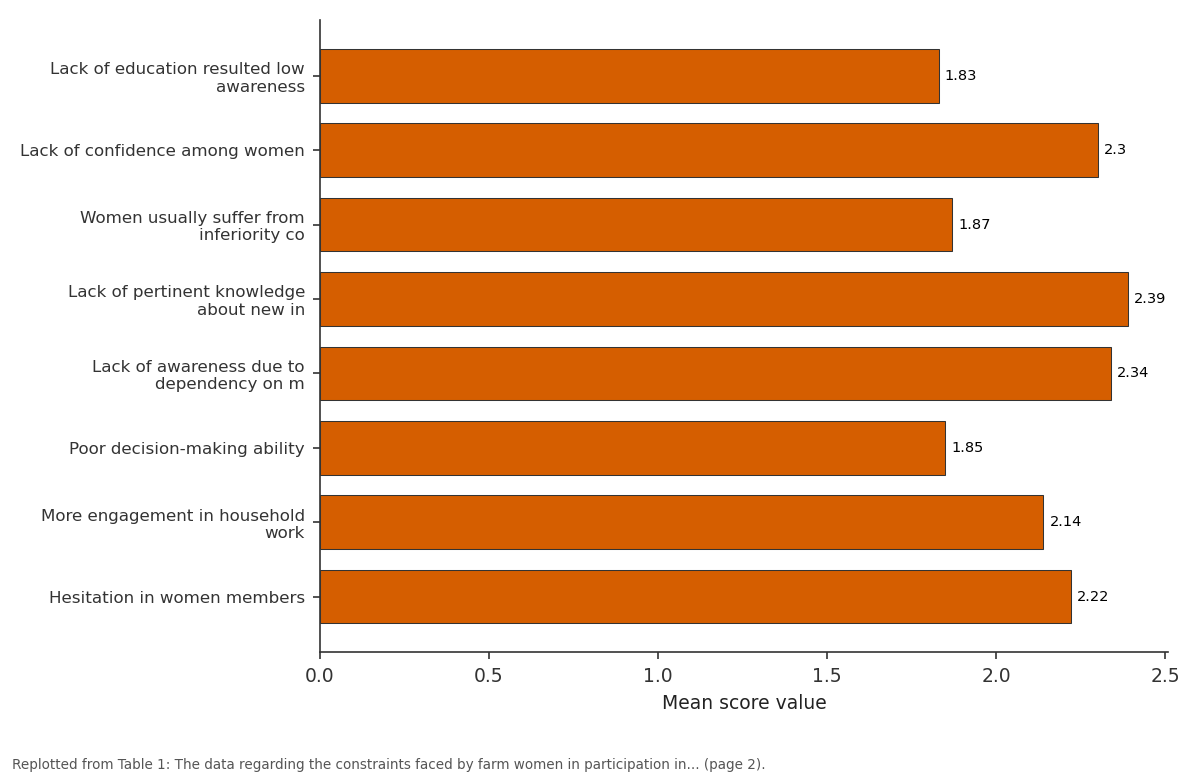
Mean score value: Lack of education... vs Lack of confidence... vs Women usually suffer... vs Lack of pertinent... vs Lack of awareness due...
Replotted from Table 1 (page 2) of the original paper. Every bar is the paper's own table value.
View source evidence ↗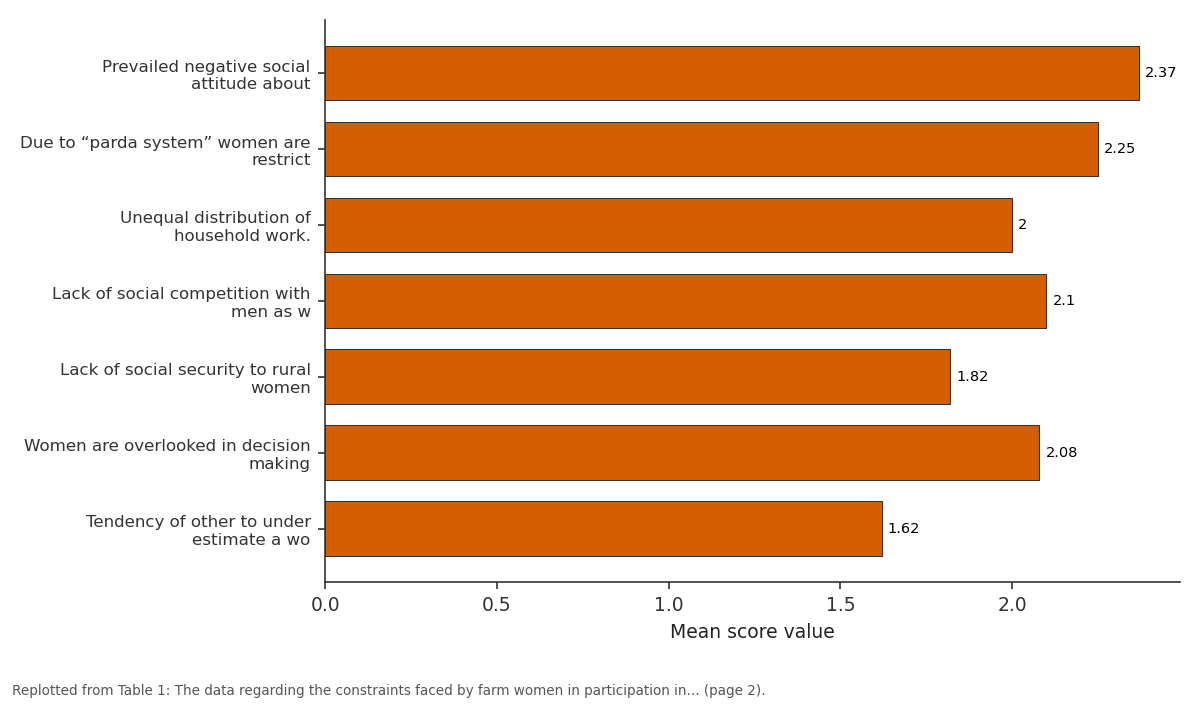
Mean score value: Prevailed negative... vs Due to “parda system”... vs Unequal distribution of... vs Lack of social... vs Lack of social security...
Replotted from Table 1 (page 2) of the original paper. Every bar is the paper's own table value.
View source evidence ↗Figures & tables
From the original paper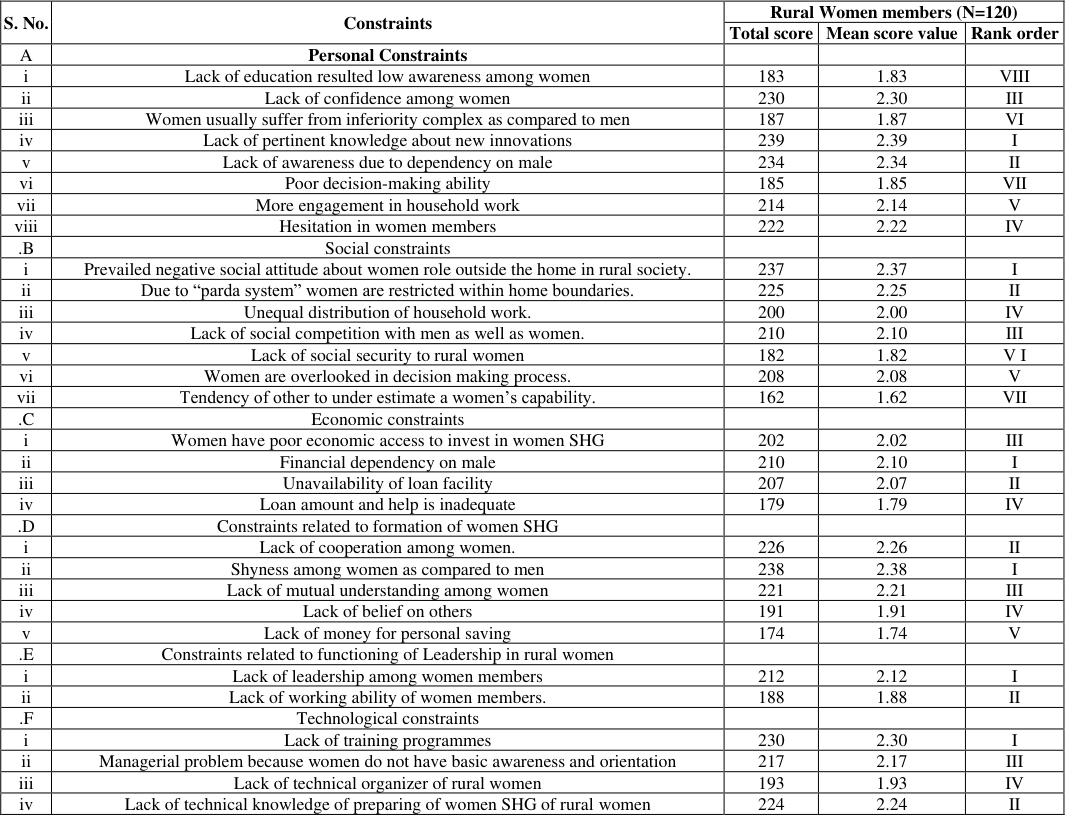 Table 1
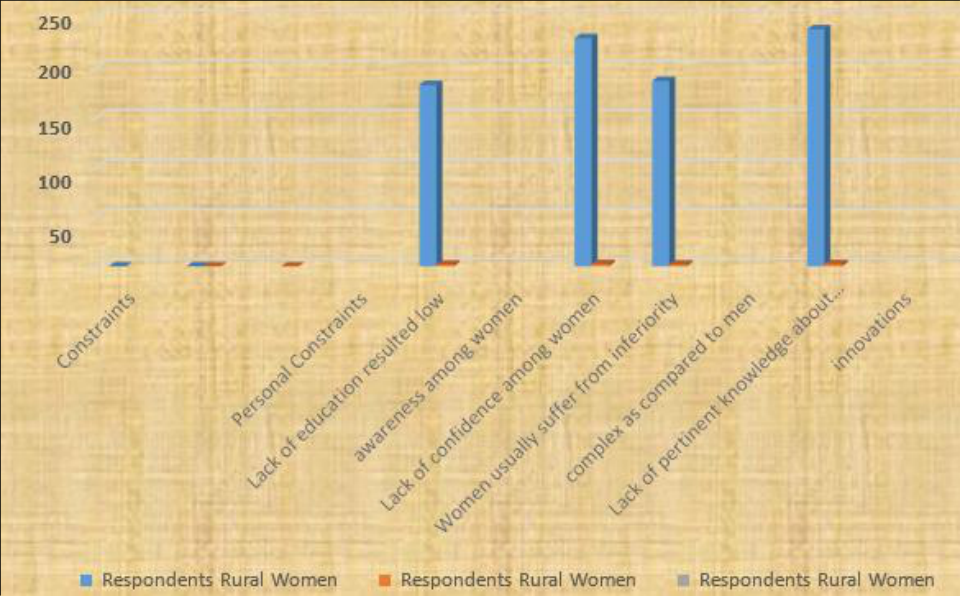 Figure 1
Introduction
In India, agriculture is the main occupation of rural people. It is the important source of livelihood for majority of the Indian people. In a patriarchal society, women, particularly in rural India, face constraints in economic activities due to gender discrimination and archaic social norms. They are used for menial unpaid jobs and have little or no access to education, healthcare, and basic amenities. Agriculture is considering as the backbone of the Indian rural economy and is a family enterprise. It is an important engine of growth and poverty reduction. India's economic security is heavily dependent on agriculture. In terms of employment, it is the most important source of income, especially for rural women. Women make up nearly half of the workforce in agriculture, and in rural India, they are a crucial component of the economy. An overwhelming 84 percent of rural women rely on agriculture for their livelihood. Agriculture accounts for about 18 percent of India's GDP and is largely driven by female labor. These rural women are involved in various agricultural tasks including the production, processing, preservation, and use of food. They are integral to the entire food system, from choosing seeds and sowing, to manuring, weeding, drying, stacking, storing, and eventually using the harvest to feed their families. Additionally, they hold significant roles in household decision-making processes. These programs equip women from diverse backgrounds with the necessary tools to face various challenges in the world confidently and gracefully. come to the forefront, where they become agents of peace and positive social change for themselves, their families, other women and their society. With this background, a study titled; Participation of farm women in agriculture activities.
Materials and Methods
The present study was conducted in Kanpur Dehat district of Uttar Pradesh State. For this study, two blocks namely Sarwankehra and Maitha were purposively selected on the basis of the maximum female population in the district, from each block 6 villages were selected on the basis of maximum female population so, total 12 villages from both tehsils were selected and from each tehsil 10 respondents were randomly selected. Total 120. Respondents selected from villages, they were interviewed, personally to collect the data with the help of pre structured interview schedule. Thereafter, data were tabulated, analysed and inferences were drawn in light of the objective.
Results and Discussion
Results and Discussion
Constraints faced by farm women in participation in agricultural activities
Farm women were asked to mention their constraints faced in participation in agricultural activities. They were asked on three-point rating i.e., mostly, some times and never faced the constraints in participation in agricultural activities and accordingly scores were given as 2, 1, and 0, respectively. Mean score was calculated for each constraint to assign them rank. The data regarding the constraints faced by farm women in participation in agricultural activities are presented in Table The Table A indicates that the rank order of personal constraints as perceived by rural women viz., 'lack of pertinent knowledge about new innovation' was ranked I with mean score (2.39) followed by lack of awareness due to dependency on male 'ranked II WMS(2.34)'lack of confidence among women' ranked III WMS(2.30), 'hesitation in rural women members' ranked IV www.extensionjournal.com WMS(2.22), 'more engagement in household work' ranked V WMS(2.14), 'women usually suffer from inferiority complex as compared to men' ranked VI WMS(1.87), 'poor decision making ability' ranked VII WMS (1.85) and lack of education resulted low awareness of women ' ranked VIII respectively With mean score(1.83). Table .B shows that the rank order of social constraints faced by women members the majority of the women SHG members were reported the constraints viz., 'prevailed negative social attitude about women role outside the home in rural society' ranked I WMS(2.37) followed by 'due to "parda system" women are restricted within home boundaries' ranked II WMS(2.25), 'Lack of social competition with men as well as women' WMS (2.10) ranked III, unequal distribution of households work' ranked IV WMS (1.83), women are overlooked in decision making process' ranked V WMS(2.08), lack of social security to rural women' ranked VI WMS(1.82) and tendency of others to under estimate a women's capability' ranked VII respectively WMS(1.62). Table C shows that majority of rural women members faced economic constraints in were reported 'women have financial dependency on male' ranked I WMS (2.10), followed by 'unavailability of loan facility' ranked II WMS (2.07), 'women have poor economic access to invest in women SHG' ranked III WMS (2.02) and loan amount and help is inadequate, 'ranked IV WMS(1.79)respectively. Table D indicates that the rank order of constraints in rural women group formation faced by the rural women members were reported 'illiteracy among women' ranked I WMS (2.38), followed by 'lack of cooperation among women' ranked IIWMS (2.26), 'Lack of mutual understanding among rural women' ranked III WMS (2.21), 'lack of belief on others' ranked IV WMS (1.91) and 'lack of money for personal saving' ranked V WMS (1.75) respectively. Table E indicates that the majority of rural women members faced the constraints in functioning of rural women were reported 'lack of leadership among members' ranked I WMS (2.12), followed by 'lack of working ability of members' ranked II WMS (1.88)respectively. Table F shows that the majority of women SHG members faced technological constraints .maximum respondent were reported 'lack of training programmers related to women SHG' ranked I WMS (2.30), followed by 'lack of technical knowledge of preparing of women SHG of rural women WMS(2.24) 'ranked II, 'managerial problem because women do not have basic awareness and orientation about women SHG' WMS (2.17) ranked III and 'lack of technical organizer of women SHG ranked IV respectively With mean score (1.93).
Figures and tables from the paper
| S. No. | Constraints | Rural Women members (N=120) | — | — |
|---|---|---|---|---|
| Total score | Mean score value | Rank order | ||
| A | Personal Constraints | |||
| i | Lack of education resulted low awareness among women | 183 | 1.83 | VIII |
| ii | Lack of confidence among women | 230 | 2.30 | III |
| iii | Women usually suffer from inferiority complex as compared to men | 187 | 1.87 | VI |
| iv | Lack of pertinent knowledge about new innovations | 239 | 2.39 | I |
| v | Lack of awareness due to dependency on male | 234 | 2.34 | II |
| vi | Poor decision-making ability | 185 | 1.85 | VII |
| vii | More engagement in household work | 214 | 2.14 | V |
| viii | Hesitation in women members | 222 | 2.22 | IV |
| .B | Social constraints | |||
| i | Prevailed negative social attitude about women role outside the home in rural society. | 237 | 2.37 | I |
| ii | Due to “parda system” women are restricted within home boundaries. | 225 | 2.25 | II |
| iii | Unequal distribution of household work. | 200 | 2.00 | IV |
| iv | Lack of social competition with men as well as women. | 210 | 2.10 | III |
| v | Lack of social security to rural women | 182 | 1.82 | V I |
| vi | Women are overlooked in decision making process. | 208 | 2.08 | V |
| vii | Tendency of other to under estimate a women’s capability. | 162 | 1.62 | VII |
| .C | Economic constraints | |||
| i | Women have poor economic access to invest in women SHG | 202 | 2.02 | III |
| ii | Financial dependency on male | 210 | 2.10 | I |
| iii | Unavailability of loan facility | 207 | 2.07 | II |
| iv | Loan amount and help is inadequate | 179 | 1.79 | IV |
| .D | Constraints related to formation of women SHG | |||
| i | Lack of cooperation among women. | 226 | 2.26 | II |
| ii | Shyness among women as compared to men | 238 | 2.38 | I |
| iii | Lack of mutual understanding among women | 221 | 2.21 | III |
| iv | Lack of belief on others | 191 | 1.91 | IV |
| v | Lack of money for personal saving | 174 | 1.74 | V |
| .E | Constraints related to functioning of Leadership in rural women | |||
| i | Lack of leadership among women members | 212 | 2.12 | I |
| ii | Lack of working ability of women members. | 188 | 1.88 | II |
| .F | Technological constraints | |||
| i | Lack of training programmes | 230 | 2.30 | I |
| ii | Managerial problem because women do not have basic awareness and orientation | 217 | 2.17 | III |
| iii | Lack of technical organizer of rural women | 193 | 1.93 | IV |
| iv | Lack of technical knowledge of preparing of women SHG of rural women | 224 | 2.24 | II |
Table text extracted from the original PDF; superscript letters are shown inline. The original table image is below.
View original table image
References
6 in the original paper- Malek SH, Sisodia SS. Constraints Faced by Farm Women in Participation in Agricultural Activities in Udaipur District of Rajasthan, India. Int. J Curr. Microbiol. App. Sci. 2019;8(11):140-142.
- Girade S, Shmbharkar Y. Profile of farm women and constraints faced by them in Participation of farm and allied activities. Indian journal of applies research. 2012;12(1):69-71.
- Gupta S. Participation of rural women in agricultural and animal husbandry-A study. Bhartiya Krishi Anushandhan Patrika. 2016;31(4):314-317.
- Jahan N, Khan N. To study the participation of farm women in various agriculture and allied activities International Journal of Home Science. 2016;2(2):180186.
- Saleh RA, Shettima MB. Analysis of women farmer's participation in agricultural activities in Konduga local government area of Borno state, Nigeria. American Journal of Environmental Science. 2016;16(1):119-125.
- Upadhyay S, Desai CP. Participation of farm women in animal husbandry in Anand district of Gujarat. Journal of Community Mobilization and Sustainable Development. 2011;6(2):117-121.