
Research article · 2024 · Full text
International Journal of Research in AgronomyEffects of different tillage practices and cropping systems on soil fertility and soil properties in maize
Volume 7(5) · Pages 183–185 · DOI: 10.33545/2618060x.2024.v7.i5c.670 ↗
Research areasCrop Yield and Soil FertilityRice Cultivation and Yield ImprovementAgricultural Science and Fertilization
Abstract
Author-writtenA shift to conservation agriculture (CA) is critical to addressing soil nutrient depletion inside the Indo-Gangetic simple. This study investigated the effect of tillage and cropping systems on soil houses and nutrient distribution after maize harvest. The trial protected three tillage practices -permanent paddy field (PB), zero tillage (ZT) and conventional tillage (CT) and 4 cropping systems: maize-wheat-mungbean (MWMb), maize-chickpea-sesbania (MCS), maize-mustard mungbean (MMuMb) and maize-maize-sesbania (MMS). Soil samples have been taken at depths of 0-five cm and 5-15 cm effects confirmed constant soil pH across tillage practices and cropping systems, even as electrical conductivity (EC) various substantially in CT. PB and ZT-flat tillage confirmed better levels of soil natural carbon (SOC), nitrogen (N), phosphorus (P), potassium and cation alternate potential (CEC) in comparison to CT. amongst cropping systems, MCS and MWMb had improved levels of SOC, N, P, and CEC at special soil depths. Overall soil properties decreased with increasing depth, besides for pH, which remained quite consistent.
Summary
Source-checkedPlain-language reading of the full paper, prepared with AI and checked against the text. Each point links to the authors' own words.
Why it matters
- Transitioning to conservation agriculture is essential for combating the depletion of soil nutrients in the Indo-Gangetic region. View evidence ↗
- Conservation agriculture is a sustainable method focusing on minimal soil disturbance, recycling crop residues, rotating crops, and using cover crops to maintain soil structure and organic matter. View evidence ↗
- Increasing soil organic carbon through conservation agriculture can improve the physical, chemical, and organic properties of the soil. View evidence ↗
The question
- The study aimed to investigate how different tillage practices and cropping systems affect soil properties and the distribution of nutrients following a maize harvest. View evidence ↗
What they did
- The research was a long-term field experiment started in 2008 by the Indian Institute of Maize Research in New Delhi, India. View evidence ↗
- The study used a split-plot design featuring three tillage treatments (permanent paddy field [PB], zero tillage [ZT], and conventional tillage [CT]) and four cropping systems (maize-wheat-mungbean [MWMb], maize-chickpea-sesbania [MCS], maize-mustard mungbean [MMuMb], and maize-maize-sesbania [MMS]). View evidence ↗
- Soil samples were collected in 2019 after the summer harvest at two depths: 0-5 cm and 5-15 cm. View evidence ↗
- Soil pH was measured using a digital pH meter in a 1:2 soil-water suspension, and electrical conductivity (EC) was measured at 25 °C using a Conductivity Bridge. View evidence ↗
What they found
- Soil pH remained constant across all treatments, ranging from 7.30 to 7.90, which indicates a neutral to slightly alkaline nature. View evidence ↗
- At 0-5 cm depth, the MCS (7.11 g kg-1) and MWMb (6.82 g kg-1) cropping systems had significantly higher SOC than MMuMb (4.74 g kg-1) and MMS (4.47 g kg-1). View evidence ↗
What it means
- The authors conclude that permanent paddy field (PB) and zero tillage (ZT), combined with maize-chickpea-sesbania (MCS) and maize-wheat-mungbean (MWMb) cropping sequences, are the most effective methods for improving soil organic carbon and physicochemical properties. View evidence ↗
- The authors state that PB and ZT treatments significantly increase nutrient availability compared to conventional tillage, which supports crop growth and helps maintain maize yields. View evidence ↗
Visual summary
2 visualsIllustrations explain the paper; charts are replotted from the paper's own table values.
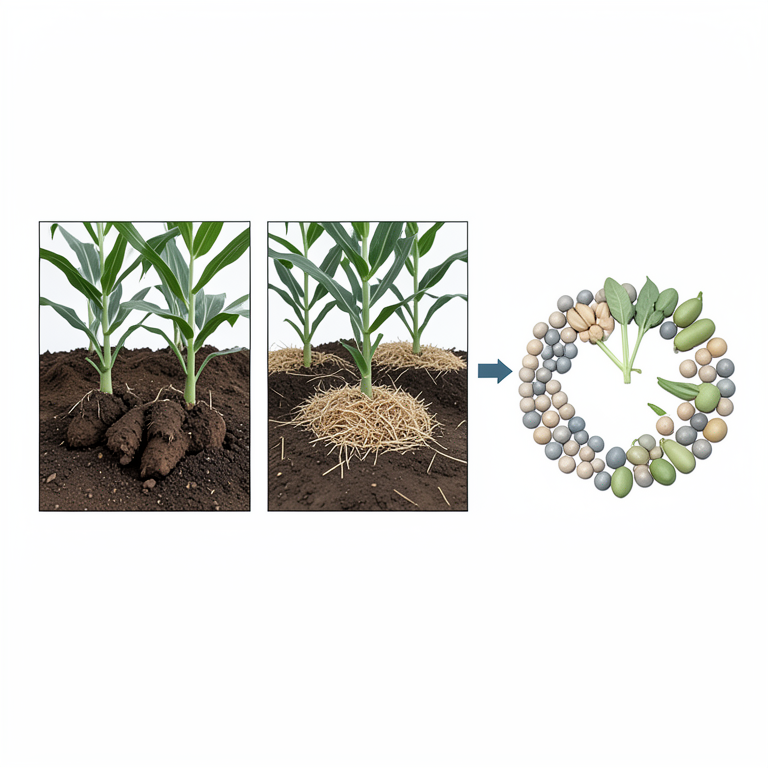
Comparison of Tillage and Cropping Systems
AI-generated conceptual illustration (Maize plants in agricultural soil). It explains the idea and does not show study data.
View source evidence ↗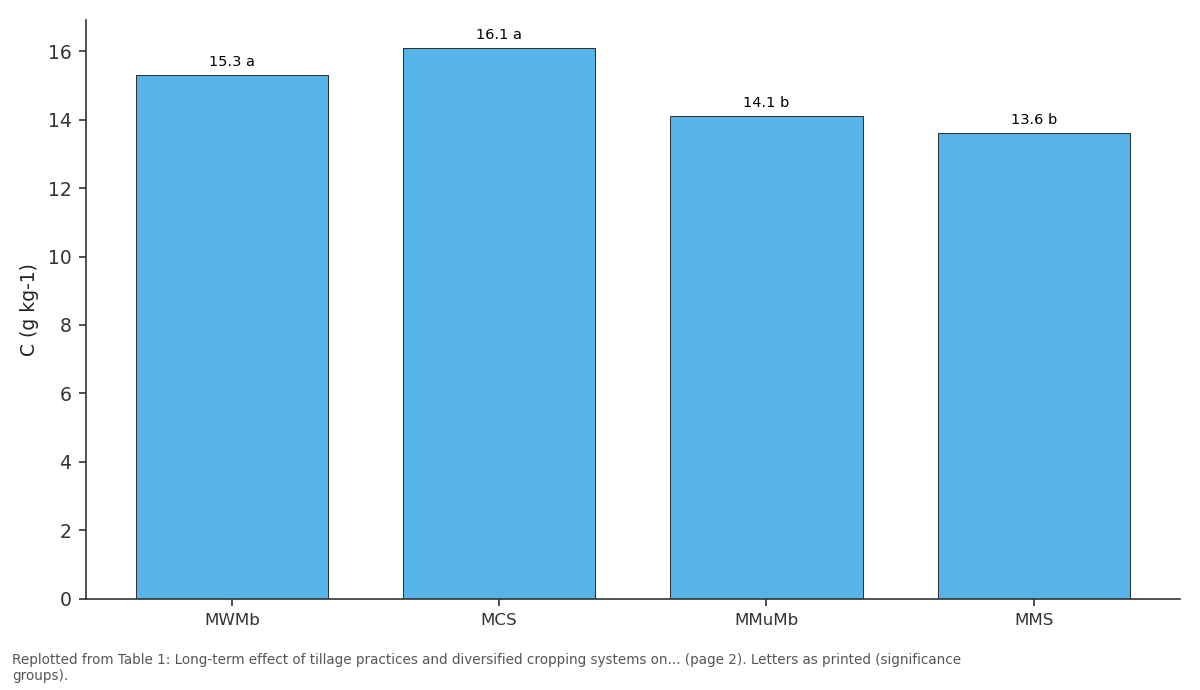
CEC (cmol kg-1): MWMb vs MCS vs MMuMb vs MMS
Replotted from Table 1 (page 2) of the original paper. Every bar is the paper's own table value.
View source evidence ↗Figures & tables
From the original paper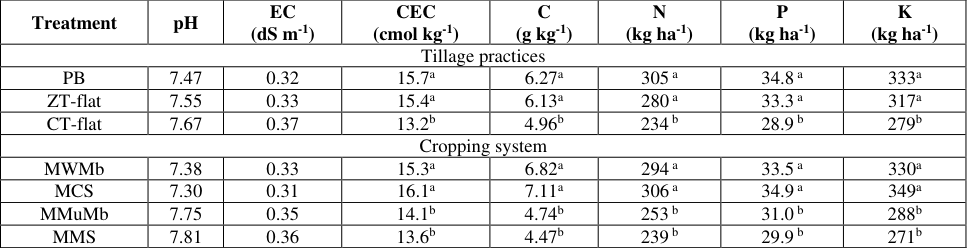 Table 1
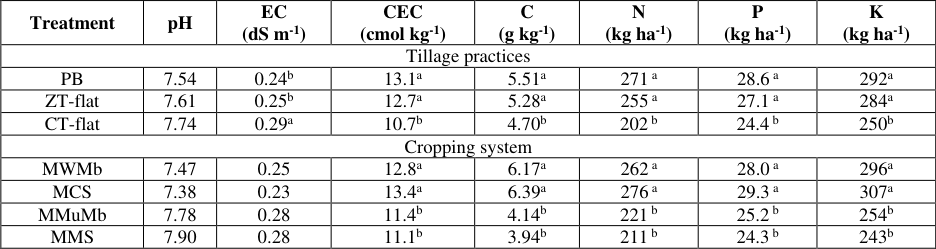 Table 2
Introduction
Conservation agriculture (CA) is a sustainable agriculture technique that emphasizes minimum soil disturbance, crop residue recycling, crop rotation, and the use of cowl crops to hold soil cowl and growth topsoil organic remember. CA along with ZT and everlasting raised beds (PB) play a critical position in improving nutrient biking and universal soil fitness in the North Indian soil, replacing rice with maize and incorporating legumes into crop rotations enables mitigate soil carbon depletion (Parihar et al., 2018) [9] . The implementation of conservation agriculture (CA) practices that lead to an increase in soil organic carbon (SOC) can positively have an effect on numerous elements of soil pleasant, which includes its physical, chemical and organic houses. Those interconnected improvements in soil fine may have a great wonderful impact on crop manufacturing. Fluctuations in soil pH are stimulated with the aid of elements such as buffering capacity, soil natural be counted (SOM) concentration, climatic conditions, and N management. In semi-dry areas wherein fertilizers and lime are not carried out, pH changes are minimal (~zero to ~0.1-zero.3 devices) over a decade of CA implementation (web page et al., 2013) however, systems based totally on legumes and mineral nitrogen fertilization can cause a good sized decrease in pH (Vieira et al., 2009) [14] . Soil cation alternate capacity (CEC) is a essential element affecting fertility, stability and pH buffering. Whilst CEC is often decided through mineralogy and clay content, it is able to be stricken by changes in soil organic be counted SOM and pH. CA outcomes on CEC can range, resulting in both increases and decreases (Sa et al., 2009; Williams et al., 2018) [10,16] . Better CEC levels are related to extra organic content, main to an increase in poor charge (Sa et al., 2009) [10] . Conversely, a lower CEC may additionally occur due to a lower in pH that shrinks pH-dependent cation trade sites (Sithole and Magwaza, 2019) [11] and improving soil natural carbon (SOC) underneath CA practices promotes better plant nutrient availability including residues to CA systems will increase the content and distribution of vitamins, together with nitrogen, phosphorus, calcium, magnesium, potassium, manganese and zinc (Sithole and Magwaza, 2019) [11] .
However, it's far crucial to be aware that a better deliver of nutrients does not guarantee on the spot availability to vegetation. Inside the case of nitrogen, at the same time as overall stocks may additionally increase beneath CA, plantavailable nitrogen can also first of all decline, necessitating the utility of nitrogen fertilizers for most suitable yields. This decrease can be attributed to slower nitrogen mineralization because of decreased mixing of soil with stubble and increased immobilization of crop residues with excessive carbon to nitrogen ratios. over the years, nitrogen deliver may also improve as a new balance is installed strategies (Soane et al., 2012) [12] .
Methods and Materials
The long-time period subject test initiated via the Indian Institute of Maize Research in New Delhi, India in 2008 aimed to assess different tillage practices and the results of cropping structures on soil properties. The experimental web site is placed in a semiarid vicinity and receives 650 mm of annual precipitation and 850 mm of evaporation. The soil, categorised as loamy and non-saline, has an electrical conductivity (EC) of 0.32 dS m-1 and a pH of 7.8. The experimental setup used a break up-plot layout with 3 tillage treatments PB, ZT, and CT and 4 cropping structures: MWMb, MCS, MMuMb and MMS. In 2019, after the summer time crop harvest, soil samples were taken from depths of 0-5 cm and 5-15 cm. The accrued soil samples had been air-dried and overwhelmed, after which subjected to various analyzes of soil parameters. Soil pH turned into decided the use of a digital pH meter consistent with Jackson's 1993 approach with a 1:2 soil-water suspension. Electric conductivity (EC) turned into measured at 25 °C the use of a Conductivity Bridge consistent with Jackson's 1973 technique. To determine cation trade potential (CEC), soil samples have been centrifuged 3 times with 1N ammonium acetate (pH=7.0) followed with the aid of washing with ethanol to extra ammonia become removed. in the end, they have been centrifuged three times with 1N sodium acetate (pH=7.0). NH 4 + -N content material changed into envisioned in an aliquot and CEC turned into decided the use of the technique of Jackson (1973) [3] . SOC changed into assessed by way of the Walkley and Black technique of 1934 and the alkaline potassium permanganate method developed through Subbiah and Asija in 1956 [13] . For organic carbon, the Olsen technique using a 0.5 M sodium bicarbonate extractant with spectrophotometric analysis at 420 nm as defined in Olsen et al. in 1974 [17] . to be had potassium changed into decided by extraction with ammonium acetate (soil:solution ratio 1:5), accompanied by means of filtration and quantification with a flame photometer in line with the approach described by means of Hanway and Heidel in 1952 [2] .
Result and Discussion
The records from Tables 1 and2 show that most soils have a pH starting from 7.30 to 7.90, indicating a neutral to barely alkaline nature in all treatments. Soil pH remained constant regardless of adjustments in tillage methods and cropping systems. However, slightly decrease pH values and 0 region tillage have been determined for PB in comparison to traditional tillage. this can be attributed to the buildup of soil natural count number, which releases organic acids because it decomposes, thereby lowering soil pH in PB and no-until systems. These findings are regular with the observations of Kahlon (2014) [4] , who additionally determined no great effect of tillage practices on soil pH. In terms of electrical conductivity (EC), enormous version changed into noted over the years in flat CT soils, with tremendous interactions among tillage and cropping systems at 0-5 cm and 5-15 cm depths. However, cropping structures had minimal impact on EC. Cation change ability (CEC) changed into significantly higher in PB and ZT-flat tillage structures as compared to traditional tillage, which turned into attributed to retention of organic count number residues and improved transformation of clay content material and this is regular with the findings of Kalyani (2012) [5] . Soil natural carbon (SOC) ranges expanded in PB and ZT-flat systems compared to preliminary measurements in 2008. SOC content material expanded considerably in PB and no-till compared to traditional tillage practices. among cropping structures, SOC was appreciably higher in MCS and MWMb as compared to MMuMb and MMS at all soil depths (0-5 cm and 5-15 cm), attributed to annual residue retention in PB and ZT flat systems, with MCS displaying the best SOC content due to extra root biomass and residue retention, mainly from chickpea crops. Kumar et al. (2017) [6] also stated better SOC stages in no-tillage structures as compared to conventional tillage and better usable nitrogen content material was determined in PB and ZT-flat tillage structures in comparison to conventional tillage, specifically due to improved residue retention. MCS confirmed higher soil nitrogen popularity, that's attributed to chickpea's capacity to fix atmospheric nitrogen and hold residues, thereby increasing nitrogen availability. comparable tendencies have been found in soil to be had phosphorus and potassium, with the PB and ZT-flat tillage systems displaying the highest values because of decrease fixation availability compared to traditional tillage. Guzman et al. (2006) [17] supported these findings. The higher soil potassium ranges within the PB and ZT tillage structures had been attributed to minimal or no soil disturbance, ensuing in elevated residue retention and subsequent launch of potassium in the course of residue decomposition. Conversely, non-stop plowing under conventional tillage resulted in uniform blending of potassium, main to more leaching losses and fixation (Busaria et al., 2015) [1] .
Figures and tables from the paper
| Treatment | pH | EC (dS m-1) | CEC (cmol kg-1) | C (g kg-1) | N (kg ha-1) | P (kg ha-1) | K (kg ha-1) |
|---|---|---|---|---|---|---|---|
| Tillage practices | |||||||
| PB | 7.47 | 0.32 | 15.7a | 6.27a | 305 a | 34.8 a | 333a |
| ZT-flat | 7.55 | 0.33 | 15.4a | 6.13a | 280 a | 33.3 a | 317a |
| CT-flat | 7.67 | 0.37 | 13.2b | 4.96b | 234 b | 28.9 b | 279b |
| Cropping system | |||||||
| MWMb | 7.38 | 0.33 | 15.3a | 6.82a | 294 a | 33.5 a | 330a |
| MCS | 7.30 | 0.31 | 16.1a | 7.11a | 306 a | 34.9 a | 349a |
| MMuMb | 7.75 | 0.35 | 14.1b | 4.74b | 253 b | 31.0 b | 288b |
| MMS | 7.81 | 0.36 | 13.6b | 4.47b | 239 b | 29.9 b | 271b |
Table text extracted from the original PDF; superscript letters are shown inline. The original table image is below.
View original table image
| Treatment | pH | EC (dS m-1) | CEC (cmol kg-1) | C (g kg-1) | N (kg ha-1) | P (kg ha-1) | K (kg ha-1) |
|---|---|---|---|---|---|---|---|
| Tillage practices | |||||||
| PB | 7.54 | 0.24b | 13.1a | 5.51a | 271 a | 28.6 a | 292a |
| ZT-flat | 7.61 | 0.25b | 12.7a | 5.28a | 255 a | 27.1 a | 284a |
| CT-flat | 7.74 | 0.29a | 10.7b | 4.70b | 202 b | 24.4 b | 250b |
| Cropping system | |||||||
| MWMb | 7.47 | 0.25 | 12.8a | 6.17a | 262 a | 28.0 a | 296a |
| MCS | 7.38 | 0.23 | 13.4a | 6.39a | 276 a | 29.3 a | 307a |
| MMuMb | 7.78 | 0.28 | 11.4b | 4.14b | 221 b | 25.2 b | 254b |
| MMS | 7.90 | 0.28 | 11.1b | 3.94b | 211 b | 24.3 b | 243b |
Table text extracted from the original PDF; superscript letters are shown inline. The original table image is below.
View original table image
References
16 in the original paper- Busaria AM, Singh SK, Kaur A, Bhatt R, Dulazib AA. Open access conservation tillage impacts on soil and crop. International Soil and Water Conservation Research. 2015;3:119-29.
- Hanway JJ, Heidel H. Soil analysis methods as used in Iowa State College Soil Testing Laboratory. Iowa Agriculture. 1952;57:1-13.
- Jackson ML. Soil chemical analysis. Prentice hall of India Pvt. Ltd, New Delhi. 1973.
- Kahlon MS. Soil physical characteristics and crop productivity as affected by tillage in rice-wheat system. Journal of Agricultural Science. 2014;6(12):1916-9760.
- M.Sc. (Ag.) Thesis, Acharya N G Ranga Agricultural University, Hyderabad, India. 2012.
- Kumar RS, Shambhavi S, Beura K, Kumar S, Singh RG. Soil microbial budgeting as influenced by contrasting tillage and crop diversification under rice based cropping systems in Inceptisol of Bihar. Journal of Pure and Applied Microbiology. 2017;11(1):539-47.
- Page KL, Dang YP, Dalal RC. The ability of conservation agriculture to conserve soil organic carbon and the subsequent impact on soil physical, chemical, and biological properties and yield. Frontiers Sustainable Food Systems. 2020;4:31.
- Parihar CM, Parihar MD, Sapkota TB, Nanwal RK, Singh AK, Jat SL, et al. Long-term impact of conservation agriculture and diversified maize rotations on carbon pools and stocks, mineral nitrogen fractions and nitrous oxide fluxes in inceptisol of India. Sciences Total Environment. 2018;640:1382-1392.
- Sa JCD, Cerri CC, Lal R, Dick WA, Piccolo MD, Feigl BE. Soil organic carbon and fertility interactions affected by a tillage chronosequence in a Brazilian Oxisol. Soil Tillage Research. 2009;104:56-64.
- Sithole NJ, Magwaza LS. Long-term changes of soil chemical characteristics and maize yield in no-till conservation agriculture in a semi-arid environment of South Africa. Soil Tillage Research. 2019;194:104-317.
- Soane BD, Ball BC, Arvidsson J, Basch G, Moreno F, Roger-Estrade J. No-till in northern, western and southwestern Europe: a review of problems and opportunities for crop production and the environment. Soil Tillage Research. 2012;118:66-87.
- Subbiah BV, Asija GL. A rapid procedure for the determination of available nitrogenin soils. Current Science. 1956;25:259-260.
- Vieira FCB, Bayer C, Zanatta J, Ernani PR. Organic matter kept Al toxicity low in a subtropical no-tillage soil under long-term (21-year) legume-based crop systems and N fertilisation. Australian Journal of Soil Research. 2009;47:707-714.
- Walkley A, Black IA. An examination of the Degtjareff method for determining soil organic matter, and proposed modification of the chromic acid titration method. Soil Science. 1934;37:29-38.
- Williams A, Jordan NR, Smith RG, Hunter MC, Kammerer M, Kane DA. A regionally-adapted implementation of conservation agriculture delivers rapid improvements to soil properties associated with crop yield stability. Scientific Reports. 2018;8:8467.
- Jordan CT, Guzman ML, Noble M. Cancer stem cells. New England Journal of Medicine. 2006 Sep 21;355(12):12531261.