
Research article · 2024 · Full text
International Journal of Agriculture Extension and Social DevelopmentFactors affecting the academic achievements of under graduate college students in Ayodhya district eastern Uttar Pradesh
Volume 7(5) · Pages 30–33 · DOI: 10.33545/26180723.2024.v7.i5a.596 ↗
Research areasEmotional Intelligence and Performance
Abstract
Author-writtenThe research delves into the multifaceted factors affecting the academic achievement of undergraduate college students in Ayodhya district, Eastern Uttar Pradeshwith A sample of 300 students from Acharya Narendra Deva University of Agriculture and Technology, Kumarganj, Ayodhya. The students were proportionally and randomly selected from four college of the University to represent the undergraduate population. Leveraging the students' most recent examination scores as benchmarks, a structured questionnaire was developed to gauge the influence of various factors on academic performance. The questionnaire covered factors such as Family Dynamics, Self-assessment, Institutional support, Peer Group & Social Circle, Technology & Digital Influence, Stress Management, Study Habits & Time Management, and Governmental Policies & Support. Employing multivariate regression analysis at a significance level of 0.05, the study scrutinized the significance of these factors. The study found that factors including Family Dynamics, Self-assessment, Institutional support, Peer Group & Social Circle, Technology & Digital Influence, Stress Management, Study Habits & Time Management, and Governmental Policies & Support collectively account for 80.36% of the variation in students' academic performance. This underscores the multifaceted nature of academic achievement determinants. Thus, the research sheds light on the paramount importance of fostering conducive environments within families, promoting self-assessment practices, enhancing institutional support systems, nurturing positive peer relationships and social circle, leveraging technology, implementing stress management techniques, cultivating effective study habits, managing time efficiently, and ensuring supportive governmental policies. The findings underscore the necessity for holistic interventions targeting diverse aspects of students' lives to foster academic success and enhance educational outcomes in the region.
Summary
Source-checkedPlain-language reading of the full paper, prepared with AI and checked against the text. Each point links to the authors' own words.
Why it matters
- Obtaining a quality education is universally important, yet many individuals face difficulties in achieving academic success. View evidence ↗
- Academic achievement is influenced by a variety of factors, including family background, institutional support, and stress management. View evidence ↗
- Effective learning is essential for academic success as it enables knowledge acquisition, critical thinking, and personal growth. View evidence ↗
What they did
- The study sampled 300 undergraduate students from Acharya Narendra Deva University of Agriculture and Technology in Ayodhya, Uttar Pradesh. View evidence ↗
- Participants were selected from four colleges on the main campus using a proportionate simple random sampling technique. View evidence ↗
- Data was gathered through physical and digital questionnaires using a three-point Likert scale (0 = Disagree to 2 = Agree). View evidence ↗
- The researchers used Microsoft Excel 2013 to perform multivariate regression analysis on the collected data. View evidence ↗
What they found
- The eight studied factors collectively explain 80.36% of the variance in the academic achievement of the undergraduate students. View evidence ↗
- The regression model was determined to be a good fit for the data, with an F-test value of 148.81 (p < 0.000). View evidence ↗
- Family dynamics, self-assessment, institutional support, peer group/social circle, stress management, study habits/time management, and governmental policies/support were all significant contributors to academic achievement (p < 0.05). View evidence ↗
- Institutional support had the greatest impact on academic achievement, with a coefficient value of 1.248. View evidence ↗
- The three most influential factors affecting academic achievement were institutional support, peer group and social circle, and study habits and time management. View evidence ↗
What it means
- The authors conclude that student performance can be significantly improved by enhancing institutional support, fostering better peer relationships, and improving time management and study habits. View evidence ↗
Visual summary
1 visualsIllustrations explain the paper; charts are replotted from the paper's own table values.
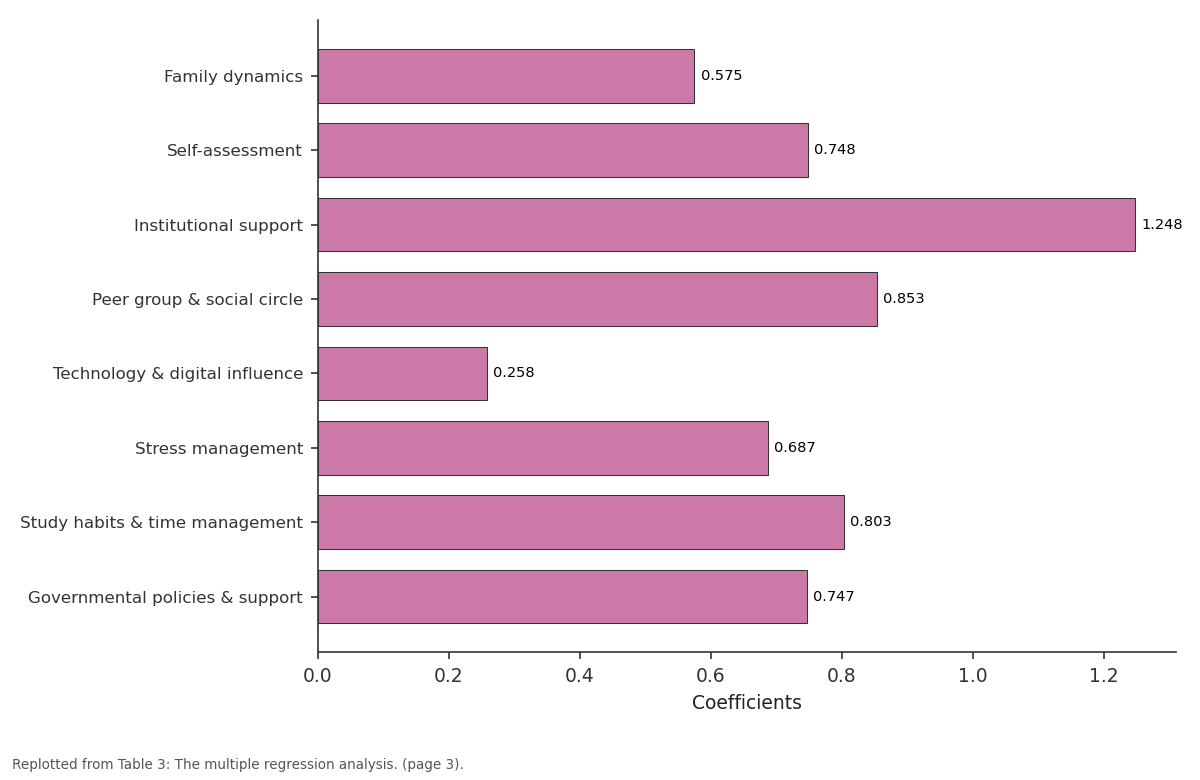
Coefficients: Family dynamics vs Self-assessment vs Institutional support vs Peer group & social... vs Technology & digital...
Replotted from Table 3 (page 3) of the original paper. Every bar is the paper's own table value.
View source evidence ↗Figures & tables
From the original paper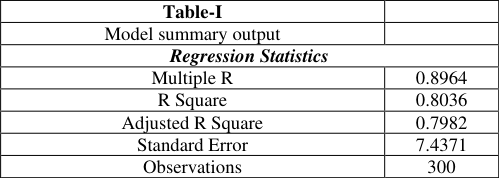 Table 1
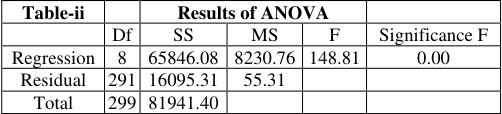 Table 2
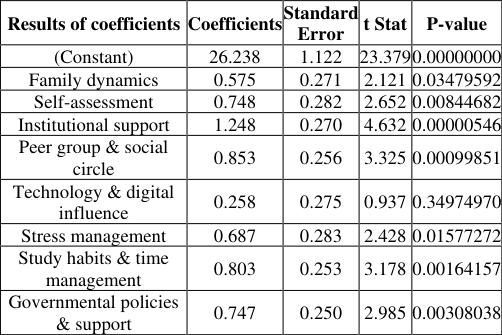 Table 3
Introduction
This study looks at what influences the academic achievement of undergraduate college students because getting a good education is important for everyone, but it can be hard for some individuals. The studies have revealed that it is because of many reasons, like family background, how well the college helps students, and even how students manage their stress (ref, year). Shahzadi & Ahmad (2011) [1] examined the factors influencing academic performance among university students. Their model suggested that home environment plays the strongest role, impacting both learning skills and academic performance. Additionally, academic interaction was shown to influenced study habits and home environment, and ultimately affects academic achievement. Singh & Kamra, (2016) [2] found in the study that prolonged internet surfing for non-academic purposed was linked to lower academic performance. This suggested the importance of time management and minimizing distractions. Academic performance is a complex outcome influenced by a multitude of factors. The review explored key themes identified in recent research, highlighting the individual, socioeconomic, school-related, and parental influences on student achievement. Learning is critically important for academic achievement as it facilitates the acquisition of knowledge, development of critical thinking skills, retention and application of concepts, motivation and engagement, preparation for future success, and personal growth. Effective learning strategies and environments are essential for supporting students in achieving their academic goals. Studies by Shahzadi & Ahmad (2011) [1] and Sharma et al. (2017) [4] emphasized the importance of learning skills and www.extensionjournal.com motivation in academic success. The home environment plays a crucial role in academic achievement by providing a supportive learning environment, fostering parental involvement, offering emotional support, reflecting cultural and socioeconomic factors, promoting stability and routine, and serving as a model for academic attitudes and behaviours. Home environments are essential for maximizing students' potential and ensuring their academic success. Shahzadi & Ahmad (2011) [1] found that strong learning skills are influenced by a positive home environment, ultimately leading to higher academic performance. Studying habits and time management are critical for academic achievement as they enable students to make efficient use of their time, optimize learning opportunities, prevent academic stress and burnout, maintain consistent progress, effectively prepare for exams and assessments, and develop transferable skills that are essential for success in academia and beyond. Effective time management and strong study habits are crucial for academic achievement, as identified by Singh & Malik (2016) [3] and Arora et al. (2017) [5] . Prioritizing a healthy lifestyle and avoiding tobacco gives your brain the tools it needs to function at its best, significantly improving your chances of better academic achievements. Research by Kavi & Walvekar (2020) [14] suggested that healthy lifestyle choices, such as regular breakfast consumption and avoiding tobacco use, can positively influence academic performance among secondary school students. Parental support, socioeconomic background, and academic background all intertwine to influence academic achievement. Several studies highlighted the significant role of parental support and a positive home environment in influencing academic performance (Shahzadi & Ahmad, 2011; Kapur, 2018; Dhakal, 2020) [1,7,12] . Parental socio-economic status and academic background can also plays a crucial role in academic performance (Dhakal, 2020) [12] . Quality teachers and effective teaching methods work together to create an optimal learning environment. The quality of teachers and the teaching methods employed significantly impact student learning outcomes (Kapur, 2018; Dhakal, 2020) [7,12] . The availability of learning resources and a positive school climate are additional school-related factors that influence academic performance (Dhakal, 2020; Khan et al., 2020) [12,13] . Positive parental involvement, guidance, and support were consistently identified as important factors in student academic achievement (Shahzadi & Ahmad, 2011; Khan et al., 2020) [1,13] . The influence of gender on academic performance remains an open question. While Arora & Singh (2017) [5] suggested a potential correlation, further research is needed to understand the underlying causes (Singh & Kamra, 2016) [2] . Technology presents a doubleedged sword. Excessive internet usage can be a distraction (Singh & Kamra, 2016) [2] , but social media can potentially enhance learning if used judiciously (Basumatary & Kumar, 2020) [15] . Positive academic influences from peers can benefit student performance (Khan et al., 2020) [13] . Understanding the complex interplay of individual, socioeconomic, school-related, and parental factors is crucial for promoting student academic success. Therefore, the was undertaken with the objective to find out the relationship between academic achievement of undergraduate college students and various factors like family dynamics, self-assessment, institutional support, peer group & social circle, technology & digital influence, stress management, study habits & time management, and governmental policies & support.
Martials and Methods
Martials and Methods
Sample and sampling technique:
The sample of the study consisted of 300 undergraduate college students of university namely Acharya Narendra Deva University of Agriculture and Technology, Kumarganj, Ayodhya, Uttar Pradesh state. For selecting the sample, the proportionate simple random sampling technique was used from four colleges in the main campus. The data was collected using a questionnaire consisted of three Likert scale ranging from (0= Disagree, 2= agree). The questionnaires were distributed to the students via Google form and physical questionnaire.
Hypothesis: Null hypothesis (H0):
Hypothesis: Null hypothesis (H0):
Figures and tables from the paper
| Table-I | — |
|---|---|
| Model summary output | |
| Regression Statistics | |
| Multiple R | 0.8964 |
| R Square | 0.8036 |
| Adjusted R Square | 0.7982 |
| Standard Error | 7.4371 |
| Observations | 300 |
Table text extracted from the original PDF; superscript letters are shown inline. The original table image is below.
View original table image
| Table-ii | — | Results of ANOVA | — | — | — |
|---|---|---|---|---|---|
| Df | SS | MS | F | Significance F | |
| Regression | 8 | 65846.08 | 8230.76 | 148.81 | 0.00 |
| Residual | 291 | 16095.31 | 55.31 | ||
| Total | 299 | 81941.40 |
Table text extracted from the original PDF; superscript letters are shown inline. The original table image is below.
View original table image
| Results of coefficients | Coefficients | Standard Error | t Stat | P-value |
|---|---|---|---|---|
| (Constant) | 26.238 | 1.122 | 23.379 | 0.00000000 |
| Family dynamics | 0.575 | 0.271 | 2.121 | 0.03479592 |
| Self-assessment | 0.748 | 0.282 | 2.652 | 0.00844682 |
| Institutional support | 1.248 | 0.270 | 4.632 | 0.00000546 |
| Peer group & social circle | 0.853 | 0.256 | 3.325 | 0.00099851 |
| Technology & digital influence | 0.258 | 0.275 | 0.937 | 0.34974970 |
| Stress management | 0.687 | 0.283 | 2.428 | 0.01577272 |
| Study habits & time management | 0.803 | 0.253 | 3.178 | 0.00164157 |
| Governmental policies & support | 0.747 | 0.250 | 2.985 | 0.00308038 |
Table text extracted from the original PDF; superscript letters are shown inline. The original table image is below.
View original table image
References
15 in the original paper- Singh S, Kamra D. Study of factors affecting academic achievement in medical students. J Med Sci. Res (JMSCR). 2016;4(12):14968-14972.
- Singh S, Malik S, Singh P. Research Paper Factors Affecting Academic Performance of Students. Indian J Res Paripex. 2016.
- Sharma P, Singh P, Kalhan S, Garg S. Analysis of Factors Affecting Academic Performance of MBBS Students in Pathology. Ann Int. Med Dent Res. 2017;2.
- Arora N, Singh N. Factors Affecting the Academic Performance of College Students. I-manager's J Educ. Technol. 2017;14:47.
- Balasubramanian T. Exploring The High Potential Factors That Affects Students Academic Performance. Int. J Comput. Sci. Eng. 2018;6:128-134.
- Sharma S. Analysis of Factors Affecting Academic Achievement among Senior Secondary School Students. 2019.
- Islam N, Saha P. An Analysis of the Factors Affecting Academic Performance of Undergraduate Students. SSRN Electronic Journal. 2020.
- Dhakal K. Factors Affecting Academic Performance of Students at Community Secondary Schools in Nepal. 2020.
- Khan K, Ramzan M, Zia Y, Zafar Y, Khan M, Saeed H. Factors Affecting Academic Performance of Medical Students. Life and Science. 2020;1(4).
- Kavi A, Walvekar P. Lifestyle factors influencing the academic performance among the secondary school students in an urban area of south India. Int. J Adolescent Med Health. 2020.
- Duwal B, Khonju L. Factors Affecting Students' Academic Performance: The Case of Students at Community Colleges in Bhaktapur District. Int. Res J Management Sci. 2021;5.
- D'souza D, Magre S. Factors Affecting the Academic Achievement of the Secondary School Students. Learning Community. 2021;12(02):115-125.
- Madhukar G, Krishnaiah J, Durgesham G, Dharmteja, Shaba N, Begum S, et al. Factors Influencing the Student's Academic Performance in Secondary Schools in Hyderabad. BRICS J Educ Res. 2023;13(3):87-89.
- Gebregergis W, Furtuna B, Mulubrhan M, Munira A, Nahom D, Tsega A, et al. Factors Influencing Academic Achievement Among College Students: The Influence of Emotional Intelligence, Student Engagement and Demographics. Eur. J Psychol. Educ. Res. 2023;6:181-193.
- Nisar A. Academic Achievement of Higher Secondary School Students in Relation to their Family Relationship. Int. J Sci. Res (IJSR). 2023;12:876-878.