
Research article · 2024 · Full text
International Journal of Agriculture Extension and Social DevelopmentEvaluating the impact and performance of Gadat Vibhag Vividh Karyakari Sahkari Khedut Mandali Ltd. on marketing of horticultural produce in Navsari district
Volume 7(5) · Pages 25–29 · DOI: 10.33545/26180723.2024.v7.i5a.595 ↗
Research areasAgricultural Economics and Practices
Abstract
Author-writtenIndia is an agricultural country and laid the foundation of world’s biggest co-operatives moment in the world. Co-operative is a way of life and it has an important means for weaker section of the society. South Gujarat region is especially recognized for successful sugar and agriculture co-operatives. Apparently, this study provides more insight on the impact and performance of the small scale co-operative. The present study was on “Performance and Profitability of Gadat Vibhag Vividh Karyakari Sahkari Khedut Mandali Ltd., Gadat of Navsari District, Gujarat”. The selected co-operative society is one of the oldest co-operative society existed since 1944. The selected co-operative society was operating in 9 villages. The study covered all 9 villages, from each village 10 registered members and 10 non-members of the society were selected randomly. The study conducted an impact evaluation of a co-operative society in South Gujarat, focusing on member opinions and the society's influence on marketing. The surveyed members expressed high satisfaction, particularly with staff behavior, marketing, and consumer services. Input supply, including groceries, pesticides, and technology, played a crucial role, with 87.78% citing quality as the primary reason for purchasing from the co-operative. Additionally, the society's role in organizing training programs, exhibitions, and providing credit loans was well-received. The comparative analysis revealed that the co-operative markets had a positive impact on mango, sapota, and banana marketing, emphasizing the society's service-oriented approach over profit-making. Overall, the findings underscore the positive impact of co-operative societies on farmers' well-being and market dynamics.
Summary
Source-checkedPlain-language reading of the full paper, prepared with AI and checked against the text. Each point links to the authors' own words.
Why it matters
- Agriculture is a critical pillar of the Indian economy, contributing approximately 15.96% of the GDP and employing about 53% of the population. View evidence ↗
- Agricultural cooperatives are used in India to encourage large-scale production and promote equity and cooperation within communities. View evidence ↗
- While many studies focus on large-scale cooperatives, there is a need for more insight into the performance of small-scale cooperatives, such as those in the South Gujarat region. View evidence ↗
The question
- The objective of the study was to evaluate the impact of the Gadat Vibhag Vividh Karyakari Sahkari Khedut Mandali Ltd. cooperative society within its service area. View evidence ↗
What they did
- The study sampled 90 registered members (10 from each of the 9 operational villages) out of a total membership of 3,276. View evidence ↗
- Primary data for 2019-2020 were collected from members, retailers, and wholesalers, supplemented by secondary data from society records and audit reports. View evidence ↗
What they found
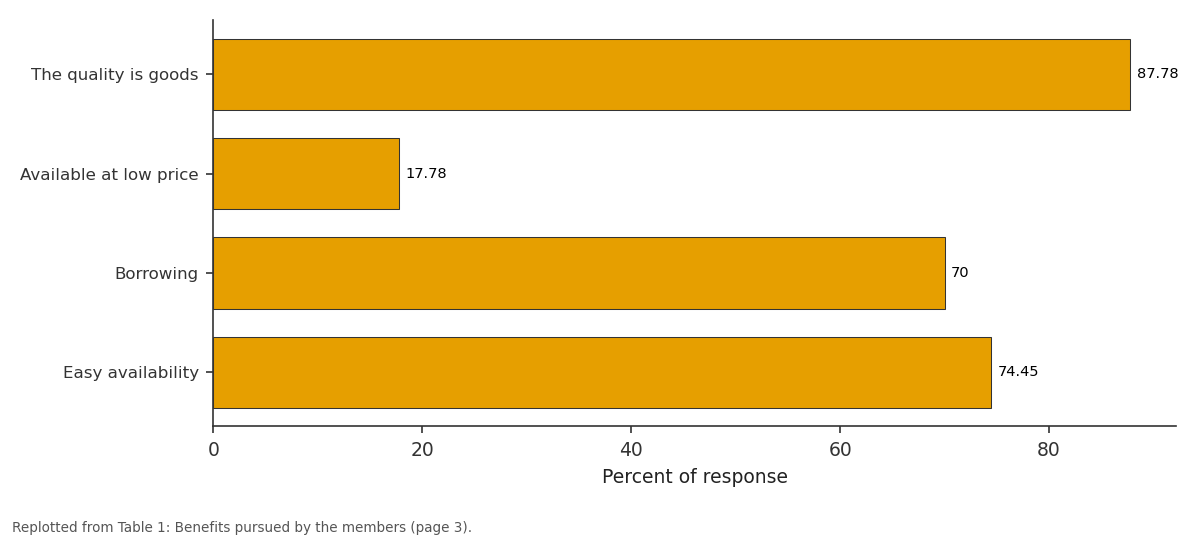
- The primary reasons for purchasing inputs from the cooperative were good quality (87.78%), easy availability (74.45%), and a 30-day borrowing period (70%). View evidence ↗
- A significant majority of members (82.22%) participated in training programs organized by the society. View evidence ↗
- For mangoes, the producer's share in the consumer's rupee was higher in the cooperative market (54.73%) compared to the wholesale market (reported as 51.45% in text and 45.77% in table). View evidence ↗
- For sapota, the producer's share was higher in the cooperative market (reported as 55.84% in text and 54.87% in table) than in the wholesale market (53.04%). View evidence ↗
- For bananas, the producer's share was higher in the cooperative market (64.36%) compared to the wholesale market (58.98%). View evidence ↗
What it means
- The authors conclude that cooperative societies have a positive impact on market dynamics and the overall well-being of farmers. View evidence ↗
Visual summary
2 visualsIllustrations explain the paper; charts are replotted from the paper's own table values.
Percent of response: The quality is goods vs Available at low price vs Borrowing vs Easy availability
Replotted from Table 1 (page 3) of the original paper. Every bar is the paper's own table value.
View source evidence ↗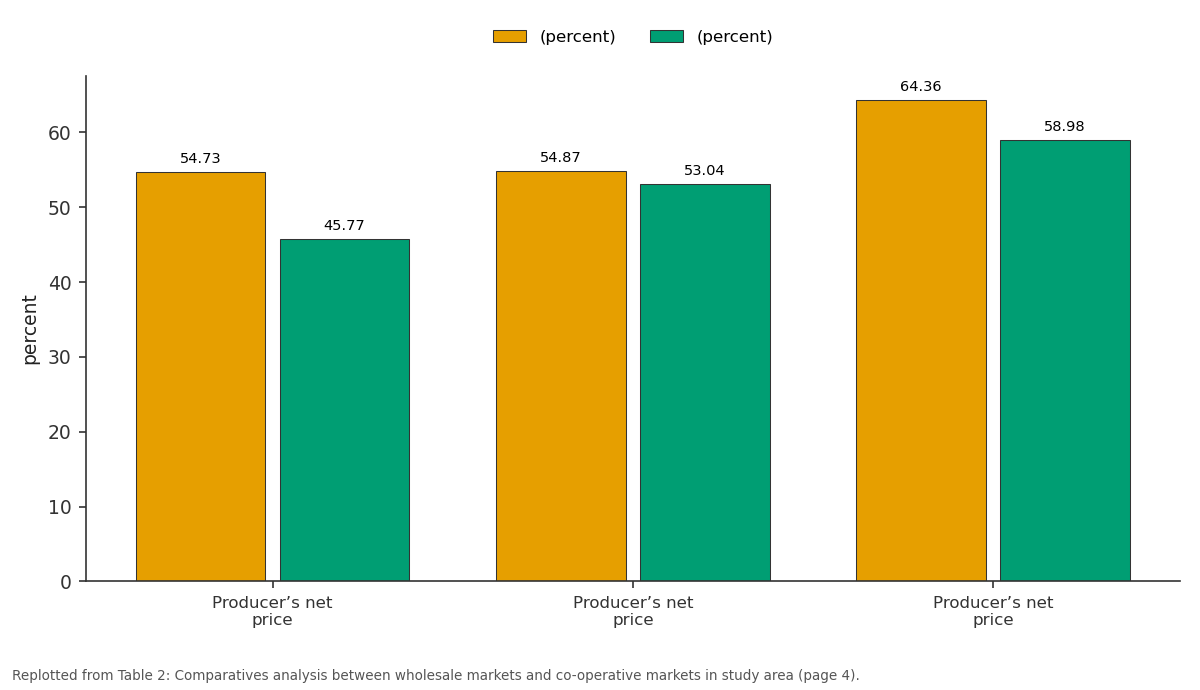
(percent) and (percent): Producer’s net price vs Producer’s net price vs Producer’s net price
Replotted from Table 2 (page 4) of the original paper. Every bar is the paper's own table value.
View source evidence ↗Figures & tables
From the original paper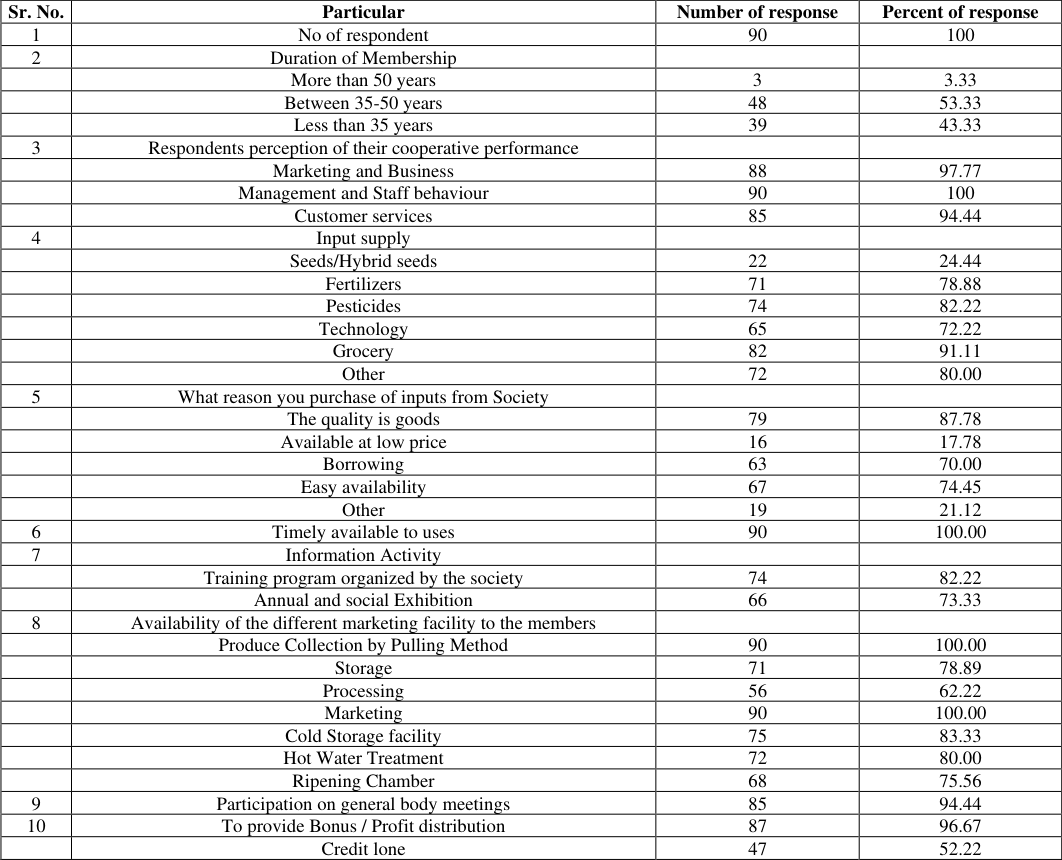 Table 1
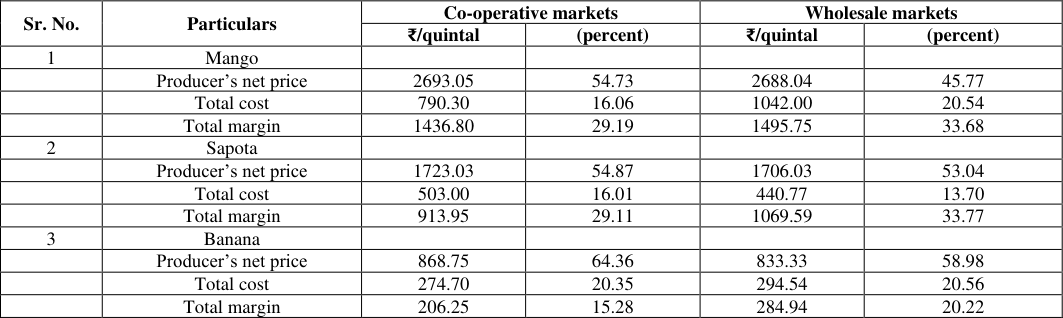 Table 2
Introduction
India is an agricultural country and laid the foundation of world's biggest co-operatives moment in the world. Cooperative is a way of life and it has an important means for weaker section of the society. Agriculture plays an important role in Indian economy. Agriculture and allied sector contribute about 15.96 percent of Indian GDP at current prices. It is worth to mention that the agriculture sector provides jobs to around 53 percent population of India. (The Global Economy.com; 2019) Agricultural cooperatives have been promoted in India's economic development programme as a means of encouraging large scale production while enhancing community co-operation and equity. The government of India, immediately after independence realizing the important role co-operatives can play in development of national economy, recognized cooperatives as third economic sector. They were charged with the responsibility for taking care the needs and aspirations of rural India with special emphasis on uplifting small and marginal farmers as well as weaker section of the society. Government of India is stressing upon and working tirelessly towards the vision of culture of agriculture with an aim to doubling farmers' income by 2022. Co-operatives have played an important role in achieving this aim as "Cooperatives have the potential to revitalize agriculture and make it sustainable." "In 2004, India completed 100 Years of Co-operative societies in India". In India co-operatives is the idea for fighting rural indebtedness suggested by Mr. Fredric Nicholson. He strongly recommended the establishment of co-operative credit societies in India. Within the global census on co-operative the most common type of cooperative is an agricultural co-operative. This is influence by large number of co-operative in India due to small size of land holdings makes it important for farmers to work together to gain economies of scale and scope. This control significant market share in certain sectors, for example Indian co-operative have 36 percent market share in fertilizer market. According to (Anonymous, 2019) [2] total no of co-operatives in India were 8.54 lakhs having 290.60 million membership and ₹ 406.89 billions of share capital, among the total co-operatives 17 were National level, 390 state level co-operative, 8 federations while 2750 were district level co-operative federations. In India we find that the state of Maharashtra and Gujarat are well developed whereas the Andhra Pradesh, Rajasthan and Karnataka have shown remarkable progress in the co-operative movement. This co-operative sector expanding all over in Gujarat with 81,468 working co-operative society out of them 30 from sugar sector, 4780 from irrigation sector, 907 from farming sector, 15,877 from milk sector and 9999 from primary agricultural co-operative sector. Out of all this co-operative societies, total 10,538 co-operative societies are present only in south Gujarat. Out of them 1125 primary agriculture www.extensionjournal.com credit society, 3077 milk co-operatives, 1080 irrigation cooperatives, 499 marketing co-operatives, 54 processing and 21 sugar co-operatives. While in Navsari there are about 779 co-operative societies. In some areas and in some sectors, the co-operative societies are serving the masses and playing a vital role in the development of small and marginal farmers and their income while in some areas their performances are not up to the mark. There are networks of co-operatives exist at local, regional, state and national levels, which have an expansion in the field mostly related to dairy (AMUL, Mother dairy), fertilizers (KRIBHCO, IFFCO), sugar co-operatives and agriculture co-operatives. A large number of studies had been attempt but most of them focus on large scale cooperatives. In this context, South Gujarat region is especially recognized for successful sugar and agriculture co-operatives. Apparently, this study provides more insight on the impact and performance of the small scale cooperative. To attempt this study we selected "Gadat Vibhag Vividh Karyakari Sahakari Khedut Mandali Ltd., Gadat of Navsari district, Gujarat". This society was established in 1944 by the Freedom Fighters of the surrounding area. Its main office is at Gadat. This society has above 3000 registered members with the trademark of GKM. In November, 2019 this co-operative society successfully completes 75 years and celebrated "Amrutmahotsava". This society is ISO 9001-2015 certified and marketed their product as brand name "GKM" in big cities like Ahemdabad and Surat for mango, Delhi, UP, Himachal for sapota. Main activities include collection of Mango, Chiku, Banana, Elephant yam and Paddy on pooling basis and giving reasonable price to its members. It has seven branches in overall operational villages. This society has morden technology for fast processing as well as value addition like grading machine, cold storage, ripening chamber and hot water treatment plant etc. This society has adopted The Ambika High School, Gadat as its permanent project and provides strong support to the school. The average collection of mango is around 1224.38 MT and that of chiku is 4435.72 MT in year 2018-2019 (Anonymous, 2019) [2] . Other activities include selling of steel, fertilizers and pesticides selling, departmental store, flour mill, fast food corner, grocery, tractor facilities, cement, cement sheets, petrol, diesel, oil etc.
Objective:
To access the impact evaluation of the cooperative society in the service area
Materials and Methods
This study is based on Navsari district of south Gujarat region. For this study purpose we selected one of the oldest cooperative society in study area. The selected co-operative society is one of the oldest co-operative society existed since 1944. The selected co-operative society was operating in 9 villages. The study covered all 9 villages, from each village 10 registered members. The primary data were collected from respondents pertains to the year 2019-2020. The market related data was collected from concerned markets as well as retailers and wholesalers. Secondary data were collected from the previous records of the society and its audit reports. In order to fulfill the stipulated objectives of the study, the major analytical tools employed were
Relative change
The data were analyzed in the light of above mentioned tools and presented in tabular form for interpretation of result.
Marketing cost
The marketing cost incurred by farmers will be computed by using following formula:
Results and Discussion
Impact evaluation of the co-operative society: For impact evaluation of the cooperative society we divided this study in two part 1) opinion of the members and 2) impact of cooperative society in marketing. For assessing the impact of the selected co-operative society in its operational area a survey based on opinion of the members regarding performance of the society was conducted. The survey was aimed to know the extent of benefits and satisfaction of the member and highlight the strong and weak points of the cooperative society. For that purpose, out of 3276 members spread over in operational area of society, 90 beneficiaries were selected from all nine villages. 10 member respondents from each of the village and they were subjected to detailed inquiry for the services rendered by the society and their reactions for its service performance. These 90 members were selected for personal contact and filled the pre-tested interview schedule to collect the data regarding different aspect like technical guidance in view of selected respondent is presented in the 1. With the society between the 35 to 50 years followed by 43.33 percent members with membership with society less than 35 years. It is revealed from the table that more than 53.33 percent members have duration of membership horticulture crops production, supply of input time, information about different activities as organization of exhibition, distribution of literature of crop production and participation in meeting, election and dividend distribution etc. The detail information about view of selected respondent is presented in the Table 1. With the society between the 35 to 50 years followed by 43.33 percent members with membership with society less than 35 years. All members (100.00) were satisfied with the behavior of www.extensionjournal.com staff of the society followed by 97.77 percent members with the marketing and business of the society 94.44% with the consumer service given by the society. Out of all input supply provide by the society grocery supply is highest (91.11%) among all other inputs followed by pesticides, insecticides and technology. Out of them seed supply was lowest (24.44%) because the members not taking because of less requirement. The members purchasing their inputs from the society because of the 87.78 percent members responded that quality was good followed by 74.45 percent members responded easy availability of the inputs to the farmers and 70 percent members responded that the inputs was available to the farmers has 30 days borrowing period. Most of the farmers were agreed that the supply of the input from the society was timely and at the doorstep of the farmers. 82.22 percent members took part in the training programme organized by the society. The time of this training programme was most of before the season of particular crop or as and when farmers required training. 73.33 percent members agreed that the society organized annual and social exhibition in the form of Krishi-mela once in the year by the agricultural university. From the table it was found that 94.44 percent members were participated in general body meetings. 96.67 percent members satisfied with the profit distributed by the cooperative society. The co-operative society also provide credit loan to its members and 52.22 percent members responded they take this credit loan. The members were benefited by the society in different activities like input supply including seed, fertilizers, pesticides, grocery, technology etc. The society was made commitment to perform various activities and they were taken up to the desired level of satisfaction like training programme, exhibition, cold storage facilities, ripening chamber and hot water treatment plant and distribution of dividend or profit.
| Sr. No. | Particular | Number of response | Percent of response |
|---|---|---|---|
| 1 | No of respondent | 90 | 100 |
| 2 | Duration of Membership | ||
| More than 50 years | 3 | 3.33 | |
| Between 35-50 years | 48 | 53.33 | |
| Less than 35 years | 39 | 43.33 | |
| 3 | Respondents perception of their cooperative performance | ||
| Marketing and Business | 88 | 97.77 | |
| Management and Staff behaviour | 90 | 100 | |
| Customer services | 85 | 94.44 | |
| 4 | Input supply | ||
| Seeds/Hybrid seeds | 22 | 24.44 | |
| Fertilizers | 71 | 78.88 | |
| Pesticides | 74 | 82.22 | |
| Technology | 65 | 72.22 | |
| Grocery | 82 | 91.11 | |
| Other | 72 | 80.00 | |
| 5 | What reason you purchase of inputs from Society | ||
| The quality is goods | 79 | 87.78 | |
| Available at low price | 16 | 17.78 | |
| Borrowing | 63 | 70.00 | |
| Easy availability | 67 | 74.45 | |
| Other | 19 | 21.12 | |
| 6 | Timely available to uses | 90 | 100.00 |
| 7 | Information Activity | ||
| Training program organized by the society | 74 | 82.22 | |
| Annual and social Exhibition | 66 | 73.33 | |
| 8 | Availability of the different marketing facility to the members | ||
| Produce Collection by Pulling Method | 90 | 100.00 | |
| Storage | 71 | 78.89 | |
| Processing | 56 | 62.22 | |
| Marketing | 90 | 100.00 | |
| Cold Storage facility | 75 | 83.33 | |
| Hot Water Treatment | 72 | 80.00 | |
| Ripening Chamber | 68 | 75.56 | |
| 9 | Participation on general body meetings | 85 | 94.44 |
| 10 | To provide Bonus / Profit distribution | 87 | 96.67 |
| Credit lone | 47 | 52.22 |
Table text extracted from the original PDF; superscript letters are shown inline. The original table image is below.
View original table image
Impact of Co-operative Society in Marketing
The comparatives analysis between wholesale markets and co-operative markets in study area was presented in Table 2. From the table it pretends impact of co-operative society for marketing of mango, sapota and banana in study area. For mango crop, producer's share in consumer's rupee highest for co-operative society was 54.73 percent than wholesale market 51.45 percent, total margin is highest in wholesale market 28.63 percent than co-operative market 29.21 percent. For sapota crop, producer's share in consumer's rupee highest for co-operative society was 55.84 percent than wholesale market 53.04 percent, total margin is highest in wholesale market 33.25 percent than co-operative market 29.62 percent. For banana crop, producer's share in consumer's rupee highest for co-operative society was 64.36 percent than wholesale market 58.98 percent, total margin is highest in wholesale market 20.22 percent than co-operative market 15.28 percent. This is may be due to because of co-operative society not worked for earned profit they worked only for provide service and platform for farmer marketing. Overall results showed that co-operative marketing channel is beneficial for marketing of mango, sapota and banana in study area. Farmer given positive opinion toward cooperative society because of co-operative society reduce commission agent charge, reduce market risk, provide credit, to gain well price for produce, time saving marketing, better supply channel management, throughout year provide platform for marketing, to obtain input and convenience. These results were on traditionalism with the results obtained by Mehta and Thakor (2013) [7] and Gajanana et al. (2006) [5] .
| Sr. No. | Particulars | Co-operative markets | — | Wholesale markets | — |
|---|---|---|---|---|---|
| ₹/quintal | (percent) | ₹/quintal | (percent) | ||
| 1 | Mango | ||||
| Producer’s net price | 2693.05 | 54.73 | 2688.04 | 45.77 | |
| Total cost | 790.30 | 16.06 | 1042.00 | 20.54 | |
| Total margin | 1436.80 | 29.19 | 1495.75 | 33.68 | |
| 2 | Sapota | ||||
| Producer’s net price | 1723.03 | 54.87 | 1706.03 | 53.04 | |
| Total cost | 503.00 | 16.01 | 440.77 | 13.70 | |
| Total margin | 913.95 | 29.11 | 1069.59 | 33.77 | |
| 3 | Banana | ||||
| Producer’s net price | 868.75 | 64.36 | 833.33 | 58.98 | |
| Total cost | 274.70 | 20.35 | 294.54 | 20.56 | |
| Total margin | 206.25 | 15.28 | 284.94 | 20.22 |
Table text extracted from the original PDF; superscript letters are shown inline. The original table image is below.
View original table image
Conclusion
The study conducted an impact evaluation of a co-operative society in South Gujarat, focusing on member opinions and the society's influence on marketing. The surveyed members expressed high satisfaction, particularly with staff behavior, marketing, and consumer services. Input supply, including groceries, pesticides, and technology, played a crucial role, with 87.78% citing quality as the primary reason for purchasing from the co-operative. Additionally, the society's role in organizing training programs, exhibitions, and providing credit loans was well-received. The comparative analysis revealed that the co-operative markets had a positive impact on mango, sapota, and banana marketing, emphasizing the society's service-oriented approach over profit-making. Overall, the findings underscore the positive impact of co-operative societies on farmers' well-being and market dynamics.
References
10 in the original paper- Ahmed Wani S, Sankhala G, Niketha L, Singh A. Participation and level of satisfaction of member farmers in dairy cooperative societies of Jammu & Kashmir. Indian J Dairy Sci. 2016;69(6):709-716.
- Anonymous. 75th Annual report of Gadat Vibhag Vividh Karyakari Sahakari Mandali Ltd. 2019.
- Asodiya PS, Asodiya PS, Dhandhukiya R, Parmar VK, Makadiya JJ. Impact of Primary Agricultural Cooperative Societies's on Farmer's Economy of Panchmahal District of Middle Gujarat, India. J Agril. Sci. 2014;6(6):195-204.
- Bayan B. Impacts of dairy cooperatives in smallholder dairy production systems : a case study in Assam. J Agril Econ Res Rev. 2018;31(1):87-94.
- Gajanana TM, Sudha M, Dakshinamoorthy V. Marketing and post-harvest loss assessment in sapota. J Hort Sci. 2006;1(1):71-75.
- Meena GL, Jain DK, Burark SS. Impact of Dairy Cooperatives on the Rural Household Economy in Alwar District of Rajasthan. Ind. J Agril. Mark. 2018;24(2):92-103.
- Mehta BM, Thakor RF. Opinion regarding services of co-operative societies by sapota growers of Navsari district of Gujarat state. Asian J Hort. 2013;8(2):620624.
- Priscilla L, Chauhan AK. Economic impact of cooperative membership on dairy farmers in Manipur: a propensity score matching approach. Agril Econ Res Rev. 2019;32(1):117-123.
- Siddique A. The Role of Cooperative Society for Marketing Agricultural Products in Bangladesh. EMarketing. 2015;15(5):13-17.
- Soni A, Singh D. A study on cooperative marketing with reference of Chhattisgarh Markfed limited. Int. J Sales Marketing Mgt. Res Dev. (IJSMMRD). 2013;1(3):35-44.