
Research article · 2024 · Full text
International Journal of Geography Geology and EnvironmentRadon concentrations in water using rad-7 technical: Review
Volume 6(1) · Pages 356–360 · DOI: 10.22271/27067483.2024.v6.i1e.240 ↗
Research areasNuclear Physics and ApplicationsGraphite, nuclear technology, radiation studiesRadioactivity and Radon Measurements
Abstract
Author-writtenRadon is an inert gas that is very dangerous to humans and exists in varying proportions in soil, air and various water sources. Additionally, radon gas has a shorter lifespan but poses a greater public health risk. Humans are good users of water, whether through food, drinking water, vegetables, showering or washing dishes, but we don’t yet have a good understanding of the dangers of radon gas and we need to do more research because it is a major one of the water sources. Factors responsible for various cancers such as lung cancer and gastric cancer. This review uses different data from a number of studies in different countries (Brazil, Sudan, India, Syria, Iraq, Yemen and Qatar) that use RAD7 detectors due to their higher accuracy and faster detection measurements. This study found that Brazil’s average radon level is high (36.1 Bq/L), which is higher than the world drinking water standard value (103 Bq/L). There are many influencing factors in each country, and the issue of low radon concentrations in water is controversial.
Summary
Source-checkedPlain-language reading of the full paper, prepared with AI and checked against the text. Each point links to the authors' own words.
Why it matters
- Radon is a dangerous inert gas found in various proportions across air, soil, and water sources. View evidence ↗
- Radon exposure, particularly through inhalation and its decay products like Polonium-218 and Polonium-214, is a major health risk and a primary cause of lung cancer. View evidence ↗
- Because radon has no visual or olfactory properties, it is imperceptible to human senses, making awareness of its sources critical. View evidence ↗
The question
- The review aims to examine global radon concentrations in water, the methods used for measurement, influencing factors, and the associated regulations and challenges. View evidence ↗
What they did
- The authors reviewed data from studies in Brazil, Sudan, India, Syria, Iraq, Yemen, and Qatar that specifically utilized RAD7 detectors for their speed and accuracy. View evidence ↗
- The RAD7 detector uses a semiconductor solid state and a voltage between 2000 and 2500 V to convert alpha particle radiation into electrical signals. View evidence ↗
- To measure radon in water, the RAD7 system rotates air in the water for five minutes to reach equilibrium, repeats the process after another five minutes, and then prints the concentration. View evidence ↗
What they found
- Data for Brazil showed high radon levels, with one reported average of 103 Bq/L in 2021, though the abstract also mentions a value of 36.1 Bq/L. View evidence ↗
- In Yemen, public water sources in Sanaa showed an average radon concentration of 23.46 Bq/L, with levels reaching up to 38.73 Bq/L. View evidence ↗
- Groundwater in Qatar exhibited radon levels ranging from 2.7 to 60.7 Bq/L, with an average of 20.6 Bq/L. View evidence ↗
- In Iraq, groundwater samples measured with RAD-7 showed average radon levels between 174.5±24.242 Bq/m3 and 2000.5±165.8 Bq/m3. View evidence ↗
- Nigeria reported a maximum average radon concentration of 36.1 Bq/L, attributed to geological configurations and rich volcanic rocks. View evidence ↗
- In Iran, a study of deep farm water found that 42% of samples had a radon concentration of 11 Bq/L or higher. View evidence ↗
What it means
- The authors state a need for additional information regarding the general radiation field, specifically concerning radon. View evidence ↗
Figures & tables
From the original paper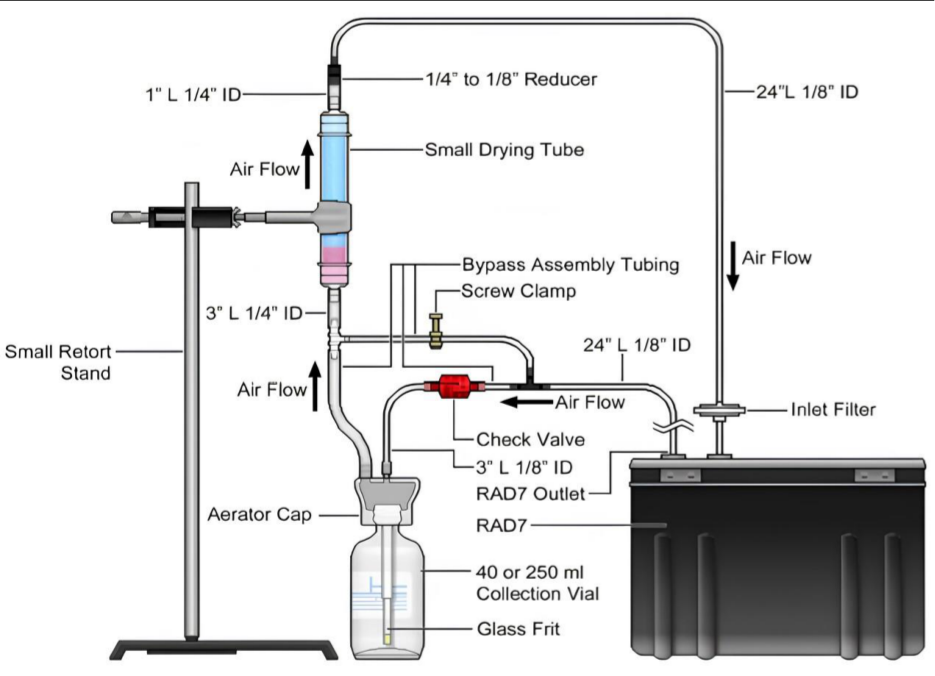 Figure 1
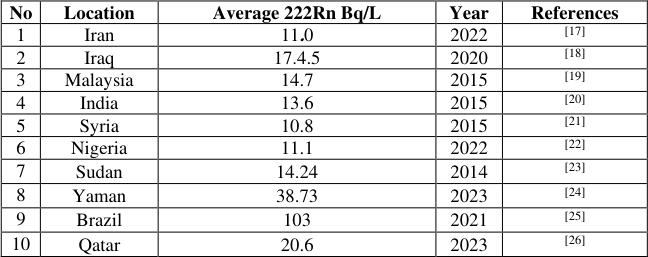 Table 1
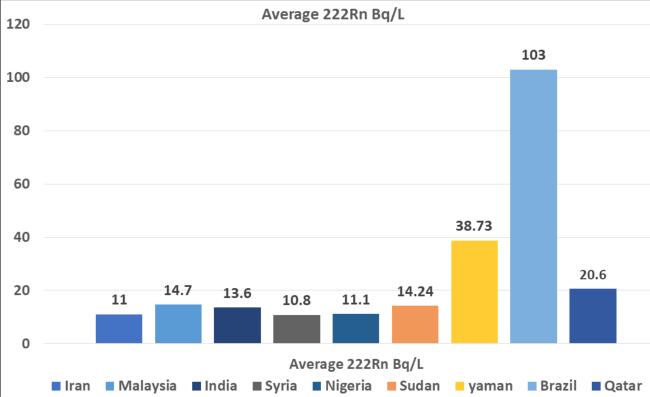 Figure 1
Introduction
Radon is a noble gas. Exposure to radon and its radioactive progenies represents a major risk for human health, mainly through lung cancer when inhaled [1] . While radon in air has already been recognized as a serious issue, presence of radon in water also deserves attention because it can be equally harmful to health. This paper looks into measuring global radon concentrations in water sources worldwide; sources methods factors influencing concentrations regulations challenges associated with accurate measurements. Radon is imperceptible to human senses as it does not exhibit any visual or olfactory properties despite being present along with its decay products [2] . It is important for people to be aware of where radon comes from and how it can affect them since they cannot see or smell this dangerous gas that might be around them. Different techniques are used to measure the amount of radon present in water samples: direct measurement using gamma ray spectrometry which does not require any phase transfer, liquid scintillation counting specifically aimed at detecting radon-222 since it is one of the common radionuclides found in water, or even diffusion into chambers where air is tested for radon concentration thus giving an idea about overall levels [3,4,5] . Factors like temperature. Countries seem to have different priorities when dealing with indoor exposure. Some have no guidelines while others have already set limit values like Switzerland which shows there can be varying approaches taken by different countries towards this common issue [7] . The establishment of comprehensive rules should be an important part toward ensuring safe drinking water supply available everywhere so that people do not end up consuming toxic substances unknowingly leading further adverse effects on their health later Radon: variations influenced by groundwater temperature [8] . Containing radon and an increased risk of health effects, particularly internal organ cancers, is not definitively confirmed by epidemiological studies [9] , the potential health implications of radon exposure through water remain a concern. Radon present in drinking water could lead to adverse health effects beyond lung cancer [1] . Ensuring the quality of drinking water, especially in terms of radon levels, is crucial for safeguarding public health and well-being.
RAD 7 Detector
The new research reveals that investigations before this one have employed reference material techniques to establish radon levels in drinking water. An often-used method is the RAD 7 detector, depicted in Figure 1 (The schematic diagram of RAD7). With a superior quality detector that is able to swiftly record data on radon detection every 30 minutes, the RAD7 presents itself as a feasible option for both laboratory and field use. It is easily deployable and cost-effective while ensuring high measurement qualityenabling organizations to conduct radon and isotopes measurements within short periods using state-of-the-art technology. The researchers use RAD7 in various settings (labs, research areas, home) which ensures more reliable results compared to other detectors [10][11] .
Fig 1:
A schematic diagram of the RAD7 [11] .
Produces RAD7 radon detection equipment [12,13] . RAD7 electronically evaluates any alpha particles and diagnoses the isotopes created by the radiation (218 Po, 214 Po). It is also used to distinguish between old and new radon. The device employs a semiconductor solid state to transform alpha particle radiation directly into an electrical signal. Thoron gas and an element derived by electrical noise. Water-covering conductors and semiconductors near the hemisphere's center have a 0.7 ml hemispheric penetration, which characterizes RAD7. The electric field adjusts to the hemisphere of a conductor when a voltage between 2000 and 2500 V is applied, drawing all particles that vent forward to the surface of the device. In order to distinguish between radon gas and water, the RAD7's operation starts the air in the water rotating until the device system finds equilibrium. After five minutes of oscillation, the device will mechanically cease. Five minutes later, repeat the same procedure. The detector prints the radon concentration when the procedure is complete. Calculate the remaining time for the procedure and the sampling by using Equation [14] . More information about radon and its hazards is needed, as levels of the gas fluctuate in water. As in other international and European nations, the concentration in drinking water may be minimized and addressed using one of the ways provided by deliberate, dependable, and precise measurement. It is exceedingly difficult to eliminate radon if it is present in excess of the permissible level. Groundwater is restricted for use in drinking water due to distinct processes than surface water, which are mostly associated with the region's geological structure and uranium rock concentration [15] . While radon measurement methods varies, one standard needs to be adhered to, the World Health Organization does not promote any particular method, and Environmental Defense Fund (EDWD) groups suggest alternative radon measurement approaches based on their convictions. For samples to be observed, they need to be distinct and varied from location to place. Each laboratory measurement is dependent on a number of factors, including precision and equipment, depending on the volume of water, as the analysis's duration is limited [16] .
Literature review
Table (1) shows a summary of certain reported figures on 222Rn levels from studies with different potable water origins in varying nations. After smoking, radon gas might be ranked as the second contributor to lung cancer. The table lists the 222Rn activity concentrations in drinking water reported from various countries. Mehdi Rashmi et al. In 2022 [17] , there was a study done in Iran. Rahimi, M. did study on how much radon is in the groundwater in Zaland, Iran. An study looked at how radon levels are related to the geology and a number of physical and chemical traits. In this study, we looked at groundwater in the Zalande region. We measured the amount of radon gas present and looked into how it related to the water's chemical makeup and natural structure. The RAD7 electronic analyzer was used to measure 48 samples of deep farm water. It found that 42% of the samples had a concentration of 11 BqL-1 or higher. We measured radon levels with gamma rays and found that they ranged from 4.667±2.077 to 31.550±4.912 BqL-1. Iraq in 2020, Abojassim, A.A. The study looked at active and passive methods for measuring radon levels in groundwater in Najaf, Iraq. Using RAD-7, the average radon level in groundwater samples was between (174.5±24.242 Bq/m3) and (2000.5±165.8 Bq/m 3 ). Using CR-39, the average radon level was between (179.101±55.286 Bq/m3) and (557.772±166.546 Bq/m3). [18] . In 2015, Alsaffa, M.A.
Researchers are looking into how much radon is in water that will be used for drinking and farming in the Sungai for radon. The study was done using the RAD7, an active electronic device made in the United States by the Durridge Company. The level of radon in the water is higher than the allowed level of 11.1 Bq/L [22] . (Elzain, 2014) estimated radon concentrations in 248 water samples collected from various water bodies in Sudan using a solid-state nuclear trace detector. Results showed a variation range for 222Rn from 6.93 Bq/L to 22.74 Bq/L, with an average value of 14.24 Bq/L. There was a research done not showing any significant disparity between the radon concentration of Hafhel's water and rivers [23] . Elzain (2014) implemented a similar study in Sudan using a solid-state nuclear trace detector on 248 water samples. It was discovered that the value of 222Rn ranged from 6.93 to 22.74 Bq/L, having an average rate of 14.24 Bq/L; no substantial distinction was reported among radon levels in Hafir water and rivers [24] . In 2023, Abdul-rahim, A. K., and Al-Maqtari, N.A. wanted to find out how much radon 222 was in public water sources in Sanaa, Yemen. They did this by collecting 43 samples of water from different sources and using a RAD7 device to do alpha spectroscopy on them. The levels were between 0.82 and 0.38 Bq/L and 38.73 to 2.98 Bq/L, with 23.46 Bq/L being the average [25] . It is known in Brazil that places with lots of air flow can have problems with radon gas. However, the government is still not doing enough to deal with the dangerously high amounts of this gas, even though they are very bad for your health. However, the Alpha-RAD7 monitor in Timoteo, MG state, in the southeast of Brazil, has been used to measure the natural radiation risk from being exposed to radon inside a home. Every two hours during the wet and dry seasons of 2017 and 2018, measurements of radon levels inside buildings and weather conditions like temperature and rainfall were written down.
There are about 18.0 to 412.8 Bq m-3 of radon in the air on average [26] . Henri Manawi, Ahmad A., Subeh M., Hushari M., Bukhari S., and Al-Sulaiti H. Finding out how much radon is in Qatari groundwater sources. The main goal of this study is to give a full account of how groundwater quality and radon levels are related in Qatar and to figure out what health risks come with high radon levels. They used ArcGIS to make maps and analyze groundwater from all over Qatar as part of their study. They then used radiology to do a risk estimate of radon in Qatar. In Qatar, no in-depth studies have been done to look into the behavior of radon in the groundwater or how it affects health. In Qatar, the amount of radon in groundwater has been found to be between 2.7 and 60.7 Bq/L, with 20.6 Bq/L being the average.
Discussion
When water is polluted with radioactive atoms, it poses a risk to human health. Several concerns exist regarding this, as it is likely to cause multiple types of cancer. If the volume of radon in the water is greater than the legal limit of 11.1 Bq/L, it may have an effect on human health. Not all water consumed is free of radon. However, water derived from surface reservoirs like lakes and rivers as well as subterranean reservoirs, may already contain radon at the time it is reached at your home. When a community can consistently provide water that is both portable and affordable, it has a positive effect on individuals in regards to financial and temporal limitations. This is because having a dependable water source for drinking ensures a healthy lifestyle and avoids the need to spend time or resources in finding a safe water source. The adverse effect is observed in children that are unable to participate in education, this results in long-term consequences for individuals and can potentially contribute to poverty at a societal level. Developed countries actively manage the volume of radioactivity in their water sources for drinking, but poorer countries are unaware of this issue. This investigation considers a selection of publications that were published between 2014 and 2024 in a particular country. It's evident that different areas of the country have different levels of radon due to the different composition of their rocks and the differing geological structures. This evaluation has a crucial role in determining the magnitude of the impact of radiation on society, specifically regarding the consumption of water that is radioactive. It also describes the associated health dangers and suggests protective actions. The concentrations of radon in several countries, including Brazil, Sudan, India, J, and Nejiria, are above the recommended levels, as listed in Table 1. The concentration of radon in Iraq, Syria, and Iran is lower than the recommended threshold in all locations examined. However, in Nigeria, the maximum average radon concentration was observed to be 36.1 Bq/L, which is greater than the average reported value because of the presence of rich volcanic rocks and geological configurations. Radon 222 is crucial to the isotope because it can be converted into the offspring of (218 PO) and subsequently decayed to produce the substance (214 PO) is distinguished by its hazardous properties and the severe impact it has on the human body. Other than its primary carcinogenic role, Radon is primarily considered to have health effects, specifically on the lungs. One of the most serious effects is the development of chronic fibrosis that is fatal. The EPA is the governmental agency that monitors and regulates water quality. They also have to address the issue of water contamination in drinking. It's crucial for people to be aware of and educated about this issue, because it directly affects the general population. When data is gathered, it is observed that the temperature decreases during cold days. This is because the frequency of radon's activity is greatest on cold days, which is typically recorded in wells at its highest level. During a research study that was conducted in the U.S. from 1995-97, specifically in New York state, a sample of 1000 individuals was interviewed. A large number of participants failed to provide responses to specific questions: "Have you heard of radon?" Many individuals participated negatively, which suggests that they are unaware of the dangers of radon. Only 21% of the participants had heard of radon, but no one knew about it. However, a subsequent study from 2004 revealed that people were more aware of the danger of radon, but still lacked a comprehensive understanding of its effects. Some individuals considered radon to be cancer-causing, while others failed to recognize it as causing headaches. Some people even mistook the symptoms of radon exposure for those of carbon monoxide poisoning, with the primary symptoms being headaches. As a result, understanding radon is the primary impetus for its treatment. To mitigate the effects of radon on society, extensive research and investigation are necessary. Radon is a public concern across all countries, with varying levels of exposure. The influence of radon is significant.
| No | Location | Average 222Rn Bq/L | Year | References |
|---|---|---|---|---|
| 1 | Iran | 11.0 | 2022 | [17] |
| 2 | Iraq | 17.4.5 | 2020 | [18] |
| 3 | Malaysia | 14.7 | 2015 | [19] |
| 4 | India | 13.6 | 2015 | [20] |
| 5 | Syria | 10.8 | 2015 | [21] |
| 6 | Nigeria | 11.1 | 2022 | [22] |
| 7 | Sudan | 14.24 | 2014 | [23] |
| 8 | Yaman | 38.73 | 2023 | [24] |
| 9 | Brazil | 103 | 2021 | [25] |
| 10 | Qatar | 20.6 | 2023 | [26] |
Table text extracted from the original PDF; superscript letters are shown inline. The original table image is below.
View original table image
Conclusion
Radiation is a common component of natural environments. Every person is exposed to ionizing radiation from various sources, and the radiation is consistently present. In the interior, the majority of radon is released through the soil's gas infiltration. Radon is difficult to recognize in air, water and soil, but it poses a health threat when it's the second greatest cause of cancer. It's only lived for a short time. It's crucial to have greater knowledge and education regarding how to prevent radiation from reaching the recommended level. This overview discusses the measurement of radon in drinking water in eight different countries. Nigeria, Jamaica, and Brazil had higher concentrations than expected, while Iran and China had lower concentrations. The investigation's area has multiple parameters and values that are different in different areas. Varied in terms of the composition of the ground's geological formation. The controversy surrounding radiation is a general one in multiple locations across the globe. For example, in the U.S., approximately 21,000 people perish every year, with road accidents that account for two times as many fatalities. This number is significant and cannot be ignored. Additionally, radon is the second greatest cause of lung cancer, a number that is still unknown to the majority and that is not adequately addressed through public education. Many individuals don't realize that radon is present, this poses a significant problem. The sole method of addressing this issue is through scientific methods, which have a significant role in protecting and preserving humans. The contamination of water for drinking typically results in poverty, disease, lack of education, and starvation. We want additional information about the general radiation field, specifically regarding radon.
References
25 in the original paper- Jobbágy V, Altzitzoglou T, Malo P, Tanner V, Hult M. A brief overview on radon measurements in drinking water. Journal of Environmental Radioactivity. 2017;173:18-24.
- Dua SK, Hopke PK, Kotrappa P. Electret method for continuous measurement of the concentration of radon in water. Health Physics. 1995;68(1):110-114.
- Nagaraja M, Sukumar A, Dhanalakshmi V, Rajashekara S. Factors influencing radon (^222Ra) levels of water: an international comparison. Journal of Geoscience and Environment Protection. 2019;7(5):69-80.
- AboJassim AA, Shitake AR. Estimated the mean of annual effective dose of radon gases for drinking water in some locations at Al-Najaf city. Journal of KufaPhysics. 2013;5(2):53-58.
- Jabar Dosh R, Hasan AK, Abojassim AA. Effective dose (Ingestion and inhalation) due to radon from tap water samples in children at primary schools in Najaf city, Iraq. Water Supply. 2023;23(3):1234-1249.
- Alaboodi AS, Kadhim NA, Abojassim AA, Hassan AB. Radiological hazards due to natural radioactivity and radon concentrations in water samples at Al-Hurrah city, Iraq. International Journal of Radiation Research. 2020;18(1):1-11.
- Li C, Zhao S, Zhang C, Li M, Guo J, Dimova NT, et al. Further refinements of a continuous radon monitor for surface ocean water measurements. Frontiers in Marine Science. 2022;9:1-10.
- Jobbágy V, Stroh H, Marissens G, Hult M. Comprehensive study on the technical aspects of sampling, transporting and measuring radon-in-water. Journal of Environmental Radioactivity. 2019;197:3038.
- Opoku-Ntim AB, Andam TT, Akiti J, Flectcher V, Roca R. Annual effective dose of radon in groundwater samples for different age groups in Obuasi and Offinso in the Ashanti Region, Ghana. Environmental Research Communications. 2019;1(10):105002.
- Ćujić M, Mandić LJ, Petrović J, Dragović R, Đorđević M, Đokić M, et al. Radon-222: Environmental behavior and impact to (Human and non-human) biota. International Journal of Biometeorology. 2021;65:6983.
- Hopke P, Borak T, Doull J, Cleaver J, Eckerman K, Gundersen L, et al. Health risks due to radon in drinking water. ACS Publications. 2000;34(6):921-926
- Inácio M, Soares S, Almeida P. Radon concentration assessment in public drinking water sources of Covilhã's county, Portugal. Journal of Radiation Research and Applied Sciences. 2017;10(2):135-139.
- Jafir O, Ahmad AH, Saridan WM, editors. Seasonal radon measurements in Darbandikhan Lake water resources at Kurdistan region-northeastern of Iraq. AIP Conference Proceedings. 2016;1718(1):01-04.
- Jobbágy V, Altzitzoglou T, Malo P, Tanner V, Hult M. A brief overview on radon measurements in drinking water. Journal of Environmental Radioactivity. 2017;173:18-24.
- Alam J, ur Rehman N, Ahmad N, Nazir A, Hameed A, Hussain A. An overview on the concentration of radioactive elements and physiochemical analysis of soil and water in Iraq. Reviews on Environmental Health. 2020;35(2):147-155.
- Rahimi M, Abadi AAM, Koopaei LJ. Radon concentration in groundwater, its relation with geological structure and some physicochemical parameters of Zarand in Iran. Applied Radiation and Isotopes. 2022;185:110223.
- Abojassim AA. Comparative study between active and passive techniques for measuring radon concentrations in groundwater of Al-Najaf city, Iraq. Groundwater for Sustainable Development. 2020;11:100476.
- Ahmad N, Jaafar MS, Alsaffar MS. Study of radon concentration and toxic elements in drinking and irrigated water and its implications in Sungai Petani, Kedah, Malaysia. Journal of Radiation Research and Applied Sciences. 2015;8(3):294-299.
- Yashaswini T, Ningappa C, Niranjan R, Sannappa J. Radon concentration level in ground and drinking water around Kabini River basin, Karnataka. Journal of the Geological Society of India. 2020;95(3):273-278.
- Shweikani R, Raja G. Natural radionuclides monitoring in drinking water of Homs city. Radiation Physics and Chemistry. 2015;106:333-336.
- Mostafa M, Olaoye MA, Ademola AK, Jegede OA, Saka AA, Khalaf H. Measurement of radon concentration in water within Ojo axis of Lagos State, Nigeria. Analytica. 2022;3(3):325-334.
- Elzain AEA. A study of indoor radon levels and radon effective dose in dwellings of some cities of Gezira State in Sudan. Nuclear Technology and Radiation Protection. 2014;29(4):307-312.
- Abdul-rahim AK, Al-Maqtari NA. Study of Radon Concentrations in Some of public Ground water wells, Sana'a-Yemen. Hadhramout University Journal of Natural and Applied Sciences. 2023;20(1):25-34.
- Silva CR, Smoak JM, da Silva-Filho EV. Residential radon exposure and seasonal variation in the countryside of south eastern Brazil. Environmental Monitoring and Assessment. 2020;192(8):544.
- Manawi Y, Ahmad A, Subeh M, Hushari M, Bukhari S, Al-Sulaiti H. Evaluation of the Radon Levels in the Groundwater Wells of Qatar: Radiological Risk Assessment. Water. 2023;15(22):01-20.
Cited by 1
From OpenAlex, OpenCitations and reference lists read by Scinovex
- Radon Detection in Drinking Water: Instruments and Measurement Techniques—A Comprehensive Review ↗
Phoka Caiphus Rathebe, Mota Xavier Kholopo · Applied Sciences · 2026
Radon (222Rn) is a naturally occurring radioactive noble gas and a leading cause of lung cancer after tobacco smoking. Elevated concentrations in groundwater, mainly from uranium-rich geological formations, pose significant health risks in regions reliant on groundwater. This review critically examines current tools and techniques for detecting radon in drinking water, focusing on how methodological choices affect reported levels and…
❝ 0PDF