
Research article · 2024 · Full text
International Journal of Agriculture and Food ScienceInfluence of organic manure on growth of transplanted rice (Oryza sativa L.)
Volume 6(1) · Pages 107–109 · DOI: 10.33545/2664844x.2024.v6.i1b.173 ↗
Research areasRice Cultivation and Yield ImprovementCrop Yield and Soil FertilityAgricultural Science and Fertilization
Abstract
Author-writtenA field experiment was planned and conducted during 2022 at Crop Research Center, School of Agricultural Sciences, Shri Guru Ram Rai University, Pathri Bagh, Dehradun, Uttarakhand, India to investigate the “Influence of organic manure on growth of transplanted Rice (Oryza sativa L.,). The experiment was laid out in randomized block design with three replications and 8 treatments. The treatments comprised following combinations of organic manure viz. T0: Control, T1: FYM (100%), T2: Vermicompost (100%), T3: Poultry manure (100%), T4: FYM + Vermicompost (1:1), T5: FYM + Poultry manure (1:1), T6: Vermicompost+ Poultry manure (1:1) T7: FYM + Vermicompost + Poultry manure (1:1:1). The sowing of Rice was done 10July 2022.Observations on various growth parameters were recorded. All the observations were recorded using standard method measurements. Of all the treatment of soil application, treatment T3 (Poultry manure 100%) has shown a significant improvement in growth than other treatments. The treatment T3 recorded highest plant height, number of tillers, dry matter accumulation, leaf area index.
Summary
Source-checkedPlain-language reading of the full paper, prepared with AI and checked against the text. Each point links to the authors' own words.
Why it matters
- Rice (Oryza sativa L.) is a critical global food crop that provides sustenance for over half of the world's population. View evidence ↗
- Low rice yields are significantly driven by soil fertility decline caused by the continuous use of inorganic fertilizers and imbalanced application. View evidence ↗
- Organic fertilizers, including animal manure, offer a way to reduce reliance on inorganic chemicals while improving soil quality and organic matter. View evidence ↗
The question
- The study aimed to investigate how different types of organic manure influence the growth of transplanted rice. View evidence ↗
What they did
- The research used a randomized block design featuring eight different treatments and three replications. View evidence ↗
- Treatments included a control and various applications of Farmyard Manure (FYM), Vermicompost, and Poultry manure, either alone or in combinations. View evidence ↗
- The study was conducted in sandy loam soil with a pH of 6.5 and specific levels of organic carbon (0.42%), nitrogen (3.52%), phosphorus (7.1%), and potassium (18.1%). View evidence ↗
- Growth parameters measured included plant height, dry matter production, and Leaf Area Index (LAI), with data analyzed using ANOVA. View evidence ↗
What they found
- Treatment T3 (100% poultry manure) resulted in the highest plant height at 60 days (82.27 cm) and 90 days (104.34 cm) after sowing. View evidence ↗
- The highest number of tillers was observed in T3 (10.8 at 60 DAS and 11.28 at 90 DAS), significantly outperforming other treatments. View evidence ↗
- The Leaf Area Index (LAI) was significantly highest in T3 at 60 days (4.25) and 90 days (4.09). View evidence ↗
- Treatments T7 (combination of poultry manure, FYM, and vermicompost) and T5 (FYM and poultry manure) were statistically comparable to T3 in terms of plant height. View evidence ↗
What it means
- The authors conclude that 100% poultry manure (T3) is the most effective organic manure for enhancing the growth parameters of transplanted rice. View evidence ↗
Visual summary
1 visualsIllustrations explain the paper; they do not show study data.
Experimental Treatment Layout
AI-generated conceptual illustration (transplanted rice (Oryza sativa L.) in a paddy field). It explains the idea and does not show study data.
View source evidence ↗Figures & tables
From the original paper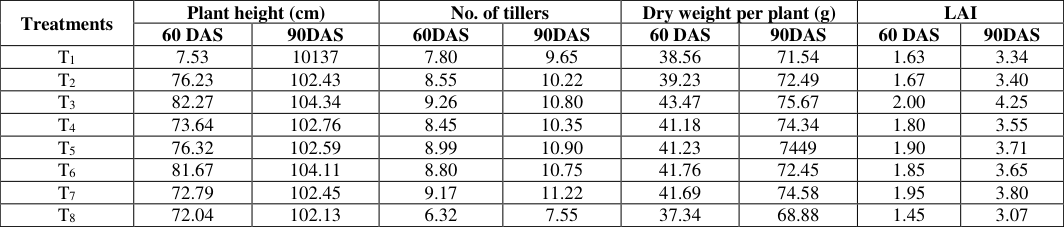 Table 1
Introduction
A food crop that is extensively produced and feeds more than half of the world's population is rice (Oryza sativa L.). The phrase "rice is life" is the most fitting one for the entire planet, since this grain is essential to the food security of our country and employs millions of people in rural areas. The vast area dedicated to rice cultivation does not yield much rice because of several interconnected issues. An imbalance in fertilizer application and the ongoing use of inorganic fertilizers, which has decreased soil fertility, are two major contributors to low yield. The maximum yields of grain and straw were obtained when inorganic fertilizers were used in conjunction with organic resources. It would be highly promising to combine chemical and organic manure fertilizers in order to improve soil fertility and maintain output stability. For optimum growth, plants need a sufficient amount of nutrients from a variety of sources. Native sources of these nutrients include water, manure, rice straw, soil minerals, and soil organic matter; nevertheless, the amounts provided by these sources are typically insufficient to produce a high and sustainable yield. To close the gap between crop requirements and nutrient availability from the aforementioned sources, fertilizer must be administered. The season and kind of the crop determine the amount of nutrients required. However, proper crop management and efficient agronomic techniques are necessary to realize the full potential of enhanced nutrient management and efficient agronomic management are required in order to fully investigate rice's yield potential. Paddy is cultivated globally, being one of the most important cereal crops worldwide. The USDA Global rice production in 2021/22 is forecasted at a record 510.8 million tons (Milled basis) down 0.9 million tons from the previous forecast (USDA, 2021). Total production of Rice during 2020-21 is estimated at record 121.46 million tones. It is higher by 9.01 million tones than the last five years' average production of 112.44 million tones. Rice is established mostly by the growing seedling in a confined space under controlled conditions followed by transplanting of 20-30 days old seedling in the main field. Transplanting is the traditional method which commonly practiced as a method of weed control in water stagnation in rainfed areas. The rice is transplanted by two methods i.e. random or in line.
Recent studies showed that the line transplanted shows slightly lower population, and fertilizer application can easily be done in line transplanting. Even through due to less labour recruitment and time during the transplanting time farmer still practice random transplanting in general, particularly in the Bundelkhand region. Organic manuring is becoming an increasingly significant part of healthy, long-term farming. Plant nutrients are replenished in agricultural soils primarily through inorganic, organic, and biofertilizers. Inorganic fertilizers are used indefinitely, causing a decline in soil chemical, physical, and biological qualities, as well as soil health. Chemical fertilizer's negative effects, combined with rising prices, have sparked a surge in interest in organic fertilizers as a nutritional source. For sustainable agricultural production, the use of organic resources as fertilizers has obtained plenty of attention. Organic materials have a plenty of potential as a source of numerous nutrients and as a method for improving soil properties. Application of organic fertilizers such as animal manure, sawdust, and others, or the combination of organic and inorganic fertilizers, can be an alternative option to reduce the utilization of inorganic fertilizers, maintain soil quality, increase soil organic matter, as well as improve soil physical and chemical properties through the decomposition of its substances. Organic matter enhances soil nutrients, plant growth regulators, and biodiversity. Thus, an integrated nutrient management system is required to maintain soil quality as well as to obtain high yield and preferred grain quality.
Materials and Methods
The field research was carried out in experimental field of Shri Guru Ram Rai University, Patel Nagar, and Dehradun, India during kharif season in 2022 to study the Influence of organic manure on growth and yield of by organically produced transplanted rice (Oryza sativa L.) under different organic manure. The geographical situation of the farm lies in the North-Gangetic alluvial plain at 25°18` north latitudes 83°03` East longitude and at an altitude of 128.93 meters above the mean sea level. The following therapies were used: T0: Control T1, FYM (100%), T2: Vermicompost (100%), T3: Poultry manure (100%), T4: FYM + Vermicompost (1:1), T5: FYM + Poultry manure (1:1), T6: Vermicompost + Poultry manure (1:1), T7: FYM + Vermicompost + Poultry manure (1:1:1), T0: Control; The experiment was laid out in randomized block design with three replications. The soil of the experimental plot was sandy loam. The land was primarily ploughed followed by two harrowing. The field was given a pre-sowing irrigation before field preparation to obtained proper germination and establishment of the crop (T8). To determine of organic manure on growth of transplanted rice. The experiment site was sandy loam in texture with pH 6.5, organic carbon (0.42%), available nitrogen (3.52%), available phosphorus (7.1%), and available potassium (18.1%). Between germination to harvesting several plant growth parameters were recorded. In growth parameter plant height (cm), dry matter production of crop plant (g/m2), Leaf Area Index (LAI). The data recorded for different characteristics were subjected to statistical analysis by adopted the method of ANOVA.
Results and Discussion
Results and Discussion
Effect of different treatment on growth parameters of rice
Effect of different treatment on growth parameters of rice
Conclusion
The result of all the treatments for growth parameters is summarized in Table 1 showing that T3 (Poultry manure 100%) have shown significant growth among all the treatments. The similar result is supported by Kyi Kyi Shwe, et al. 2021 [1] .
| Treatments | Plant height (cm) | — | No. of tillers | — | Dry weight per plant (g) | — | LAI | — |
|---|---|---|---|---|---|---|---|---|
| 60 DAS | 90DAS | 60DAS | 90DAS | 60 DAS | 90DAS | 60 DAS | 90DAS | |
| T1 | 7.53 | 10137 | 7.80 | 9.65 | 38.56 | 71.54 | 1.63 | 3.34 |
| T2 | 76.23 | 102.43 | 8.55 | 10.22 | 39.23 | 72.49 | 1.67 | 3.40 |
| T3 | 82.27 | 104.34 | 9.26 | 10.80 | 43.47 | 75.67 | 2.00 | 4.25 |
| T4 | 73.64 | 102.76 | 8.45 | 10.35 | 41.18 | 74.34 | 1.80 | 3.55 |
| T5 | 76.32 | 102.59 | 8.99 | 10.90 | 41.23 | 7449 | 1.90 | 3.71 |
| T6 | 81.67 | 104.11 | 8.80 | 10.75 | 41.76 | 72.45 | 1.85 | 3.65 |
| T7 | 72.79 | 102.45 | 9.17 | 11.22 | 41.69 | 74.58 | 1.95 | 3.80 |
| T8 | 72.04 | 102.13 | 6.32 | 7.55 | 37.34 | 68.88 | 1.45 | 3.07 |
Table text extracted from the original PDF; superscript letters are shown inline. The original table image is below.
View original table image
International Journal of Agriculture and Food Science https://www.agriculturaljournals.com
The aforementioned study on the impact of organic manure on transplanted rice revealed that 100% poultry manure was the best organic manure for increasing growth parameters.
References
15 in the original paper- Shwe KK, Mar SS, Winwin T, Hlaing Y, Ngwe HMT, Sakai T, et al. Effect of Chicken Manure and Chemical Fertilizer Applications on Growth and Yield of Rice sativa L.). International Society of Environmental and Rural Development. 2021;12(1):149-159.
- Sims TT, Murphy DW, Handweker TS. Composting of Poultry Wastes: Implication for Dead Poultry Disposal and Manure Management. Journal of Sustainable Agriculture. 2013;2(4):67-82.
- Sangeetha SP, Balakrishnan A, Devasenapathy P. Influence of Organic Manures on Yield and Quality of Rice (Oryza sativa L.) and Blackgram (Vigna mungo L.) in Rice-Blackgram Cropping Sequence. American Journal of Plant Sciences. 2013;4:1151-1157.
- Barik T, Sahu S, Garnayak LM, Gulati JM, Bastia DK. Split application of vermicompost and its effect on growth and yield of organic rice. ORYZA-An International Journal on Rice. 2011;48(3):226-232.
- Atiyeh RM, Subler S, Edwards CA, Bachman G, Metzger JD, Shuster W, et al. Effects of vermicompost and composts on plant growth in horticultural container media and soil. Pedobiologia. 2000;44:579-590.
- Rahimabadi Taheri E, Ansari MH, Nematollahi R. Influence of cow manure and its vermicomposting on the improvement of grain yield and quality of rice (Oryza sativa L.) in field conditions. Applied Ecology and Environmental Research. 2017;16(1):97-110.
- Lalandera CH, Komakecha AJ, Vinneråsa B. Vermicomposting as manure management strategy for urban small-holder animal farms -Kampala case study. Waste Manag. 2015;39:96-103.
- Frederickson J, Howell G, Hobson AM. Effect of precomposting and vermicomposting on compost characteristics. European Journal of Soil Biology. 2007;S320-S326.
- Devi KE, Mehera B, Meshram MR, Sanodiya LK. Effect of varieties and organic manure on growth and yield of Black Rice (Oryza sativa L.). The Pharma Innovation Journal. 2022;4:1680-1684.
- Borah N, Athokpam FD, Semwal RL, Gorkotti SC. Chachao (Black rice; Oryza sativa L.): The culturally important and stress-tolerant traditional rice variety of Manipur. Indian Journal of Traditional Knowledge. 2018;17(4):789-794.
- Motavalli PP, Singh RP, Anders MM. Perception and management of farmyard manure in the semiarid tropics of India. Agricultural Systems. 1994;46(2):189-204.
- Sepehya S, Subehia SK, Rana SS, Negi SC. Effect of integrated nutrient management on rice-wheat yield and soil properties in a North-Western Himalayan Region. Indian Journal of Soil Conservation. 2012;40(2):135140.
- Vasanthi D, Kumarswamy K. Efficacy of vermicompost to improve soil fertility and rice yield. Journal of the Indian Society of Soil Science. 2000;47(2):268-272.
- Ghosh A. Comparative study on combined and individual effects of farmyard manure and greenmanuring with fertilizer N on growth and yield of rice (Oryza sativa) under submergence-prone situation. Indian J Agron. 2007;52(1):43-45.
- Pandey N, Verma AK, Anurag, Tripathi RS. Integrated nutrient management in transplanted hybrid rice (Oryza sativa). Indian Journal of Agronomy. 2007;52(1):40-42.