
Research article · 2024 · Full text
International Journal of Research in AgronomyInfluence of biofertilizers and phosphorus on growth and yield of greengram
Volume 7(5) · Pages 36–40 · DOI: 10.33545/2618060x.2024.v7.i5a.665 ↗
Research areasAgricultural Science and FertilizationAgronomic Practices and Intercropping SystemsCrop Yield and Soil Fertility
Abstract
Author-writtenA field experiment was conducted during Zaid season 2023 at Crop Research Farm, Department of Agronomy, Naini Agricultural Institute, Sam Higginbottom University of Agriculture, Sciences and Technology. To determine “Influence of Biofertilizers and Phosphorus on growth and yield of Greengram (Phaseolus radiatus L.)”. The result revealed that treatment 9 (Rhizobium + PSB + Phosphorus 50 kg/ha) recorded significant and higher plant height (47.13 cm), maximum number of nodules/plant (8.55), higher plant dry weight (7.75 g), maximum number of pods/plant (29.51), maximum number of seeds/pod (7.47), higher test weight (40.59 g), higher seed yield (1204.92 kg/ha), and higher stover yield (2209.93 kg/ha), maximum gross return (97,498.83 INR/ha), maximum net return (64,684.83 INR/ha), maximum B:C ratio (1.97) was recorded in treatment 9 (Rhizobium + PSB + Phosphorus 50 kg/ha) as compared to other treatments was found to be productive as well as economically feasible
Summary
Source-checkedPlain-language reading of the full paper, prepared with AI and checked against the text. Each point links to the authors' own words.
Why it matters
- Low yields of pulse crops across different soil types are frequently associated with a lack of phosphorus and biofertilizers. View evidence ↗
- Biofertilizers such as Phosphorus Solubilizing Bacteria (PSB) and Rhizobium can improve crop productivity by increasing the availability of nitrogen and phosphorus. View evidence ↗
The question
- The study aimed to determine how different combinations of biofertilizers and phosphorus levels influence the growth and yield of greengram. View evidence ↗
What they did
- The field experiment took place during the Zaid season of 2023 at the Crop Research Farm in Prayagraj, Uttar Pradesh. View evidence ↗
- The researchers used a Randomized Block Design (RBD) consisting of 10 different treatments, each replicated three times. View evidence ↗
- Treatments involved three levels of biofertilizers combined with three levels of phosphorus, plus a control group. View evidence ↗
What they found
- The highest plant height of 47.13 cm was achieved using a combination of Rhizobium, PSB, and 50 kg/ha of phosphorus (Treatment 9). View evidence ↗
- Treatment 9 (Rhizobium + PSB + 50 kg/ha Phosphorus) resulted in the maximum number of nodules per plant at 8.55. View evidence ↗
- The highest plant dry weight of 7.75 g was recorded for Treatment 9. View evidence ↗
- Treatment 9 produced the maximum number of pods per plant, totaling 29.51. View evidence ↗
- The maximum number of seeds per pod (7.47) was observed in Treatment 9. View evidence ↗
- The highest seed yield of 1204.92 kg/ha was recorded for Treatment 9. View evidence ↗
- Treatment 9 also achieved the highest stover yield at 2209.93 kg/ha. View evidence ↗
- Treatment 9 was the most economically viable, yielding a maximum gross return of 97,498.83 INR/ha, a net return of 64,684.83 INR/ha, and a benefit-cost ratio of 1.97. View evidence ↗
What it means
- The authors conclude that the combination of Rhizobium, PSB, and 50 kg/ha of phosphorus is the most effective for maximizing grain yield and economic returns in greengram. View evidence ↗
Visual summary
2 visualsIllustrations explain the paper; charts are replotted from the paper's own table values.
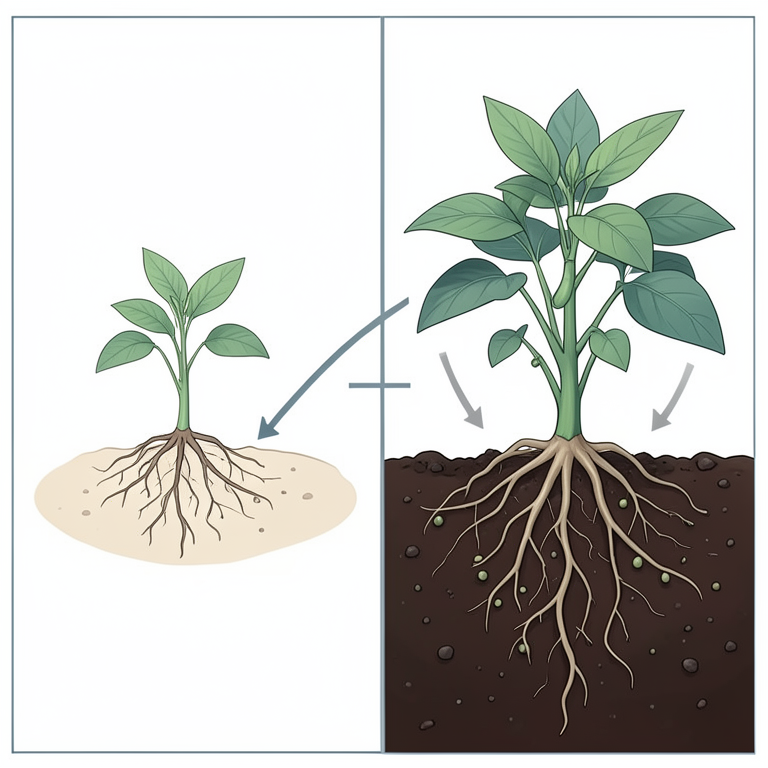
Synergistic Effect of Nutrients
AI-generated conceptual illustration (greengram plants). It explains the idea and does not show study data.
View source evidence ↗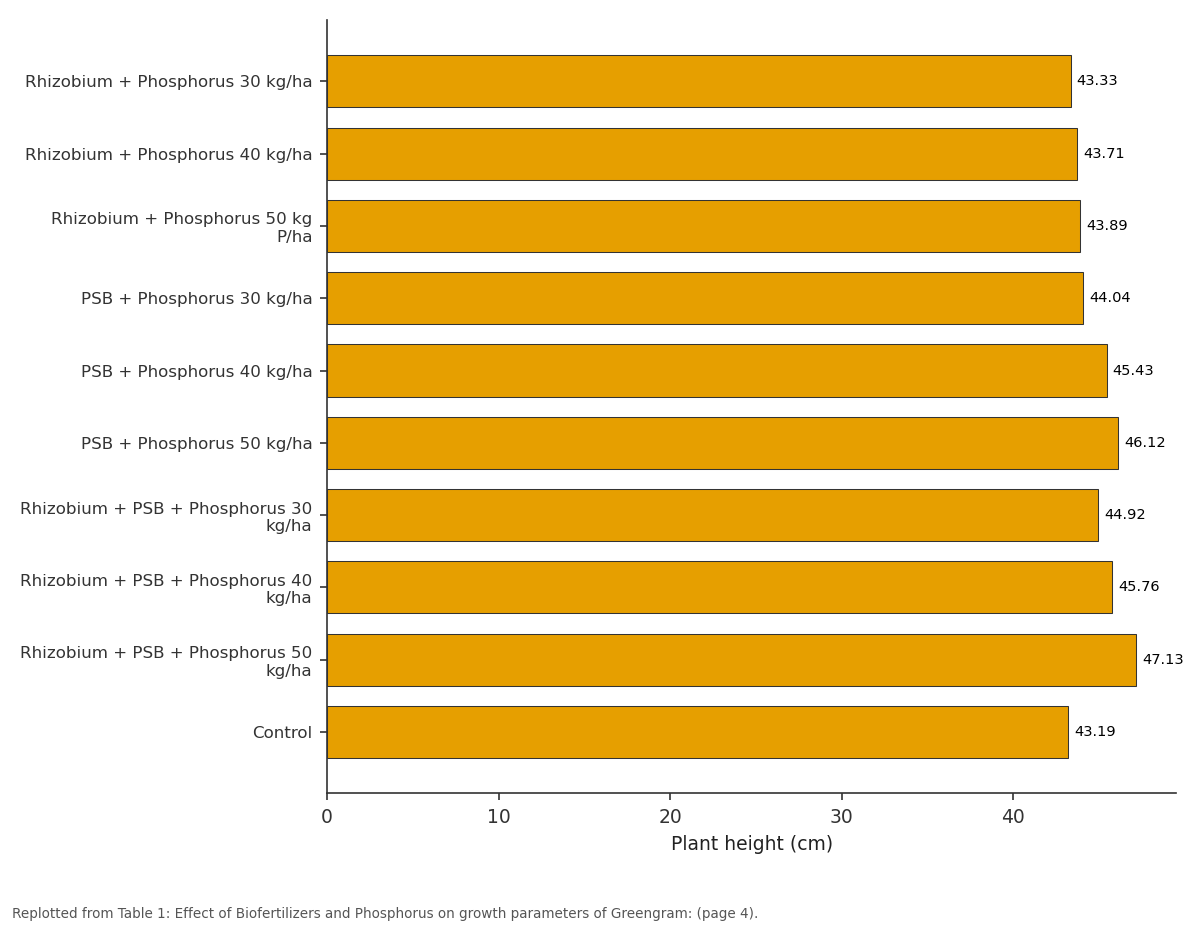
Plant height (cm): Rhizobium + Phosphorus... vs Rhizobium + Phosphorus... vs Rhizobium + Phosphorus... vs PSB + Phosphorus 30... vs PSB + Phosphorus 40...
Replotted from Table 1 (page 4) of the original paper. Every bar is the paper's own table value.
View source evidence ↗Figures & tables
From the original paper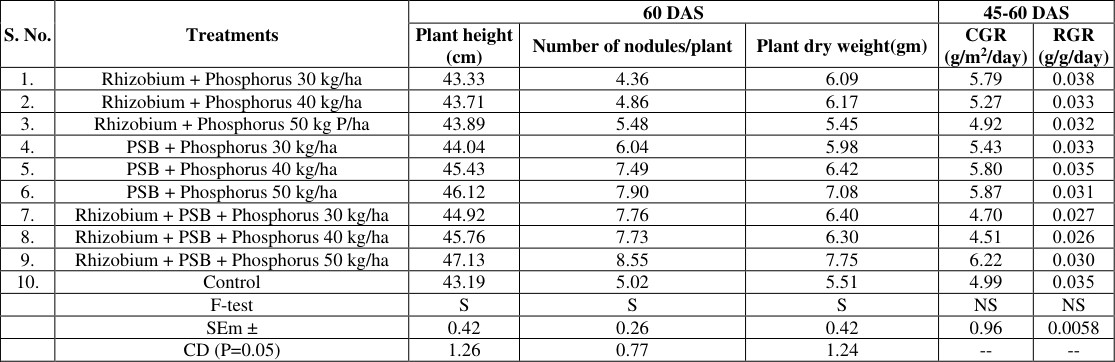 Table 1
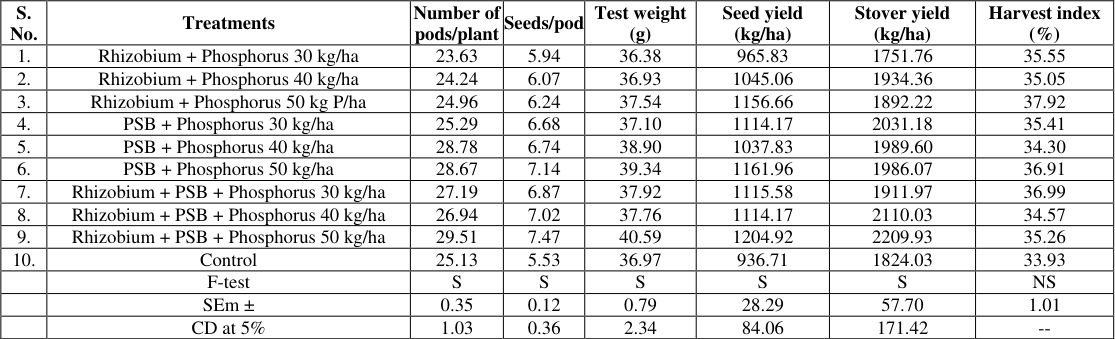 Table 2
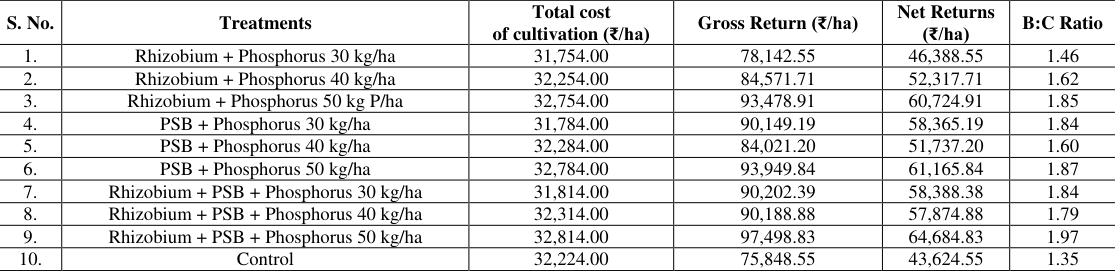 Table 3
Introduction
Greengram, also known as "Moong Dal" in India, is the third most significant pulse crop in the legume family, covering around 8% of the country's total pulse-growing area. Widely cultivated across Asia, particularly in India, it is prized for its high digestibility and palatability, making it a crucial protein source for India's vegetarian population. India leads globally in greengram production, accounting for 65% of its cultivation area and 54% of its total output. This versatile crop is packed with nutrients, offering 334 calories per 100 grams, with a crude protein content of 24.0%, fat content of 1.3%, carbohydrate content of 56.6%, minerals content of 3.5%, lysine content (0.43%), ionine content (0.10%), and tryptophan content (0.04%). Due to its short growth cycle, it is commonly intercropped with other major crops, making it a vital component of India's agriculture. In the global scenario, India ranks first in pulse production, with an impressive area of 959.68 lakh ha with a production of 973.92 lakh tonnes and an average productivity of 1015 kg/ha (FAO, 2022). India currently ranks greengram as the fourth most important pulse crop, accounting for nearly 17% of the total pulse area in the country. In India, greengram is grown in 48.52 lakhs ha area with a production of 26.48 lakh tonnes and productivity of 546 kg/ha. Uttar Pradesh is one of the major greengram producing state in India. In Uttar Pradesh, greengram is grown in area of 0.89 lakh ha with production of 0.54 lakh tonnes and the average productivity is 608 kg/ha (GOI, 2022) [9] . Greengram holds paramount importance in India not only for grain production but also for forage and green manure purposes. However, poor pulse yields on various soils are often linked to deficiencies in biofertilizers and phosphorus. Biofertilizers are critical for protein and nucleic acid synthesis, impacting crop productivity significantly. Inadequate fertilizer management, especially on marginal lands, diminishes soil fertility, affecting mungbean and other pulse crop growth. The scarcity of phosphorus in Indian soils exacerbates this issue, impacting vegetative growth, branching, and leaf development in crops. Balancing fertilization strategies is essential to optimize pulse yields and sustain agricultural productivity. Despite their pivotal role, rising fertilizer costs, particularly for nitrogenous and phosphatic types, present financial challenges for farmers. Sustainable agricultural practices are crucial for improving pulse yields and ensuring economic viability. Effective use of biofertilizers like Rhizobium and PSB enhances nitrogen and phosphorus availability through biological nitrogen fixation and increased phosphorus uptake. Phosphorus, a vital mineral element, is essential for pulse crop growth and development, constituting a major part of proteins and nucleic acids. Biofertilizers play a critical role in integrated nutrient management systems for sustainable agriculture in India, offering a cost-effective and eco-friendly alternative to chemical fertilizers. Inoculating pulse seeds with phosphorus solubilizers enhances phosphorus availability in the rhizosphere, crucial for improving pulse yields across diverse soil types. Efficient strains of Rhizobium introduced into nitrogen-deficient soil can significantly boost nitrogen fixation, thereby enhancing productivity. Additionally, phosphorus-solubilizing bacteria improve phosphorus use efficiency by solubilizing insoluble phosphate in the root zone, supporting green gram yield. Given the scarcity and rising costs of chemical fertilizers, judicious use of both chemical fertilizers and biofertilizers is essential for maximizing greengram production. Phosphorus is particularly vital for root and dry matter production, nodulation, nitrogen fixation, and protein synthesis (Bhatt et al. 2013) [3] . Phosphorus is a vital nutrient essential for plant growth, serving as a key component of enzymes involved in vital processes like carbohydrate metabolism, energy transformation, and photosynthesis. Adequate phosphorus levels are crucial for optimal nodulation and efficient nitrogen fixation, leading to higher yields. During early growth stages, plants require significant phosphorus for cell division. Deficiency symptoms include slow, weak, and stunted growth, along with dark to bluegreen discoloration on older leaves due to phosphorus mobility within plants. Severe phosphorus deficiency can cause leaf and stem purpling, delayed maturity, and poor seed and fruit development, ultimately reducing overall plant growth and yield (Singh. et al. 2020) [17] . Approximately 30% of applied phosphorus is accessible to crops, with the remainder being converted into insoluble forms. Adding extra phosphorus beyond the recommended dose enhances nitrogen fixation, ultimately boosting greengram productivity. Phosphorus is vital for various metabolic processes in plants, such as photosynthesis, energy transfer, signal transduction, macromolecular biosynthesis, and respiration (Singh et al. 2021) [19] . Keeping in view the above facts, the experiment was conducted to find out "Influence of Biofertilizers and Phosphorus on growth and yield of Greengram".
Materials and Methods
The experiment was conducted during Zaid season 2023 at Crop Research Farm, Department of Agronomy, SHUATS, Prayagraj (U.P). The soil of the experimental field was sandy loam in texture, a pH of 7.8 that was virtually neutral, low level of organic carbon (0.62%), available N (225 Kg/ha), P (38.2 kg/ha), K (240.7 kg/ha) and Zn (2.32 mg/kg). The treatment consists of three levels of Biofertilizer along with the combination of three levels of Phosphorus and a control. The experiment was laid out in RBD with 10 treatments each replicated thrice. The treatment combinations are T 1 Rhizobium + Phosphorus 30 kg/ha, T 2 Rhizobium + Phosphorus 40 kg/ha, T 3 Rhizobium + Phosphorus 50 kg/ha, T 4 PSB + Phosphorus 30 kg/ha, T 5 PSB + Phosphorus 40 kg/ha, T 6 PSB + Phosphorus 50 kg/ha, T 7 [Rhizobium + PSB]+ Phosphorus 30 kg/ha, T 8 [Rhizobium + PSB ]+ Phosphorus 40 kg/ha, T 9 [Rhizobium + PSB] + Phosphorus 50 kg/ha, T 10 (Control) N:P:K 25:50:25 kg/ha. Data recorded on different aspects of crop, viz., growth, yield attributes and yield were subjected to statistically analysed by analysis of variance method as described by Gomez and Gomez (1976) [8] .
Result and Discussion
Result and Discussion
The data revealed that significant and higher plant height (47.13 cm) was recorded in treatment 9 [Rhizobium + PSB + Phosphorus 50 kg/ha]. However, treatment 6 [PSB + Phosphorus 50 kg/ha], was found to be statistically at par with treatment 9 [Rhizobium + PSB + Phosphorus 50 kg/ha]. Significant and higher plant height was observed with the application of Rhizobium along with PSB might be due to seed inoculation with Rhizobium and PSB improved plant nutrient uptake and translocation by the greengram plant. Its inoculation may also have benefited the plants by supplying atmospheric nitrogen and making the insoluble phosphorous available form. Similar results were also reported by Singh et al. (2019) [18] . Further, significant and higher plant height was observed with the application of phosphorus (50kg/ha) might be due to the adequate availability of plant nutrient through appropriate nutrient supply and sunlight to each plant. An adequate phosphorus supply indirectly helps in providing nitrogen supply and its availability helps the plants to attain more vigour in term of plant height. Similar results were also reported by Khan et al. (2017) [10] .
Number of nodules/plant
The data revealed that significant and maximum number of nodules/plant (8.55) was recorded in treatment 9 [Rhizobium + PSB + Phosphorus 50 kg/ha]. However, treatment 6 [PSB + Phosphorus 50 kg/ha], was found to be statistically at par with treatment 9 [Rhizobium + PSB + Phosphorus 50 kg/ha]. Significant and maximum number of nodules/plant was observed with the application of Rhizobium along with PSB may be due to the of biofertilizers like rhizobium and along with PSB helped in higher nitrogen fixation and phosphorous solubilization respectively which helped in higher root growth and nodules development. Similar results were also reported by Verma et al. (2022) [20] . Further, significant and maximum number of nodule/plant was observed with the application of Phosphorus (50kg/ha) might be due to better proliferation of roots and increased nodulation due to higher phosphorus availability which leads to higher plant growth. Similar results were also reported by Patel et al. (2020) [12] .
The data revealed that significant and higher plant dry weight (7.75 g) was recorded in treatment 9 [Rhizobium + PSB + Phosphorus 50 kg/ha]. However, treatment 6 [PSB + Phosphorus 50kg/ha], was found to be statistically at par with treatment 9 [Rhizobium + PSB + Phosphorus 50 kg/ha]. Significant and higher plant dry weight was observed with the application of Rhizobium and along with PSB biofertilizers inoculation might be due to increase in yield characteristics resulting in improved plant growth parameters, ultimately yielding a larger dry matter production. Similar results were also reported by Abhishali et al. (2023) [1] . Further significant and Higher Plant dry weight was observed with the application of Phosphorus (50kg/ha), might be due to adequate supply and availability of Phosphorus increased plant dry weight and better photosynthetic activity due to greater exposure to light and increases the availability of nutrients in plants. Similar result was reported by Swamy et al. (2020) [4] .
The data revealed that During 45-60 DAS, treatment 9 [Rhizobium + PSB + Phosphorus 50 kg/ha] recorded highest crop growth rate (6.22 g/m 2 /day), though there was no significant difference among the treatments.
The data revealed that During 45-60 DAS, treatment 1 [Rhizobium + Phosphorus 30 kg/ha]. recorded highest Relative Growth Rate (0.038 g/g/day), though there was no significant difference among the treatments.
Yield and Yield Parameters 3.2.1 Number of pods/plant
The data revealed that significant and maximum number of pods/plant (29.51) was recorded in treatment 9 [Rhizobium + PSB + Phosphorus 50 kg/ha]. However, treatment 5 [PSB + Phosphorus 40 kg/ha], treatment 6 [PSB + Phosphorus 50 kg/ha], was found to be statistically at par with treatment 9 [Rhizobium + PSB + Phosphorus 50 kg/ha]. Significant and maximum number of pods/plant was observed with the application of Rhizobium along with PSB which improves the availability of Nitrogen and Phosphorous, more pods are generated as a result of higher rates of primordial production. Similar results were also reported by Verma et al. (2022) [20] . Further the significant and maximum number of pods/plant with the application of Phosphorus (50kg/ha) might be due to rapid transfer of energy facilitates increased photosynthates this resulted in increased total biomass production and their translocation in various plant parts. Similar result were reported by Punse et al. (2018) [11] .
Number of seeds/pods
The data revealed that significant and maximum number of seeds/pods (7.47) was recorded in treatment 9 [Rhizobium + PSB + Phosphorus 50 kg/ha]. However, treatment 6 [PSB + Phosphorus 50 kg/ha], was found to be statistically at par with treatment 9 [Rhizobium + PSB + Phosphorus 50 kg/ha]. Significant and maximum number of seeds/pods was observed with the application of Rhizobium along with PSB might be due to in addition to accelerating growth, overall increased nodulation, an extensive root system, and higher metabolite production and translocation, particularly to productive structures (pods and seeds). Similar results were also reported by Ghanshyam et al. (2010) [6] . Further the significant and maximum number of seeds/pods with the application of Phosphorus (50kg/ha) might be due to sufficient availability of nutrients and their absorption by the plants, with better photosynthetic activity. Similar result was reported by Kumar and Debbarma (2023) [16] .
The data revealed that significant and higher test weight (40.59 g) was recorded in treatment 9 [Rhizobium + PSB + Phosphorus 50 kg/ha]. However treatment 6 [PSB + Phosphorus 50 kg/ha], treatment 5 [PSB + Phosphorus 40 kg/ha], was found to be statistically at par with treatment 9 [Rhizobium + PSB + Phosphorus 50 kg/ha]. Significant and higher test weight was observed with the application of Rhizobium along with PSB might be due to applying a medium degree of fertility may have increased test weight because it improved the removal and translocation of nutrients, notably phosphorus, which led to hold seed production by growing the size and weight of grains. Similar results were also reported by Abhishali et al. (2023) [1] . Further the significant and higher test weight was observed with the application of Phosphorus (50kg/ha) might be due to root growth resulted plant absorbed more nutrient from soil for effective dry matter production and translocation of photosynthates from leaves to reproductive parts for better development of seeds. Similar result was reported by Reddy et al. (2023 ) [5] .
The data revealed that significant and higher seed yield (1204.92 kg/ha) was recorded in treatment 9 [Rhizobium + PSB + Phosphorus 50 kg/ha]. However, treatment 6 [PSB + Phosphorus 50 kg/ha], treatment 3 [Rhizobium + Phosphorus 50 kg P/ha], was found to be statistically at par with treatment 9 [Rhizobium + PSB + Phosphorus 50 kg/ha]. Significant and higher seed yield was observed with the application of Rhizobium might be due to synergistic effects by improving growth prompting hormones, controlling pathogenesis and growth reducing agents via producing fungicide antibiotics and compounds (antagonistic effect), nitrogen fixing and also producing growth prompting hormones such as auxin, cytokinin and gibberellin and solving mineral compound, ultimately increases seed yield. Similar result was reported by Khatana et al. (2021) [13] in blackgram. Further, significant and higher seed yield was observed with the application of PSB might be due to increase in phosphorus avalibility by solubilization of phosphate rich compounds it secreates various organic acids that can form chelates, resulting in effective solubilization of phosphate, helped higher nitrogen fixation, dry matter accumulation, rapid plant growth, higher absorption and utilization of phosphorus and other plant nutrients and ultimately leading to positive effects on yield attributes, particularly seed yield. Similar results were also reported by Bhabai et al. (2019) [2] . Another reason, the significant and higher seed yield was observed with application of Phosphorus (50 kg/ha) might be due to cumulative favourable effect of the higher number of effective pods/plant and seed/pod occurred due to better plant metabolism which in turn produced higher seed yield. Similar result was reported by Abbas et al. (2011) [7] .
The data revealed that significant and higher stover yield (2209.93 kg/ha) was recorded in treatment 9 [Rhizobium + PSB + Phosphorus 50 kg/ha]. However, treatment 8 [Rhizobium + PSB + Phosphorus 40 kg/ha], was found to be statistically at par with treatment 9 [Rhizobium + PSB + Phosphorus 50 kg/ha]. Significant and higher stover yield was observed with the application of Rhizobium along with PSB might be due to the best root development and higher dry matter build up allowed for maximal nutrient and moisture absorption, which produced the highest possible stover yield. Similar results were also reported by Rajesh et al. (2013) [14] . Further, significant and higher stover yield was obtained with the application of phosphorus (50kg/ha) might be due to increase in photosynthetic activities of plant and root system enabled the plant to extract more water and nutrient from soil. Similar results were also reported by Rekha et al. (2018) [15] .
The data revealed that highest harvest index (37.92%) was recorded in treatment 3 [Rhizobium + Phosphorus 50 kg P/ha]. There was no significant difference among the treatments.
Economics
The result showed that Maximum gross return (97,498.83 INR/ha), Maximum net return (64684.83 INR/ha) and Maximum benefit cost ratio (1.97) was recorded in treatment 9 [Rhizobium + PSB + Phosphorus 50 kg/ha] as compared to other treatments.
Maximum benefit cost ratio was recorded with the application of Rhizobium along with PSB might be due to increase in grain and straw yield with increasing levels of phosphorus, wich in turn produces maximum benefit cost ratio and net return. Further, Maximum gross return, net return and benefit cost ratio was recorded with application of Phosphorus (50kg/ha) might be due to better growth and yield attributing character resulting in more seed and stover yield. Similar results were also reported by Singh et al. (2020) [17] .
Conclusion
It is concluded that in Greengram (treatment 9) with the combination of Rhizobium, PSB along with phosphorus (50 kg/ha) was observed highest grain yield and benefit cost ratio.
Acknowledgement
The authors are thankful to Department of Agronomy, Naini Agricultural Institute, Prayagraj, Sam Higginbottom University of Agriculture Technology and sciences, (U.P) India for providing necessary facilities to undertake the studies.
Figures and tables from the paper
| S. No. | Treatments | 60 DAS | — | — | 45-60 DAS | — |
|---|---|---|---|---|---|---|
| Plant height (cm) | Number of nodules/plant | Plant dry weight(gm) | CGR (g/m2/day) | RGR (g/g/day) | ||
| 1. | Rhizobium + Phosphorus 30 kg/ha | 43.33 | 4.36 | 6.09 | 5.79 | 0.038 |
| 2. | Rhizobium + Phosphorus 40 kg/ha | 43.71 | 4.86 | 6.17 | 5.27 | 0.033 |
| 3. | Rhizobium + Phosphorus 50 kg P/ha | 43.89 | 5.48 | 5.45 | 4.92 | 0.032 |
| 4. | PSB + Phosphorus 30 kg/ha | 44.04 | 6.04 | 5.98 | 5.43 | 0.033 |
| 5. | PSB + Phosphorus 40 kg/ha | 45.43 | 7.49 | 6.42 | 5.80 | 0.035 |
| 6. | PSB + Phosphorus 50 kg/ha | 46.12 | 7.90 | 7.08 | 5.87 | 0.031 |
| 7. | Rhizobium + PSB + Phosphorus 30 kg/ha | 44.92 | 7.76 | 6.40 | 4.70 | 0.027 |
| 8. | Rhizobium + PSB + Phosphorus 40 kg/ha | 45.76 | 7.73 | 6.30 | 4.51 | 0.026 |
| 9. | Rhizobium + PSB + Phosphorus 50 kg/ha | 47.13 | 8.55 | 7.75 | 6.22 | 0.030 |
| 10. | Control | 43.19 | 5.02 | 5.51 | 4.99 | 0.035 |
| F-test | S | S | S | NS | NS | |
| SEm ± | 0.42 | 0.26 | 0.42 | 0.96 | 0.0058 | |
| CD (P=0.05) | 1.26 | 0.77 | 1.24 | -- | -- |
Table text extracted from the original PDF; superscript letters are shown inline. The original table image is below.
View original table image
| S. No. | Treatments | Number of pods/plant | Seeds/pod | Test weight (g) | Seed yield (kg/ha) | Stover yield (kg/ha) | Harvest index (%) |
|---|---|---|---|---|---|---|---|
| 1. | Rhizobium + Phosphorus 30 kg/ha | 23.63 | 5.94 | 36.38 | 965.83 | 1751.76 | 35.55 |
| 2. | Rhizobium + Phosphorus 40 kg/ha | 24.24 | 6.07 | 36.93 | 1045.06 | 1934.36 | 35.05 |
| 3. | Rhizobium + Phosphorus 50 kg P/ha | 24.96 | 6.24 | 37.54 | 1156.66 | 1892.22 | 37.92 |
| 4. | PSB + Phosphorus 30 kg/ha | 25.29 | 6.68 | 37.10 | 1114.17 | 2031.18 | 35.41 |
| 5. | PSB + Phosphorus 40 kg/ha | 28.78 | 6.74 | 38.90 | 1037.83 | 1989.60 | 34.30 |
| 6. | PSB + Phosphorus 50 kg/ha | 28.67 | 7.14 | 39.34 | 1161.96 | 1986.07 | 36.91 |
| 7. | Rhizobium + PSB + Phosphorus 30 kg/ha | 27.19 | 6.87 | 37.92 | 1115.58 | 1911.97 | 36.99 |
| 8. | Rhizobium + PSB + Phosphorus 40 kg/ha | 26.94 | 7.02 | 37.76 | 1114.17 | 2110.03 | 34.57 |
| 9. | Rhizobium + PSB + Phosphorus 50 kg/ha | 29.51 | 7.47 | 40.59 | 1204.92 | 2209.93 | 35.26 |
| 10. | Control | 25.13 | 5.53 | 36.97 | 936.71 | 1824.03 | 33.93 |
| F-test | S | S | S | S | S | NS | |
| SEm ± | 0.35 | 0.12 | 0.79 | 28.29 | 57.70 | 1.01 | |
| CD at 5% | 1.03 | 0.36 | 2.34 | 84.06 | 171.42 | -- |
Table text extracted from the original PDF; superscript letters are shown inline. The original table image is below.
View original table image
| S. No. | Treatments | Total cost of cultivation (₹/ha) | Gross Return (₹/ha) | Net Returns (₹/ha) | B:C Ratio |
|---|---|---|---|---|---|
| 1. | Rhizobium + Phosphorus 30 kg/ha | 31,754.00 | 78,142.55 | 46,388.55 | 1.46 |
| 2. | Rhizobium + Phosphorus 40 kg/ha | 32,254.00 | 84,571.71 | 52,317.71 | 1.62 |
| 3. | Rhizobium + Phosphorus 50 kg P/ha | 32,754.00 | 93,478.91 | 60,724.91 | 1.85 |
| 4. | PSB + Phosphorus 30 kg/ha | 31,784.00 | 90,149.19 | 58,365.19 | 1.84 |
| 5. | PSB + Phosphorus 40 kg/ha | 32,284.00 | 84,021.20 | 51,737.20 | 1.60 |
| 6. | PSB + Phosphorus 50 kg/ha | 32,784.00 | 93,949.84 | 61,165.84 | 1.87 |
| 7. | Rhizobium + PSB + Phosphorus 30 kg/ha | 31,814.00 | 90,202.39 | 58,388.38 | 1.84 |
| 8. | Rhizobium + PSB + Phosphorus 40 kg/ha | 32,314.00 | 90,188.88 | 57,874.88 | 1.79 |
| 9. | Rhizobium + PSB + Phosphorus 50 kg/ha | 32,814.00 | 97,498.83 | 64,684.83 | 1.97 |
| 10. | Control | 32,224.00 | 75,848.55 | 43,624.55 | 1.35 |
Table text extracted from the original PDF; superscript letters are shown inline. The original table image is below.
View original table image
References
20 in the original paper- Abhishali, Victor Debbarma, Abishek Chauhan. Effect of Biofertilizer and foliar application of Boron on Growth and yield of Greengram (Phaseolus radiates L.). Biological Forum -An International Journal. 2023;15(3):277-28.
- B Bhabai, D Mukhopadhyay, B Mitra. Effect of biofertilizer and phosphorous on greengram (Vigna radiata). Journal of Pharmacognosy and Phytochemistry. 2019;8(4):505-509.
- Bhatt PK, Patel PT, Patel BT, Raval CH, Vyas KG, Ali S. Productivity, quality, nutrient content and soil fertility of summer greengram (Vigna radiata L.) as influenced by different levels of vermicompost and phosphorus with and without PSB. International Journal of Agricultural Sciences. 2013;9(1):659-662.
- BMV Prasad Swamy, Vikram Singh, Dhananjay Tiwari, Indu Thakur. Study of System of Crop Intensification (SCI) and Phosphorus Management on Growth, Yield and Economics of Greengram (Vigna radiata L.). International Journal of Current Microbiology and Applied Sciences. 2020;9(8):1950-1958.
- Geedipally Srinivas Reddy, Victor Debbarma, Pallepati Ravinder Rao. Effect of Phosphorous and Mulching on Growth and Yield of Zaid Green gram (Vigna radiata L.). International Journal of Environment and Climate Change. 2023;13(10):2581-8627.
- Ghanshyam, Rakesh Kumar, Jat RK. Productivity and soil fertility as affected by organic manures and inorganic fertilizers in green gram (Vigna radiata)-Wheat (Triticum aestivum) system. Indian Journal of Agronomy. 2010;55(1):16-21.
- Ghulam Abbas, Zafar Abbas, M Aslam, Asmat Ullah Malik, M Ishaque, F. Effect of organic and inorganic fertilizers on Mungbean Biofertilizer and foliar application of Boron on Growth and yield of Greengram (Vigna radiata L.). Arid climate. International Research Journal. 2011;2(4):094-098.
- Gomez KA, Gomez AA. Three or more factor experiment. (In:) Statistical Procedure for Agricultural research. 2nd ed. 1976:139-141.
- GOI. Agricultural statistics at glance: Ministry of agriculture, Government of India. [Online] [Accessed on January 17, 2024]. Available from: http://www.agricoop.nic.in
- Khan MMS, Singh VP, Kumar A. Studies on effect of phosphorous levels on growth and yield of kharif mungbean (Vigna radiata L. wilczek). Journal of Pure & Applied Biosciences. 2017;5(4):800-808.
- Punse M, Pagar PC, Rangari P, Siddagangamma KR. Effect of Phosphorus and Sulphur on Growth, yield and Economics of Greengram. Journal of Soils and Crops. 2018;28(2):402-406.
- Patel BK, Patel HK, Makawana SN, Shiyal VN, Chotaliya RL. Effect of various sources of nitrogen and phosphorus on growth, yield and economics of summer green gram (Vigna radiata L. Wilczek). International Journal of Current Microbiology and Applied Sciences. 2020;11:745-752.
- Khatana RNS, Thomas T, Barthwal A, Kumar T. Effect of NPK levels and Rhizobium on soil physic-chemical properties, growth, yield and economics of summer black gram (Vigna munga L.) var. Shekhar-2. The Pharma Innovation Journal. 2021;10(8):1555-1561.
- Rajesh M, Jayakumar TK, Kannan S. Effect of Biofertilizers Application on Growth and Yield Parameters of Green Gram (Vigna radiata L.). International Journal of Fertilizer, Tillage Practices and Weed Control Methods. 2013;3(7):254-256.
- Rekha K, Pavaya RP, Malav JK, Chaudhary N, Patel IM, Patel JK. Effect of FYM, phosphorus and PSB on yield, nutrient content and uptake by green gram (Vigna radiata (L.) Wilckzek) on loamy sand. International Journal of Chemical Studies. 2018;6(2):1026-1029.
- Kumar S, Debbarma V. Effects of Phosphorus and Boron on Growth, Yield and Economics of Green Gram (Vigna radiata L.). International Journal of Plant and Soil Science. 2023;35(11):2320-7035.
- Singh RE, Singh V, Tiwari D, Masih A. Effect of Levels of Phosphorus and Sulphur on Growth and Yield of Black gram (Vigna mungo L.). International Journal of Current Microbiology and Applied Sciences. 2020;9(10):2784-2791.
- Singh SN, Singh V. Effect of liquid biofertilizer, plant geometry and phosphorous levels on growth and yield of greengram (Vigna radiata L.). Journal of Pharmacognosy and Phytochemistry. 2019;9(1):1826-1830.
- Singh V, Singh V. Influence of Spacing and Phosphorus on Growth and Yield of Green Gram (Vigna radiata L.) in Prayagraj Condition. Biological Forum -An International Journal. 2021;13(2):408-412.
- Verma R, Singh M, Dawson J, Muddassir P, Khan I. Effect of bio-fertilizers and organic manures on growth and yield of greengram (Vigna radiata L.). The Pharma Innovation Journal. 2022;11(4):1599-1602.
Cited by 2
From OpenAlex, OpenCitations and reference lists read by Scinovex
- Enhancing lentil productivity through residue management and biofertilizers: A review
Smriti Patel, Aashu Rajput, Sharad Pandey, Gaurav Jain · International Journal of Research in Agronomy · 2026
The present review envisages available information regarding the importance of the incorporation of crop residues and biofertilizers in enhancing the growth and yield of lentil. The productivity of lentil varies considerably with the soil conditions and therefore, sustainable soil management practices play a key role in maintaining good production. Incorporation of crop residues increases soil organic carbon, water retention, aggregation and microbial activity, thus increasing the proper cycling and availability of nutrients. Nonetheless, temporary problems like immobilization of nitrogen and
- Effect of integrated nutrient management on growth parameters and nodulation of Lentil (Lens culinaris M.)
Sarthak Dwivedi, Mandeep Kumar, Ravikesh Kumar Pal, Naveen Kumar Maurya, Durgesh Kumar Maurya, Rishu Kumari · International Journal of Research in Agronomy · 2026
The experiment Effect of Integrated Nutrient management on nodulation, growth and yield of lentil (Lens culinaris M.) was conducted at the Agricultural Research Farm, Faculty of Agricultural Sciences and Allied Industries, Rama University, Kanpur, during the rabi season of 2025-26. Eight treatments comprising various levels of Recommended Dose of Fertilizers (RDF), organic manure (Vermicompost), and biofertilizers (Rhizobium and PSB) were evaluated in a Randomized Block Design with three replications. The results indicated that the application of RDF 75% + Vermicompost + PSB + Rhizobium (T8) s