
Research article · 2024 · Full text
International Journal of Research in AgronomyStudy on genetic variability and correlation in okra (Abelmoschus esculentus L.)
Volume 7(5) · Pages 125–128 · DOI: 10.33545/2618060x.2024.v7.i5b.659 ↗
Research areasAgricultural Practices and Plant GeneticsAgricultural pest management studiesGenetics and Plant Breeding
Abstract
Author-writtenAt the Vegetable Research Farm, Department of Horticulture, Naini Agricultural Institute, Sam Higginbottom University of Agriculture Technology and Sciences, Prayagraj, research on twenty different accession of okra [Abelmoschus esculentus (L.) was conducted in a randomised block design with three replications during the rainy season of 2023 to study the genetic variability, heritability, genetic advance, and characters association. There was discovered to be a large degree of genetic diversity in the materials for all genotypes under consideration, as indicated by the analysis of variance, which revealed extremely significant differences for each genotype. The phenotypic coefficient of variance was greater than the matching genotypic coefficient of variation for every research participant. There is enough variety in the number of branches per plant and chlorophyll concentration, as evidenced by the significant genotypic and phenotypic variance in both traits. High heritability was noted for the following parameters: height, fruit production per plant, length of internodes, number of internodes on main stem, number of branches per plant, amount of fruit per plant, and predicted genetic advancement represented as a percentage of the mean. The prevalence of additive gene activity was suggested by this data. It can be concluded that due weight should be given to plant height, number of internodes on main stem, length of internodes, number of branches per plant, fruit length, fruit weight, number of fruits per plant, and fruit yield while imposing selection for genetic improvement of fruit yield per plant in okra. These conclusions are based on performance, heritability, and genetic advance as a percent of mean, the genotypes. In order to develop high-yielding okra varieties and hybrids, the genotypes Parabhani Kranti, Arka Anamika, Azad Bhindi, Varsha Uphar, Kashi Vibhuti, Pusa Makhmali, VRO-3, and VRO-4 that had higher values for the aforementioned characters can be further tested and used in future breeding programmes.
Summary
Source-checkedPlain-language reading of the full paper, prepared with AI and checked against the text. Each point links to the authors' own words.
Why it matters
- Okra is an annual seed-grown crop cultivated in tropical and subtropical regions, including India, Africa, and Turkey. View evidence ↗
- In India, okra is a highly significant vegetable crop grown for its soft green fruits during the rainy and summer seasons. View evidence ↗
- Genetic variability is essential for breeding programs because selection is most effective in populations that possess substantial diversity. View evidence ↗
The question
- The study aimed to evaluate genetic variability, heritability, genetic advance, and the association between characters across twenty different okra accessions. View evidence ↗
What they did
- The experiment used a randomized block design with three replications of twenty okra accessions during the 2023 rainy season. View evidence ↗
- The study was conducted at the Naini Agricultural Institute in Prayagraj, Uttar Pradesh, during the Kharif 2023 season. View evidence ↗
- The researchers performed a variance analysis on 15 different plant characters. View evidence ↗
What they found
- Analysis of variance showed extremely significant differences for each genotype, indicating a high degree of genetic diversity across all studied materials. View evidence ↗
- The highest genetic and phenotypic variation was found in chlorophyll content (GCV 21.4%, PCV 21.94%) and the number of branches per plant (GCV 29.42%, PCV 30.19%). View evidence ↗
- High heritability was observed for chlorophyll content (95.10%), number of branches per plant (95.00%), length of internodes (93.90%), and number of internodes on main stem (84.10%), among other traits. View evidence ↗
- High genetic advance as a percentage of the mean was recorded for the number of branches per plant (59.23%), chlorophyll content (43.23%), and number of internodes on main stem (30.38%). View evidence ↗
- Fruit yield per plant showed a strong positive correlation with plant height, nodes per plant, and fruit per plant at both genotypic and phenotypic levels. View evidence ↗
What it means
- The authors conclude that additive gene action predominates for traits like plant height and chlorophyll content, meaning they can be effectively improved through simple selection. View evidence ↗
- The authors recommend using genotypes such as Parabhani Kranti, Arka Anamika, and VRO-3/4 in future breeding programs to develop high-yielding hybrids. View evidence ↗
Visual summary
3 visualsIllustrations explain the paper; charts are replotted from the paper's own table values.
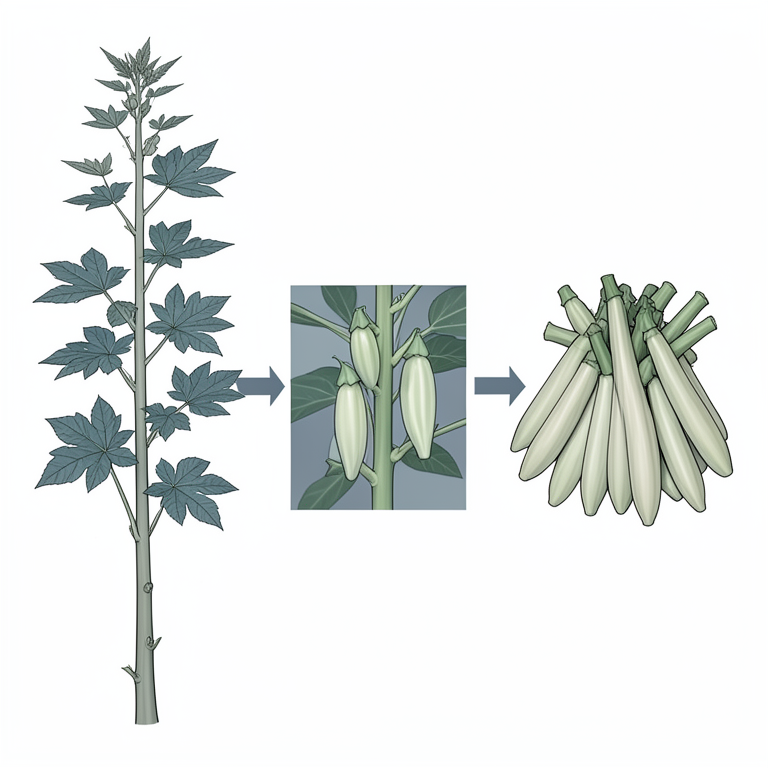
Correlation Network of Okra Yield
AI-generated conceptual illustration (okra plants (Abelmoschus esculentus)). It explains the idea and does not show study data.
View source evidence ↗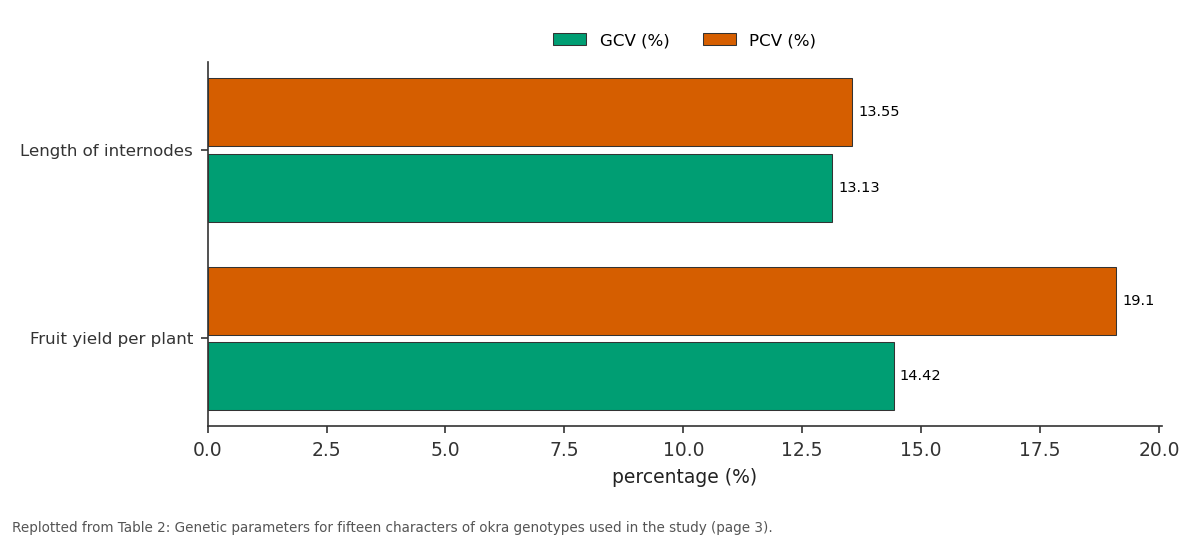
GCV (%) and PCV (%): Length of internodes vs Fruit yield per plant
Replotted from Table 2 (page 3) of the original paper. Every bar is the paper's own table value.
View source evidence ↗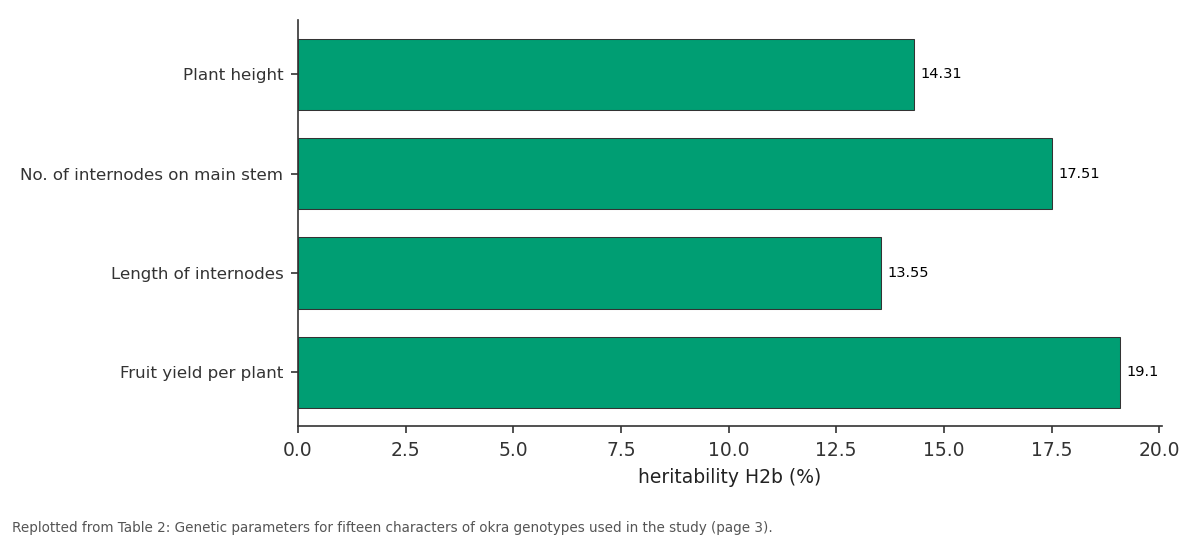
PCV (%): Plant height vs No. of internodes on... vs Length of internodes vs Fruit yield per plant
Replotted from Table 2 (page 3) of the original paper. Every bar is the paper's own table value.
View source evidence ↗Figures & tables
From the original paper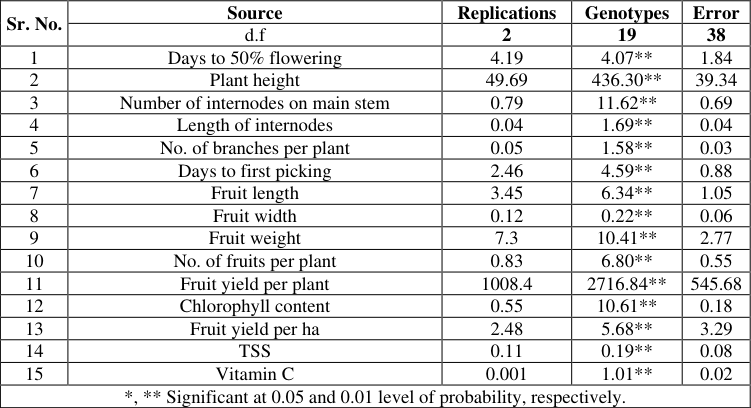 Table 1
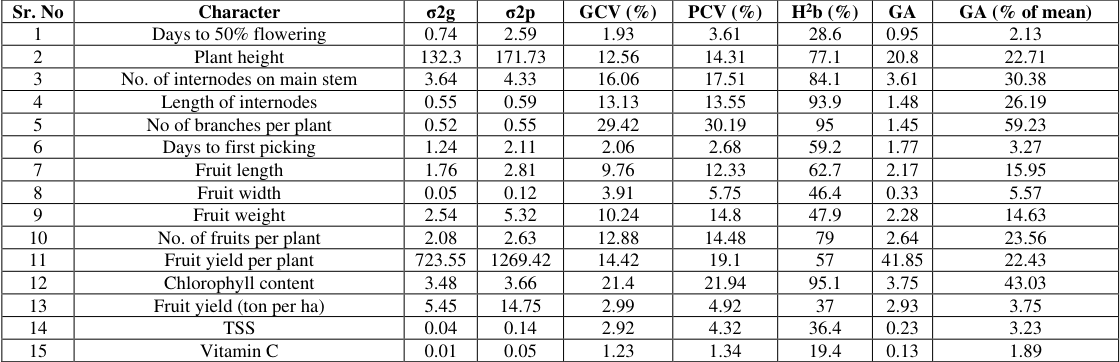 Table 2
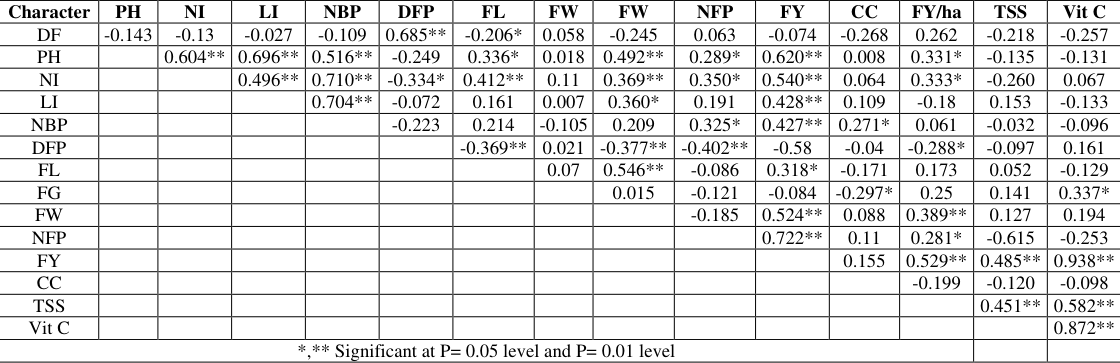 Table 3
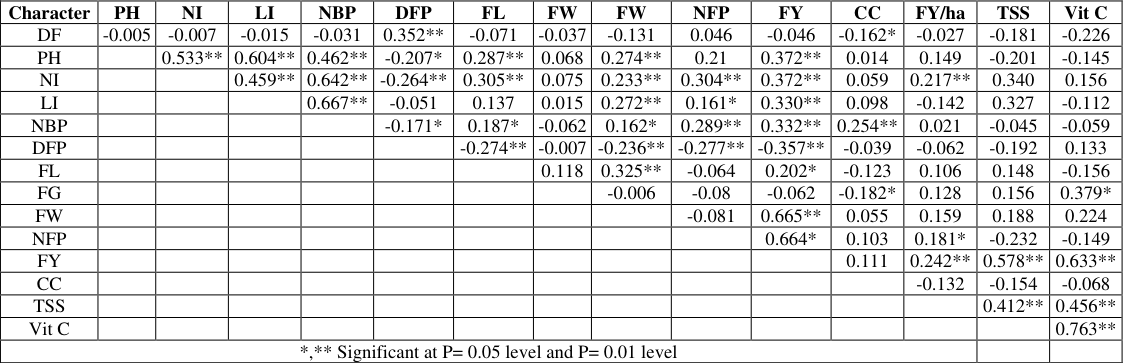 Table 4
Introduction
In tropical and subtropical parts of the world, including India, Africa, Turkey, and other nearby nations, okra (Abelmoschus esculentus) is an annual crop grown from seeds. Among the veggies, okra has become more popular. Compared to green veggies, okra is more productive. In India, okra is one of the most significant vegetables farmed for its soft green fruits during the summer and rainy season. Crop okra is a polyploid member of the Malvaceae family and is frequently cross-pollinated. Outcrossing occurs in the context of insect-assisted pollination to a maximum of 42.2% and to an extent of 4 to 19%. Any breeding strategy should logically begin with an analysis of the variety in the material that is currently available. It is stated that the quanon of any such programme is genetic variability. Selection is thought to be effective in populations with substantial genetic variability. Measures of transmissibility of variation and responsiveness to selection are provided by the genetic fractions of observed variability, which comprise genetic variability and its components. One might argue that selection is effective in a population characterised by high genetic variability. A portion of the reported variability consists of genetic variation and its constituents, which together provide an evaluation of the transmissibility of variability and responsiveness to selection. The understanding of the inheritance patterns of different species must be taken into consideration while choosing the best breeding techniques for each crop. Breeders choose the material for any enhancement effort based on the degree of genetic diversity present. Usually, the genotype is not accurately represented by the phenotype.
Breeders choose the material for any enhancement effort based on the degree of genetic diversity present. Usually, the genotype is not accurately represented by the phenotype. Variability in phenotype is caused by the interplay between genetics and environment. The examination of correlation and path coefficients sheds light on a population's genetic diversity. The correlation coefficient is used to ascertain the manual association between various plant characteristics and to choose the component that would increase fruit harvests. The path coefficient analysis facilitates the elite genotype selection by varying the correlation coefficient to the direct and indirect impacts of a collection of independent factors based on the dependent variable. Correlation studies of 15 important okra characters observed in the present study revealed a strong and positive relationship between fruit yield per plant and plant height, nodes per plant, and fruit per plant at the genotypic and phenotypic levels, indicating a common association of these traits. As a result, you may select these characteristics and get fruit on every okra plant.
Material and Methods
Twenty different okra genotypes were gathered for this experiment from different sources. These accessions have been evaluated in the area with respect to yield and yield contributing factors. In Kharif 2023, the experiment was conducted in the Horticulture Field Experiment Department of Naini Agricultural Institute, Sam Higginbottom University of Agriculture, Technology and Sciences, Prayagraj (Uttar Pradesh).
Experimental details
Experimental details
List of genotypes
List of genotypes
Sr. No
Sr. No
Genotypes Symbol
Genotypes Symbol
Name of Genotypes
Name of Genotypes
Sr. No
Sr. No
Results and Discussion
Results and Discussion
Analysis of variance
The degree of variability for each variable under analysis varied significantly between genotypes, and this difference has been demonstrated to be substantially larger for all analysed samples. There are therefore several options for selection for the majority of the features in the genotypes. Atotkar et al. (2010) [1] , Goswami et al. (2012) [5] , Kumar et al. (2016) [6,7] , Sharma et al.
(2017), and Singh et al. have all reported findings that are comparable. A variance analysis for each of the 15 characters is provided in Table 1.
| Sr. No. | Source | Replications | Genotypes | Error |
|---|---|---|---|---|
| d.f | 2 | 19 | 38 | |
| 1 | Days to 50% flowering | 4.19 | 4.07** | 1.84 |
| 2 | Plant height | 49.69 | 436.30** | 39.34 |
| 3 | Number of internodes on main stem | 0.79 | 11.62** | 0.69 |
| 4 | Length of internodes | 0.04 | 1.69** | 0.04 |
| 5 | No. of branches per plant | 0.05 | 1.58** | 0.03 |
| 6 | Days to first picking | 2.46 | 4.59** | 0.88 |
| 7 | Fruit length | 3.45 | 6.34** | 1.05 |
| 8 | Fruit width | 0.12 | 0.22** | 0.06 |
| 9 | Fruit weight | 7.3 | 10.41** | 2.77 |
| 10 | No. of fruits per plant | 0.83 | 6.80** | 0.55 |
| 11 | Fruit yield per plant | 1008.4 | 2716.84** | 545.68 |
| 12 | Chlorophyll content | 0.55 | 10.61** | 0.18 |
| 13 | Fruit yield per ha | 2.48 | 5.68** | 3.29 |
| 14 | TSS | 0.11 | 0.19** | 0.08 |
| 15 | Vitamin C | 0.001 | 1.01** | 0.02 |
| *, ** Significant at 0.05 and 0.01 level of probability, respectively. |
Table text extracted from the original PDF; superscript letters are shown inline. The original table image is below.
View original table image
Genetic parameters
Fruit yield per plant (723.55) had the highest genotypic variance, followed by plant height (132.30). On the other hand, fruit yield per tonn (5.45) had the lowest genotypic variance, followed by the number of internodes on the main stem (3.64), fruit weight (2.54), days to 50% flowering (0.74), days of first picking (1.24), days to 50% flowering (0.74), length of internodes (0.55), number of branches per plant (0.52), and fruit width (0.05). Fruit yield per plant (1269.42) and plant height (171.73) also had high phenotypic variances; fruit yield ton/ha (14.75) had moderate variances. On the other hand, fruit weight (5.32), the number of internodes on the main stem (4.33), the chlorophyll content (3.66), fruit length (2.81), the number of fruits per plant (2.63), the days to 50% flowering (2.59), the days to first picking (2.11), the length of internodes (0.59), the number of branches per plant (0.55), and fruit width (0.12) showed low phenotype variances. Greater variety for these features was suggested by the high genotypic and phenotypic coefficient of variation for the number of branches per plant (GCV: 29.42%; PCV: 30.19%) and chlorophyll content (GCV: 21.4%; PCV: 21.94%) in okra. Therefore, improving this crop by direct selection for these qualities would be beneficial. On the other hand, the material under investigation showed moderate variability in terms of genotypic and phenotypic coefficient of variation for the following: number of internodes on main stem (GCV: 16.06%; PCV: 17.51%), fruit yield per plant (GCV: 14.42; PCV: 19.1%), length of internodes (GCV: 13.13%; PCV: 13.55%), number of fruits per plant (GCV: 12.88; PCV: 14.48%), plant height (GCV: 12.56%; PCV: 14.31%), and fruit weight (GCV: 10.24%; PCV: 14.8%).
Fruit width (GCV: 3.91%; PCV: 5.75%), fruit yield per ha (GCV: 2.99; PCV: 4.92%), days to first picking (GCV: 2.06%; PCV: 2.68%), and days to 50% flowering (GCV: 1.93%; PCV: 3.61%) all had low genotypic and phenotypic coefficient of variation values, indicating a limited range of variation for these characters in the genotypes and little room for further improvement of these characters through simple selection. High estimates of heredity were found for the following characteristics: fruit yield (79.00%), plant height (77.10%), fruit length (62.70%), length of internodes (93.90%), number of branches per plant (95.00%), number of internodes on main stem (84.10%), and chlorophyll content (95.10%). Higher heritability and wide sense scores for these traits indicated a reduced influence of environmental influences. Days to first picking (59.20%), fruit yield per plant (57.00%), fruit weight (47.90%), fruit width (46.40%), TSS (36.40%), and moisture content (37.00%) all had moderate estimates of heredity. For vitamin C (19.4%) and days to 50% blooming (28.60%), estimates of poor heritability were noted. The character does not respond well to selection, as evidenced by the fact that the environment has a greater impact on it.
Fruit yield/plant (41.85) and plant height (20.8) showed high genetic advance, whereas cholorophyll content (3.75), number of internodes on main stem (3.61), fruit yield/ha (2.93), number of fruits per plant (2.64), fruit weight (2.28), and fruit length (2.17) showed moderate genetic advance. Fruit width (0.33), days to 50% blooming (0.95), number of branches per plant (1.45), internode length (1.48), days to first harvesting (1.77), TSS (0.23), and vitamin C (0.13) were all estimated to be poor. There are three categories for the projected genetic progress as a percentage of mean: high (more than 20%), moderate (10-20%), and low (0-10%). There was a genetic increase ranging from 2.13% to 59.23% of the mean. Plant height (22.71%), fruit yield per plant (22.43%), number of branches per plant (59.23%), chlorophyll content (43.23%), number of internodes on main stem (30.38%), length of internodes (26.19%), and number of fruits per plant (23.56%) were all high. Genetic gains for fruit weight and length as a proportion of the mean have been minor, at 14.63% and 15.95%, respectively. Fruit yield per hectare (3.75%), days to first harvesting (3.27%), days to 50% blooming (2.13%), low fruit width (5.57%), TSS (3.23%), and vitamin C (1.89%) Where, σ2g = Genotypic variance, GCV % = Genotypic coefficient of variation, H 2 = Broad sense heritability, GA = Genetic Advance and GA (% of mean) = Genetic advance expressed as per cent of mean The phenotypic coefficient of variation was greater for all the species where the environment was shown to have an impact on expression than the corresponding genetic variability. Plant height, internode length, number of branches per plant, number of fruits per plant TSS, vitamin C, and chlorophyll content all showed high estimates of genotypic and phenotypic coefficient of variations, indicating the presence of sufficient variability for these traits in the genotypes studied. The traits plant height, internode length, number of branches per plant, number of fruits per plant TSS, vitamin C, and chlorophyll content were found to have high heritability and high genetic advance. This suggests that additive gene action predominates and that there is therefore better potential for these characters to be improved through straightforward selection, which will be fruitful. Overall, phenotypes and genotypic correlations had an estimated correlation that was higher than the matching genotypic correlation factor. This could be the result of environmental changes that have an impact on character genotype associations. The relationship between fruit yield per plant and height, the number of internodes on the main stem, the length of the internodes, the number of branches in each plant, the length, weight, and quantity of fruits per plant, as well as moisture content, was positive and highly significant at both the genotypic and phenotypic levels.
Conclusion
The studies mentioned above lead to the conclusion that, in order to improve fruit yield per plant genetically, selection should be made for increased fruit length, weight, number of internodes on the main stem, number of branches per plant, fruit height, number of fruits per plant, and fruit yield. For the development of high yield hybrids in okra, it is possible to test and use genotypes with higher value for these characters such as Parabhani Kranti, Arka Anamika; Azad Bhindi, Varsha Uphar Kashi Vibhuti, Pusamali Makhari VRO 3 and VRO 4 on future breeding programmes.
Figures and tables from the paper
| Sr. No | Character | σ2g | σ2p | GCV (%) | PCV (%) | H2b (%) | GA | GA (% of mean) |
|---|---|---|---|---|---|---|---|---|
| 1 | Days to 50% flowering | 0.74 | 2.59 | 1.93 | 3.61 | 28.6 | 0.95 | 2.13 |
| 2 | Plant height | 132.3 | 171.73 | 12.56 | 14.31 | 77.1 | 20.8 | 22.71 |
| 3 | No. of internodes on main stem | 3.64 | 4.33 | 16.06 | 17.51 | 84.1 | 3.61 | 30.38 |
| 4 | Length of internodes | 0.55 | 0.59 | 13.13 | 13.55 | 93.9 | 1.48 | 26.19 |
| 5 | No of branches per plant | 0.52 | 0.55 | 29.42 | 30.19 | 95 | 1.45 | 59.23 |
| 6 | Days to first picking | 1.24 | 2.11 | 2.06 | 2.68 | 59.2 | 1.77 | 3.27 |
| 7 | Fruit length | 1.76 | 2.81 | 9.76 | 12.33 | 62.7 | 2.17 | 15.95 |
| 8 | Fruit width | 0.05 | 0.12 | 3.91 | 5.75 | 46.4 | 0.33 | 5.57 |
| 9 | Fruit weight | 2.54 | 5.32 | 10.24 | 14.8 | 47.9 | 2.28 | 14.63 |
| 10 | No. of fruits per plant | 2.08 | 2.63 | 12.88 | 14.48 | 79 | 2.64 | 23.56 |
| 11 | Fruit yield per plant | 723.55 | 1269.42 | 14.42 | 19.1 | 57 | 41.85 | 22.43 |
| 12 | Chlorophyll content | 3.48 | 3.66 | 21.4 | 21.94 | 95.1 | 3.75 | 43.03 |
| 13 | Fruit yield (ton per ha) | 5.45 | 14.75 | 2.99 | 4.92 | 37 | 2.93 | 3.75 |
| 14 | TSS | 0.04 | 0.14 | 2.92 | 4.32 | 36.4 | 0.23 | 3.23 |
| 15 | Vitamin C | 0.01 | 0.05 | 1.23 | 1.34 | 19.4 | 0.13 | 1.89 |
Table text extracted from the original PDF; superscript letters are shown inline. The original table image is below.
View original table image
| Character | PH | NI | LI | NBP | DFP | FL | FW | FW | NFP | FY | CC | FY/ha | TSS | Vit C |
|---|---|---|---|---|---|---|---|---|---|---|---|---|---|---|
| DF | -0.143 | -0.13 | -0.027 | -0.109 | 0.685** | -0.206* | 0.058 | -0.245 | 0.063 | -0.074 | -0.268 | 0.262 | -0.218 | -0.257 |
| PH | 0.604** | 0.696** | 0.516** | -0.249 | 0.336* | 0.018 | 0.492** | 0.289* | 0.620** | 0.008 | 0.331* | -0.135 | -0.131 | |
| NI | 0.496** | 0.710** | -0.334* | 0.412** | 0.11 | 0.369** | 0.350* | 0.540** | 0.064 | 0.333* | -0.260 | 0.067 | ||
| LI | 0.704** | -0.072 | 0.161 | 0.007 | 0.360* | 0.191 | 0.428** | 0.109 | -0.18 | 0.153 | -0.133 | |||
| NBP | -0.223 | 0.214 | -0.105 | 0.209 | 0.325* | 0.427** | 0.271* | 0.061 | -0.032 | -0.096 | ||||
| DFP | -0.369** | 0.021 | -0.377** | -0.402** | -0.58 | -0.04 | -0.288* | -0.097 | 0.161 | |||||
| FL | 0.07 | 0.546** | -0.086 | 0.318* | -0.171 | 0.173 | 0.052 | -0.129 | ||||||
| FG | 0.015 | -0.121 | -0.084 | -0.297* | 0.25 | 0.141 | 0.337* | |||||||
| FW | -0.185 | 0.524** | 0.088 | 0.389** | 0.127 | 0.194 | ||||||||
| NFP | 0.722** | 0.11 | 0.281* | -0.615 | -0.253 | |||||||||
| FY | 0.155 | 0.529** | 0.485** | 0.938** | ||||||||||
| CC | -0.199 | -0.120 | -0.098 | |||||||||||
| TSS | 0.451** | 0.582** | ||||||||||||
| Vit C | 0.872** | |||||||||||||
| *,** Significant at P= 0.05 level and P= 0.01 level |
Table text extracted from the original PDF; superscript letters are shown inline. The original table image is below.
View original table image
| Character | PH | NI | LI | NBP | DFP | FL | FW | FW | NFP | FY | CC | FY/ha | TSS | Vit C |
|---|---|---|---|---|---|---|---|---|---|---|---|---|---|---|
| DF | -0.005 | -0.007 | -0.015 | -0.031 | 0.352** | -0.071 | -0.037 | -0.131 | 0.046 | -0.046 | -0.162* | -0.027 | -0.181 | -0.226 |
| PH | 0.533** | 0.604** | 0.462** | -0.207* | 0.287** | 0.068 | 0.274** | 0.21 | 0.372** | 0.014 | 0.149 | -0.201 | -0.145 | |
| NI | 0.459** | 0.642** | -0.264** | 0.305** | 0.075 | 0.233** | 0.304** | 0.372** | 0.059 | 0.217** | 0.340 | 0.156 | ||
| LI | 0.667** | -0.051 | 0.137 | 0.015 | 0.272** | 0.161* | 0.330** | 0.098 | -0.142 | 0.327 | -0.112 | |||
| NBP | -0.171* | 0.187* | -0.062 | 0.162* | 0.289** | 0.332** | 0.254** | 0.021 | -0.045 | -0.059 | ||||
| DFP | -0.274** | -0.007 | -0.236** | -0.277** | -0.357** | -0.039 | -0.062 | -0.192 | 0.133 | |||||
| FL | 0.118 | 0.325** | -0.064 | 0.202* | -0.123 | 0.106 | 0.148 | -0.156 | ||||||
| FG | -0.006 | -0.08 | -0.062 | -0.182* | 0.128 | 0.156 | 0.379* | |||||||
| FW | -0.081 | 0.665** | 0.055 | 0.159 | 0.188 | 0.224 | ||||||||
| NFP | 0.664* | 0.103 | 0.181* | -0.232 | -0.149 | |||||||||
| FY | 0.111 | 0.242** | 0.578** | 0.633** | ||||||||||
| CC | -0.132 | -0.154 | -0.068 | |||||||||||
| TSS | 0.412** | 0.456** | ||||||||||||
| Vit C | 0.763** | |||||||||||||
| *,** Significant at P= 0.05 level and P= 0.01 level |
Table text extracted from the original PDF; superscript letters are shown inline. The original table image is below.
View original table image
References
8 in the original paper- Allard RW. Implications of genotype-environment interactions in applied plant breeding. Crop Sci. 1960;4:503-508.
- Chadha KL. Hand book of Horticulture, ICAR publication. Chron Bot. 2001;13:1949-1950.
- Goswami A, Kumar A, Singh B, Pandey PS. Genetic divergence and relationship analysis among the okra genotypes by morphological traits. Prog Agric. 2017;17(2):212-215.
- Goswami A, Singh B, Kumar A, Bhadana G. Genetic variability in okra (Abelmoschus esculentus (L.) Moench). Prog Agric. 2012;12(2):407-411.
- Kumar A, Kumar S, Maji S. Genetic variability, heritability and genetic advance studied in okra [Abelmoschus esculentus (L.) Moench.]. Int J Agric Sci. 2016;8(57):31223124.
- Kumar A, Solankey SS, Nand N, Adarsh A, Verma RB. Assessment of genetic diversity in okra [Abelmoschus esculentus (L.) Moench] for yield and yellow vein mosaic virus incidence. Int J Agric Environ Biotechnol. 2016;9(4):485.
- Singh D, Dudi BS, Dhankhar SK, Rajkumar. Genetic diversity analysis of okra genotypes using morphological markers. Int J Curr Microbiol App Sci. 2018;7(1):16671675.
- Singh B, Goswami A, Shami V. Study of Genetic Diversity in Okra [Abelmoschus esculentus (L.) Moench]. VegetosAn Int J Plant Res. 2017;30:109. 10.5958/22294473.2017.00044.1.
Cited by 3
From OpenAlex, OpenCitations and reference lists read by Scinovex
- Seed coating for biocontrol: a sustainable strategy against fungal pathogens in okra and cotton ↗
Diksha, Rakesh Kumar, Satish Kumar, Anju Kumari · Antonie van Leeuwenhoek · 2026
❝ 0 - Assessment of heterosis for growth parameters in anthocyanin-rich okra (Abelmoschus esculentus L.) hybrids
Anjali BN, Prakash Kerure, Shruti P Gondi, Nandini C, Y Kantharaj · International Journal of Advanced Biochemistry Research · 2026
The study entitled “Assessment of Heterosis for Growth Parameters in Anthocyanin-Rich Okra (Abelmoschus esculentus L.) Hybrids” was conducted during 2025-26 at the Department of Vegetable Science, College of Horticulture, Hiriyur, Karnataka. Fifteen F₁ hybrids were developed by crossing six diverse anthocyanin-rich okra genotypes in a half-diallel mating design (excluding reciprocals). These hybrids, along with their parental lines and two standard checks (Arka Nikita and Pusa Lal Bhindi-1), were evaluated in a Randomized Complete Block Design with three replications. Analysis of variance indi
- Assessment of heterosis for key growth and early harvest traits in okra using line × tester mating design
N Pallavi, Prakash Kerure, V. Srinivasa, C. Nandini, Y Kantharaj · International Journal of Advanced Biochemistry Research · 2025
A field study was conducted during 2024–2025 at the experimental site of the Department of Vegetable Science, College of Horticulture, Hiriyur, Chitradurga district, Karnataka, to evaluate heterosis for key growth and early harvest traits in okra using a line by tester mating design. The experimental material consisted of nine lines, three testers, their twenty-seven F1 hybrids, and two commercially popular varieties, NS7774 and Arka Nikitha, as standard checks. The per se performance of genotypes and hybrids was assessed for number of branches per plant, plant height, internodal length, stem