
Research article · 2024 · Full text
International Journal of Research in AgronomyEvaluation of the effect of mechanical damage of seeds at different seed ages on faba bean (Vicia faba L.) seedling development and disease
Volume 7(4) · Pages 750–753 · DOI: 10.33545/2618060x.2024.v7.i4j.642 ↗
Research areasGenetic and Environmental Crop StudiesAgricultural pest management studiesAgronomic Practices and Intercropping Systems
Abstract
Author-writtenMechanical injury can significantly cause losses in both the quality and quantity of the legume plants at the germination stage by affecting the stage directly or indirectly causing a pathogen attack. The objective of this research was to determine the mechanical injury effect on seedling development and visible disease on Vicia faba L. seeds at different seed ages. The germination and seedling experiments were conducted using one and two years old faba bean seeds with or without mechanical damage: [1) Non-injured 1-year-old seeds, 2) Mechanically injured 1-year-old seeds, 3) Non-injured 2-years old seeds, 4) Mechanically injured 2-years-old seeds] under climatic growth chamber. The trials were conducted a using completely randomized design with three replicates. End of the study, the results were obtained about seedling emergence ratio, seedling emergence time, seedling ratio, root and shoot length of the seedling, diseased seed, and seedling ratio. Faba bean seedling emergence time, seedling ratio, root length of the seedlings and diseased seed-seedling ratio were affected by mechanical injury and age. One-year old non-injured seeds showed a higher seedling rate than the other treatments. One-year-old injured seeds showed the shortest emergence time, and the highest diseased seed-seedling ratio. Two-year old seedlings from mechanically injured-seeds showed the least root length and disease ratio. This study made us think that the pathogen load may be higher in younger seeds.
Summary
Source-checkedPlain-language reading of the full paper, prepared with AI and checked against the text. Each point links to the authors' own words.
Why it matters
- Mechanical injury to legume seeds can lead to significant losses in plant quality and quantity during germination, either through direct effects or by facilitating pathogen attacks. View evidence ↗
- The faba bean (Vicia faba L.) is an important legume crop known for high seed and pod yields, making it a suitable model for this study. View evidence ↗
- Mechanical injuries serve as entry points for soil-borne diseases, compounding the problem of physical seed damage. View evidence ↗
The question
- The study aimed to determine how mechanical injury affects the development of faba bean seedlings and the occurrence of visible disease across different seed ages. View evidence ↗
What they did
- The experiment used a climatic growth chamber to test four groups: non-injured and mechanically injured seeds that were either one or two years old. View evidence ↗
- Mechanical damage was induced by a single blow with a stone, applying enough force to damage the seed coat without breaking the seed. View evidence ↗
- The study employed a completely randomized design with four treatments, three replicates per treatment, and five seeds per replicate, evaluating 60 seedlings in total. View evidence ↗
- After 14 days of sowing, the researchers measured the seedling emergence ratio and time, the overall seedling ratio, root and shoot lengths, and the disease ratio of seeds and seedlings. View evidence ↗
What they found
- One-year-old seeds had the highest emergence rate at 80%, while both groups of mechanically injured seeds had the lowest rate at 60%. View evidence ↗
- Mechanically injured one-year-old seeds emerged the fastest, with a statistically significant emergence time of 4.5 days. View evidence ↗
- The longest roots were found in one-year-old seeds (6.2 cm for non-injured and 6 cm for injured), while the shortest roots (4 cm) occurred in injured two-year-old seeds. View evidence ↗
- The highest seedling ratio (defined as having at least 2 cm root and 2 cm shoot) was 80%, observed in non-injured one-year-old seeds. View evidence ↗
- Among the injured seeds, the maximum loss was observed in the one-year-old group, whereas the two-year-old group showed the minimum loss. View evidence ↗
What it means
- The authors conclude that the pathogen load in seeds may gradually decrease as the seeds age. View evidence ↗
- The overall evaluation indicates that seeds that are both young and non-injured achieve the best seedling rate. View evidence ↗
Visual summary
2 visualsIllustrations explain the paper; charts are replotted from the paper's own table values.
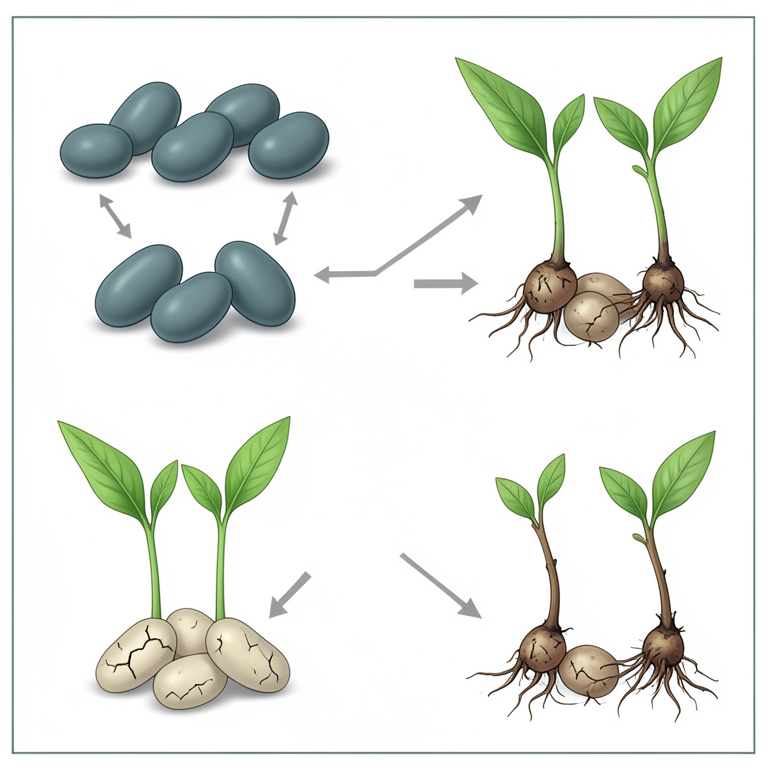
Experimental Matrix
AI-generated conceptual illustration (faba bean seeds and seedlings). It explains the idea and does not show study data.
View source evidence ↗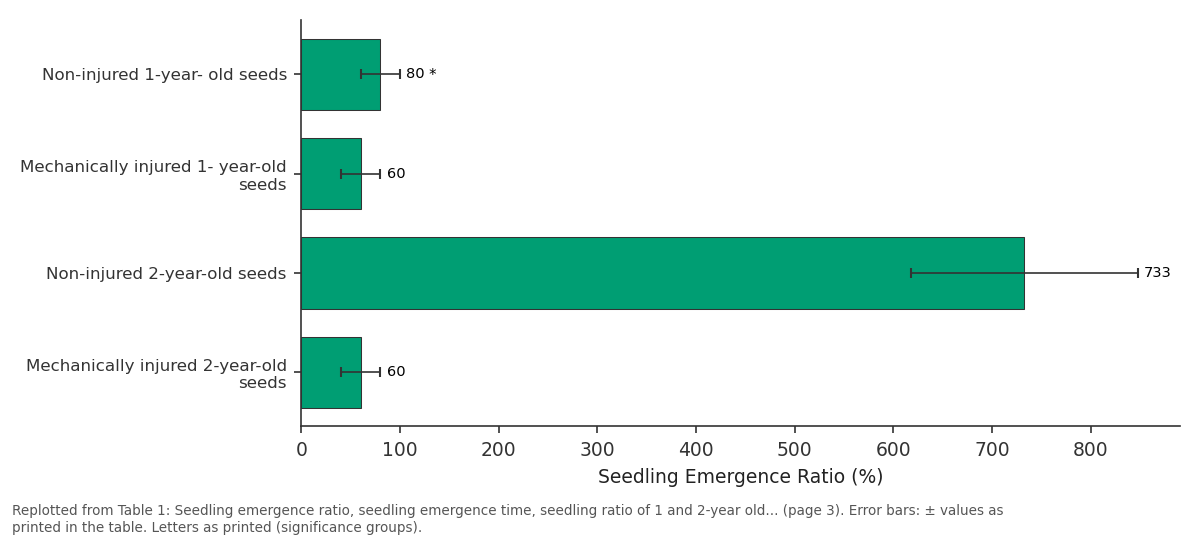
Seedling Emergence Ratio (%): Non-injured 1-year- old... vs Mechanically injured 1-... vs Non-injured 2-year-old... vs Mechanically injured...
Replotted from Table 1 (page 3) of the original paper. Every bar is the paper's own table value.
View source evidence ↗Figures & tables
From the original paper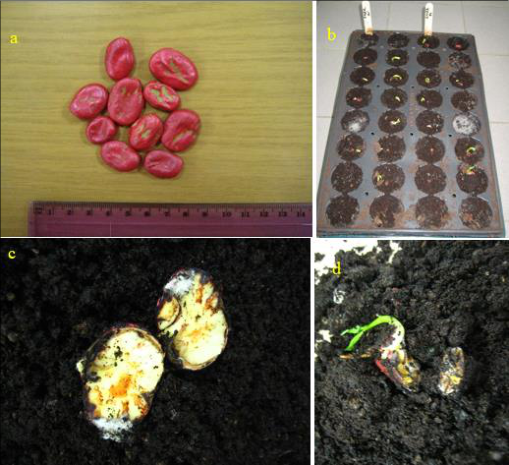 Figure 1
 Table 1
 Table 2
 Table 3
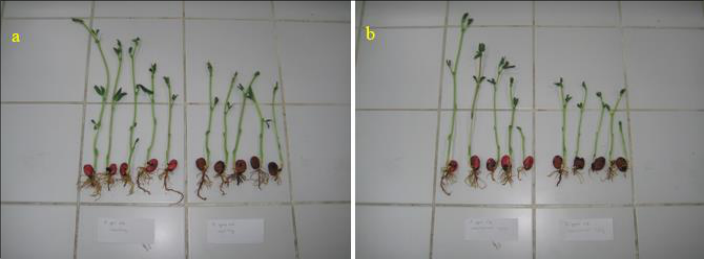 Figure 2
Introduction
Mechanical injury can significantly cause losses in both the quality and quantity of the legume plants. Mechanical injuries can occur at shelling, combining, transporting, and packaging. In seed pathology, microorganisms-related factors are not only mentioned alone as seed internal factors. An external pathogen can turn into an internal pathogen when the seed begins to absorb water (Baker and Smith, 1966) [2] and a mechanical injury may also encourage this situation more than necessary. Injuries also cause an open door to an influx of pathogen pests besides microorganisms. In addition, not only visible damage, but also invisible damage can affect seed physiology, quality, seedling, and full-grown plant growth. Most of the studies on this subject have been on seed damage caused using mechanical tools or combines during harvest (Pacheco et al., 2015; Govindaraj et al., 2017; Gu et al., 2019) [9,6,7] . There are some studies and reviews that indicate the effects of mechanical injury on increasing infection (Bell, 1974; Lamichhane et al., 2020; Rehman et al., 2021) [3,8,10] . Faba bean (Vicia faba L.) is a model plant in this study, and is an important legume crop with high pod and seed yield. This plant can be exposed to many biotic and abiotic stress conditions during cultivation, harvest, and storage steps. One of the abiotic stress conditions is mechanical injury, at any of the steps. While injury is already a problem, it is also an important open door for the entry of soil-borne diseases. Faba bean faces symptomatic Fusarium root rot caused by Fusarium solani (Ali et al., 2019) [1] , and Aphanomyces root rot caused by Aphanomyces euteiches (van Leur et al., 2008) [12] etc. In addition, in some environmental conditions, root rot pathogens were found in complexity (Šišić et al., 2022) [11] .
On the other hand, seed age is a significant factor in both plant growth and pathogenic microorganism load. The factor not only affects seed deterioration, but also causes seedling rotting and abnormal seedling growth (Gebeyaw, 2020) [4] . On the contrary, sometimes infection may not be affected by seed age at all (Warham, 1990) [13] . When all these results are evaluated, both seed age and mechanical damage should be considered together at the level of genera, species and even pathogen interaction with these factors. In this study, the effects of mechanical damage applied to one and two years old stored seeds of the faba bean (Vicia faba L.) on seedling development and degree of visible disease were investigated.
Materials and Methods
Seeds of Vicia faba L. cv. Major bought from a commercial seed market one and two years ago were used in the experiments (Fig. 1.a). The seeds were kept under the same dark and airy conditions in the paper bags under laboratory conditions at 25±2 0 C until the conduction of the experiment. The experiments consisted of four applications; 1) Non-injured 1-year-old seeds, 2) Mechanically injured 1-year-old seeds, 3) Non-injured 2years old seeds, 4) Mechanically injured 2-years-old seeds. Just before the experiment, the weights of 1000 one-year-old and two-years-old seeds were 1335 g and 1273 g respectively. For mechanical damage, the applied force was at a level that would not break the seed but would damage the seed coat and accomplished with a single blow with a stone. After the application, the seeds of faba beans in each group were planted 2 cm deep, one in each eye on trays (Fig. 1.b). The peat was used for the first time, 30 mL of water was given to each sown seed. Again 30 mL watering was done every five days during experiments. During the experiments data for germination time were obtained daily. At the end of the experiments, after the 14 days of seed sowing, seedling emergence ratio (%), seedling emergence time (day), seedling ratio (%), root length (cm), shoot length (cm), and seed-seedling disease ratio (%) were calculated (Fig. 2). Seedling ratio calculated from seed that included at least one 2 cm primer root and 2 cm primer shoot. The seedling disease ratio was calculated from rotted seeds without germination and rotted seedlings without healthy growth, because of fungal and bacterial invasions (Fig. 1.c, Fig. 1.d). The study was conducted in a Completely Randomized Design with a total of four treatments each comprising three replicates. Each replicate consisted of five seeds that were placed in a seedling tray and a total of 60 seedlings from seeds were evaluated. The recorded data were analyzed via using statistical software (SPSS Statistics 16.0). A two-way analysis of variance was used to test differences among treatments. Comparisons were made using Duncan's Multiple Range Test at least p≤0,05 degree.
Results and Discussion
Mechanical damage did not affect the seedling emergence ratio at 1-and 2-year-old seeds (Table 1). However, the mechanical damage application was significantly effective on seedling emergence time, seedling ratio, root length (Table 1, Table 2, Figure 2), and diseased seed-seedling ratio (Table 3). In the seedlings, emergence ratios of non-injured seeds were higher than the same old injured seeds numerically. The 1-year-old seed showed the highest emergence rate (80%), and both of the injured seeds showed the lowest (60%). Data for the emergence time showed that mechanical injury and younger seeds shortened the emergence time. In this manner, 1-year-old injured seeds showed earliness in the emergence time statistically (4.5 days) and the other treatments shared the same statistical group. Root length of the seedlings from 1-year-old non-injured and injured seeds showed the highest results with 6.2 and 6 cm/seedling, respectively. The seedlings from 2-year-old injured seeds gave the lowest results with 4 cm/seedling. According to visual observations the root of 2-year-old seedlings showed browning. The seedling ratio which consisted of at least 2 cm root and 2 cm shoot, was statistically highest in 1-year-old non-injured seeds (80%). However, some of the seedlings showed disease symptoms with root and shoot rot. Because of this situation, it became necessary to compare cases with the seedling ratio and diseased seed-seedling ratio. The data showed that a maximum loss was observed from 1-year-old while 2-year-old in a minimum loss among injured seeds. The results gave us the idea that seed aging may cause the pathogen load to decrease. Among the data from non-injured seeds 1-and 2-years old supported that idea. In one of the studies (Pacheco et al., 2015) [9] , soybean seeds were harvested at two moisture content (16,6% and 13,7%) and combine adjusted three different threshing (highest, lowest, and ideal). Their results showed that the lesser moisture content and the highest threshing caused significantly broken seeds, lesser seed viability, seed vigor, and germination capacity. In another study (Gomes-Junior et al., 2019) [5] maize seeds were used as mechanically damaged and undamaged seeds. In addition, the damages were confirmed with an imaging system. Their results clearly showed that mechanical injury reduced seed mass, seedling length and dry biomass. Another study about the effect of harvesting-threshing methods on rice varieties (Govindaraj et al., 2017) [6] indicates that germination percentage and root length were not affected by varieties and harvesting methods. The study concluded that a manual/combine harvester can be recommended without affecting the germination and seedling vigor.
Conclusion
The study has shown that the seedling ratio in non-injured seeds is higher than in injured seeds at similar ages. In overall evaluation, being young and non-injured contributed to the seedling rate. Similarly, younger seeds showed the highest shoot length numerically and the highest root length statistically. Injured seeds helped shorten the germination time. When the seedlings were evaluated, it can be said that although some seeds could turn into seedlings, it was observed that they lost their health in a short time or were infected by the seed rot pathogens. In this context, the fact that the highest rate belonged to 1-yearold seeds-seedlings suggested that the microorganism load in the seeds may gradually decrease.
References
13 in the original paper- Ali MB, Haridy AG, Mahmoud AF. Evaluation of faba bean genotypes for yield and resistance to Fusarium root rot under greenhouse and field conditions. Int. J Biosci. 2009;14(2):374-385.
- Baker KF, Smith SH. Dynamics of seed transmission of plant pathogens. Annu Rev Phytopathol. 1966;4(1):311334.
- Bell DK. Effects of mechanical injury, fungi, and soil temperature on peanut seed decay in soil. Phytopathology. 1974;64:241-243.
- Gebeyaw M. Review on: Impact of seed-borne pathogens on seed quality. Am J Plant Biol. 2020;5(4):77-83.
- Gomes-Junior FG, Cicero SM, Vaz CMP, Lasso PRO. Xray microtomography in comparison to radiographic analysis of mechanically damaged maize seeds and its effect on seed germination. Acta Sci. Agron. 2019;41:e42608.
- Govindaraj M, Masilamani P, Asokan D, Rajkumar P, Selvaraju P. Effect of different harvesting and threshing methods on seed quality of rice varieties. Int J Curr Microbiol Appl Sci. 2017:6(8);2375-2383.
- Gu RL, Huang R, Jia GY, Yuan ZP, Ren LS, Li L, Wang JH. Effect of mechanical threshing on damage and vigor of maize seed threshed at different moisture contents. J Integr. Agric. 2019;18(7):1571-1578.
- Lamichhane JR, You MP, Laudinot V, Barbetti MJ, Aubertot JN. Revisiting sustainability of fungicide seed treatments for field crops. Plant Dis. 2020;104(3):610-623.
- Pacheco FP, Nóbrega LHP, Lima GPD, Santorum M, Boller W, Formighieri L. Physiological quality of Soybean seeds under mechanical injuries caused by combines. Rev Caatinga. 2015;28(4):190-201.
- Rehman FU, Adnan M, Kalsoom M, Naz N, Husnain MG, Ilahi H, et al. Seed-borne fungal diseases of maize (Zea mays L.): A review. Agrinula: J Agroteknol Perkebunan. 2021;4(1):43-60.
- Šišić A, Baćanović-Šišić J, Schmidt H, Finckh MR. Farming system effects on root rot pathogen complex and yield of faba bean (Vicia faba) in Germany. Front Plant Sci. 2022;13:1009906.
- Van Leur JAG, Southwell RJ, Mackie JM. Aphanomyces root rot on faba bean in northern NSW. Austral as Plant Dis Notes. 2008;3(1):8-9.
- Warham EJ. Effect of Tilletia indica infection on viability, germination and vigour of wheat seed. Plant Dis. 1990;74(2):130-132.