
Research article · 2024 · Full text
International Journal of Agriculture Extension and Social DevelopmentDevelopment of semi-automatic besan sieving machine
Volume 7(4) · Pages 466–468 · DOI: 10.33545/26180723.2024.v7.i4f.587 ↗
Research areasMetallurgy and Material Forming
Abstract
Author-writtenA machine is developed to solve the purpose of sieving without much involvement of labours in the work and to replace slow manual process of sieving. In this particular machinery, the machine is operated by a motor which is not directly connected to any shaft. The vibration is created in the machine by placing an eccentric load in the motor shaft & vibration produced in the body of motor is transferred to the sieving box, which is connected by the springs to the main frame of the machine. This machine is fitted with sieve of size 500 micron. This sieving machine can be used for sifting Bengal gram flour to get clean product of desired quality after removing other larger particles present in it. The capacity of this machine was found to be 44 kg/hr when run on full capacity of 5kg sieving material (besan).
Summary
Source-checkedPlain-language reading of the full paper, prepared with AI and checked against the text. Each point links to the authors' own words.
Why it matters
- Besan, also known as Bengal gram flour, is produced by grinding dried, dehusked Bengal gram. View evidence ↗
- Sifting is necessary after grinding to ensure the flour has a uniform size and is free of impurities. View evidence ↗
- Manual sieving is problematic because it is time-consuming, energy-intensive, and can cause hand pain. View evidence ↗
The question
- The goal of the study was to develop a machine that replaces the slow manual sieving process and reduces the need for labor. View evidence ↗
What they did
- The machine was constructed using stainless steel square tubes and sheets, an AC motor, springs, and a 500-micron sieve. View evidence ↗
- The physical dimensions of the fabricated machine are 46 cm in length, 46 cm in breadth, and 63 cm in height. View evidence ↗
- Vibrations are created using an eccentric load on the motor shaft and transferred to the sieving box via springs. View evidence ↗
- The machine's capacity was tested using three different batches of besan weighing 3 kg, 4 kg, and 5 kg. View evidence ↗
What they found
- The machine's output capacity varied by batch size: 24 kg/hr for 3 kg, 46 kg/hr for 4 kg, and 63 kg/hr for 5 kg of material. View evidence ↗
- The average output capacity of the developed sieving machine was found to be 44 kg/hr. View evidence ↗
- Variations in capacity occurred because the entire mesh screen area is only utilized at the start of the process. View evidence ↗
What it means
- The authors conclude that this machine will benefit small and medium-sized food industries in producing high-quality products. View evidence ↗
- The authors state that the machine will be useful for the development of entrepreneurship. View evidence ↗
Visual summary
1 visualsIllustrations explain the paper; they do not show study data.
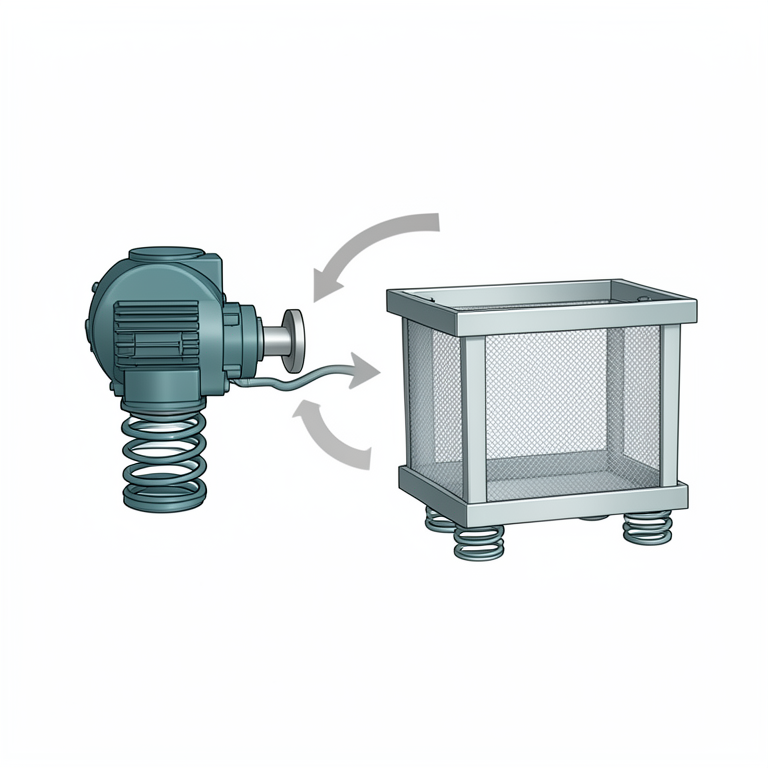
Vibration Mechanism
AI-generated conceptual illustration (semi-automatic besan sieving machine). It explains the idea and does not show study data.
View source evidence ↗Figures & tables
From the original paper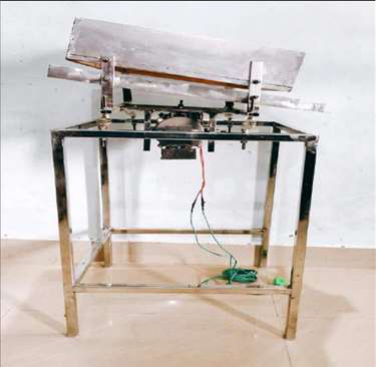 Figure 1
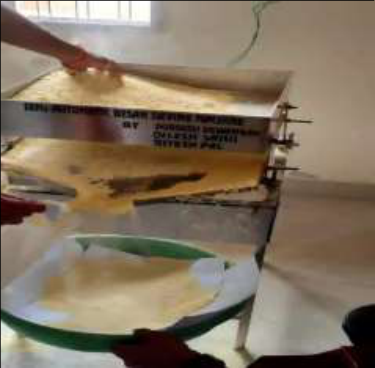 Figure 1
Introduction
Bengal gram flour is a product obtained by grinding, dried dehusked Bengal gram. It is also known as besan in hindi language. This Bengal gram flour is obtained by grinding it in hammer mill or other type of pulverisers. After grinding operation sifting of gram flour is needed to get uniform size flour, free from impurities. Gram flour is rich is protein, fiber and other vitamins and minerals including iron, magnesium and folate. Gram flour is used in making various types of dishes. It is used as a substitute of wheat flour in home and bakery in many dishes. It is also used in cosmetics products. Sieving is one of the most common activities carried out before make any dish in every household and bakery shop in their kitchen. One of the main problem faced by them in sieving is it consumes lot of energy and is time consuming. Because most of the sieving equipments are hand operated, it also causes pain in hand. There is large size sieving machine present in the market which is of high cost. A sieving machine is designed to separate the particle according to their mesh size. A vibrating sieving machine, also known as a vibrating sieve or vibratory separator, is a mechanical device designed to separate particles based on their size or shape. It utilizes a vibrating motor or multiple motors to generate vibrations, causing the material being processed to move across a screening surface. As the material is fed onto the screen surface, the vibrating motion causes it to spread evenly across the screen, allowing efficient separation. The vibrations also help to prevent clogging or blinding of the screen, ensuring continuous operation. Vibrating sieving machines are widely used in various industries such as food processing, pharmaceuticals, chemicals, minerals, and construction materials In our fabricated machinery, the motor, vibration is transferred to the sieving chamber, by which sieving takes place. The vibration is created by putting eccentric load in the motor. The machine is divided in three parts; sieving chamber, collecting & discharging chamber and supporting frame. The vibration produced by the motor is damped by spring to reach structural frame supporting the sieving chamber and collecting pan. In developing the machine attempt has been made to create a portable, low cost, semiautomatic gram flour sieving machine.
Materials and Methods
The fabrication of semiautomatic besan sieving machine required following materials: stainless steel square tube, stainless steel sheets, sieve (500 micron), spring, Motor (AC), nut & bolt etc. Construction of the sieving chamber (meshes or screen deck), collecting chamber (collecting pan), supporting frame (machine body), motor assembly, and eccentric load application were all necessary for the machine's construction. The sieve of 500 micron having length and breadth of 38.2 cm x 39.8 cm respectively is fitted in the sieving chamber made of stainless steel sheets. The collecting and discharging chamber were also made up of stainless steel sheets and the supporting frame and motor assembling unit is made up of stainless steel square tube. The frame was connected by welding and motor is attached by nut and bolt to the frame. The overall length, breadth and height of the machine are 46 cm x 46 cm x 63 cm respectively. www.extensionjournal.com
The fabrication of different component of the machine is shown below: 1. Machine body: The main component of the whole machine, it's the main structure over which the all other parts are being placed or fitted. This carries the whole load (weight) of the machine and keeps it stable during the sieving vibration process. 2. Motor: The vibrating sieving machine is powered by an electric motor of 0.18kW & 1400rpm, which create the vibration required for operation. 3. Mesh or Screen deck: It separates the wanted material from unwanted materials, it facilitate efficient particle separation. In this particular machine 500 micron sieve size is used for besan sieving, which is the standard size for sieving of besan. 4. Collecting pan: This carries the fine separated besan, after besan is sieved and separates it from the materials which fail to pass the sieve (unwanted materials). It is made of stainless steel 5. Motor frame: The frame over which motor is bolted, it holds the motor in position and carries the weight of the motor. It is also the main part of the system which carries vibration from motor to the sieving chamber and collecting chamber. 6. Spring: The springs are fitted to prevent the transfer of vibration of the motor to the machine body. The spring are fitted with bolt and nut on its top and end area on all four corners.
7. Eccentric Weights: Uneven load is attached to the motor shaft, eccentric load creates an unbalanced force when the motor rotates. This imbalance results in vibratory in motor.
The steps followed for assembling different parts of machine is given below and it's shown in figure.1: 1. Stainless steel square tube is welded, to form a square frame type body, which will acts as the main structure of whole machine. 2. A frame for mounting the motor is made. 3. The motor is then mounted on the frame, with the help of nuts and bolts. 4. Holes are made by drilling machine in the body, for attaching spring and to join motor frame & body through nuts & bolts. 5. Flat stainless steel plate was used for making screen deck & collecting pan. 6. Mesh is then placed, in the stainless steel frame box (screen deck). 7. Screen deck & collecting pan is then mounted, with the help of nuts and bolts above the motor frame. 8. A regulator is also fitted to control the speed of motor. 9. A Load is also added to the motor shaft, for uneven weight distribution. 10. A fiber plate is then attached all around the machine body for safety purpose. This machine works on vibrations produced by the motor, causing the material being processed to move across a screening surface and sieve. As the material is fed onto the screen surface, the vibration causes it to spread and pass though the screen, allowing efficient separation. The vibrations also help to prevent clogging of the screen, ensuring continuous operation, and then the sieved particles are then passed on the pan. The sieved material (besan) is then collected from the pan and packaged. The vibration of the machine is controlled with the help of the regulator provided. The process flow chart for operation of the machine for sieving besan is given below:
Process flowchart for operation of machine
Figures and tables from the paper
References
4 in the original paper- Smith J, Johnson A. Enhancing Flour Sifting Efficiency: A Motorized Approach. Food Eng J. 2023;45(2):78-85.
- Sahare S, Shamkuwar D, Kumar N, Kumar M, Khandare H, Bhaisare Y. Design and Fabrication of Wheat Sieving Machine. Int Res J Modern Eng Technol Sci. 2022;4(5):4854-4859.
- Sahay KM, Singh KK. Unit Operations of Agricultural Processing. 2nd Revised Edition. Vikash publishing house PVT.LTD.; 2010. p. 103-110, 219-223, 239-240.
- Lee MD, Lee PS. Design and Development of Size Segregation Sieve Machine with Centrifugal Action. Universal J Mech Eng. 2020;8(4):208-215.