
Research article · 2024 · Full text
International Journal of Agriculture Extension and Social DevelopmentExploring the attitude of farmers towards training program in Dhenkanal Krishi Vigyan Kendra (KVK)
Volume 7(4) · Pages 645–647 · DOI: 10.33545/26180723.2024.v7.i4h.589 ↗
Research areasAgricultural Economics and PracticesLivestock Management and Performance ImprovementAgricultural Systems and Practices
Abstract
Author-writtenThe KVKs are essential in implementing several developmental projects on farmers' farms to raise agricultural output and raise their standard of living. Today's agricultural organisers and institutions must create efficient, practical, and need-based programmes to help farmers gain the necessary knowledge and cultivate a positive attitude towards agricultural methods. The study was conducted in Dhenkanal district of Odisha. The total number of respondents selected randomly were 130. The study revealed that most of the farmers were having medium level of attitude towards KVK training. The study also revealed that educational qualification and source of information are positively and significantly associated with the dependent variable attitude towards training.
Summary
Source-checkedPlain-language reading of the full paper, prepared with AI and checked against the text. Each point links to the authors' own words.
Why it matters
- Krishi Vigyan Kendras (KVKs) are critical for implementing developmental projects that aim to increase agricultural production and improve the living standards of farmers. View evidence ↗
- KVKs operate at the district level to provide farmers with technological and socioeconomic support for their overall development. View evidence ↗
- To boost productivity and profit, KVKs offer various services including agricultural information, modern and location-specific technologies, research facilities, and tailored training. View evidence ↗
The question
- The primary objective of this research was to understand the attitudes of farmers toward the training programs provided by the KVK. View evidence ↗
What they did
- The researchers used a descriptive research design, focusing on three purposively selected blocks in the Dhenkanal district: Odapada, Gondia, and Dhenkanal Sadar. View evidence ↗
- A total of 130 respondents were randomly selected from five randomly chosen villages: Indipur, Arachua, Jhili, Tarava, and Siminai. View evidence ↗
- Data was collected using a structured interview schedule designed based on pilot studies, expert consultation, and existing literature. View evidence ↗
- The study employed several statistical tools for analysis, including mean, standard deviation, frequency, percentage, and correlation coefficients. View evidence ↗
What they found
- The majority of farmers (72.50%) exhibited a medium level of attitude toward KVK training, while 13.83% had a low attitude and 16.15% had a high attitude. View evidence ↗
- The attitude of the respondents was distributed with a mean value of 72.50 and a standard deviation of 9.87. View evidence ↗
- Educational qualification and the source of information were found to be positively and significantly associated with the farmers' attitude toward training. View evidence ↗
- KVK training had a major impact on the adoption of new knowledge and technologies compared to farmers who did not receive training. View evidence ↗
What it means
- The authors conclude that KVK Dhenkanal is essential for disseminating new agricultural technologies, which leads to increased crop yields. View evidence ↗
- The study concludes that the technology transferred through KVK is widely welcomed and perceived as profitable by the farming community. View evidence ↗
Visual summary
1 visualsIllustrations explain the paper; charts are replotted from the paper's own table values.
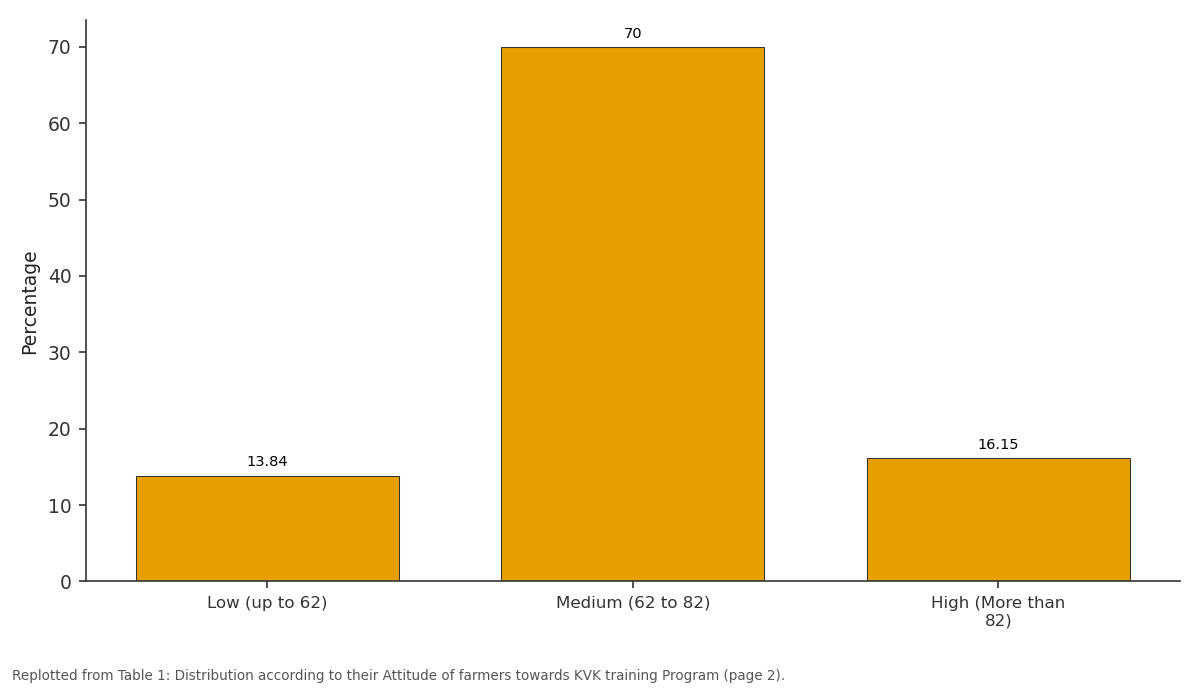
Percentage: Low (up to 62) vs Medium (62 to 82) vs High (More than 82)
Replotted from Table 1 (page 2) of the original paper. Every bar is the paper's own table value.
View source evidence ↗Figures & tables
From the original paper Table 1
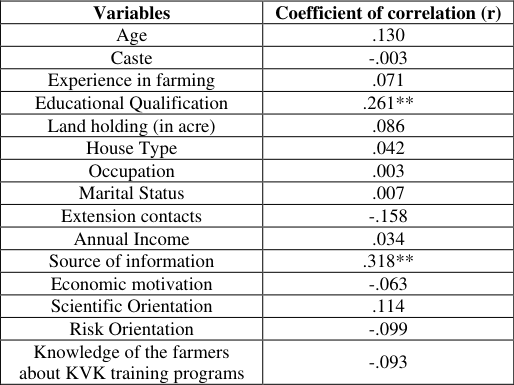 Table 2
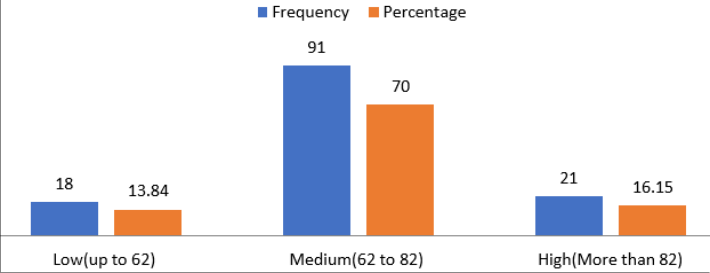 Figure 1
Introduction
The agriculture system in India is very large due to different types agro-climatic zones, soil structure, food habits and types of farmer’s needs. To fulfil the need of farmers, Indian Council of Agriculture (ICAR) established Krishi Vigyan Kendra (KVK) in different districts of our country. KVK is the organisation working at the district level that supports the farmers technologically and socioeconomically for their development. KVK provides all type of agricultural information, modern technologies, location specific technologies, research facility and different types of training according to the farmers need to increase the production, productivity and profit of the farmers.
So, the attitude of farmers towards KVK training program is good. The farmers had most favorable attitude towards training
Methodology
and least favourable attitude towards the physical facilities provided to trainees during training programmes. However, the majority of the respondents had a medium level of favourableness, towards training programmes conducted by Krishi Vigyan Kendra (Sahare et al. 2017) [1]. The KVK training programmes were quite effective in increasing the favourable attitude of the trainees (Ramakrishnan et al. 2020) [2]. The exposure of KVK training programmes significantly changed the attitude of farmers in desired direction, which one could obviously expect(Sharma et al. 2013) [3].
From the nine independent variables, correlation coefficient had shown positive and significant relationship in case of variables namely, occupation, experience in farming, training received at KVK, scientific orientation and innovation while, non- significant relationship in case of age education, size of land holding and animal possession with attitude of the farmers toward training organized by KVK(Katole et al.2017) [4]. As per the agriculture is concerned in Dhenkanal, the District produces a substantial agricultural yield and paddy, ground nut, cashew nut, potato, mango, jackfruit, sugarcane and some vegetables as its primary agricultural products. The study conducted with the objective: To understand the attitude of farmers towards KVK training program.
Materials And Methods
The present study was followed descriptive research design. The study was carried out in 3 blocks selected purposively of Dhenkanal district Odapada, Gondia, Dhenkanal Sadar. The villages were selected randomly that is Indipur, Arachua, Jhili, Tarava, Siminai. The total number of respondets from these villages were 130 selected randomly.
In accordance with the proposed study's objectives, a structured interview schedule will be used as a data collection tool. Based on variables selected, statements were framed under each variable with experience gained during pilot study, consultation with experts and referring literature. The statistical tools used for the study were mean, standard deviation, frequency, percentage, corelation coefficient. 645 https://www.extensionjournal.com
Results And Discussion
Table 1: Distribution according to their Attitude of farmers towards KVK training Program Category Frequency Percentage Statistics Low (up to 62) 18 13.84 Range = 43.00 Mean = 72.50 distribution according to their attitude of farmers towards kvk training program and it is categorised under low (13.83%), medium (72.50%) and high (16.15%). the variable of respondents is distributed with a mean value 72.50 and standard deviation is 9.87. SD = 9.87 Medium (62 to 82) 91 70 High (More than 82) 21 16.15 Respondents had more favourable attitude and exposure to KVK training programmes significantly changed the attitude of farmers in desired direction. It also indicated that KVK training have major impact on farmers to adoption of newer technologies and knowledge than those farmers who have not undergone any training. The table-1 represent the Fig 1: Distribution according to their Attitude of farmers towards KVK training Program Table 2: Correlation Coefficient of Attitude of the farmers towards KVK training Program of respondents with independent variables Variables Coefficient of correlation (r) Age .130 Caste -.003 Experience in farming .071 Educational Qualification .261** Land holding (in acre) .086 House Type .042 Occupation .003 Marital Status .007 Extension contacts -.158 Annual Income .034 Source of information .318** Economic motivation -.063 Scientific Orientation .114 Risk Orientation -.099 Knowledge of the farmers about KVK training programs -.093 of any activity needs risk assimilation and creativity.
| Variables | Coefficient of correlation (r) |
|---|---|
| Age | .130 |
| Caste | -.003 |
| Experience in farming | .071 |
| Educational Qualification | .261** |
| Land holding (in acre) | .086 |
| House Type | .042 |
| Occupation | .003 |
| Marital Status | .007 |
| Extension contacts | -.158 |
| Annual Income | .034 |
| Source of information | .318** |
| Economic motivation | -.063 |
| Scientific Orientation | .114 |
| Risk Orientation | -.099 |
| Knowledge of the farmers about KVK training programs | -.093 |
Table text extracted from the original PDF; superscript letters are shown inline. The original table image is below.
View original table image
Educated farmers having positive attitude towards KVK training as it is helpful for them to increase their production as well as marketing of agricultural produce. Information also plays a vital role in the change of attitude. Source of information creates changes in the farmers towards KVK training.
Conclusion
According to the study, after participating in the training programmes, participants shown a considerable improvement in their knowledge acquisition and gave more accurate answers. These initiatives seek to provide farmers with workable solutions that will increase production on land, in water, and with labour, all the while reducing demand on water resources and promoting ecosystem restoration. All the farmers expressed gratitude for the technical assistance they received during the training sessions, which included field trips and demonstrations. This suggests that KVK, Dhenkanal, is essential to the spread of new agricultural technologies, which in turn raises crop yields.
The farming community finds the transferred technology to be profitable and widely welcomed.
Acknowledgement
Sincerely thanks to the respondents from the Dhenkanal district for their earnest cooperation during the investigation.
References
4 in the original paper- Sahare K, Gupta A, Singh S, Tiwari BK, Dharmendra. Attitude of the trained farmers towards the trainings Conducted by Krishi Vigyan Kendras of shahdol ** Significant at 1% level *Significant at 5% level Table-2 reflects the Pearson’s coefficient of correlation among the dependent variable, attitude of the farmers towards KVK training Program with the fourteen causal variables. The result shows that the educational qualification and source of information are positively and significantly associated with the dependent variable. It means changes in these variables will change the knowledge of the farmers in same direction. Education is the process through which one individual can gather knowledge and change the attitude to adopt something. In other words, education makes an individual perfect through the manifestation of different positive traits prevailed within an individual. The perfection 646 https://www.extensionjournal.com division (M.P.), India. Plant Archives. 2017;17(1):99- 102.
- Ramakrishnan K, Sakunthalai A, Paulpandi VK. Attitude of Trainees towards KVK Training Programmes in Tamil Nadu. Ind J Pure App Biosci. 2020;8(5):150-152.
- Sharma N, Arora RK, Kher S. Attitude of farmers towards KVK training programmes and their impact. Agric Update. 2013;8(1&2):31-34.
- Katole SB, Patel GG, Parmar AB. Determinants of attitude of the farmers towards Krishi Vigyan Kendra’s activities. Guj J Ext Edu. 2017;Special Issue on National Seminar:133-137 647