
Research article · 2024 · Full text
International Journal of Agriculture Extension and Social DevelopmentDevelopment of infrared food dehydrator
Volume 7(4) · Pages 463–465 · DOI: 10.33545/26180723.2024.v7.i4f.586 ↗
Research areasFood Industry and Aquatic BiologyFreezing and Crystallization Processes
Abstract
Author-writtenInfrared drying is the latest technology used for drying of food products. There are also ovens present in the market for cooking using infrared light. An infrared dehydrator is developed for drying of Non Timber Forest Produce and Horticultural Crops. A dehydrator is developed which is rectangular in shape and has a drying area of 6.84 square feet. Two infrared bulbs of 250 Wattage each, is used for production of heat and two fans are also attached for circulation of air in it. Two trays made up of wire mesh screens were used for keeping product in it. In a trial a sample of 200 g Neem leaves having an initial moisture content of 58% were kept in the fabricated dehydrator. Time taken for drying of product from 58% moisture content to 10% moisture content at different temperatures of 45 °C, 50 °C, 60 °C, 65 °C and 70 °C was 2 hr, 1.5 hr, 1 hr, 0.75 hr and 0.5 hr respectively. The fabrication cost of this machine is around Rs. 7,500.00.
Summary
Source-checkedPlain-language reading of the full paper, prepared with AI and checked against the text. Each point links to the authors' own words.
Why it matters
- Traditional sun drying of agricultural produce is problematic because products are exposed to dust and environmental contaminants. View evidence ↗
- Existing mechanical dryers are primarily used in industry because their high initial and operational costs make them inaccessible to smaller users. View evidence ↗
- Neem leaves are typically preserved through drying to maintain their various medicinal properties. View evidence ↗
The question
- The study aimed to develop a food dehydrator that allows for processing products with low initial and operational costs. View evidence ↗
What they did
- The developed rectangular dehydrator has a drying area (reported as both 6.84 and 3.42 sq. ft.) capable of holding up to 3 kg of neem leaves. View evidence ↗
- The device utilizes two 250-watt infrared bulbs for heat production and two fans for air circulation. View evidence ↗
- The system includes internal thermal sensors and a relay module that controls the infrared bulbs to maintain temperatures between 50 and 110 °C. View evidence ↗
- Testing was conducted using a 200 g sample of neem leaves with an initial moisture content of 58%. View evidence ↗
What they found
- Drying time to reach 10% moisture content decreased as temperature increased, ranging from 2 hours at 45 °C to 0.5 hours at 70 °C. View evidence ↗
- Energy efficiency increased with temperature, rising from 3.76% at 45 °C to 30.75% at 70 °C. View evidence ↗
- Energy consumption per kg of neem leaves decreased as temperature increased, from 0.33 kWh at 45 °C to 0.17 kWh at 60 °C. View evidence ↗
- The total cost to fabricate the infrared dehydrator was approximately Rs. 7,500.00. View evidence ↗
What it means
- The authors conclude that the dehydrator is a useful tool for individuals wanting to start small food processing businesses. View evidence ↗
- The authors state that the machine makes dehydration easier while saving both time and electricity. View evidence ↗
Visual summary
3 visualsIllustrations explain the paper; charts are replotted from the paper's own table values.
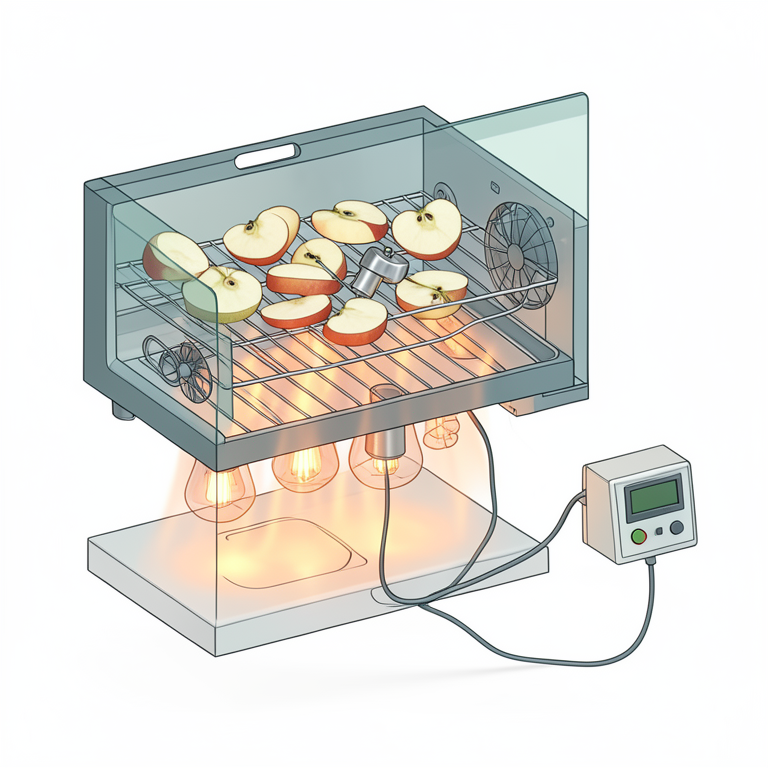
Infrared Dehydrator System Layout
AI-generated conceptual illustration (a rectangular food dehydrator containing sliced apple pieces). It explains the idea and does not show study data.
View source evidence ↗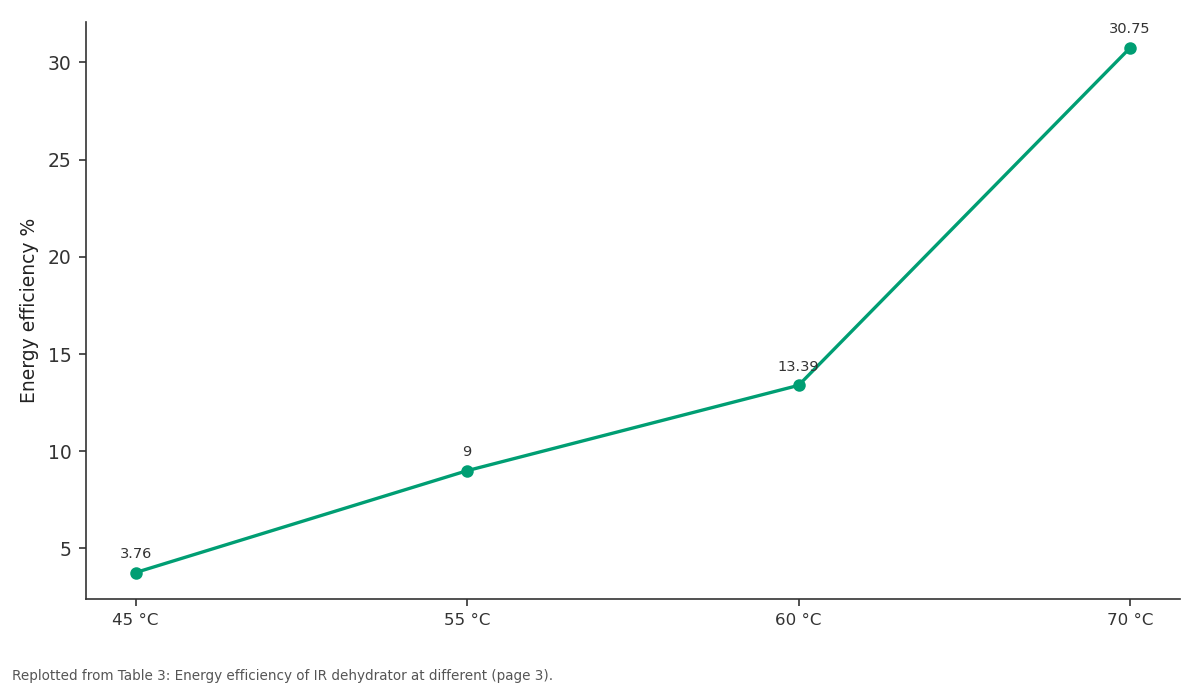
Energy efficiency %: 45 °C vs 55 °C vs 60 °C vs 70 °C
Replotted from Table 3 (page 3) of the original paper. Every bar is the paper's own table value.
View source evidence ↗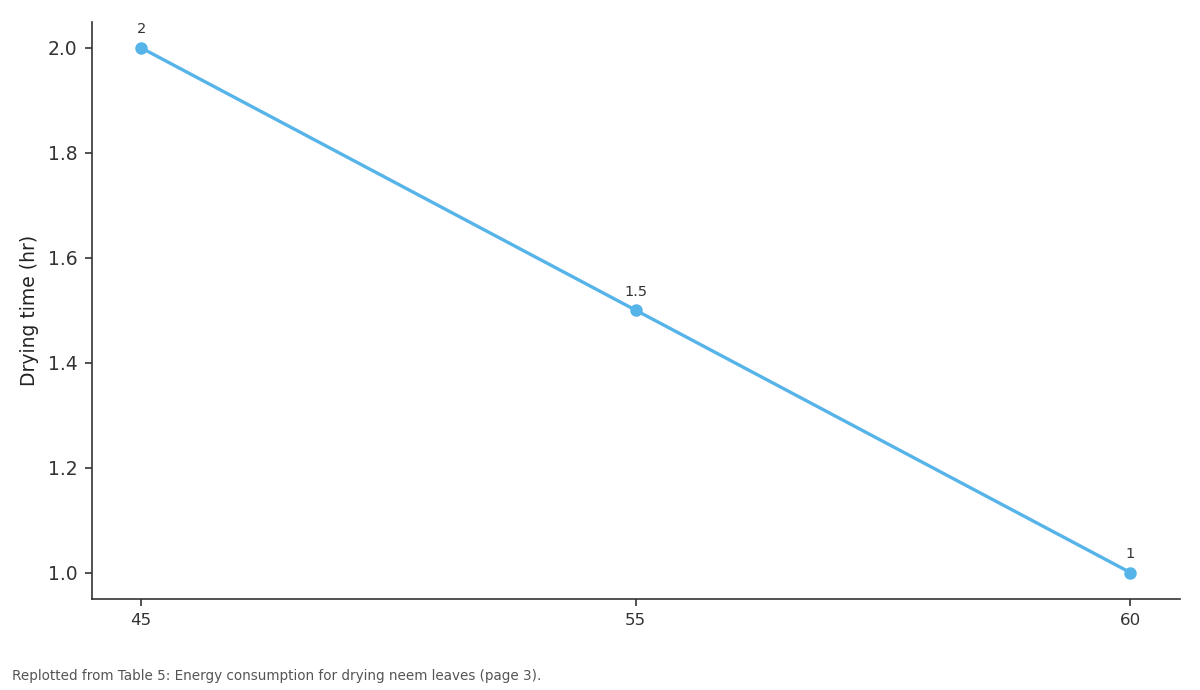
Drying time (hr): 45 vs 55 vs 60
Replotted from Table 5 (page 3) of the original paper. Every bar is the paper's own table value.
View source evidence ↗Figures & tables
From the original paper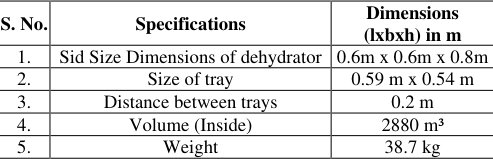 Table 1
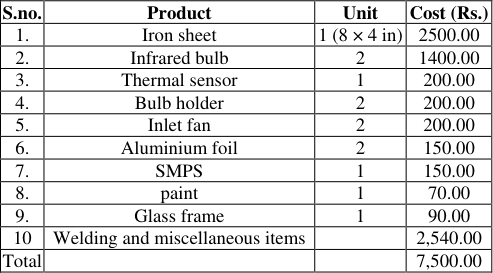 Table 2
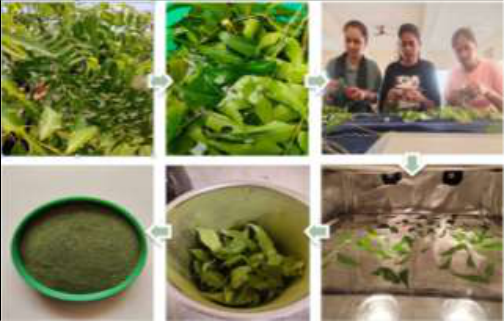 Figure 3
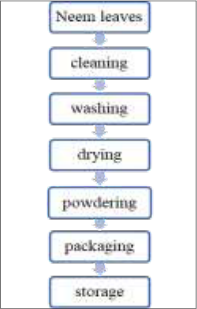 Figure 2
 Figure 1
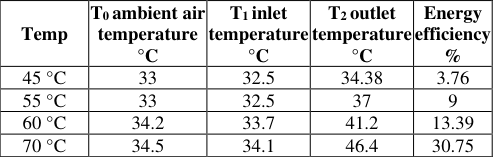 Table 3
 Table 4
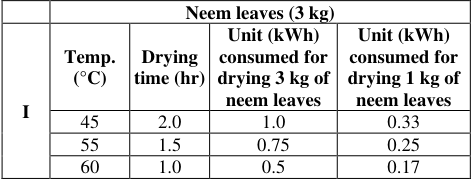 Table 5
Introduction
Drying of herbs, vegetables, fruits, grains etc. are practiced since ancient times. The traditional method employed for drying of this agriculture produce is primarily sun light. In traditional method of sun drying the products get affected by dust and environment of the surrounding. There are many types of fruits, vegetables and leaves of many trees which require drying for use as food product and for extension of their shelf life. In villages farmers dry many types of herbs for food and medicine use. There are many mechanical dryers also available but due to their high initial and operation cost they are still practiced by food processors in the Industry only. The application of this infrared dryer/dehydrator will benefit farmers and small entrepreneurs to get high quality product at less processing time. Neem (Azadirachta indica.) is a tree having various uses for human beings. All parts of the Neem tree like leaves, flower and bark is used for medicinal purpose. Its leaves are also used during storage of food grains to prevent its deterioration by grain weevil. Due to many medicinal properties of neem leaves it is generally preserved by drying. Dried neem leaves are also powdered to make it easier for consumption by mixing it in another product. Neem leaves are useful against eczema, chicken pox, herpes, hepatitis, asthma, ulcers, diabetes, gum diseases, malaria etc. Neem powder also has cosmetic use.
The machine is developed with the objective to process product with low initial and processing cost. This machine is also capable of protecting the product from dust, dirt etc. and also able to work during night hours. The fabricated machine was tested for its efficiency and dehydration test was tested on neem leaves.
Materials and Methods
A dehydrator was fabricated with MS iron sheet having two trays for keeping product. Aluminium foil was used to make a second layer in the dehydrator touching the MS iron sheet of dehydrator. Two infrared bulb of 250 Watt each was fitted at the bottom portion, inside the dehydrator. In front portion of the dehydrator a square transparent glass is fitted. Behind the dehydrator two fans were fitted on upper portion to suck air from outside atmosphere. Thermal sensors were placed inside the dehydrator and its display was fitted outside the dehydrator. It comes with a relay which is connected to the IR bulb. If the required temperature is achieved, this module can control the output using relay. It has a control range of 50 to 110 degree Celsius. SMPS was also used in the machine. It also embeds the matrix LED Display, in which the measured temperature is shown. Drying area of dehydrator is 3.42 sq. ft. which can hold upmost 3 kg of neem leaves properly. The specification of infrared dehydrator is given in table no. 1 and its cost of construction is given in table no. 2. Dehydrated neem leaves were prepared in this IR dehydrator. The steps followed for its preparation is given below and its process flow chart is given in Fig. 2: 1. Collecting neem leaves from neem tree. 2. Washing it with clean water was done to remove the unwanted dust particles from it. 3. Now the products are kept on a cotton cloth, to absorb the water present on the surface of the leaves. It is left under fan for few hours to complete removal of water molecules present on the outer surface of leaves. 4. Grading was done to separate out the damaged leaves. 5. Leaves put it in the dehydrator for drying. The following formulae were used to find out the moisture content of leaves and Energy efficiency of infrared food dehydrator. Total amount of moisture removed from neem leaves was calculated according to the following formula: Initial weight of sample-final weight of sample Moisture content (%) =
Fabrication of machine
Fabrication of machine
Grinding dried neem leaves
x 100 Initial weight of sample If, T₁ and T₂ correspond to the inlet and outlet temperature and T₀ represents the ambient air temperature. Then Thermal performance in terms of energy efficiency is calculated by using the following formula.
(T₁-T₂) Energy efficiency = (T₁-T₀)
Results and Discussions
The neem leaves was dried and its powder is made, which is shown in figure no. 3. The initial moisture content of dried leaves was measured to be 58% by using hot air oven drying method. The thermal performance of the dehydrator is shown in table no.3, which shows that as the temperature increases the infrared dehydrator becomes more efficient. The effect of temperature on time of drying is shown in table no. 4, which shows that as the temperature increases the drying time reduces.
Summary and Conclusion
This machine is going to be so useful in today's times where people have less time to do household work. It's going to make dehydration easier and save a lot of time and electricity consumption. This infrared dehydrator will also be helpful for people seeking to start a new business related to food processing. The maximum and minimum energy consumption for dehydration of 1 kg of neem leaves at 45 °C and 60 °C were 0.33 Unit (kWh) and 0.17 Unit (kWh) respectively. The maximum energy efficiency of Infrared dehydrator was found when it operates at 70 °C.
Figures and tables from the paper
| S. No. | Specifications | Dimensions (lxbxh) in m |
|---|---|---|
| 1. | Sid Size Dimensions of dehydrator | 0.6m x 0.6m x 0.8m |
| 2. | Size of tray | 0.59 m x 0.54 m |
| 3. | Distance between trays | 0.2 m |
| 4. | Volume (Inside) | 2880 m³ |
| 5. | Weight | 38.7 kg |
Table text extracted from the original PDF; superscript letters are shown inline. The original table image is below.
View original table image
| S.no. | Product | Unit | Cost (Rs.) |
|---|---|---|---|
| 1. | Iron sheet | 1 (8 × 4 in) | 2500.00 |
| 2. | Infrared bulb | 2 | 1400.00 |
| 3. | Thermal sensor | 1 | 200.00 |
| 4. | Bulb holder | 2 | 200.00 |
| 5. | Inlet fan | 2 | 200.00 |
| 6. | Aluminium foil | 2 | 150.00 |
| 7. | SMPS | 1 | 150.00 |
| 8. | paint | 1 | 70.00 |
| 9. | Glass frame | 1 | 90.00 |
| 10 | Welding and miscellaneous items | 2,540.00 | |
| Total | 7,500.00 |
Table text extracted from the original PDF; superscript letters are shown inline. The original table image is below.
View original table image
References
3 in the original paper- Madhankumar S, Muthukkhumaran KSR, Navaneeth RA, Padmanabhan M, Shriram KM. Design and modelling of automated hot oven food dehydrator. In: 2021 7th International Conference on Advanced Computing and Communication Systems (ICACCS). IEEE; c2021. p. 1130-1134.
- Kumar MA, Kumaresan G, Rajakarunakaran S. Performance Evaluation of Heat Pump Dryer in Specific Moisture Evaporation Rate for Various Herbal Leaves. Int J Eng Res Technol (IJERT). 2021;10.
- Singh P, Tiwari M. Review on Azadirachta Indica. Int J Pharma Life Sci. 2021;2(1 Part A):28-33.
Cited by 1
From OpenAlex, OpenCitations and reference lists read by Scinovex
- Effect of dehydrator drying temperature on antioxidant activity, pH, and alcohol content of kefir “Lotong” powder ↗
Dewi Ramadani, Fatma Maruddin · IOP Conference Series Earth and Environmental Science · 2026
Abstract Developing functional cosmetics from fermented natural ingredients has become a new trend in the skincare industry. This study investigated the effect of different dehydrator drying temperatures on the antioxidant activity, pH, and alcohol content of a kefir-”lotong” powder mask. The experimental method used a completely randomized design with three temperature treatments: control (no drying), 45 °C, and 50 °C.…
❝ 0PDF