
Research article · 2024 · Full text
International Journal of Research in AgronomyEffect of row orientation and spacing on growth and yield of sweet corn
Volume 7(4) · Pages 747–749 · DOI: 10.33545/2618060x.2024.v7.i4j.634 ↗
Research areasCrop Yield and Soil Fertility
Abstract
Author-writtenA field experiment was conducted during kharif season of 2023 at Crop Research Farm, Department of Agronomy, SHUATS, Prayagraj, Uttar Pradesh to analyse the effect of Row orientation and Plant spacing. In terms of soil reactivity (pH 6.7), the experimental soil had a sandy loam texture, organic carbon (0.59%), Nitrogen (163.48 kg/ha), Phosphorus (32.3 kg/ha) and potassium (243.6 kg/ha). The treatments consisted of 2 directions of Row Orientation (East- West & North- South) and 4 plant spacing (45 x 30 cm2, 55 x 20 cm2, 60 x 25 cm2, 65 x 30 cm2) along with recommended doses of Nitrogen, Phosphorus and Potash and a control (120:60:40 kg N:P:K/ ha). The experiment was laid out in a Randomized Block Design with 9 treatments and replication thrice. Application of East-West direction of sowing along with 60 x 25 cm2 spacing (Treatment 3) recorded highest plant height (166.62 cm), maximum plant dry weight (130.22 g), highest no. of cobs per plant (2.03), highest no. of rows per cob (18.03), highest no. of grains per row (24.67), highest cob length (16.56 cm), cob yield (6.95 t/ha) and green fodder yield (17.33 t/ha).
Summary
Source-checkedPlain-language reading of the full paper, prepared with AI and checked against the text. Each point links to the authors' own words.
Why it matters
- Sweet corn is increasing in popularity across Asia, with a particular rise in India. View evidence ↗
- Planting in an East-West direction may provide a yield advantage in dry seasons by conserving moisture through inter-row cooling and shading. View evidence ↗
- Providing a specific amount of space for each plant is necessary to maximize yield and ensure optimum growth. View evidence ↗
The question
- The study aimed to analyze how row orientation and plant spacing affect the growth and yield of sweet corn. View evidence ↗
What they did
- The experiment took place from July to October 2023 during the kharif season at the SHUATS Crop Research Farm in Prayagraj, Uttar Pradesh. View evidence ↗
- The study tested two row orientations (East-West and North-South) and four spacing options (45x30, 55x20, 60x25, and 65x30 cm²), using a control with 120:60:40 kg N:P:K/ha. View evidence ↗
- A Randomized Block Design was used with nine treatments, each replicated three times. View evidence ↗
- Researchers measured plant height, dry weight, yield attributes, and total yield, analyzing the data using ANOVA. View evidence ↗
What they found
- The highest plant height of 166.62 cm was achieved using East-West sowing with 60 x 25 cm² spacing. View evidence ↗
- The maximum plant dry weight of 130.22 g was recorded for the East-West orientation with 60 x 25 cm² spacing. View evidence ↗
- East-West sowing with 60 x 25 cm² spacing resulted in the longest cobs, measuring 16.56 cm. View evidence ↗
- The highest cob yield of 6.95 t/ha was produced by the East-West orientation combined with 60 x 25 cm² spacing. View evidence ↗
- The maximum green fodder yield of 17.33 t/ha was achieved with East-West sowing and 60 x 25 cm² spacing. View evidence ↗
- The East-West orientation with 60 x 25 cm² spacing also produced the highest number of cobs per plant (2.03) and rows per cob (18.03). View evidence ↗
What it means
- The authors concluded that East-West sowing with 60 x 25 cm² spacing is the most effective combination for improving sweet corn growth and yield. View evidence ↗
Visual summary
3 visualsIllustrations explain the paper; charts are replotted from the paper's own table values.
Experimental Layout Concept
AI-generated conceptual illustration (sweet corn plants in a field). It explains the idea and does not show study data.
View source evidence ↗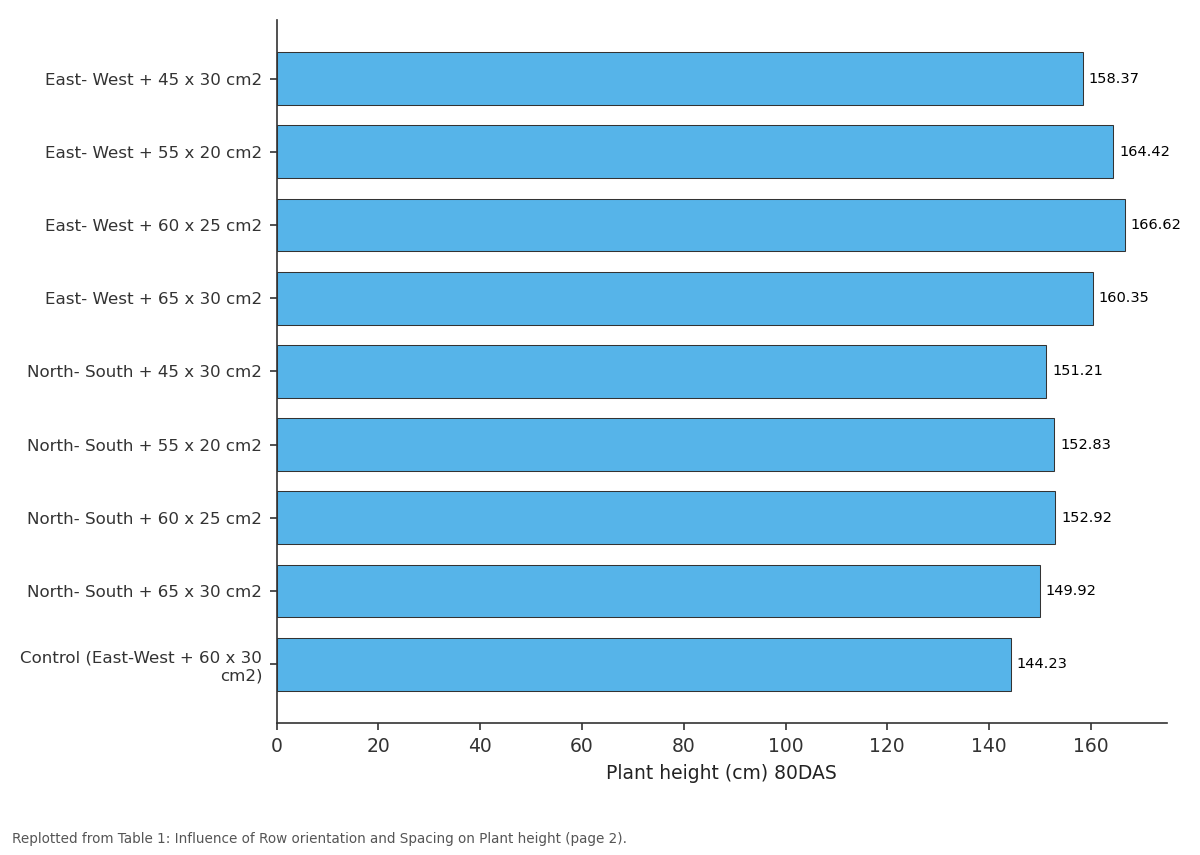
Plant height (cm) 80DAS: East- West + 45 x 30 cm2 vs East- West + 55 x 20 cm2 vs East- West + 60 x 25 cm2 vs East- West + 65 x 30 cm2 vs North- South + 45 x 30...
Replotted from Table 1 (page 2) of the original paper. Every bar is the paper's own table value.
View source evidence ↗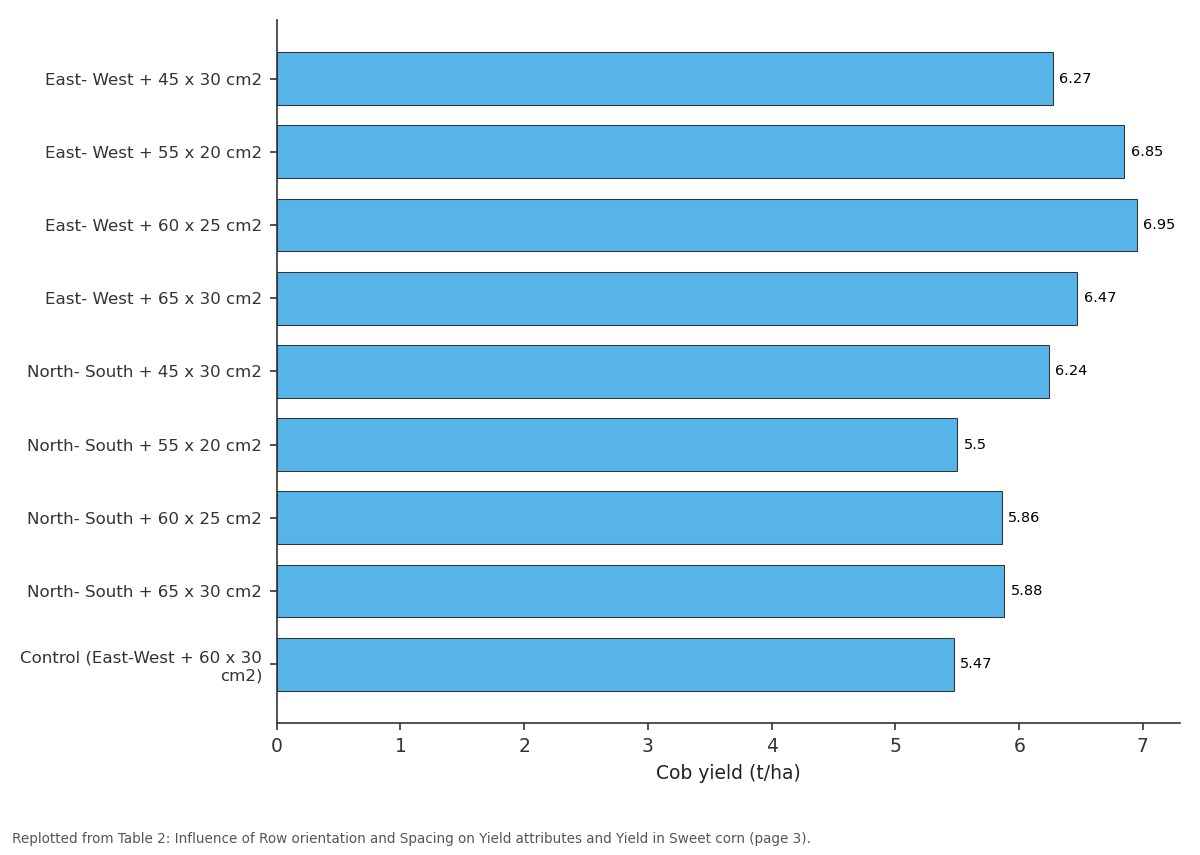
Cob yield (t/ha): East- West + 45 x 30 cm2 vs East- West + 55 x 20 cm2 vs East- West + 60 x 25 cm2 vs East- West + 65 x 30 cm2 vs North- South + 45 x 30...
Replotted from Table 2 (page 3) of the original paper. Every bar is the paper's own table value.
View source evidence ↗Figures & tables
From the original paper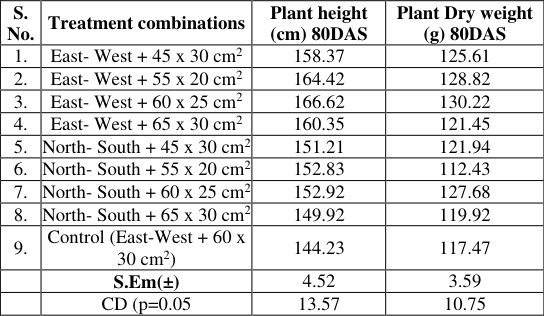 Table 1
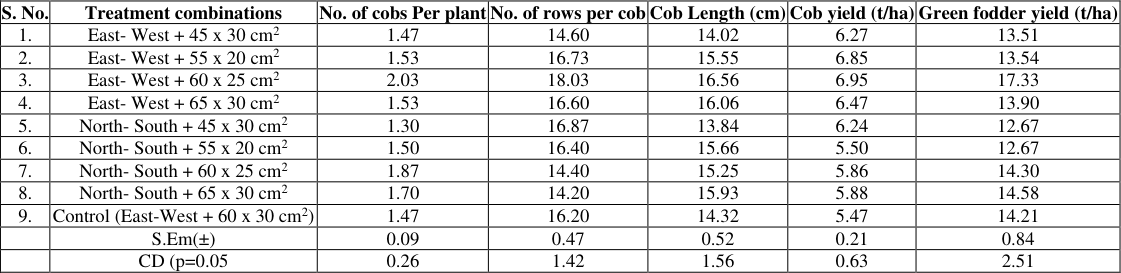 Table 2
Introduction
Sweet corn (Zea mays L.) is becoming more and more popular across Asia, particularly in India. This type of corn is not same as popcorn, field maize or decorative corn because of the kernels have a high sugar content while they are in the milky or early dough stage. The crop is consumed when it is still immature. Inter-row shading or cooling can help conserve moisture when planted in East-West direction of sowing, which can lead to a yield advantage during a dry season. Moreover, East-West sowing may improve the crop's capacity to combat weeds and achieve greater light interception. It is noteworthy, therefore, that our environment has not seen a great deal of research on the direction of sowing in broad acre crops. For optimum crop growth and development, every individual plant need a specific amount of space which also maximises the yield. Corn is primarily farmed for its fresh green cobs, which are consumed by humans. It is also utilised as a raw and processed material in the food industry. It is a significant source of minerals, Vitamin A and C, and dietary fibre. Due to its delicious and nutritious qualities, Sweet corn is a highly prized commodity worldwide, and its production potential is continually expanding (Olabode and Sangodele 2015) [10] . Sweet corn often reaches maturity in 90 -95 days in the spring, which raises the intensity of cropping (Williams 2006) [16] . Due to its low starch content, delicious and high sugar content (14-20%) Sweet corn is attaining popularity in rural and urban area simultaneously. In India, the market value is high and has a wide and great market potential (Sahoo and Mahapatra 2007) [11] . Among the microclimatic condition approaches that can be used to create the ideal microclimate for crop growth and development are adjustments to sowing time, spacing and row orientation, as well as the use of suitable cropping systems (Kingra and Kaur 2017) [7] . In comparison to the crops planted with narrower spacing at 60 cm x 15 cm and 45 cm x 15 cm, Sweet corn cultivated with wider spacing (60 cm x 20 cm) recorded considerably higher plant height (206.33 cm), stem girth(2.11 cm) and cob length (15.25 cm) (Narayanaswamy and Siddaraju 2011a) [9] . Due to intra-row plant competition for more sun radiation, plants with closure spacing of 40 cm x 15 cm grew 25% taller than those with 60 cm x 15 cm (Archana and Lalitha Bai 2016) [1] .
Materials and Methods
The field trial was carried out in the Crop Research Farm, Department of Agronomy, SHUATS, Prayagraj, Uttar Pradesh, from July to October 2023 during the kharif season. Soil has a pH of 6.7, which is mildly alkaline. The soil is sandy loam with a medium phosphorus content, high levels of potassium (K), nitrogen (N), and other elements. The study employed a Randomised Block Design with nine distinct treatment combinations, T 1 : East-West + 45 x 30 cm 2 , T 2 : East-West + 55 x 20 cm 2 ,T 3 : East-West + 60 x 25 cm2, T 4 : East-West + 65 x 30 cm2, T 5 : North-South + 45 x 30 cm 2 ,T 6 : North-South + 55 x 20 cm 2 , T 7 : North-South + 60 x 25 cm 2 ,T 8 : North-South + 65 x 30 cm 2 , T 9 : Control (East -West + 60 x 30 cm 2 ), respectively replicated thrice. The experimental field was brought to a fine tilth by ploughing and removing stubbles. As per the recommendation i.e. (120:60:40 kg/ha) the nutrients were applied as basal at the time of sowing through Urea, SSP and MOP to all treatments. The variety Sweet heart sown according to the treatment of direction of sowing and plant spacing. The growth parameters, plant height (cm), dry weight (g/plant), yield attributes, yield (t/ha) were recorded and data was statistically analysed by using analysis of variance (ANOVA) technique (Gomez and Gomez 1984).
Results and Discussion
Results and Discussion
Growth parameters
The data shown in table 1 illustrates that how different treatments affect the growth characteristics of Sweet corn. There were notable significant differences in plant height and dry weight. Results were noteworthy for treatments that combined with direction of sowing with different plant spacing. From the data observed, the significantly higher plant height was obtained with application of East-West direction of sowing along with plant spacing 60 x 25 cm 2 (166.62 cm). However, treatment (2) was found to be statistically at par with highest data obtained i.e. treatment (3) East-West direction of sowing along with plant spacing 60 x 25 cm 2 . This indicates a beneficial effect of row orientations and spacing on plant height. Plants require light for survival and that competition for light in a shady location affects the growth of the plants. (Imaizumi and Kay 2006) [4] . Comparable outputs were also reported by (Narayanaswamy and Siddaraju 2011b) [9] . Similarly, from the observed data, the significantly highest dry weight was obtained with application of East-West direction of sowing along with plant spacing 60 x 25 cm 2 (130.22 g). However, treatment (2) was noticed to be statistically at par with the highest data obtained i.e. treatment (3) East-West direction of sowing along with plant spacing 60 x 25 cm 2 . The notable variations in crop dry weight that have been linked to the impact of direction of sowing and plant spacing to a larger accumulation of plant biomass.
| S. No. | Treatment combinations | Plant height (cm) 80DAS | Plant Dry weight (g) 80DAS |
|---|---|---|---|
| 1. | East- West + 45 x 30 cm2 | 158.37 | 125.61 |
| 2. | East- West + 55 x 20 cm2 | 164.42 | 128.82 |
| 3. | East- West + 60 x 25 cm2 | 166.62 | 130.22 |
| 4. | East- West + 65 x 30 cm2 | 160.35 | 121.45 |
| 5. | North- South + 45 x 30 cm2 | 151.21 | 121.94 |
| 6. | North- South + 55 x 20 cm2 | 152.83 | 112.43 |
| 7. | North- South + 60 x 25 cm2 | 152.92 | 127.68 |
| 8. | North- South + 65 x 30 cm2 | 149.92 | 119.92 |
| 9. | Control (East-West + 60 x 30 cm2) | 144.23 | 117.47 |
| S.Em(±) | 4.52 | 3.59 | |
| CD (p=0.05 | 13.57 | 10.75 |
Table text extracted from the original PDF; superscript letters are shown inline. The original table image is below.
View original table image
Yield parameters
Table 2 represents data that demonstrates how various treatments impacts the yield attributes of Sweet corn. The no. of cobs per plant, no. of rows per cob, cob length, cob yield, Green fodder yield showed substantial variations. From the observed data, the combination of East-West orientation with 60 x 25 cm 2 plant spacing produced the highest average number of cobs per plant (2.03). However, treatment (7) was recorded statistically at par with the highest data obtained i.e. treatment (3) East-West direction of sowing along with plant spacing 60 x 25 cm 2 . When compared to alternative treatments, this shows a significant boost in yield potential. Similar findings were also made public by (Naik et al. 2019) [8] . From the observed data, the significantly highest number of rows per cob (18.03) was obtained with application of East-West direction of sowing along with plant spacing 60 x 25 cm 2 . However, treatment (2) was found to be statistically at par with the highest data obtained i.e. treatment (3) East-West direction of sowing along with plant spacing 60 x 25 cm 2 . This points to better organisation of the kernel and potential for higher yield per cob. This illustrates how using various sowing orientations and spacing strategies lengthens the cob. The significantly highest cob length (16.56 cm) was obtained with application of East-West direction of sowing along with plant spacing 60 x 25 cm 2 .However, treatment (4) was recorded statistically at par with the highest data obtained i.e. treatment (3) East-West direction of sowing along with plant spacing 60 x 25 cm 2 . Similar results were also reported by (Singh et al. 2015) [12] . The significantly highest cob yield (6.95 t/ha) was obtained with application of East-West along with plant spacing 60 x 25 cm 2 . However, Treatment (2) was recorded statistically at par with the highest data obtained i.e. treatment (3) East-West direction of sowing along with plant spacing 60 x 25 cm 2 . This demonstrates how different directions of sowing and spacing techniques leads to higher outputs. Similar results were also reported by (Gosavi and Bhagat 2009) [3] . Using Row orientations and different spacing also produced a nice side effect of increasing the production of green fodder. From the observed data, the significantly highest green fodder yield (17.33 t/ha) was obtained with application of East-West direction of sowing along with plant spacing 60 x 25 cm 2 . However Treatment (8) was found to be statistically at par with the highest data obtained i.e. treatment (3) East-West direction of sowing along with plant spacing 60 x 25 cm 2 . The Green fodder productivity increases with increased plant spacing, but decreases with reduced water availability. However, because of competition for nutrients and water, further reduction leads to a decrease in yield (Kheibari et al. 2012) [6] . Comparable results were also revealed by (Kar et al. 2006) [5] .
| S. No. | Treatment combinations | No. of cobs Per plant | No. of rows per cob | Cob Length (cm) | Cob yield (t/ha) | Green fodder yield (t/ha) |
|---|---|---|---|---|---|---|
| 1. | East- West + 45 x 30 cm2 | 1.47 | 14.60 | 14.02 | 6.27 | 13.51 |
| 2. | East- West + 55 x 20 cm2 | 1.53 | 16.73 | 15.55 | 6.85 | 13.54 |
| 3. | East- West + 60 x 25 cm2 | 2.03 | 18.03 | 16.56 | 6.95 | 17.33 |
| 4. | East- West + 65 x 30 cm2 | 1.53 | 16.60 | 16.06 | 6.47 | 13.90 |
| 5. | North- South + 45 x 30 cm2 | 1.30 | 16.87 | 13.84 | 6.24 | 12.67 |
| 6. | North- South + 55 x 20 cm2 | 1.50 | 16.40 | 15.66 | 5.50 | 12.67 |
| 7. | North- South + 60 x 25 cm2 | 1.87 | 14.40 | 15.25 | 5.86 | 14.30 |
| 8. | North- South + 65 x 30 cm2 | 1.70 | 14.20 | 15.93 | 5.88 | 14.58 |
| 9. | Control (East-West + 60 x 30 cm2) | 1.47 | 16.20 | 14.32 | 5.47 | 14.21 |
| S.Em(±) | 0.09 | 0.47 | 0.52 | 0.21 | 0.84 | |
| CD (p=0.05 | 0.26 | 1.42 | 1.56 | 0.63 | 2.51 |
Table text extracted from the original PDF; superscript letters are shown inline. The original table image is below.
View original table image
Summary and Conclusion
The Field trail concluded that, Application of East-West direction of sowing along with 60 x 25 cm 2 spacing (Treatment-3) has performed well in terms of growth and yield parameters.
Acknowledgement
AcknowledgementI extend my heartfelt thanks to my advisor Dr. Rajesh Singh, Associate Professor, Department of Agronomy, SHUATS for his continuous support and expert guidance throughout the research process.
References
11 in the original paper- Archana CR, Lalitha Bai EK. Influence of varieties and spacing on yield of dual purpose baby corns (Zea mays L.) in summer rice fallows of Kerala. Journal of Tropical Agriculture. 2016;54(2):190-193.
- Gosavi SP, Bhagat SB. Effect of nitrogen levels and spacing on yield attributes, yield and quality parameters of baby corn. Annals of Agricultural Research. 2009;30(3&4):125128.
- Imaizumi T, Kay SA. Photoperiodic control of flowering: not only by coincidence. Trends in Plant Science. 2006;11:550-558.
- Kar PP, Barik KC, Mahapatra RK, Garnayak LM, Rath BS, Bastia DK, et al. Effect of planting geometry and nitrogen on yield, economics and nitrogen uptake of sweet corn. Indian Journal of Agronomy. 2006;51(1):43-45.
- Kheibari M, Khorasani SK, Taheri G. Effects of plant density and variety on some of morphological traits, yield and yield components of baby corn (Zea mays L.). International Research Journal of Applied and Basic Sciences. 2012;3(10):2009-2014.
- Kingra PK, Kaur H. Microclimatic modifications to manage extreme weather vulnerability and climatic risks in crop production. Journal of Agricultural Physics. 2017;17:1-15.
- Naik AA, Reddy MF, Babu PVR, Kavitha P. Effect of plant density and nitrogen management on growth, yield and economics of sweet corn (Zea mays var. Saccharata). The Pharma Innovation Journal. 2019;8(6):839-842.
- Narayanaswamy S, Siddaraju R. Influence of spacing and mother plant nutrition on seed yield and quality of sweet corn (Zea mays var. Rugosa). Mysore Journal of Agricultural Sciences. 2011;45(2):296-299.
- Olabode OS, Sangodele AO. Effect of weed control methods on the performance of sweet corn (Zea mays var. saccharata) in Ogbomoso, South West Nigeria. Journal of Global Biosciences. 2015;4(1):1145-1150.
- Singh G, Kumar S, Singh R, Singh SS. Growth and yield of Baby Corn (Zea mays L.) as influenced by varieties, spacings and dates of sowing. Indian Journal of Agricultural Research. 2015;49(4):353-357.
- Williams MM, Masiunas JB. Functional relationships between giant ragweed (Ambrosia trifida) interference and sweet corn yield and ear traits. Weed Science. 2006;54(5):948-953.