
Research article · 2024 · Full text
International Journal of Agriculture Extension and Social DevelopmentEmotional and behavioural problems of orphan and non-orphan adolescents
Volume 7(4) · Pages 637–641 · DOI: 10.33545/26180723.2024.v7.i4h.583 ↗
Research areasFamily and Disability Support ResearchChild and Adolescent Psychosocial and Emotional DevelopmentChild Nutrition and Feeding Issues
Abstract
Author-writtenBehavioural and Emotional problems of Orphan and Non-Orphan Adolescents were studied on a sample of 200 adolescents (100 orphans and 100 non-orphans) who were in the age range of 11 to 17 years. Strengths and Difficulties Questionnaire developed by Goodman (1997) was used to study the behavioural and emotional problems perceived by adoelscents and PY1-Parent Report Measure for Youth aged 11y-17y developed by Goodman (1997) was used to study the perception of Parent/caretaker on adolescent’s behavioural and emotional problems. The study was conducted in the Vishakhapatnam district of Andhra Pradesh. Results revealed a significant difference between the number and type of emotional and behavioural problems perceived by orphan and non-orphan adolescents where orphans exhibited high total difficulty score than non-orphans. Perception of caretakers and parents differed significantly with the perceptions of orphans and non-orphans on emotional and behavioural problems. Period of stay in Orphange was strongly correlated with emotional symptoms, conduct problems and peer problems in case of orphans.
Summary
Source-checkedPlain-language reading of the full paper, prepared with AI and checked against the text. Each point links to the authors' own words.
Why it matters
- There is a significant population of orphans in India, with 30 million identified nationwide and over 26,000 in Andhra Pradesh. View evidence ↗
- Orphan children are frequently exposed to neglect, abuse, and a lack of love, which often leads to emotional and behavioral problems. View evidence ↗
- There is a lack of comparative research regarding the emotional and behavioral status of orphans versus non-orphans specifically within Andhra Pradesh. View evidence ↗
The question
- The study aimed to compare the emotional and behavioral problems experienced by orphan and non-orphan adolescents. View evidence ↗
What they did
- The study utilized an exploratory research design and selected participants through a purposive random sampling method. View evidence ↗
- Data were collected using a general information schedule and the Strengths and Difficulties Questionnaire (SDQ), and analyzed using frequencies, percentages, and t-tests. View evidence ↗
What they found
- Orphans exhibited higher levels of emotional and behavioral problems than non-orphans across all measured dimensions except for prosocial behavior. View evidence ↗
- Gender differences showed that males tended to score higher on hyperactivity, conduct, and peer problems, while females scored higher on prosocial behavior and emotional symptoms. View evidence ↗
What it means
- The authors concluded that most orphans experience significantly higher emotional and behavioral problems than their non-orphan peers. View evidence ↗
- The findings emphasize that the environment and available support systems are critical factors in the psychological well-being of adolescents. View evidence ↗
Visual summary
2 visualsIllustrations explain the paper; charts are replotted from the paper's own table values.
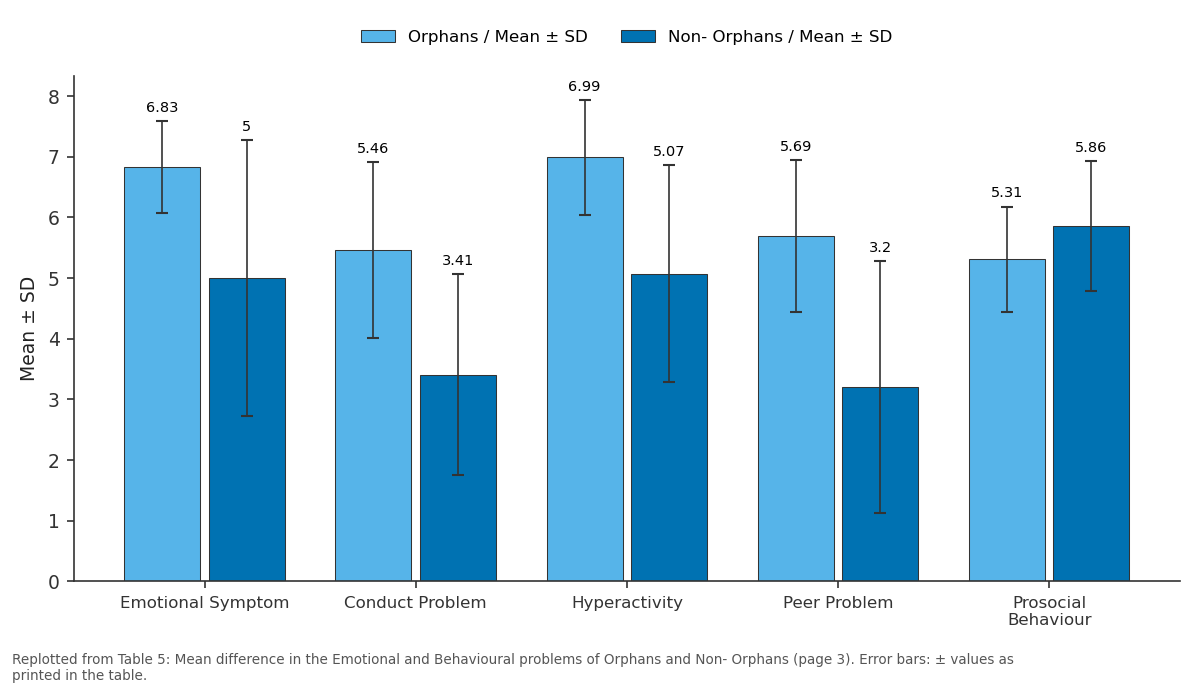
Orphans / Mean ± SD and Non- Orphans / Mean ± SD: Emotional Symptom vs Conduct Problem vs Hyperactivity vs Peer Problem vs Prosocial Behaviour
Replotted from Table 5 (page 3) of the original paper. Every bar is the paper's own table value.
View source evidence ↗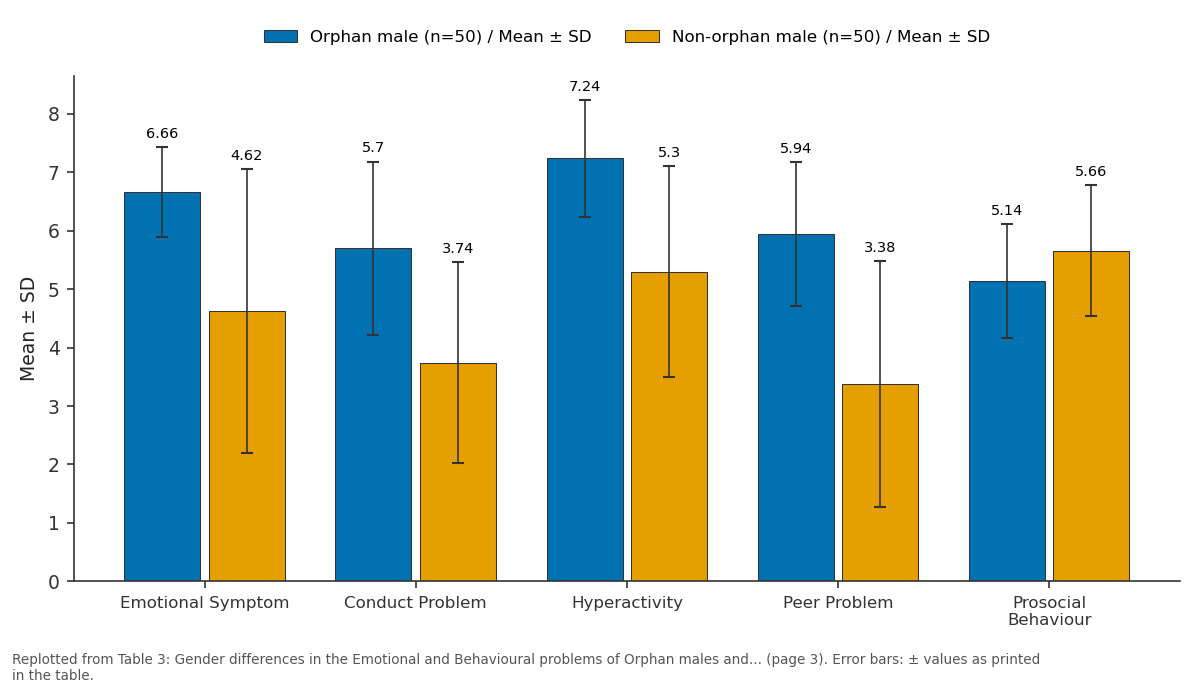
Orphan male (n=50) / Mean ± SD and Non-orphan male (n=50) / Mean ± SD: Emotional Symptom vs Conduct Problem vs Hyperactivity vs Peer Problem vs Prosocial Behaviour
Replotted from Table 3 (page 3) of the original paper. Every bar is the paper's own table value.
View source evidence ↗Figures & tables
From the original paper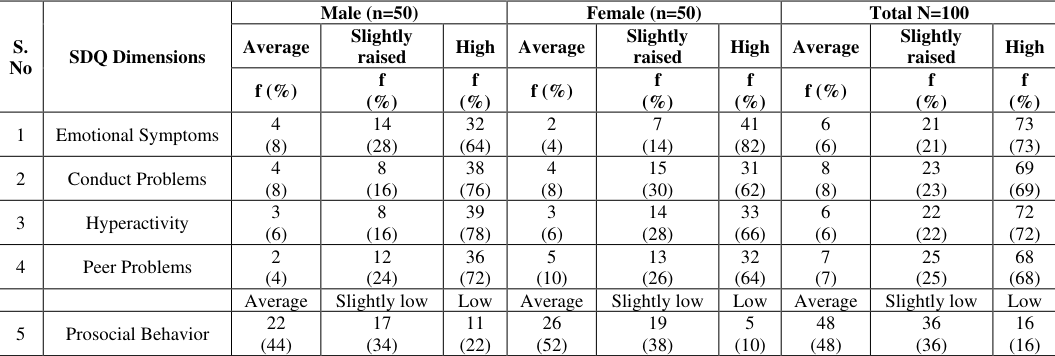 Table 1
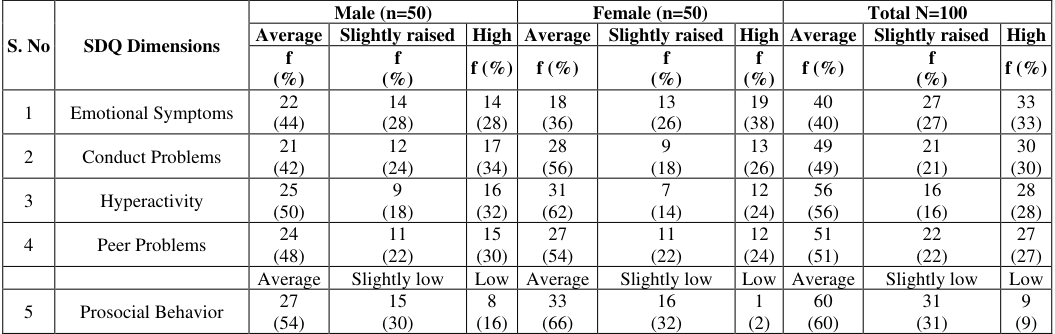 Table 2
 Table 3
 Table 4
 Table 5
Introduction
Adolescence is a multifaceted developmental period encompassing individuals aged 10 to 19 years old. This phase is characterized by substantial physical, cognitive, emotional, and social changes, serving as a pivotal bridge between childhood and adulthood. Physiologically, adolescents undergo rapid growth spurts, hormonal fluctuations and the maturation of their reproductive systems. Cognitively, adolescents experience profound transformations in abstract thinking, problem-solving, and decision-making processes. This cognitive restructuring facilitates the exploration and questioning of their environment, fostering curiosity and laying the groundwork for their future aspirations. Emotionally, adolescents navigate a complex array of sentiments, oscillating between newfound independence and the need for guidance. They grapple with the intricacies of friendships, romantic interests, familial relationships, and the formation of their individual identity. Socially, they navigate an ever-evolving landscape, seeking acceptance and belonging among peers while negotiating societal norms and expectations. The digital era has further reshaped their social interactions, introducing both opportunities for connectivity and the complexities of online presence. Adolescence is not a uniform experience. It is influenced by various factors such as cultural backgrounds, socioeconomic status, family dynamics, and individual personalities. These factors contribute to a diverse mosaic of experiences, shaping each adolescent's journey uniquely. Understanding adolescents necessitates a nuanced exploration of their world with empathy. It involves acknowledging their challenges, celebrating their successes and providing support as they navigate the intricate path toward adulthood. This developmental period, brimming with challenges and discoveries, holds immense promise and potential, reflecting the aspirations and fabric of our future society. Orphan is an individual who is under the age of 18years and lost both the parents due to death (ONE Track International, 2019) [5] . UNICEF has classified orphans into three types. Absence of father is known as Paternal orphan. Absence of mother is known as Maternal orphan. Absence of both the parents is known as double orphan. In India 30 million orphans are identified (Outlook, 2021) [6] . In Andhra Pradesh the orphan population has crossed 26,000 (The Hans India, 2018) [9] . Reasons for increase in orphans are death of parents, divorce, wars and conflicts, Natural disasters, epidemics, poverty and mass migration. The emotional and behavioural problems were observed in majority of orphan children. The orphan children were exposed to abuse, exploitation, neglect and lack of love. A non-orphan is a child who has both parents and living with parents or family. According to Goodman (1997), behavioural problems encompass difficulties related to externalizing behaviours, such as conduct problems, hyperactivity, and peer relationship issues whereas emotional problems refer to internalizing behaviours including symptoms of anxiety, depression, and emotional distress. Adolescence is a time of intense change, and emotional and behavioral issues can often arise during this period. Some common problems adolescents faced were mood swings, anxiety and depression, substance abuse, eating disorders, behavioral www.extensionjournal.com problems and self-harm and risky behavior. The available research on orphans provides evidence that the behaviour and emotional problems in orphans are due to their socioeconomic, cultural and environmental factors. In Andhra Pradesh there is minimal comparative research evidence on emotional and behavioural status of orphans and non-orphans.
Materials and Methods
Comparative study was conducted to examine the emotional and behavioural problems of orphan and non-orphan adolescents. The present study was carried out in Vizianagaram district of Andhra Pradesh with a sample of 200 respondents, 100 were orphans and 100 were nonorphans. The age range of respondents was 11-17 years. Purposive random sampling method was used to select the respondents. Exploratory research design was adopted for the study. General information schedule and Strengths and Difficulties Questionnaire by Goodman (1997) were used. Frequency, percentages and t-test were used for the analysis of the data. The data pertaining to the emotional and behavioural problems of orphans revealed that orphan males scored high levels on conduct problems (76%), hyperactivity (78%) and peer problems (72%) while orphan females scored high levels on emotional symptoms (82%) and prosocial behaviour (52%). Overall majority of adolescents had high levels of emotional and behavioural problems as adolescents were lack of love, care, affection and family support. Akhter et al., (2023) [1] also found that conduct problems were more prevalent among orphans followed by peer and emotional problems. Ginige et al., (2020) [3] results showed that externalizing problems like rule-breaking and aggression were more common than internalizing problems and male adolescents exhibited more behavioral problems. Kaur et al., (2018) [4] also found that orphans had low prosocial behaviour. Non-orphan males scored high levels on conduct problems (34%), hyperactivity (32%) and peer problems (30%) whereas non-orphan females scored high levels on emotional symptoms (38%) and prosocial behaviour (66%). Overall majority of adolescents had low levels of emotional and behaviour problems. Shekhawat and Gopalan (2023) [7] revealed significant differences in emotion regulation and well-being between adolescents living in orphanages and adolescents living with their biological parents. www.extensionjournal.com Orphan males had high means when compared to nonorphan males in all dimensions of emotional and behavioural problems except for prosocial behaviour and highly significant difference was observed. Whereas prosocial behaviour was less significant. The data pertaining to the prosocial behaviour between orphan and non-orphan adolescents was found to be significant. However not much difference in the mean scores was observed. It was perceived that adolescents who were raised in a nuclear families, working families and addiction of adolescents to mobiles were the reasons of low prosocial behaviour. Orphans faced adverse childhood experiences such as neglect, abuse and exposure to violence leads to emotional and behavioural problems. Loss of parents leads to psychological distress, such as depression or anxiety disorders. As non-orphans had role models contributed to healthy behaviours, communication skills and emotional regulation. Stable family environment, parenting pratices and socioemotional support of the adolescents contributed to healthy social interactions and emotional development. Vinnakota and Kaur (2018) [4] also revealed that that depression among institutionalized males were significantly higher compared to adolescents living with their families. 98 *Significant at the 0.01 level High significant difference was observed between the emotional and behavioural problems of orphan females and non-orphan females and for prosocial behaviour less significant was observed. Orphan females had high mean scores in all dimensions when compared to non-orphan females except for prosocial behaviour. Orphans were lack in resources and trained personnel in promoting adequate emotional and psychological support to the adolescents. This scarcity hinder the development of coping mechanisms of the adolescents and increasing emotional and behavioural challenges. For non-orphans, parents provide guidance, comfort and assistance in managing emotions and stress. Consistent care to the Adolescents foster emotional resilience and better coping mechanisms. Sushma et al., (2016) [8] also found similar findings that orphan females reported higher levels of social interaction anxiety than nonorphan females. The comparision between the orphans and non-orphans indicating that orphans had high levels of emotional and behavioural problems compared to non-orphans except for prosocial behaviour. Highly significant difference was observed. Orphans had traumatic experiences due to parental loss or unstable living conditions which leads to emotional distress and behavioral difficulties. In contrast, non-orphan adolescents had more stable family environments and support networks which contributed to lower levels of emotional and behavioral challenges. Furthermore, orphanages were lack in providing personalized attention and emotional support to the www.extensionjournal.com adolescents which leads to increase emotional distress to the orphans. Datta et al., (2018) [2] also found similar findings that conduct problems, peer problems, emotional problems and hyperactivity problems were more prevalent in children out of parental control than in children under parental care.
Results and Discussion
Results and Discussion
Conclusion
The study concluded that majority of orphans exhibited high emotional and behavioural problems compared to nonorphans and significant difference was observed. The gender differences revealed that comparatively males scored high on conduct problems, hyperactivity and peer problems whereas females scored high on emotional symptoms and prosocial behaviour. The significant differences in emotional and behavioral problems between orphans and non-orphans highlight the importance of the environment and support systems in adolescent's psychological wellbeing.
Figures and tables from the paper
| S. No | SDQ Dimensions | Male (n=50) | — | — | Female (n=50) | — | — | Total N=100 | — | — |
|---|---|---|---|---|---|---|---|---|---|---|
| Average | Slightly raised | High | Average | Slightly raised | High | Average | Slightly raised | High | ||
| f (%) | f (%) | f (%) | f (%) | f (%) | f (%) | f (%) | f (%) | f (%) | ||
| 1 | Emotional Symptoms | 4 (8) | 14 (28) | 32 (64) | 2 (4) | 7 (14) | 41 (82) | 6 (6) | 21 (21) | 73 (73) |
| 2 | Conduct Problems | 4 (8) | 8 (16) | 38 (76) | 4 (8) | 15 (30) | 31 (62) | 8 (8) | 23 (23) | 69 (69) |
| 3 | Hyperactivity | 3 (6) | 8 (16) | 39 (78) | 3 (6) | 14 (28) | 33 (66) | 6 (6) | 22 (22) | 72 (72) |
| 4 | Peer Problems | 2 (4) | 12 (24) | 36 (72) | 5 (10) | 13 (26) | 32 (64) | 7 (7) | 25 (25) | 68 (68) |
| Average | Slightly low | Low | Average | Slightly low | Low | Average | Slightly low | Low | ||
| 5 | Prosocial Behavior | 22 (44) | 17 (34) | 11 (22) | 26 (52) | 19 (38) | 5 (10) | 48 (48) | 36 (36) | 16 (16) |
Table text extracted from the original PDF; superscript letters are shown inline. The original table image is below.
View original table image
| S. No | SDQ Dimensions | Male (n=50) | — | — | Female (n=50) | — | — | Total N=100 | — | — |
|---|---|---|---|---|---|---|---|---|---|---|
| Average | Slightly raised | High | Average | Slightly raised | High | Average | Slightly raised | High | ||
| f (%) | f (%) | f (%) | f (%) | f (%) | f (%) | f (%) | f (%) | f (%) | ||
| 1 | Emotional Symptoms | 22 (44) | 14 (28) | 14 (28) | 18 (36) | 13 (26) | 19 (38) | 40 (40) | 27 (27) | 33 (33) |
| 2 | Conduct Problems | 21 (42) | 12 (24) | 17 (34) | 28 (56) | 9 (18) | 13 (26) | 49 (49) | 21 (21) | 30 (30) |
| 3 | Hyperactivity | 25 (50) | 9 (18) | 16 (32) | 31 (62) | 7 (14) | 12 (24) | 56 (56) | 16 (16) | 28 (28) |
| 4 | Peer Problems | 24 (48) | 11 (22) | 15 (30) | 27 (54) | 11 (22) | 12 (24) | 51 (51) | 22 (22) | 27 (27) |
| Average | Slightly low | Low | Average | Slightly low | Low | Average | Slightly low | Low | ||
| 5 | Prosocial Behavior | 27 (54) | 15 (30) | 8 (16) | 33 (66) | 16 (32) | 1 (2) | 60 (60) | 31 (31) | 9 (9) |
Table text extracted from the original PDF; superscript letters are shown inline. The original table image is below.
View original table image
| S. No | SDQ Dimensions | Orphan male (n=50) | Non-orphan male (n=50) | t-stat value | t-critical value |
|---|---|---|---|---|---|
| Mean ± SD | Mean ± SD | ||||
| 1 | Emotional Symptom | 6.66±0.77 | 4.62±2.43 | 5.65** | 1.98 |
| 2 | Conduct Problem | 5.7±1.48 | 3.74±1.72 | 6.08** | 1.98 |
| 3 | Hyperactivity | 7.24±1.00 | 5.3±1.81 | 6.63** | 1.98 |
| 4 | Peer Problem | 5.94±1.23 | 3.38±2.1 | 7.45** | 1.98 |
| 5 | Prosocial Behaviour | 5.14±0.97 | 5.66±1.12 | 2.51** | 1.98 |
Table text extracted from the original PDF; superscript letters are shown inline. The original table image is below.
View original table image
| S. No | SDQ Dimensions | Orphan female (n=50) | Non-orphan female (n=50) | t-stat value | t-critical value |
|---|---|---|---|---|---|
| Mean ± SD | Mean ± SD | ||||
| 1 | Emotional Symptom | 7±0.73 | 5.38±2.07 | 5.21** | 1.98 |
| 2 | Conduct Problem | 5.22±1.38 | 3.08±1.52 | 7.33** | 1.98 |
| 3 | Hyperactivity | 6.77±0.82 | 4.84±1.78 | 6.91** | 1.98 |
| 4 | Peer Problem | 5.44±1.23 | 3.02±2.09 | 7.04** | 1.98 |
| 5 | Prosocial Behaviour | 5.48±0.76 | 6.06±0.99 | 3.26** | 1.98 |
Table text extracted from the original PDF; superscript letters are shown inline. The original table image is below.
View original table image
| S. No | SDQ Dimensions | Orphans | Non- Orphans | t -stat Value | t-critical value |
|---|---|---|---|---|---|
| Mean ± SD | Mean ± SD | ||||
| 1 | Emotional Symptom | 6.83±0.76 | 5±2.28 | 7.59** | 1.972 |
| 2 | Conduct Problem | 5.46±1.45 | 3.41±1.65 | 9.25** | 1.972 |
| 3 | Hyperactivity | 6.99±0.95 | 5.07±1.79 | 9.44** | 1.972 |
| 4 | Peer Problem | 5.69±1.25 | 3.2±2.08 | 10.22** | 1.972 |
| 5 | Prosocial Behaviour | 5.31±0.87 | 5.86±1.07 | 3.97** | 1.972 |
Table text extracted from the original PDF; superscript letters are shown inline. The original table image is below.
View original table image
References
10 in the original paper- Akhter, et al. Cross-sectional study on behavioral and emotional problems of orphans staying in institutional homes of Jaipur city, 2023.
- Ganguly D, Roy. The prevalence of behavioural disorders among children under parental care and out of parental care: A comparative study in India. International Journal of Pediatrics and Adolescent Medicine. 2018;5(4):145-151.
- Baminiwatta G, Jayawardana. Prevalence and predictors of emotional and behavioral problems among institutionalized children in Kandy District, Sri Lanka. Child abuse & neglect. 2020;103:104435.
- Kaur, et al. A descriptive study on behavioral and emotional problems in orphans and other vulnerable children staying in institutional homes. Indian journal of psychological medicine. 2018;40(2):161-168.
- ONE Track International. Who is an Orphan? 26 February 2019. https://onetrackinternational.org/
- Outlook. In Faridabad, A Home For Orphans Left Out of The Adoption System, 2021. www.extensionjournal.com https://www.outlookindia.com.
- Shekhawat, Gopalan. Psychosocial Profile of Adolescents Living in Orphanages and Adolescents Living with Biological Parents. International Neuropsychiatric Disease Journal. 2023;20(3):9-20.
- Sushma, et al. Well Being, Psychosocial Problems and Social Interaction Anxiety in Children. International Journal of Indian Psychology. 2016;3(4):30-43.
- The Hans India. Number of child orphans crosses 26,000 in Andhra Pradesh, 2018. https://www.thehansindia.com.
- Vinnakota, Kaur. A study of depression, externalizing, and internalizing behaviors among adolescents living in institutional homes. International Journal of Applied and Basic Medical Research. 2018;8(2):89.
Cited by 2
From OpenAlex, OpenCitations and reference lists read by Scinovex
- Emotional and Behavioural Problems in Adolescent Orphans: A Study on Sociodemographic Factors ↗
Darsana, Vinod Kumar S · Institutionalised Children Explorations and Beyond · 2026
Background Despite being raised in well-run institutions, orphans often face neglect and are at heightened risk for various psychological challenges. Objective This study investigates whether there are differences in emotional and behavioural problems based on the sociodemographic characteristics of adolescent orphans. Methods An exploratory study was conducted with 400 adolescent orphans in Kerala. Emotional and behavioural problems were assessed using…
❝ 0 - Efficacy of Acceptance and Commitment Therapy on Emotional and Behavioral Problems Among Adolescent Orphans ↗
Darsana, Vinod Kumar S · Residential Treatment for Children & Youth · 2025
Orphans are more likely to develop emotional and behavioral problems due to higher risks of abuse, exploitation, and a lack of love, food, education, and care. This study aims to examine the effectiveness of Acceptance and Commitment Therapy (ACT) on the emotional and behavioral issues faced by orphans. The current study employs a randomized two-group design. The participants were adolescent…
❝ 0