
Research article · 2024 · Full text
International Journal of Agriculture Extension and Social DevelopmentMultiple media outlets' impact on farmers' knowledge enhancement about pest of sugarcane and their socio-b profile
Volume 7(4) · Pages 616–622 · DOI: 10.33545/26180723.2024.v7.i4h.580 ↗
Research areasPlant Virus Research StudiesAgricultural Innovations and PracticesSugarcane Cultivation and Processing
Abstract
Author-writtenIndia's agriculture sector, which accounts for 20% of the country's GDP (Gross Domestic Product), is crucial for socioeconomic growth. A study in five villages in SAS Nagar, Mohali, focuses on the socioeconomic dynamics of farming communities and the role of multimedia technologies in promoting sustainable practices and agricultural knowledge. The study emphasizes the importance of staple crops like sugarcane in fostering economic prosperity and food security, and the need for evidence-based solutions to pest infestation. A video-questionnaire survey was used to increase farmer awareness of sugarcane cultivation. Common pests, such as termites, gurdaspur borer, black bug, Pyrilla, early shoot borer, and Pyrilla, significantly affect sugarcane yield and quality. Effective pest management strategies, including chemical, biological, and cultural approaches, are necessary to reduce risks and ensure sustained sugarcane production. The main goal is to educate farmers about and control these pests.
Summary
Source-checkedPlain-language reading of the full paper, prepared with AI and checked against the text. Each point links to the authors' own words.
Why it matters
- Agriculture is vital to India's socioeconomic growth, supporting approximately 70% of rural households and contributing about 20% of the national GDP. View evidence ↗
- Sugarcane production is threatened by pests such as termites, borers, and bugs, which reduce crop yield and cause financial losses for farmers. View evidence ↗
- Visual aids and videos are considered effective tools for agricultural extension because they can bypass literacy and language barriers. View evidence ↗
The question
- The primary goal of the study was to increase farmers' awareness regarding various sugarcane pests and the methods to manage them. View evidence ↗
What they did
- The researchers randomly selected 60 farmers from five villages (Sahauran, Hasanpur, Radiala, Ghataur, and Allahpur) in the Kharar block of the SAS district. View evidence ↗
- A quantitative research design was used, employing a questionnaire to measure farmer knowledge both before and after they watched an informational video. View evidence ↗
What they found
- The majority of the surveyed farmers (33%) were aged between 31 and 50 years. View evidence ↗
- Regarding education, 40% of farmers completed higher secondary education, 36.66% completed SSLC, and 23.33% were graduates. View evidence ↗
- Land ownership among the participants was split, with 60% owning more than 2 hectares and 40% owning between 1 and 2 hectares. View evidence ↗
- Technology access was high, with 100% of farmers owning a mobile phone and 83.33% having internet access. View evidence ↗
- Approximately 67% of the farmers surveyed owned livestock, while 33% did not. View evidence ↗
- The mean knowledge score of farmers increased significantly from 12% before watching the video to 60% after watching it. View evidence ↗
- Specific knowledge gains were high; for example, correct identification of termite control (rotten farm yard) and gurdaspur borer control rose from 5% to 71.6%. View evidence ↗
What it means
- The authors conclude that using video-based surveys is a successful method for disseminating critical agricultural knowledge to farmers. View evidence ↗
Visual summary
1 visualsIllustrations explain the paper; they do not show study data.
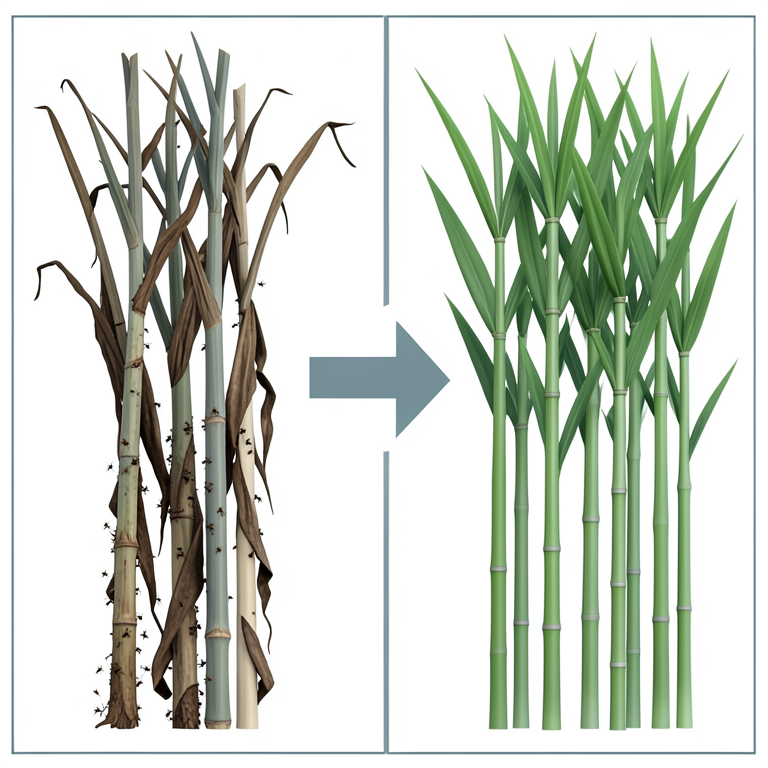
Knowledge Gain Comparison
AI-generated conceptual illustration (sugarcane plants and farmers' agricultural tools). It explains the idea and does not show study data.
View source evidence ↗Figures & tables
From the original paper Table 1
 Table 2
 Table 3
 Table 4
 Table 5
 Table 6
 Table 7
 Table 8
 Table 9
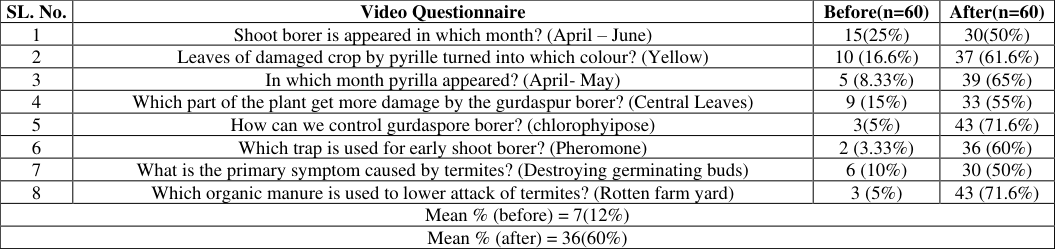 Table 10
Introduction
In India, around 58 percent of the population and about 70 percent of rural households solely depend on agriculture. The agriculture industry plays a significant role in the country's economy, accounting for about 20 percent of GDP (Gross Domestic Product). Agriculture plays a vital role in socioeconomic development. Historically, agriculture was only done for domestic use. However, as time went on, advances in agronomic techniques and new technologies were made to increase crop productivity, and people began to make a living from it as well. Nevertheless, a number of socioeconomic challenges and environmental risks also emerged. Agriculture technology plays a critical role in the sustainability of food systems. The Green Revolution is an example of how scale-independent technology has transformed agricultural productivity India is the world's leader in net cultivated land, although the proportion of the economy devoted to agriculture is steadily declining as the global economy expands as a whole (Kaur et al, 2023) [3] . Farmers must be educated in order to use modern agricultural technologies to tackle local problems. The effective execution of developmental programs is hampered by the requirement for detailed information on the socioeconomic situation of the target group. Increasing agricultural productivity-mostly through improved technique-is the main objective of rural development, which aims to boost living standards. Socio-economic surveys, which provide data on housing patterns, agricultural practices, monthly earnings and expenses, and population trends, are essential for creating and improving policies that address the specific needs of community members. (Singh et al., 2023) [3] . Modern technology is being used for rural development by state agricultural universities, non-governmental organisations, the government, and private businesses. As the extension of self-sustainable development into rural regions, as well as giving people autonomy over decisions, are all made possible by the integration of new communication Technologies. In order to guarantee an accountable, responsive, and citizen-friendly environment for rural residents, scientific and technological developments in the fields of agriculture, education, health care, women's welfare, and grassroots development can be implemented. Given that 70% of human communication is non-verbal, visual aids such as presentations can help people overcome language and literacy obstacles (Adams 1992). Videos that showcase innovative farming methods seem like a suitable means of providing information. Given the notable advancements over the past 10 years, there is a continuing need to increase the video films' content. Video films' usefulness in real life will be considerably improved when the movies are shown in accordance with the audience's responses and degree of satisfaction. Informational videos about agriculture can be extremely helpful in spreading the word in order to achieve the goal. It describes the respondents' increased knowledge both before and after watching a film on sugarcane pest attack and their management. The production and quality of sugarcane are significantly impacted by pests. Termites, early shoot borer, black bug, Pyrilla, stem borer and gurdaspur borer are common pests. These pests attack different sections of the sugarcane plant, www.extensionjournal.com which lowers yield and costs farmers money. It takes effective pest management techniques, such as chemical, biological, and cultural methods, to reduce these hazards and guarantee sugarcane production that is sustainable. Here our main objective is to make farmers aware about different pests of sugarcane and their management.
Materials and Methods
The study was carried out in the SAS district of Kharar block. Five villages-Sahauran, Hasanpur, Radiala, Ghataur and Allahpur-were chosen at random. A total of 60 farmers were chosen for the interview on a random basis. The purpose of this study was to evaluate the socioeconomic standing of farmers in the Punjabi villages of Sahauran, Hasanpur, Radiala, Ghataur and Allahpur in SAS Nagar. Using a primary data source, a questionnaire-based methodology was used. The study adopted a quantitative research design to collect data. The primary data collecting method was a census that was done in these villages, involving 60 households that included self-employed company owners, government employees, and farmers. Direct observation, focus groups, and community groups were added to the systematic surveys and in-person door-todoor interviews. Senior and neighboring villagers were personally interviewed to get qualitative data (Pandey and Upadhayay, 2012) [4] . For better understanding, percentages are given in the data below where we applied the following formula:
Where, N: Total no. of respondents from all the 5 villages i.e., 60 respondents. N: The no. of respondents from each village.
Results and Discussion
Results and Discussion
Image 1: Age
The primary factors influencing each and every career are age and qualifications. As seen in Table 1 and Figure 1, the majority of farmers (58, 33%) fall into the 31-50 age group. Then, 15% of farmers fall into the 18-30age group, and 6.66% into the 51 and above age group. 2 illustrates that 36.66% had completed SSLC, 40% had completed higher secondary education, 23.33% had finished their graduation. Among the farmers, there weren't many illiterates. They clarified that this was because, although they had not placed as much value on education in the past, they had come to do so over time and had pushed their children to pursue higher education by enrolling them in universities and other educational institutions mentioned in TABLE-2 below and shown in IMAGE-2. According to the methodology used for the poll, the majority of participants-99% from each of the chosen villages-belong to the General category. While these villages do have additional categories, the majority of them do not belong to the landowner or farmer groups. Some other occupation occupied their time. This group includes the majority of farmers. Not a single farmer owns a kaccha or even a Semi-Kaccha house; they are all pucca homes. A mere 36.66% of farmers reside in joint families, whereas the majority, 63.33 percent, are part of nuclear households. Each respondent has a unique set of extension connections and information sources. Contact with progressive farmers, who primarily serve as excellent sources of information for farmers regarding new crops and agrochemicals, is reported by 45% of all respondents. In addition, 35% of farmers get information from newspapers, and 58,33% of respondents visit Kissan Melas, which are held in the farmers' surrounding areas (Mohali, Kharar, Ludhiana). These visits help farmers improve their skills. 26.66% of young farmers have downloaded agriculture apps on their phones to create information. What is the primary symptom caused by termites? (Destroying germinating buds) 6 (10%) 30 (50%) 8
| S. No | Parameters | Sahauran n=10 | Hasanpur n=12 | Radiala n=14 | Ghataur n=13 | Allahpur n=11 | Overall% n=60 |
|---|---|---|---|---|---|---|---|
| 1. | 10th | 3 | 5 | 3 | 4 | 7 | 36.66 |
| 2. | 12th | 6 | 5 | 7 | 4 | 2 | 40 |
| 3. | Graduated | 1 | 2 | 4 | 5 | 2 | 23.33 |
Table text extracted from the original PDF; superscript letters are shown inline. The original table image is below.
View original table image
Land Holdings
Which organic manure is used to lower attack of termites? (Rotten farm yard) 3 (5%) 43 (71.6%) Mean % (before) = 7(12%) Mean % (after) = 36(60%)
Conclusion
In conclusion, agriculture is the main source of food, as demonstrated by Punjab's status as the "Granary of India."This research explores the socio-economic dynamics of farming communities in five villages-Sahauran, Hasanpur, Radiala, Ghataur, and Allahpur-in SAS Nagar, Mohali area, acknowledging the critical role that multimedia technologies play in promoting sustainable practices and spreading agricultural knowledge. Furthermore, it is impossible to overestimate the importance of staple crops like sugarcane in promoting both economic success and food security, underscoring the necessity of evidence-based approaches to problems like pest infestation. Raising farmer awareness of sugarcane growing through the use of a video questionnaire survey has shown to be a successful method of spreading important knowledge and information. Through the use of contemporary multimedia technologies, we have
Figures and tables from the paper
| S. No | Parameters | Sahauran n=10 | Hasanpur n=12 | Radiala n=14 | Ghataur n=13 | Allahpur n=11 | Overall% n=60 |
|---|---|---|---|---|---|---|---|
| 1. | 1-2 HECTARE | 4 | 2 | 7 | 7 | 4 | 40 |
| 2. | ABOVE 2(Ha) | 6 | 10 | 7 | 6 | 7 | 60 |
Table text extracted from the original PDF; superscript letters are shown inline. The original table image is below.
View original table image
| SL. No. | Video Questionnaire | Before(n=60) | After(n=60) |
|---|---|---|---|
| 1 | Shoot borer is appeared in which month? (April – June) | 15(25%) | 30(50%) |
| 2 | Leaves of damaged crop by pyrille turned into which colour? (Yellow) | 10 (16.6%) | 37 (61.6%) |
| 3 | In which month pyrilla appeared? (April- May) | 5 (8.33%) | 39 (65%) |
| 4 | Which part of the plant get more damage by the gurdaspur borer? (Central Leaves) | 9 (15%) | 33 (55%) |
| 5 | How can we control gurdaspore borer? (chlorophyipose) | 3(5%) | 43 (71.6%) |
| 6 | Which trap is used for early shoot borer? (Pheromone) | 2 (3.33%) | 36 (60%) |
| 7 | What is the primary symptom caused by termites? (Destroying germinating buds) | 6 (10%) | 30 (50%) |
| 8 | Which organic manure is used to lower attack of termites? (Rotten farm yard) | 3 (5%) | 43 (71.6%) |
| Mean % (before) = 7(12%) | |||
| Mean % (after) = 36(60%) |
Table text extracted from the original PDF; superscript letters are shown inline. The original table image is below.
View original table image
References
4 in the original paper- Acharya Balkrishna et al. Current status of Indian agriculture: problems and challenges. Biological Forum An International Journal (PDF) Current Status of Indian Agriculture: Problems, Challenges and Solution; 2021.
- Ahmad L, Kanth R, H, Parvaze S, Mahdi SS. Agroclimatic and agro-ecological zones of India. In Experimental agro meteorology: A practical manual. Springer, Cham Department of Agriculture, Cooperation & Farmers' Welfare (DAC&FW). Annual Report (2020-21). 2017;99-118.
- Kaur H, Mohan I, Singh G. The social profile of farmers in the village of S.A.S. Nagar district of Punjab. Journal of agriculture and ecology. 2023.
- Pandey DK, Upadhayay AD. Socio-economic profile of fish farmers of an adopted model aquaculture village: Kulubari, West Tripura. Indian Research Journal of Extension Education, 2012.2(1): 55-58.