
Research article · 2024 · Full text
International Journal of Veterinary Sciences and Animal HusbandryTherapeutic management of pre and post-partum vagino-cervical prolapse in bovine by homoeopathic formulation “Prolapse Cure”
Volume 9(2S) · Pages 402–405 · DOI: 10.22271/veterinary.2024.v9.i2sf.1349 ↗
Research areasPelvic floor disorders treatments
Abstract
Author-writtenVagino cervical prolapse is a significant reproductive disorder in cattle and buffaloes, requiring emergency management to prevent complications such as edema, mucosal trauma, contamination, tear and fetal hemorrhage. In this study, a homeopathic formulation called “Prolapse Cure” was successfully used to treat 115 animals with pre- and post-partum vaginal prolapse. The animals were divided into three groups, with group A receiving Prolapse cure and antimicrobial therapy pre-partum, group B receiving the same treatment post-partum and group C receiving only Prolapse Cure for previous prolapse history. In group A, 17 cattle and 24 buffalo showed no recurrence of prolapse after treatment, while some animals displayed mild prolapse towards the end of pregnancy. Group B animals showed complete recovery within 2 days of treatment, with all animals returning to heat within 2-3 months post- calving. In Group C, only 3 buffalo showed mild prolapse during the final days of gestation. Overall, the results indicate excellent recovery in managing vagino cervical prolapse in bovine animals using the homeopathic formulation “Prolapse Cure”. This study highlights the effectiveness of this treatment approach in treating and preventing reproductive disorders in cattle and buffalo.
Summary
Source-checkedPlain-language reading of the full paper, prepared with AI and checked against the text. Each point links to the authors' own words.
Why it matters
- Vagino-cervical prolapse is a serious reproductive issue in cattle and buffaloes that requires urgent care to avoid complications like fetal hemorrhage, mucosal trauma, and edema. View evidence ↗
- The condition is often driven by hormonal changes in the last trimester of pregnancy, where increased estrogen and relaxin cause pelvic ligaments to relax, combined with high intra-abdominal pressure. View evidence ↗
The question
- The study aimed to evaluate the effectiveness of a homeopathic formulation called 'Prolapse Cure' for the therapeutic management of cervico-vaginal prolapse in bovine animals. View evidence ↗
What they did
- The study was conducted in the Bansakantha district of Gujarat, India, over a 12-month period from January 2022 to May 2023, using crossbred dairy cows and buffaloes. View evidence ↗
- A total of 115 crossbred dairy cows and buffaloes with a history of pre- and post-partum vaginal prolapse were selected for the study. View evidence ↗
- The 'Prolapse Cure' formulation consists of five homeopathic ingredients: Lilium tigrinum, Podophyllum peltatum, Atropa belladonna, Aloes socotrina, and Murax purpurea. View evidence ↗
- Group B was treated with 2 ml of Prolapse Cure orally twice daily for 10 days and Gentamicin injections (5 mg/kg) every 12 hours for 2 days. View evidence ↗
- Group C received only 2 ml of Prolapse Cure orally twice daily from the onset of symptoms until parturition. View evidence ↗
What they found
- In Group A, 17 cattle and 24 buffaloes showed no recurrence of prolapse after 4 days of treatment, while 3 cattle and 6 buffaloes experienced mild prolapse in the final 2-3 days of pregnancy. View evidence ↗
- All animals in Group B (10 cattle, 20 buffaloes) recovered from straining and prolapse within 2 days of treatment and returned to heat within 2-3 months after calving. View evidence ↗
Visual summary
1 visualsIllustrations explain the paper; they do not show study data.
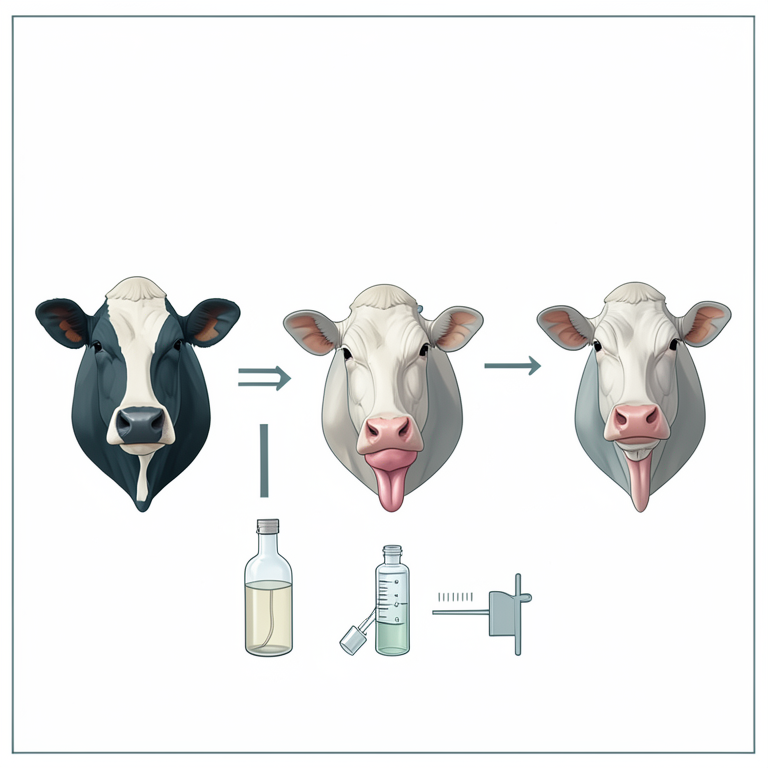
Treatment Group Workflow
AI-generated conceptual illustration (bovine (cows)). It explains the idea and does not show study data.
View source evidence ↗Figures & tables
From the original paper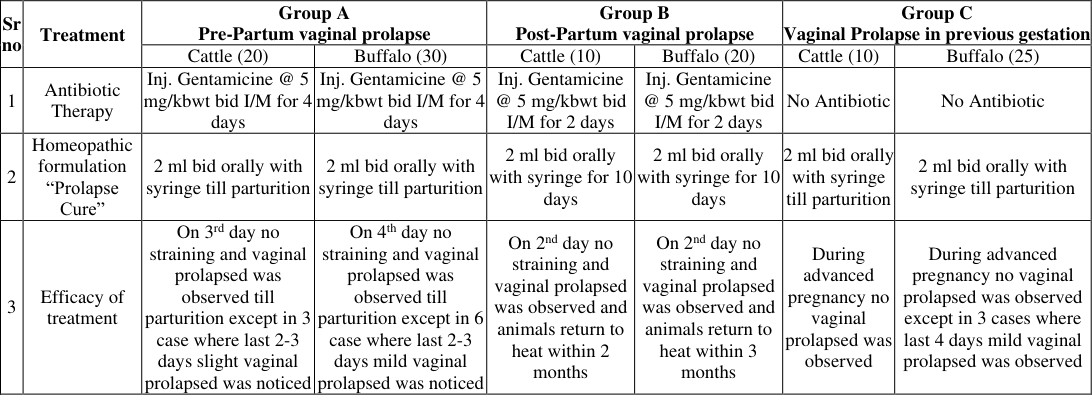 Table 1
Introduction
Vaginal protrusion through the vulval lips is known as vaginal-cervical prolapse. In the latter trimester of pregnancy, it is one of the reproductive illnesses that affect adult female cows.The Vagino-Cervical prolapse is an emergency reproductive condition that occurs in all species of domestic animals but most commonly in the bovine (Roberts, 1971) [25] . One of the main reproductive problems affecting cows is vaginal prolapse during pregnancy (Azawi, 2010) [5] . According to Sah and Nakao (2003) [26] , it typically happens in the seventh month of pregnancy or right after parturition. It can also occur during postpartum period, during oestrus and post-oestrus period in non-pregnant cows (Youngquist, 1997; Yotov et al., 2013) [33] . Major reproductive disorders in cattle and buffaloes include vaginal prolapse (Ahmed et al., 2005) [1] . This problem is urgent and needs to be treated before it causes severe edoema, mucosal damage, contamination, tearing, or foetal haemorrhage (Miesner and Anderson, 2008) [16] . This disorder is primarily seen in cows because of the hormonal changes that take place during the last trimester of pregnancy. Specifically, the creation of relaxin and an increase in oestrogen lead the pelvic ligaments and associated soft tissue structures to relax (Wolfe, 2009) [32] . Tissue relaxation brought on by the elevated intra-abdominal pressure during pregnancy is a significant risk factor for vaginal prolapse (Kahn, 2005) [12] . Certain minor factors, such as intra-abdominal fat buildup and rumen distention, might elevate intra-abdominal pressure. Additionally, large foetuses, many foetuses, and occasionally hilly terrains can contribute to the occurrence of vaginal prolapse (Drost, 2007) [8] . Nutritional imbalance (Kelkar et al., 1989; Ahmed et al., 2005) [13,1] , hormonal imbalance (Roberts, 1971; Sharma et al., 1977; Arthur et al., 1989; Galhotra et al., 1991; Tyagi & Singh, 2002) [25,28,4,9,30] , seasonal-managemental factors (Mishra et al., 1998; Gurcharan et al., 2003; Akhtar et al., 2010) [17,10,3] , and genetic predisposition (Nanda and Sharma, 1982) are some of the etiologic factors of prepartum vaginal prolapse in bovines. According to Nayak and Samantara (2010) [20] , chronic vaginal prolapse is primarily linked to tenesmus, which is a condition caused by persistent irritation, such as cervicitis, vaginitis, or traumatising lesions on the vulva and vagina. Three ways are utilised to manage vaginal prolapse in cows, depending on the extent and severity of damage: conservative measures, suturing methods or truss (Parikh et al., 2018) [22] , and surgical techniques (Jackson, 2004) [11] . According to Lakde et al. (2014) [15] , the rope truss is a relatively simple, safe, non-invasive, and effective technique for retaining antepartum cervico vaginal prolapse. The present study highlights the successful therapeutic management of cervico-vaginal prolapsed by using homoeopathic formulation "Prolapse Cure" in bovines.
Materials and Methods
Materials and Methods
Animal and Location
Cross breed dairy cows and buffalo with history of prolapsed from dairy farmer at Bansakantha district of Gujarat, India for a period of 12 months from January 2022 to May 2023.
Selection of animals
A list of dairy farm owners from Banas dairy, Palanpur and visited dairy farms. All the animals maintained under stall fed condition. A total of 115 crossbred dairy cows and buffalo of variable age and lactation were selected having history of pre and post-partum vaginal prolapse.
Selection of drugs
A complex of homeopathic remedies viz. Prolapse Cure mfd by Ashoka Homoeopathic Laboratory, Hissar, Haryana (125006) were selected for the present study to treat pre and post-partum vaginal prolapse along with antimicrobial therapy.
Composition of Prolapse Cure each 5 ml contains
Composition of Prolapse Cure each 5 ml contains
Grouping of animals:
All 115 animals were categorized into 3 groups viz. group A comprising 50 animals (cow 20 and buffalo 30) having pre-partum vaginal prolapse, group B comprising 30 animals (cow 10 and buffalo 20) having post-partum vaginal prolapse and group C comprising 35 animals (cow 10 and buffalo 15) having history of pre-partum prolapsed in previous pregnancy. Group A animals were treated with homeopathic remedies viz. Proplapse Cure starting from day animal showing prolapsed till parturition along with antimicrobial therapy for four days. Group B animals were treated with homeopathic remedies viz. Proplapse Cure starting from day animal showing prolapsed for 10 days along with antimicrobial therapy for two days. Group C animals were treated with only homeopathic remedies viz. Proplapse Cure starting from 8 month gestation period till parturition. All the animals were observed daily during course of the treatment till recovery.
Administration of homeopathic medicine
Two ml of Prolapse Cure were given orally with syringe twice daily per animal till parturition along with antimicrobial therapy Viz. Gentamicin Injection @ 5 mg/kg bwt 12 hours interval was also administered by IM route daily for 4 days in group A and Group B 2 ml of Prolapse Cure were administered orally with syringe twice daily per animal for 10 days along with antimicrobial therapy Viz. Gentamicin Injection @ 5 mg/kg bwt 12 hours interval was also administered by IM route daily for 2 days. While in Group C animals only Homoeopathic formulation "Prolapse Cure" 2ml were after symptoms of prolapsed were given orally with syringe twice daily per animal till parturition. All the animals were carefully observed daily during course of the treatment till recovery.
Results
In present study pre-partum prolapsed group-A animals comprising 20 cattle and 30 buffalo among them 17 cattle and 24 buffalo having no recurrence of vaginal prolapsed after 4 days post treatment till parturition but in 3 cattle and 6 buffalo having mild vaginal prolapsed last 2-3 of pregnancy. Postpartum prolapsed group-B comprising 10 cattle and 20 buffalo all animals having no straining and vaginal prolapsed after 2 day post treatment and all animals were return to heat within 2-3 months post calving. While group-C having 10 cattle and 25 buffalo having history of vaginal prolapse in previous gestation among them only 3 buffalo having mild vaginal prolapsed observed during last 4 days of gestation (Table-1).
Discussion
Prevention of recurrence was achieved with the application of rope truss technique following standard operational procedure described by Kumar (2015) [14] with a 3 mm diameter sized jute rope. Only a rope truss was applied for physical immobilization around the vulva. According to Lakde et al. (2014) [15] , the rope truss is a relatively simple, safe, noninvasive, and successful way to retain vagino-cervical prolapse. In buffaloes with vaginal prolapse, progesterone concentrations have been found to decrease (Zicarelli, 2000) [34] . According to Wolfe (2009) [32] , placental oestrogen production increases in the last trimester of pregnancy, which is also when vaginal or vagino-cervical prolapse most frequently occurs. Increased oestrogen production causes relaxin to be produced, which relaxes the pelvic ligaments and surrounding structures. This leads to edoema and relaxes the vulva and vulvar sphincter muscles. Some cows and buffaloes had increased abdominal pressure, which caused the loosely linked vagina and bladder to evert through the vulva. These animals also experienced more relaxing of the pelvic tissues in the near term. Vaginal prolapse can be caused by a number of predisposing circumstances, including abdominal straining, slack pelvic ligament, open cervix, and atony from hypocalcaemia. Low serum progesterone concentrations have been linked to pre-partum vagino-cervical prolapse in cattle (Bhattacharyya et al., 2012) [6] and buffaloes (Sah and Nakao, 2003) [26] . These reports demonstrate the effectiveness of progesterone therapy in treating pre-partum vagino-cervical prolapse. Patidar et al. (2010) [23] also noted a higher frequency of genital prolapse in buffaloes with gestations longer than eight months. At the time of the vaginal prolapse, straining was thought to be caused by infection of the urethra and vagina from the prolapsed mass. Suspecting the possibility of urinary tract infection based on results of urine examination and clinical symptoms, the buffalo was treated with Gentamicin Injection @ 5 mg/kg bwt 12 hours interval was also administered by IM route daily for 2-4 days. "Prolapse Cure" is a homoeopathic formulation that contains the following ingredients: Lillium tigrinum 200 CH 20%W/V, Podophyllum peltatum 200 CH 20%W/V, Atropa belladonna 1 M 20%W/V, Aloes socotrina 30 CH 20%W/V, and Murax purpurea 30 CH 20%W/V. It is administered twice a day using a syringe in the mouth. After three days of treatment, all animals responded well to the medication, and appropriate urine flow was seen. Additionally, the animal's feed intake improved, and there was no longer any straining or vaginocervical prolapse. The vulva was physically immobilised using a rope truss, which was removed after three days of treatment. With the aid of a mouth syringe, administer 2 millilitres of the homoeopathic formulation "Prolapse Cure" twice a day. No more therapy was given. All parturiting animals were healthy and uneventful, with the exception of a small amount of manual help needed to remove the calf. The results of present trial show excellent recovery in the management of pre and post-partum vagino-cervical prolapse in bovine. Homoeopathic complexes have commercially popular in European countries. Lilium tigrinum, which manifests powerful influence over the pelvic organs specially uterus and adapted to many reflex states dependent on some pathological condition of uterus like congestion of uterus and prolapsed conditions. Podophyllum peltatum, which help in reducing pain in straining with prolapsed and also effect on pelvic tenesmus which help in prevention of prolapse. Atropa belladonna, which has marked action on the vascular system and acts upon every part of the nervous system ultimately help in reduction of redness and burning sensation while urination. Also act as local anaesthetic and antispasmodic property which help in prevention of prolapse. Aloes socotrina, it is an excellent remedy to aid in re-establishing physiological equilibrium and prevent colic and burning sensation. Murax purpurea, it effect on female genital organ which reduce pain during prolapsed and pelvic tenesmus resulting which help in prevention and reoccurrence of prolapse during pregnancy and after parturition. (William Boerick, 1906) [31] . In India, some preliminary trials using homoeopathic combination remedies in the treatment of dairy animals have been reported with promising results (Parsani et al., 2022) [21] . Compared to allopathic treatment, the homoeopathic formulation "Prolapse Cure" had an average total cost of therapy that was much cheaper. Furthermore, unlike animals treated with allopathy, those treated with homoeopathy were simple to cure and did not have the issue of residue in animal products. The inability to sell milk during the "withdrawal period" after allopathic therapy and the organic farming standards' prohibition on preventive antibiotic treatments have put financial strain on dairy farms and prompted them to look for alternatives. While homoeopathy has emerged as a favoured alternative approach, progressive farmers and veterinarians are increasingly interested in using alternative therapy in organic farming systems.
Conclusion
Thus, it can be said that homoeopathic treatment using the "Prolapse Cure" was a very successful, non-invasive, nonhormonal, non-antibiotic, easy to administer, and less expensive method for treating vagino-cervical prolapse in bovines before and after parturition without any complications or difficulties.
Acknowledgement
The authors are appreciative of Ashoka Homoeopathic Lab's assistance in providing the homoeopathic formulation "Prolapse Cure" from Hisar, India.
Figures and tables from the paper
References
29 in the original paper- Ahmed S, Ahmad I, Lodhi LA, Ahmad N, Samad HA. Clinical, haematological and serum macro mineral contents in buffaloes with genital prolapse. Pakistan Veterinary Journal. 2005;25(4):167-170.
- Akhtar MS, Lodhi LA, Ahmad I, Qureshi ZI, Muhammad G. Incidence of pre-partum vaginal prolapse in Nili-Ravi buffalo under two different agro-ecological zones of Punjab, Pakistan. Revista Veterinaria. 2010;21(1).
- Arthur GH, Noakes ED, Pearson H, Parkinson TJ. Veterinary Reproduction and Obstetrics. 8th edn. WB Saunders Company Ltd. London. 1989:134-140.
- Azawi OI. Uterine infection in buffalo cows: a review. Buffalo Bulletin. 2010;29:154-171.
- Bhattacharyya HK, Fazili MR, Buchoo BA, Akand AH. Genital prolapse in crossbred cows: prevalence, clinical picture and management by a modified Bühner's technique using infusion (drip) set tubing as suture material. Veterinarski Arhiv. 2012;82(1):11-24.
- Dhillon KS, Singh BB, Kumar H, Bal MS, Singh J. Treatment of vaginal prolapse in cows and buffaloes. The Veterinary Record. 2006;158(9):312.
- Drost M. Complications during gestation in the cow. Theriogenology. 2007;68(3):487-491.
- Galhotra MM, Georgie GC, Dixit VP. FSH, LH and prolactin in antepartum vaginal prolapse of buffaloes (Bubalus bubalis L.) in relation to cortisol and degree of stress. Indian Veterinary Journal. 1991;68:332-335.
- Gurcharan Singh GS, Sidhu SS, Verma HK. Incidence of reproductive disorders of buffaloes in different zones of Punjab State. Punjab Agricultural Research Journal. 2003;40:79-80.
- Jackson PGG. Postparturient Problems in Large Animals. In: Handbook of Veterinary Obstetrics. 2004:209-231.
- Kahn CM. The Merck Veterinary Manual 9th ed. White house station, NJ, USA, Merck & CO. INC, 2005, 22012206.
- Kelkar MA, Khar SK, Mandakhot VM. Studies on antepartum prolapse of the vagina in buffalo--plasma trace element concentrations. Archiv fur Experimentelle Veterinarmedizin. 1989;43(2):315-318.
- Lakde MB, Markandeya NM, Sanap NA, Chaudhari RJ. Comparative evaluation of techniques for management of cervico-vaginal prolapse in ante-partum buffaloes. Intas Polivet. 2014;15(2):456-458.
- Miesner MD, Anderson DE. Management of uterine and vaginal prolapse in the bovine. Veterinary Clinics of North America: Food Animal Practice. 2008;24(2):409419.
- Mishra UK, Agrawal RG, Pandit RK. Incidence of prolapse of genitalia in Murrah buffaloes in relation to season, pregnancy, parity and management. Indian Veterinary Journal. 1998;75:254-255.
- Murphy AM, Dobson H. Predisposition, subsequent fertility, and mortality of cows with uterine prolapse. The Veterinary Record. 2002;151(24):733.
- Nanda AS, Sharma RD. Incidence and aetiology of prepartum prolapse of vagina in buffaloes, 1982, 168171.
- Nayak S, Samantara S. Surgical correction of chronic cervico-vaginal prolapse in a Red Sindhi cow through intravaginal approach. Veterinary World. 2010;3(9):427428.
- Parikh SS, Makwana RB, Savaliya BD, Patbandha TK, Kumar R. Pre-Partum Cervico-Vaginal prolapse in a gir cow. Journal of Pharmacognosy and Phytochemistry. 2018;7(4S):238-240.
- Patidar A, Shukla SP, Nema SP, Pandey SS. Studies on surveillance of genital prolapse in buffaloes (Bubalus bubalis). Indian Journal of Field Veterinarians (The). 2010;6(2).
- Rao AVN, Sreemannarayana O. Clinical analysis of reproductive failure among female buffaloes (Bubalus bubalis) under village management in Andhra Pradesh. Theriogenology. 1983;18:403-411.
- Roberts SJ. Veterinary Obstetrics and Genital Diseases (Theriogenology). 2nd edn. CBS Publishers and Distributors, India. 1971, 189-196.
- Sah SK, Nakao T. Some characteristics of vaginal prolapse in Nepali buffaloes. Journal of veterinary medical science. 2003;65(11):1213-1215.
- Samad A, Ali CS, Rehman N, Ahmad A, Ahmad N. Clinician incidence of reproductive disorders in the buffalo. Pakistan Veterinary Journal. 1987;7:16-19.
- Sharma RD, Jit Singh, Kumar VR, Prasad B. Threatened vaginal prolapse due to urinary infection in a buffalo. Indian Veterinary Journal. 1977;54:758-759.
- Sood P, Kumar P, Sharma A, Barman P, Kumar N. Successful management of dystocia due to incomplete abortion in a buffalo. Buffalo Bulletin. 2011;30:226-227.
- Tyagi RPS, Jit Singh. Ruminant Surgery. CBS, Publishers and Distributors, New Delhi, First edition. 2002, 289.
- Youngquist RS. Current Therapy in Large Animal Theriogenology. 1st edition. W. B. Saunders Company, USA. 1997, 436.
- Zicarelli L. Considerations about the prophylaxis of the uterine and vaginal prolapse in Italian Mediterranean buffalo cows. Bubalus Bubalis. 2000;3:71-90.
Cited by 1
From OpenAlex, OpenCitations and reference lists read by Scinovex
- Clinical and haemato-biochemical assessment of herbal therapy in the treatment of genital prolapse in buffaloes
YV Pridhvidhar Reddy, Y Nagendra Reddy, M Satish Chandra · International Journal of Advanced Biochemistry Research · 2026
Genital prolapse is a common and life-threatening obstetrical emergency in buffaloes, particularly during the peri-parturient period. The present study was undertaken to evaluate the clinical efficacy and haemato-biochemical changes associated with herbal therapy in the management of vaginal and uterine prolapse in buffaloes. A total of forty buffaloes presented with genital prolapse were selected and categorized into two major conditions, namely vaginal prolapse (n = 20) and uterine prolapse (n = 20). Animals in each condition were further divided into two treatment groups: Pop-in herbal spra