
Research article · 2024 · Full text
International Journal of Agriculture Extension and Social DevelopmentDynamics and role of hill farm women in agricultural production activities in Mid Hills, Sub Humid Agro Climatic Zone of Himachal Pradesh
Volume 7(4) · Pages 543–545 · DOI: 10.33545/26180723.2024.v7.i4g.574 ↗
Research areasLivestock Management and Performance ImprovementAgricultural Economics and PracticesAgricultural risk and resilience
Abstract
Author-writtenIndian economy is rural based as it has a web of more than 6 lakh villages and majority of the population lives in rural areas. The primary occupation of this population is agriculture. In the hilly state of Himachal Pradesh too, majority of the people lives in rural areas with marginal and small land holdings. They are contributing a lot in state’s economy. In Himachal women are the strongest pillars of the families as men folk are working outside the homes or home towns for earning cash and the women are looking after the household chores as well as the agricultural activities. So it can be rightly said that hilly women are very good workers as well as managers. Hence the present study was performed to analyse the dynamics and role of 300 farm women engaged in crop related production activities in Gohar and Chauntra blocks of Mandi district of Himachal Pradesh under All India Coordinated Research Project- Women in Agriculture funded by ICAR-CIWA, Bhubaneswar. In the study, majority of the respondents jointly participate in almost all crop production related activities like sowing (91.33%), management of farm labour (89.00%), harvesting of farm produce (87.67%) and retention of farm produce for sale (84.67%). Women’s participation alone was found highest in weeding (55.33%) and lowest in management of farm labour (7.33%). Likewise participation, decisions related to all crop related activities were taken jointly by the husband and wife. Women’s decision making was found highest only in weeding (53.33%) and retention of farm produce for consumption (50.33%). In the study it was also revealed that labour was engaged only in few activities i.e. at the time of land preparation, sowing and harvesting only. It was also found that men’s participation alone in all activities were very less as compared to that of women. Thus it can be said that crop production related activities were done with the cooperation of all family members and with labour engagement in very few activities and highest women’s participation was found in very intricate works of agriculture like weeding. Hence there is a need to focus on formulating gender inclusive agricultural strategies and technologies.
Summary
Source-checkedPlain-language reading of the full paper, prepared with AI and checked against the text. Each point links to the authors' own words.
Why it matters
- In Himachal Pradesh, women often manage both household chores and agricultural activities because men frequently migrate to other towns for cash earnings. View evidence ↗
- Approximately 87.79% of the population in Himachal Pradesh lives in rural areas and relies on agriculture and allied activities for their basic needs. View evidence ↗
The question
- The study aimed to analyze the roles and dynamics of 300 farm women involved in crop production activities within the Gohar and Chauntra blocks of the Mandi district in Himachal Pradesh. View evidence ↗
What they did
- Data was collected through personal interviews using a validated and structured interview schedule. View evidence ↗
- Participation was measured on a three-point scale: 'Women alone' (2), 'Jointly' (1), and 'Men alone' (0). View evidence ↗
What they found
- Weeding was the activity with the highest women-only participation at 55.33%, ranking first overall. View evidence ↗
- Most activities were performed jointly, including sowing (91.33%), labor management (89.00%), harvesting (87.67%), and retaining produce for sale (84.67%). View evidence ↗
- Women held the primary decision-making role for retaining farm produce for consumption, with 55.67% deciding alone. View evidence ↗
- Supervision of hired labor was primarily a joint effort, particularly during land preparation (95.67%) and harvesting (93.67%). View evidence ↗
- While men's solo participation was generally low, they were more likely to handle the sale of produce alone (15%) compared to women (5%). View evidence ↗
What it means
- The authors recommend sensitizing women to the monetary value of their agricultural labor to help them transition from laborers to economic earners and achieve empowerment. View evidence ↗
- The study concludes that there is a need to develop agricultural technologies and strategies that are gender-inclusive. View evidence ↗
Visual summary
1 visualsIllustrations explain the paper; they do not show study data.
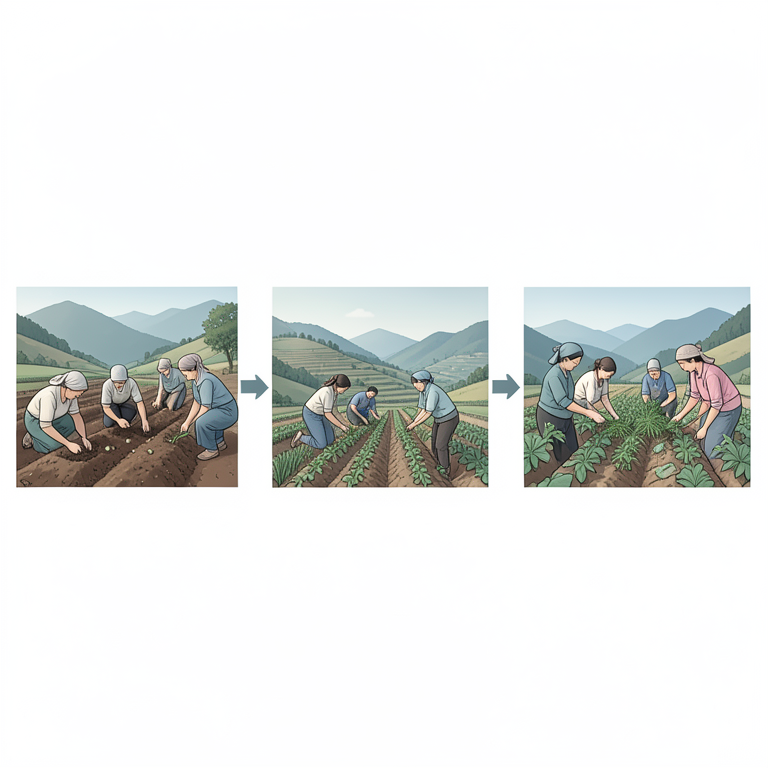
Agricultural Labor Distribution
AI-generated conceptual illustration (Women farmers in the Mid Hills of Himachal Pradesh). It explains the idea and does not show study data.
View source evidence ↗Figures & tables
From the original paper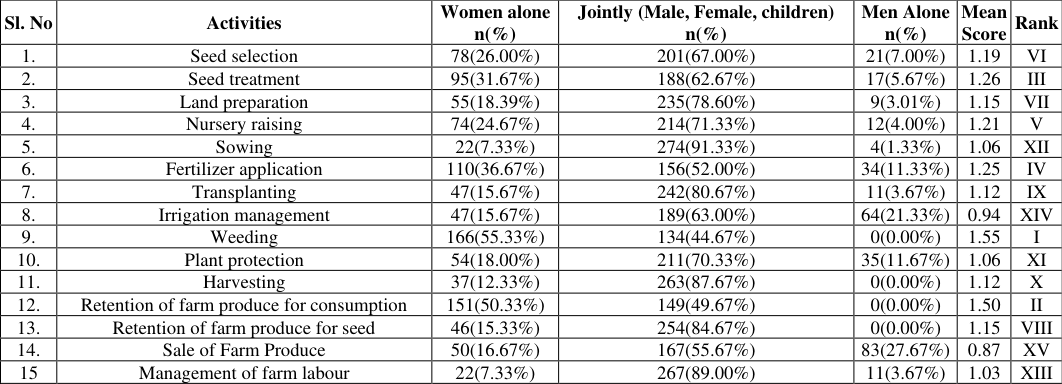 Table 1
 Table 2
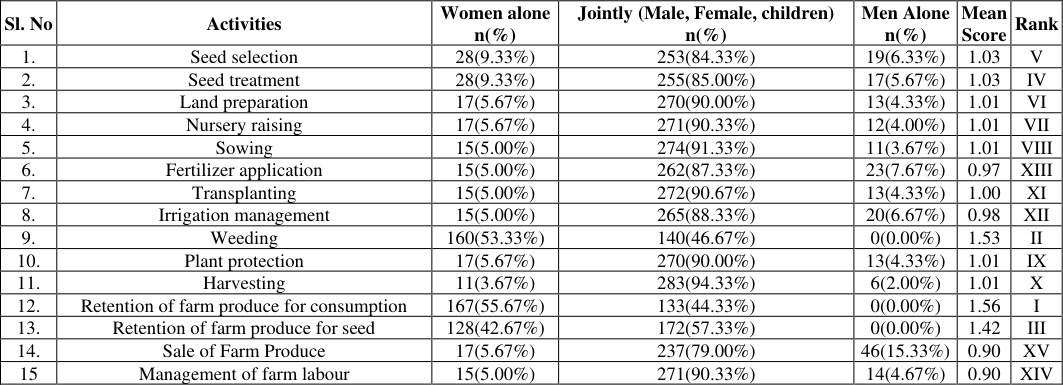 Table 3
Introduction
India is a web of more than 600,000 villages scattered all over the country and has reported the densest rural population all over the world. About 72.2% of the population lives in villages and the rest 27.8% in towns and urban agglomerations. In the hilly state of Himachal Pradesh, out of the total population 87.79 percent lives in rural areas and are engaged in agricultural and allied activities for meeting out their basic requirements. Agriculture is quite laborious and full time job which begins with land preparation and ends up with drying, cleaning and storing of the produce. In between multiple agricultural operations are being carried out to come up with the end product of agricultural produce. For carrying out these operations although family as a whole work together but the major burden of agricultural operations is being headed over to a great extent by the women. Economic Survey conducted during 2017-18 revealed that with the rising migration of rural people to urban areas, the feminization of agricultural sector started to flourish with the escalating number of women engaged in numerous responsibilities such as cultivators, entrepreneurs, and laborers also (Malo,2020) [5] . In the state of Himachal Pradesh men folk migrated to cities in search of earning hard cash and women are left behind to look after various household chores and agricultural activities. It's right to say that women are the major actors in performing all agricultural activities either it may be done individually or jointly. Sustainability of agriculture in the hilly state of H.P is the result of hard turmoil of the hill women folk. They are busy all the day with their household chores and agricultural activities. Their activities include cooking food, collecting fuel and water, caring of family members, elders and children, livestock rearing and working in the fields for agricultural production. Choudhary and Singh 2003 [2] has reported that 70 percent of actual farm work is the responsibility of women and they constitute 60 percent of the farming population. Hence an effort has been made to study the women's participatory, supervisory and decision making roles in performing agricultural activities.
Materials and Methods
The present study was conducted as a part of All India Coordinated Research Project-Women in Agriculture funded by ICAR-CIWA, Bhubaneshwar. The study involved multistage random sampling technique. In first www.extensionjournal.com stage Mandi district lying in Mid Hills, Sub Humid Agro Climatic Zone of Himachal Pradesh was selected. In second stage two blocks named Chauntra and Gohar were selected purposively from the district. In third stage a sample of 150 farm women from each block was selected randomly thus comprising of 300 farm women from Mandi district. Selected respondents were interviewed personally using well structured and validated interview schedule. The extent of rural women participation in farm management activities was assessed by using a three point continuum namely 'Women alone,' 'Jointly (with the help of family members)' and 'Men alone' which was assigned scores of 2, 1 and 0, respectively. For the purpose of ranking of different activities performed by rural women the frequency of responses from each of the three columns of a specific activity under major activity was tabulated and multiplied by concerned score. Then, they were added together to get the total score for each specific activity for the purpose of their ranking. Thus frequency, percentages and weighted mean scores were used to conclude the results.
Results and Discussions
Table 1 shows rural women's participation in production activities. Rural women in the study area was found largely involved in weeding, retention of farm produce for consumption, seed treatment, fertilizer application and nursery raising as these activities were ranked with 1 st , 2 nd , 3 rd , 4 th and 5 th positions, respectively. Water management to the field and sale of farm produce were the least performed activities by the women and were ranked as14 th and 15 th , respectively. Table also depicts that in case of almost all agricultural production activities listed in the table majority of the respondents have reported joint participation 91-62 percent. In the activities like weeding, harvesting, retention of farm produce for sale and consumption men alone did not participate at all. Mulugeta and Amsalu (2014) [7] in a study on 90 women respondents in Amhara region, Ethiopia found that all respondents have reported their participation in weeding activities indicating their significant contribution for better and vigour growth and development of the crops at early growth stage. In order to study the engagement of labour and its supervision in various production activities it was found that labour was engaged in very few activities and that too occasionally as and when required. Table 2 depicts that land preparation was the only activity where supervision role exists as tractors/ power tillers were used for ploughing the land. Regarding this activity, almost all the respondents (95.67%) reported joint participation. Table further shows that labour was also engaged at the time of harvesting of the crop. In this activity too almost all the respondents (93.67%) reported that supervision was done jointly by all the family members. During the survey the respondents were given the option to respond as who makes the decision in the family male head of the family, the women in the family or the decision is jointly made by them. Table 3 exhibited the decisive role performed by the women in production activities. It was found that in majority of the agricultural activities women reported joint participation (90-57%). However most of the decision related to retention of farm produce for consumption, wedding and retention of farm produce for sale were taken by women holding 1 st , 2 nd and 3 rd positions, respectively. These were the activities where men did not participate at all. It was surprising to note that although men's participation alone was very less in all activities however in case of selling of the farm produce men (15%) showed more participation as against women (5%). In a study by Pal and Halder 2016 [8] on 200 farmers (100 men www.extensionjournal.com and 100 women)of Burdwan district of West Bengal with regard to participation and role of rural women in decision making related to farm activities it was observed that 20% of responding women had no participation in decision making in the area of farm production. In most cases (33.18%), responding women took joint decisions.
| Sl. No | Activities | Women alone n(%) | Jointly (Male, Female, children) n(%) | Men Alone n(%) | Mean Score | Rank |
|---|---|---|---|---|---|---|
| 1. | Seed selection | 28(9.33%) | 253(84.33%) | 19(6.33%) | 1.03 | V |
| 2. | Seed treatment | 28(9.33%) | 255(85.00%) | 17(5.67%) | 1.03 | IV |
| 3. | Land preparation | 17(5.67%) | 270(90.00%) | 13(4.33%) | 1.01 | VI |
| 4. | Nursery raising | 17(5.67%) | 271(90.33%) | 12(4.00%) | 1.01 | VII |
| 5. | Sowing | 15(5.00%) | 274(91.33%) | 11(3.67%) | 1.01 | VIII |
| 6. | Fertilizer application | 15(5.00%) | 262(87.33%) | 23(7.67%) | 0.97 | XIII |
| 7. | Transplanting | 15(5.00%) | 272(90.67%) | 13(4.33%) | 1.00 | XI |
| 8. | Irrigation management | 15(5.00%) | 265(88.33%) | 20(6.67%) | 0.98 | XII |
| 9. | Weeding | 160(53.33%) | 140(46.67%) | 0(0.00%) | 1.53 | II |
| 10. | Plant protection | 17(5.67%) | 270(90.00%) | 13(4.33%) | 1.01 | IX |
| 11. | Harvesting | 11(3.67%) | 283(94.33%) | 6(2.00%) | 1.01 | X |
| 12. | Retention of farm produce for consumption | 167(55.67%) | 133(44.33%) | 0(0.00%) | 1.56 | I |
| 13. | Retention of farm produce for seed | 128(42.67%) | 172(57.33%) | 0(0.00%) | 1.42 | III |
| 14. | Sale of Farm Produce | 17(5.67%) | 237(79.00%) | 46(15.33%) | 0.90 | XV |
| 15 | Management of farm labour | 15(5.00%) | 271(90.33%) | 14(4.67%) | 0.90 | XIV |
Table text extracted from the original PDF; superscript letters are shown inline. The original table image is below.
View original table image
| Sl. No | Activities | Women alone n (%) | Jointly (Male, Female, children) n (%) | Men Alone n (%) | Mean Score | Rank |
|---|---|---|---|---|---|---|
| 1. | Land preparation | 10(3.33%) | 287(95.67%) | 3(1.00%) | 1.02 | I |
| 2. | Sowing | 8(2.67%) | 31(10.33) | 0(0.00%) | 0.15 | II |
| 3. | Harvesting | 13(4.33%) | 281(93.67%) | 0(0.00%) | 1.02 | I |
Table text extracted from the original PDF; superscript letters are shown inline. The original table image is below.
View original table image
| Sl. No | Activities | Women alone n(%) | Jointly (Male, Female, children) n(%) | Men Alone n(%) | Mean Score | Rank |
|---|---|---|---|---|---|---|
| 1. | Seed selection | 78(26.00%) | 201(67.00%) | 21(7.00%) | 1.19 | VI |
| 2. | Seed treatment | 95(31.67%) | 188(62.67%) | 17(5.67%) | 1.26 | III |
| 3. | Land preparation | 55(18.39%) | 235(78.60%) | 9(3.01%) | 1.15 | VII |
| 4. | Nursery raising | 74(24.67%) | 214(71.33%) | 12(4.00%) | 1.21 | V |
| 5. | Sowing | 22(7.33%) | 274(91.33%) | 4(1.33%) | 1.06 | XII |
| 6. | Fertilizer application | 110(36.67%) | 156(52.00%) | 34(11.33%) | 1.25 | IV |
| 7. | Transplanting | 47(15.67%) | 242(80.67%) | 11(3.67%) | 1.12 | IX |
| 8. | Irrigation management | 47(15.67%) | 189(63.00%) | 64(21.33%) | 0.94 | XIV |
| 9. | Weeding | 166(55.33%) | 134(44.67%) | 0(0.00%) | 1.55 | I |
| 10. | Plant protection | 54(18.00%) | 211(70.33%) | 35(11.67%) | 1.06 | XI |
| 11. | Harvesting | 37(12.33%) | 263(87.67%) | 0(0.00%) | 1.12 | X |
| 12. | Retention of farm produce for consumption | 151(50.33%) | 149(49.67%) | 0(0.00%) | 1.50 | II |
| 13. | Retention of farm produce for seed | 46(15.33%) | 254(84.67%) | 0(0.00%) | 1.15 | VIII |
| 14. | Sale of Farm Produce | 50(16.67%) | 167(55.67%) | 83(27.67%) | 0.87 | XV |
| 15 | Management of farm labour | 22(7.33%) | 267(89.00%) | 11(3.67%) | 1.03 | XIII |
Table text extracted from the original PDF; superscript letters are shown inline. The original table image is below.
View original table image
Conclusion
From the above findings it can thus be concluded that farm women were found largely involved in those activities which were confined to home and field only like weeding, retention of farm produce for consumption, seed treatment, fertilizer application and nursery raising. However men's engagement was more in activities like water management and sale of farm produce only as compared to women. It was also worth mentioning that labour engagement in production activities was done only in few activities and that too occasionally as and when required in hill farming especially while land preparation and harvesting. This shows that hilly people are quite hard worker and agriculture was considered to be a family occupation being carried out jointly by all the family members. Women's role in decision making was also found limited to management of meeting out the food requirements of the family and managing the intricate field operations. In case of joint participation too women were helped by their female children more as compared to that of their male members of the family. Male involvement was found only in carrying out the heavy and technical works and marketing of the produce. Therefore efforts should be made to make women aware about the hard turmoil they are putting in the form of labour in the fields and must be sensitized about the monetary value of the work done by them so that they don't only act as laborers but be the hard core earners for the family and get economically empowered.
References
9 in the original paper- Choudhary H, Singh S. Farm women in agriculture operations. Agriculture Extension Review. 2003;15(1):21-23.
- Enete AA, Amusa TA. Determinates of women's contribution to farming decision in coca based agro forestry household of Ekiti State, Nigeria. Journal of Field Actions. 2010;6(4):23-29.
- Katiyar S, Acharaya GP, Tripathi SN. Role of farm women in decision making concerning farm and home activities. Rajasthan Journal of Extension Education. 2008;16:195-198.
- Malo M. Role of women in Agriculture. Agrialius. 2020;2(10).
- Mishra S, Sharma S, Vasudevan P, Bhatt RK, Pandey S, Singh S, et al. Gender participation and role of women in livestock management practices in Bundelkhand region of central India. International Journal of Rural Studies. 2008;15(1):1-9.
- Mulugeta M, Amsalu T. Gender, Participation and Decision Making Process in Farming Activities: The case of Yilman Densa District, Amhara Region, Ethiopia. Journal of Economics and Sustainable. 2014;5(1):28-34.
- Pal S, Haldar S. Participation and role of rural women in decision making related to farm activities: A study in Burdwan district of West Bengal. Economic Affairs. 2016;61(1):55-63.
- Segaye T, Dessalegn D, Yimam TA, Kefale M. Extent of rural women participation and decision making in seed production activities. Global Advanced Research Journal of Agricultural Science. 2004;1(7):186-190.
- Singh P, Jhamtani A, Bhadauria C, Srivastava R, Singh R, Singh J. Participation of women in agriculture. Indian Journal of Extension Education. 2004;XXX(34):23-27.
Cited by 1
From OpenAlex, OpenCitations and reference lists read by Scinovex
- Women’s contributions, opportunities, and challenges in Indian agriculture: A systematic review ↗
Amanda Kordor Thabah, Surjo Bey, Premangini Basumatary, Aahen Chanu Waikhom, Aditi Nath, Gudeta Weldesemayat Sileshi et al. · CABI Agriculture and Bioscience · 2026
Abstract Background : Women constitute the backbone of Indian agriculture and account for up to 80% of the rural labour force, playing a critical role in seed selection, biodiversity conservation, soil fertility management, and food production. Despite this, they remain structurally undervalued and institutionally marginalised. Despite existing national laws and policies, and international commitments that affirm women’s rights and gender…
❝ 0PDF