
Research article · 2024 · Full text
International Journal of Agriculture Extension and Social DevelopmentParticipation of women of Gandhinagar district of Gujarat in dairy farming activities
Volume 7(4) · Pages 535–538 · DOI: 10.33545/26180723.2024.v7.i4g.572 ↗
Research areasLivestock Management and Performance ImprovementAgricultural Economics and PracticesAgricultural Systems and Practices
Abstract
Author-writtenIndia’s economy is based on agriculture, animal husbandry and allied occupations. Dairy farming and dairy industry are important component of India’s rural economy. Gujarat is one of the leading state in milk production. Majority of the work connected to dairy farming from fodder collection to looking after the livestock is all done by women. Although women are performing the majority of the work, yet their role in dairy farming and agriculture is grossly underestimated. Women perform all kinds of related work of looking after the livestock in addition to their domestic responsibilities but since they are rarely connected in marketing the produce; therefore, their work is invisible and not valued. Even the transfer of new technology in this sector is rarely transmitted to them because of the underestimation of their role. This study attempts to understand the role and contribution of women in the dairy farming in Gujarat. The study used purposive and random sampling methods to select 250 respondents who owned at least five dairy animals at the time of investigation.
Summary
Source-checkedPlain-language reading of the full paper, prepared with AI and checked against the text. Each point links to the authors' own words.
Why it matters
- Dairy farming and the associated industry are critical components of the rural economy in India. View evidence ↗
- Women perform the majority of dairy farming tasks, ranging from fodder collection to livestock care. View evidence ↗
- Despite their heavy workload, the role of women in agriculture and dairy farming is often significantly underestimated. View evidence ↗
The question
- The study aims to understand the specific roles and contributions of women within the dairy farming sector of Gujarat. View evidence ↗
What they did
- The research was carried out in the Gandhinagar district of Gujarat during 2022-23. View evidence ↗
- The sample consisted of 250 women dairy farmers, selected via random sampling, who each owned at least five dairy animals. View evidence ↗
- Data collection was performed through personal interviews and analyzed using mean scores, percentages, standard deviations, and correlation coefficients. View evidence ↗
What they found
- Women showed high regular participation in feeding activities, including watering animals (94.00%) and feeding them (92.00%). View evidence ↗
- Regular participation was very high in management tasks, particularly cleaning sheds (96.80%) and milking (95.20%). View evidence ↗
- The lowest levels of regular participation were found in constructing animal sheds (19.60%) and maintaining farm records (24.40%). View evidence ↗
- Women regularly participated in several breeding activities, such as calling veterinarians during parturition difficulties (76.40%) and pregnancy diagnosis (64.00%). View evidence ↗
- Health care was a primary area of involvement, with regular participation in caring for pregnant animals (95.60%) and sick animals (92.40%). View evidence ↗
- While 84.40% of women regularly sold milk and products, only 48.00% were involved in processing activities like making butter or ghee. View evidence ↗
- The overall participation index for women in dairy farming activities was calculated at 72.74%. View evidence ↗
- The majority of respondents (71.60%) exhibited a medium level of participation in dairy farming. View evidence ↗
What it means
- The authors conclude that despite their significant role, women have minimal control over livestock, the resulting income, and decisions regarding sales and purchases. View evidence ↗
- The authors recommend the urgent development of technologies to reduce the physical drudgery and monotonous nature of the work performed by women. View evidence ↗
Visual summary
3 visualsIllustrations explain the paper; charts are replotted from the paper's own table values.
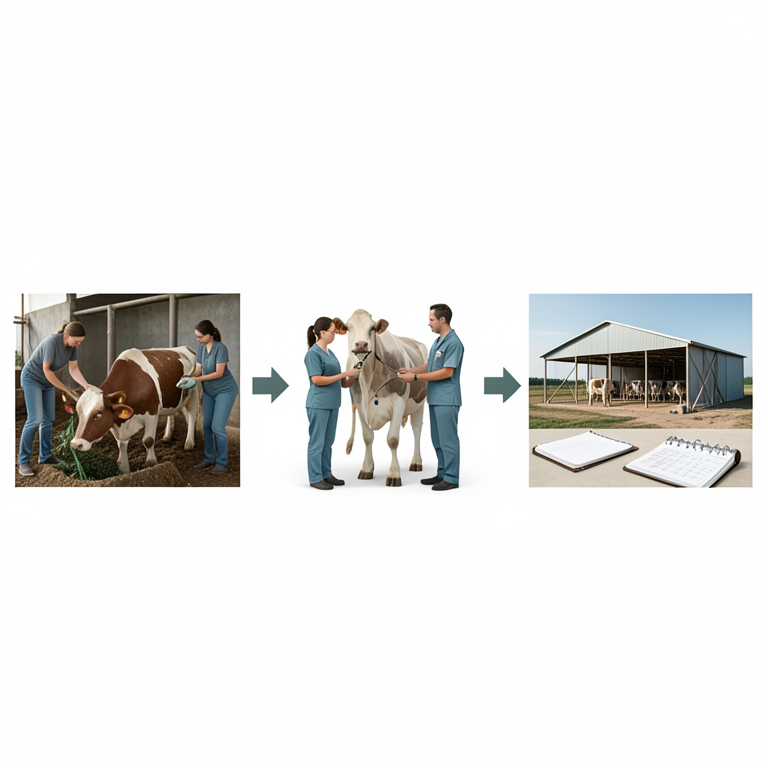
Spectrum of Women's Participation in Dairy Farming
AI-generated conceptual illustration (Women in Gujarat, India, performing dairy farming tasks with cows). It explains the idea and does not show study data.
View source evidence ↗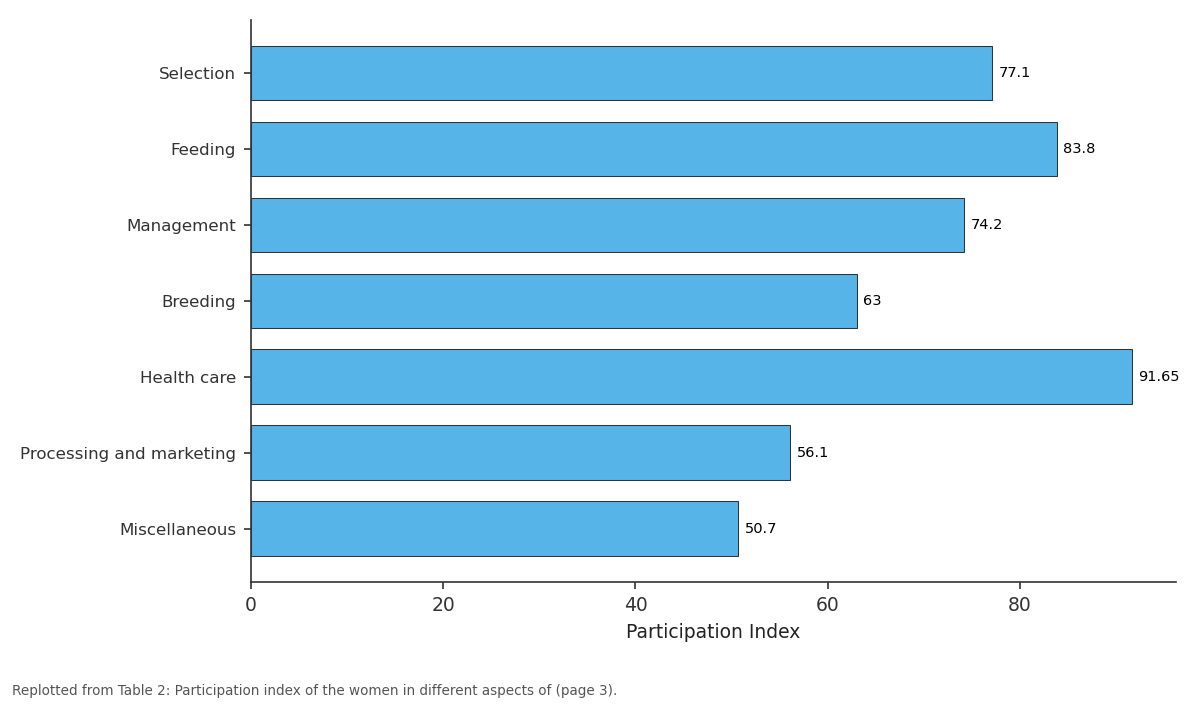
Participation Index: Selection vs Feeding vs Management vs Breeding vs Health care
Replotted from Table 2 (page 3) of the original paper. Every bar is the paper's own table value.
View source evidence ↗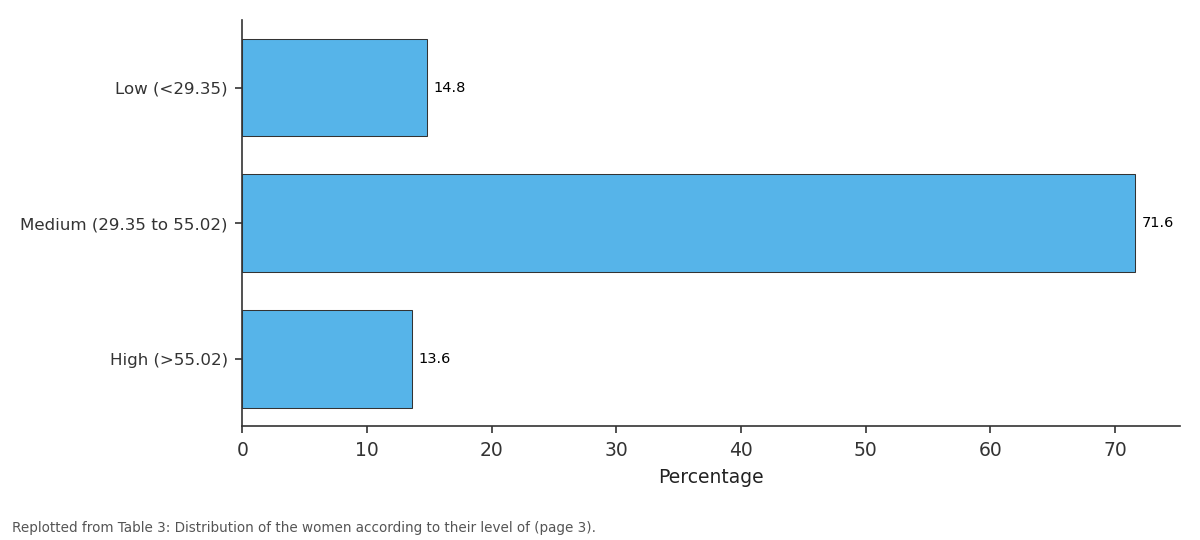
Percentage: Low (<29.35) vs Medium (29.35 to 55.02) vs High (>55.02)
Replotted from Table 3 (page 3) of the original paper. Every bar is the paper's own table value.
View source evidence ↗Figures & tables
From the original paper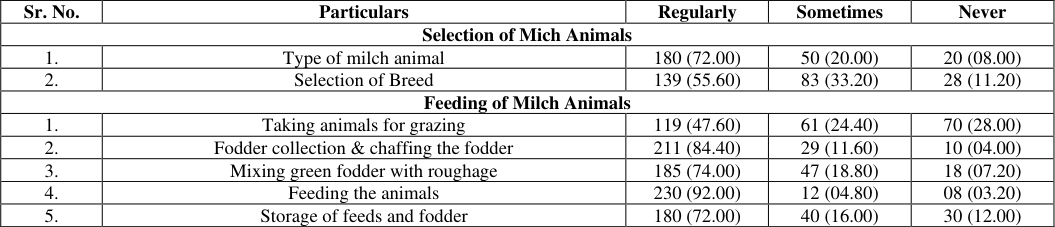 Table 1
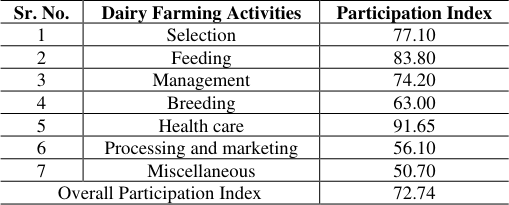 Table 2
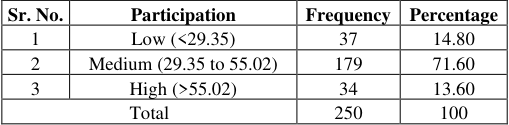 Table 3
Introduction
Gujarat is one of India's leading milk-producing states, and dairy animals provide primary or secondary income for many families, especially landless and marginal farmers. These animals also serve as essential assets that provide financial security to their owners. Women are the backbone of animal husbandry activities, and dairy farming has played a significant role in socio-economic upliftment and employment generation, especially among landless small farmers and farm women groups. In Gujarat, dairy farming occupation is mostly handled by women of the family. Women Dairy farmers significantly contributed for animal husbandry related operations. It was thought that participation of women dairy farmers might be influenced by their individual characteristics, availability of time and other aspects. It was therefore decided to determine the nature and extent of participation of dairy farm women in animal husbandry occupation.
Materials and Methods
The study was conducted in Gandhinagar district, Gujarat, during the year 2022-23. The district is comprised of four talukas: Gandhinagar, Mansa, Dehgam, and Kalol, all of which were purposively selected. Five villages from each taluka were also purposively selected based on higher milk production. A total of 250 women dairy farmers were proportionately selected using random sampling from the total households in each village. The criteria for selecting respondents were that they should own at least five dairy animals. Statements on the work related to different aspects of livestock management and animal husbandry occupation such as general aspects, feeding, breeding, management and milking and preparing milk products related aspects were prepared in consultation with the specialists and were included in the schedule. Various characteristics of women dairy farmers were measured using a well-structured interview schedule. Data were collected through personal interviews and analyzed using statistical tools such as percentages, mean scores, standard deviations and coefficients of correlation. 1 that almost majority (92.00%) of the respondents and more than four fifth (88.80%) of the women dairy farmers participated in deciding type of milch animals and selection of breed either regularly or sometimes, whereas only 08.00 and 11.20 percent of them did not participate in deciding the type of animal and selection of breed. This finding is similar to the findings of Rathod et al. (2011) [8] , Upadhyay and Desai (2011) [12] , Kathiriya et al. (2013) [13] , Patel et al. (2016) [7] and Kabir et al. (2019) [2] .
Results and Discussion
Results and Discussion
Participation of women in feeding of milch animals
The data from the table 1 reveals that majority of the women dairy farmers regularly participated in watering the animals (94.00%), feeding the animals (92.00%), fodder collection and chaffing the fodder (84.40%), mixing green fodder with roughage (74.00%), storage of feeds and fodder (72.00%). However, regular participation of women dairy farmers in taking animals for grazing was low (47.60%). This clearly showed that women dairy farmers largely participated in feeding activities of dairy animals. It was observed that in the area under study the work regarding dairy farming was largely done by female members of the family. The women stayed at home most of the time might be the probable reason for this result. Parallel findings were also observed by Kaur et al. (2019) [5] and Manisha and Satpathy (2022) [6] .
| Sr. No. | Particulars | Regularly | Sometimes | Never |
|---|---|---|---|---|
| Selection of Mich Animals | ||||
| 1. | Type of milch animal | 180 (72.00) | 50 (20.00) | 20 (08.00) |
| 2. | Selection of Breed | 139 (55.60) | 83 (33.20) | 28 (11.20) |
| Feeding of Milch Animals | ||||
| 1. | Taking animals for grazing | 119 (47.60) | 61 (24.40) | 70 (28.00) |
| 2. | Fodder collection & chaffing the fodder | 211 (84.40) | 29 (11.60) | 10 (04.00) |
| 3. | Mixing green fodder with roughage | 185 (74.00) | 47 (18.80) | 18 (07.20) |
| 4. | Feeding the animals | 230 (92.00) | 12 (04.80) | 08 (03.20) |
| 5. | Storage of feeds and fodder | 180 (72.00) | 40 (16.00) | 30 (12.00) |
Table text extracted from the original PDF; superscript letters are shown inline. The original table image is below.
View original table image
Participation of women in management of milch animals
The data presented in table 1 reveals that majority of the women dairy farmers regularly participated in management activities of dairy animals i.e. cleaning of animal shed (96.80%), milking of animals (95.20%), disposal of cow dung (90.80%) and washing and grooming of animals (79.20%). Least participation was observed in maintaining farm and dairy records (24.40%) and construction of animal sheds (19.60%). It was further noticed that majority of the women dairy farmers did not participate in maintaining farm and dairy records and construction of animal sheds. This clearly indicated that due to lack of knowledge of maintenance of farm record and requirement of more physical labour in construction of shed led to less involvement in these activities by women dairy farmers. This finding is similar to the findings of Rathod et al. (2011) [8] , Upadhyay and Desai (2011) [12] and Hiremath et al. (2019) [1] .
Participation of women in breeding of milch animals
It can be seen from table 1 that half of the women dairy farmers regularly participated in taking animals for artificial insemination (50.40%), taking animals for pregnancy diagnosis (64.00%), arranging materials during parturition (72.40%) and calling veterinarian during difficulty in parturition (76.40%). The data further indicated that more than four fifth (82.40%) of the women dairy farmers did not participate or participated sometimes in taking animals for natural service. From above findings it can be concluded that majority of the women dairy farmers regularly did activities pertaining to breeding of milch animals except in case of natural service. In Gandhinagar district the facility for artificial insemination is available at every milk cooperative society and veterinary dispensary. Hence, they availed the facility. Only few animals conceived through natural service and the responsibility for taking animals for natural service was performed by male members of the family might be the possible reason behind this finding. Similar results were also observed by Kathiriya et al. (2013) [3] and Saiful et al. (2019) [10] .
Participation of women in health care of milch animals
It is apparent from the table 1 that majority of the women dairy farmers regularly participated in care of sick animals (92.40%), care of pregnant animals (95.60%), taking animals for treatment (88.40%) and taking animals for vaccination (83.20%). The result indicated that majority of the women dairy farmers participated regularly in health care of animals. The probable reason might be the availability of veterinary health care services in areas under report. This finding is similar to the findings of Kathiriya et al. (2013) [3] and Sharma et al. (2019) [11] .
Participation of women in processing and marketing of milk
Table 1 indicates that 84.40% of the women dairy farmers were regularly involved in sale of milk and milk products while, 48.00 percent of women dairy farmers performed milk processing activities like ghee making and butter preparation. Less participation was observed in sale and purchase of animals (18.40%) and purchase of feed and fodder (13.20%). The results indicated that participation of women in processing and marketing activities was not much appreciated. Less participation of the women dairy farmers was observed in milk processing and making milk products like ghee, butter, khoa etc. The milk was supplied to milk collection centers of Uttam Dairy/Doodhsagar Dairy or Madhur Dairy. The women felt that preparation of milk products added to their existing labour. They also perceived that more time and effort was required for processing of milk and hence, only few women took up processing only on a small scale. They produced mainly milk products like ghee, butter and Khoa only for their household consumption. The similar findings were observed by Kaur (2015) [5] and Rubi et al. (2022) [9] .
Participation of women in miscellaneous activities
Majority of the women dairy farmers in the study area were not aware about importance of maintaining record and hence, it was observed that only 37.20% of the women dairy farmers maintained records in a small book or in a piece of paper. While, 40.00% of the respondents availed loan or credit from nearby bank or cooperative society. Similar findings were observed by researchers Rathod et al. (2011) [8] and Kaur (2015) [5] .
Participation index of women dairy farmers in different aspects of dairy farming
In the present study, efforts were made to determine whether participation of the women dairy farmers differed in different activities of dairy farming. For this purpose, participation index of the women dairy farmers in different aspects of dairy farming was worked out. The data in this regard are given in table 2.
| Sr. No. | Dairy Farming Activities | Participation Index |
|---|---|---|
| 1 | Selection | 77.10 |
| 2 | Feeding | 83.80 |
| 3 | Management | 74.20 |
| 4 | Breeding | 63.00 |
| 5 | Health care | 91.65 |
| 6 | Processing and marketing | 56.10 |
| 7 | Miscellaneous | 50.70 |
| Overall Participation Index | 72.74 |
Table text extracted from the original PDF; superscript letters are shown inline. The original table image is below.
View original table image
Overall participation of women dairy farmers in dairy farming:
In the present study an attempt was also made to categorize the participation of women dairy farmers on the basis of mean and standard deviation. The data in this regard are presented in table 3. The data presented in table 3 indicates that 71.60% of the respondents were found with medium participation, whereas 14.80% respondents were found with low participation and 13.60% of respondents had high participation in the dairy farming occupation. Based on above result, it can be concluded that majority of the respondents were found with regular participation. The probable reason could be that majority of the respondents were educated up to secondary and higher level in the study area and they showed medium information source utilization. This definitely influenced their participation level. Similar findings were observed by Kaur et al. (2019) [5] . www.extensionjournal.com
| Sr. No. | Participation | Frequency | Percentage |
|---|---|---|---|
| 1 | Low (<29.35) | 37 | 14.80 |
| 2 | Medium (29.35 to 55.02) | 179 | 71.60 |
| 3 | High (>55.02) | 34 | 13.60 |
| Total | 250 | 100 |
Table text extracted from the original PDF; superscript letters are shown inline. The original table image is below.
View original table image
Conclusion
Women dairy farmers handle most of the critical jobs and are considered to be the main actors in small scale farming. Though women play a significant role in dairy farming their control over livestock and its products is very minimal. The income from dairy animals does not remain in the hands of women and neither does the decision regarding sale and purchase. There is an urgent need to develop technologies which will help the respondents carry out the activities with ease since they are relatively unpleasing, back breaking, monotonous and involve drudgery, physical exertion which ultimately affects their physical and psychological wellbeing. Women dairy farmers have to be motivated to acquire more scientific knowledge for increasing the livestock production through various extension techniques.
References
12 in the original paper- Hiremath D, Badiger C. Gender wise participation of Gowli's in dairy activity. The Pharma Innovation Journal. 2019;8(8):93-96.
- Kabir MS, Moon MP, Islam MD. Women participation in integrated farming and household food security in Sirajganj district. Science Arena Publications Specialty Journal of Humanities and Cultural Science. 2019;4(3):1-6.
- Kathiriya JB, Dhamasia DM, Kabaria BB. Role of rural women in dairy farming of Rajkot district. Tamil Nadu Journal of Veterinary & Animal Sciences. 2013;9(4):239-247.
- Kaur K. Participation of rural women in dairy activities. Journal of Krishi Vigyan. 2015;4(1):72-75.
- Kaur S, Singh J, Verma HK, Dash SK, Kansal SK. Participation appraisal of women farmers in dairy husbandry practices in Indo-Pak border area of Punjab (India). International Journal of Current Microbiology and Applied Sciences. 2019;8(05):2298-2305. https://doi.org/10.20546/ijcmas.2019.805.271
- Manisha, Satpathy B. Participation of Farm Women in Dairy Keeping -A Case Study of Bihar. Vigyan Varta. 2022;3(10):31-33.
- Patel MR, Patel A, Desai JD, Patel VB. Scientific orientation of tribal farm women and its relationship with their contribution in agriculture and animal husbandry. International Journal of Information Research and Review. 2016;3(7):2596-2598.
- Rathod PK, Landge S, Nikam TR, Vajreshwari S. Socio-personal profile and constraints of dairy farmers. Karnataka Journal of Agricultural Science. 2011;24(4):619-621.
- Rubi K, Atkare VG, Chore NS, Adpawar P. Studies on involvement of rural women in preparation of milk and milk products in Tirora tahsil of Gondia district (M.S.). Journal of Soils and Crops. 2022;32(1):208-211.
- Saiful IM, Islam SS, Islam MM, Billah MM. Exploring women participation in small-scale dairy farming: A case of Paikgachha Upazila, Khulna, Bangladesh. Asian Journal of Research in Animal and Veterinary Sciences. 2019;3(4):1-13.
- Sharma A, Singh M, Singh L, Dhakad SS, Singh R. A study on awareness and participation of farm women in improved cattle management practices in Sehore district of Madhya Pradesh. International Journal of Pure and Applied Bioscience. 2019;7(2):368-374.
- Upadhyay S, Desai CP. Participation of farm women in animal husbandry in Anand district of Gujarat. Journal of Community Mobilization and Sustainable Development. 2011;6(2):117-121.