
Research article · 2024 · Full text
International Journal of Agriculture Extension and Social DevelopmentDemonstration of integrated pest and disease management package and its economic impact in rice
Volume 7(4) · Pages 546–549 · DOI: 10.33545/26180723.2024.v7.i4g.575 ↗
Research areasAgricultural Systems and PracticesAgricultural Research and Practices
Abstract
Author-writtenThe Krishi Vigyan Kendra (KVK) in Bhadradri Kothagudem conducted Front Line Demonstrations (FLD) on integrated pest and disease management packages during the Kharif seasons of 2019, 2020, and 2021 within its operational area. These demonstrations compared the effectiveness of technology-demonstrated integrated pest and disease management packages with traditional farmer practices. The results showed that the technology-demonstrated plots had higher cost-benefit ratios (BC Ratio) of 2.3:1, 2.63:1, and 2.44:1 compared to the BC ratios of 2.1:1, 2.21:1, and 2.09:1 in the farmers' practice plots during the corresponding years. Additionally, farmers practiced plots typically sprayed pesticide mixtures after noticing pests.
Summary
Source-checkedPlain-language reading of the full paper, prepared with AI and checked against the text. Each point links to the authors' own words.
Why it matters
- Rice is a critical global staple, providing up to 50% of dietary calories and significant protein for over half the world's population. View evidence ↗
- Intensive farming methods used to increase rice production, such as high-yielding cultivars and nitrogen fertilizers, have inadvertently increased the pressure from pests and diseases. View evidence ↗
- Farmers often react to pest pressures by overusing expensive pesticides, which can cause ecological imbalances, residual toxicity, and pesticide resistance. View evidence ↗
The question
- The study aimed to use Front Line Demonstrations (FLD) to show the potential damage of pests and diseases and the effectiveness of specific management strategies. View evidence ↗
What they did
- The research was conducted over three consecutive Kharif seasons (2019, 2020, and 2021) across ten farmers' fields in the Bhadradri Kothagudem district of Telangana, comparing a technology demonstration against traditional farmers' practices. View evidence ↗
- The study used the rice variety RNR-15048 (Telangana Sona) planted in 0.4-hectare plots at ten different locations for each treatment group. View evidence ↗
- Researchers collected data every two weeks on the incidence of leaf blast disease and two major pests: the brown planthopper and the rice yellow stem borer. View evidence ↗
What they found
- The incidence of white ears (yellow stem borer) was lower in technology plots (9.15%, 8.01%, and 7.88% for 2019-2021) compared to farmers' practice plots (13.23%, 12.62%, and 13.24%). View evidence ↗
- Leaf blast incidence was reduced in technology plots (11.6%, 9.2%, and 9.0% for 2019-2021) compared to farmers' practice plots (22.0%, 16.6%, and 14.8%). View evidence ↗
- The benefit-cost (B:C) ratio was consistently higher in technology plots (2.30:1, 2.63:1, and 2.44:1) than in farmers' practice plots (2.10:1, 2.21:1, and 2.09:1) across the three years. View evidence ↗
What it means
- The authors conclude that the positive results justify wider implementation of the IPM module in the Bhadradri Kothagudem district to increase returns and reduce unnecessary pesticide use. View evidence ↗
- The authors state that the yield difference between the two groups highlights an urgent need for better extension services to educate farmers on improved technologies. View evidence ↗
Visual summary
2 visualsIllustrations explain the paper; charts are replotted from the paper's own table values.
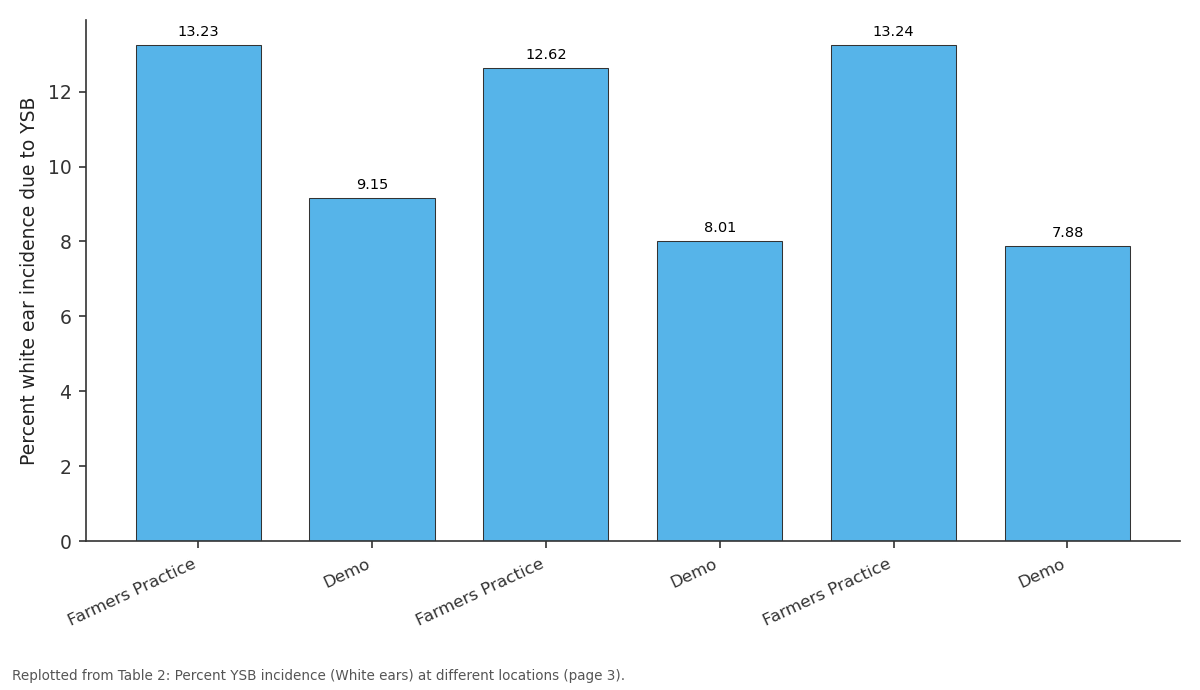
Mean: Farmers Practice vs Demo vs Farmers Practice vs Demo vs Farmers Practice
Replotted from Table 2 (page 3) of the original paper. Every bar is the paper's own table value.
View source evidence ↗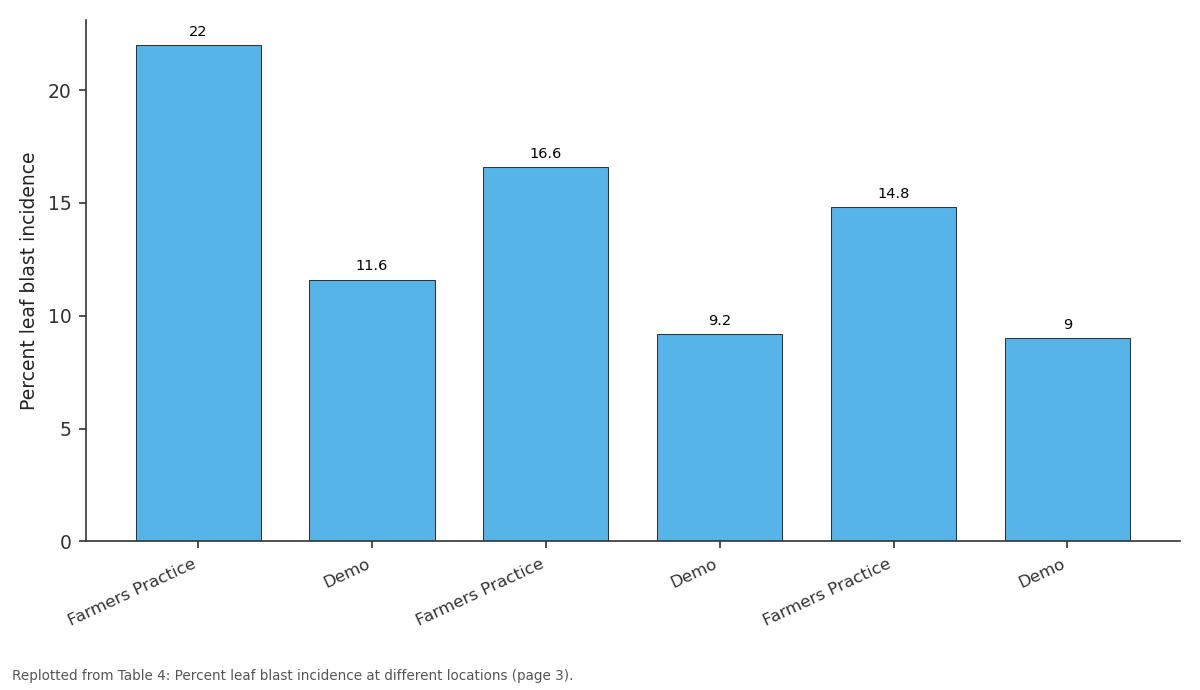
Mean: Farmers Practice vs Demo vs Farmers Practice vs Demo vs Farmers Practice
Replotted from Table 4 (page 3) of the original paper. Every bar is the paper's own table value.
View source evidence ↗Figures & tables
From the original paper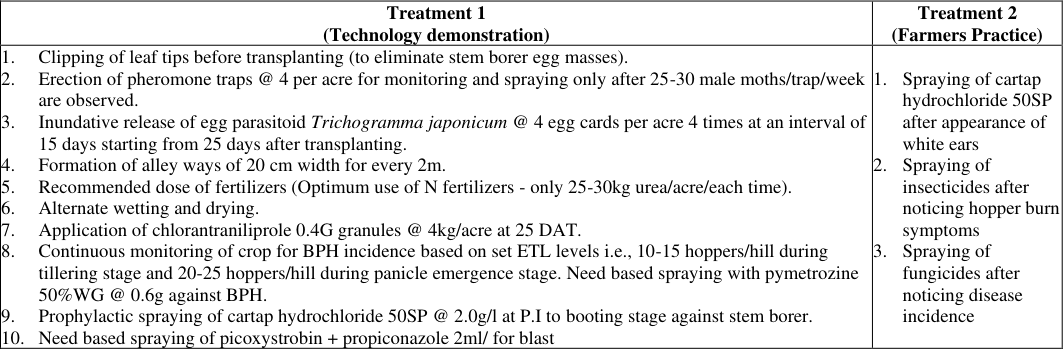 Table 1
 Table 2
 Table 3
 Table 4
 Table 5
Introduction
Rice holds significant importance as a primary cereal crop and a staple food for more than half of the global population, contributing up to 50% of the world's dietary caloric supply and a substantial portion of protein intake for many people worldwide. Its role in food security and political stability is closely intertwined. To meet the demand for increased rice production driven by population growth, intensive cultivation methods have been adopted, including high-yielding cultivars, increased plant density, and nitrogenous fertilizers. However, these practices have also led to heightened pest and disease pressures. The warm and humid climates in many rice-growing regions are conducive to a range of pests and diseases, posing significant challenges to increasing production. Common threats include stem borers, leaf folders, brown plant hoppers, sheath blight, bacterial leaf blight, and blast disease (Kushwaha, 1990) [9] . In response, farmers often resort to excessive and indiscriminate use of costly pesticides, leading to issues such as pesticide resistance, residual toxicity, and ecological imbalance (Prajapati el al. 2013) [14] .
To address these challenges, there is a need for locationspecific integrated pest management strategies that are economically feasible, socially acceptable, and environmentally sustainable. Unfortunately, farmers often lack the necessary knowledge and guidance on implementing effective pest and disease management practices. In Bhadradri Kothagudem district, where rice cultivation is predominant, farmers face significant pest and disease pressures without adequate understanding of their impact or appropriate management strategies. Hence, Front Line Demonstrations (FLD) were organized to showcase the damage potential and effective management strategies for these agricultural threats.
Materials and Methods
The present study was undertaken at ten different farmers fields of Bhadradri Kothagudem district of Telangana with two treatments viz., technology demonstration and check (farmers practice) ( The methodology for the Front Line Demonstrations (FLD) followed guidelines outlined by Choudhary (1999) [5] , including experimental design, site selection, farmer selection, demonstration layout, and farmer participation. Agronomic practices were rigorously applied, with the rice variety RNR-15048 (Telangana Sona) cultivated in plots sized at 0.4 hectares across ten locations for each treatment.The data was collected at fortnightly intervals on incidence of two major pests i.e rice yellow stem borer and brown planthopper and one major disease i.e leaf blast.
Yellow Stem Borer (YSB):
The incidence of YSB was recorded in terms of percent damage by counting the damage done i.e., white ears to total number of panicles per hill. For white ear head-Number of white ear plants in panicle stage and total number of panicles were recorded from ten hills in each plot and percent damage was calculated by using following formula. [15] , Samui et al. (2000) [18] , and Lakshmi Narayanamma et al. (2023) [10] , the economic impact of treatments was assessed through benefit-cost ratio calculations. -------------------------------------X ------------------------X 100 Potential yield
Results and Discussion
Based on the current findings and subsequent data analysis over three consecutive years, it was observed that overall pest and disease incidences were lower in the technologydemonstrated plots compared to farmers' practice plots. This reduction can be attributed to regular monitoring of pest and disease incidences and the judicious use of integrated pest management strategies, resulting in a reduced pest and disease load. Specifically, the incidence of white ears was notably lower in the demonstrated plots, with values of 9. Overall, the benefit-cost ratio was higher in the treatment plots compared to the control plots throughout the experimentation period, indicating the effectiveness of the technology in reducing pest and disease incidences, increasing yields, and improving economic returns. also reported similar results, with technologydemonstrated plots showing higher BC Ratios of 2.1:1 and 2.2:1 in Rabi seasons 2018-19 and 2019-20, respectively, compared to 1.85:1 and 1.88:1 in farmers' practice plots during the corresponding periods. This could be attributed to practices such as regular leaf tip clipping before transplanting, pheromone trap installation for monitoring, and judicious insecticide application.
The implementation of alleyways (20 cm wide for every 2 meters), recommended fertilizer doses, alternate wetting and drying, and targeted spraying of pymetrozine 50 WG @ 0.6g against brown planthoppers (BPH) contributed to reduced BPH infestations in technology-demonstrated plots. Ratnakar et al. (2020) [17] observed higher BPH infestations in farmers' practice plots, with 20.9 adults/hill during Kharif 2018 and 29.8 adults/hill during Kharif 2019. Additionally, studies by Adhikari et al. (2019) [1] , Deekshita et al. (2018) [6] , Lakshmi et al. (2010) [11] , and Liu et al. (2013) [12] support the efficacy of pymetrozine against BPH, inhibiting their feeding behavior. Fungicide applications are commonly used to mitigate www.extensionjournal.com fungal diseases in rice cultivation due to their ease of use and effectiveness. The results are consistent with previous research, demonstrating that fungicide application, particularly picoxystrobin + propiconazole at 600 ml/ha, reduces leaf blast incidence by 16.5%, as evidenced by studies by Bag et al. (2016) [2] , Bhuvaneswari (2012) [4] , Naik et al. (2012) [13] , and Balol et al. (2022) [3] .
Conclusion
Based on the findings of this study, it can be inferred that location-specific Integrated Pest Management (IPM) modules have become crucial due to the dynamic pest patterns across seasons and agro-ecosystems. The noticeable yield disparity between farmers' practices and technologydemonstrated plots underscores the urgent necessity for robust extension services to educate farmers on adopting improved technologies. Furthermore, the lower yield levels observed in local practices indicate room for improvement through the adoption of recommended IPM strategies. The Front Line Demonstration (FLD) intervention has proven highly effective in enhancing net returns among farmers. The positive outcomes observed in technologydemonstrated plots warrant wider implementation across the Bhadradri Kothagudem district. These results can be leveraged to encourage farmers to adopt these practices, thereby reducing unnecessary and unwarranted usage of insecticides and fungicides.
Acknowledgement
AcknowledgementThe authors express their sincere gratitude to ICAR-ATARI and PJTSAU, Rajendranagar, Hyderabad, for their financial support. Special thanks are extended to the innovative farmers of Bhadradri Kothagudem district, Telangana, for their invaluable assistance in field layout, experiment planning, data collection, and the successful execution of the investigation over three consecutive years.
Figures and tables from the paper
| — | Percent white ear incidence due to YSB/ locations | — | — | — | — | — | — | — | — | — | — | — |
|---|---|---|---|---|---|---|---|---|---|---|---|---|
| 1 | 2 | 3 | 4 | 5 | 6 | 7 | 8 | 9 | 10 | Mean | ||
| 2019 | Farmers Practice | 12 | 16.2 | 12.3 | 12.5 | 12.8 | 12.4 | 15.1 | 12.5 | 13 | 13.5 | 13.23 |
| Demo | 9.2 | 9.1 | 8.5 | 11.2 | 8.9 | 10.6 | 7.5 | 8.8 | 9.5 | 8.2 | 9.15 | |
| 2020 | Farmers Practice | 12.7 | 14.1 | 12.5 | 10.1 | 11.4 | 12.7 | 12.4 | 12.4 | 15.8 | 12.1 | 12.62 |
| Demo | 10.1 | 8.4 | 5.7 | 7.2 | 5.5 | 8.2 | 10.3 | 7.6 | 9.9 | 7.2 | 8.01 | |
| 2021 | Farmers Practice | 13.1 | 14.2 | 12.1 | 14.5 | 12.5 | 11.7 | 13.5 | 10.8 | 13.5 | 16.5 | 13.24 |
| Demo | 9.1 | 6.7 | 6.6 | 7.8 | 7.1 | 9.5 | 9.2 | 7.5 | 8.1 | 7.2 | 7.88 |
Table text extracted from the original PDF; superscript letters are shown inline. The original table image is below.
View original table image
| — | BPH / hill / locations | — | — | — | — | — | — | — | — | — | — | — |
|---|---|---|---|---|---|---|---|---|---|---|---|---|
| 1 | 2 | 3 | 4 | 5 | 6 | 7 | 8 | 9 | 10 | Mean | ||
| 2019-20 | Farmers Practice | 28.1 | 30.2 | 26.2 | 27.5 | 28.1 | 27.3 | 29.3 | 21.2 | 25.3 | 30.5 | 27.37 |
| Demo | 19.2 | 16.3 | 14.6 | 15.6 | 14.9 | 19.2 | 16.3 | 14.6 | 14.9 | 18.2 | 16.38 | |
| 2020-21 | Farmers Practice | 30.1 | 27.2 | 22.2 | 26.5 | 28.2 | 28.6 | 28.5 | 25.4 | 22.1 | 19.5 | 25.83 |
| Demo | 17.9 | 14.2 | 15.6 | 12.6 | 17.3 | 18.9 | 14.7 | 11.9 | 17.6 | 19.1 | 15.98 | |
| 2021-22 | Farmers Practice | 22.3 | 24.6 | 25.6 | 30.5 | 28.3 | 30.5 | 28.3 | 23.3 | 24.6 | 25.3 | 26.33 |
| Demo | 12.4 | 12.2 | 12.5 | 14.7 | 12.5 | 15.2 | 12.6 | 10.2 | 13.2 | 11.9 | 12.74 |
Table text extracted from the original PDF; superscript letters are shown inline. The original table image is below.
View original table image
| — | Percent incidence / locations | — | — | — | — | — | — | — | — | — | — | — |
|---|---|---|---|---|---|---|---|---|---|---|---|---|
| 1 | 2 | 3 | 4 | 5 | 6 | 7 | 8 | 9 | 10 | Mean | ||
| 2019-20 | Farmers Practice | 21.3 | 27.0 | 12.7 | 16.9 | 30.0 | 23.3 | 24.0 | 26.7 | 17.1 | 21.0 | 22.0 |
| Demo | 10.3 | 14.0 | 11.7 | 12.0 | 11.7 | 12.3 | 13.3 | 10.8 | 8.3 | 12.0 | 11.6 | |
| 2020-21 | Farmers Practice | 18.0 | 17.8 | 16.2 | 10.0 | 15.7 | 14.7 | 20.0 | 18.7 | 18.0 | 16.7 | 16.6 |
| Demo | 9.0 | 9.0 | 6.0 | 6.7 | 8.1 | 10.7 | 9.3 | 11.7 | 10.3 | 11.1 | 9.2 | |
| 2021-22 | Farmers Practice | 15.0 | 15.3 | 14.9 | 14.7 | 16.0 | 13.9 | 15.0 | 16.0 | 14.0 | 13.3 | 14.8 |
| Demo | 9.9 | 8.8 | 9.6 | 10.7 | 10.0 | 6.7 | 8.3 | 9.2 | 8.0 | 8.8 | 9.0 |
Table text extracted from the original PDF; superscript letters are shown inline. The original table image is below.
View original table image
| Year | Yield (Kg/ha) | — | Net returns (Rs. /ha) | — | B:C Ratio | — |
|---|---|---|---|---|---|---|
| Demo | Farmers Practice | Demo | Farmers Practice | Demo | Farmers Practice | |
| 2019-20 | 7044 | 6617 | 89,992 | 86,675 | 2.30:1 | 2.10:1 |
| 2020-21 | 7200 | 6875 | 89,000 | 77,500 | 2.63:1 | 2.21:1 |
| 2021-22 | 6944 | 6522 | 86,800 | 81,525 | 2.44:1 | 2.09:1 |
Table text extracted from the original PDF; superscript letters are shown inline. The original table image is below.
View original table image
References
18 in the original paper- Adhikari BJ, Padhi, Dohling PNK. Pymetrozine: An effective insecticide for management of planthoppers in rice. J Entomol. Zool. Stud. 2019;7(1):528-531.
- Bag MK, Yadav M, Mukherjee AK. Bio efficacy of strobilurin based fungicides against rice sheath blight disease. Transcriptomics. 2016;4:128.
- Balol G, Talekar SC, Satish RG. Efficacy of various fungicides on the management of rice blast disease caused by Pyricularia oryzae (Cav.) under field condition in Dharwad district of Karnataka. Int. J Plant Sci. 2022;17(2):214-217.
- Bhuvaneswari V, Raju KS. Efficacy of new combination fungicide against rice sheath blight caused by Rhizoctonia solani (Kuhn). J Rice Res. 2012;(5):1-2.
- Choudhary BN. Krishi Vigyan Kendra-A guide for KVK managers. Publication, Division of Agricultural Extension, ICAR. 1999. pp 73-78.
- Deekshita K, Ramarao CV. Pymetrozine: A Pyridine Azomethine insecticide for management of rice brown planthopper in India. Chem Sci. Rev Lett. 2018;7(25):335-339.
- Dias MC. Phytotoxicity: An Overview of the Physiological Responses of Plants Exposed to Fungicides. J Botany. 2012;1-4.
- He Y, Zhang J, Chen J, Wu Q, Chen L, et al. Influence of Pymetrozine on Feeding Behaviors of Three Rice Planthoppers and a Rice Leafhopper Using Electrical Penetration Graphs. J Econ Entomology. 2011;104(6):1877-1884.
- Kushwaha KS. Insect pest complex of rice in Haryana. Indian J Entomol. 1990;50:127-130.
- Lakshmi Narayanamma V, Ratnakar V, Vishwatej R, Ram Prasad M, Shiva B, Veeranna G, Uma Reddy R. Demonstration on management strategies of stem weevil Pempherulus affinis (Faust) and its economic impact in cotton. Pharma Innov J. 2023;12(6):317-320.
- Lakshmi VJ, Krishnaiah NV, Katti G, Pasalu IC, Chirutkar PM. Screening of insecticides for toxicity to rice hoppers and their predators. Oryza. 2010;47(4):295-301.
- Liu J, Zhang J, Qin X, Chen Y, Yuan F, Zhang R. Toxic effects of Pymetrozine on the brown planthopper, Nilaparvata lugens (Stal.) (Homoptera: Delphacidae). J Entomol Sci. 2013;48(1):17-22.
- Naik GR, Naik GB, Naik BT, Naik KR. Fungicidal management of leaf blast disease in rice. Global J Biosci Biotechnol. 2012;1(1):18-21.
- Prajapati CR, Gupta AK, Dutt S. Evaluation of integrated pest and diseases management (IPDM) package on basmati/aromatic rice. Afr. J Agric Res. 2013;8(41):5116-5121.
- Rajashekhar M, Prabhakar Reddy T, Chandrashekara KM, Rajashekar B, Jagan Mohan Reddy M, Ramakrishna K, et al. Evaluation of integrated pest management module for pink bollworm, Pectinophora gossypiella (Saunders) and its economic analysis under farmer's field conditions. Int. J Pest Manage. 2022;68(3):1-9.
- Ratnakar V, Lakshmi Narayanamma V, Vishwatej R, Shiva B, Ram Prasad M, Jagan Mohan Rao P, Veeranna G, et al. Front Line Demonstration on Management of Yellow Stem Borer, Scirpophaga incertulas (Walker) in Rabi Rice. In: 3 rd National Symposium Entomology 2022: Innovation and Entrepreneurship. 2022;216-217.
- Ratnakar V, Shiva B, Veeranna G, Jagan Mohan Rao P, Raghurami Reddy P. Front Line Demonstration for the Management of brown plant hopper (BPH), Nilaparvata lugens (Stal) in Paddy. J Entomol. Zool. 2022;8(4):1801-1803.
- Samui SK, Maitra S, Roy DK, Mondal AK, Saha D. Evaluation of front-line demonstration on groundnut (Arachis hypoggaea L.) in Sundarbans. J Indian Soc. Coastal Agric Res. 2000;18(2):180-183.