
Research article · 2024 · Full text
International Journal of Research in AgronomyImpact of diverse weed management strategies on soil microbial population dynamics in maize
Volume 7(4) · Pages 648–651 · DOI: 10.33545/2618060x.2024.v7.i4i.617 ↗
Research areasSoil Carbon and Nitrogen DynamicsAgronomic Practices and Intercropping SystemsWeed Control and Herbicide Applications
Abstract
Author-writtenField experiment was conducted at Eastern block farm, Department of Agronomy, Tamil Nadu Agricultural University, Coimbatore during 2018-19 and 2019-20 to evaluate different weed management practices on soil microbial dynamics in maize. Experiment was laid out in randomized completely block design with three replications and ten treatments comprised of pre emergence atrazine fb (followed by) hand weeding at 20 DAS, pre emergence atrazine fb power weeder at 20 DAS, pre emergence atrazine at + pendimethalin at (tank mix), pre emergence atrazine + pendimethalin (tank mix) fb hand weeding at 20 DAS, early post emergence topramezone at 20 DAS, pre emergence atrazine fb early post emergence topramezone at 20 DAS, early post emergence tembotrione at 20 DAS, pre emergence atrazine fb early post emergence tembotrione at 20 DAS, hand weeding twice at 20 and 45 DAS and control. Maize was raised during kharif season of 2018 and 2019 followed by the residual crop of sunflower in rabi season of 2018-19 and 2019-20. The crops were raised under irrigated conditions. The results shown that microbial population was significantly lower in pre emergence atrazine fb either early post emergence topramezone at 20 DAS or early post emergence tembotrione at 20 DAS from 3 DAS to 60 DAS, later the microflora started increasing, but it was lesser than control. Unweeded control did not affect the soil microflora from initial to harvest stage of the maize crop.
Summary
Source-checkedPlain-language reading of the full paper, prepared with AI and checked against the text. Each point links to the authors' own words.
Why it matters
- Weeds are the primary cause of reduced maize yields because they compete for water, sunlight, space, and nutrients. View evidence ↗
- Soil microorganisms are essential for nutrient cycling and energy flow, making them key indicators of overall soil health. View evidence ↗
The question
- The study aimed to investigate how different herbicide treatments affect the soil microflora in maize crops. View evidence ↗
What they did
- The field experiment took place at Tamil Nadu Agricultural University in Coimbatore during the 2018-19 and 2019-20 seasons. View evidence ↗
- The study used a randomized block design with three replications and ten treatments, including various combinations of pre-emergence (PE) and early post-emergence (EPOE) herbicides, hand weeding, power weeding, and a control. View evidence ↗
- Soil samples were collected from between rows at a depth of 0-15 cm at initial, 0, 3, 15, 30, 60, and 90 days after sowing (DAS). View evidence ↗
- Microbial populations were measured using the dilution plate technique on specific media for bacteria (10-6 dilution), fungi (10-4 dilution), and actinomycetes (10-5 dilution). View evidence ↗
What they found
- The highest bacterial populations across all observation stages were found in the unweeded control and the plots with hand weeding twice. View evidence ↗
- Actinomycetes populations remained highest in the control and hand-weeded plots throughout the study. View evidence ↗
- Fungal populations were consistently higher in the control and hand-weeded plots than in herbicide-treated plots. View evidence ↗
- Pre-emergence and early post-emergence herbicides significantly reduced microbial counts for up to 30 days after application, followed by a slow recovery. View evidence ↗
What it means
- The authors concluded that combining pre-emergence atrazine with either topramezone or tembotrione significantly reduced microbial populations up to 60 DAS, and although they recovered, they remained lower than the control. View evidence ↗
- The authors found that leaving the soil unweeded had no negative effect on soil microflora throughout the maize crop cycle. View evidence ↗
Visual summary
1 visualsIllustrations explain the paper; they do not show study data.
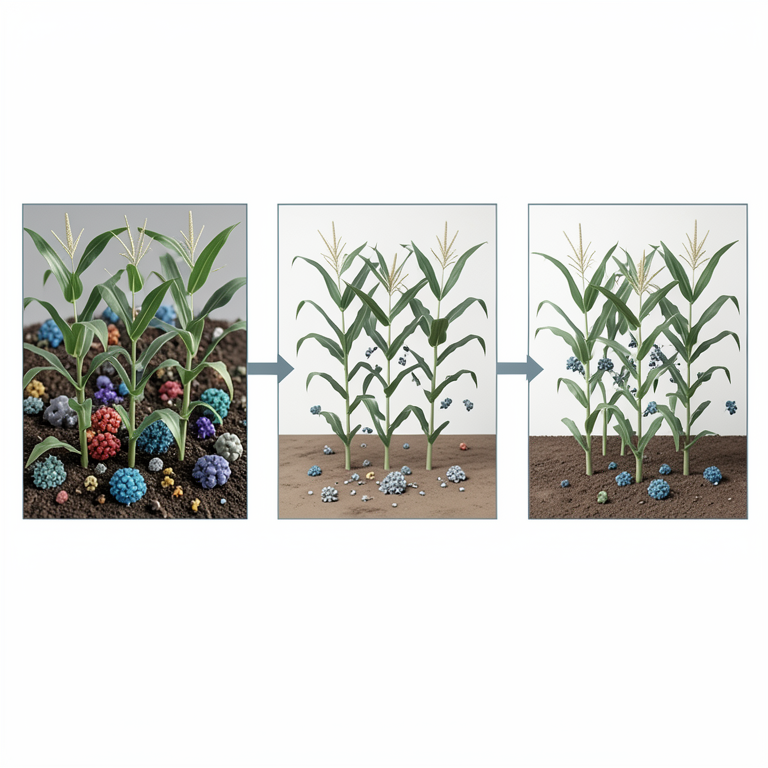
Microbial Population Recovery Cycle
AI-generated conceptual illustration (maize plants in soil with microbial colonies). It explains the idea and does not show study data.
View source evidence ↗Figures & tables
From the original paper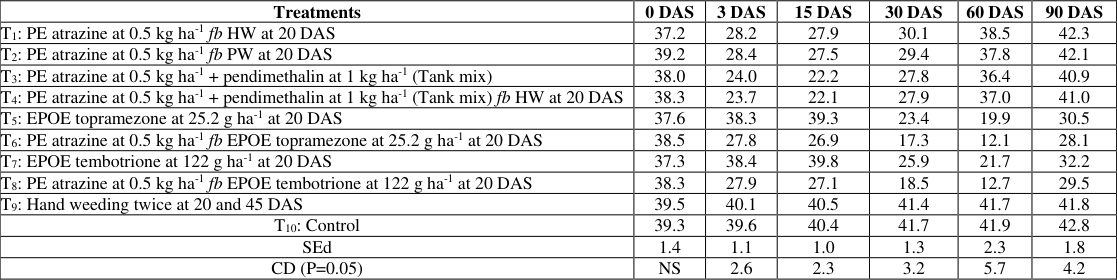 Table 1
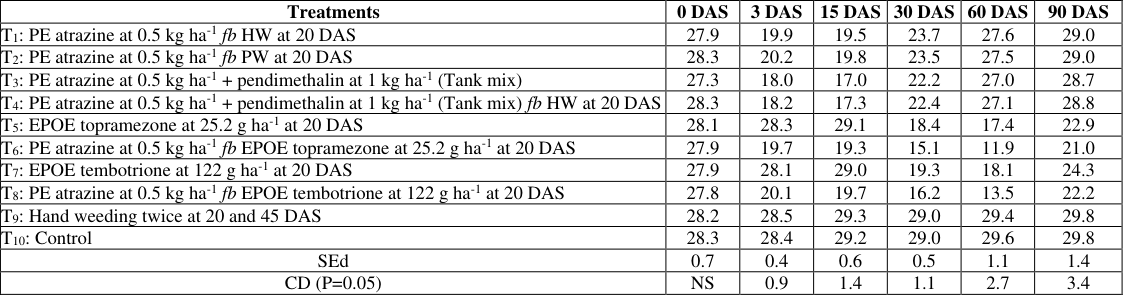 Table 2
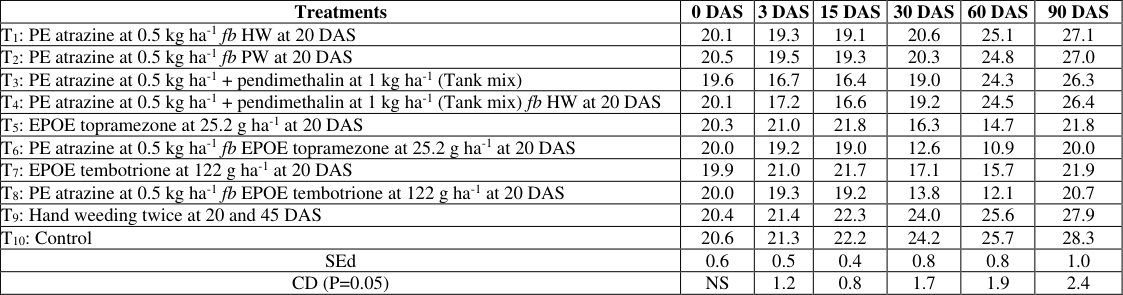 Table 3
Introduction
Corn (Zea mays L.), often considered the "queen of cereals," holds a pivotal role in global agriculture, serving as a crucial grain for both human consumption and livestock feed. In the face of shifting climate conditions, enhancing and preserving soil health becomes paramount to sustain agricultural production, crucial for securing India's food and nutritional stability. Among the various factors influencing lower maize yields, weeds emerge as the predominant factor, competing with the crop for essential resources such as nutrients, water, sunlight and space. Studies have shown that the reduction in maize grain yield ranges from 33 to 50 percent, varying according to the type of weed species present in the standing crop (Hawaldar and Agasimani, 2012) [1] . Increased weed growth can be attributed to factors such as wide spacing, intensive input usage and the initial slow growth of maize plants. In earlier times, before the advent of synthetic chemicals, weed control relied on methods such as manual weeding, crop rotation, polyculture and other low-input yet sustainable management practices. With the discovery of synthetic herbicides in the early 1930s led to a transition in control methods towards high-input and target-oriented approaches. The scarcity of labor in agriculture is increasingly evident, with availability often delayed and costs prohibitive. Herbicide usage presents a viable alternative to manual weeding. In India, the widespread recommendation for weed control in maize has predominantly focused on the pre-emergence application of atrazine or pendimethalin. The management of weeds that emerge 15-25 days after crop planting is crucial as they compete severely for growth resources, thereby reducing maize productivity. Therefore, there is a need to explore post-emergence herbicides that do not leave residual effects, as they offer greater practicality in the field. Despite the economic benefits, herbicides can also have negative impacts on the soil environment (Fang et al., 2015; Pereria et al., 2009) [2][3] .
Once herbicides penetrate the soil, they can affect the soil environment through processes such as sorption-desorption, transformation, transportation to groundwater and degradation (Chowdary et al., 2008) [4] . Therefore, assessing the impact of herbicides on microbial count which are commonly used as indicators of soil fertility and health (Zang et al., 2010) [5] is essential for the prudent utilization of herbicides. Microorganisms are pivotal in the cycling of nutrients and the flow of energy within soil ecosystems, serving as significant indicators of soil health, pollution and ecological restoration (Wu et al., 2016; Liu et al., 2013) [6][7] . The application of herbicides can lead to inhibition, activation, or no discernible effects on soil microorganisms. According to Xu et al., (2017) [8] sterane initially reduced both the diversity and abundance of soil bacteria in a maize field 10 days after application, but these metrics increased after 60 days. Field-level doses of herbicides typically pose minimal risk to soil microbes; however, predicting their response to herbicide application across all environments is challenging. This unpredictability arises from the complex interaction between herbicides and microbes, which is influenced not only by the molecular structure of the herbicide but also by various soil and climatic factors such as temperature, soil moisture and acidity (Tyagi et al., 2018) [9] . Therefore, this current study aims to investigate the impact of various herbicidal treatments on soil microflora in maize crop. The herbicides as per the treatment schedule were applied as pre -emergence at 1 DAS and post emergence at 20 DAS. Maize crop was fertilized with 250 kg N ha -1 , 75 kg P 2 O 5 ha -1 and 75 kg K 2 O ha -1 , respectively. Nitrogen was applied in three splits. 25 per cent nitrogen and full dose of phosphorus and potassium were given as basal dose along with ZnSO4 @ 37.5 kg ha-1. Remaining 50 per cent of nitrogen and 25 per cent of nitrogen was top dressed at 25 and 45 DAS respectively. Excluding the weed management practice, all the recommended improved package of practices of maize was followed in this experiment including the general plant protection measures. The methods employed for analyzing the microbial properties from the experimental plots were collected from the space between the rows at a depth up to 0-15 cm on different dates viz., initial (pre-treatment), 0, 3, 15, 30, 60 and 90 day after Sowing (DAS). The soil samples from different replicates for the same weed control treatment were pooled together and then composite soil samples of each herbicidal treatment were taken for microbial analysis by using dilution plate technique following standard methods. Soil dilutions were prepared in sterile distilled water by constant shaking and plating was done separately in replicates in specific media like for bacteria-Nutrient agar medium (Collins et al., 2004) [10] at 10 -6 dilutions, for fungi-Martin'rose bengal streptomycin agar medium (Martin, 1950) [11] at 10 -4 dilutions and for actinomycetes-Khenheights (Kenknight and munice, 1939) [12] at 10 -5 dilutions. The petri plates were incubated at 30 °C, 2 days, 4 days and 7 days for bacteria, fungi and actinomycetes respectively. After incubation time, emerged colonies were developed and the viable count of soil microbes was enumerated by following the given formula and expressed as CFU per gram of soil (Colony forming unit).
Material and Methods
Material and Methods
Results and Discussion
Results and Discussion
Effect of treatments on soil microbes
The experimental results revealed that when the PE and EPOE applied, significant detrimental effect on soil bacteria, fungi and actinomycetes population registering a reduced microbial count up to 30 DAHA (days after herbicide application). Thereafter, microbial activity started to recover slowly. In the plots not receiving the herbicides such as hand weeded, power weeder weeding and unweeded control, the microbial density increased continuously. PE and EPOE herbicides applied at 1 DAS and 20 DAS respectively. Microbial population was estimated in the soil at 0, 3, 15, 30, 60 and 90 DAS of maize.
Soil bacteria
Bacterial population was significantly influenced by weed control methods. During initial stages, no marked variations among the treatments were noticed (Table 1). Hand weeding twice at 20 and 45 DAS (T 9 ) and Unweeded control (T 10 ) significantly recorded higher bacterial population at all stages of observation. This was on par with EPOE tembotrione (T 7 ) and EPOE topramezone (T 5 ) at 3 and 15 DAS. Application of PE atrazine fb HW at 20 DAS (T 1 ), PE atrazine fb power weeder at 20 DAS (T 2 ), PE atrazine + pendimethalin (tank mix) fb HW at 20 DAS (T 4 ) and PE atrazine + pendimethalin (tank mix) (T 3 ) were on par with T 10 at 60 and 90 DAS. PE atrazine + pendimethalin (tank mix) fb HW at 20 DAS (T 4 ) recorded lower bacterial count which was comparable with PE atrazine + pendimethalin (tank mix) (T 3 ) at 3 and 15 DAS. Whereas, at 30, 60 and 90 DAS, lower bacterial count was recorded with EPOE tembotrione (T 7 ), EPOE topramezone (T 5 ), PE atrazine fb EPOE tembotrione (T 8 ) and PE atrazine fb EPOE topramezone (T 6 ) during pooled data of 2018 and 2019. The reason might be that the herbicides inhibited the microbial population immediately after application due to toxicity in soil environment. As the time passed on, with progressive degradation in herbicidal activity, the microbes adjusted themselves to the new environment and started building up. This was in accordance with the findings of Nalayini (2013) [13] and Sarkar et al. (2005) [14] who reported that pendimethalin (0.75 and 1.00) and fluchloralin (1.00 and 1.50) reduced the total soil bacterial population.
| Treatments | 0 DAS | 3 DAS | 15 DAS | 30 DAS | 60 DAS | 90 DAS |
|---|---|---|---|---|---|---|
| T1: PE atrazine at 0.5 kg ha-1 fb HW at 20 DAS | 37.2 | 28.2 | 27.9 | 30.1 | 38.5 | 42.3 |
| T2: PE atrazine at 0.5 kg ha-1 fb PW at 20 DAS | 39.2 | 28.4 | 27.5 | 29.4 | 37.8 | 42.1 |
| T3: PE atrazine at 0.5 kg ha-1 + pendimethalin at 1 kg ha-1 (Tank mix) | 38.0 | 24.0 | 22.2 | 27.8 | 36.4 | 40.9 |
| T4: PE atrazine at 0.5 kg ha-1 + pendimethalin at 1 kg ha-1 (Tank mix) fb HW at 20 DAS | 38.3 | 23.7 | 22.1 | 27.9 | 37.0 | 41.0 |
| T5: EPOE topramezone at 25.2 g ha-1 at 20 DAS | 37.6 | 38.3 | 39.3 | 23.4 | 19.9 | 30.5 |
| T6: PE atrazine at 0.5 kg ha-1 fb EPOE topramezone at 25.2 g ha-1 at 20 DAS | 38.5 | 27.8 | 26.9 | 17.3 | 12.1 | 28.1 |
| T7: EPOE tembotrione at 122 g ha-1 at 20 DAS | 37.3 | 38.4 | 39.8 | 25.9 | 21.7 | 32.2 |
| T8: PE atrazine at 0.5 kg ha-1 fb EPOE tembotrione at 122 g ha-1 at 20 DAS | 38.3 | 27.9 | 27.1 | 18.5 | 12.7 | 29.5 |
| T9: Hand weeding twice at 20 and 45 DAS | 39.5 | 40.1 | 40.5 | 41.4 | 41.7 | 41.8 |
| T10: Control | 39.3 | 39.6 | 40.4 | 41.7 | 41.9 | 42.8 |
| SEd | 1.4 | 1.1 | 1.0 | 1.3 | 2.3 | 1.8 |
| CD (P=0.05) | NS | 2.6 | 2.3 | 3.2 | 5.7 | 4.2 |
Table text extracted from the original PDF; superscript letters are shown inline. The original table image is below.
View original table image
Soil actinomycetes
Weed management methods had significant influence on the actinomycetes population during 3, 15, 30, 60 and 90 DAS during kharif 2018 and 2019 of pooled data (Table 2). were on par with T 9 and T 10 .
| Treatments | 0 DAS | 3 DAS | 15 DAS | 30 DAS | 60 DAS | 90 DAS |
|---|---|---|---|---|---|---|
| T1: PE atrazine at 0.5 kg ha-1 fb HW at 20 DAS | 27.9 | 19.9 | 19.5 | 23.7 | 27.6 | 29.0 |
| T2: PE atrazine at 0.5 kg ha-1 fb PW at 20 DAS | 28.3 | 20.2 | 19.8 | 23.5 | 27.5 | 29.0 |
| T3: PE atrazine at 0.5 kg ha-1 + pendimethalin at 1 kg ha-1 (Tank mix) | 27.3 | 18.0 | 17.0 | 22.2 | 27.0 | 28.7 |
| T4: PE atrazine at 0.5 kg ha-1 + pendimethalin at 1 kg ha-1 (Tank mix) fb HW at 20 DAS | 28.3 | 18.2 | 17.3 | 22.4 | 27.1 | 28.8 |
| T5: EPOE topramezone at 25.2 g ha-1 at 20 DAS | 28.1 | 28.3 | 29.1 | 18.4 | 17.4 | 22.9 |
| T6: PE atrazine at 0.5 kg ha-1 fb EPOE topramezone at 25.2 g ha-1 at 20 DAS | 27.9 | 19.7 | 19.3 | 15.1 | 11.9 | 21.0 |
| T7: EPOE tembotrione at 122 g ha-1 at 20 DAS | 27.9 | 28.1 | 29.0 | 19.3 | 18.1 | 24.3 |
| T8: PE atrazine at 0.5 kg ha-1 fb EPOE tembotrione at 122 g ha-1 at 20 DAS | 27.8 | 20.1 | 19.7 | 16.2 | 13.5 | 22.2 |
| T9: Hand weeding twice at 20 and 45 DAS | 28.2 | 28.5 | 29.3 | 29.0 | 29.4 | 29.8 |
| T10: Control | 28.3 | 28.4 | 29.2 | 29.0 | 29.6 | 29.8 |
| SEd | 0.7 | 0.4 | 0.6 | 0.5 | 1.1 | 1.4 |
| CD (P=0.05) | NS | 0.9 | 1.4 | 1.1 | 2.7 | 3.4 |
Table text extracted from the original PDF; superscript letters are shown inline. The original table image is below.
View original table image
Soil fungi
The effect of weed control methods on the population of fungi followed a similar trend as that of bacterial population and significant variations were observed (Table 3).
| Treatments | 0 DAS | 3 DAS | 15 DAS | 30 DAS | 60 DAS | 90 DAS |
|---|---|---|---|---|---|---|
| T1: PE atrazine at 0.5 kg ha-1 fb HW at 20 DAS | 20.1 | 19.3 | 19.1 | 20.6 | 25.1 | 27.1 |
| T2: PE atrazine at 0.5 kg ha-1 fb PW at 20 DAS | 20.5 | 19.5 | 19.3 | 20.3 | 24.8 | 27.0 |
| T3: PE atrazine at 0.5 kg ha-1 + pendimethalin at 1 kg ha-1 (Tank mix) | 19.6 | 16.7 | 16.4 | 19.0 | 24.3 | 26.3 |
| T4: PE atrazine at 0.5 kg ha-1 + pendimethalin at 1 kg ha-1 (Tank mix) fb HW at 20 DAS | 20.1 | 17.2 | 16.6 | 19.2 | 24.5 | 26.4 |
| T5: EPOE topramezone at 25.2 g ha-1 at 20 DAS | 20.3 | 21.0 | 21.8 | 16.3 | 14.7 | 21.8 |
| T6: PE atrazine at 0.5 kg ha-1 fb EPOE topramezone at 25.2 g ha-1 at 20 DAS | 20.0 | 19.2 | 19.0 | 12.6 | 10.9 | 20.0 |
| T7: EPOE tembotrione at 122 g ha-1 at 20 DAS | 19.9 | 21.0 | 21.7 | 17.1 | 15.7 | 21.9 |
| T8: PE atrazine at 0.5 kg ha-1 fb EPOE tembotrione at 122 g ha-1 at 20 DAS | 20.0 | 19.3 | 19.2 | 13.8 | 12.1 | 20.7 |
| T9: Hand weeding twice at 20 and 45 DAS | 20.4 | 21.4 | 22.3 | 24.0 | 25.6 | 27.9 |
| T10: Control | 20.6 | 21.3 | 22.2 | 24.2 | 25.7 | 28.3 |
| SEd | 0.6 | 0.5 | 0.4 | 0.8 | 0.8 | 1.0 |
| CD (P=0.05) | NS | 1.2 | 0.8 | 1.7 | 1.9 | 2.4 |
Table text extracted from the original PDF; superscript letters are shown inline. The original table image is below.
View original table image
Conclusion
Microbial population was significantly lesser in pre emergence atrazine at fb either early post emergence topramezone at 20 DAS or early post emergence tembotrione at 20 DAS from initial stage to 60 DAS, later it started increasing but it was lesser than control. Unweeded control did not affect the soil microflora from initial to till harvest of the maize crop. Similar results are in line with Tu and Bollen (1968) [15] who had mentioned herbicides have varying effect on soil microbial populations depending on herbicide concentrations and the microbial species present. Low residue levels can enhance population while higher levels can cause population declines.
References
15 in the original paper- Hawaldar S, Agasimani CA. Effect of herbicides on weed control and productivity of maize (Zea mays L.). Karnataka Journal of Agricultural Sciences. 2012;25(1):137-143.
- Fang H, Lian J, Wang H, Cai L, Yu Y. Exploring bacterial community structure and function associated with atrazine biodegradation in repeatedly treated soils. Journal of Hazardous Materials. 2015;28(6):457-465.
- Pereira L, Antunes SC, Castro BB. Toxicity evaluation of three pesticides on non-target aquatic and soil organisms: commercial formulation versus active ingredient. Ecotoxicology. 2009;18(4):455-463.
- Chowdhury A, Pradhan S, Saha M, Sanyal N. Impact of pesticides on soil microbiological parameters and possible bioremediation strategies. Indian Journal of Microbiology. 2008;48(1):114-127.
- Zhang NN, Sun YM, Li L, Wang ET, Chen WX, Yuan HL. Effects of intercropping and rhizobium inoculation on yield and rhizosphere bacterial community of faba (Vicia faba L.). Biology and Fertility of Soils. 2010;46:625-639.
- Liu BB, Chen D, Kang QY, Liu MQ, Li HX, Jiao JG. The biological indication of soil organisms to soil environment of insecticide factory. Chinese Journal of Soil Science. 2013;44(5):1210-1217.
- Wu XN, Sun JJ, Lu YY, Liu WJ, Yao J. Effect of glyphosate on energy metabolism of soil microorganisms. Chemistry and Bioengineering. 2016;4(5):18-21.
- Xu YR, Fang ZJ, Lu XP, Hao LJ. Effects of starane on maize soil bacterial diversity analyzed by high-throughput sequencing technology. Acta Microbiologica Sinica. 2017;57(7):985-993.
- Tyagi S, Mandal SK, Kumar R, Kumar S. Effect of different herbicides on soil microbial population dynamics in rabi maize (Zea mays L.). International Journal of Current Microbiology and Applied Sciences. 2018; (Spl Issue 7):3751-3758.
- Collins CH, Lyne PM, Grange JM, Falkinham JO. Microbiological methods. 8th ed. Buttrtworths, London, 2004, 144-154.
- Martin JP. Use of acid, rose bengal and streptomycin in the plate method for estimating soil fungi. Soil Science. 1950;69(3):215-232.
- Kenknight G, Muncie JH. Isolation of phytopathogenic actinomycetes. Phytopathology. 1939;29(11):1000-1001.
- Nalayini G. Herbigation in cotton (Gossypium spp): effects on weeds control, soil microflora and succeeding greengram (Vigna radiata). Indian Journal of Agricultural Science. 2013;83(11):4-8.
- Sarkar A, Mukherjee PK, Bhattacharya PM. Bio-efficacy of pendimethalin and fluchloralin in mustard. Indian Journal of Weed Science. 2005;32(1):79-83.
- Tu CM, Bollen WB. Effect of paraquat on microbial activities in soils. Weed Research. 1968;8(1):28-37.