
Research article · 2024 · Full text
International Journal of Research in AgronomyExploring the relevance and impact of ITKs on soil and water conservation in Bagalkot district
Volume 7(4S) · Pages 276–280 · DOI: 10.33545/2618060x.2024.v7.i4sd.622 ↗
Research areasTransboundary Water Resource ManagementFisheries and Aquaculture StudiesAgriculture, Water, and Health
Abstract
Author-writtenITK is the sum total knowledge and practices which are based on people's accumulated experiences in dealing with situations and problems in various aspects of life and such knowledge and practices are special to a particular culture. Many of these knowledge and technologies are at par with the modern knowledge and technology system and have been provided the indigenous communities with comfort and self-sufficiency. These traditional knowledge and technologies are location specific, it is ‘local’, as it is rooted in particular community and situated within broader cultural traditions; it is a set of experiences generated by people living in those communities. Particularly ITKs pertaining to soil and water conservation are being practiced in various localities in different agro ecosystems. Each set of ITKs are suitable only to the selected area and many a times cannot be replicated. The present study aims at documenting, study the relevance and assess the impact of ITKS in soil and water conservation using snowball sampling technique. A total of 120 farmers were interviewed in 3 villages and 2 talukas spread across Bagalkote district adopting expost-facto research design. A semi structured schedule was prepared with the help of experts in the concerned fields. Participant observation and personal interview method with the help of the schedule was used for data collection. The present study was initiated during the year 2017-2019. Frequency percentages were used to interpret the data. Results revealed that, among the ITKs on soil conservation, preparatory tillage (100%) was performed by all the farmers under the study area followed by earthen bunding and field bunding (66.6%). Vegetative barrier adopted by (33%), stone bunding (30%), while compartmental bunding (8.3%), cover crops (9.6%) and bench terrace (4.16%). Similarly, for ITKs on water conservation measures, farm pond was adopted by 54% of the farmers followed by percolation pond (50%). Rest of the measures like earthen check dam runoff storage structure and groundwater recharge were adopted by the (16.66%) 12.5 percent and 10.83 percent respectively. Similarly, under the category of ITKs on soil health measures, application of FYM and preparatory tillage were adopted by all the farmers followed by application of sheep and goat manure (80%) and finally the application of tank silt (29.16%) wherever possible. The study explored the rationale of these ITKs as perceived by the farmers. It was revealed that, promotion of infiltration increases the groundwater recharge (60%), biofencing with vegetative barriers (30%), reduction in soil erosion (8%), retaining soil organic matter and reducing the velocity of water run off were the reasons for adopting the ITKS on soil conservation. The rationale for adopting ITKs on soil health management revealed that, application of Farm Yard Manure and sheep and goat manure improves soil fertility, (100%), summer ploughing eradicates weeds and controls pest (100%),application of tank silt improves soil fertility (29%). The impact of ITKS on yield levels of Kharif and Rabi crops (Greengram and onion as kharif crops sorghum and Bengalgram as Rabi crops) was analyzed and presented in the paper.
Summary
Source-checkedPlain-language reading of the full paper, prepared with AI and checked against the text. Each point links to the authors' own words.
Why it matters
- Indigenous Technical Knowledge (ITK) systems are traditional practices developed over generations that are often energy efficient and provide high economic returns. View evidence ↗
- ITKs are considered beneficial because they are generally cheaper, locally available, and have fewer side effects than modern alternatives. View evidence ↗
- The Bagalkote district in Karnataka's Northern dry zone is characterized by low annual rainfall of approximately 530 mm. View evidence ↗
The question
- The study aimed to document, analyze the relevance of, and assess the impact of indigenous technical knowledge (ITK) on soil and water conservation. View evidence ↗
What they did
- The researchers used an ex-post-facto research design, interviewing 120 farmers across three villages and two talukas in the Bagalkote district. View evidence ↗
- Data was collected through participant observation and personal interviews using a semi-structured schedule developed with expert assistance. View evidence ↗
- The study was conducted between 2017 and 2019, and the resulting data were interpreted using frequency percentages. View evidence ↗
What they found
- For soil conservation, preparatory tillage was used by 100% of farmers, while earthen and field bunding were used by 66.6%. View evidence ↗
- Regarding water conservation, farm ponds were the most adopted measure (54%), followed by percolation ponds (50%). View evidence ↗
- Farmers adopting ITKs achieved a higher green gram yield of 7.35 q/ha compared to 6.13 q/ha in non-adopting areas. View evidence ↗
- The use of ITKs in onion crops resulted in an additional yield of 9.5 tons/ha and a monetary benefit of Rs. 11,010. View evidence ↗
- For rabi crops, sorghum showed an additional yield of 4 q/ha in areas where ITKs were practiced. View evidence ↗
What it means
- The authors recommend that the government implement programs to promote ITKs in collaboration with experienced farmers to conserve the ecosystem. View evidence ↗
Visual summary
2 visualsIllustrations explain the paper; charts are replotted from the paper's own table values.
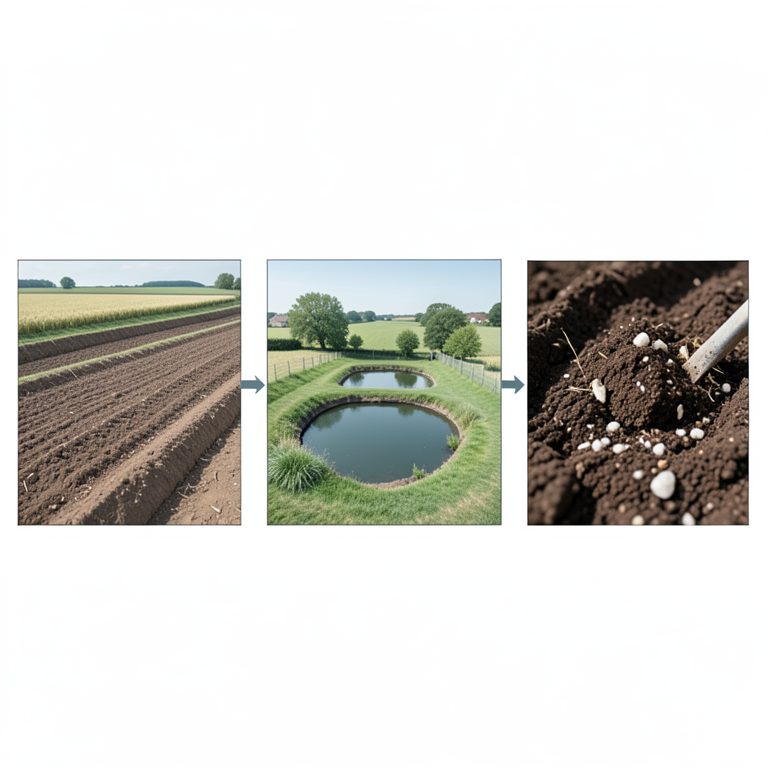
Categorization of ITKs
AI-generated conceptual illustration (Agricultural landscapes in Bagalkot district featuring traditional soil and water conservation structures). It explains the idea and does not show study data.
View source evidence ↗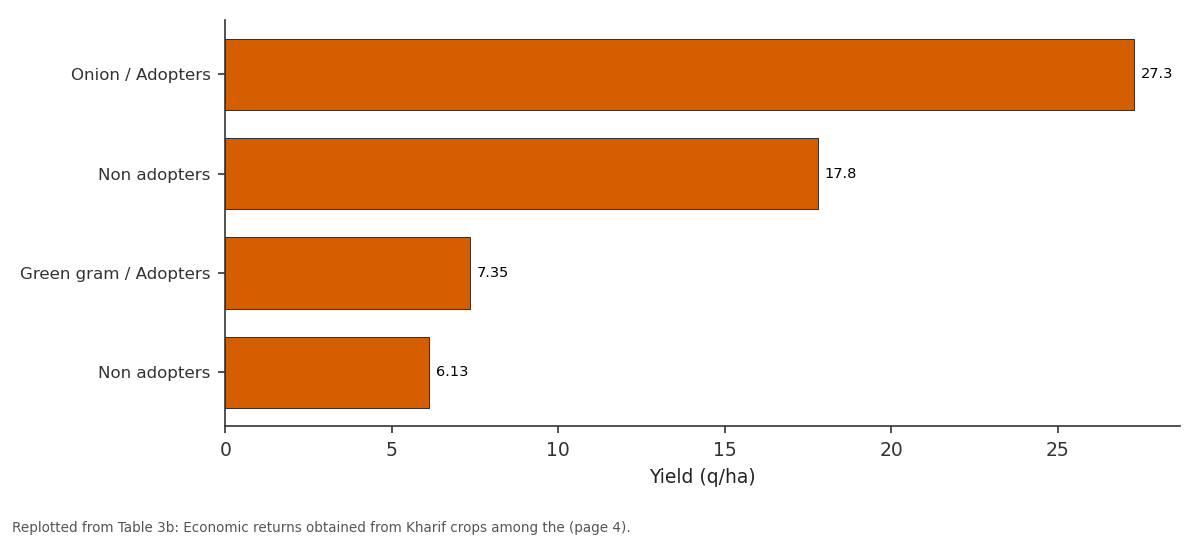
Yield (q/ha): Onion / Adopters vs Non adopters vs Green gram / Adopters vs Non adopters
Replotted from Table 3B (page 4) of the original paper. Every bar is the paper's own table value.
View source evidence ↗Figures & tables
From the original paper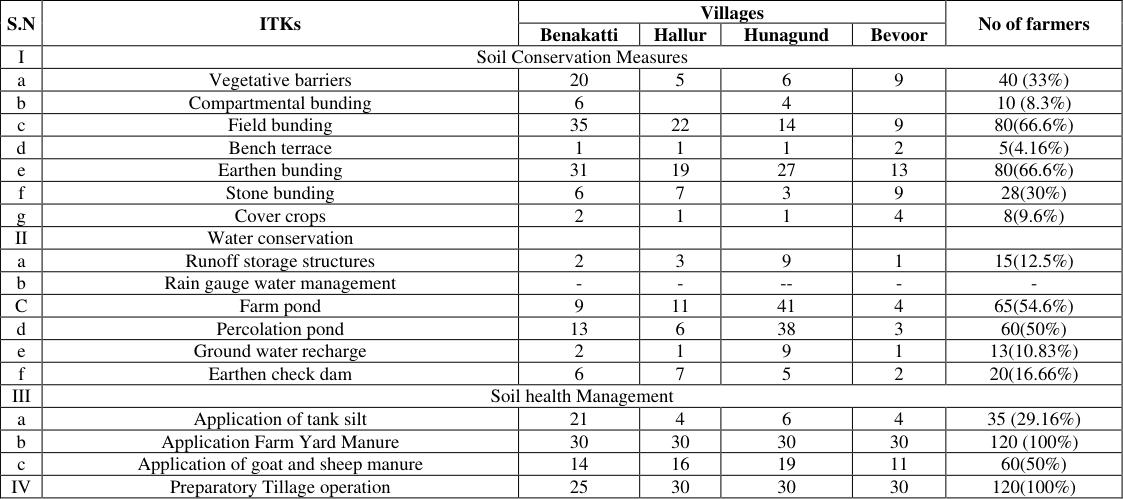 Table 1
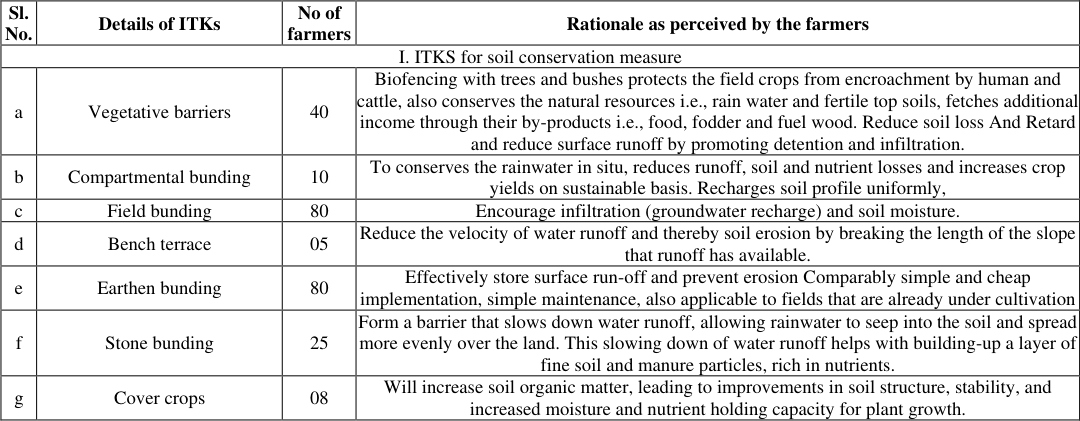 Table 2
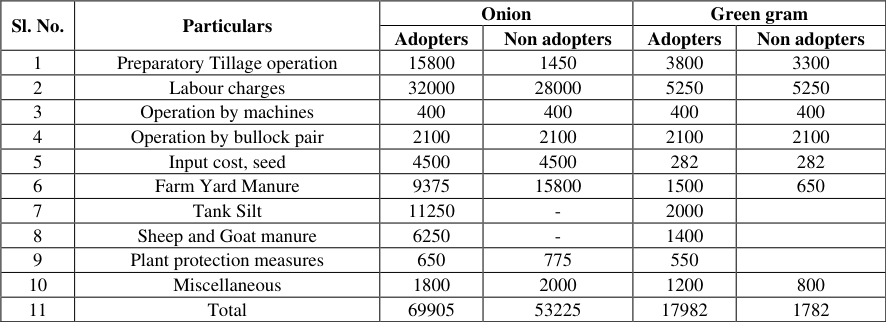 Table 3A
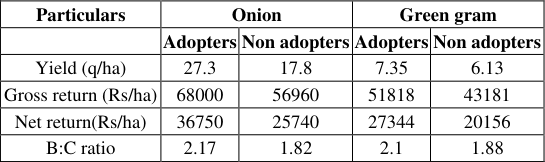 Table 3B
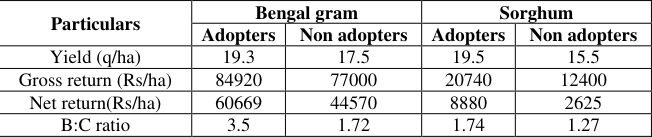 Table 3C
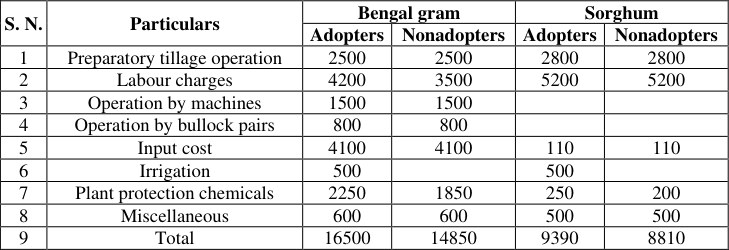 Table 4
Introduction
Indigenous Technical Knowledge (ITK) Systems developed over many generations are often energy efficient, at the same time it provides high economic returns to the farmers. In this context, there is a renewed interest in this traditional agro-ecosystem. One of the major lacunae in India agricultural and rural development is its relative failure to recognize the importance of ITK of farm people, as a potent surface of powerful ingredient of a judiciously synthesized technology. Since the ITKs seem to be cheaper, are locally and easily available even in remote areas and have lesser side effects, the use of these ITKs may be encouraged.
Therefore, it becomes important to, study and understand, document and share the rich resources of indigenous knowledge, traditional practices and innovations followed by the farmers. Particularly ITKs pertaining to soil and water conservation are being practiced in various localities in different agro ecosystems. Each set of ITKs are suitable only to the selected area and many a times cannot be replicated. Bagalkote district in Karnataka state with belonging to Northern dry zone receives annual rainfall of about 530 mm/annum. At present the district has irrigation facility to an extent of about 57 percent, still another 40 percent area is under rainfed agriculture system. The farmers under rainfed system in Bagalkote district especially in Hunagund and Bagalkote still practice the ITKs to conserve soil and harvest rainwater and realized better yields when compared to non-adopter farmers. Hence an attempt was made to document, study the relevance and assess the impact of ITKS in soil and water conservation and their relevance
Methodology
The present study is an innovative effort. Hence, the methodology of documenting indigenous technologies and studying their rationale was evolved during the course of this study and that no existing standard methodology was available for reference. Bagalkote district was purposively selected, based on area receiving low rainfall in northern Karnataka. Bagalkote belongs to Northern Dry zone and receives average 562 mm rainfall yearly. It comprises of six talukas namely, Badami, Bagalkote, Bilagi, Hungund, Jamkhandi, Mudhol. Recently three talukas have been added, thus making a total of nine talukas, of which Hunagund and Bagalkot talukas were purposively selected for the present study with 81601 ha and 29703 ha of dryland respectively. The selection of the villages and farmers was primarily done in consultation with the extension workers of State Department of Agriculture, NGOs and farmers groups.Extension workers worldwide are attracts to progressive farmers like magnets. This is exactly what happened during the present investigation. The extension personnel, particularly those belonging to the State Department of Agriculture, mostly suggested the progressive farmers were the 'old balls ' as Gupta and Patel (1992) [5] call them, ie., the people who think different and who often try old experiments. Apart from purposive selection of such farmers (the old ball) suggested by the extension personnel, some elderly farmers were also selected on random basis who could throw light on the farming practices of pre-green revolution era. Thus, farmers of such villages where certain indigenous technologies were either being practiced or were developed by farmers themselves and continued to practice, were consulted. During the field investigation farmers were asked to inform such of those villages and farmers that they knew where certain specific farm technologies were evolved or were in practice. As a result of this 'snowball approach' names of farmers spread all over the state were suggested, both by the extension personnel as well as farmers. However, care was taken to visit only the villages and farmers coming under the study area i., e, Bagalkote and Hunagund taluka. The respondents included practitioners of indigenous technologies, present generation evolvers of technologies are also the endorsers of prevalent indigenous technologies. In this way, the villages visited and farmers contacted included those visited randomly as well as purposively. In all 120 farmers were interviewed in 3 villages and 2 talukas spread across Bagalkote district. A semi structured schedule was prepared and used for data collection. The draft schedule was pre-tested in a non -sample area to locate the ambiguity. Since varied information on indigenous technologies was forthcoming from the farmers, like information on traditional practices, contemporary innovations etc., it was realized that it was not possible to carry a standard schedule to collect all types of information. Hence an exhaustive list of leading question to cover both traditional technologies as well as, contemporary innovations was designed. The emphasis here was on making use of a combination of common sense, a genuine desire to learn from people and eye for detail as Gupta and Patel (1991) [6] put it. After completion of field survey a comprehensive list of technologies identified was prepared. The list was then sorted out, based on the nature of technologies identified by consulting experts. As and when the respondents mentioned of any indigenous technologies that they had devised, innovated or were practicing since generations, they were requested to elicit the benefits or economic advantages including soil fertility and yield etc. as well as non-economic benefits like the technologies being environmentally friendly, sustainable etc the economic advantages perceived by the farmers were noted down. Scientific rationale refers to the possible scientific explanation for each of the indigenous technology document i.e., The systemic procedure involved in practicing the technology, the active principles and ingredients responsible for particular elicit etc., the purpose behind studying the rationality was to reinforce farmers ingenuity and experimentation. For establishing scientific rationality, the technologies documented through field survey were sorted out into the technologies that are indigenous but already in vogue among the farmers and scientists alike and those which are seemingly new or unknown to a majority of farmers and scientists. The data was processed and tabulated by using simple statistical tools like frequency and percentages.
Results and Discussion
In the category of ITKs on water conservation measures, farm pond was adopted by 54% of the farmers followed by percolation pond (50%). Rest of the measures like earthen check dam runoff storage structure and groundwater recharge were adopted by the (16.66%) 12.5 percent and 10.83 percent respectively. The results revealed that, indigenous tool rainguage was not adopted by the farmers in the study area. In the category of ITKs on soil health measures, application of FYM was widely practiced by all the farmers followed by application of sheep and goat manure (80%) the farmers (80%) which was an additional source of nutrients to the soil and finally the application of tank silt (29.16%) was practiced in the farmers' field wherever possible. Preparatory tillage was adopted by 100 percent farmers. From the village wise data (Table 1), it is clear that among soil conservation measures, field bunding and earthen bunding were the most prevalent practices followed by vegetative barriers. Among the villages, Benakatti has highest number of vegetative barriers followed by Bevoor. Field bunding were also prominently seen in Benakatti followed by Hallur and Hunagund area. Whereas earthen bunding was prominently practiced in Benakatti followed by Hunagund and Hallur farmers. Cover crops, compartment bunding and bench terrace were the least practiced ITKs with 9.6%, 8.3%, 4.1% respectively. Among the ITKs on water conservation measures, farm pond was the single largest measure adopted by 54.16 percent of the farmers followed by percolation pond, earthen checkdam (16.66%), run off storage structure (12.5%) and ground water recharge were the other practices followed by the farmer. Respondent farmers from Hunagund had more number of farm ponds and percolation ponds. In the category of ITKs on soil health management application of FYM was practiced by all the farmers followed by application of sheep and goat manure (50%). Application of tank silt was practiced by 29.16% of the farmers. Preparatory tillage was another practice which was being followed in the study area. %). Results are in line with findings obtained by many researchers (Ingle et al.; 2000 and Chittiraichelvan and Raman; 1992, Dekel and Fairs; 1992, Dey; 1992) [8,2,3,4] reveal that ploughing and harrowing across the slopes is an indigenous land preparation, ploughing during April May for maximum retention of rain water and enhancing fertility status of the soil., summer ploughing was proven ITK which controls insect pest and diseases on one hand and decreases soil compaction, increases aeration and infiltration rate on the soil. Hulagur (2006) [7] also found that, through effective soil and moistureconservation measures, there was remarkable improvement in groundwater table and vegetative treatments and also proved that comprehensive watershed development with people's participation is a feasible proposition. The results presented in table 2 reveals the rationality behind the identified ITKS. Since the rationale for adoption of soil and water conservation measures, soil health management were documented based on the perception of the farmers, though the farmers could not quantify the soil eroded, quantity of the water conserved and the exact enhancement of nutritional status of the soil, they were able to judge the benefits of these ITKSs, based in their experience. Retention of sunflower stalks acts as a barrier for runoff and reduces soil loss. It provides more opportunity time for the infiltration of rainwater. It increased the yield of rabi sorghum, sunflower and chickpea to a extent of 30-35 percent (Surkod et al. 2003) [12] , these authors also mentioned about the use of groundnut shells as cover mulching agent. These researchers also document the advantages of stone bunding. They opine that, there will not be moving of top soil to the bund. Top fertile soil is conserved and breaching of bunds is not observed as in case of earthen bunds. The increase in yield of rabi sorghum chickpea, sunflower and pearl millet was to an extent of 40-45 percent compared with no bunding in the field. [13] concluded that the scientists highly favored the continuous use of 8 out of the 26 traditional practices as such on the basis of their scientific rationality, which relates to inter culturing in kharif, use of local implements for removal of weeds and preparing soil, tying a piece of cloth on plough for adjusting depth of sowing, collecting seed of mustard during noon hours and deep sowing of chickpea. The scientists were undecided about the scientific rationality of another set of 8 traditional practices. The remaining 10 practices were related to unscientific Major crops cultivated under the study area were onion, Greengram in kharif season, Bengalgram and sorghum in rabi season. The results presented in table 3a and 3b depicts effect of soil and water conservation measure on yield and economics of these crops. Yield levels of green gram in the study area was 7.35 q/ha when compared to non-adopted area (6.13 q/ha). An additional income of Rs. 7188/ha was realized by the farmers practicing ITK with a B:C ratio of 1: 1.21 in the ITK area while 1.18 in non-practicing area. In the onion crop an additional yield of 9.5 tons/ha was realized in study area with monitory benefit of Rs. 11010. The B:C ratio was 1:2.17 in study area while it was 1.82 in nonpracticing area. It can be clearly seen that, the difference in the gross return, the difference in the cost of production is almost equivalent inonion, the net return was more. Among rabi crops sorghum (Table 3c) was found to be the main crop, here also an additional yield of 4 q/ha was obtained in ITK practiced area with a B:C ratio of 1.72, while in non practicing area, the yields were less i.e., 15.5 q/ha with a B:C ratio of 1.27. Similarly, in Bengal gram, the total yield was 19.30q/ha in ITK practiced area, while in 17.5 q/ha in non-practicing area, giving an additional yield of 1.8 q/ha. The cultivation of Bengal gram was found to be economical compared to all the crops. It could be because of the reason the per quintal price of the Bengal gram is more when compared other crops. The net return was Rs.60669/ha in ITK practiced area and Rs. 44570/-in nonpracticing area with a B:C ratio of 1:3.5 and 1:1.72 respectively. Due to recycling of pond water, 30%-40% of the catchment area gets recharged with moisture and the yield increases between 55% and 90% and the gross return by 55% and 86% with 5 cm and 10 cm of additional water, respectively (Adhikari and Mishra 2009) [1] . A study showed that in a normal year, the supplemental irrigation provided from the stored water from a 10 ha catchment yields net benefits of Rs.76627, Rs, 61215 and Rs. 59210 from 5 cm, 7.5 cm and 10 cm of irrigation water from pond by irrigating 5.2 ha, 3.5 ha and 2.6 ha respectively. Lingappa and Itnal (2006) [9] documented the impact of compartmental bunding on the yield levels of rabi crops. They found that, there was 40 percent, 35 percent, 38 percent and 50 percent increase in yields of Rabi sorghum, sunflower, safflower and chickpea respectively. At central soil and water conservation Research and training Institute, Research Centre Bellary (Karnataka) in deep black soils (vertisols), laying out of fields with compartment bunds increased the rabi sorghum yields by 26% during 1989 and 17% during 2003. The magnitude of increase in grain yield with compartmental bunding was higher (28%) during moderate drought year as compared to only 16% during normal year.
| S.N | ITKs | Villages | — | — | — | No of farmers |
|---|---|---|---|---|---|---|
| Benakatti | Hallur | Hunagund | Bevoor | |||
| I | Soil Conservation Measures | |||||
| a | Vegetative barriers | 20 | 5 | 6 | 9 | 40 (33%) |
| b | Compartmental bunding | 6 | 4 | 10 (8.3%) | ||
| c | Field bunding | 35 | 22 | 14 | 9 | 80(66.6%) |
| d | Bench terrace | 1 | 1 | 1 | 2 | 5(4.16%) |
| e | Earthen bunding | 31 | 19 | 27 | 13 | 80(66.6%) |
| f | Stone bunding | 6 | 7 | 3 | 9 | 28(30%) |
| g | Cover crops | 2 | 1 | 1 | 4 | 8(9.6%) |
| II | Water conservation | |||||
| a | Runoff storage structures | 2 | 3 | 9 | 1 | 15(12.5%) |
| b | Rain gauge water management | - | - | -- | - | - |
| C | Farm pond | 9 | 11 | 41 | 4 | 65(54.6%) |
| d | Percolation pond | 13 | 6 | 38 | 3 | 60(50%) |
| e | Ground water recharge | 2 | 1 | 9 | 1 | 13(10.83%) |
| f | Earthen check dam | 6 | 7 | 5 | 2 | 20(16.66%) |
| III | Soil health Management | |||||
| a | Application of tank silt | 21 | 4 | 6 | 4 | 35 (29.16%) |
| b | Application Farm Yard Manure | 30 | 30 | 30 | 30 | 120 (100%) |
| c | Application of goat and sheep manure | 14 | 16 | 19 | 11 | 60(50%) |
| IV | Preparatory Tillage operation | 25 | 30 | 30 | 30 | 120(100%) |
Table text extracted from the original PDF; superscript letters are shown inline. The original table image is below.
View original table image
Conclusion
Indigenous technical knowledge is generated by trial and error, experiences and keen observation over a time period in agriculture. This is eco-friendly, cost effective and sustainable with local resources. So, there is need of documentation of these ITKs before valuable knowledge lost forever. The application of ITKs in soil and water management have shown impact on yields, hence these ITKs may be replicated in the areas wit similar ecosystem. There may be some programs from the Govt to promote ITKs in consultation with the learned farmers in order to make effective use of these ITKs and conserve ecosystem.
Figures and tables from the paper
| Sl. No. | Particulars | Onion | — | Green gram | — |
|---|---|---|---|---|---|
| Adopters | Non adopters | Adopters | Non adopters | ||
| 1 | Preparatory Tillage operation | 15800 | 1450 | 3800 | 3300 |
| 2 | Labour charges | 32000 | 28000 | 5250 | 5250 |
| 3 | Operation by machines | 400 | 400 | 400 | 400 |
| 4 | Operation by bullock pair | 2100 | 2100 | 2100 | 2100 |
| 5 | Input cost, seed | 4500 | 4500 | 282 | 282 |
| 6 | Farm Yard Manure | 9375 | 15800 | 1500 | 650 |
| 7 | Tank Silt | 11250 | - | 2000 | |
| 8 | Sheep and Goat manure | 6250 | - | 1400 | |
| 9 | Plant protection measures | 650 | 775 | 550 | |
| 10 | Miscellaneous | 1800 | 2000 | 1200 | 800 |
| 11 | Total | 69905 | 53225 | 17982 | 1782 |
Table text extracted from the original PDF; superscript letters are shown inline. The original table image is below.
View original table image
| Particulars | Onion | — | Green gram | — |
|---|---|---|---|---|
| Adopters | Non adopters | Adopters | Non adopters | |
| Yield (q/ha) | 27.3 | 17.8 | 7.35 | 6.13 |
| Gross return (Rs/ha) | 68000 | 56960 | 51818 | 43181 |
| Net return(Rs/ha) | 36750 | 25740 | 27344 | 20156 |
| B:C ratio | 2.17 | 1.82 | 2.1 | 1.88 |
Table text extracted from the original PDF; superscript letters are shown inline. The original table image is below.
View original table image
| Particulars | Bengal gram | — | Sorghum | — |
|---|---|---|---|---|
| Adopters | Non adopters | Adopters | Non adopters | |
| Yield (q/ha) | 19.3 | 17.5 | 19.5 | 15.5 |
| Gross return (Rs/ha) | 84920 | 77000 | 20740 | 12400 |
| Net return(Rs/ha) | 60669 | 44570 | 8880 | 2625 |
| B:C ratio | 3.5 | 1.72 | 1.74 | 1.27 |
Table text extracted from the original PDF; superscript letters are shown inline. The original table image is below.
View original table image
| S. N. | Particulars | Bengal gram | — | Sorghum | — |
|---|---|---|---|---|---|
| Adopters | Nonadopters | Adopters | Nonadopters | ||
| 1 | Preparatory tillage operation | 2500 | 2500 | 2800 | 2800 |
| 2 | Labour charges | 4200 | 3500 | 5200 | 5200 |
| 3 | Operation by machines | 1500 | 1500 | ||
| 4 | Operation by bullock pairs | 800 | 800 | ||
| 5 | Input cost | 4100 | 4100 | 110 | 110 |
| 6 | Irrigation | 500 | 500 | ||
| 7 | Plant protection chemicals | 2250 | 1850 | 250 | 200 |
| 8 | Miscellaneous | 600 | 600 | 500 | 500 |
| 9 | Total | 16500 | 14850 | 9390 | 8810 |
Table text extracted from the original PDF; superscript letters are shown inline. The original table image is below.
View original table image
References
5 in the original paper- Gupta AK, Patel KK. Survey of farmers innovation in Gujarat, part II. Honey bee. 1992;3(1):9-18.
- Gupta AK, Patel KK. Experimenting farmers, pastoralists and artisans: Report of survey of local innovations in dry regions of Gujarat. Honey Bee. 1991;2(1):12-23.
- Hulagur BF. Watershed development-NABARD initiatives. Technical digest. 2006;6:1-4.
- Padaria RN, Singh RP. Risk adjustment and traditional wisdom in dryland farming. Indian Journal of Extension Education. 1990;26(3 and 4):1-7.
- Kumar K, Nath R, Wyant GM. Treatment of chronic pain by epidural spinal cord stimulation: a 10-year experience. Journal of neurosurgery. 1991 Sep 1;75(3):402-407.
Cited by 1
From OpenAlex, OpenCitations and reference lists read by Scinovex
- Integrating Tradition and Innovation ↗
Sanjeev Kumar, N. D. Chethan Patil, Harpinder Singh Sandhu, Sapna Jarial · IGI Global eBooks · 2025
This chapter examines the integration of Indigenous Technical Knowledge (ITK) with modern agricultural practices to promote sustainability, productivity, and resilience in farming systems. Rooted in centuries of adaptation to local environments, ITK encompasses diverse methods such as water harvesting, soil health management, animal health practices, and biodiversity conservation. Highlighting practices like the khadin system, johads, panchagavya, and sacred groves, this…
❝ 0