
Research article · 2024 · Full text
International Journal of Research in AgronomyManagement of wheat pests under rainfed conditions
Volume 7(4) · Pages 584–588 · DOI: 10.33545/2618060x.2024.v7.i4h.608 ↗
Research areasAgriculture and Biological StudiesCrop Yield and Soil Fertility
Abstract
Author-writtenThe studies on “Management of wheat pests under rainfed conditions” were conducted at Dharwad during rabi, 2013. Wheat productivity in Karnataka is very low 988 kg/ha as compared to national average 2900kg/ha. This mainy due to large area (60%) grown under rainfed condition and recent introduction of aphids, wheat shoot fly and stem borer causing (20-35%) reduction in yield. In order to mitigate these pests, organized research programme on bio rational management of wheat pests under field conditions. After six days of treatment Imidacloprid 17.8SL @ 0.3ml/L was found to be best treatment resulted 0.15 aphids per sq. inch per plant per tiller and biorational, Nimbecidine 0.03% @ 5 ml/L recorded 2.33 aphids/sq. inch. Against shoot fly after eight days of treatment. It was significantly lowest percent dead heart (1.03%) recorded at seed treatment with Imidacloprid 600 FS @ 5ml/kg seed followed by foliar spray of Imidacloprid 17.8SL @ 0.3ml/L. Nimbecidine 0.03% @ 5 ml/L recorded (3.48%) dead heart. However, it was (24.83%) dead heart registered at control. Against stem borer Thiamethoxam 70 WS @ 5gm/kg and foliar spray of Thiamethoxam 25 WG @ 0.3 g/L was found to be best treatment that recorded lowest 0.53 percent dead heart after eight days after treatment.
Summary
Source-checkedPlain-language reading of the full paper, prepared with AI and checked against the text. Each point links to the authors' own words.
Why it matters
- Wheat is a critical global food source, ranking second only to rice in production. View evidence ↗
- Wheat productivity in Karnataka is significantly lower than the Indian national average, largely because 60% of the crop is grown under rainfed conditions and suffers from insect attacks. View evidence ↗
- In northern Karnataka, aphids, shoot fly, and stem borers have become the primary insect pests causing damage to wheat. View evidence ↗
The question
- The study aimed to evaluate the efficacy of various insecticides and biorational treatments in managing wheat pests under rainfed conditions. View evidence ↗
What they did
- The research was conducted at MARS Dharwad during the 2012-13 rabi season using a randomized block design with seven treatments replicated three times. View evidence ↗
- The study utilized the wheat variety UAS-304, sown in late November. View evidence ↗
What they found
- Against shoot fly, Imidacloprid (T1) achieved the lowest dead heart incidence (1.03%) after eight days, compared to 24.83% in the control group. View evidence ↗
- For stem borer control at 8 days after treatment, Thiamethoxam (T2) and Profenophos (T6) recorded the lowest dead heart incidence (0.53% and 0.83% respectively), while the control had 15.17%. View evidence ↗
- In the aphid study, Imidacloprid (T1) resulted in the highest grain yield (44.50 q/ha), while the untreated check had the lowest (40.47 q/ha). View evidence ↗
- For shoot fly and stem borer management, the combination of Imidacloprid seed treatment and foliar spray (T1) produced the highest yield (41.80 q/ha), significantly higher than the control (30.65 q/ha). View evidence ↗
What it means
- The authors concluded that imidacloprid and thiomethoxam are highly effective for controlling aphids, shoot flies, and stem borers in wheat. View evidence ↗
- The authors recommend integrated pest management strategies that combine seed treatments and foliar sprays to improve wheat productivity. View evidence ↗
Visual summary
1 visualsIllustrations explain the paper; they do not show study data.
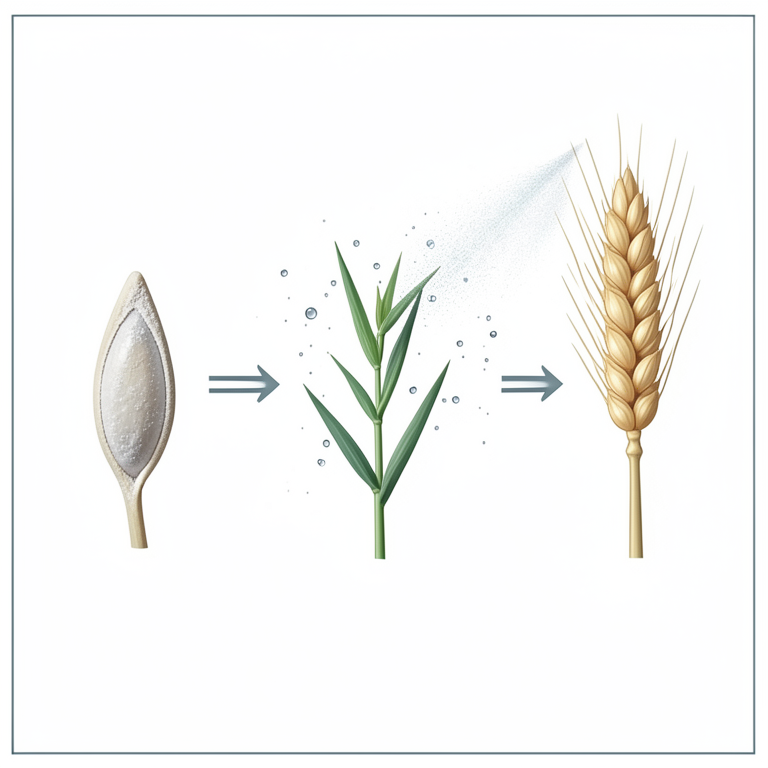
Integrated Pest Management Strategy
AI-generated conceptual illustration (wheat plants). It explains the idea and does not show study data.
View source evidence ↗Figures & tables
From the original paper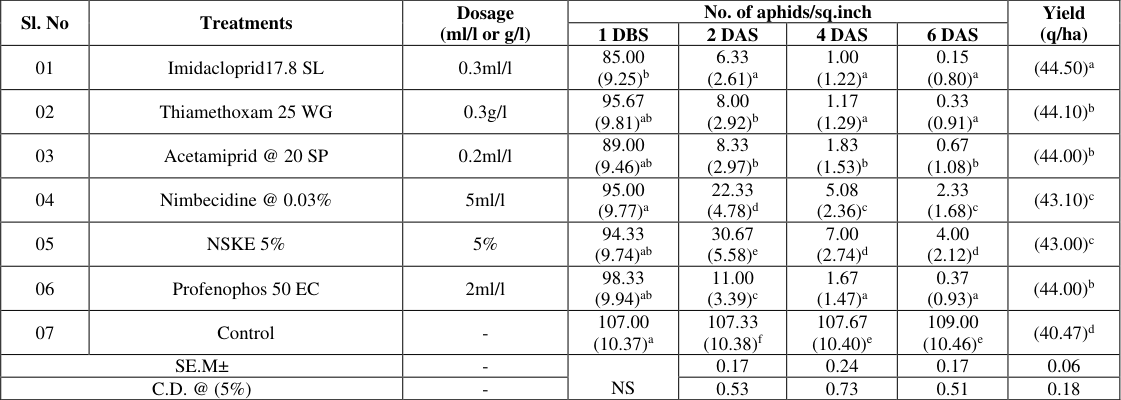 Table 1
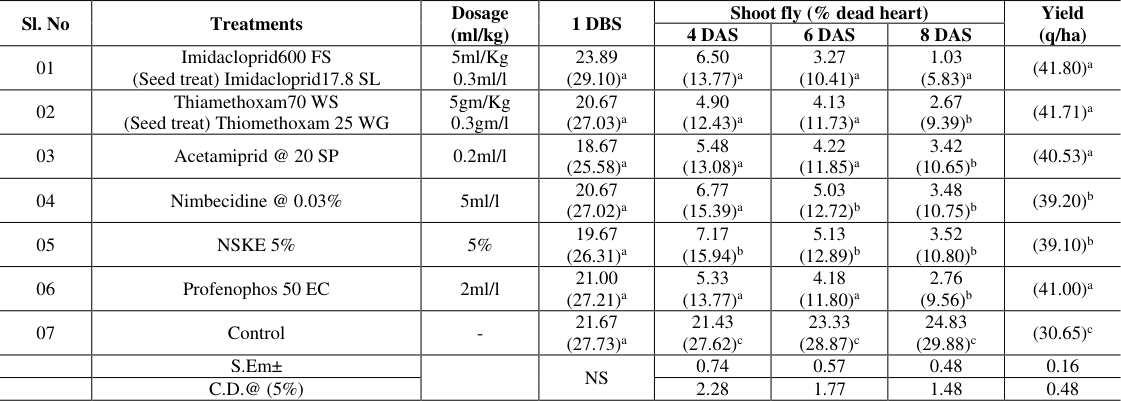 Table 2
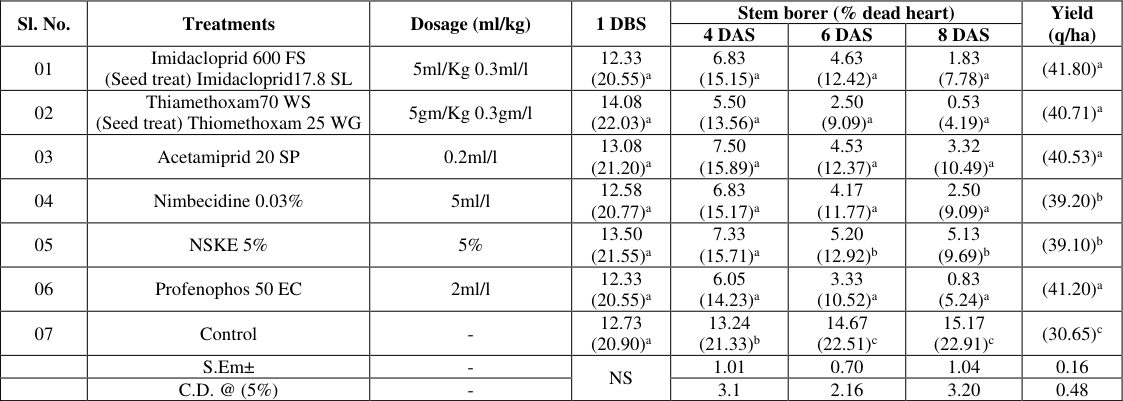 Table 3
Introduction
Wheat (Triticum spp.) is a stuff of life and has been considered as the "versatile cereal food". It is also described as "King of cereals" for centuries and continues to retain this pride of place with its roots ramifying into the depths of human culture with evolutionary history parallel with the human civilization itself. Wheat occupies second position next to rice in production among all the cultivated crops due to its feeding boon to mankind. It is the number one food grain consumed directly by human beings and is estimated that more than 35 percent of the world population depends on wheat (Borlaug 1968) [3] as it supplies more nutrients particularly, essential amino acids than any other single crop. India ranks second in wheat production with 33.20 M ha as under cultivation and production of 97.9 million tonne and with an average productivity of 30q/ha (Anonymous 2016) [1] . Wheat cultivation in Karnataka is unique where in all the three cultivated species are grown in typical hot tropical climate, characterized by the high temperature during the crop growth. Wheat is the one of the important Rabi crop grown mainly in Northern Karnataka both under the rainfed and irrigated conditions covering an area of 2.14 lakh hectares with an annual production of 2.3 lakh tones (Singh, 2014) [9] . The productivity of wheat is very low (988 kg/ha) in Karnataka as compared to the national average of 2900 kg/ha. This is mainly due to the fact that large area of wheat (60%) is grown under rain fed condition, non-adaptability of improved technologies and attack of many insects. Although damage caused by most of these insects is either insignificant or limited to isolated areas, other pests inflict serious yield and forage losses. Some of these pest problems are directly linked to the unique farming system employed in a particular area, while other pests are opportunistic or generalist herbivores that do not specifically target wheat as a host (Miller and Pike, 2002) [8] . So far more than twenty six (26) insect pests have been recorded on this crop under Indian conditions (Anonymous, 2016) [1] . In the past fifty years there has been an increase in wheat productivity and have also been marked by considerable changes in the pest complex.
Introduction of high yielding wheat varieties has changed the wheat ecosystem and the changes in the crop environment have become conducive for the development and multiplication of certain insect pest species and have accelerated the incidence of older but innocuous pests and also have lead to emergence of new ones. Consequently over the years, various regions of the country have witnessed limited epidemics of pests like army worm; ghujiya weevil etc., while pests like shoot fly, pink stem borers, brown wheat mite, foliar aphids, termites, have become common and of almost regular occurrence and some new emerging threats to wheat i.e., pink stem borer with the regular involvement of the entomologist in the All India Wheat and Barley Improvement Project. According to Duveiller et al. (2007) [4] Chewing and feeding insects usually do not cause major direct damages in wheat, unless populations reach very high levels. Infestation by several aphids feeding on wheat, such as Sitobion avenae or Rhopalosiphum padi, result in higher BYDV incidence. In some areas, green bug (Shizaphis graminum) and Russian wheat aphids (Diuraphis noxia) cause damage by injecting a toxin when they feed on leaves. Pink Stem borer (Sesamia inferens Walker), Shoot fly (Atherigona oryzae Malloch) Termites, (Microtermus obesus Holmgren) and (Odontotermus obesus Rambur) and Cut worms (Agrotis ipsilon Hufnagel) Wheat thrips, (Anaphothrips sudanensis Trybom) Aphid, (Macrosiphum miscanthi Takahashi) are the insects presently occurring on wheat. In the last five years shoot fly, stem borer and aphids are causing more damage in the various district of northern Karnataka. Shoot fly is causing more than 26 percent dead heart damages followed by Pink Stem Borer causing 10 percent dead hearts and white ear heads at later crop growth stage, followed by Aphids (Anonymous, 2016) [1] . Based on these data collected we planned our programme of research on management of wheat pests under rainfed conditions was carried out at UAS Dharwad, Karnataka.
Materials and Methods
1. Bio-+6 2. .0/efficacy of insecticides and biorationals on incidence of aphid, (Rhopalosiphum maidis) on wheat at MARS Dharwad (rabi, 2012-13)
The studies on management of aphids were carried out at MARS Dharwad under rainfed conditions during (rabi, 2012-13) with seven treatments that were replicated thrice in randomised block design to test the efficacy of insecticides against aphids. The sowing of wheat variety UAS-304 was done in second fortnight of November (30/11/2013). Seven treatments were imposed to study the efficacy of chemicals and biorationals. Treatments were imposed at ETL with help of pneumatic sprayer covering the both the sides of the leaves and all shoot thoroughly. The observations on number of aphids per square inch were recorded at one day before spray, two, four and six days after treatment respectively.
Bioefficacy of insecticides and biorationals on incidence of shoot fly, (A. soccata Rond) and stem borer (Sesamia inferens) on wheat at MARS Dharwad (rabi, 2012-13)
The studies on management of shoot fly were carried out at MARS Dharwad under rainfed conditions during (rabi, 2012-13) with seven treatments that were replicated thrice in randomised block design to test the efficacy of insecticides against aphids. The sowing of wheat variety UAS-304 was done in second fortnight of November (30/11/2013). Seven treatments were imposed to study the efficacy of chemicals and biorationals.
Treatments viz. T1: Seed treatment with Imidacloprid 600 FS @ 5ml/Kg seed followed by foliar spray of Imidacloprid17.8 SL @ 0.3ml/L T2: Seed treatment with Thiamethoxam70 WS @ 5g/Kg seed followed by foliar spray of Thiamethoxam 25 WG) T3: Acetamiprid 20 SP T4: Nimbecidine 0.03% T5: NSKE 5% T6: Profenophos 50 EC T7: Control Treatments were imposed at ETL. Observations were recorded on percent dead heart in treated plot one day before treatment two, four six and eight days after treatment for shoot fly and stem borer. After crop attained maturity it was harvested, the earheads were kept separately from each treatment. The plot wise yield was computed on hectare basis for statistical interpretations. The cost of cultivation was worked out as per the recommended package of practices. The economics of different treatment was worked out based on the grain and fodder yield and cost of protection. Treatment cost was added to each treatment, and then sale price of the grain and fodder was also considered to work out gross profit. Based on the cost of cultivation and gross profit economy of different treatments was worked out and BCR calculated.
Statistical analyses
All the data collected in each experiment was subjected to the suitable transformations to analyse. The analysis was done using RBD excel design and values were analysed using Duccans Multiple Range Test in M-STAT software.
For sucking pests (Aphids) = Number of aphids per square inch leaf
For sucking pests (Aphids) = Number of aphids per square inch leaf
Results
Results
Bioefficacy of insecticides and biorationals on incidence of aphid, (Rhopalosiphum maidis) on wheat at MARS Dharwad (rabi, 2012-13)
The data on efficacy of various treatments in reducing aphid population was recorded and furnished in the (Table 1). There was no significant difference in the aphid population among the treatments a day before imposition of treatments with a population range of from 85 to 107.00/sq inch. Two days after spray, T 1 was significantly superior to all the treatments. This was followed by T 2 & T 3 which were on par with each other. T 6 was the next best and was superior to T 4 & T 5 which recorded highest infestation both were superior to untreated check. Whereas untreated check recorded significantly highest aphid population of 107.33/sq.inch. Four days after spraying T 1 , T 2 and T 6 (1.00, 1.17 & 1.67/sq.inch) were on par with each other. This was followed by T 3 which was significantly superior to T 4 & T 5 . T 4 was superior to T 5 . All insecticide treatments were significantly superior over the untreated check (107.67/m 2 ). Six days after spraying T 1 recorded only 0.15/sq. inch aphids and was on par with T 2 & T 6 (0.33 & 0.37). This was followed by T 3 , T 4 & T 5 (0.67, 2.33 & 4.00). T 3 was superior to both T 4 & T 5 . All insecticide treatments were significantly superior over the untreated check (109.0 aphids/sq.inch).
| Sl. No | Treatments | Dosage (ml/l or g/l) | No. of aphids/sq.inch | — | — | — | Yield (q/ha) |
|---|---|---|---|---|---|---|---|
| 1 DBS | 2 DAS | 4 DAS | 6 DAS | ||||
| 01 | Imidacloprid17.8 SL | 0.3ml/l | 85.00 (9.25)b | 6.33 (2.61)a | 1.00 (1.22)a | 0.15 (0.80)a | (44.50)a |
| 02 | Thiamethoxam 25 WG | 0.3g/l | 95.67 (9.81)ab | 8.00 (2.92)b | 1.17 (1.29)a | 0.33 (0.91)a | (44.10)b |
| 03 | Acetamiprid @ 20 SP | 0.2ml/l | 89.00 (9.46)ab | 8.33 (2.97)b | 1.83 (1.53)b | 0.67 (1.08)b | (44.00)b |
| 04 | Nimbecidine @ 0.03% | 5ml/l | 95.00 (9.77)a | 22.33 (4.78)d | 5.08 (2.36)c | 2.33 (1.68)c | (43.10)c |
| 05 | NSKE 5% | 5% | 94.33 (9.74)ab | 30.67 (5.58)e | 7.00 (2.74)d | 4.00 (2.12)d | (43.00)c |
| 06 | Profenophos 50 EC | 2ml/l | 98.33 (9.94)ab | 11.00 (3.39)c | 1.67 (1.47)a | 0.37 (0.93)a | (44.00)b |
| 07 | Control | - | 107.00 (10.37)a | 107.33 (10.38)f | 107.67 (10.40)e | 109.00 (10.46)e | (40.47)d |
| SE.M± | - | NS | 0.17 | 0.24 | 0.17 | 0.06 | |
| C.D. @ (5%) | - | 0.53 | 0.73 | 0.51 | 0.18 |
Table text extracted from the original PDF; superscript letters are shown inline. The original table image is below.
View original table image
(a) Yield: Among the treatments T 1 gave significantly maximum yield of 44.50q/ha. This was followed by T 2 , T 3 & T 6 were on par with each other. Whereas lowest yield was obtained in untreated check (40.47q/ha).
(ii) Bioefficacy of insecticides and biorationals on incidence of shoot fly Atherigona soccata
Rond and stem borer Sesamia inferens on wheat at MARS Dharwad (rabi, 2012-13): The data on efficacy of various treatments in reducing the pest population after the spray was recorded and furnished in the (Table 2). There was no significant difference in the shoot fly population among the treatments a day before imposition of treatments. The percent dead heart/m 2 ranged from 18.67 to 23.89. Four days after spray, all sequential spray were on par with each other by recording dead heart ranging from 4.90 (T 2 ) to 5.33 (T 6 ) this was followed by T 5 (7.17) and untreated check that recorded significantly highest percent dead heart of 21.43/m 2 . Six days after spray T 1 with lower incidence of 3.27/m 2 was superior over rest of the treatments but on par with the T 2 , T 3 and T 6 with 4.13, 4.22 and 4.18 percent dead heart respectively. This was followed by T 4 (5.03%) and T 5 (5.13%) All treatments were significantly superior over the untreated check 21.43/m 2 . Eight days after spraying, again T 1 with lower incidence of 1.03 /m 2 was significantly superior to all other treatments. This was followed by T 2 recorded (2.67/m 2 ), T 6 (2.76/m 2 ), T 4 (3.48%) and T 5 (3.52%). All insecticide treatments were significantly superior over the untreated check (24.83/m 2 ). The data on efficacy of various treatments in reducing stem borer population after the spray was recorded and furnished in the (Table 3).There was no significant difference in the stem borer population among the treatments a day before imposition of treatments. The percent dead heart ranged from 12.33 to 14.08/m 2 . Four days after spray, all sequential spray were significantly superior to untreated check. However, T 2 (5.50%) and T 6 (6.05/m 2 ) recorded lowest percent dead heart and were on par with each other. Six days after spraying T 2 with lower incidence of 2.50/m 2 was on par with the T 6 , T 3 , T 1 and T 4 recording 3.33, 4.53 4.63 and 4.17 percent dead heart respectively followed by T 5 (5.20%). All insecticide treatments were significantly superior over the untreated check (14.67/m 2 ).Similar to six days even at eight days after spraying but for (T 5 ) (5.13%) all treatments executed similar response among themselves but were significantly superior to untreated check.
| Sl. No. | Treatments | Dosage (ml/kg) | 1 DBS | Stem borer (% dead heart) | — | — | Yield (q/ha) |
|---|---|---|---|---|---|---|---|
| 4 DAS | 6 DAS | 8 DAS | |||||
| 01 | Imidacloprid 600 FS (Seed treat) Imidacloprid17.8 SL | 5ml/Kg 0.3ml/l | 12.33 (20.55)a | 6.83 (15.15)a | 4.63 (12.42)a | 1.83 (7.78)a | (41.80)a |
| 02 | Thiamethoxam70 WS (Seed treat) Thiomethoxam 25 WG | 5gm/Kg 0.3gm/l | 14.08 (22.03)a | 5.50 (13.56)a | 2.50 (9.09)a | 0.53 (4.19)a | (40.71)a |
| 03 | Acetamiprid 20 SP | 0.2ml/l | 13.08 (21.20)a | 7.50 (15.89)a | 4.53 (12.37)a | 3.32 (10.49)a | (40.53)a |
| 04 | Nimbecidine 0.03% | 5ml/l | 12.58 (20.77)a | 6.83 (15.17)a | 4.17 (11.77)a | 2.50 (9.09)a | (39.20)b |
| 05 | NSKE 5% | 5% | 13.50 (21.55)a | 7.33 (15.71)a | 5.20 (12.92)b | 5.13 (9.69)b | (39.10)b |
| 06 | Profenophos 50 EC | 2ml/l | 12.33 (20.55)a | 6.05 (14.23)a | 3.33 (10.52)a | 0.83 (5.24)a | (41.20)a |
| 07 | Control | - | 12.73 (20.90)a | 13.24 (21.33)b | 14.67 (22.51)c | 15.17 (22.91)c | (30.65)c |
| S.Em± | - | NS | 1.01 | 0.70 | 1.04 | 0.16 | |
| C.D. @ (5%) | - | 3.1 | 2.16 | 3.20 | 0.48 |
Table text extracted from the original PDF; superscript letters are shown inline. The original table image is below.
View original table image
| Sl. No | Treatments | Dosage (ml/kg) | 1 DBS | Shoot fly (% dead heart) | — | — | Yield (q/ha) |
|---|---|---|---|---|---|---|---|
| 4 DAS | 6 DAS | 8 DAS | |||||
| 01 | Imidacloprid600 FS (Seed treat) Imidacloprid17.8 SL | 5ml/Kg 0.3ml/l | 23.89 (29.10)a | 6.50 (13.77)a | 3.27 (10.41)a | 1.03 (5.83)a | (41.80)a |
| 02 | Thiamethoxam70 WS (Seed treat) Thiomethoxam 25 WG | 5gm/Kg 0.3gm/l | 20.67 (27.03)a | 4.90 (12.43)a | 4.13 (11.73)a | 2.67 (9.39)b | (41.71)a |
| 03 | Acetamiprid @ 20 SP | 0.2ml/l | 18.67 (25.58)a | 5.48 (13.08)a | 4.22 (11.85)a | 3.42 (10.65)b | (40.53)a |
| 04 | Nimbecidine @ 0.03% | 5ml/l | 20.67 (27.02)a | 6.77 (15.39)a | 5.03 (12.72)b | 3.48 (10.75)b | (39.20)b |
| 05 | NSKE 5% | 5% | 19.67 (26.31)a | 7.17 (15.94)b | 5.13 (12.89)b | 3.52 (10.80)b | (39.10)b |
| 06 | Profenophos 50 EC | 2ml/l | 21.00 (27.21)a | 5.33 (13.77)a | 4.18 (11.80)a | 2.76 (9.56)b | (41.00)a |
| 07 | Control | - | 21.67 (27.73)a | 21.43 (27.62)c | 23.33 (28.87)c | 24.83 (29.88)c | (30.65)c |
| S.Em± | NS | 0.74 | 0.57 | 0.48 | 0.16 | ||
| C.D.@ (5%) | 2.28 | 1.77 | 1.48 | 0.48 |
Table text extracted from the original PDF; superscript letters are shown inline. The original table image is below.
View original table image
Yield: Among the treatments (T 1 ) recorded maximum yield of 41.80q/ha but was on par with the T 2 , T 3 and T 6 with 40.71, 40.53 and 41.20 q/ha respectively. This was followed by T 4 and T 5 (39.20 & 39.10q/ha). Among the various treatments T 1 (imidacloprid 600FS Seed treatment and foliar spray of imidacloprid 17.8 SL) recorded significantly higher yield of 41.80q/ha which was on par with T 2 , T 3 and T 6 with grain yield of 41.71, 41.00 and 40.53 q/ha respectively. This was followed by T 4 (39.20q/ha) and T 5 (39.10q/ha) whereas lowest yield of 30.65q/ha was recorded in untreated check.
Discussion (i) Bioefficacy of insecticides and biorationals on incidence of aphid, (Rhopalosiphum maidis) on wheat at MARS Dharwad (rabi, 2012-13):
Six days after spray T 1 , T 2 , and T 6 viz., 0.15, 0.33 and 0.37 number/ Sq. inch were recorded significantly lower incidence of aphids. This was followed by T 3 (0.67 numbers/ Sq. inch) was significantly superior to T 4 . T 4 and T 5 (2.33 and 4.00 numbers/ Sq. inch) also differed significantly. All treatments excelled untreated check. The present findings are in agreement with Swaminathan (2013d) [10] who reported that imidacloprid 200SL, thiomethoxam 25WG and acetamiprid 20SP are very effective in complete management of aphids in wheat crop. Further, Malschi (2003b) [6] from Central Transylvania reported that under special conditions of 1989-2003 period, the attack of the main wheat pests (diptera, aphids, cicades, thrips etc.) increased. According to him optimal application of modern insecticides like: thiachloprid, thiametoxam, fipronil, bensultap, acetamiprid, dimethoate, chlorpirifos-metil, deltametrin, lambdacihalothrin, novaluron, lufenuron, fenitrotion with fenvalerat, oxidemetonmethyl with beta-ciflutrin, chlorpirifos with cypermetrin, dimethoate with cypermetrin etc., had a very good efficiency in controlling in cereal flies, leafhopper, aphids, thrips, cereal leaf beetle, increasing of grain yields by 7-24 percent. In the present findings imidacloprid and thiomethoxam were significantly superior to the untreated check but on par with profenophos. This was followed by acetamiprid and is in line with Malschi (2003b) [6] . However, Balikai (2012b) [2] from Bijapur reported that IPM module consisting of seed dressing with thiomethoxam 70 WS @ 4g/kg seeds + one spray with NSKE @ 5% 30 days after sowing recorded lowest shoot fly (4.7%) and Aphid (12.7%) incidence and produced higher seed yield (22.4q/ha). This is comparable to application of thiomethoxam 25 WG and foliar spray of NSKE 5% of the present study which has resulted in lowest incidence of aphid 0.33 numbers/Sq.inch as compared to the untreated check (109.00 numbers/Sq.inch).
(ii) Bioefficacy of insecticides and biorationals on incidence of shoot fly Atherigona soccata
Rond and stem borer Sesamia inferens on wheat at MARS Dharwad (rabi, 2012-13): Overall results reaveled that 8DAS, T 1 (1.03%) and T 2 (2.67%) recorded lowest incidence of shoot fly followed by T 6 , T 3 , T 4 and T 5 with 2.76, 3.42, 3.48 and 3.52 percent while untreated check had 24.83 percent at Dharwad. The present findings are in agreement with Balikai (2012) [2] from Bijapur who reported that in sorghum seed treatment with thiomethoxam 70 WS @ 4g/kg seeds recorded lowest shoot fly incidence (4.2% dead heart) followed by seed treatment with thiomethoxam 70 WS @ 3g/kg seeds (6% dead hearts) and were at par with each other. The next best treatment with respect to shoot fly suppression was seed treatment with imidacloprid 70 WS @ 7.5 g/kg and seed soaking in endosulfan 35 EC @ 0.07% + CaCl 2 @ 2% for 8 hours with 7.1, 7.4 and 7.6% dead hearts respectively. The higher grain yields were harnessed by seed treatment with imidacloprid 70 WS @ 10 g/kg seeds, seed treatment with thiamethoxam 70 WS @ 4g/kg seeds, seed treatment with thiomethoxam 70 WS@ 3g/kg seeds, seed treatment with imidacloprid 70 WS @ 7.5 g/kg seeds, seed treatment with thiomethoxam 70 WS@ 2g/kg seeds and seed soaking in endosulfan 35 EC @ 0.07% + Cacl 2 @ 2% for 8 hours with 26.7, 25.7, 25.2, 25.1, 24.9 and 24.2 q/ha. Whereas T 1 recorded lowest incidence of shoot fly in both the study areas by recording (0.46%) at Bandiwad and (1.03%) at Dharwad which is in line with the efficacy seed treatment of both thiomethoxam and imidacloprid against shoot fly in sorghum. Analysis of results at different days of application revealed that T 2 (0.53% dead heart) and T 6 (0.83% dead heart) recorded lowest incidence of stem borer 8DAT and were on par with T 1 and T 3 with 1.83, 2.50 and 3.32 percent dead heart respectively as against 15.17 percent dead heart in untreated check. All the treatments were significantly superior to untreated check. Mashwani et al. (2011) [7] studied the relative efficacy of different insecticides as seed dressers, granules and foliar formulations against maize stem borer (C. partellus). The results of two field experiments indicated that the seed dressers (thiomethoxam 70WS and imidacloprid 70WS each @ 5 g/kg seed) were considerably more effective as compared to granules and foliar sprays. As a whole the insecticides treatments resulted in 50% reduction of stem borer infestation as compared to control. Imidacloprid was the most effective among the treatments causing 97.30 percent reduction infestation. This was followed by thiomethoxam with 88 percent reduction in C. partellus as compared to control this strongly support the present findings with respect to superiority of both imidacloprid and thiomethoxam seed treatments against S inferens in wheat. Kumar et al. (2007) [5] from Raichur showed that seed treatment with thiamethoxam 70 WS @ 2 g/kg recorded lower infestation of dead heart (7.9%) with less shoot bug population (5.83/5 plant), and higher grain yield (31.93 q/ha) besides, higher fodder yield (56.92 q/ha). Imidacloprid 70 WS @ 5 g/ha, Endosulfan 35 EC seed soaking (8 hrs) @ 2 ml/lt/kg and carbosulfan 25 DS @ 40 g/kg were the next best treatments and were on par with each other. The results are comparable to the present study with respect to efficacy of seed treatment with imidacloprid and thiomethoxam followed by a spray of each of imidacloprid and thiomethoxam.
Conclusion
The bioefficacy of various insecticides and biorationals in managing aphid, shoot fly, and stem borer populations on wheat at MARS Dharwad during the rabi season of 2012-13 was evaluated. The treatments showed significant effectiveness in reducing pest populations and improving yield compared to the untreated check. Specifically, treatments involving imidacloprid and thiomethoxam exhibited superior efficacy in controlling aphids, shoot flies, and stem borers, consistent with previous studies. These findings highlight the importance of integrated pest management strategies incorporating seed treatments and foliar sprays with these insecticides for effective pest control and enhanced crop productivity in wheat cultivation.
References
6 in the original paper- Balikai RA. Evaluation of IPM modules for the management of shoot fly and aphid in rabi sorghum. J Agric Sci. 2012;3:428-430.
- Borlaug E. Wheat Breeding and Its Impact on World Food Supply. Public lecture at the Third International Wheat Genetics Symposium, Canberra August 5-9; 1968.
- Duveiller E, Ravi P, Singh E, Julie MN. The challenges of maintaining Wheat productivity: pests, diseases, and potential epidemics. Euphytica. 2007;157:417-430.
- Kumar LV, Prabhuraj A. Bio-efficacy of chemicals for seed treatment against sorghum shoot fly, Atherigona soccata and shoot bug, Peregrinus maidis. Ann Plant Prot. Sci. 2007;15:312-315.
- Mashwani MA, Ullah F, Sattar S, Ahmad S, Anwar Khan M. Efficacy of different insecticides against maize stem borer, Chilo partellus Swinhoe (lepidoptera; pyralidae) at Peshawar and swat valleys of Khyber Pakhtunkhwa, Pakistan. Sarhad J Agric. 2011;27:459-465.
- Singh SS. National Conference on Agriculture for Rabi Campaign, Rabi Strategy increasing productivity of Wheat Region wise Recommendations. September 17, 2014.