
Research article · 2024 · Full text
International Journal of Agriculture Extension and Social DevelopmentComparative study on two different weeders on efficiency and ergonomic parameters for farm women
Volume 7(4) · Pages 308–312 · DOI: 10.33545/26180723.2024.v7.i4d.566 ↗
Research areasErgonomics and Musculoskeletal DisordersAgriculture and Farm Safety
Abstract
Author-writtenWith the purpose of enhancing farm women's weeding productivity, the current study was conducted in the adopted villages of Krishi Vigyan Kendra, Banavasi, Kurnool, utilizing the CRIJAF weeder and CRIDA wheel hoe. The reduction of women’s drudgery with the use of weeders was assessed in terms of time, labour required, weeding efficiency, and drudgery index score. The outcome shows the amount of work produced during the weeding process using both conventional and advanced technologies. The CRIDA wheel hoe has a significantly higher work output than the CIJAF weeder, followed by the hand hoe. There was a decrease in labour requirements for both weeders when compared to the traditional method. The time taken for weeding was recorded to be less in the CRIDA wheel hoe (4 hours), followed by the CRIJAF nail weeder (6 hours), whereas in manual feeding it was recorded as 8 hours. The weeding efficiency percentage was found to be highest for hand hoes (76.5%), followed by CRIJAF and CRIDA weeders. When utilising the advanced weeders, moderate drudgery (drudgery index score between 35.4 and 42.2) was noted; however, maximum drudgery (drudgery index score 68) was noted when using the hand hoe. As a result, it is advised that farm women use enhanced technology for their weeding tasks in order to maximize their productivity, lessen their labor and save time.
Summary
Source-checkedPlain-language reading of the full paper, prepared with AI and checked against the text. Each point links to the authors' own words.
Why it matters
- Most women in agriculture rely on traditional hand tools such as khurpis and sickles for weed control. View evidence ↗
- Traditional weeding requires bending and squatting, which leads to physiological strain and musculoskeletal problems for farm women. View evidence ↗
- Applying ergonomic design to agricultural tools can protect worker health and improve the efficiency of the human-machine interface. View evidence ↗
The question
- The study aimed to evaluate if introducing CRIDA and CRIJAF weeders could reduce drudgery, increase productivity, and lower expenses for farm women. View evidence ↗
What they did
- The health status of the participants was assessed using Body Mass Index (BMI) based on Garrow's categorization. View evidence ↗
- Weeding efficiency was measured as a percentage by comparing the number of weeds per square meter before and after the operation. View evidence ↗
- A Drudgery Index (DI) was calculated using coefficients for difficulty, performance, and average time spent. View evidence ↗
What they found
- For 1 acre of work, the CRIDA weeder was the fastest (4 hours), followed by the CRIJAF weeder (6 hours), and the manual method (8 hours). View evidence ↗
- The hand hoe had the highest weeding efficiency at 76.5%, while the CRIJAF and CRIDA weeders were lower at 64% and 61.2%, respectively. View evidence ↗
- Traditional tools caused severe pain in the back, knees, and shoulders, whereas improved weeders only caused mild to moderate discomfort in the arms and shoulders. View evidence ↗
What it means
- The authors conclude that the CRIDA weeder is the most beneficial tool for reducing labor costs, time, and effort while increasing productivity. View evidence ↗
- The authors recommend that agricultural women be encouraged to adopt these ergonomic weeding instruments to improve their working conditions. View evidence ↗
Visual summary
3 visualsIllustrations explain the paper; charts are replotted from the paper's own table values.
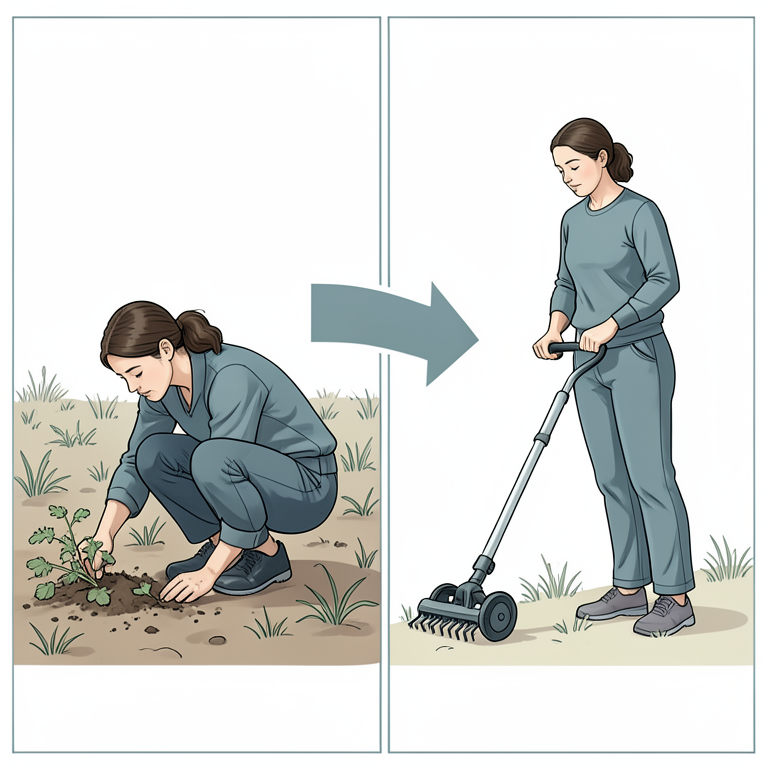
Ergonomic Impact Comparison
AI-generated conceptual illustration (farm women using weeding tools in a field). It explains the idea and does not show study data.
View source evidence ↗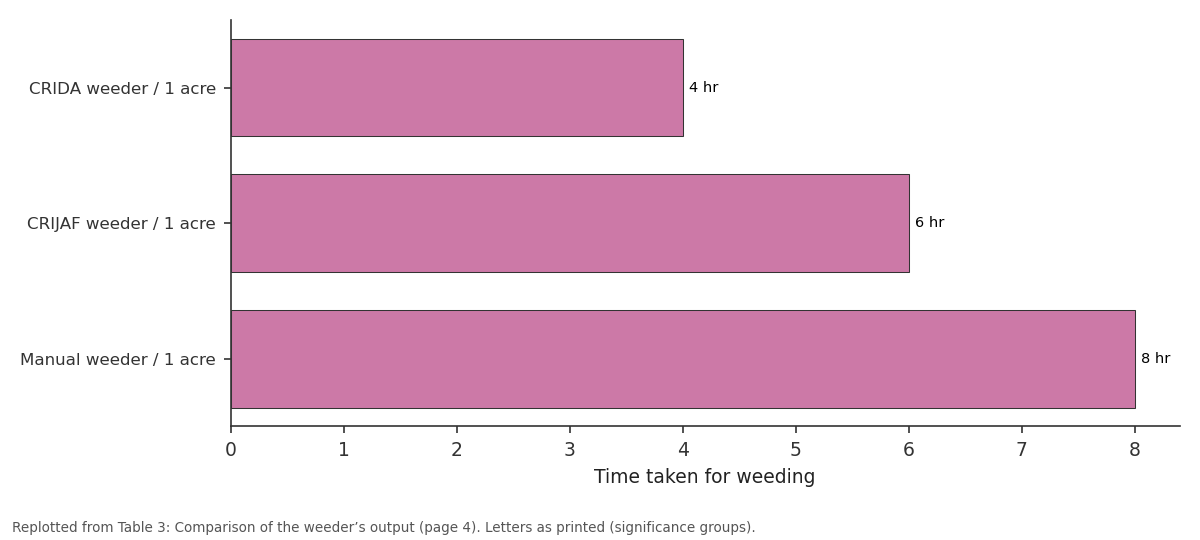
Time taken for weeding: CRIDA weeder / 1 acre vs CRIJAF weeder / 1 acre vs Manual weeder / 1 acre
Replotted from Table 3 (page 4) of the original paper. Every bar is the paper's own table value.
View source evidence ↗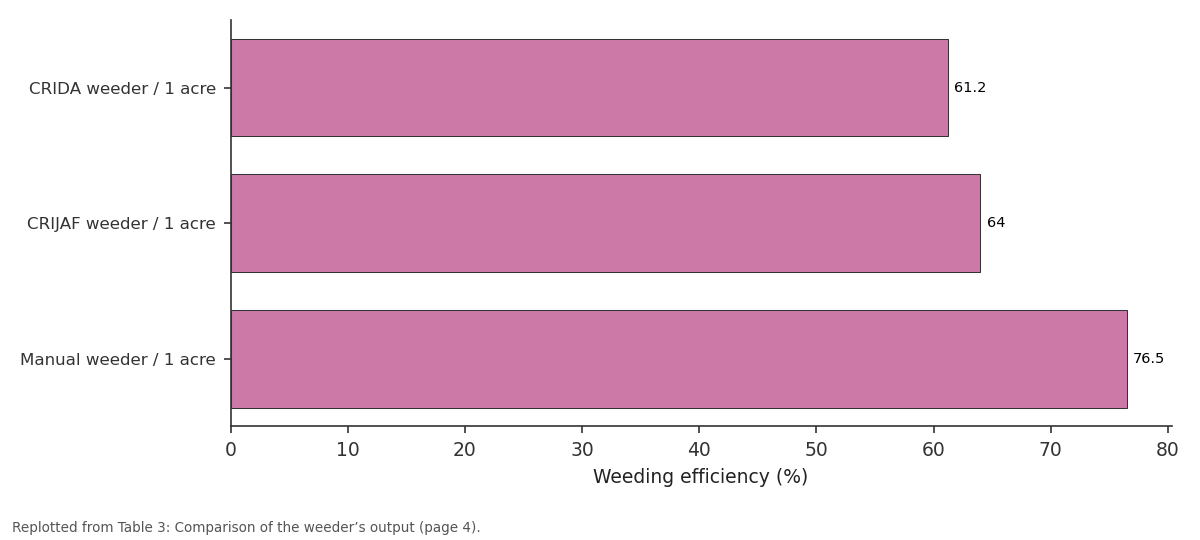
Weeding efficiency (%): CRIDA weeder / 1 acre vs CRIJAF weeder / 1 acre vs Manual weeder / 1 acre
Replotted from Table 3 (page 4) of the original paper. Every bar is the paper's own table value.
View source evidence ↗Figures & tables
From the original paper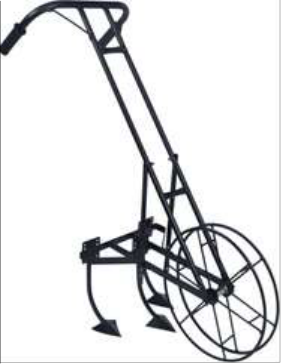 Figure 1
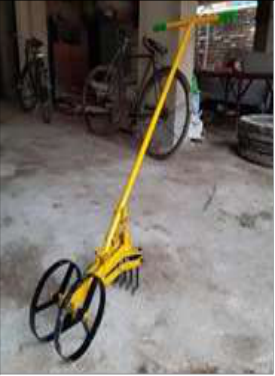 Figure 2
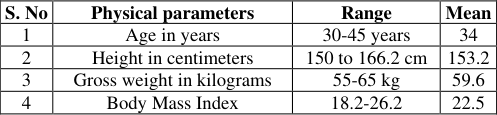 Table 1
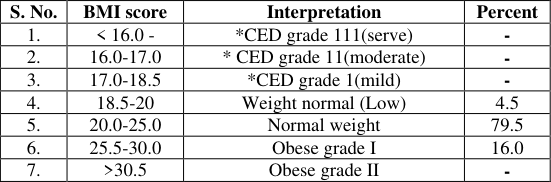 Table 2
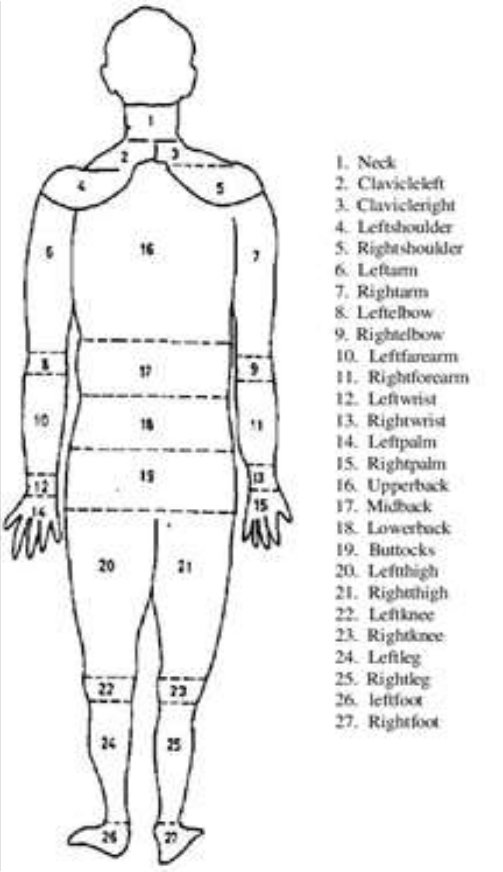 Figure 3
 Table 3
 Table 4
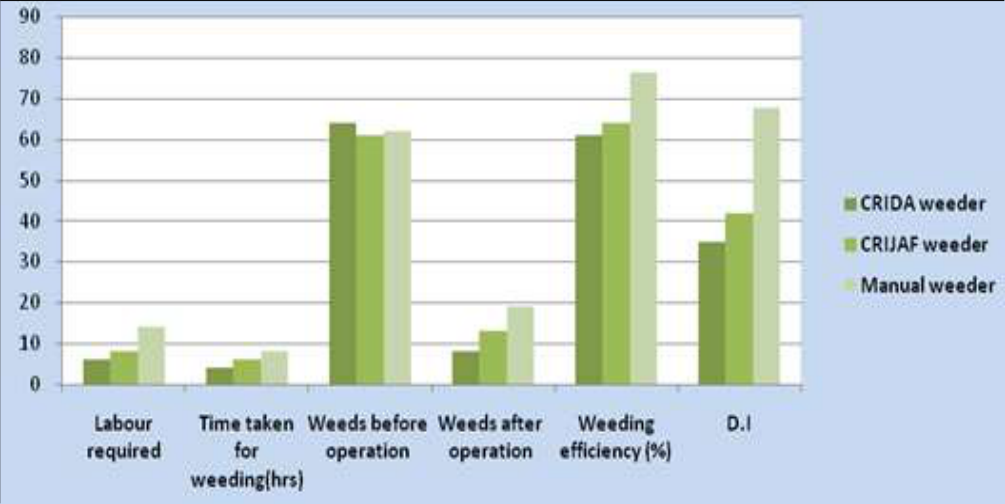 Figure 4
Introduction
For farm women, weeding operations are a serious challenge. The majority of agricultural women control weeds with hand tools like sickles, khurpis and other similar implements. For a healthy yield, timely weeding is therefore essential. This can only be done by using mechanical weeders, which can reduce the time (measured in man hours), expense, and tedium involved with hand weeding by concurrently performing the task of hoeing and weeding. In India, women have a significant influence on the nation's economy. According to Singh et al. (2007) [10] , there are an estimated 92 million women working in agriculture and related industries, which represents 40% of all rural employees in the nation. Based on data from the 2011 Census, women make up 25.51% of the labor force nationwide. Among all workers, women made up 47.20 percent; among agricultural laborers, 24.92 percent; domestic workers, 18.56 percent; and other workers, 2.95 percent. Women play a significant part in agriculture as farmers, co-farmers, female family caregivers, female agricultural laborers, female farm managers, and female farm entrepreneurs, according to Prakash et al. (2014) [8] . For agricultural women, weed control is a huge challenge. For agricultural women, weed control is a huge challenge. The majority of agricultural women manage weeds with hand tools like sickles, khurpis, and other similar implements. Although this strategy works, it is laborious and full of drudgery. They adopt bending and squatting body posture while engaging in these activities, which increases their physiological strain and exposes them to a variety of musculoskeletal issues. As a result, the ability of women to work is significantly reduced. For this study, physiological indicators like labour, drudgery and work output were assessed. The scientific study of ergonomics explores how an individual interacts with many aspects of their working environment, such as lighting, materials, equipment, work habits, and organizational structure. If ergonomic factors are not given enough consideration, the man-implement system's performance may suffer. Additionally, it could result in clinical or anatomical problems and harm the health of the workers. Designing and operating systems with proper consideration for ergonomics will improve the efficiency of the human-machine interface while also protecting the health of the workforce (Gite, 1997) [3] . The study primary goal was to decrease drudgery, boost farm women's productivity, and lower farmers' weeding expenses by introducing the CRIDA and CRIJAF weeders.
Materials and Methods
Materials and Methods
CRIDA Weeder
Popular equipment for pulling weeds in row crops is the wheel hand hoe. This tool has a long handle and is used by pressing and pulling. There are one to two wheels, and the diameter is determined by the design. Various types of soil working equipment, including sweeps, V-blades, tine cultivators, pronged hoes, micro furrowers, spike harrows (rakes), and reversible blades, can be accommodated by the www.extensionjournal.com frame. One person is able to operate it. The tool's soil working parts are all comprised of medium carbon steel that has been hardened to a temperature between 40 and 45 HRC. To operate, one must adjust the tool's working depth and handle height. The wheel hoe is then operated by repeatedly pushing and pulling the soil working components, which allows the weeds to be buried as well as cut or uprooted in between crop rows.
CRIJAF Weeder
CRIJAF Weeder contains three types of hoeing assembly e.g., i) nail assemblies, from 2 to 15 nails (6-8 mm in thickness fitted with nuts on nail holding assembly) fixed at and 3 cm apart in a series ii) one scrapper and iii) one tyne, to suit different operations in field conditions. Provisions have been made here two attach iv) two conical rotors and v) one boat for its use in transplanted rice field CRIJAF Nail weeder has been developed to weed out young composite weed flora including germinating ones from line sown and broadcast field crops (jute, mesta, cereals, pulses, vegetables etc.) since 3 -7 days of crop sowing.
Weeding Index percent
The amount of weeds that a particular weeder can remove in a given amount of time is known as its weeding efficiency.
To calculate the weeding index, the weeder was tested in the same field. The formula below is used to compute it: e= ((W1 -W2)/W1) × 100
Where, e = Weeding index, percent W1 = Number of weeds/m2 before weeding W2 = Number of weeds/m2 after weeding.
Musculo-skeletal problems
The body map (Fig. 3) was used to determine the incidence of musculoskeletal issues, showing discomfort in various body areas both before and right after the exercise was finished. Scale of severity 5. Extremely harsh 4. Extreme 3. Calm 2. Gentle Extremely gentle. 1. Very mild A five-point rating system was employed to document the level of pain www.extensionjournal.com in each body part: 5, 4, 3, 2, and 1 denoting very severe, severe, moderate, mild, and very mild, respectively.
Overall discomfort rating (ODR)
The overall discomfort rating, or ODR, is a graduated scale that is 70 centimeters long. The left end of the scale is marked zero and the right end is marked 10, which correspond to "no discomfort" and "extreme discomfort," respectively. On the scale, there was a sliding pointer to indicate the degree of discomfort. Subjects were asked to indicate on the scale how uncomfortable they felt overall at the conclusion of each trial. The average of the discomfort ratings given by all 20 people served as the mean rating.
2.6 Drudgery index: Farm women's experiences with physical and mental strain, exhaustion, repetition, and misery during weeding operations were operationalized as drudgery. (Kumar et al., 2011) [6] .
Results and Discussion
Table 1 displays the subjects' basic anthropometric information. The chosen farm women ranged in age from 30 to 45 years old, had an average height of 153.2 cm, and weighed between 55 and 65 kg grossly. Their computed mean BMI of 23.90 indicated that they fell within the normal range.
| S. No | Physical parameters | Range | Mean |
|---|---|---|---|
| 1 | Age in years | 30-45 years | 34 |
| 2 | Height in centimeters | 150 to 166.2 cm | 153.2 |
| 3 | Gross weight in kilograms | 55-65 kg | 59.6 |
| 4 | Body Mass Index | 18.2-26.2 | 22.5 |
Table text extracted from the original PDF; superscript letters are shown inline. The original table image is below.
View original table image
Workload
According to Garrow's (1987) classification, the health state of women was rated based on BMI. Table 2 displays the distribution of responses based on BMI scores. The majority of respondents (79.5%) had BMI ratings that were within the normal range, as shown in Table 2. 4.5% of women had been found to have a low weight health status. It can be noted that 16% of respondents fell into the obese grade I group of great health. The outcome of the weeding operation using both conventional and upgraded technology is shown in Fig. 4.
| S. No. | BMI score | Interpretation | Percent |
|---|---|---|---|
| 1. | < 16.0 - | *CED grade 111(serve) | - |
| 2. | 16.0-17.0 | * CED grade 11(moderate) | - |
| 3. | 17.0-18.5 | *CED grade 1(mild) | - |
| 4. | 18.5-20 | Weight normal (Low) | 4.5 |
| 5. | 20.0-25.0 | Normal weight | 79.5 |
| 6. | 25.5-30.0 | Obese grade I | 16.0 |
| 7. | >30.5 | Obese grade II | - |
Table text extracted from the original PDF; superscript letters are shown inline. The original table image is below.
View original table image
The CRIDA wheel hoe has a significantly higher work output than the CIJAFT nail weeder, followed by the hand hoe. There was a decrease in labour requirements for both weeders when compared to the traditional method. The time taken for weeding was recorded to be less in the CRIDA weeder (4 hours), followed by the CRIJAF weeder (6 hours), whereas in manual feeding, the time taken for weeding in 1 acre was recorded as 8 hours. It is also observed that there was decrease in weed percentage of weed before and after operations in a square meter.
The weeding efficiency percentage was found maximum for hand hoe (76.5%) followed by CRIJAF weeder with 64% and CRIDA weeder with 61.2%. The maximum weeding efficiency with hand hoe was because of time consumption and heavy drudgery (76.5%) while weeding. However, the two weeders have taken less time and moderate drudgery (35 to 42%) for removing the weeds. The CRIDA and CRIJAF weeders has the capacity to till the soil to the desired depth, therefore, it works much better between two rows for weeds control. But the hand hoe may cause damage to crop plant, if it is tilled nearer to the rows.
Overall discomfort rating (ODR)
Vegetable crop weeding is a task where musculoskeletal issues are particularly noticeable. The reason is that weeding takes time and must be done consistently for many hours. The conventional approach involves constant sitting while using a traditional hand hoe to weed. The manual hoe's overall discomfort rating was 8.4, whereas the CRIDA AND CRIJAF weeders recorded 4.3 and 4.9, more than moderate and light discomfort, respectively (Table 4).
| Weeding method | ODR* | MSP* | RPE* | DI Score |
|---|---|---|---|---|
| Hand weeder | 8.4 | Severe back, hand, shoulder, and knee pain | Heavy | 68 |
| CRIJAF weeder | 4.3 | Moderate to light pain in shoulder, hands and arms. | Minimum | 42.2 |
| CRIDA weeder | 4.9 | Moderate to light pain in shoulder, hands and arms. | Minimum | 35.4 |
Table text extracted from the original PDF; superscript letters are shown inline. The original table image is below.
View original table image
Musculo-skeletal problems
By analyzing the respondents' responses regarding the areas of their bodies where they had difficulty following weeding using both traditional and sophisticated technologies, the www.extensionjournal.com musculoskeletal issues and posture were investigated. The information in Table 4 demonstrates that women who worked hard to pull weeds with traditional instruments experienced severe pain in their hands, knees, shoulders, and mid back. On the other hand, using the improved weeding tools (CRIDA and CRIJAF weeders) resulted in mild to moderate stiffness or discomfort in the hands, arms, and shoulders. They had alleviation from back pain, better tool use (using a wheel hoe while standing instead of sitting all the time), and some mobility. The degree of perceived effort was likewise assessed as moderate when better weeders were used.
Drudgery Index
The drudgery index for manual hoe weeding as well as for the CRIDA and CRIJAF weeders was determined using the time co-efficient, frequency of performance coefficient, and difficulty coefficient. Moderate drudgery (drudgery index score between 35.4 and 42.2) was observed when using the advanced weeders; nevertheless, maximum drudgery (drudgery index score 68) was observed when using the hand hoe. This study shows that in order to improve the quality of work life, boost productivity, and support health, safety, and well-being, working instruments must be ergonomically designed and women-friendly. It was decided that the weeding performance of CRIDA and CRIJAF was satisfactory because they provided a pleasant working environment, increased labor efficiency, and reduced tedium. Women experienced less effort and fatigue and felt more at peace. It is feasible to enhance the working conditions and atmosphere, reduce the physical strain of weeding, and greatly boost production with such small tools. Therefore, the top focus should be encouraging farm women who work in agriculture to use these instruments.
Conclusion
When compared to the CRIJAF weeder, the CRIDA weeder was shown to be more beneficial in terms of reducing labor costs, time, and effort, as well as boosting productivity. It was discovered to be the most effective for weeding vegetable fields and to be suitable, manageable, and usable in field settings. It was found that using both weeders helped women's efficiency and posture. The hand hoe was determined to have the highest percentage of weeding efficiency (76.5%), followed by the CRIJAF weeder (76.4%) and the CRIDA weeder (61.2%). Weeders eliminated muscular tiredness and overstress on the intervertebral discs in the backbone by requiring standing position, which decreased body discomfort. This demonstrated that weeders increased worker productivity, were women-friendly, ergonomically sound, and reduced drudgery.
Figures and tables from the paper
| Parameters | CRIDA weeder | CRIJAF weeder | Manual weeder |
|---|---|---|---|
| Area of work | 1 acre | 1 acre | 1 acre |
| Labour required | 6 | 8 | 14 |
| Labour wages | Rs.900 per ha @ 150/labour | Rs.1200 per ha @ 150/labour | Rs.2100 per ha @ 150/labour |
| Time taken for weeding | 4 hr | 6 hr | 8 hr |
| Total no. of weeds before operation /sq.mt | 64 | 61 | 62 |
| Total no. of weeds after operation /sq.mt | 8 | 13 | 19 |
| Weeding efficiency (%) | 61.2 | 64 | 76.5 |
| Drudgery index Score | 35% (Minimum) | 42% (Minimum) | 68% (Moderate) |
Table text extracted from the original PDF; superscript letters are shown inline. The original table image is below.
View original table image
References
5 in the original paper- Chaudhary V, Gangwar B, Pandey D. Auditing of energy use and output of different cropping systems in India. Agricultural Engineering International, The CIGRE Journal, manuscript EE05 001 (VII). 2006;3.
- Kumar Bharat PP, Govinda, Gowda V, Khandekar Neeta. Time Utilization Pattern and Drudgery of Horticulture Farmers. Int J Eng, Manage & Sci. 2011;2(2):93-96.
- Manjunatha K, Shirwal S, Sushilendra, Vijayakumar P. Development and evaluation of manually operated sprocket weeder. Intern J Agric Engg. 2014;7(1):156159.
- Sam B, Regeena S. Development and ergonomic evaluation of long handle weeders for uplands. International Journal of Research in Engineering and Social Sciences. 2015;5(6):1-13.
- Verma Shilpi, Gupta Shobhana, Pachauri CP. An ergonomic study on evaluation of single wheel hoe in reducing drudgery. Agric Update. 2013;8(4):665-669.