
Research article · 2024 · Full text
International Journal of Advanced Biochemistry ResearchComparative analysis of fatty acid profiles in indigenous cattle breeds: A comprehensive evaluation
Volume 8(4S) · Pages 378–381 · DOI: 10.33545/26174693.2024.v8.i4se.1008 ↗
Research areasNatural Products and Biological Research
Abstract
Author-writtenThis study investigates the fatty acid profiles of milk from three indigenous cattle breeds, Gir, Sahiwal, and Tharparkar, aiming to elucidate breed-specific variations and their implications for nutritional quality. Comparative analysis was conducted using gas chromatography coupled with flame ionization detector (GC-FID). The study revealed significant differences in fatty acid composition among the breeds, attributed to genetic, dietary, and environmental factors. Gir milk exhibited higher levels of medium-chain fatty acids, along with elevated proportions of palmitic acid and monounsaturated fatty acids (MUFAs). Sahiwal milk displayed lower levels of MUFAs, while Tharparkar milk demonstrated the highest content of polyunsaturated fatty acids (PUFAs). These findings underscore the importance of considering breed-specific variations in fatty acid composition for optimizing the nutritional quality of dairy products.
Summary
Source-checkedPlain-language reading of the full paper, prepared with AI and checked against the text. Each point links to the authors' own words.
Why it matters
- Milk is considered a complete diet because it provides all the essential elements required for newborns. View evidence ↗
- Milk fat is a complex natural fat characterized by a wide variety of constituent fatty acids. View evidence ↗
- Variations in milk fat composition between individual animals and breeds significantly impact how dairy products are processed and manufactured. View evidence ↗
The question
- The study aims to identify breed-specific differences in the fatty acid profiles of milk from Gir, Sahiwal, and Tharparkar cattle to understand their effect on nutritional quality. View evidence ↗
What they did
- Standardized 250 ml milk samples were collected from Gir, Sahiwal, and Tharparkar cattle from local farmers in Karnal. View evidence ↗
- The researchers used gas chromatography coupled with a flame ionization detector (GC-FID) to analyze the fatty acid profiles. View evidence ↗
- Statistical analysis was performed using the R program and ANOVA, with significance set at p < 0.05. View evidence ↗
What they found
- Gir milk had a significantly higher proportion of palmitic acid (33.05±0.03%) compared to Sahiwal (32.05±0.014%) and Tharparkar (31.23±0.089%) breeds. View evidence ↗
- Tharparkar milk contained significantly higher levels of butyric acid (1.45±0.14%) and caproic acid (1.75±0.04%) than the other breeds. View evidence ↗
- Sahiwal milk fat had the highest total saturated fatty acids (63.28±0.64%), followed by Gir (61.47±0.21%) and Tharparkar (60.53±0.44%). View evidence ↗
- Tharparkar milk exhibited the highest content of total polyunsaturated fatty acids (4.31±0.36%) compared to Gir (3.51±0.12%) and Sahiwal (3.76±0.35%). View evidence ↗
- Gir milk had the highest total monounsaturated fatty acids (36.92±0.56%), which may provide cardiovascular benefits. View evidence ↗
What it means
- The authors state that further research is required to understand the mechanisms behind these variations and to develop strategies for improving nutritional value. View evidence ↗
Visual summary
3 visualsIllustrations explain the paper; charts are replotted from the paper's own table values.
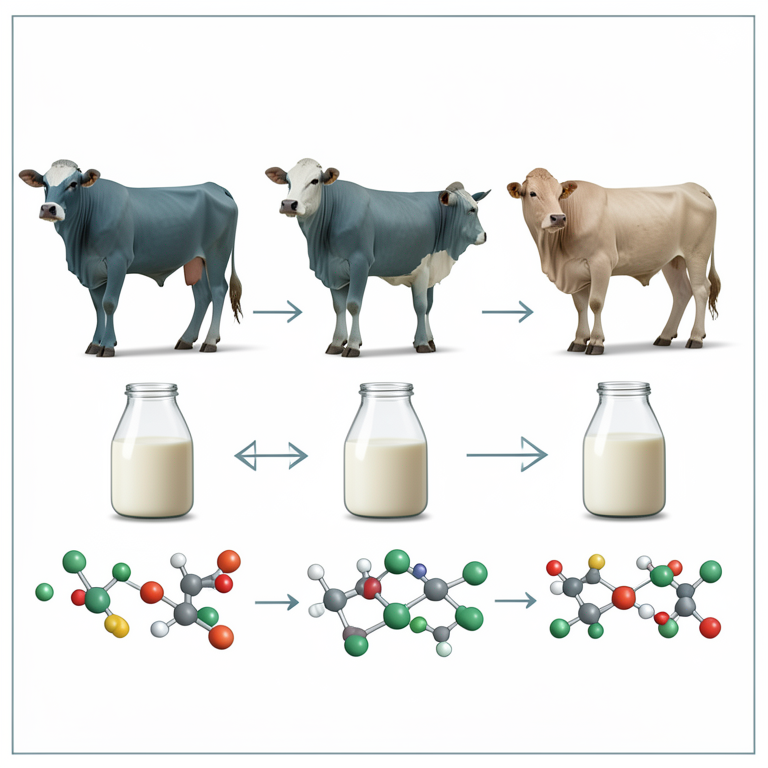
Comparative Fatty Acid Distribution
AI-generated conceptual illustration (Gir, Sahiwal, and Tharparkar cattle). It explains the idea and does not show study data.
View source evidence ↗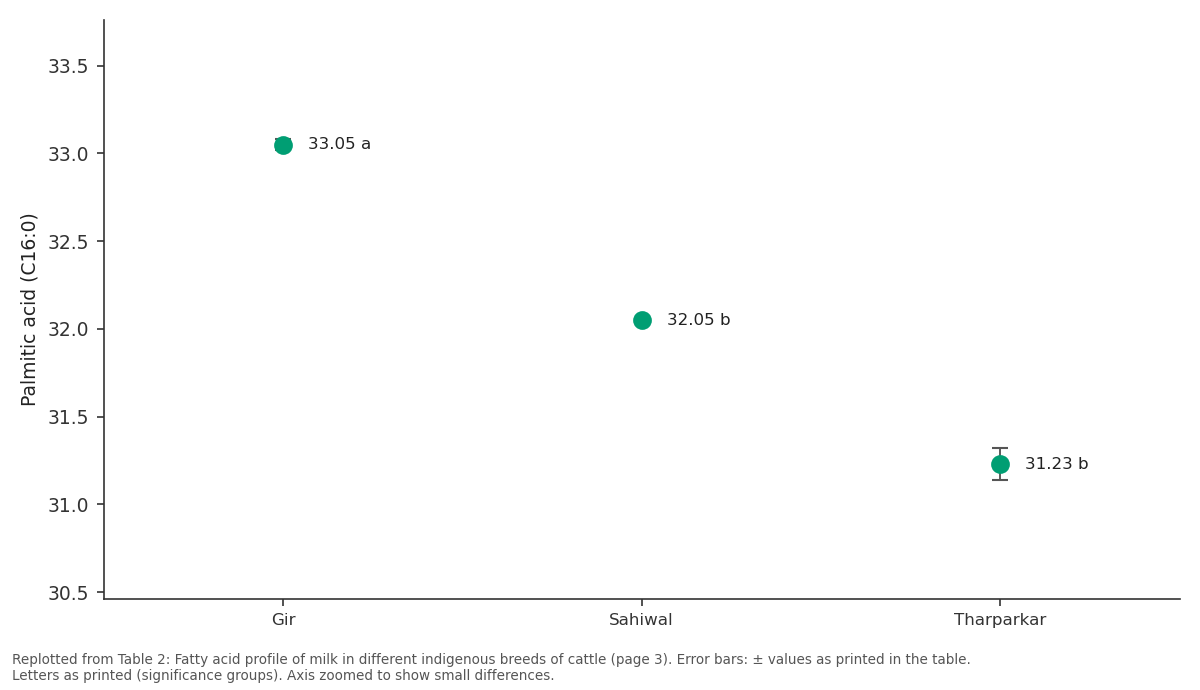
Palmitic acid (C16:0): Gir vs Sahiwal vs Tharparkar
Replotted from Table 2 (page 3) of the original paper. Every bar is the paper's own table value.
View source evidence ↗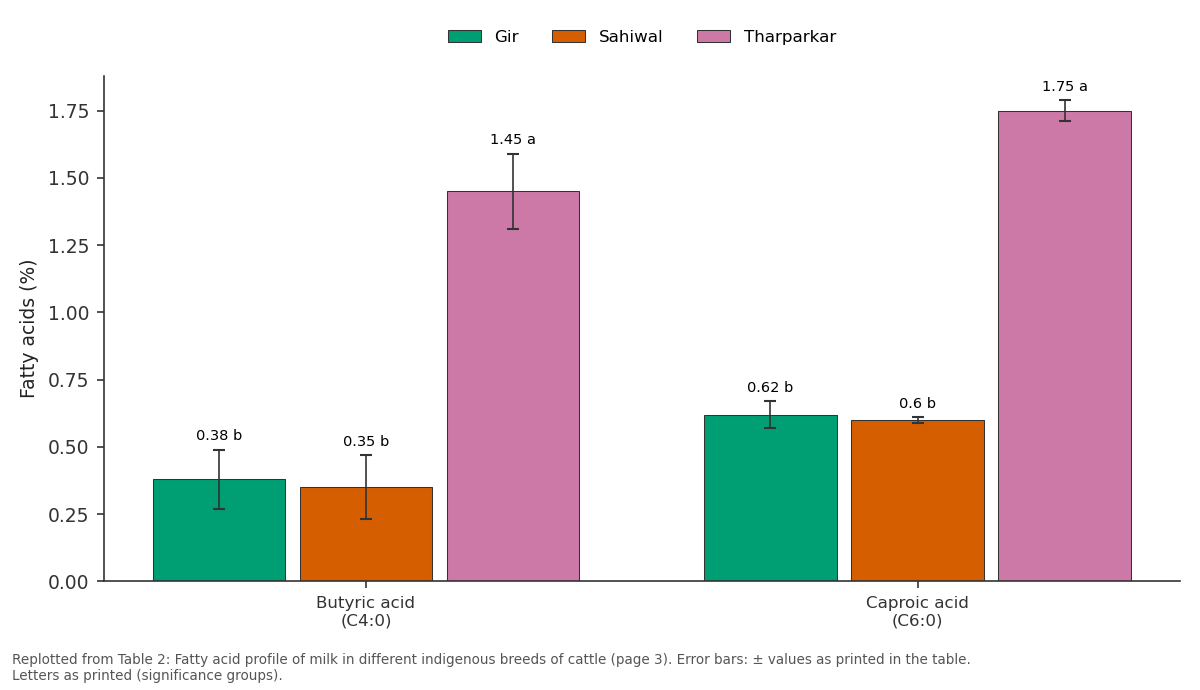
Gir and Sahiwal and more: Butyric acid (C4:0) vs Caproic acid (C6:0)
Replotted from Table 2 (page 3) of the original paper. Every bar is the paper's own table value.
View source evidence ↗Figures & tables
From the original paper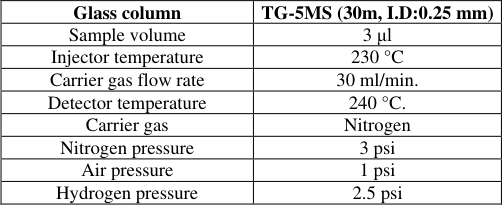 Table 1
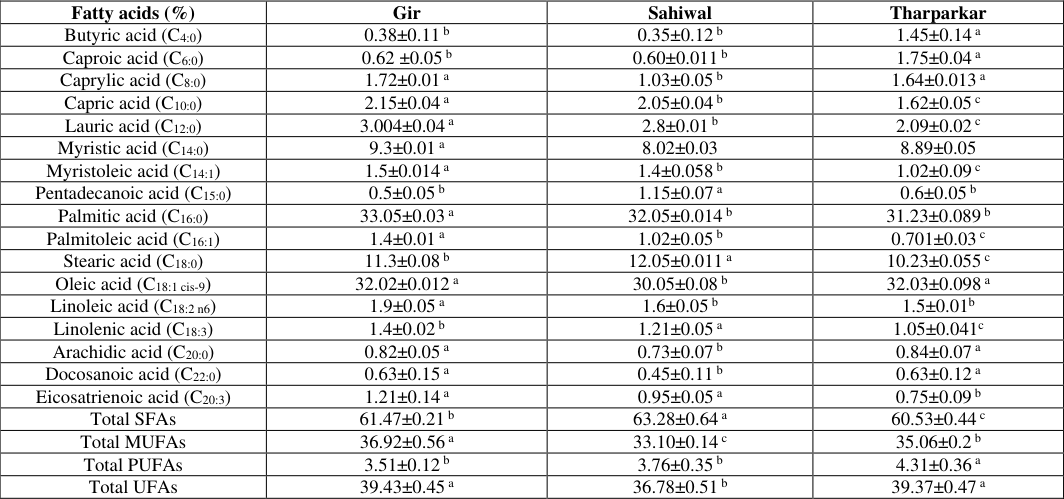 Table 2
Introduction
Milk is classified as a complete diet since it contains all of the necessary elements a newborn need. It is regarded as nature's most comprehensive biological fluid essential for the growth and feeding of children and adults [1] . Milk is defined as a typical secretion of all mammals' mammary glands that is essential for the sustenance of their young ones [2] . Milk is the most crucial food for a child throughout his or her first years of life. Because of the range of nutrients in milk, it is regarded as one of the healthiest foods for infants and adults [3] . Milk contains various nutrients and bioactive substances, including high-quality fat, a unique fatty acid composition, and good-quality protein such as amino acids, whey, and casein. These nutrients and bioactive chemicals have a significant impact on human health. In addition to these nutrients, milk provides a healthy balance of vitamins and minerals needed for daily metabolic activities. These contain vitamins A, D, and B complex, calcium, phosphorus, and magnesium. Because of the distinctive makeup of milk, it is crucial to consume it according to dietary recommendations. Consuming insufficient milk and other dairy products while an adult increases the risk of developing primary health conditions, including rickets and osteoporosis [4] . Milk is typically 85% water and 15% milk solids, with 4% fat and 9% Solid Not Fat (SNF), comprising lactose (4.8-5%), protein (3.4%), and minerals (<1%) [5] . Milk fat stands out as a remarkably intricate natural fat due to its diverse array of constituent fatty acids. Within milk fat, 69% of fatty acids are saturated, 27% are monounsaturated, and 4% are polyunsaturated. Notably, linolenic acid, a primary fatty acid in mammalian milk, offers numerous health benefits, including cancer, heart disease, and high blood pressure prevention [6,7] . Fat plays a crucial role in imparting the unique flavor and nutritional advantages to milk. Milk fat serves as a rich reservoir of fat-soluble vitamins such as A, D, E, and K, along with essential fatty acids like linoleic acid, linolenic acid, and arachidonic acid [8,9,10] . However, the composition and yield of milk fat exhibit significant variability among individual animals and even within different breeds of the same species, thereby exerting a notable influence on the manufacturing and processing of dairy products. For instance, Gir milk has a fat concentration of 4.5%, while Tharparkar milk has approximately 4.2% fat. Various factors, including the lactation stage, breed, and seasonal fluctuations, significantly affect the quality and quantity of milk fat [7] .
The nutritional richness and accessibility of milk play a pivotal role in promoting health, particularly in impoverished regions where food security is a concern. Addressing poverty and malnutrition, the predominant causes of mortality in developing nations, can be facilitated through enhancements in livestock, advancements in dairy technology, and improvements in milk quality. Dairy cattle significantly contribute to the global dairy industry, with cattle milk accounting for 81% of total milk production worldwide, as highlighted in the OECD-FAO Agricultural Outlook, spanning from 2020 to 2029 [12] . Across the globe, various breeds of cattle have been selectively developed to cater to diverse needs. Notably, in India, Gir, Sahiwal, and Tharparkar stand out as the primary indigenous cattle breeds [11] . The dairy industry stands as the leading sector among agriculture's allied fields, contributing significantly to the country's GDP, accounting for around 5%. It serves as a crucial support system for over eight crore farmers. India holds the prestigious title of being the world's largest milk producer, contributing 23% to the global milk output. As per the National Dairy Development Board (NDDB) report, the nation's milk production soared to 230.60 million tonnes in the fiscal year 2022-23, reflecting a commendable compound annual growth rate of around 6.2% from 2014-15, where production stood at 146.31 million tonnes [13] . Maintaining its global supremacy in total milk production, India recorded a remarkable 3.83% increase compared to the previous year (2021 -22). The per-capita availability of milk stands at 459 grams per day [13] . Exotic/crossbred cattle exhibit an average yield of 8.55 Kg/day/animal, while indigenous/non-descript cattle yield 3.44 Kg/day/animal. Both categories have witnessed a surge in production, with exotic/crossbred cattle experiencing a rise of 3.75% and indigenous/non-descript cattle witnessing a growth of 2.63%. The composition of milk varies among different breeds of animals. This variation is mainly observed due to the different variable components that affect the quality and quantity of the milk. Some of these variables include seasonal and environmental variations, the type of feed used, the animal's age and health, and the stage of lactation. These elements also impact the quality of dairy products like butter and other cheeses [14] . There is a notable scarcity of data regarding the seasonal changes in the nutritional composition of milk across various cattle breeds of India. To address this gap and analyze the variations in milk composition among specific breeds during winter and summer, we conducted a study examining the nutritional profiles of three indigenous milkproducing cattle breeds: Gir, Sahiwal, and Tharparkar.
Materials and Methods
Materials and Methods
Sample collection
Milk samples were systematically collected in labelled sterilized bottles, each assigned a specific code, from three distinct breeds: Gir, Sahiwal, and Tharparkar, sourced from local dairy farmar, Karnal. A standardized volume of 250 ml was collected from each animal. These samples were then carefully stored in labelled sterilized bottles and maintained at a refrigerated temperature of 4 °C for subsequent analysis.
Fatty acid profile 2.3 Preparation of fatty acid methyl esters:
The estimation of fatty acid was done in two phases. In the first phase, extraction of milk fat was performed using the Röse-Gottlieb method ISO (1211:2010) [15] . After that fatty acids profile of samples in methylated form were analyzed in capillary column using gas chromatograph (Thermo Fisher Scientific-Trace 1110) equipped with flame ionization detector. Fatty acid methyl esters were prepared in accordance with the procedures outlined in ISO/IDF (2002) [16] guidelines. Approximately 0.2 g of the melted fat sample and addition of 0.3 ml of 0.2 N sodium methoxide and 0.1 ml of benzene by making about double the quantity of solvents (sodium methoxide and benzene) to that of fat. The tube was sealed and placed in an oven maintained at 75 °C and shaking was done at regular intervals of 10 to 15 minutes. The methylation was completed in an hour, as evident from the change of two-phase system into one phase system. At the time of analysis, ester tubes were broken and sample was injected into the GC column without any further treatment.
Statistical analysis
Data were analyzed statistically using the R programme. ANOVA was used, and differences were considered significant at p< 0.05.
Result and Discussion
The concentration of medium-chain and short-chain fatty acids in milk was estimated using gas chromatography. The results obtained were used for the comparative study of various fatty acids across cattle breeds of India. From the obtained data, it was evident that there was a difference in the fatty acid concentration among the milk of different breeds. Table 2 shows the mean of each fatty acid in different breeds. The concentration of various short-chain fatty acids was a minimal amount. Out of all the long-chain fatty acids estimated, the concentration of C 16:0 , C 18:0 and C 18:1 were more than other medium-chain fatty acids. The higher levels of short-chain fatty acids, particularly butyric acid (C ) and caproic acid (C 6:0 ), in Tharparkar milk suggest potential benefits such as antimicrobial and anti-inflammatory properties [17] . Conversely, the higher proportions of medium-chain fatty acids, including lauric acid (C 12:0 ) and myristic acid (C 14:0 ), in Gir milk may contribute to enhanced antimicrobial and metabolic effects [18] . Palmitic acid (C 16:0 ), a predominant saturated fatty acid (SFA), was found in higher proportions in Gir milk compared to Sahiwal and Tharparkar breeds (p< 0.05) [19] . Conversely, Tharparkar milk had the lowest content of palmitic acid. Similarly, the concentration of C 14:0 , C 16:0 , C 18:0 , and C 18:1 was higher in Gir and Sahiwal milk than the other fatty acids. However, the concentration of C 20:0 was found to be higher than other estimated fatty acids in Tharparkar milk. The total saturated fatty acids (SFAs) in milk fat encompass a range of fatty acids including C 4:0 , C 6:0 , C 8:0 , C 10:0 , C 12:0 , C 13:0 , C 14:0 , C 15:0 , C 16:0 , C 18:0 , C 20:0 , and C 22:0 . When calculated, it is observed that Sahiwal milk fat exhibits the highest content of total SFAs, followed by Gir cow and Tharparkar. On the other hand, total unsaturated fatty acids (UFAs) are calculated by summing up monounsaturated fatty acids (MUFAs) such as C 14:1 , C 16:1 , and C 18:1 , along with polyunsaturated fatty acids (PFAs) including C 18:2 n6 , C 18:3 , and C 20:3 . It is noted that the total UFAs are higher in Gir milk fat compared to Tharparkar, with Sahiwal cow milk containing the lowest levels.
| Fatty acids (%) | Gir | Sahiwal | Tharparkar |
|---|---|---|---|
| Butyric acid (C4:0) | 0.38±0.11 b | 0.35±0.12 b | 1.45±0.14 a |
| Caproic acid (C6:0) | 0.62 ±0.05 b | 0.60±0.011 b | 1.75±0.04 a |
| Caprylic acid (C8:0) | 1.72±0.01 a | 1.03±0.05 b | 1.64±0.013 a |
| Capric acid (C10:0) | 2.15±0.04 a | 2.05±0.04 b | 1.62±0.05 c |
| Lauric acid (C12:0) | 3.004±0.04 a | 2.8±0.01 b | 2.09±0.02 c |
| Myristic acid (C14:0) | 9.3±0.01 a | 8.02±0.03 | 8.89±0.05 |
| Myristoleic acid (C14:1) | 1.5±0.014 a | 1.4±0.058 b | 1.02±0.09 c |
| Pentadecanoic acid (C15:0) | 0.5±0.05 b | 1.15±0.07 a | 0.6±0.05 b |
| Palmitic acid (C16:0) | 33.05±0.03 a | 32.05±0.014 b | 31.23±0.089 b |
| Palmitoleic acid (C16:1) | 1.4±0.01 a | 1.02±0.05 b | 0.701±0.03 c |
| Stearic acid (C18:0) | 11.3±0.08 b | 12.05±0.011 a | 10.23±0.055 c |
| Oleic acid (C18:1 cis-9) | 32.02±0.012 a | 30.05±0.08 b | 32.03±0.098 a |
| Linoleic acid (C18:2 n6) | 1.9±0.05 a | 1.6±0.05 b | 1.5±0.01b |
| Linolenic acid (C18:3) | 1.4±0.02 b | 1.21±0.05 a | 1.05±0.041c |
| Arachidic acid (C20:0) | 0.82±0.05 a | 0.73±0.07 b | 0.84±0.07 a |
| Docosanoic acid (C22:0) | 0.63±0.15 a | 0.45±0.11 b | 0.63±0.12 a |
| Eicosatrienoic acid (C20:3) | 1.21±0.14 a | 0.95±0.05 a | 0.75±0.09 b |
| Total SFAs | 61.47±0.21 b | 63.28±0.64 a | 60.53±0.44 c |
| Total MUFAs | 36.92±0.56 a | 33.10±0.14 c | 35.06±0.2 b |
| Total PUFAs | 3.51±0.12 b | 3.76±0.35 b | 4.31±0.36 a |
| Total UFAs | 39.43±0.45 a | 36.78±0.51 b | 39.37±0.47 a |
Table text extracted from the original PDF; superscript letters are shown inline. The original table image is below.
View original table image
Additionally, the higher levels of MUFAs, especially oleic acid, in Gir milk may offer cardiovascular benefits and contribute to the desirable flavor profile of dairy products [20] . Further research may delve into understanding the underlying factors contributing to these differences and their potential impacts on human health and dairy product manufacturing. Out of total milk fat, 69% is contributed by saturated fatty acids, 27% by monounsaturated fatty acids (MUFA), and 4% by polyunsaturated fatty acids. Tharparkar milk's higher PUFA content, particularly linoleic acid and linolenic acid, may provide health benefits such as anti-inflammatory and cardioprotective effects [21] . However, the overall lower PUFA content in all three breeds warrants further investigation to optimize the nutritional quality of milk and dairy products [19] . Milk and its products are one of the most nutritious in the human diet. The exclusive nutritional quality of milk and milk products is due to their fat portion. Milk fat comprises more than 400 fatty acids. Several factors are responsible for variations in fat concentration, including animal breed, diet, animal health, season, and lactation stage. Heart diseases, cancer, obesity, and diabetes account for more than 80% of deaths worldwide. One of the essential factors in controlling the prevention of all these health-related issues is the fat, type of fat, and amount of it to be consumed. Milk fat consists of approximately 400-500 fatty acids. Mono Unsaturated Fatty Acids are beneficial as they increase the circulatory concentration of HDL (high-density lipoprotein) cholesterol and decrease the circulatory concentration of LDL (low-density lipoprotein) cholesterol in the blood. Oleic acid (C 18:1 ) is one of the MUFA found in higher concentrations in the milk of all mammals. Other MUFAs found in small amount includes C 14:1 and C 16:1 . Saturated fatty acid (SFA) is the most durable component and primary fat component of the human diet [21] . However, these fatty acids are responsible for significant health hazards, including heart disease, obesity, etc. One of the most important SFA is C 16:0 . SFAs are responsible for increased LDL blood concentration [22] . According to a study conducted by Saroj et al. [19] , variations in the fatty acid composition of different species occur due to different seasons. Results of the present study for C 6:0 , C 8:0 , C 10:0 , C 12:0 , and C 14:0 for all species are similar to Saroj et al. [19] . Total SFA's in the present study ranged between 55-65g/100g. These results are also in accordance with Saroj et al. [19] . Medium and long chain saturated fatty acids, i.e., myristic, palmatic, and stearic, and long chain unsaturated fatty acids, i.e., oleic acid. These fatty acids make up more than 65% of the TFA. The present study's results are similar to those reported by Rodríguez-Alcalá. et al. [23] . C 16:0 and C 18:1 were the highest among all fatty acids across the various breeds of indigenous cattle with the highest C 16:0 in Gir and high C 18:1 in Tharparkar. These results are favoured by Saroj et al. [19] . It is also observed from the present study that 3-5% of TFA comprises PUFA in milk in all the breeds.
Conclusion
Our study highlights significant variations in fatty acid profiles among indigenous cattle breeds: Gir, Sahiwal, and Tharparkar-attributed to genetic, dietary, and environmental factors. Gir milk displayed higher medium-chain fatty acids, with elevated levels of palmitic acid and MUFAs. Sahiwal milk showed lower levels of MUFA fatty acids, while Tharparkar milk had the highest PUFA content. These findings stress the importance of considering breed-specific
Figures and tables from the paper
| Glass column | TG-5MS (30m, I.D:0.25 mm) |
|---|---|
| Sample volume | 3 μl |
| Injector temperature | 230 °C |
| Carrier gas flow rate | 30 ml/min. |
| Detector temperature | 240 °C. |
| Carrier gas | Nitrogen |
| Nitrogen pressure | 3 psi |
| Air pressure | 1 psi |
| Hydrogen pressure | 2.5 psi |
Table text extracted from the original PDF; superscript letters are shown inline. The original table image is below.
View original table image
References
15 in the original paper- Ratajczak AE, Zawada A, Rychter AM, Dobrowolska A, Krela-Kaźmierczak I. Milk and dairy products: good or bad for human bone? Practical dietary recommendations for the prevention and management of osteoporosis. Nutrients. 2021;13(4):1329.
- Ramani A, Hazra TH, Parmar MP, Sindhav RG, Ramani VM. A simple rapid technique for detection of palm oil in ghee. Indian Journal of Dairy Science. 2019;72(4):441-444.
- Savaliya V, Thumar M, Ramani A, Taherabbas S. Seasonal variations in the fatty acid profile of cow, buffalo, and goat milk. The Pharma Innovation Journal. 2022;SP-11(10):2088-2092.
- Hazra T, Ramani A, Hariyani A, Sudheendra CHVK, VK AK, Ramani V, et al. A simple rapid chromogenic test for detection of palm oil adulteration in milk. International Journal of Chemical Studies. 2018;6(6):1227-1229.
- Ramani A, Hazra T, Sudheendra CV, Hariyani AS, Prasad S, Ramani VM, et al. Comparative appraisal of ghee and palm oil adulterated ghee on the basis of chromogenic test. Int. J Curr. Microbiol. App Sci. 2018;7(12):623-627.
- Siddharajsinh Z, Hazra T, Manishkumar PP, Govani R. Sensitivity of modified DMAB test for lower level detection of urea in milk. International Journal of Chemical Studies. 2019;7(2):10-12.
- Barłowska J, Szwajkowska M, Litwińczuk Z, Król J. Nutritional value and technological suitability of milk from various animal species used for dairy production. Comprehensive reviews in food science and food safety. 2011;10(6):291-302.
- NDDB Report. Milk production in India. https://www.nddb.coop/information/stats/milkprodindi. Published 2023.
- Ozrenk E, Inci SS. The effect of seasonal variation on the composition of cow milk in Van Province. Pakistan Journal of nutrition. 2008;7(1):161-164.
- Singh R, JM H, Kishore A. Evaluation of nutritional quality of fat obtained from different breeds of cow and buffalo with respect to fatty acids and in vitro digestibility. International Journal of Dairy Technology. 2023;76(3):683-694.
- Bharwade M, Balakrishnan S, Chaudhary N, Jain AK. Fatty acid profile and physico-chemical characteristics of milk lipids of Kankrej cow. Int. J Current Microbiol. Appl. Sci. 2017;6:3035-3047.
- Saroj B, Tran L, Sharma A, Kumar SACHIN, Tyagi A. Seasonal variation in fatty acid profile in the milk of different species under popularly followed feeding system in India. Indian Journal of Animal Sciences. 2017;87(4):484-489.
- Tyagi AK, Shandilya UK, Srivastava A, Kale VR, Kewalramani NJ. Fatty acids profile of milk and milk products in cow and buffalo fed roughage-based diet. Indian Journal of Animal Sciences. 2015;85(8):889896.
- Markiewicz-Kęszycka M, Czyżak-Runowska G, Lipińska P, Wójtowski J. Fatty acid profile of milk-a review. Journal of Veterinary Research. 2013;57(2):135-139.
- Rodríguez-Alcalá LM, Harte F, Fontecha J. Fatty acid profile and CLA isomers content of cow, ewe and goat milks processed by high pressure homogenization. Innovative food science & emerging technologies. 2009;10(1):32-36.
Cited by 1
From OpenAlex, OpenCitations and reference lists read by Scinovex
- Definition of Meat Quality Across Different Cattle Breeds ↗
Egidia Costanzi, Francesca Blasi, Federica Ianni, Marco Tassinari, Claudio Truzzi, Beniamino Terzo Cenci-Goga et al. · Animals · 2025
This study investigates the impact of cattle breed on key quality attributes-color, marbling, and tenderness-central to consumer choice. Six different bovine breeds were taken into consideration: German Red Pied, Piemontese, Chianina, Angus, Holstein, and a Polish crossbreed. The muscle taken into consideration was the Longissimus thoracis et lumborum. Colorimetric assessments, marbling evaluations, fatty acid profiling, and tenderness measurements were conducted…
❝ 2PDF