
Research article · 2024 · Full text
International Journal of Advanced Biochemistry ResearchSystematic review of innovative seed metering mechanisms including belt-type battery-operated systems in precision planters
Volume 8(4S) · Pages 458–460 · DOI: 10.33545/26174693.2024.v8.i4sf.1007 ↗
Research areasSoil Mechanics and Vehicle DynamicsAgricultural Engineering and MechanizationSmart Agriculture and AI
Abstract
Author-writtenThis review systematically analyses belt-type battery-operated seed metering mechanisms within precision agricultural planters, providing a critical comparison with traditional seed metering technologies. Utilizing studies from 1970 to 2023 sourced from databases like Scopus and IEEE X-plore, this paper explores these mechanisms' technological advancements, design variations, and operational efficiencies. Belt-type mechanisms offer adaptability across various seed sizes and environmental conditions, significantly reducing seed damage. In contrast, battery-operated mechanisms provide crucial benefits in portability and flexibility, making them especially suitable for precision planting in remote areas. Both technologies have been found to enhance seed placement accuracy, streamline operational processes, and offer substantial labour savings over conventional methods. However, they also face specific challenges, such as belt types, mechanical speed limitations and battery-operated systems' energy dependency. The review underscores the need for future research to enhance system durability, increase adaptability to diverse agricultural needs, and improve the energy efficiency of these planting technologies. These improvements are essential for advancing precision planters' capabilities and meeting modern agriculture's increasing demands.
Summary
Source-checkedPlain-language reading of the full paper, prepared with AI and checked against the text. Each point links to the authors' own words.
Why it matters
- Precision agriculture uses technology to shift crop planting and management toward higher efficiency and productivity. View evidence ↗
- Innovations in seed metering mechanisms are critical because they significantly impact how successfully crops are established. View evidence ↗
- Belt-type and battery-operated seed metering systems are pivotal because they improve accuracy, reduce waste, and adapt to various conditions to optimize planting. View evidence ↗
The question
- The study aims to synthesize literature on belt-type battery-operated seed metering mechanisms to evaluate their impact on precision planter efficiency and identify research gaps. View evidence ↗
What they did
- The review analyzed studies published between 1970 and 2023 from databases including Scopus, Web of Science, PubMed, IEEE Xplore, and ASABE. View evidence ↗
- Studies were excluded if they lacked quantitative performance assessments or did not provide a comparative analysis involving belt-type battery-operated systems. View evidence ↗
- The researchers performed a qualitative synthesis by extracting and categorizing data on design, operational parameters, performance metrics, and application contexts. View evidence ↗
What they found
- Belt-type mechanisms reduce seed damage and adapt to various seed sizes and conditions, which can enhance seed viability and crop yield. View evidence ↗
- Battery-operated systems increase portability and flexibility, reducing manual labor and enabling precision planting in remote areas. View evidence ↗
- Battery-operated systems utilizing 12V DC stepper motors provide energy efficiency and precise control. View evidence ↗
- A single-row manual planter reduced labor requirements to approximately 83 person-hours per hectare compared to traditional methods. View evidence ↗
- Belt-type battery-operated systems show operational efficiency and seed placement accuracy that is comparable or superior to traditional pneumatic and vacuum systems. View evidence ↗
- These systems are limited by mechanical speed constraints and a dependency on battery life, with efficiency declining as the battery charge depletes. View evidence ↗
- Dust and extreme temperatures can impair system functionality and increase the need for maintenance. View evidence ↗
What it means
- The authors conclude that belt-type battery-operated mechanisms are a significant advancement that can streamline planting, improve accuracy, and lower labor costs. View evidence ↗
- Future research is required to improve system durability in various environments, expand the range of compatible seed types, and increase energy efficiency to extend operational time. View evidence ↗
Visual summary
1 visualsIllustrations explain the paper; they do not show study data.
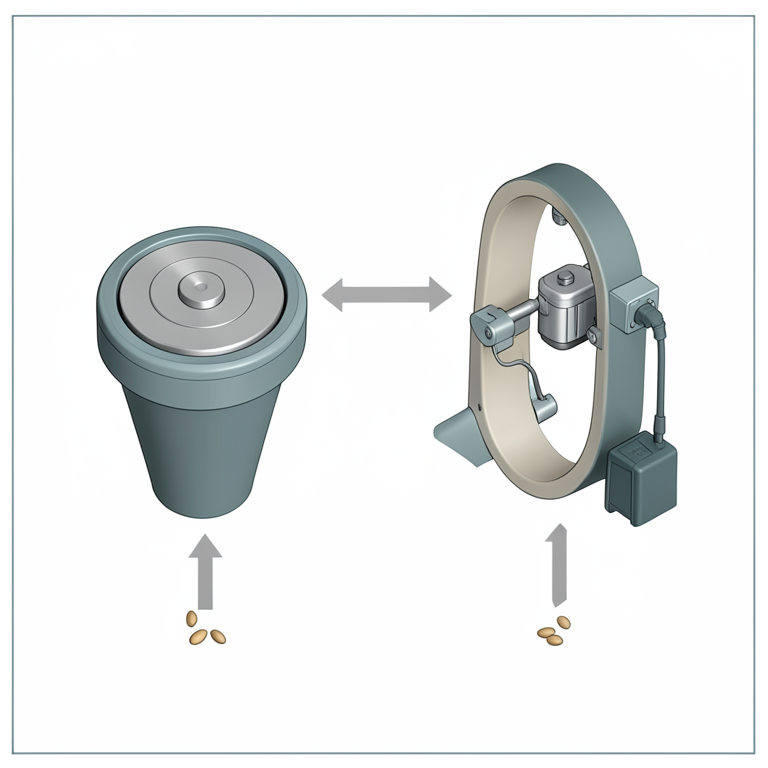
Comparison of Seed Metering Technologies
AI-generated conceptual illustration (precision planter seed metering mechanisms). It explains the idea and does not show study data.
View source evidence ↗Introduction
Precision agriculture represents a paradigm shift in how crop planting and management are approached, aiming to increase efficiency and productivity through technology. Key to this approach are innovations in seed metering mechanisms, which significantly influence the success of crop establishment. Belt-type and battery-operated seed metering mechanisms have emerged as pivotal technologies. These systems offer enhanced accuracy, reduced seed waste, and improved adaptability to various seeding conditions, which are crucial for optimizing planting operations and ensuring sustainability.
Scope
This review will focus on the belt-type battery-operated seed metering mechanism in precision agricultural planters. It will cover these technologies' development, design variations, comparative effectiveness, and operational outcomes. While the review will touch upon general seed metering technologies for context, the primary focus will remain on belttype battery-operated seed metering mechanisms.
Objective
This paper aims to comprehensively review and Synthesise existing literature on belt-type battery-operated seed metering mechanisms, evaluate their impact on the efficiency of precision planters, and identify areas needing further research. By doing so, the paper aims to provide a resource for agricultural engineers, equipment designers, and farm managers, facilitating informed decision-making in adopting and developing precision planting technologies.
Methodology data sources
The literature for this review was primarily sourced from academic databases such as Scopus, Web of Science, and PubMed, and engineering-specific repositories like IEEE Xplore and the ASABE (American Society of Agricultural and Biological Engineers) database. Search terms used included "precision agriculture," "seed metering mechanisms," "belt-type seed metering," "battery-operated planters," and combinations thereof. Additionally, patents and industry reports were examined to capture technological advancements and emerging trends not yet discussed in academic research.
Inclusion criteria
Studies selected for inclusion were those published in English from 1970 to 2023, focusing on the development, testing, and application of seed metering mechanisms, specifically belt-type battery-operated ones. The review excluded studies that did not provide quantitative assessments of mechanism performance (such as seed placement accuracy or operational efficiency) and those focusing exclusively on other metering technologies without comparative analysis involving belt-type battery-operated systems.
Analysis methods
The selected articles were subjected to a qualitative synthesis, where data regarding mechanism design, operational parameters, performance metrics, and application contexts were extracted and categorised. Comparative analyses were conducted to discern the relative advantages and performance outcomes between belt-type battery-operated mechanisms versus traditional systems. The synthesis aimed to highlight patterns, discrepancies, and consensus within the literature to coherently understand the state-of-the-art seed metering technology.
Seed metering mechanism technologies overview of mechanisms
Seed metering mechanisms are crucial for precision agriculture, enabling controlled and precise seed placement. They are categorised based on operational principles, such as belt-type, battery-operated, pneumatic, and vacuum.
Belt-type mechanisms
Belt-type seed metering mechanisms utilise a continuous belt that picks seeds from a hopper and delivers them at predetermined intervals. This type is particularly beneficial in handling a variety of seed sizes and shapes without requiring extensive adjustments. Okuda (1974) [6] developed a seed planter ideal for Nigerian farmers, highlighting that horizontal plate-type metering devices integrated with level gearing or chain drives significantly enhance adaptability to hard or trashy grounds. Additionally, Dhaliwal (1991) [2] assessed the feed mechanism of a drill for wheat and oilseeds, showing that belt-type mechanisms can effectively reduce seed damage through improved handling techniques.
Battery-operated systems
Battery-operated planters provide a modern solution to planting with enhanced portability and reduced dependence on manual labour or large machinery. Singh and Mane (2011) [9] illustrated the efficacy of a DC motor-controlled seed metering plate that delivers seeds closer to targeted spacings. Baral et al. (2019) [1] further developed this concept by integrating a sensor-based system that precisiontunes the seed release, significantly refining the planting process.
analysis of metering mechanisms comparison with other mechanisms
Comparatively, belt-type battery-operated systems are evaluated against traditional methods, such as pneumatic and vacuum seed metering systems, which are prevalent for their speed and precision and are especially suitable for delicate seeds like vegetables and sugar beets. Kepner et al. (1987) [4] remarked that inclined plate devices with peripheral cups provide gentler handling than horizontal plates, indicating the nuanced benefits of different designs.
Advantages and limitations
Belt-type battery-operated Mechanisms in agriculture offer precise and consistent seed placement, enhancing operational efficiency with reduced labour costs and quicker planting across diverse terrains due to their portability and energy efficiency. However, these advantages are tempered by their reliance on battery life, which limits operation time and can lead to inconsistent performance as power wanes. Additionally, the higher initial investment, potential costs associated with battery maintenance, and environmental sensitivities that may affect the battery and mechanical parts add complexity and could restrict their use under certain conditions. Despite these challenges, their low maintenance needs and alignment with sustainable practices make them a valuable tool for modern farming.
Operational parameters and efficiency field efficiency
Garg and Dixit (2003) [3] introduced a single-row manual planter that drastically reduces labour by requiring only about 83 person-hours per hectare, a significant decrease from traditional methods. Sahoo and Srivastava (2008) [8] studied various metering systems for soaked okra seeds, concluding that inclined plate systems provided the closest spacing to theoretical expectations, suggesting a superior field efficiency.
Seed placement accuracy
This technology's seed placement precision is critical for achieving optimal plant growth and yield. Ryu and Kim (1998) [7] designed a roller-type metering device that improved the uniformity of seed placements across various crops. This precision is particularly impactful in reducing seed waste and improving crop yields.
Power requirements and sustainability
Regarding sustainability and power usage, battery-operated systems like those discussed by Leela and Kumar (2019) [5] efficiently use electric power. These systems are powered by 12V DC stepper motors, which are both energy-efficient and capable of precise control, making them ideal for modern precision planters.
Results
The systematic review of belt-type battery-operated seed metering mechanisms in precision agricultural planters elucidates several critical findings. Firstly, belt-type mechanisms, characterised by using a continuous belt to deliver seeds at predetermined intervals, have demonstrated high adaptability to various seed sizes and conditions. Studies such as those by Okuda (1974) [6] and Dhaliwal (1991) [2] provide evidence that these mechanisms can significantly reduce seed damage, thereby enhancing seed viability and potential crop yield. As exemplified in the works of Singh and Mane (2011) [9] and Baral et al. (2019) [1] , battery-operated systems introduce advanced portability and flexibility, reducing reliance on manual labour and enabling precision planting even in remote locations. Integrating DC motor-controlled systems and sensor-based technologies has allowed for more accurate seed placements, closely matching targeted spacing's and optimizing planting density.
Comparative analyses against traditional pneumatic and vacuum systems, often preferred for their speed and precision with delicate seeds, suggest that belt-type batteryoperated systems provide comparable, if not superior, operational efficiency and seed placement accuracy. The findings from Garg and Dixit (2003) [3] and Sahoo and Srivastava (2008) [8] further reinforce this, demonstrating substantial reductions in labour requirements and improvements in field efficiency. However, the results also highlight inherent limitations. The dependency on battery life significantly affects operational continuity and performance consistency, with field studies indicating a decline in mechanism efficiency as battery charge depletes. Environmental factors such as temperature extremes and dust also pose challenges, potentially impairing system functionality and necessitating frequent maintenance.
Conclusion
Adopting belt-type battery-operated seed metering mechanisms within precision agriculture represents a significant technological advancement with the potential to streamline planting processes, enhance seed placement accuracy, and reduce labour costs. These systems are particularly beneficial for their mechanical simplicity, energy efficiency, and adaptability to diverse agricultural environments. Nonetheless, the practical application of these technologies is not without challenges. The dependency on battery life and environmental sensitivity of these systems necessitate ongoing technical improvements to enhance their reliability and operational scope. Future research should focus on extending battery life, perhaps through more efficient battery technologies or renewable charging systems and improving the durability of mechanical components to withstand harsh agricultural environments. Additionally, expanding the adaptability of these systems to handle a broader range of seed types and sizes could broaden their applicability, making them a more universal solution for precision agriculture. In conclusion, while belt-type battery-operated seed metering mechanisms promise to transform agricultural planting operations, their broader adoption will depend on addressing the current technological limitations. Continued innovation and research are essential to fully realize the potential of these systems in meeting the growing demands of modern agriculture. This will enhance their practicality and align them more closely with sustainable farming practices, contributing to global efforts in achieving food security and environmental sustainability.
Future research directions
Further research is needed to ▪ Enhance the durability and reliability of these mechanisms under various environmental conditions. ▪ Develop multi-functional metering systems that adaptively handle a more comprehensive range of seed types and sizes. ▪ Improve the energy efficiency of battery-operated systems to extend their operational capacity without frequent recharges. ▪ Continued innovation and research in seed metering technology will be critical in meeting the growing demands of precision agriculture and sustaining the global food supply.
References
8 in the original paper- Baral SS, Budhe VK, Kumar R, Swarnkar R. Development of tractor-drawn electronic multi-crop planter cum fertilizer applicator for precision farming. Int. J Adv. Agric Sci. Technol. 2019;6:1-16.
- Dhaliwal. Evaluating alternatives to rice-wheat system in western Indo-Gangetic Plains: crop yields, water productivity, and economic profitability. Field Crops Res. 1991;218. DOI:10.1016/j.fcr.
- Garg IK, Dixit A. Development and evaluation of manually operated garlic planter. AMA. 2003;34(2):1922.
- Leela C, Kumar SM. Development of Electronically Meterized Maize Planter. Int. J Curr. Microbiol Appl. Sci. 2019;8(04):2432-2440.
- Okuda. Design, Construction, and Evaluation of a Vertical Plate Maize Seed Planter for Gardens and Small Holder Farmers. Niger J Technol. 1974;35(3):647-655.
- Ryu IH, Kim KU. Design of roller type metering device for precision planting. Trans ASAE. 1998;41:923-930.
- Sahoo PK, Srivastava AP. Seed pattern characteristics of different metering systems for soaked okra seed. J Agric Eng. 2008;45(1):1-6.
- Singh TP, Mane DM. Development and laboratory performance of an electronically controlled metering mechanism for okra seed. AMA-Agricultural Mechanization in Asia, Africa and Latin America. 2011;42(2):63.