
Research article · 2024 · Full text
International Journal of Research in AgronomyEvaluating the production potential and economic feasibility of castor (Ricinus communis L.) intercropping systems
Volume 7(4) · Pages 486–490 · DOI: 10.33545/2618060x.2024.v7.i4g.594 ↗
Research areasAgronomic Practices and Intercropping Systems
Abstract
Author-writtenThe inter-cropping system based on castor cultivation creates a favorable microclimate for intercrops, leading to increased yields with a minimum investment. This system not only generates additional income per unit area but also offers ample opportunity for intercrops to thrive between castor rows, given castor's slow growth rate. Consequently, an experiment titled Evaluating the production and economic feasibility of castor (Ricinus communis L.) intercropping systems was led-out at the Regional Research Station, Bawal, CCSHAU during the 2020-21 kharif season. The primary objectives were to identify the most suitable intercrops for castor cultivation and to analyze the economic viability. The experiment followed a randomized block design and replicated thrice, comprising eleven treatments. These included sole crops of castor (DCH 177) at 150 and 200 cm row spacing, as well as green gram (MH 421), bajra (HHB 67 Imp.) and sesame (HT 2). Additionally, intercropping combinations of green gram, bajra and sesame with castor were tested in 2 and 4 row ratios. Results specified that significantly superior yields (both economic and biological) under castor sole system (200 cm), with yield values of 3,879 and 5,656 kg ha-1, respectively. This performance was comparable to castor sole (150 cm) and the castor (150 cm) + green gram (2 rows) intercropping system. The highest system equivalent yield was recorded in the castor (200 cm) with green gram (4 rows) (4220 kg ha-1) intercropping system. Economic assessment of the treatments found that the castor (200 cm) with green gram (4 rows) intercropping system yielded the higher net profit (Rs. 1,57,453 ha-1) and with benefit-cost ratio of 3.78.
Summary
Source-checkedPlain-language reading of the full paper, prepared with AI and checked against the text. Each point links to the authors' own words.
Why it matters
- Castor is a globally significant non-edible oilseed crop, serving as the world's second largest source of such oil with a seed oil content of 50-55%. View evidence ↗
- Castor oil is highly versatile and used in various industrial applications, including pharmaceuticals, cosmetics, nylon fibers, and lubricants for jet engines and hydraulic fluids. View evidence ↗
- Because castor is a long-term crop grown with wide spacing, it provides an opportunity to intercrop with short-duration pulses, oilseeds, or food grains to improve land productivity. View evidence ↗
The question
- The study aimed to determine which intercrops are most suitable for castor cultivation and to evaluate the economic feasibility of these systems. View evidence ↗
What they did
- Using a randomized block design with three replications, the study tested eleven treatments, including sole castor (at 150 and 200 cm spacing), sole intercrops (green gram, bajra, sesame), and various intercropping combinations in 2 and 4 row ratios. View evidence ↗
- The soil at the experimental site was loamy-sand with a pH of 8.5, characterized by low organic carbon (0.21%) and nitrogen (125 kg ha-1), and medium phosphorus (16.2 kg ha-1) and potassium (195.4 kg ha-1). View evidence ↗
What they found
- The sole castor system with 200 cm spacing produced the highest economic yield (3,879 kg ha-1) and biological yield (5,656 kg ha-1). View evidence ↗
- When intercropped, castor achieved higher seed yields when paired with green gram compared to other intercrops. View evidence ↗
- The intercropping system consisting of castor (200 cm) and green gram (4 rows) achieved the highest system equivalent yield of 4,220 kg ha-1. View evidence ↗
- The castor (200 cm) and green gram (4 rows) system was the most economically viable, providing a net profit of Rs. 1,57,453 ha-1 and a benefit-cost ratio of 3.78. View evidence ↗
- Intercropping castor with bajra or sesame resulted in a greater reduction in system equivalent yield compared to green gram. View evidence ↗
What it means
- The authors conclude that using wider spacing and intercropping with legumes provides significant advantages in yield, equivalent yield, and economic returns over other systems. View evidence ↗
- The study concludes that intercropping systems are more sustainable and profitable than sole castor cultivation for farmers in Haryana. View evidence ↗
Visual summary
3 visualsIllustrations explain the paper; charts are replotted from the paper's own table values.
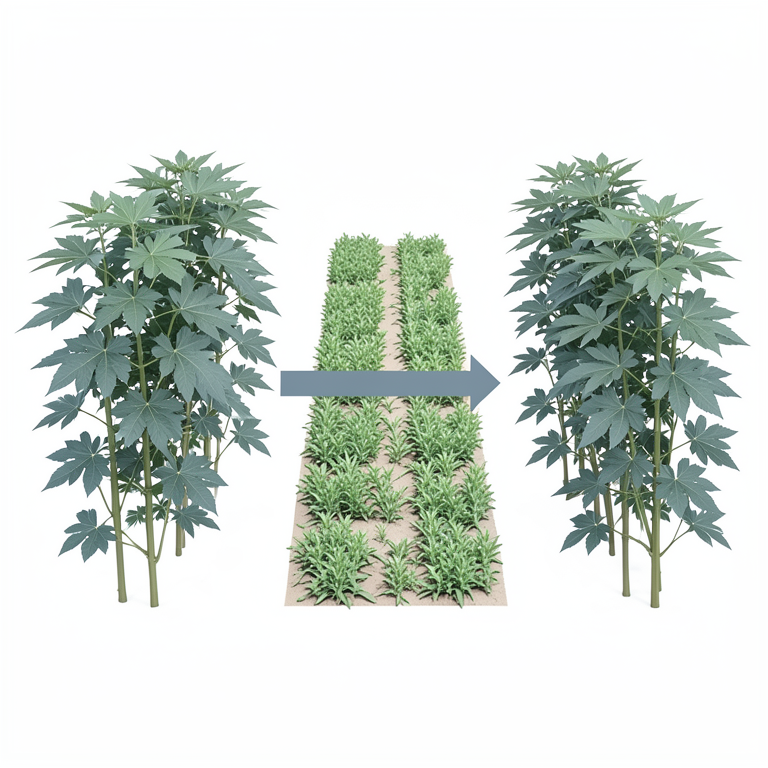
Intercropping Layout
AI-generated conceptual illustration (Castor plants (Ricinus communis) and green gram plants in a field). It explains the idea and does not show study data.
View source evidence ↗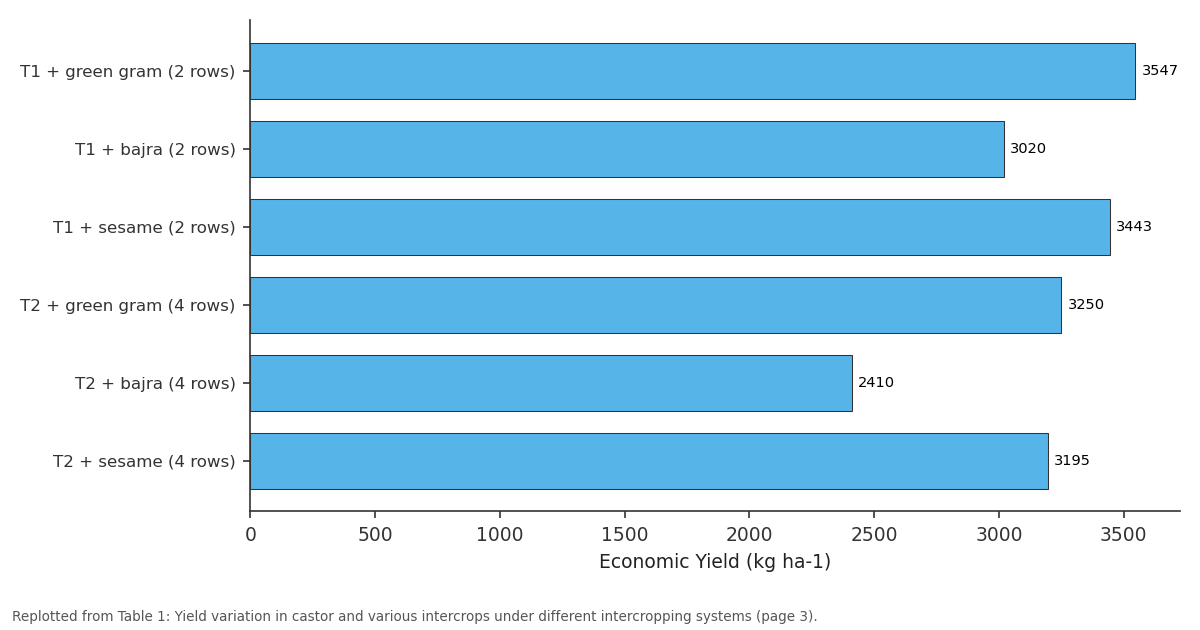
Yield (kg ha-1) / Economic / Castor: T1 + green gram (2 rows) vs T1 + bajra (2 rows) vs T1 + sesame (2 rows) vs T2 + green gram (4 rows) vs T2 + bajra (4 rows)
Replotted from Table 1 (page 3) of the original paper. Every bar is the paper's own table value.
View source evidence ↗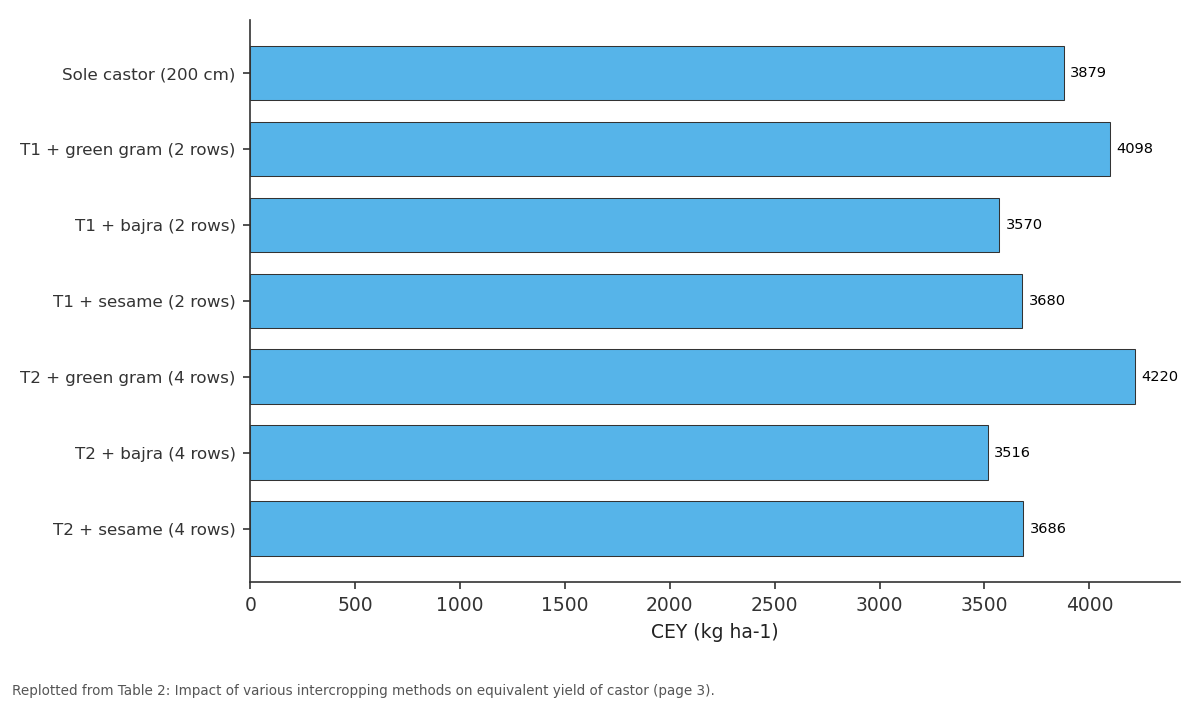
CEY (kg ha-1): Sole castor (200 cm) vs T1 + green gram (2 rows) vs T1 + bajra (2 rows) vs T1 + sesame (2 rows) vs T2 + green gram (4 rows)
Replotted from Table 2 (page 3) of the original paper. Every bar is the paper's own table value.
View source evidence ↗Figures & tables
From the original paper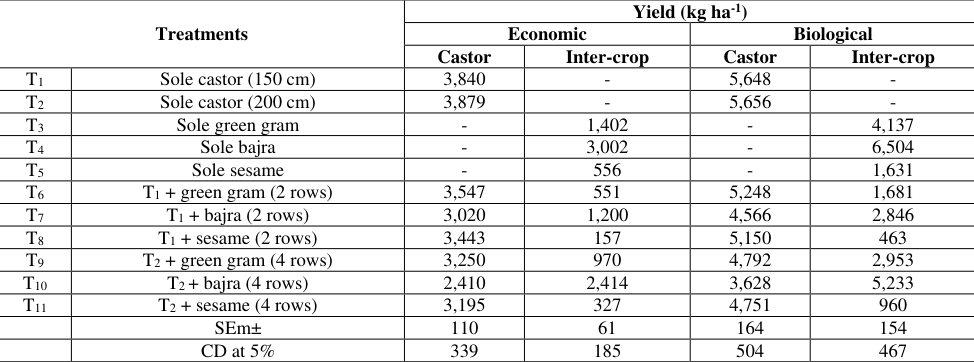 Table 1
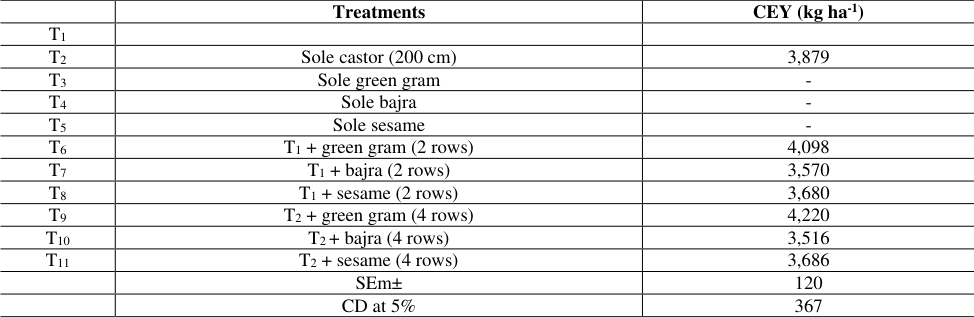 Table 2
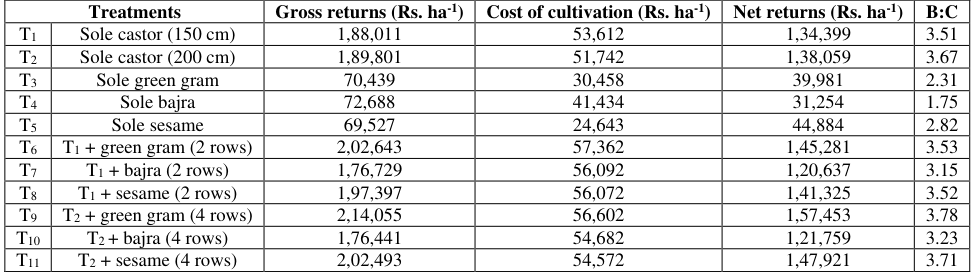 Table 3
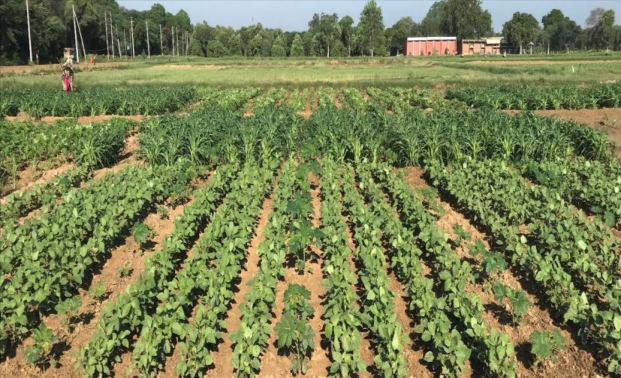 Figure 1
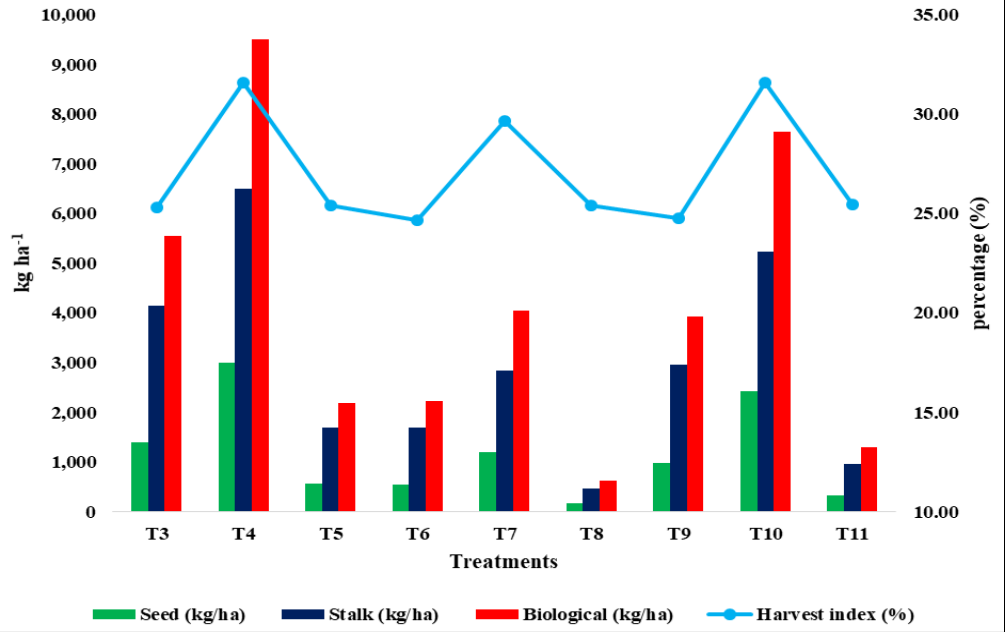 Figure 3
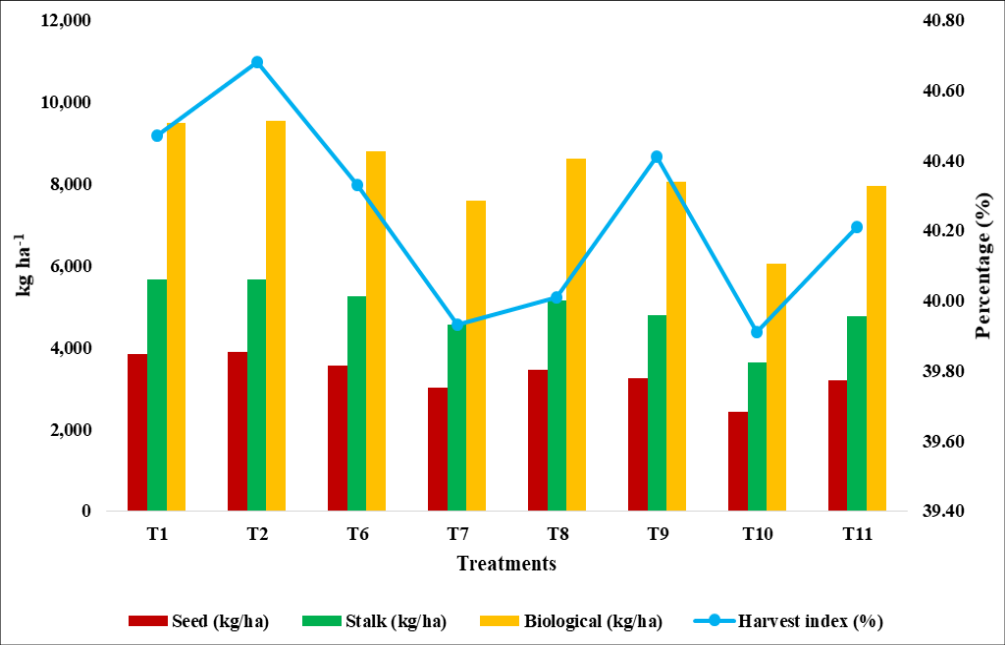 Figure 2
Introduction
Castor is classified as an indeterminate, non-edible oilseed crop, belonging to the Euphorbiaceae family. Its origins trace back to Eastern Africa, with Ethiopia as its place of origin. Primarily cultivated in regions with low rainfall, particularly the semi-arid areas of India, due to its drought tolerance, India stands at the first in production of castor seed globally. Castor seeds boast an oil content ranging from 50-55%, marking it as the world's second major source of nonedible oil. The oil extracted from castor seeds finds extensive utility across a diverse spectrum of industries, including the production of hydraulic fluids, nylon fibres, cosmetics, jet engine lubricants and pharmaceuticals. Additionally, castor oil proves to be a viable candidate for biodiesel conversion. Furthermore, castor cake, a byproduct of oil extraction, serves as a valuable organic fertilizer, boasting high concentrations of nutrients. It contains approximately 4.5% nitrogen, 2.6% phosphorus and 1.2% potassium, alongside 22.37% protein and 45-46% carbohydrates, making it a potent organic supplement for soil enrichment. Castor is typically cultivated as a long-term crop with wide spacing between plants. This allows for the possibility of intercropping with fast-growing, short-duration food grains, pulses and oilseed crops, arranged in a suitable pattern to enhance crop growth, yield production and productivity per unit time and land. Widening the row spacing for castor may reduce the plant density per acre, but the crop can compensate for yield loss by boosting the growth of plants and productivity of individual plants (Dhimmer et al., 2009) [1] . In castor intercropping system, by optimized or adjusting crop geometry will maximize the solar energy absorption (Willey, 1979) [9] and selecting appropriate intercrops.
Intercropping is familiar as a beneficial farming practice that can sustainably increase yields compared to monoculture practice. These advantages are particularly valuable as they are attained without requiring expensive inputs and they also contribute to improved crop growth. Intercropping offers insurance against complete crop failure and helps mitigate soil erosion, especially when subsidiary crops have trailing habits. Recognizing the promising potential of castor cultivation in the irrigated ecosystems of Southern-Western Haryana, efforts were made to maximize net returns. To optimize resource utilization, this study was designed to explore varied crop dimensions and incorporate short-duration intercrops in the underutilized interrow spaces, leveraging the early slow growth phase of castor.
Materials and Methods
A research trail was led out from 2020 to 2021 at the RRS, Bawal (Rewari), under the auspices of CCSHAU, Hisar. The experimental site soil was characterized as loamy-sand with a slightly alkaline pH of 8.5. It exhibited low levels of organic carbon and nitrogen (0.21% and 125 kg ha -1 , respectively), with medium levels of phosphorus and potassium (16.2 and 195.4 kg ha -1 , respectively). The trial was organized using a randomized block design, encompassing eleven treatments involving both sole and diverse intercropping systems, with each treatment replicated thrice. DCH-177 was the castor hybrid, MH-421, HHB-67 Imp. and HT-2 were the varieties of green gram, bajra and sesame, respectively, were sown on July 10th, with intercrops spaced at 30 cm x 10 cm in rows. The duration of the crop season witnessed a total rainfall of 312.9 mm. Harvesting occurred at three intervals, namely 120, 180 and 240 days after sowing (DAS), respectively. All necessary intercultural management practices adhered to the prescribed package of practices recommended by CCSHAU.
Results and Discussion
The seed and stalk yield of castor exhibited significant differences as a result of varying intercropping methods within two distinct row spacings for castor cultivation The findings from Table 1 suggest that the economic yield of castor increases with wider intercropping spacing of 200 cm compared to narrower spacing of 150 cm. Castor grown alone yields higher seed output than when intercropped, mainly due to competition from other crops for resources. Among the intercrops, castor demonstrates higher seed yield when intercropped with green gram. Both 150 cm and 200 cm row spacings for green gram show similar yields, outperforming intercropping with bajra at their respective spacings. This could be attributed to the nitrogen enrichment of the soil by legumes, facilitating castor growth post-legume harvest, a concept supported by Reddy et al. (2008) [6] , who noted pulses' complementary effect and cereals' competitive effect when intercropped with castor. In three different 4 rows system, castor + bajra intercropping system at 200 cm spacing yields the lowest equated to other row ratios. Emphasizing that wider row system enhances yield of castor compared to narrower spacings (Rana et al. 2006) [5] . Additionally, studies by Narayan Mavarkar (2006) [4] and Leela Rani (2008) [2] suggest that intercropping with leguminous crops enhances yield of castor compared to non-leguminous ones, despite an overall decrease in seed yield under intercropping compared to monocropping. The outcomes presented in Table 1 indicate that sole castor cultivation (200 cm) led to significantly higher economic and biological yields, likely due to the presence of a superior number of yield-contributing factors. This finding aligns with the observations of Mohsin et al. (2018) [3] , who also noted comparable outcomes in intercropping involving castor. Notably, sole castor planting yielded higher stalks compared to various intercropping arrangements. Aside from competitive effects, the predominant prices of economic yield serve as a supplementary factor in determining the components of an intercropping system. Consequently, the intercrops yield was converted into equivalent yield of castor and added to the castor yield. Equivalent yield (Table 2) of castor showed significant increases in castor (200 cm) + green gram (4 rows) and castor (150 cm) + green gram (2 rows) intercropping systems compared to sole systems and other intercropping systems. This could be attributed to both the higher price and yield of greengram, as well as the less decrease in main crop seed yield in this particular intercropping systems. These findings align with the observations of Narayan Mavarkar (2006) [4] and Thanunathan et al. (2006) [7] . The higher system equivalent yield was in the castor with greengram intercropping system by Mohsin et al. (2018) [3] . Conversely, a greater reduction in equivalent yield of system was observed in bajra and sesame intercropping systems, resulting in lesser castor equivalent yield. This corroborates the findings of Vaghela et al. (2019) [8] , who similarly noted that intercropping of bajra and sesame under castor cropping system has shown lesser system equivalent yield equated to the green gram intercropping system. Intercropping treatments demonstrated significantly higher economic returns, in-terms of both gross and net returns, correlated to castor monoculture cropping, as illustrated in Table 3. Amid different intercropping systems, combinations such as castor (200 cm) with green gram (4 rows) and castor (150 cm) with green gram (2 rows) intercropping systems yielded the highest net returns, surpassing both sole cropping and intercropping systems cultivation. This superior economic performance could be attributed due to the higher yields obtained from both main crop and intercrops within these systems. Notably, the castor with green gram (4 rows) intercropping system stood out with a remarkable net return of Rs. 1,57,453 ha -1 and a B:C ratio of 3.78. This result was mainly due to the high yield of green gram and the relatively minor reduction in castor economic yield of within this intercropping arrangement. Similar findings were observed by Mohsin et al. (2018) [3] , who also noted elevated net profit and B:C ratios in castor-green gram intercropping setups. However, intercropping castor with bajra and sesame led to a decrease in castor economic yield due to a suppressive effect on castor crop growth. Consequently, economic returns were diminished equated to sole cropping and other intercropping systems cultivation. This observation aligns with previous studies by Vaghela et al. (2019) [8] , who found that intercropping castor with summer sesame or summer bajra resulted in lower gross and net returns compared to intercropping with summer green gram.
| Treatments | — | Gross returns (Rs. ha-1) | Cost of cultivation (Rs. ha-1) | Net returns (Rs. ha-1) | B:C |
|---|---|---|---|---|---|
| T1 | Sole castor (150 cm) | 1,88,011 | 53,612 | 1,34,399 | 3.51 |
| T2 | Sole castor (200 cm) | 1,89,801 | 51,742 | 1,38,059 | 3.67 |
| T3 | Sole green gram | 70,439 | 30,458 | 39,981 | 2.31 |
| T4 | Sole bajra | 72,688 | 41,434 | 31,254 | 1.75 |
| T5 | Sole sesame | 69,527 | 24,643 | 44,884 | 2.82 |
| T6 | T1 + green gram (2 rows) | 2,02,643 | 57,362 | 1,45,281 | 3.53 |
| T7 | T1 + bajra (2 rows) | 1,76,729 | 56,092 | 1,20,637 | 3.15 |
| T8 | T1 + sesame (2 rows) | 1,97,397 | 56,072 | 1,41,325 | 3.52 |
| T9 | T2 + green gram (4 rows) | 2,14,055 | 56,602 | 1,57,453 | 3.78 |
| T10 | T2 + bajra (4 rows) | 1,76,441 | 54,682 | 1,21,759 | 3.23 |
| T11 | T2 + sesame (4 rows) | 2,02,493 | 54,572 | 1,47,921 | 3.71 |
Table text extracted from the original PDF; superscript letters are shown inline. The original table image is below.
View original table image
| — | Treatments | CEY (kg ha-1) |
|---|---|---|
| T1 | ||
| T2 | Sole castor (200 cm) | 3,879 |
| T3 | Sole green gram | - |
| T4 | Sole bajra | - |
| T5 | Sole sesame | - |
| T6 | T1 + green gram (2 rows) | 4,098 |
| T7 | T1 + bajra (2 rows) | 3,570 |
| T8 | T1 + sesame (2 rows) | 3,680 |
| T9 | T2 + green gram (4 rows) | 4,220 |
| T10 | T2 + bajra (4 rows) | 3,516 |
| T11 | T2 + sesame (4 rows) | 3,686 |
| SEm± | 120 | |
| CD at 5% | 367 |
Table text extracted from the original PDF; superscript letters are shown inline. The original table image is below.
View original table image
| Treatments | — | Yield (kg ha-1) | — | — | — |
|---|---|---|---|---|---|
| Economic | Biological | ||||
| Castor | Inter-crop | Castor | Inter-crop | ||
| T1 | Sole castor (150 cm) | 3,840 | - | 5,648 | - |
| T2 | Sole castor (200 cm) | 3,879 | - | 5,656 | - |
| T3 | Sole green gram | - | 1,402 | - | 4,137 |
| T4 | Sole bajra | - | 3,002 | - | 6,504 |
| T5 | Sole sesame | - | 556 | - | 1,631 |
| T6 | T1 + green gram (2 rows) | 3,547 | 551 | 5,248 | 1,681 |
| T7 | T1 + bajra (2 rows) | 3,020 | 1,200 | 4,566 | 2,846 |
| T8 | T1 + sesame (2 rows) | 3,443 | 157 | 5,150 | 463 |
| T9 | T2 + green gram (4 rows) | 3,250 | 970 | 4,792 | 2,953 |
| T10 | T2 + bajra (4 rows) | 2,410 | 2,414 | 3,628 | 5,233 |
| T11 | T2 + sesame (4 rows) | 3,195 | 327 | 4,751 | 960 |
| SEm± | 110 | 61 | 164 | 154 | |
| CD at 5% | 339 | 185 | 504 | 467 |
Table text extracted from the original PDF; superscript letters are shown inline. The original table image is below.
View original table image
Conclusion
This study reveals that incorporating legume intercropping with wider spacing leads to significant advantages, including increased castor yield, castor equivalent yield, net returns and B:C ratio compared to other intercropping and sole cropping systems. Specifically, the combination of castor (200 cm) and green gram in a 1:4 row ratio demonstrated superior performance over all other treatments. Consequently, intercropping systems prove to be higher sustainable and profitable than sole castor cultivation, offering greater remuneration to farmers of Haryana.
Figures and tables from the paper
References
8 in the original paper- Dhimmar SK, Raj VC. Effect of growth and yield of rabi castor in pulses intercropping under varying planting geometry. Am Eurasian J Sustain Agric. 2009;3(3):448-451.
- Leela Rani P. Study on castor (Ricinus communis) based intercropping system under rainfed conditions. J Oilseeds Res. 2008;25(1):92-93.
- Mohsin M, Yadav JS, Harender, Rathi N. Effect of castor based intercropping systems on yields and economics of castor (Ricinus communis). Int J Curr Microbiol App Sci. 2018;7(10):3014-3020.
- Bangalore, Karnataka: University of Agricultural Sciences; 2006.
- Rana DS, Giri G, Pachauri DK. Evaluation of castor (Ricinus communis L.) genotypes for productivity, economics, litter fall and changes in soil properties under different levels of inter-row spacing and nitrogen. Indian J Agron. 2006;51(4):318-322.
- Reddy BN, Raghavaiah CV, Padmavathi P. Fertilizer management in intercropping systems involving castor or sunflower under rain fed conditions. J Oilseeds Res. 2008;25(1):89-91.
- Thanunathan K, Malarvizhi S, Thiruppathi M, Imayavaramban V. Economic evaluation of castor-based intercropping systems. Madras Agric J. 2006;93(1-6):38-41.
- Vaghela SJ, Patel JC, Patel DG, Dabhi KB, Dabhi JS. Yield, equivalent yield and economics of castor as influenced by different castor (Ricinus communis) based cropping systems in North Gujarat Agro-climatic condition. J Pharma Phytochem. 2019;8(5):1727-1731.
Cited by 3
From OpenAlex, OpenCitations and reference lists read by Scinovex
- Exploring Castor Hybrid (YRCH 1) as an Alternate Crop in Mettur-noyyal Sub Basin of Tamil Nadu, India ↗
Natarajan. S.K, R Gowsalya., P. Kathirvelan, S R Venkatachalam, Jaya Prabhavathi. S, S Elankavi et al. · International Journal of Plant & Soil Science · 2025
Aims: The aim of this study is to introduce castor hybrid as an alternative crop in gap areas to promote agricultural diversification and enhance productivity. Place and Duration of Study: Mettur-Noyyal confluence sub basin areas of Tamil Nadu by the Tapioca and Castor research Research station, Yethapur for the past five years (2019-2024). Methodology: The on farm demonstrations was carried…
❝ 1PDF - Effect of intercropping on yield and economics of castor (Ricinus communis L.) under rainfed conditions of Coimbatore
John Jelly Suriyan P, K. Sharmili, K. N. Vinodh Kumar, B. Balaganesh, S Sumaiya Parveen, R Freeda Blessie · International Journal of Research in Agronomy · 2026
A field research was carried out on castor-based intercropping under rainfed circumstances was conducted at Karunya Institute of Technology and Sciences, Coimbatore, Tamil Nadu. During the rabi season of 2025. Castor was intercropped with pulse, vegetables and oilseeds like green gram, horse gram, chickpea, groundnut, sesame, soybean, lablab, bhendi and brinjal with the row ratio of 2:2. The results indicated that increased in both seed yield (911 kg/ha) and stalk yield (1881 kg/ha) of castor was obtained when castor was intercropped with pulses when compared to sole castor. To evaluate the be
- An assessment of productivity potential, biological feasibility and economic viability of castor based relay intercropping system in Rainfed Alfisols of Karnataka
K. Gangadhar, Mohan Kumar R, S. T. Bhairappanavar, Jayadeva HM, Kadabagere Narayanaswamy Hemavathi, Veena CV · International Journal of Advanced Biochemistry Research · 2025
A field experiment was conducted at the Zonal Agricultural Research Station (ZARS), University of Agricultural Sciences, GKVK, Bengaluru during the kharif and rabi season of 2022-23 and 2023-24 to evaluate the feasibility of a castor-based relay intercropping system under rainfed alfisols of Karnataka. The experiment followed a split-plot design, comprising four main plot treatments involving different crop geometries combined with fingermillet intercropping, four subplot treatments consisting of various relay intercropping system and seven treatments under sole cropping for comparison. The st