
Research article · 2024 · Full text
International Journal of Agriculture Extension and Social DevelopmentImpact study on substitution possibilities between water and other production inputs for the aggregate bleaching and dyeing industries in Tiruppur district
Volume 7(4) · Pages 447–451 · DOI: 10.33545/26180723.2024.v7.i4f.561 ↗
Research areasAgricultural Economics and Practices
Abstract
Author-writtenWater is an essential resource for both civilization and the planet, as it is present in every surface. Insufficient water can result in famines and droughts; excessive water can cause flooding; and water that is judiciously distributed across fields promotes food production. Water usage in agriculture has thus been an integral component of the process from its inception. Assumedly, for the economy as a whole to expand in a sustainable manner, both industrial and agricultural water requirements must be satisfied, according to the study. Due to this, it is critical to find alternatives to water used in the dying and cleaning industries as soon as possible in order to alleviate the contamination caused by industrial refuse and the district of Tiruppur's excessive water demands. In order to reduce the quantity of chemicals in the waste water and the expenditure on water replacements and
Summary
Source-checkedPlain-language reading of the full paper, prepared with AI and checked against the text. Each point links to the authors' own words.
Why it matters
- Overuse of groundwater in the state has led to serious environmental issues, including the depletion of aquifers and the intrusion of saltwater into coastal areas. View evidence ↗
- In the Tiruppur region, groundwater is heavily contaminated with dissolved substances due to industrial activities. View evidence ↗
- Finding alternatives to water in the dyeing and cleaning industries is essential to reduce industrial pollution and the high water demand in Tiruppur. View evidence ↗
The question
- The study aimed to determine the elasticity of substituting water with other production inputs in the dyeing and cleaning industries. View evidence ↗
What they did
- The researchers examined how capital and labor could be used as substitutes for water in the production process. View evidence ↗
- A trans-log cost function was used to analyze the possibilities for replacing water with other inputs. View evidence ↗
- The study surveyed 40 bleaching and dyeing firms with capital investments ranging from Rs. 300,000 to 102,000,000. View evidence ↗
What they found
- The price-to-demand elasticity for water was found to be -0.0448, which is considered very low. View evidence ↗
- Water accounts for a small part of total production costs, with a maximum content of 12% to 18%. View evidence ↗
- Strongly positive elasticities for water-capital and capital-water indicate that capital can effectively substitute for both water and labor. View evidence ↗
- Negative elasticities for labor and water suggest that these two inputs complement each other rather than acting as substitutes. View evidence ↗
- In the long term, lower capital prices are expected to lead to increased capital investment and a corresponding decrease in water usage. View evidence ↗
What it means
- To mitigate water loss, the authors suggest implementing innovative irrigation techniques such as drip and sprinkler systems. View evidence ↗
Visual summary
2 visualsIllustrations explain the paper; charts are replotted from the paper's own table values.
Input Substitution Dynamics
AI-generated conceptual illustration (Industrial textile dyeing and bleaching machinery and resources). It explains the idea and does not show study data.
View source evidence ↗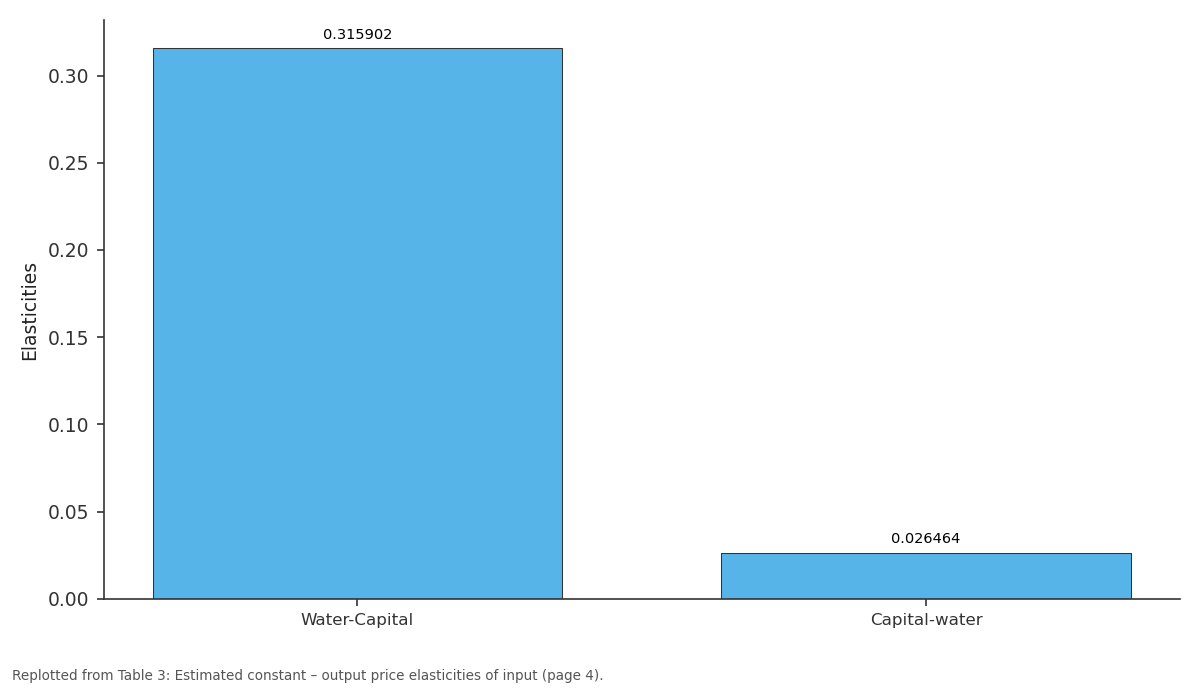
Elasticities: Water-Capital vs Capital-water
Replotted from Table 3 (page 4) of the original paper. Every bar is the paper's own table value.
View source evidence ↗Figures & tables
From the original paper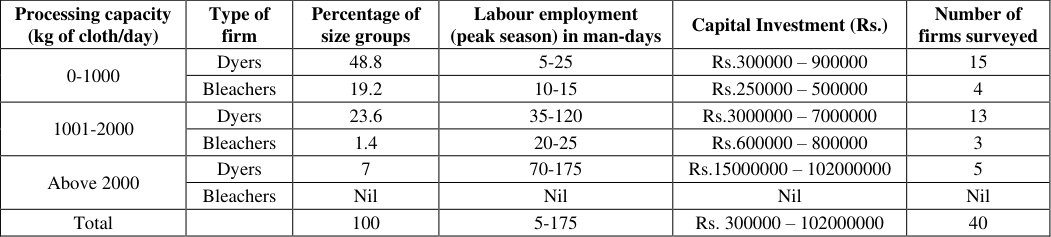 Table 1
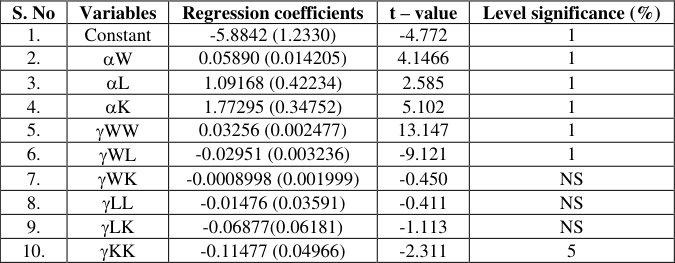 Table 2
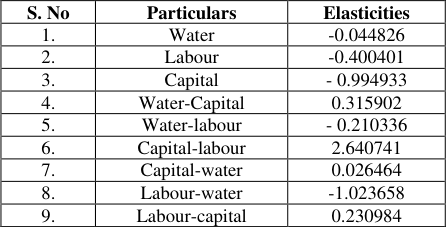 Table 3
Introduction
It is purported that excessive utilization of numerous sections of the state's groundwater resource has resulted in adverse consequences such as the ingress of saline water into coastal regions, depletion of subterranean aquifers, and a consistent decline in the groundwater table. This not only jeopardizes present and future agricultural water supplies but also leads to population displacement and unemployment, particularly in regions where surface water resources are not critical [1] . Excessive groundwater consumption is observed in both rural and urban/industrial regions of the district of Tiruppur, which is recognized as a pioneering area in the state with regards to industrial and agricultural development. Additionally, the condition of groundwater is a significant natural issue. Groundwater contamination is one of the challenges associated with effective groundwater management in India. Pollution threatens every subterranean source in the nation, and the resulting damage is virtually irreparable. Pollution and degraded groundwater quality posed significant challenges to its utilization for agricultural, domestic, and industrial sectors. Certain past works and concepts were examined in these domains and are presented below. Jacob unequivocally described how industrial activities in the Tiruppur region impact groundwater quality. The discharge of effluent from the factories potentially caused irreparable harm to the groundwater in the vicinity. According to farmers residing in various cities situated along the Noyyal River, the water's excessive hardness is impeding optimal crop growth [2] . Krupanidhi stated that for over a decade, cultivators and the Jodhpur administration have been in conflict regarding the Rampura-Mathana groundwater. Water quality is inextricably linked to overdraft problems. The distinction became even more evident when examining blocks that bore labels denoting darkness or gray, as well as those of poor quality [3] . Jacks et al. report that a recently constructed dam has been established at Orathupalayam, a location situated downstream of Tiruppur. Its dual purpose is to prevent sudden floods and provide agricultural water. The SAR (Sodium Absorption Ratio) of the brackish (TDS 7000 mgl-1) water in the dam was intermediate between that of the effluent and the groundwater in the city of Tiruppur. This implies that groundwater from the city of Tiruppur became contaminated with effluent from the textile industry that was discharged directly into Noyyal. The water was unfit for any purpose due to its excessive sodium content [4] . A seminal work on historical groundwater quality is the "Groundwater Resources of Noyyal Basin" study conducted by the Central Groundwater Board in 1976-1977 with assistance from the Swedish International Development Agency (SIDA). The electrical conductivity, salt, and sulfate concentrations of water from 18 wells in the Tiruppur region were assessed both prior to and subsequent to the monsoon season (January-June) between 1976 and www.extensionjournal.com significantly greater concentrations of EC, chloride, and sulfate than others. This may be attributed to the establishment of textile manufacturing facilities in that region during the 1970s [5] . Later that year, the Central Groundwater Board published a report titled "Groundwater Resources and Development Prospects in Coimbatore District" that provided a concise overview of the groundwater contamination issue in Tiruppur. Tiruppur was home to numerous hosiery factories, each of which utilized a unique combination of chemicals and pigments. Without appropriate treatment, the wastewater from these establishments was discharged into adjacent lands, waterways, and low-lying regions. These deleterious wastewaters accumulate in low-lying regions, where they infiltrate the groundwater via surface infiltration. The analysis of water samples collected from wells excavated in the vicinity of Tiruppur revealed that they were exceedingly polluted and contained an abundance of dissolved substances. Other varieties of water were blended with the water extracted from the well. Pollution of groundwater may have severe consequences over time. It remained unclear to what extent the damage had occurred, but dissolved particulate levels in water from wells near Tiruppur were reportedly increasing from 1472 to 2106 mg l-1. The ground has been significantly contaminated by the effluents, resulting in reduced soil fertility [6] . The research conducted by Rajaguru and Subburam revealed that the groundwater in the Tiruppur area was unfit for potable use, agricultural purposes, or manufacturing [7] . A study was conducted by Palanivel and Rajaguru to compare the summer and winter conditions of the surface water in the Noyyal River at various locations, focusing on its physiochemical and physical characteristics. The water originated from 28 points along the Noyyal River's 101kilometer length. Zone I, located prior to Tiruppur, was devoid of industrial waste. Zone II was situated approximately 17 kilometers distant. Zone III was located less polluted downstream of Tiruppur. Zone IV, which receives effluents from the river and is located at a greater distance, was the most heavily polluted area. Zone I contained less pollution than zones II and III, as determined by the research. A factor in the marginal reduction in pollution further downstream (iii) was the river's capacity for self-cleansing. Due to the exceptionally high concentrations of TSS and TDS in the river water beyond Tiruppur, it is unfit for any purpose, including field irrigation. (iv). The moderate water flow that occurred during the rainfall was insufficient to remediate the river [8] . According to S., Gandhimathi, and N. Dhanabaghiyam, industrial pollution is the primary cause of environmental degradation. The environmental issues in agricultural land have become more severe in tandem with the expansion of enterprises. Therefore, laws that promote healthy agriculture are necessary to ensure that everyone has enough food, to generate employment in rural areas, and to produce environmentally friendly instruments. It was evident from the study's findings that each farmer (percentage) cited industrial waste disposal as the primary cause of industrial contamination in agriculture. As a result of the industrial contamination caused by dyeing, the crops burned and the earth lost all of its quality. It would not be suitable for supplying farms and animals with potable water. The farm's profit would have been reduced by $3,24,64,19 had an additional farmer chosen to cultivate in a region already occupied by polluting enterprises. Moreover, the ability of producers in polluted areas to distribute agricultural inputs was compromised. As a consequence, it was determined that the industrial function of the contaminated area lacked scientific validity [9] . Sivakumar V. et al. demonstrated, through the use of an optimization model, that the government's purchase objectives could be achieved, on average, without irrigation, by relocating food production and procurement regions. In addition to increasing net farm income, this would prevent groundwater loss. In addition to daily temperature data spanning more than a century ago, we incorporate current, regionally specific information regarding the economy, agricultural production, and other relevant factors. 30% increase in average net agricultural income is observed when irrigation is permitted [10] .
Methods and Materials
Water resource planners and policymakers will perpetually find the economics of water usage in various sectors of the economy to be crucial. When making predictions regarding future water demands, individuals often assume that constant factors will remain constant. Although nearly everyone concurs that forecasting the future water demands of industry necessitates a comprehensive examination of existing, emerging, and potential water-using technologies, alongside alternative material substitutions for water in the manufacturing process, this requires a detailed examination. Given this context, it would be intriguing to investigate the significance of water substitutes in the manufacturing process. Alternatively, one may employ statistical analysis of industry-wide data to ascertain the extent to which replacement has impacted industrial water demand. The objective of this research was to determine the degree of elasticity associated with the transition from water to alternative production inputs in the dyeing and cleaning industries.
Substitution for Water in Production
The main aim is to examine the extent to which conventional inputs such as capital and labour would be substituted for the water input in production. Two types of substitution away from water withdrawals are possible: a) Industry might utilize existing technology to design and install production processes use less water per unit of output. The extent to which this is possible would depend on current stock of technical knowledge. b) Recycling might reduce withdrawals. Recycling may be viewed as the substitution of capital, labour, energy and other materials used in recovering and treating wastewater for the withdrawal of new water.
Engineering-economic studies would differentiate between these two substitutions. The econometric approach, however, would explain the combined effects of the different sources of substitution without identifying the separate contribution of each. This perspective seems mostly appropriate if it is more concerned with estimating www.extensionjournal.com the total effects of such changes in water prices or in interest rates/investment. The substitution possibilities also require the consideration of time horizon. In the short run, curtailments in the water supply likely would effect on production because current processes have specified water use characteristics. In the very long run, the application of advanced dyeing machine or more labour or other materials is possible to insure the most efficient uses of existing supplies of water given a constant capital stock. This implies that limited possibility for substitution in the short run and a greater potential for substitution would exist in the long run. In the very long run sufficient to invest entirely new techniques/rapid dyeing technique, substitution possibilities presumably would be the highest of all. The empirical analysis was done based on cross section data that relate to the range of production technologies currently under use.
Results and Discussion
Results and Discussion
Analysis of Size and Investment Pattern in Bleaching and Dyeing Units and Analyse the Substitution Possibility for Water with Other Production Inputs
Fabric and thread dying and bleaching are crucial steps in the garment-making process. As a consequence, the industry for bleaching and dying has expanded at a comparable pace to the overall knitwear sector. During the early 1980s, the city was home to fewer than one hundred businesses. There were 866 businesses in the area as of 1996. About 180 to 250 businesses (termed "bleachers" for short) exclusively bleach garments. The majority of bleaching and dying units are occupationally connected to the knitwear in its entirety. Seventy-five percent of bleaching and dying units obtain their fabrics from other knitwear manufacturers through contract work. 25% are independent producers, which are typically sizable corporations engaged in the dual production of fabric and apparel.
Size and Investment Pattern in Bleaching and Dyeing Units
In contrast to more machine-intensive industries such as embroidery or stitching, the bleaching and dying sector offers comparatively reduced initial investment requirements (Table 1). In the context of bleaching and dying, the overall financial outlay for very tiny units is comparatively lower than that of larger units, given the capacity of the former to process. In order to process 200 kg per day, a small unit could have achieved that capacity for as little as Rs. 3,000,000; to process 500 kg per day, a medium-sized unit would require an investment of approximately Rs. 5,000,000. Adding an additional tonne of production capacity incurs a relative cost in excess of nine million rupees. Strict pollution regulations in recent years have required each unit to either construct its own effluent treatment unit or join a shared one. This has altered the way in which dying and bleaching divisions allocate their funds. Investing trends in bleaching and dying units have multiplied significantly since 1996, as all of them are required to incorporate sewage treatment facilities in order to comply with pollution control regulations.
Substituting for Water in Bleaching and Dyeing Units with Other Production Inputs using Trans-log cost function
The majority of inputs are water-based. In the cleansing and dying industries, for instance, water is the most essential input; labor and other inputs must be derived from this requirement. Because of this, it is critical to investigate methods for minimizing water consumption and pollution prevention. This implies that in the bleaching and dyeing industries, alternative options for replacements should be considered. The trans-log cost function was employed to evaluate the various replacement alternatives.
The results are presented in Tables 2 and3. The majority of anticipated coefficients are critical, and water accounts for a significant portion of the overall expense. The intermediate terms for input cost share illustrate this. 3.54% of the substance is water. Table 3 presents the own and cross-price elasticities of input demand. Elasticities were calculated utilizing mean supply cost shares. A significant disparity exists between each of the estimated elasticities and zero. The price-to-demand ratio for water is -0.0448. This value represents the output-constant price elasticities of input demand, which may be exceedingly low. They likely do not demonstrate as much as they ought to regarding the extent to which input costs influence output costs. Frequently, this is insufficient for labor and other components that constitute a significant portion of the total cost. However, the water input constitutes a negligible portion of the overall cost of the function. Its maximum water content is 12 to 18 percent. Variations in the cost of water input are improbable to significantly impact the cost of output. Consequently, the constant-output price elasticity of water input demand may not be an accurate indicator of its true elasticity. www.extensionjournal.com Water-Capital 0.315902 5.
| S. No | Particulars | Elasticities |
|---|---|---|
| 1. | Water | -0.044826 |
| 2. | Labour | -0.400401 |
| 3. | Capital | - 0.994933 |
| 4. | Water-Capital | 0.315902 |
| 5. | Water-labour | - 0.210336 |
| 6. | Capital-labour | 2.640741 |
| 7. | Capital-water | 0.026464 |
| 8. | Labour-water | -1.023658 |
| 9. | Labour-capital | 0.230984 |
Table text extracted from the original PDF; superscript letters are shown inline. The original table image is below.
View original table image
Capital-labour 2.640741 7.
Cross-price elasticity was found between water and two other sources, like capital and labor. The elasticity of watercapital, capital-water, labor-capital, and capital-labour are all strongly positive. This means that capital can be used instead of water and labor in output. But the elasticity of labor and the elasticity of water are both very negative. When the price of labor goes down, negative crosselasticities show that two things work better together instead of replacing each other. The use of capital goes up, but the use of water and labor goes down. Based on the results of this study, it seems possible that water and cash could be swapped.
Many industrial processes see water and labor as a group of inputs, and when they are used together, water and labor can be switched out. If the cost of one item, like capital, goes up, the cost of labor and water also goes up. The findings showed that the strong relationship between labor and water showed that this relationship was most important in traditional dyeing businesses.
In the long run, the finding means that production processes will need more capital because capital prices will be lower. Their water factors would go down, which makes them unique. Therefore, the supports used to help India's industrial growth to encourage capital investment, like tax breaks, have made the bleaching and dying industries more reliant on water withdrawals. In the same way, if all other factors stay the same, rising interest rates will cause water coefficients to rise. The study used very separate water price data and was based on the idea that there are two main types of production functions in the bleaching and dying industries: the old winch type and the modern compact dyeing machine.
Conclusion
The primary water source utilized for agricultural, domestic, and industrial purposes is groundwater. In numerous locations, groundwater serves as the sole water source.
Local town planning authorities and industrial development agencies taking proactive measures to implement effective pollution abatement measures and a sufficient water supply from perennial sources is the most direct solution. It is necessary to promote increased capital investment in the bleaching and dyeing sectors as an alternative to water usage and to implement "soft flow" dyeing machinery, which effectively reduce chemical concentrations in effluent waste water and water consumption. Significant limitations in irrigated agriculture include substandard agricultural output prices, elevated labour costs accompanied by low productivity, insufficient water resources for agricultural purposes, and escalated input expenditures. As a consequence, a number of farmers engaged in recurring water sales once the water needs of their standing perennial crops and livestock had been fulfilled. When there was insufficient water in the wells to support the crop, farmers resorted to cultivating crops with lower water demands and sold the excess water. At present, the Tiruppur region is home to approximately 800 operational bleaching and dying facilities, the success of which is predominately reliant on the availability of highquality water. When no other surface water source was available, these facilities relied on water tankers to transport groundwater from agricultural areas. As per the Tiruppur Dyer's Association, 80% of water transfer was facilitated by industrial proprietors utilizing their personal water tanker trucks.
Water transfers occurred from villages within a 7-30 kilometer radius of the city of Tiruppur, with village agricultural wells serving as the primary supply of water for industrial purposes. The water table in the wells varied between 24 and 150 meters due to the fact that the Tiruppur region was a gloomy, overexploited groundwater region. Fabric and thread bleaching and dying are crucial intermediate procedures in the garment manufacturing process. As a result, the expansion of the bleaching and dying sector has been consistent with that of the knitwear industry as a whole. Compared to processing capacity, total investments in very small units were comparatively lower in the bleaching and dyeing industries than in larger units.
Policy
It is necessary to promote the adoption of "soft flow" dyeing machinery by the bleaching and dyeing sectors as a means to decrease water consumption and chemical concentrations www.extensionjournal.com in effluent wastewater. Innovative irrigation techniques, including drip and sprinkler systems, as well as enhanced gravitational irrigation methods, ought to be implemented in order to reduce water loss during the irrigation process.
It is necessary to conduct research on crop management in contaminated water in order to rectify the current situation.
Figures and tables from the paper
| S. No | Variables | Regression coefficients | t – value | Level significance (%) |
|---|---|---|---|---|
| 1. | Constant | -5.8842 (1.2330) | -4.772 | 1 |
| 2. | W | 0.05890 (0.014205) | 4.1466 | 1 |
| 3. | L | 1.09168 (0.42234) | 2.585 | 1 |
| 4. | K | 1.77295 (0.34752) | 5.102 | 1 |
| 5. | WW | 0.03256 (0.002477) | 13.147 | 1 |
| 6. | WL | -0.02951 (0.003236) | -9.121 | 1 |
| 7. | WK | -0.0008998 (0.001999) | -0.450 | NS |
| 8. | LL | -0.01476 (0.03591) | -0.411 | NS |
| 9. | LK | -0.06877(0.06181) | -1.113 | NS |
| 10. | KK | -0.11477 (0.04966) | -2.311 | 5 |
Table text extracted from the original PDF; superscript letters are shown inline. The original table image is below.
View original table image
References
2 in the original paper- Gandhimathi S, Dhanabaghiyam N. Impact of Dyeing Industrial Pollution on Farm Income and Production in Tiruppur District of Tamil Nadu. Journal of Rural Development. 2017;36:243.
- Sivakumar V, Sashik Kumar MC, Logesh Natarajan, Priyadarsi Roy D, Lakshumanan Chokkalingam. Vulnerability Assessment of Groundwater in Industrialized Tiruppur Area of South India using GISbased DRASTIC model. J Geol Soc India. 2022;98:696-702.